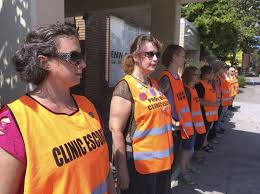
America’s abortion clinics experienced a major upsurge in trespassing, obstruction and blockades by anti-abortion activists in 2017, according to an annual survey by an industry group.

The National Abortion Federation report chronicled a litany of actions that ranged from coordinated trespassing efforts by abortion opponents, repeated brick-throwing at windows of a Cleveland clinic and an attempted bombing in Illinois.

The report found that there was an overall decrease in acts of vandalism against clinics but a significant increase in activities aimed at disrupting services and intimidating patients and providers. Acts of trespassing increased from 247 in 2016 to 823 in 2017, instances of obstruction tripled to 1,704 and threats of death or other harm nearly doubled to 62.

“The protesters are feeling emboldened by the political environment and seeing what they could get away with,” said the federation’s president, Vicki Saporta. “They want to make it more difficult to provide care, without going to very extreme forms of violence.”

The federation based its findings on monthly reports filed by its members who make up the vast majority of abortion clinics nationally.

Many clinics across the U.S. routinely are targeted by legal picketing near their premises. But in some cases, the protests escalated and led to intervention by federal and law enforcement agencies.

At least 10 people were arrested last May when anti-abortion activists blocked the entrance to the EMW Women’s Surgical Center in Louisville, Kentucky — the last abortion clinic still operating in the state. Saporta said the protesters, organized by the militant anti-abortion group Operation Save America, were emboldened by Kentucky Gov. Matt Bevin’s high-profile efforts to shut down the clinic.

As a result of the blockade, a federal judge established a buffer zone outside the clinic to keep protesters from assembling in front of the entrance.

Among those arrested in Louisville was Operation Save America’s national director, Rev. Rusty Lee Thomas. While awaiting trial, he said abortion should be outlawed, declaring “Our justice system is committing another grave injustice by arresting the wrong people.”

Elsewhere, several trespassing arrests occurred during coordinated actions by anti-abortion protesters in Virginia, Michigan and other states. Activists entered clinics, conveyed their anti-abortion views to patients, and refused to leave when told to do so by law enforcement.

Citizens for a Pro-Life Society, a group headed by Roman Catholic theology professor Monica Migliorino Miller, described the incursions as “an act of nonviolent defense of unborn children about to be aborted.” Miller was among those arrested in Michigan, and in February was convicted of trespassing.

The one attempted bombing in 2017 involved a pipe bomb that did not explode after being placed in an abortion clinic in Champaign, Illinois, in November. The three men charged by federal authorities are allegedly part of a militia group called the “White Rabbits” who also have been charged in the bombing of a Minnesota mosque last year.

A clinic in Cleveland incurred more than $32,000 in damages because of repeated brick-throwing attacks on its windows.

The report does not include a violent case in February when — according to prosecutors — a Massachusetts man deliberately crashed a stolen truck into a Planned Parenthood clinic in New Jersey, injuring three people, including a pregnant woman. That was the first major violent attack on a U.S. abortion clinic since 2015, when a man killed three people at a Planned Parenthood clinic during a shooting attack in Colorado.

The picketing in 2017 often was more aggressive than in recent years, according to the Feminist Majority Foundation, which operates a national clinic access program.

“They’re telling us they’ve never seen this level of intensity,” said the foundation’s executive director, Kathy Spillar.

The threat of attacks and vandalism can significantly boost clinics’ costs, notably to provide security for facilities and staff. Some clinics have faced extra legal costs challenging state laws aimed at restricting abortions.

In part, because of the legal and financial challenges, the number of abortion clinics in the U.S. has been declining. As of 2014, when the last comprehensive tally was made, there were 788 clinics.

Source: https://abcnews.go.com/Health/wireStory/us-abortion-clinics-face-surge-trespassing-blockades-54982471

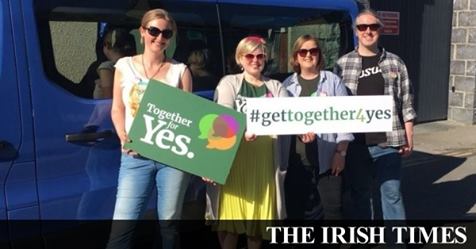
Group embarks on 12-day trip to push for repeal of ‘unforgiving’ Eighth Amendment

Together for Yes campaigners as the group begins its 12-day tour. Photograph: Together for Yes

The Together for Yes group has embarked on a 12-day tour of 22 locations across the State in an effort to convince more voters to back repeal of the Eighth Amendment in the forthcoming referendum on the issue.

Co-director Orla O’Connor told the campaign group’s first “Get Together For Yes” gathering, held in Athlone on Sunday, that the May 25th ballot was not a vote on abortion as “we already have abortion in Ireland”, but a vote “to decide if we will regulate it, make it safe, and care for the women of Ireland”.

She said the Amendment was “broad and unforgiving” and failed to reflect the reality for “women and families in every community, every village, every town and every county in Ireland”.

She pointed to figures from the department of health and social care in the UK which state that, between 2012 and 2016, more than 18,000 women gave Irish addresses at British abortion clinics.

“This doesn’t count those who didn’t give addresses, or who went to other European countries for the care they needed,” she said.

The May 25th referendum will ask voters whether they want to repeal the Eighth Amendment, which prohibits abortion, and allow for legislation that would permit terminations without restriction up to 12 weeks into a pregnancy.

‘Failed experiment’

At the Athlone event, the chair of the Institute of Obstetricians and Gynaecologists, Dr Peter Boylan, described the Eighth Amendment as “a failed experiment”, adding that “abortion is here already”.

He said that, over the last year, 2,000 women in Ireland imported illegal abortion pills from online providers.

“These pills are very safe when used under medical supervision. However, if taken in the wrong dosage or at the wrong time they can cause serious, potentially fatal problems such as uterine rupture and haemorrhage,” he said.

He suggested that the Amendment created the “risk [of] waking up one morning to the news that a woman has bled to death, alone in her bathroom”, a risk that could not be ignored.

He said the “fact is that as long as we have the Eighth Amendment, we can do nothing about fatal foetal anomalies, pregnant rape victims, or some cancer patients”.

Ms O’Connor said she accepted abortion can be “a difficult topic to discuss”, but added that sometimes a private matter needed public support.

“Our ‘Get Together For Yes’ conversations tour recognises this, and it is why we are visiting 22 locations across Ireland over the next 12 days, so that we can help people start that conversation and open up that discussion,” she said.

https://www.irishtimes.com/news/social-affairs/together-for-yes-begins-tour-of-ireland-ahead-of-abortion-vote-1.3486142

(Photo: Mandel Ngan, AFP/Getty Images)

COLUMBIA, S.C. — A bill that would have outlawed most abortions in South Carolina was killed early Friday after Democratic state senators, who hold only two-fifths of the seats, waged a lengthy filibuster.

The 24-21 vote at about 1 a.m. ET, where five Republicans joined the minority party, sent a bill back to committee that had been amended Wednesday night to outlaw all abortion in the state except in instances that would save a mother’s life or in cases of incest or rape.

“The abortion ban in South Carolina is no longer,” Sen. Marlon Kimpson, a Democrat from Charleston, wrote on Twitter. “Women will continue to have the right to choose and make their own personal decisions about their bodies in consultation with their families and doctors.”

He and other Democrats had swapped places at the Senate podium to keep talking and block consideration of the bill. Republicans tried repeatedly to give the bill a final approval, but in the end came up one vote short of ending the Democrats’ speeches.

The Democrats had talked about food, coffee, swimming, lack of money for what they believe are the state’s most pressing issues and why the legislation was a  “bad bill” that even South Carolina House leaders opposed.

“Why are we wasting our time?” Kimpson asked in the middle of his hours at the podium Thursday.

Sen. Marlon Kimpson@KimpsonForSC

The abortion ban in SC is no longer. After hours of filibuster, the bill has now been recommitted to committee. Women will continue to have the right to choose and make their own personal decisions about their bodies in consultation with their faimilies and doctors.

The bill initially banned only a procedure called dismemberment abortion, which was performed 22 times out of 5,736 abortions in 2016 in South Carolina.

But a Democrat who has spent years fighting restrictions against abortions took a risk. State Sen. Brad Hutto of Orangeburg suggested changing the bill to ban all abortions with few exceptions; Republicans agreed on a 24-1 vote with most Democrats sitting out.

The change galvanized the debate, and Democrats started a filibuster.

The bill would have violated the U.S. Supreme Court’s 1973 landmark ruling Roe v. Wade and invited a lawsuit the state would lose, opponents argued. Democrats also pointed out the broad proposal could be read as banning many forms of birth control including intrauterine devices and birth control pills.

“We were right there on pins and needles until the very end,” said Sen. Gerald Malloy, a Democrat from Hartsville.

The bill initially passed the state Senate 28-10 Wednesday and needed only a final vote to return to the House. If the bill had made it to Gov. Henry McMaster’s desk, he previously has vowed to sign any bill reducing abortions in the state.

“It is over!” tweeted Vicki Ringer, a spokeswoman for Planned Parenthood Votes! South Atlantic who called the bill extreme earlier Thursday. “With just three days left in the session, it should be dead for the year.”

Source: https://www.usatoday.com/story/news/politics/2018/05/04/south-carolina-abortion-ban-bill-killed/582611002/

(Photo: Charlie Neibergall, AP)

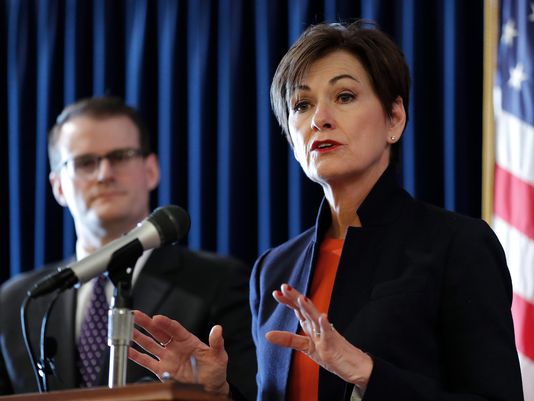
DES MOINES — Iowa’s governor signed legislation Friday prohibiting nearly all abortions in the stateafter a fetal heartbeat is detected, making it the most restrictive abortion ban in the nation.

Security was tightened at the Iowa Capitol in advance of the signing and several state troopers were seen Friday afternoon outside Gov. Kim Reynolds’ formal office.

“I believe that all innocent life is precious and sacred, and as governor, I pledged to do everything in my power to protect it. That is what I am doing today,” Reynolds said.

The bill received final approval early Wednesday from the Iowa Senate on a divided vote. The House passed the legislation Tuesday night.

The law, which goes into effect July 1 if the courts don’t stop it, will require physicians to conduct an abdominal ultrasound to test for a fetal heartbeat on any woman seeking an abortion. If a heartbeat is detected, a physician cannot perform an abortion.

A fetal heartbeat can be detected about six weeks into a pregnancy and often before a woman realizes she’s pregnant, experts said.

Planned Parenthood for the Heartland, which is Iowa’s largest provider of abortions, announced earlier Friday it would file a lawsuit if Reynolds signed the legislation.

“It’s shameful that when Planned Parenthood heard lawmakers were introducing legislation to ban abortion, we were outraged — but we weren’t surprised,” said Suzanna de Baca, president and chief executive officer of Planned Parenthood of the Heartland. “But I think many of us still never expected that Governor Reynolds would so swiftly jump to sign a bill that is so clearly unconstitutional.”

Reynolds, a Republican who has been outspoken in her opposition to abortion, had declined to say Wednesday whether she would sign the legislation. She had said she would work with her staff before making any final decisions although faith-based lobbyists told The Des Moines Register they fully expected Reynolds would sign the bill.

Iowa law has barred most abortions after 20 weeks under legislation enacted last year. Those provisions already were among the most strict abortion bans in the country.

But many Iowa Republican lawmakers said they believe the time is right to pass legislation that could advance to the U.S. Supreme Court and pose a challenge to Roe v. Wade, the 1973 landmark case that found women have a constitutionally protected right to abortion.

The Supreme Court has declined to hear similar cases in recent years. But as states continue to pass legislation restricting abortions and President Trump appoints more conservative federal judges, abortion opponents are increasingly optimistic.

Source: https://www.usatoday.com/story/news/politics/2018/05/04/iowa-fetal-heartbeat-abortion-ban-law/581980002/

Texas legislators shovel millions into fake clinics that promote an anti-choice agenda. Only a small portion of the funding pays for assistance, such as maternity clothing, baby clothing, and diapers.

The Texas Alternatives to Abortion (A2A) program since September 2014 has distributed more than $21.6 million in funding to organizations that oppose abortion rights and supposedly provide support services to pregnant people and adoptive parents.

During that period, more than $10.3 million in taxpayer dollars has been funneled to so-called crisis pregnancy centers, fake clinics that use anti-choice propaganda to dissuade people from seeking abortion services, according to documents reviewed by Rewire.News.

Subcontractors over the past three years were reimbursed more than $13.9 million dollars for “counseling” services and more than $4.3 million for pregnancy, childbirth, and parenting classes. Only $3.4 million was distributed to organizations to pay for assistance, such as maternity clothing, baby clothing, and diapers.

Anti-choice clinics will be eligible to receive an unprecedented $40.5 million in taxpayer dollars from 14 states this fiscal year, and Texas accounts for more than half of funding for fake clinics.

“Political leaders in Texas should be ashamed. When over 14 percent of households in the state experience food insecurity because the Texans living in them lack consistent access to regular meals, it is a dereliction of duty to give hard earned tax dollars to shady, anti-abortion fake clinics that exist to talk women out of having abortions,” Pamela Merritt, co-director of ReproAction, told Rewire.News.

Texas Gov. Greg Abbott (R) in June 2017 signed an appropriations bill that allocated $38.3 million over two years for the A2A program, after the state’s GOP-held legislature approved an amendment to more than double the program’s funding.

The A2A program is administered by the state’s Health and Human Services Commission, which contracts with an outside organization to distribute the funds. The Texas Pregnancy Care Network (TPCN), an Austin-based nonprofit, was awarded a contract to distribute funds to the subcontractors that the network selects and oversees. Organizations that provide abortion care or refer clients to abortion providers are not eligible to receive funding through the A2A program.

TPCN this fiscal year has distributed more than $4 million to 55 subcontractors that operate more than 121 facilities. Nearly $2 million has been directed to 51 fake clinics.

Rewire.News investigation found TPCN funneled $2 million in state funds to fake clinics in 2015, and the majority of the funding was not used for concrete assistance or services.

Houston Pregnancy Help Centers is subcontractor provider for TPCN, which claims to provide “life-affirming alternatives to the tragedy of abortion” to pregnant people who are experiencing an unplanned pregnancy. The organization offers limited medical services at two locations in Houston, along with a mobile clinic.

Houston Pregnancy Help Centers, which states that it seeks to “equip and encourage Christian volunteers” and “share the Gospel of Jesus Christ,” has received more TPCN taxpayer funding since September 2014 than any other state-funded fake clinic: $1.2 million.

“Just think about the impact on food insecurity or infant mortality over $10 million dollars, including the $1.2 million awarded to Houston Pregnancy Help Center alone, would have had,” Merritt said.

Source: https://rewire.news/article/2018/05/04/found-much-taxpayer-money-texas-lawmakers-handed-fake-clinics/


South Carolina’s state Senate voted Wednesday to ban virtually all abortions, The State reported.

The measure, approved 28-10, blocks abortions except in cases of rape, incest or medical emergencies that could seriously harm the pregnant woman.

This would reportedly ban approximately 97 percent of the roughly 5,700 abortions performed in South Carolina each year.

If signed into law, it would almost certainly face a court challenge — exactly what Senate Republicans are hoping for.

“It’s designed to give the court an opportunity to revisit Roe v. Wade,” Senate Majority Leader Shane Massey (R) said, referencing the 1973 Supreme Court decision legalizing abortion nationwide.

State Sen. Brad Hutto (D) said the bill is “clearly unconstitutional,” but said the state Senate should hold a vote on the measure so it didn’t clog up the legislative calendar.

“It’s an attempt to get it to the courts so we don’t have to keep debating it over and over and over,” Hutto said.

Hutto said he’s confident the courts will eventually strike down the abortion ban.

The bill now heads back to the GOP-controlled House for approval. Republican Gov. Henry McMaster and Lt. Gov. Kevin Bryant (R) have both endorsed anti-abortion bills.

Source: http://thehill.com/homenews/state-watch/386064-south-carolina-senate-votes-to-effectively-outlaw-nearly-all-abortions

“This bill is one more example of state politicians, emboldened by the Trump-Pence administration, carrying out policy after policy that strip away people’s freedoms and access to care.”

The Iowa legislature on Wednesday passed a total abortion ban as part of a crusade by Republican lawmakers and anti-choice activists to challenge the U.S. Supreme Court’s landmark ruling in Roe v. Wade.

State Sen. Rick Bertrand (R-Sioux City) said Iowa will be “ground zero” in an effort to reverse the Supreme Court’s decision legalizing abortion care. “I believe this bill will be the vehicle that will ultimately provide change and provide the opportunity to overturn Roe v. Wade,” Bertrand said, according to Iowa Public Radio.

Ohio GOP legislators in March mounted a challenge to Roe by passing a law that would criminalize abortion care. Republicans in the U.S. House of Representatives introduced Congress’s first-ever total abortion ban in January 2017.

So-called heartbeat bans have been deemed unconstitutional because they seek to ban abortion months before the point at which a fetus is viable. The “heartbeat bans,” which outlaw abortion care as early as six weeks’ gestation—before many people even know they’re pregnant—have been blocked by courts in both Arkansas and North Dakota. The Supreme Court declined to review either case.

Dawn Laguens, executive vice president of Planned Parenthood Federation of America, said in a statement that the GOP legislation is an “extreme and draconian policy” intended to restrict the right to access reproductive health care.

“This bill is one more example of state politicians, emboldened by the Trump-Pence administration, carrying out policy after policy that strip away people’s freedoms and access to care,” Laguens said. “The right to control your body includes the right to access safe, legal abortion. Your body is your own, if it is not, we cannot be truly free or equal.”

SF 359 would prohibit abortion from the time a fetus has a detectable heartbeat. A fetal heartbeat can be detected as early as six weeks into pregnancy, two weeks after a first missed period, and well before a person may realize that they are pregnant.

The bill includes an exception for rape, if it is reported within 45 days to a law enforcement agency or a private health agency, along with an exception for incest, if the incident is reported within 140 days. There are exceptions for fetal abnormalities that a physician determines are “incompatible with life,” and for a medical emergency, in which a physician determines the pregnancy must be terminated to “preserve the life” of the pregnant person.

There were 3,719 abortions performed in Iowa in 2016, and all but 230 abortions—6.2 percent—were performed prior to 14 weeks of pregnancy, according to the Iowa Department of Public Health.

Rep. Beth Wessel-Kroeschell (D-Ames) said during the floor debate that the courts have ruled that similar laws were unconstitutional, and that the Iowa GOP’s total abortion ban would disproportionately affect marginalized communities, reported the Cedar Rapids Gazette.

“Middle-class and upper-class women always have access,” Wessel-Kroeschell said. “If Iowa manages to pass this extreme, ideological proposal, middle- and upper-class will travel to another state. These women can afford the plane ticket or auto fuel and possible hotel stays they need to accommodate an out-of-state abortion.”

After several hours of debate, the Republican-controlled house Tuesday evening passed the bill with a narrow 51-46 vote, with six GOP lawmakers joining Democrats to vote against the bill. The bill was then sent to the state senate, where lawmakers in the early morning hours on Wednesday voted 29 to 17 to approve the changes made by the house.

The bill now heads to Gov. Kim Reynolds (R), who has not stated whether she intends to sign the bill.

Brenna Smith, the governor’s spokesperson, said the governor is “100 percent prolife,” but the governor’s office has not received legislation and the “governor does not comment on any bill until she sees it in its final form,” reported the Des Moines Register.

Source: https://rewire.news/article/2018/05/02/iowa-republicans-pass-total-abortion-ban-vehicle-challenge-roe/

Juanita Perez Williams’ claims about abortion perpetuate widely debunked anti-choice propaganda.[Photo: Juanita Perez Williams against a white background]

In February, Democratic leaders in New York’s 24th Congressional District chose Dana Balter—a visiting professor and a PhD candidate at the Maxwell School of Citizenship and Public Affairs at Syracuse University—as their candidate for U.S. Congress. The Democratic Congressional Campaign Committee (DCCC) apparently had other ideas: The DCCC recently stepped in to support another candidate who entered the race at the last minute, whose campaign website includes no formal positions on critical issues, and who has promoted erroneous anti-choice propaganda.

As the Intercept reported Saturday, Juanita Perez Williams, a former prosecutor and candidate running for the U.S. House of Representatives, described her personal anti-choice views in a series of private posts to Facebook. “My heart has also been changed for life from the many women I know, both young and old like me, who have suffered greatly from abortion,” she wrote two years ago in a post, according to the publication.

“It is a choice that leaves many with years of suffering,” she claimed. “It is a choice that leaves one with depression, and sadness, and often hurts relationships. I mention this because there is nothing in my pro-life advocacy that even suggests judging or condemnation. I hate that crap! Women suffer with pregnancy and often feel hopeless. This I know! Be good!”

Perez Williams’ claims about abortion perpetuate widely debunked anti-choice falsehoods.

In another post, Perez Williams said she had attended the anti-choice March for Life. She did not dispute the authenticity of the posts to the Intercept.

In a statement also provided to Rewire.News, Perez Williams vowed that if elected she would protect reproductive rights and claimed her “personal opinions are far more nuanced.”

“I believe 100 percent in a women’s [sic] right to choose and will always defend and protect that right. I further believe that women should have access, funding, and education with regard to their reproductive health and therefore I will advocate for and defend organizations like Planned Parenthood,” she said. “Like many women, my personal beliefs on the issue of choice have been shaped by my life experiences, both as a Hispanic and a Catholic and as a mother and a grandmother. My own personal opinions are far more nuanced then [sic] some people would like you to believe. I will always vote to support the choice of all women.”

Balter is the favorite of voters in the district and won the Democratic designation for Oswego, Cayuga and Wayne counties earlier this year. She was the presumptive nominee until Perez Williams jumped into the race.

Balter’s campaign site highlights health care as “a fundamental human right,” and promotes Medicare-for-All. Her platform includes calls to “guarantee coverage for essential health services that protect our families like maternity care, hospital services, and mental health care” and to “safeguard women’s access to reproductive health care.” She has the support of the Indivisible Project and Zephyr Teachout, who launched a progressive challenge to Gov. Andrew Cuomo (D) in 2014.

In a statement to Rewire.News, Balter said that Perez Williams’ statements were “disturbing.”

“How can we consider electing a Democrat who describes herself as a pro-life advocate? How can we trust that she will stand firmly with choice when she attends Pro-Life rallies, rallies designed to persuade Congress to ban abortion,” said Balter. “Women’s access to abortion is under attack across the country, we need candidates who will unequivocally stand with choice,” she continued. “I am absolutely pro-choice and believe that abortion is a personal decision between a woman, her family, her faith, and her doctor.”

Perez Williams’ campaign site does not include her platform or her positions on various issues. Despite anti-choice claims on her private Facebook page, EMILY’s List, which ostensibly works to elect pro-choice women, endorsed her during her 2017 Syracuse mayoral race. She also attended the EMILY’s List annual gala in Washington, D.C. this week. EMILY’s List did not respond to a request from Rewire.News for comment on Perez Williams’ position by the time of publication.

But an EMILY’s List spokesperson told the Intercept it was “taking a close look at this race.” “Although we do not discuss our internal endorsement process, we do reexamine every candidate with fresh eyes when she pursues a new office and evaluate every race on a case-by-case basis.”

Mark English, chair of the Onondaga County Democratic Committee—the same county from which Perez Williams had run for mayor—told Rewire.News he had “not heard anything about her position” on reproductive rights.

English, speaking before Perez Williams’ social media posts came to light, said reproductive rights “will always be an issue that matters” to voters in his district.

The Democratic National Committee (DNC) supported Perez Williams in her 2017 mayoral bid.  DNC Chair Tom Perez called Perez Williams the “embodiment of the American dream.” She lost that election by a landslide. Despite this and the fact that Balter is favored by voters in the district, the DCCC is backing Perez Williams.

Local party officials were dismayed when the DCCC—the arm of the Democratic Party that looks to elect members to the U.S. House of Representatives— jumped into the race in her support.

“The recent DCCC actions in NY24 are unfortunately just the latest example (see PA-7, TX-7, PA-16 & a half dozen others) of not taking into account the work happening at the grassroots this year,” the chairs of the Onondaga, Cayuga, Oswego and Wayne County democratic committees said this month in a joint statement. “From people engaged for the very first time this year, to party and elected officials we stand united behind our designated nominee Dana Balter and against the DC meddling that has hampered far too many races thus far.”

The race made headlines this week when a complaint was filed with the state’s Board of Elections alleging that some signatures collected to get Perez Williams on the ballot were invalid. After she launched her last-minute campaign, she gathered more than 3,200 signatures with help from the DCCC, as the Auburn Citizen reported. Only 1,250 valid signatures are needed to qualify for the ballot. The Board of Elections is reportedly set to decide on the matter on May 3.

The DCCC doubled down on its support of Perez Williams last week, officially adding the candidate to their “Red to Blue” program, which “arms top-tier candidates with organizational and fundraising support.”

The Democratic Party has been embroiled in a visible debate over its values since last spring when high-ranking party members were slated to appear at a rally alongside Heath Mello, a Democratic mayoral candidate with an anti-choice voting record. But Rep. Ben Ray Luján (D-NM), who chairs the DCCC, has said support for abortion rights will not be used as a litmus test for its support.

The Democratic primary will be held on June 26. The winner will face Republican U.S. Rep. John Katko in the general election.

Source: https://rewire.news/article/2018/04/28/dccc-backing-ny-congressional-candidate-ill-informed-anti-choice-positions/

More than 3,600 individuals and groups responded to the Abortion Reform Bill consultation

Abortion is set to be decriminalised on the Isle of Man as part of a radical reform.

The changes are set to turn the self-governing crown dependency, where abortion is currently only allowed in very limited circumstances, into one of the world’s most progressive places for reproductive rights.

The legislation, which will make the laws even more relaxed than in England and Wales, will allow abortion up to 14 weeks on request, up to 24 weeks in cases of foetal anomaly or serious social reasons, and after 24 weeks in rare circumstances where the life of the mother or baby is at risk.

Counselling must be offered before and after the procedure, and a clause allows medical professionals to not deliver treatment if it clashes with their personal views.

The move follows a consultation on The Abortion Reform Bill which received more responses than any other on the island, with more than 3,600 respondents giving feedback.

Alex Allinson, the politician elected after placing the issue at the centre of his manifesto, said the aim of the reforms is to take abortion “out of the realm of the criminal justice system” and make it available “on request” to women in a broad range of circumstances.

The former GP said decriminalising abortion would free up midwives from “not constantly having to look over their shoulder”, allowing them to “look forward and provide decent services”.

He called the reforms a “major step forward”.

“What we’re doing is making it legal and firmly putting it in terms of women’s healthcare,” he said.

“And I think that’s very, very important, that women are actually empowered to be part of the system that supplies their healthcare.

“This is the first move to break down some of the stigma about abortion, to try to get rid of the shame some women feel, either making the decision or afterwards, which can affect their mental health, so it’s more than symbolism, this is a really positive step forward.”

In England and Wales, abortion is legal on a wide range of grounds but not decriminalised entirely.

Dr Allinson said the move on the Isle of Man and “will hopefully lead the way” with regard to the Irish referendum and other countries considering reform.

Source: https://www.independent.co.uk/news/uk/home-news/isle-of-man-decriminalise-abortionalex-allinson-a8328231.html?S2ref=907022

State Department removes reproductive rights indicators from annual country reporting

© Getty Images

Last Friday’s release of the U.S. Department of State’s annual Country Reports on Human Rights Practices has a gaping hole: the “Reproductive Rights” section has disappeared. This section was previously included for each one of the 195 countries covered by this comprehensive assessment of the state of human rights around the world With his confirmation now settled, Secretary of State Pompeo should understand — and reverse — his predecessor’s dramatic about-face in U.S. efforts to protect the rights of women.

The country reports form a critical body of evidence for capturing human rights conditions. They provide narrative evidence of compliance with human rights norms — an established part of international law — incorporating rights to free press, association, religion, fair trials and conditions of confinement, as well freedom from racial, ethnic and gender-based discrimination.

The reports shed light on abuses and help human rights bodies, lawmakers and civil society address violations with direct intervention, sanctions, or other corrective means. For example, their documentation of forced military conscription of children as young as eight years old contributed to the 2007 passage of the Child Soldiers Prevention Act, which denies U.S. support to countries who continue this brutal practice.

Included in past reports was documentation of violations of women’s reproductive rights such as high rates of maternal mortality and limited availability of contraception. Moreover, last year’s country reports covered the harsh penal consequences of criminal abortion laws for women in El Salvador and Uganda and the denial of medical care to Filipino womensuffering complications from unsafe abortion. In the just-released reports, the “Reproductive Rights” section has been eliminated altogether. Instead, the only reporting on women’s human rights with respect to reproduction is a section labelled “Coercion in Population Control.”

Without question, coerced abortion and sterilization are human rights abuses that must be denounced. So too should other affronts to women’s human dignity and ability to control their bodies and their lives. Gone from this year’s reports are government restrictions on contraceptive methods and instances of women criminalized for ending a pregnancy. Rates of largely preventable maternal mortality are absent as well, though the reports do link to an outdated World Health Organization white paper. Taken in total, these changes materially overhaul what the United States monitors on women’s rights and sends an unmistakable signal that some lives are not entitled to equal treatment and respect.

These much-diminished reports will undermine efforts by international actors to hold nations accountable and intervene on behalf of vulnerable populations. They reveal that the U.S. no longer stands among the nations of the world which recognize women’s rights as human rights, giving tacit support to countries with deplorable human rights records.

Under this administration, the U.S. record of protecting women’s human rights within its borders merits little more than a C-minus. Now, the failure to monitor these violations overseas erases the realities of women’s lives and marks the next step in a systematic retreat by the U.S. on gender equality at home and abroad.

Reproductive rights are internationally recognized human rights. It is imperative that the State Department monitors all human rights, including those most deeply affecting women. Human rights in general — and reproductive rights in particular — are not spoils in a political contest. They are established legal obligations under international law which protect individuals all over the world from discrimination, violence, injury and death.

Failure to collect evidence of violations to reproductive rights aligns with the administration’s scornful treatment of women, survivors of sexual violence and abuse and, increasingly, the very large world beyond U.S. borders.

Source: http://thehill.com/opinion/healthcare/385077-state-department-removes-reproductive-rights-indicators-from-annual