Sen. Maggie Hassan questioned a Trump administration official about a decision to force unaccompanied immigrant minors to seek permission from Office of Refugee Resettlement Director Scott Lloyd before they can have an abortion.
Hassan repeatedly questioned Wagner about whether ORR was following the recent court order that prevents the government from blocking young people in ORR custody from accessing abortion. Chip Somodevilla/Getty Images
The failings of the Office of Refugee Resettlement (ORR) were highlighted Thursday during a congressional hearing, including an outright lie concerning the agency’s policy on abortion care for immigrants.
U.S. Sen. Margaret Hassan (D-NH) addressed Steven Wagner, acting assistant secretary of the Administration for Children and Families, which like ORR, is overseen by the Department of Health and Human Services (HHS). Hassan said she was concerned about Scott Lloyd, the ORR director who has blocked “young women from their constitutionally protected health care and privacy.”
Many of Lloyd’s colleagues have defended him in light of disturbing revelations, including receiving a weekly spreadsheet containing information on every pregnant teen in ORR’s custody. The spreadsheet tracks gestational age and whether the young person has asked for abortion care. Lloyd has traveled to meet with pregnant people in ORR detention centers to coerce them out of accessing abortion care; he’s denied seven young, undocumented women’s requests for abortion—even when the pregnancy resulted from rape, which is a violation of federal law; he has disobeyed court orders to not tell a young woman’s parents about her decision to obtain an abortion, which put her safety at risk; he has ordered that all pregnant people in ORR custody be given anti-abortion counseling; and asked officials to look into “reversing” a medication abortion.
When Hassan asked Wagner if he was aware of Lloyd’s use of spreadsheets to track the pregnancies of young people in ORR custody, Wagner sidestepped the question and cited a 2008 HHS Policy outlining how “serious medical services” that “may threaten the life of” an unaccompanied immigrant child require “heightened ORR involvement.” Despite being safer than giving birth, abortion care is listed in the policy as a serious medical service. Wagner was implying that the policy requiring approval from the ORR director to access abortion care has nothing to do with Lloyd and goes back a decade.
That is a lie, as Hassan told Wagner. Prior to the March 2017 HHS policy under Lloyd, the approval of the ORR director was not required to access abortion care while in ORR custody. It should be noted that nothing in Lloyd’s background indicates he is qualified or equipped to lead ORR or to “counsel” pregnant people in ORR custody against seeking abortion care, which he admitted to doing when speaking to the Christian Broadcasting Network.
Dawn Laguens, executive vice president of the Planned Parenthood Federation of America, said in a statement that HHS officials are pretending they didn’t create a new policy regarding access to abortion care. “Blocking undocumented women from accessing safe, legal abortion is the new policy of HHS under the Trump-Pence administration,” Laguens said. HHS “Sec. [Alex] Azar needs to immediately fire Scott Lloyd as Director of the ORR and reverse HHS’ unconstitutional policy.”
Hassan repeatedly questioned Wagner about whether ORR was following the recent court order that prevents the government from blocking young people in ORR custody from accessing abortion. While Wagner clarified they are appealing the order, he assured Hassan the court order was being followed. However, a conservative publication reported this week that a faith-based shelter in Texas that contracts with ORR is refusing to tell unaccompanied immigrant minors in its care that they have the right to access abortion care, a violation of the court order.
Lloyd is said by advocates to be ushering in a wave of “anti-choice fanaticism” into the U.S. immigration system, first illustrated by the case of Jane Doe, a pregnant unaccompanied immigrant teen in ORR custody who was essentially “held hostage” for wanting to access abortion care.
ORR’s revised policy “allows [shelters] to wield an unconstitutional veto power over unaccompanied immigrant minors’ access to abortion,” according to court documents. This directive explicitly prevented unaccompanied immigrant minors in their care from obtaining abortions by prohibiting federally funded shelters from taking “‘any action that facilitates’ abortion access to unaccompanied minors in their care without ‘direction and approval’” from Lloyd.
After a lengthy legal battle, Doe, the Salvadoran minor, was able to receive abortion care, but similar cases emerged in the following months.
The intent of the U.S. Senate Permanent Subcommittee on Investigations’ hearing was to shed light on ORR and the Department of Homeland Security’s (DHS) efforts to protect unaccompanied immigrant minors from abuse, efforts that have made little progress.
ORR has some serious problems to contend with, including the agency’s failure to keep track of children it releases to sponsors, with nearly 1,500 children going missing in a three-month period last year.
Sen. Rob Portman (R-OH), chairman of the subcommittee, began the hearing with the story of eight unaccompanied immigrant minors who, in 2015, migrated to the US with the help of human traffickers. These young people were picked up by DHS, transferred to ORR custody, and promptly released back into the custody of the human traffickers, whom ORR failed to vet and allowed to be sponsors of the children.
“The traffickers took them to an egg farm in Marion, Ohio, where the children lived in squalid conditions and were forced to work 12 hours a day, six days a week, for more than a year. The traffickers threatened the children and their families with physical harm—and even death—if the children didn’t work,” Portman said.
The situation lead to an investigation by the subcommittee and at a January 2016 congressional hearing, HHS committed to clarifying DHS and HHS responsibilities for protecting children in their care. The agencies said they would enter into a detailed “Joint Concept of Operations” (JCO) that would outline the agencies’ plan for addressing issues of safety for unaccompanied immigrant minors. The deadline for the JCO was February 2017. As of April 2018, no JCO exists.
The New York Timesrecently reported that the Trump administration has moved forward with its policy of separating children from their parents at the border, meaning ORR has taken custody from parents of approximately 700 children, including more than 100 who were younger than 4, despite the children having migrated with their parent.
These centers, aimed at convincing “abortion-minded” women to continue their pregnancies, purchase videos from the “Earn While You Learn” program with federal funds intended to address maternal health and infant mortality.
Woven throughout the “Earn While You Learn” content is evidence of another purpose: to push people to carry their pregnancies to term. EWYL
Texas has seen some of the nation’s most regressive abortion restrictions in recent years. This series chronicles the fall-out of those laws, and the litigation that has followed.
This is not your typical parenting video.
A glowing, pink fetus hurtles through a tunnel of purple and blue dots, as dubstep pulses in the background. White font spells out the title: “Bonding With Your Unborn Baby.”
A young woman appears against a backdrop of stars. She offers to take us on a journey, to reveal how “even before birth, we are uniquely connected to our tiny, unborn babies.”
“She’s not just a mass of tissues growing into what will eventually become a baby, she IS a baby,” the narrator says. “And as she’s knit so intricately together, so is her personhood.”
Then the video’s agenda comes into even sharper focus.
“Around 18 weeks, your baby begins producing the same hormones found in adults, including cortisol, which is released when she feels pain or stress,” the narrator says.
That’s long before a fetus can actually feel pain.
This video is part of a curriculum designed for fake clinics, or crisis pregnancy centers, whose primary purpose is to convince “abortion-minded” clients to carry their pregnancies to term. In North Carolina, a Rewire.News investigation found, these centers purchase videos like it with federal funds intended to address maternal health and infant mortality. In exchange for watching them and completing worksheets, women earn points they can redeem for necessities like diapers and car seats.
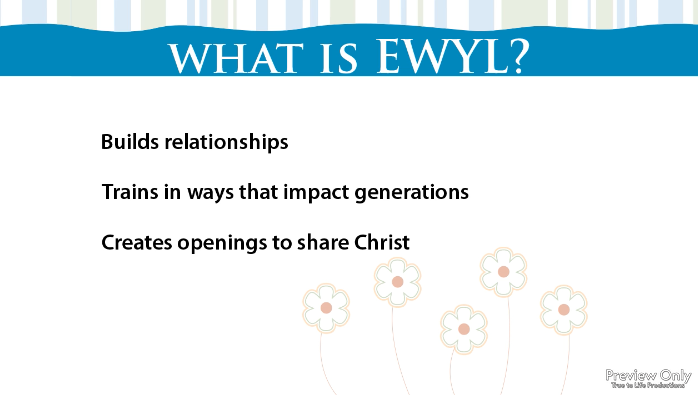
The program, called “Earn While You Learn,” is used by as many as 2,000 centers nationwide, its founder, Dinah Monahan, told Rewire.News. In an introductory video on the program’s website, Monahan says her model is aimed at combating the “entitlement mentality”—while helping anti-choice centers expand their ministry and create openings to “share Christ.”
For the past several years, the North Carolina state legislature has directed a portion of its federal Maternal and Child Health block grant to the Carolina Pregnancy Care Fellowship (CPCF), an umbrella group of anti-choice centers; that allotment is $400,000 annually for the current fiscal year and next.
Records show anti-choice centers subcontracted by CPCF have, since at least the 2015 budget year, used a portion of these funds to buy Earn While You Learn (EWYL) materials and incentives for those who complete them, with plans to buy more next year. The documents also reveal that centers, with approval from state regulators, purchased religious materials with federal funds, including DVDs intended to help men “discover authentic manhood as modeled by Jesus Christ.”
“These expenses should not have been approved and this spending is not consistent with federal law,” the North Carolina Department of Health and Human Services (DHHS) said in a statement, after Rewire.News brought these purchases to the agency’s attention. “We are strengthening oversight of this program and exploring repayment options.”
CPCF is made up of “faith-based” centers that are expected to abide by “biblical principles,” according to its bylaws.
DHHS said it has approved the use of federal funds for the EWYL program’s main and Spanish curricula, because the material focuses on prenatal education and the first year of life. Indeed, the main curriculum, with a price tag around $3,000, includes lessons on vaccines, infant hygiene, DIY maternity wear, the impact of pregnancy hormones on emotions, and the dangers of smoking while pregnant. But woven throughout the content is evidence of another purpose: to push people to carry their pregnancies to term. The goal is made plain in the program’s Best Practices booklet.
“When counselors are working to convince clients that the baby is alive, the fears of the future also need to be addressed,” the booklet reads. “EWYL gives answers to those fears. The ‘I can’t be a mother’ [fear] can be answered with, ‘We can help you learn how.’”
In an interview with Rewire.News, Monahan said the curriculum is based on science.
“It’s not from a pro-life perspective, other than the fact that we believe that the unborn baby is a human being from conception, and in believing that, we address it as such,” Monahan said.
Some of the content, however, appears distorted in service of that belief.
Take the video on “The Emotions of Pregnancy,” where the narrator explains that our “pesky fluctuating hormones” may intensify stress about finances, job changes, or relationships. Both this video and “Bonding With Your Unborn Baby” were added to the main curriculum in 2017, according to the EWYL website; the budget records don’t make clear if centers purchased these specific titles.
In an online sample of the video, the narrator acknowledges that up to 23 percent of women experience depression during pregnancy. But she glosses over the circumstances that may cause people to consider abortion—as well as the realities of postpartum mood disorders.
“While circumstances may not change, the life developing within you brings hope,” she says. “Even though some women face difficult circumstances in unplanned pregnancies, and may feel negative about their pregnancies, it is very rare that these negative feelings continue after the birth of their babies.”
“Many of the Women … Are Very Effective at Manipulating”
The Earn While You Learn program is intended for people who have already chosen to continue their pregnancies, and is meant to avoid a “handout system” for clients, most of whom are low-income, Bobbie Meyer, state director of CPCF, told Rewire.News in an interview.
“Many of the women have been brought up in a home, in a culture, where you just try and get everything you can and they are very effective at manipulating and being users,” Meyer said. “In earning points, she is learning how to work for things, and they feel good because they’re the ones that are doing something to get things for their baby.”
The information can “replace unhealthy generational family patterns” on topics like healthy eating and the importance of prenatal care, CPCF says in reports to the state.
Reproductive justice advocates say this language is rooted in stereotypes about poor parenting.
“That all comes out of racist and racially biased theories around poverty,” Laurie Bertram Roberts, co-founder and executive director of the Mississippi Reproductive Freedom Fund, told Rewire.News.
Meyer rebuffed these claims about the language.
“‘Generational family patterns’ exist in many demographics,” she wrote to Rewire.News.
Bertram Roberts says her group gives out diapers, but does not make people sit through videos first.
“I’m not going to withhold things you need until you meet some arbitrary goal because I don’t feel like you’re a worthy poor person until you do,” Bertram Roberts said. “I mean, the whole concept of Earn While You Learn is offensive to me.”
North Carolina experts say the model may also be ineffective—as efforts to place conditions on welfareshow.
“There just isn’t a lot of data to show that [adding requirements] helps people in the long term,” Whitney Tucker, research director of NC Child, told Rewire.News. “The more we try to put these strings on people’s basic needs, the more we’re just creating additional toxic stress in the lives of families that are already struggling to make ends meet in the state.”
North Carolina is ranked 39th in the nation in infant mortality. Black infants in the state are nearly three times more likely than white infants to die before their first birthday. Reproductive health advocates say every dollar of federal funds to address this crisis should go to evidence-based programs, not those with an anti-choice agenda.
“This is a diversion of funds for programs that we don’t know are actually providing any kind of benefit,” Tara Romano, executive director of NARAL Pro-Choice North Carolina, told Rewire.News.
North Carolina Democratic state Rep. Deb Butler echoed these concerns.
“It is unconscionable to try and manipulate someone in their most vulnerable moment and to give them information that is so biased and clearly one-sided and in many cases probably wholly inaccurate,” said Butler, who, last year, unsuccessfully tried to redirect North Carolina’s funding of crisis pregnancy centers to addiction treatment. Instead, the Republican-dominated legislature gave CPCF $2.6 million in state funds over a two-year period, much of it for ultrasound equipment.
When Rewire.News outlined our findings about Earn While You Learn, Butler was outraged.
“It’s also unkind,” Butler continued, “in the sense that a person comes to an organization looking for help, and in order to get the help they have to jump through hoops … [that] may violate their own religious beliefs.”
“Mommy Money” and “Daddy Dollars”
Dinah Monahan cites the “ingratitude” of women as a catalyst for Earn While You Learn. When she launched the program about two decades ago at a crisis pregnancy center in Arizona, the “girls” would complain they didn’t like or need the things the counselors gave them for free, she says, in the introductory video.
“The girls were doing exactly what they knew how to do in this entitlement society that we have,” Monahan continues. “Earn While You Learn was designed from the beginning to shift the paradigm for a generation that has grown up on handouts.”
And it has shifted the paradigm, Monahan told Rewire.News.
“You almost don’t find centers who give away stuff [for free] anymore,” Monahan said. “It’s rare.”
Most centers don’t use public money for the programs, either—at least according to Monahan.
“There’s an old saying, ‘with shekels come shackles,’” she told Rewire.News. “Most centers use the private sector, churches … businessmen, corporations, lots of charitable giving to fund this program, and of course businessmen love it, because of the earning aspect of it.”
In the video, Monahan recounts how she started writing lessons and sitting down with women one-on-one. The women earned pink “Mommy Money.” When men unexpectedly showed up, they got blue “Daddy Dollars” (the program’s website suggests keeping a closet for dads stashed with tools and sporting goods).
Earn While You Learn is distributed by the anti-choice business Heritage House ‘76, founded by Monahan’s parents and now run by her son, Brandon. While sections of the curriculum have been upgraded, some still appear to be based on Monahan’s personal opinions.
“What young women want from a guy is not sex,” she writes, in a lesson intended to teach teenagers about the “emotional damage” of sexual activity. “Consistently, when I asked girls what they wanted in a relationship with a guy, it was someone to talk to, someone whom they could be honest with, someone who would value their ideas, someone who would accept them just the way they were. Never, not one time in 20 years, has a girl answered that she wanted sex.”
“I didn’t know they still used that,” Monahan said, when Rewire.News asked her about that lesson, which is highlighted on the EWYL website as a sample from the Life Skills supplement. “It’s still true,” she added.
DHHS confirmed the Life Skills supplement has been approved for purchase with federal funds.
A Violation of Federal Law
Monahan’s vision for the program is to help centers forge bonds with “abortion-minded” clients, who then act as “missionaries” by bringing in other members of the “abortion-vulnerable population.”
It is also meant to create openings to “share Christ.”
This was the case for Jasmine Edwards, a client of the Pregnancy Resource Center of Statesville, which receives federal funds. Edwards said her counselor there helped bring her back into contact with religion, encouraging her to pray about her challenges with food insecurity.
“She prayed with me every single day,” Edwards told Rewire.News. “And I prayed about it, and I’m telling you, it was beautiful.”
Edwards and another Statesville client, Danielle Redfield, said they could earn points not just for parenting lessons, but for going to doctor’s visits, writing Facebook reviews for the center, or attending Bible study or church.
Bobbie Meyer said counselors ask for permission before praying with clients.
“We are Christian organizations,” Meyer said. “For us, that is an important piece of who we are, as individuals … but we’re not into forcing anybody else in that direction. We might encourage, but not force.”
There’s no question that crisis pregnancy centers in North Carolina fulfill a need for some clients.
When Redfield’s food stamps were cut off and her fiancé lost his job, she called her counselor.
“She’d let us come up there and get whatever we needed,” she said. “They’re very nice about [it], even if you don’t have extra points to get the stuff.”
Recent budget records show the centers have planned to spend tens of thousands of dollars in federal funds annually on incentives, including diapers, car seats, formula, cribs, baby bouncers, and $5 Walmart gift cards.
But the fact that clients could earn these materials by attending church appears to violate the constitutional separation of church and state, because the government is effectively rewarding people for worship, Robert Tuttle, a professor of law and religion at George Washington University, told Rewire.News.
Meyer called such objections “stretching the separation of church and state to an extreme.”
The current contract between the Carolina Pregnancy Care Fellowship and DHHS includes language noting that faith-based organizations cannot use “direct Federal financial assistance” to support “explicitly religious activities,” including religious instruction and proselytizing. Meyer said religious materials were not purchased this year.
A document from last year’s contract period shows CPCF reallocated $900 of federal funding to purchase three copies of “The Quest for Authentic Manhood,” a program intended to help men “discover authentic manhood as modeled by Jesus Christ and as directed by the Word of God.”
It’s part of a series called Men’s Fraternity, created in a church.
Meyer initially told Rewire.News the fellowship did not buy those DVDs, but after we sent her the document, she confirmed the materials were purchased. She said the decision to buy them had been based on a promotional blurb from Heritage House ’76 about how the program helps men “embrace authentic manhood on a journey to become who God intends them to be.”
“Yes, the word God appears at the very end,” Meyer wrote in an email to Rewire.News. “I did not notice it at the time.”
Meyer also said that in the same budget year, the Tri-County Pregnancy Center in Burnsville had purchased materials from another Men’s Fraternity program called “33 the Series.” DHHS confirmed these materials were approved and should not have been.
In a trailer for the series, described as “a journey to authentic manhood as modeled by Jesus in his 33 years on earth,” the words “Authentic Manhood” flash against a background of exposed brick. An apocalyptic score races to a pulse-pounding crescendo. Sparks fly. Surrounded by stacks of logs, pastors in button-up shirts deliver rapid-fire wisdom about fatherhood and Jesus.
This was paid for with federal funds intended for maternal health.
A second federal court has ordered the Trump administration continue funding comprehensive sex-education programming.
HHS neither provided an explanation for the decision to end the grants early nor did it give the plaintiffs or the other grantees any ability to challenge that decision, according to the lawsuits. Laura Segall/AFP/Getty Images
Evidence provided to Congress by state attorneys general and health departments proves that abortion is both extremely safe and highly regulated. Searchable by state.
A federal judge in Washington state has issued a permanent injunctionpreventing the Trump administration from cutting grants to Planned Parenthood that help fund a teen pregnancy prevention program. Tuesday’s decision is the second from a federal court ordering the administration to continue funding the program.
The U.S. Congress in 2010 created the Teen Pregnancy Prevention Program (TPPP) under President Obama to provide funding for organizations working to cut teen pregnancy rates, primarily through comprehensive sex education. The program provides federal grants for evidence-based initiatives targeting underserved communities with high rates of teen pregnancy, including youth of color, youth in foster care, and youth in rural communities, according to the lawsuits.
President Trump’s proposed budget for 2018 called for eliminating TPPP and sought $277 million to extend abstinence education in its place.The administration announced cuts to the program shortly after appointing Valerie Huber to the Office of Assistant Secretary of Health at the Department of Health and Human Services (HHS), the federal agency tasked with administering the grants. Huber is an anti-birth control advocate who was “instrumental” in attempts to push the agency away from evidence-based comprehensive sex education programs and toward abstinence-only-until-marriage programs. Research, however, has found such education to be ineffective and unethical.
The grants for the program were supposed to run through 2020, but in July 2017, HHS notified the recipients of 81 TPPP grants that their funding would be terminated as of June 30, 2018—two years before their projects were set to end—alleging the program was ineffective at reducing teen pregnancy rates.
HHS neither provided an explanation for the decision to end the grants early nor did it give the plaintiffs or the other grantees any ability to challenge that decision, according to the lawsuits.
Advocates sued the administration in February, arguing the cuts were unlawful. On Tuesday the court agreed and ruled that HHS had acted “arbitrarily and capriciously” when it decided to terminate the program two years early.
It noted that “the public interest weighs in favor of Plaintiffs, as [the order] would prevent harm to the community … and prevent loss of data regarding the effectiveness of teen pregnancy prevention.”
The decision means the administration must continue with the grant agreements for the next year.
“The courts confirmed that the Trump-Pence administration’s attempt to impose its ideological agenda on young people is unlawful,” said Dawn Laguens, executive vice president of Planned Parenthood Federation of America, in a statement. “Planned Parenthood applauds the court’s decision and is proud to continue to serve Americans in the TPPP, along with our partners.”
Tuesday’s ruling follows last week’s announcement by the administration that it would radically remake the science-based TPPP to push ineffective abstinence-only-until-marriage sex education programming.
”The Trump-Pence administration can’t turn back progress, ignore science and the needs of young people, to push its ideological agenda,” said Rachel Todd, director of education for Planned Parenthood of Greater Washington and North Idaho, in a statement following the ruling. “Shifting funds from a wide range of evidence-based programs to focus exclusively on programs that emphasize abstinence-only programs will disproportionately harm young people —including survivors of sexual violence, LGBTQ teens, youth of color, families in rural communities, and youth who already face significant barriers to accessing information or health care.”
Attorneys representing the administration argued HHS had the authority to end the grants at any time.
The Eighth Amendment of the Irish constitution gives equal right to life to the mother and the unborn child.
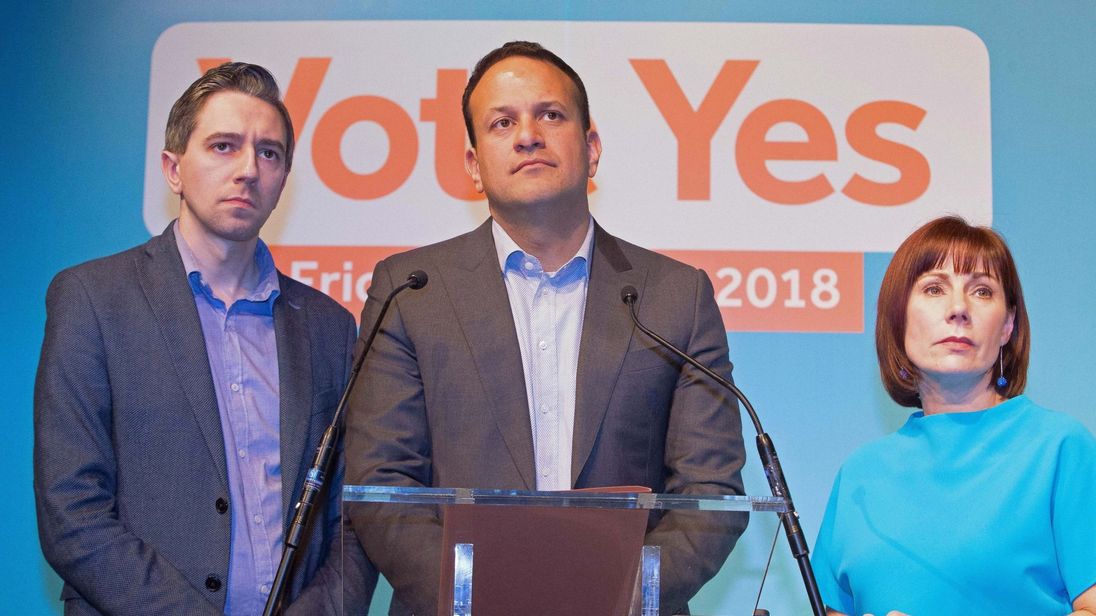
Image:Fine Gael officially launched their Yes campaign at a theatre in Dublin on Saturday
Ireland’s Prime Minister has urged his country to vote “yes” in next month’s referendum to overturn strict abortion laws in the country.
Leo Varadkar said the repeal referendum on 25 May could represent a coming-of-age moment when the nation stops cold-shouldering those in crisis.
At the moment, the Eighth Amendment of the Irish constitution, introduced in 1983, gives equal right to life to the mother and the unborn child.
Abortion is currently only available when a mother’s life is at risk and it is illegal for a woman to have an abortion even if there is a fatal foetal abnormality, or in the case of rape or incest.
Voters will be asked whether they want to remove the Eighth Amendment, and replace it with wording that would allow politicians to set Ireland’s abortion laws in the future.
During a speech in Dublin marking the start of the Yes campaign, Mr Varadkar drew on the experience of rape and child incest victims.
The Taoiseach said: “I am calling for a yes vote because I trust women and I trust doctors and instead of fearing the worst I choose to believe the best about us as a nation.
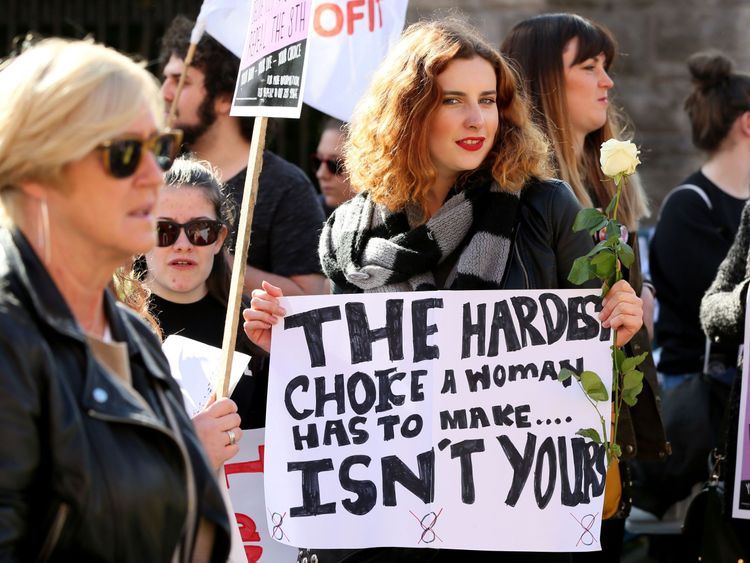
Image:Activists supporting the legalising of abortion during a March in September
“I believe a yes vote will allow us to look our sisters, our friends and our families in the eye when for far too long we have looked away.
“Now is the time to change and to put compassion at the centre of our laws.”
He added: “In Ireland in 2018 we still export our problems and import our solutions, and in the Ireland of 2018 we still turn a blind eye and a cold shoulder to our sisters, nieces, daughters, colleagues and friends when in need or when in crisis.”
The referendum campaign is likely to be fiercely debated.
Parts of Ireland are becoming increasingly secular, but the Catholic Church is among those campaigning for a No vote, those who argue that a baby’s life is sacrosanct.
A statement from Save the Eighth campaigners said Mr Varadkar’s position was too extreme, and said he had been unable to unite his governing Fine Gael party around his position.
Mississippi’s governor just signed a law, more restrictive than in any state, banning abortions after 15 weeks. Iowa’s state Senate is trying to go even further and stop abortions at around six weeks. And 20 Ohio legislators have proposed outlawing all abortions, even if the woman’s life is in danger.
In many state capitols, Republican lawmakers are backing unusually strict antiabortion laws. Many are emboldened by President Trump, who has been more supportive of their agenda than any president in decades. Conservative lawmakers also are eager to get more restrictions on the books in case November’s elections bring a surge of Democrats hostile to them.
Federal courts have immediately blocked many of these antiabortion laws, including Mississippi’s. But they still have a purpose: to set up legal challenges to Roe v. Wade, the Supreme Court decision that legalized abortion nationally, at a time when Trump could appoint the justice who helps overturn it.
“Trump has given hope to the pro-life movement,” said Ron Hood, a Republican state representative who introduced the total abortion ban in Ohio.
Under Hood’s bill, women could be criminally punished for aborting an “unborn human.” In an interview, Hood said prosecutors would decide what charges to seek, just as they do in cases of manslaughter or murder.
For years, many antiabortion groups have argued that laws should penalize the doctor, not the woman, but Hood — who calls abortion an “atrocity” — said about a quarter of his colleagues in Ohio’s 99-member House chamber are lined up behind his bill.
“We are seeing extremism on many fronts in the United States today,” said Nancy Northup, chief executive of the Center for Reproductive Rights, which supports abortion rights. “Those who oppose abortion rights are seeing this as a time to push for the most extreme measures.”
In the Trump era, the long-running abortion wars are heating up again, and the country is increasingly divided when it comes to the availability of abortions.
Many Republican-controlled states are ratcheting back access — establishing waiting periods, outlawing common medical procedures and cutting off Medicaid funding.
At the same time, Democratic-controlled states are expanding access to contraception and reproductive health; in Washington state, the governor just required insurers to cover abortion costs.
Charles Donovan, president of the research institute of the Susan B. Anthony List, which promotes politicians who oppose abortion, said the looming midterm elections “certainly do add a push” to get antiabortion laws in the pipeline for a potential Supreme Court challenge.
In 2017, Trump’s first year in the White House, 19 states passed 63 antiabortion restrictions, according to Guttmacher.
Collectively these measures send a loud message, Donovan said. “It’s a cultural message, not just a legal message, to the court,” he said.
Before Trump ran for president, he publicly said he was “very pro-choice.” But when he became a candidate, he promised to appoint judges to reverse Roe v. Wade and won over many Republican voters, including from the religious right, who remain among his steadfast supporters.
They applauded his nominee to the Supreme Court, Neil M. Gorsuch, who has never ruled in an abortion case and evaded questions at his confirmation hearings about Roe v. Wade but who has consistently voted with the court’s conservative majority. Another vacancy on the court would give Trump a chance to increase that majority, a prospect that has thrilled Trump supporters.
The opportunity has not worked out in the past. Justice Anthony M. Kennedy was once thought to be the missing vote to overturn Roe but instead affirmed the right of women to seek an abortion.
And although Kennedy has been generally supportive of abortion restrictions, he joined the court’s liberals two years ago to strike down a Texas law that was found to impose an undue burden on women.
But Kennedy is 81 and is said to be considering retirement. Two of the court’s liberals, Ruth Bader Ginsburg and Stephen G. Breyer, are 85 and 79, respectively.
The chance to replace one of the three offers abortion opponents “something they never thought they would have: a potential majority on the Supreme Court” who would overturn this landmark decision, said John Weaver, a Republican strategist who has advised Ohio Gov. John Kasich.
While many in Washington are consumed with presidential scandals about alleged mistress payoffs and FBI raids, many people across the country care more about other issues, such as abortion, Weaver said.
“It’s an issue that keeps them tethered to an untethered president,” he said.
Northup said Trump has unleashed a “new level of aggression” among abortion opponents. Recent bills include those that would prosecute doctors who perform an abortion as early as six weeks, make no exception for rape, forbid women from getting an abortion if the reason is a high probability of Down syndrome and, as in Ohio, allow a prosecutor to seek criminal charges against women.
“People better vote on November 6th like their life depends on it,” said Kellie Copeland, executive director of NARAL Pro-Choice Ohio. She said the discussion in Columbus of criminally prosecuting women “is so far out of the mainstream” that there is urgency for voters to turn out.
Democrats overwhelmingly support preserving the rights of women to end an unwanted pregnancy.
Democrats say energy is high and record numbers of women are running in November, and they are hoping for wins that could shift the power balance in state capitols.
Conservatives also say they are energized.
Susan Swayze Liebel, coordinator of the National Pro-Life Women’s Caucus for the Susan B. Anthony List, said abortion opponents are working to turn out their base and “keep the momentum going in the states.”
“The Trump effect is the hope effect for the pro-life movement,” Liebel said.
More than 90 percent of abortions are performed before 13 weeks, according to the Centers for Disease Control and Prevention.
A Pew Research poll last year found that 69 percent of Americans did not want Roe v. Wade. to be overturned. That ruling gives a women the right to an abortion up to the point where the fetus is viable outside the uterus, which is generally considered around 24 weeks.
But Pew also showed a stark party split — 75 percent of Democrats said abortion should be legal in all or most cases, while 65 percent of Republicans believed it should be illegal in those cases.
A big Republican-wave election in 2010, after the election of Barack Obama, sharply increased GOP and conservative clout in states, and that clout remains today.
Since then, 33 states have passed laws to limit abortion.
In Texas, an increasingly hostile environment for abortion providers contributed to the closures of 20 clinics, abortion rights groups said, about half of those in the state. In the Republican strongholds of Mississippi and Kentucky, only one clinic is left.
In certain parts of the country, “it is unequivocally much harder now to access abortion care than any year since Roe v. Wade,” Northup said.
Elizabeth Nash, the state policy analyst at Guttmacher, said abortion services are increasingly out of reach for many women because of the distance they would have to travel to a clinic and the cost. Women in Texas, Louisiana, Mississippi and other states have a far harder time than those on the West Coast and in many parts of New England, where ending an unwanted pregnancy is easier and cheaper.
About 75 percent of women who seek abortions are poor or have a low income, according to Guttmacher.
“Roe has already fallen in the practical sense for many women,” said Copeland, of the abortion rights group in Ohio. “They are forced to continue pregnancy, sometimes even if it’s not what is best for their health, because they cannot get past the travel and financial hurdles.”
Lawmakers passed bills that would make a slate of maternal, abortion, and other reproductive health care available to inmates while providing them with free menstrual hygiene products.
Even vendors realize when prisons cut shipments from 1,000 to 200 pads a month to save money, said Monica Cooper, former inmate and co-founder of the Maryland Justice Project, an advocacy group that pushes for prison reform.
Brian Witte AP Wire
Maryland legislators have passed landmark legislation to protect the health and dignity of incarcerated women.
Maryland’s Democratic-majority General Assembly last week passed two bills with bipartisan support to ensure the prison system develops policies on medical care for pregnant inmates and detainees, and provides free feminine hygiene products to people who are incarcerated.
“We are the first in the nation to do this and it says a lot,” Diana Philip, executive director of NARAL Pro-Choice Maryland, told Rewire.News. “It is a great foundational law and a good risk-management tool for the administration. These two bills will lead the reform that so many people are looking for.”
Expected to go into effect October 1, HB 787/SB 629 requires every correctional facility in the state to have a robust policy in place for the medical care of pregnant inmates, including prenatal testing, labor and delivery, abortion care, postpartum care, access to child placement services, and counseling. Incoming women have to be provided with the policy. This is important, advocates said, because pregnant people often don’t know their rights or even expect health care in prison.
Former inmates have shared harrowing stories of never getting prenatal testing results, a total absence of pregnancy options counseling, denial of abortion care, unlawful shackling, and even forced cesarean sections, Philip said.
“Pregnant inmates are not any less deserving of proper medical care to ensure their own health and the health of their child,” said lead sponsor of the house bill Del. Kathleen Dumais (D-Montgomery County).
The companion bill, HB 797/SB 598, requires correctional facilities in Maryland to have a written policy and sufficient supply of free menstrual hygiene products as needed. It sounds like a basic necessity, but many imprisoned women go without pads or tampons. The products can be expensive or simply unavailable, advocates said.
“Menstrual hygiene products should be considered basic necessities for women,” said state Sen. Susan Lee (D-Montgomery County), who sponsored the Senate bill. “Ensuring women in prison have access to these products is simply the right thing to do.”
Even vendors realize when prisons cut shipments from 1,000 to 200 pads a month to save money, said Monica Cooper, former inmate and co-founder of the Maryland Justice Project, an advocacy group that pushes for prison reform.
These are “dignity bills” and she hopes Maryland lawmakers will inspire other state lawmakers to follow suit, Cooper told Rewire.News.
Despite a 700 percent increase in women’s incarceration since 1980, prison policies and services have not been updated to better accommodate women. “It’s almost as if incarcerated women are an afterthought,” Cooper added.
It’s “mind blowing” that these commonsense policies are not in place everywhere, especially during a woman’s most vulnerable and at-risk time of her life, said Julie Magers, leader of the Maryland Prisoners’ Rights Coalition.
“I’ve received many many complaints from women I’ve interviewed about the lack of basic hygiene and health care so to have these bills pass. It’s landmark and so incredibly needed,” she told Rewire.News.
She has heard from a woman who was put into medical isolation after she miscarried with no aftercare provided; a woman who was shackled during labor and was forced to walk in chains after giving birth; women threatened with solitary confinement for bleeding through their uniforms during menstruation when they had maybe three pads for their entire menstrual cycle, or worse, none.
Maryland already has an anti-shackling law on the books but that policy is often not enforced, advocates said.
“You’re a prisoner so it doesn’t matter. We hear that frequently. I think that’s how (women) are made to feel,” Magers said. “One of the problems women face a lot is the lack of proper care being directly related to the fact that they are prisoners. That’s not how it should be. It shouldn’t be a matter of whether they are prisoners; they are human beings.”
Formerly incarcerated women like Kimberly Haven recently amplified the subject via the #MeToo campaign by sharing how she made sanitary products using toilet paper during her 15-month stint at a Maryland prison. This led to toxic shock syndrome and eventually, an emergency hysterectomy.
“We had no access some days to pads or tampons and some days not even to toilet paper,” said Sherell Evans, a former inmate and member of the Maryland Justice Project. “As you can imagine, in a facility that houses over 1,000 inmates, things can get pretty messy. Some people would tear up sheets to use as sanitary napkins, they were making homemade tampons out of paper and different stuff …. It was a very, very terrible situation.”
While accurate numbers of incarcerated women are hard to find, the Maryland Correctional Institution for Women in Jessup, the state’s only all-female facility, houses between 800 to 1,000 women. Advocates estimate there are more than 2,000 women detained or imprisoned statewide.
Both bills were priorities for the statewide coalition Reproductive Justice Inside, which advocated for the reforms with partner members that included doctors, midwives, lawyers, professors, and students.
“I commend our partners in the Maryland General Assembly and at Reproductive Justice Inside who worked tirelessly to pass these important measures,” said Gloria Totten, president and founder of the nonprofit Public Leadership Institute, a nonpartisan nonprofit. “I would encourage other states to follow this example and ensure that incarcerated women have access to essential health care needs such as menstrual hygiene products and information about all pregnancy outcome options including abortion.”
Republican Gov. Larry Hogan’s office did not return messages seeking comment on if he would sign the bills, but the legislation passed both chambers of the legislature with enough votes to override a potential veto.
The GOP-backed, anti-choice omnibus law “was, in effect, trying to overrule the U.S. Supreme Court,” said Kenneth Falk, legal director of the ACLU of Indiana.
The omnibus anti-choice bill was passed by wide margins by the GOP-dominated Indiana legislature. It was signed into law in March 2016 by former Gov. Mike Pence (R). Drew Angerer/Getty Images
Texas has seen some of the nation’s most regressive abortion restrictions in recent years. This series chronicles the fall-out of those laws, and the litigation that has followed.
The U.S. Court of Appeals for the 7th Circuit on Thursday affirmed a district court’s ruling striking down two provisionsof an Indiana law that restricts access to abortion care and imposes burdensome regulations on abortion providers.
Officials from Planned Parenthood of Indiana and Kentucky (PPINK) and the American Civil Liberties Union (ACLU) of Indiana on Friday praised the court’s decision during a joint press conference.
Kenneth Falk, legal director of the ACLU of Indiana, said during the press conference that existing law makes it “crystal clear” that a pregnant person has an absolute right to determine whether to terminate a pregnancy.
“Indiana sought to invade that right,” Falk said. “The law was, in effect, trying to overrule the U.S. Supreme Court.”
HB 1337 made numerous changes to state laws, including requiring forced counseling and mandatory ultrasounds for abortion patients, creating regulations on physicians who provide abortion care, and banning fetal tissue donation that has led to the development of vaccines and has had other public health benefits.
Physicians are prohibited from providing abortion care if the physician knows that the pregnant person is seeking the common medical procedure solely because of the “race, color, national origin, ancestry, sex, or diagnosis or potential diagnosis of the fetus having Down syndrome or any other disability.”
The omnibus anti-choice bill was passed by wide margins by the GOP-dominated Indiana legislature. It was signed into law in March 2016 by former Gov. Mike Pence (R).
The ACLU of Indiana in April 2016 filed a lawsuit in federal court on behalf of PPINK, as well as two abortion providers. The lawsuit challenged the so-called final disposition and anti-discrimination provisions of the law. The plaintiffs claim the law imposes an undue burden on a person’s right to choose abortion care, that the the law violates due process and equal protection under the 14th Amendment, and that it infringes upon the First Amendment right of free speech.
District Court Judge Tanya Walton Pratt in September 2017 ruled that the law was unconstitutional, and the Seventh Circuit Court’s three-judge panel unanimously upheld Pratt’s decision.
Judge William Bauer wrote in the 40-page decision that anti-discrimination provisions “clearly violate well-established Supreme Court precedent” and the fetal tissue regulations “have no rational relationship to a legitimate state interest.”
Christie Gillespie, president and CEO of PPINK, said in a statement that there was “no medical basis for these restrictions,” and that the state was interfering in the relationship between patients and medical professionals.
“Every person deserves the right to make their own personal decisions about abortion,” Gillespie said.
Indiana’s Republican Attorney General Curtis Hill has not stated if the state will appeal the court’s decision. Falk said he would not be surprised if the state sought review in the U.S. Supreme Court.
“This victory is critically important for tens of thousands of Ohioans across our state that rely on Planned Parenthood for care and education each year.”
The GOP-backed law would have barred Planned Parenthood from providing health care and educational services through six federal health programs, none of which are related to abortion care. Mark Ralston/AFP/Getty Images
Religious imposition laws are designed to shield private individuals and businesses from complying with nondiscrimination laws based on a religious objection to that service.
An Ohio federal appeals court on Wednesday affirmed a lower court order blocking a law that would have stripped Planned Parenthood clinics in the state of family planning money used to provide health-care services to people with low incomes.
The Sixth Circuit Court of Appeals sided with Planned Parenthood and ruled unconstitutional a law that would have effectively defunded the health-care provider.
Gov. John Kasich (R) in February 2016 signed into law a measure that would have stripped Planned Parenthood of $1.3 million in state and federal taxpayer funds, and diverted that money to health-care clinics that don’t perform abortions and don’t contract with organizations that provide the medical procedure.
The GOP-backed law would have barred Planned Parenthood from providing health care and educational services through six federal health programs, none of which are related to abortion care. Theseinclude the Healthy Moms, Healthy Babies program and access to free screenings for sexually transmitted infections. These programs are of particular benefit to people of color, those with low incomes, and LGBTQ people.
Weeks after Kasich signed the bill into law, Planned Parenthood officials filed a lawsuit and sought a preliminary injunction to block it. Planned Parenthood argued that the law infringed on its First Amendment rights by denying state and federal funds “because of–and in retaliation for–their constitutionally protected advocacy for abortion rights and affiliation with other organizations that also advocate for abortion rights and/or provide abortion services.”
The district court sided with Planned Parenthood.
Applying the unconstitutional conditions doctrine—a legal doctrine that bars conditioning a person’s receipt of a governmental benefit on that person waiving a constitutional right—the district court determined that the anti-choice law impermissibly conditioned funding under programs unrelated to abortion based on a recipient’s forgoing exercise of its First Amendment rights to free speech or association, and forgoing provision of abortion services protected by the Due Process Clause.
The state appealed to the Sixth Circuit, but the Sixth Circuit sided with Planned Parenthood.
Writing for the three-judge panel, Helene White—a George W. Bush appointee—wrote that the law “violates Plaintiffs’ due process rights by imposing unconstitutional conditions.”
White was troubled by the reduced access to health care that would result if Ohio could condition the provision of public funds on forgoing abortion services. White noted that clinics would no longer be able to provide health-care services for free: “Thus, as a condition of retaining access to abortion free of undue governmental interference, Ohio women must [forgo] the extensive and subsidized access to health services under federal programs that they previously enjoyed,” she wrote.
“Although Ohio women do not have a right to the programs, they do have a right not to have their access to important health services curtailed because their major abortion providers opted to protect women’s abortion rights rather than yield to unconstitutional conditions.”
Reproductive rights advocates applauded the decision.
“We are thrilled that today’s decision will safeguard our patients’ access to care,” Jerry Lawson, CEO of Planned Parenthood Southwest Ohio, said in a statement.
“This victory is critically important for tens of thousands of Ohioans across our state that rely on Planned Parenthood for care and education each year. Our patients deserve to have their health care come before political agendas; this isn’t about politics, it’s about access to health care.”
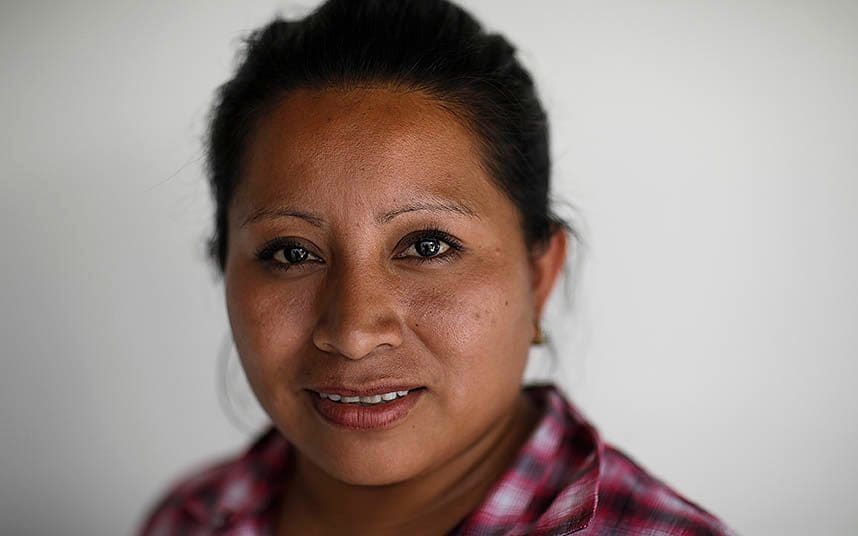
Teodora Vásquez spent 10 years in jail after giving birth to a dead baby girlCREDIT: JOSE CABEZAS/REUTERS
Nine months pregnant, Teodora Vásquez woke up on the day she would lose her second child concerned that the baby wasn’t moving. By early evening she was crumpled under searing pain as she finished her shift at the cafeteria of a private school in San Salvador.
Ms Vásquez called for an ambulance but waited for three hours and by that time she had given birth to a dead baby girl in the toilet. When she staggered out to look for help she was met by a police officer who accused her of murder.
Six months later Ms Vásquez was sentenced to 30 years for aggravated homicide. After 10 years and seven months in jail she walked free in February, her sentence commuted, and finally hugged the teenage boy she had barely seen since he was a toddler.
“My son gave me the strength to keep going while I was inside even though I didn’t see him,” the softly-spoken 35-year-old told the Daily Telegraph a month after her release. “I had lost one child, and I was not prepared to lose the other.”
Her son, who she describes as beautiful, was brought up by his grandparents while she was in jail.
“He says is that he is proud of me. Proud to have a mother like me. And we want to make the most of the time we now have together.”
They committed a real injustice with me but I don’t want to feel resentment. I don’t want revenge. I want to enjoy what I have now.Teodora Vásquez
Ms Vásquez was jailed because of El Salvador’s anti-abortion legislation that outlaws all terminations without exception. The country implements the legislation with a crusading zeal that seems intent on equating not just abortions, but any obstetric emergencies, with murder.
There are no official statistics on the number of women imprisoned for such crimes leaving the activist organisation that helped secure Ms Vásquez’s release, known as the Citizen’s Group, to rely primarily on word of mouth to identify cases.
Monica Herrera, who heads the group, says there are currently 24 women in prison serving sentences ranging from six to 35 years, and another 19-year-old accused of attempted homicide and facing a possible 15-year sentence after she gave birth to her stepfather’s child in a latrine. The baby was found alive.
But while El Salvador may be an extreme case many countries clamp down on women’s reproductive rights, limiting access to abortion, contraception and sexual and maternal healthcare. A recent report by US women’s rights organisation the Guttmacher Institute highlights the 64 other countries around the world that either prohibit all abortions, or only allow them to save a woman’s life.
Figures from Family Planning 2020, a global coalition of partners including the UK Department for International Development, the United Nations and US Aid, show that more than 220 million women in developing countries who don’t want to get pregnant have no access to contraception and voluntary family planning information and services.
Reproductive rights | In numbers
More than 220 million women in developing countries who don’t want to get pregnant cannot get hold of contraceptives
Less than 20 per cent of women in Sub-Saharan Africa and one-third of womenin South Asia use modern contraceptives
In 2012, an estimated 80 million women in developing countries had an unintended pregnancy
In the same year around 20 million women in developing countries had an unsafe abortion
There are on average 56 million abortions performed every year
There are 220 deaths for every 100,000 abortions
Source: WHO and Bill and Melinda Gates Foundation
The coalition says that enabling women to make informed decisions about whether and when to have children reduces unintended pregnancies as well as maternal and newborn deaths. It also increases educational and economic opportunities for women.
For women in countries which restrict access to reproductive health care the stigma attached to abortion or stillbirth is great. For five years Ms Vásquez told nobody why she was in prison for fear of being beaten up. She only realized she was not alone when lawyers from Citizen’s Group sought her out along with other prisoners in similar situations.
“We began to lose our fear a little because there were more of us,” she recalled, her voice cracking just a little. “We started to talk about it and that helped. It helped me to get those feelings out so that when I finally left prison I wasn’t eaten up by anger, resentment, and hate.”
And poverty also made things worse. Vásquez didn’t see her son for the last four years of her incarceration because her family couldn’t afford the time or money to do the onerous paperwork required, or make the long journey from their small village to the prison in the capital.
“Every one of us who was in prison for these crimes was poor and came from a rural area,” she said. “Every one.”
In December last year she returned to court for a review of her case but the same judge who handed down the original verdict reconfirmed the sentence.
“It felt the same as the first time. Even if you don’t want to you get your hopes up. You start hoping that you will get out. Especially when you know you didn’t do anything wrong. I was full of hope that I would be leaving prison, but instead I was sent back with the same sentence.”
And when she finally did hear that she had been released it took a while for the news to sink in. “I couldn’t believe it. I read that piece of paper about 20,000 times until I was absolutely sure that I hadn’t read it wrong,” she says.
In El Salvador attempts are being to made to reform the country’s strict abortion laws, with a proposal to permit abortion to save a woman’s life and in cases of rape.
Vásquez says she bears no grudges and seeks no revenge because she is too busy enjoying her freedom. But, she leans forward to emphasize the point, she also feels an obligation to try to change things so that younger women can avoid the kind of suffering she endured.
“I changed in prison and now I think that we women have the right to decide what happens to us,” says the woman who entered prison with three years of primary schooling and now plans to become a lawyer. “Now I think that if somebody gets pregnant and doesn’t want to have the child, then that is something personal to them.”
She adds: “They committed a real injustice with me but I don’t want to feel resentment. I don’t want revenge. I don’t want any of that, because it would take away the time I have now.”
Many of the questions answered in the Congressional Research Service’s report speak directly to talking points used by anti-choice lawmakers to demonize later abortion care.
When it comes to whether later abortions are safe, the report says that “for women in the United States, the mortality rate associated with childbirth or continuing the pregnancy is higher than the abortion mortality rate.” Shutterstock
Religious imposition laws are designed to shield private individuals and businesses from complying with nondiscrimination laws based on a religious objection to that service.
New analysis about Republicans’ proposed 20-week abortion ban says the common medical procedure is safe, and that delays in care caused by restrictions are why some are forced to seek abortion care later in pregnancy.
The Congressional Research Service (CRS), a division of the Library of Congress that provides policy analysis to members of the U.S. Congress, sought to respond to common questions about the ban in a report published last week. It did not address issues of constitutionality or state regulations on abortion at 20 weeks, nor did it “provide an ethics or morality discussion of second trimester abortion or whether a fetus is a person and has a right to life.”
Dr. Diana Greene Foster, director of research at University of California, San Francisco’s Advancing New Standards in Reproductive Health (ANSIRH), who was cited in the report, called it “very good” in an in email to Rewire.News. “It succinctly compiles a lot of the recent research on later abortions,” Foster said. “I hope that policy makers read it.”
Many of the questions answered in CRS’ report speak to talking points used by the GOP to demonize later abortion care.
For example, Republicans have long pushed a ban on abortion at 20 weeks, or 22 weeks’ gestation, based on the dubious claim that a fetus can feel pain at this point in a pregnancy. But CRS’ report pointed to a fact sheet from the American College of Obstetricians and Gynecologists (ACOG) as the authority on the matter, quoting a 2013 statement that said a “human fetus does not have the capacity to experience pain until after viability.”
“Rigorous scientific studies have found that the connections necessary to transmit signals from peripheral sensory nerves to the brain, as well as the brain structures necessary to process those signals, do not develop until at least 24 weeks of gestation,” the statement said.
The CRS report addressed how mental health can be affected by having abortions. In particular, it pointed to research finding that having an abortion does not increase the risk of mental health disorders.
Abortion rights opponents often claim that the procedure can have harmful long-term psychological effects, though there is no evidence to support that charge. A 20-week ban authored by the anti-choice group Americans United for Life and adopted by the GOP-majority Arizona legislature in 2012 falsely suggests that those who have abortions are at risk for “psychological or emotional complications.”
When it comes to whether later abortions are safe, the report says that “for women in the United States, the mortality rate associated with childbirth or continuing the pregnancy is higher than the abortion mortality rate.” Though it notes that the risk of mortality goes up as gestational age increases, CRS pointed to research from the National Academy of Sciences, Engineering, and Medicine that found the risk of death from abortion care to be less than the risk of death during colonoscopies, dental procedures, and adult tonsillectomies.
The report mentioned how often later abortion care is performed due to fetal anomaly and life endangerment, speaking to pro-choice advocates who say that later abortions are often for these reasons. Here, CRS again pointed to Foster’s work.
“Based on limited research and discussions with researchers in the field, Dr. Foster believes that abortions for fetal anomaly ‘make up a small minority of later abortion’ and that those for life endangerment are even harder to characterize,” it said.
Though she referred to it as “an extremely minor point in an otherwise excellent report,” Foster noted a small difference between her opinion and how it was characterized in CRS’ analysis.
“What I really believe is that nobody knows what fraction of later abortions are for these reasons,” said Foster. “I wouldn’t state that fetal anomaly and life endangerment are a small minority of later abortions because nobody has statistics on this.”
The report addressed the question of why some may experience delays in seeking or receiving abortion care. Along with factors such as a delay in finding out about a pregnancy and difficulty finding funds for care, the report pointed to federal and state-level restrictions on abortions as a factor.
CRS’ analysis noted recent iterations of the Pain-Capable Unborn Child Protection Act and the Born-Alive Abortion Survivors Protection Act “would require that infants born alive following an abortion procedure be transferred to a hospital for treatment.”
But, the report says, “the legislation makes no provision for the treatment costs or subsequent care needed to support these children, who could become wards of the state.”
“Infants born at 23 weeks’ gestation do not have sufficiently developed lungs and cannot breathe on their own; such infants will die at birth if not given life-sustaining therapies,” it goes on, later explaining that the long-term costs associated with premature infants may also be higher.
“In addition to the health care costs that extremely premature infants will generate post-NICU, other costs—such as day-care services, respite care, school—are likely to be much greater than those for full-term babies,” it said.
CRS’ report did not address whether there is evidence of infants “born-alive” after an abortion, another myth perpetuated by anti-choice activists, though it did address the “medical issues” premature infants face.
![[Photo: Sen. Maggie Hassan speaking during a hearing]](https://rewire.news/wp-content/uploads/2018/04/GettyImages-631929882-740x525.jpg)












 Abortion - Abortion Clinics, Abortion Pill, Abortion Information