Mayor Muriel Bowser signed the law at the Planned Parenthood location in Northeast D.C.

The D.C. government has adopted a broad women’s health bill that requires insurers to provide many women’s health services for free. It also allows pharmacists to prescribe birth control. News4’s Mark Segraves reports. (Published Wednesday, Jan. 31, 2018)

WHAT TO KNOW

  • A new D.C. law will allow pharmacists to prescribe birth control.

  • Women who want contraception would take a self-assessment of their health, then a pharmacist could give a 12-month supply of birth control.

  • Eight other states have similar laws, but the rules and regulations vary widely.

A bill that will give women access to birth control prescriptions at pharmacies was signed into law by D.C. Mayor Muriel Bowser on Wednesday, meaning that within a year, many women could get contraception without a doctor’s visit.

“We trust women to make their own decisions,” Bowser said ahead of signing the bill.

D.C. would be the eighth state to support such a law, NBC Washington reported in December.

Insurers will also be required to pay for contraceptives.

Under the law, pharmacists could start prescribing up to a 12-month supply of contraceptives to eligible patients as early as October.

Women would be required to use a self-screening tool developed by the D.C. Board of Pharmacy to identify risk factors, including high blood pressure, liver tumors, heavy smoking or heart disease so pharmacists can determine if it’s safe to prescribe.

Patients who face serious risks from contraception will be referred to their primary care doctor or a nearby clinic.

Not every pharmacist would be automatically eligible to prescribe, but every local pharmacy will be required to publicize in stores and online when women could come see a pharmacist licensed to prescribe contraception.

Bowser signed the law, which covers a range of women’s health issues, at Planned Parenthood of Metropolitan Washington’s headquarters in Northeast D.C.

“Regardless of what happens at the federal level, health insurance really has to mean something,” the mayor said. “No woman should ever have to decide between paying rent and going to simple check ups.”

Regulations on pharmacist-prescribed or over-the-counter contraception vary widely in the eight states that have similar laws.

For example, many California pharmacies choose not to offer contraception without a prescription, despite state laws that allow pharmacists to prescribe them, the Los Angeles Times reported.

Increasing birth control access is only one rule in the broad Defending Access to Women’s Health Care Services Amendment Act, which the D.C. Council unanimously passed in January.

Insurance companies will be required by D.C. to pay for a number of preventative health services, including breast cancer, diabetes and HIV screenings; well-woman exams; counseling for domestic violence survivors and breastfeeding support. Insured residents can access those services without paying anything out of pocket.

The local chapter of the American College of Obstetricians and Gynecologists told News4 the legislation should go further and make birth control available over the counter, like ibuprofen is. However, they voiced support of the bill as a whole.

“This bill is much bigger than that single provision. We support the broader legislation because, in the face of the administration’s attempts to undermine coverage, the D.C. City Council can and must be a backstop. With its passage, we will send a message to the administration: women’s health is medical, not political,” the organization’s vice chair, Sara Imershein said in a statement.

As with every D.C. law, Congress has a chance to review the legislation within 30 days.

“No other state or local jurisdiction in the country has to worry that a random congressman is going to try and meddle with a locally passed law,” Council member Charles Allen, who authored the bill, said in a statement.

“But I am worried that with a Congress obsessed with overturning a law that protects women from being charged more for basic care, we need to be ready to fight back and say hands off D.C.”

https://www.nbcwashington.com/news/local/New-Law-Allows-DC-Women-to-Get-Birth-Control-Without-A-Doctors-Visit-471955083.html

“Abortion reversal is not based in science or medicine. It is not an actual thing.

Proponents of abortion pill “reversal” aim to gain a foothold in Idaho with Republican legislation to tell those seeking abortion care about the unproven treatment.

Patients would receive a “fetal development packet” with information on “interventions, if any, that may affect the effectiveness or reversal of a chemical abortion” and where to find providers, under a bill introduced Monday by state Sen. Lori Den Hartog (R-Meridian).

Abortion pill “reversal” purports to stop a medication abortion by delivering a large dose of the hormone progesterone before a patient takes the second pill in a series of two required medications to have a medication abortion. Backed by anti-choice lawmakers, legislation advocating for the experimental treatment has appeared in at least ten states since 2015, with limited success. Colorado legislators are also considering an abortion pill “reversal” bill this year.

The American Congress of Obstetricians and Gynecologists has condemned the so-called reversal treatment, saying it is “not supported by the body of scientific evidence.” Abortion rights foes point to a 2012 study of six pregnant patients they say demonstrates the treatment works.

“Some women change their minds or have regrets after taking the first of two pills necessary to complete the chemical abortion,” Den Hartog told Rewire in an email. “I believe it is important for women in Idaho who are considering these choices during a potentially stressful time in their life to know what options might be available to them.”

More than 400 providers of so-called abortion pill reversal have sprung up around the country in a network that includes doctors, physician assistants, nurses, and midwives, according to Sara Littlefield, executive director of the Abortion Pill Reversal program, which is based in Escondido, California. The California nursing board, after much dispute, now offers continuing education credit for a course on abortion pill “reversal.”

Littlefield told Rewire that Idaho has one registered provider of abortion pill “reversal,” and others can be found across the border in Montana, Utah, and Washington state.

Den Hartog sponsored the same bill last year, but told Rewire she held it over to this session to give the legislation more time.

“We worked with the Idaho Medical Association (who took a neutral position on our bill last year) to not have language that compelled a doctor to say something about the protocol treatment,” she told Rewire.

Reproductive rights advocates had criticized the bill last year for advancing “make-believe health care.”

“Abortion reversal is not based in science or medicine. It is not an actual thing,” said Mistie Tolman, Idaho public affairs manager with Planned Parenthood Votes Northwest and Hawaii.

Last year, a panel of medical experts convened by Louisiana lawmakers to study the effectiveness of abortion pill “reversal” found “neither sufficient evidence nor a scientific basis to conclude that the effects of an abortion induced with drugs or chemicals can be reversed.”

Source: https://rewire.news/article/2018/01/31/gop-lawmakers-pushing-make-believe-health-care-across-us/

The failed bill showed that anti-choice lawmakers’ have a new strategy for undermining Roe v. Wade.

Senate Republicans tried and failed on Monday to pass the “Pain-Capable Unborn Child Protection Act,” a law that would ban abortion at 20 weeks under the false premise that a fetus can feel pain by that point. The measure was unlikely to pass—Majority Leader Mitch McConnell (R-KY) never had the 60 votes to clear the filibuster threshold, even with the help of three Democratic senators who voted in favor of it.

But the fact that Republicans have set their sights on this particular type of abortion restriction is a key indicator of anti-choice lawmakers’ strategy: legislating to advance the government’s interest in “fetal life.”

Since Roe v. Wade, the courts have identified two avenues through which the government can pass legislation to stifle abortion rights. It can either do so to advance patient safety or to promote its interest in advancing fetal life. Before Whole Woman’s Health v. Hellerstedtwhich in 2016 struck as unconstitutional two Texas anti-abortion provisions, lawmakers largely focused their attention on the “patient safety” path, enacting a panoply of restrictions targeting the business of providing abortions. These included requiring doctors performing abortions to have admitting privileges at a nearby hospital; requiring clinics to have transfer agreements with a local hospital; requiring clinics to meet the same architectural standards as stand-alone surgical centers, even if they did not provide surgical abortions; or requiring providers to adhere to outdated FDA protocol in administering medication abortions.

All in all, the list of restrictions passed in the name of advancing patient safety is long. And it was effective: Through these kinds of measures, for instance, lawmakers came very close to leaving Mississippi without any abortion clinic at all. They also decimated abortion access in the Rio Grande Valley of Texas.

That was until Hellerstedt. For the first time in over 15 years, the U.S. Supreme Court took anti-choice lawmakers to task for their brazenness in attacking abortion rights.

In Hellerstedt, the Court struck down Texas’ admitting privileges requirement and its ambulatory surgical requirement because, the Court concluded, lawmakers didn’t have any evidence to support their claim that the regulations actually advanced patient safety. If lawmakers were going to restrict abortion rights in the name of protecting abortion patients, Hellerstedt made clear they would have to be able to provide clear evidence that their proposed restriction would meet that goal. Needless to say, that evidence did not exist in the Texas fight and it’s not likely to. Closing clinics and heaping administrative burdens onto providers and patients do not advance patient health and they never did.

Some of these restrictions are still in place, as advocates use the Hellerstedt precedent to get them struck as well. As the fight in Missouri illustrates, though, even that outcome isn’t a guarantee.

Still, we’ll see the immediate impact of the Hellerstedt decision unfold over the next couple of legislative sessions as lawmakers pivot to the other path: legislating to advance fetal life. Already, states like MississippiMissouri, and New Mexico are working up pre-viability bans of various sorts. These laws, like a 15-week abortion ban or a “heartbeat ban,” or dilation and evacuation bans, are direct attacks on Roe’s fundamental holding; that the state cannot ban abortion before viability. Like the 20-week bans scattered in 21 states across the country and the repeated attempts by Congress to pass a federal 20-week ban, they are all tests designed to see how far government power to legislate on behalf of a fetus can reach.

It’s reasonable to believe one of these new restrictions will land before the Supreme Court.

There are some early markers that suggest even conservative federal judges see viability as a firm stopping point to the extent of state power to legislate in the name of fetal rights. The Supreme Court, however, has historically given mixed signals here. It refused to take up a challenge to Arizona’s 20-week ban, leaving it blocked, but upheld a pre-viability ban in Gonzales v. Carhart,. But anti-choice lawmakers in both Congress and the states wouldn’t be pushing legislation like the 20-week ban and other direct attacks on pre-viability abortions if they didn’t believe they had the votes of five friendly Supreme Court justices either. So take those mixed signals with a proverbial grain of salt.

Which brings us back to Monday’s vote and the idea of “fetal pain.” McConnell almost certainly knew the bill would fail. But he held the vote anyway. He did so, as anti-choice leaders have stated, in order to put lawmakers on record, thus making them answerable to the anti-choice lobby as midterm elections approach. But he also clearly wanted to make a very public statement: that conservatives have finally dropped all pretense of being concerned for the health of pregnant people and instead will use the full power of the government to legislate on behalf of fetal rights.

Source: https://rewire.news/article/2018/01/30/20-week-abortion-ban-scare-us/

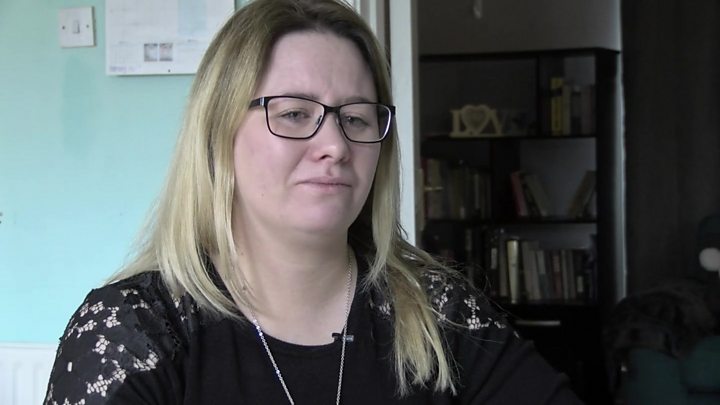
Media captionClaire had to carry her pregnancy to full term and describes her experiences

The Irish government has agreed to hold a referendum at the end of May on whether to reform the country’s near-total ban on abortion.

The vote will decide whether to repeal a constitutional amendment that effectively bans terminations.

Currently abortion is only allowed when a woman’s life is at risk, but not in cases of rape, incest or fatal foetal abnormality.

Prime Minister Leo Varadkar has said that he will campaign for reform.

The ballot will not be on specific terms of any new law, but on whether to retain or repeal article 40.3.3 of the constitution, known as the Eighth Amendment.

The amendment, which was approved by a 1983 referendum, “acknowledges the right to life of the unborn” – meaning the life of the woman and her unborn child are seen as equal.

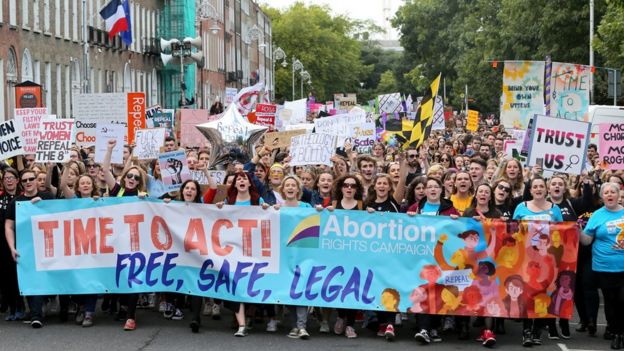
Hundreds of pro-choice protesters in Dublin on 30 SeptemberImage copyrightAFP/GETTY
Image captionTens of thousands rallied in Dublin in September for constitutional change

Before the vote, the country’s health minister will draft legislation proposing unrestricted abortion access be made available to women who are up to 12 weeks pregnant, and in exceptional circumstances after.

An exact date for the referendum will be decided after it is debated in the Irish parliament.

‘Not black and white’

Campaigners have long called for the laws to be changed, and last year a special cross-party parliamentary committee and citizens assembly both recommended repealing the amendment.

“I know this will be a difficult decision for the Irish people to make,” Mr Varadkar said.

“I know it is a very personal and private issue and for most of us it is not a black-and-white issue, it is one that is grey – the balance between the rights of a pregnant woman and the foetus or unborn.”

Mr Varadkar, the country’s former health minister who trained as a doctor, acknowledged that thousands of women in the country travelled every year for terminations or took illegal pills ordered online at home.

He said the current law meant that abortions in Ireland were “unsafe, unregulated and illegal”.

“These journeys do not have to happen, and that can change, and that’s now in our hands,” he said.

Presentational grey line

Analysis

By BBC Dublin correspondent Shane Harrison

The Irish government’s preference is to hold the referendum in late May, during university term time, as it is expected that the majority of students will support the government.

If there is a delay, polling is then most likely to happen at the start of June, when many Irish students leave the island for the summer.

Presentational grey line

Irish Health Minister Simon Harris has been working with officials in his department and the attorney general on the wording of the referendum, which is expected to be formally published at the beginning of March.

“It is very important to stress any legislation to amend constitution would remain subject to review,” said Mr Harris.

‘Issue not going away’

“The government does not intend to, or wish to, limit the power of our courts to interpret law. Anyone who wants any change to our regime, it is necessary to repeal the Eighth.

“This issue is not going away. It is time for the people of Ireland to have their say on that.”

In 2016, 3,265 women and girls gave Republic of Ireland addresses when accessing abortion services at clinics in England and Wales, according to UK Department of Health statistics.

The National Women’s Council of Ireland (NWCI) welcomed Monday’s announcement.

“Every pregnancy is different, every decision is deeply personal. Women and girls in Ireland deserve their dignity. They deserve the right to privacy, family and home,” said the group’s director Orla O’Connor.

BBC abortion map
Presentational grey line

Abortion in the Republic of Ireland

The Republic of Ireland currently has a near total ban on abortion.

Terminations are not permitted in cases of rape or incest, or when there is a foetal abnormality and thousands of women travel abroad for a termination every year.

The eighth amendment to the Republic’s constitution, introduced in 1983, “acknowledges the right to life of the unborn”.

However, there have been significant challenges and changes to the law in recent years.

A campaign to liberalise abortion gathered momentum in 2012, after Indian woman Savita Halappanavar died in a Galway hospital after she was refused an abortion during a miscarriage.

Savita HalappanavarImage copyrightTHE IRISH TIMES
Image captionSavita Halappanavar died after a miscarriage in University Hospital in Galway in October 2012

The following year, legislation was passed to legalise abortion when doctors deem that a woman’s life is at risk due to medical complications, or at risk of taking her life.

Twenty years before Mrs Halappanavar’s death, a 14-year-old rape victim was initially prevented from travelling to England to terminate her pregnancy.

It became known as the X Case, as the girl could not be named to protect her right to anonymity.

The 1992 ban on travel was later overturned by the Irish Supreme Court.

A referendum approved a further update to the constitution, stating that the eighth amendment did not restrict the freedom to travel to another state.

Source: http://www.bbc.com/news/world-europe-42868035?ocid=socialflow_facebook&ns_mchannel=social&ns_campaign=bbcnews&ns_source=facebook

Protesters on both sides of the abortion issue gathered outside the Supreme Court in Washington during the March for Life. CreditSusan Walsh/Associated Press

People who care about basic American freedoms should be grateful to the Senate majority leader, Mitch McConnell, for one thing: He has given liberals another good reason to flock to the polls in November.

Mr. McConnell is set to hold a procedural vote this week on a bill that would ban abortion at 20 weeks of pregnancy. The so-called Pain-Capable Unborn Child Protection Act, sponsored by Senator Lindsey Graham, a South Carolina Republican, is part of a long-term legislative effort by the anti-abortion movement to gut Roe v. Wade and severely curtail abortion access nationwide.

Twenty-week abortion bans, enacted in more than a dozen states and struck down in two, violate the Supreme Court’s standard that abortion can be restricted only when a fetus is viable outside the womb. Many, including the one being considered by the Senate, are based on claims not supported by most scientists about when a fetus feels pain.

Only about 1 percent of women seeking abortions do so after 21 weeks, and they often make that decision because a fetal abnormality has been found or because their own health is in danger. Twenty-week bans particularly curb access for poor women, who often struggle to find the money and time for the procedure.

The Senate bill contains exceptions for rape and incest if the women reported the abuse to law enforcement and sought counseling 48 hours before the abortion. But there is no exception to protect the health of the pregnant woman.

Abortion providers, who already face harassment and threats to their lives and work, would face criminal penalties, with a sentence of up to five years, for performing abortions after 20 weeks. The locations of all such procedures would need to be reported to the federal government.

Though President Trump urged Congress to “pass this important law and send it to my desk for signing” in his address to the anti-abortion March for Life this month, Republicans are almost certain to fall short of the 60 votes needed to formally take up the bill.

Still, abortion rights advocates and medical professionals are taking the legislation seriously, since abortion foes are working hard for it. The prospects for such a ban considerably diminish if the Democrats take back either house of Congress after the 2018 midterm elections. And if they control the Senate, Mr. Trump will have virtually no chance of picking another anti-abortion Supreme Court justice.

Since announcing his candidacy, Mr. Trump, at one time a supporter of abortion rights, has embraced anti-abortion politics with zeal. But that seems to be a matter of maintaining evangelical support. His concern for fetal life cannot be fairly measured, but his sensitivity to the needs of women, or lack of it, is well known.

Some sponsors of the version of this bill that the House passed in October seem to share Mr. Trump’s attitude. One, Trent Franks, Republican of Arizona, resigned his seat in December after it was reported that a female staff member had felt pressured to have sex with him as part of a surrogacy scheme. Another, Tim Murphy, a Pennsylvania Republican, voted for the bill just hours after news broke that he was accused of pressuring his mistress to — get this — have an abortion. He later quit.

Ultimately, the fate of the ban and other anti-abortion measures will be in the hands of voters. For supporters of abortion rights, the choice should be clear.

Source: https://www.nytimes.com/2018/01/28/opinion/editorials/threat-abortion-rights.html?mtrref=undefined&assetType=opinion

GETTY IMAGES

This week, Senate Republicans are scheduled to advance a nationwide ban on abortion care after 20 weeks, with no exceptions to protect a woman’s health or in cases of fetal abnormalities. This bill is just the latest measure in a coordinated effort to ban abortion and erode access to reproductive health care, piece by piece. Among other penalties, this bill also threatens doctors with five years’ prison time for violating the ban. 

In the early years of our marriage, my husband and I eagerly planned our family. I relished my pregnancy and, when the time came, wondered at my daughter and the deep power I had in her creation.

We tried again to grow our family, but experienced only miscarriage. Three in a row. By the time another baby finally took, the expansiveness and easy hope of my first pregnancy was stifled by bad luck.

The first trimester came and went, then the second. Still, I felt anxious. At 7 months, I tried to think positively. I picked up my knitting needles and began a tiny sweater for this next baby girl. I was working the final rows of that sweater at an ultrasound, which my midwife hoped would ease my relentless worry. When she saw me knitting, the doctor’s eyes welled with tears.

She showed me black marks on my daughter’s ultrasounds: large, fluid-filled holes in my baby’s brain. She named it: Dandy Walker Malformation, and referred me to a neurologist to learn more. She listed my options: adoption, abortion, or parenting this child with heavy medical intervention for her short life. If I chose to deliver my baby, it would be a high-risk birth for both of us, complicated by my baby’s condition.

Why was she offering me these choices? Didn’t she know how deeply I loved my baby? I tried to respond, but could only manage a question, “There are abortions for women like me?” I was 35 weeks pregnant. I wondered if there had been a mistake.

“We don’t know.” She said. “We used to send women to Kansas. But we can’t anymore.”

WHEN I CALLED MY HUSBAND FROM THE HUMMING DARKNESS OF THE ULTRASOUND ROOM, THE ONLY SOUND I COULD MUSTER WAS A DEEP, LONG WAIL.

I understood. The doctor who performed abortions for women 35 weeks pregnant had been shot by a man who followed him to his church. Somewhere in my brain, the memory of that news story revealed itself along with the stark understanding that I was entering a world in which people might want to shoot me, too, depending on my choice.

I shut it all out. When I called my husband from the humming darkness of the ultrasound room, the only sound I could muster was a deep, long wail.

The neurologist delivered more bad news: additional brain anomalies. My little daughter would likely never walk, talk, swallow, or support the weight of her head. She would require brain surgery to extend her life, but no surgery could ever cure her.

“What can she do?” I asked. “Does a child like mine just sleep all day?”

He winced at the question. “Children like yours are not generally comfortable enough to sleep.”

My wall of hope and denial crashed down around me. I could not subject my child to that kind of suffering. I wished for a miracle, but I would not risk my daughter’s wellbeing. My heart sang clearly: I would give my daughter peace. Abortion was the choice to meet our family’s values and our daughter’s needs—it was the option we could live with.

My pregnancy was so advanced, there was only one clinic in the entire country that would take us. It was a Friday afternoon when we found them, 2000 miles away. The clinic instructed us to fly Monday, get a hotel for the week, and come to the clinic first-thing Tuesday with $25,000 for a four-day outpatient procedure. We did not have that kind of money, but I agreed without hesitation, determined to figure something out. With the help of family, we did.

Our time in Colorado was deeply beautiful and crushingly sad. My care was kind, legal, compassionate, and, most importantly, safe. On the first day of the procedure, my doctor carefully, gently, lay my baby to rest in my womb. Her motion slowed and then stopped. Through my tears, I thought about that injection, one shot. It pales in comparison to the interventions she would have endured to live even one day on this Earth.

It has been five years since I lost my daughter Laurel, since I gave her the gift of peace. I carry these memories with me every day, the memories of her body, heavy on my lap. The memory of her living, moving, wriggling in my womb. The memory of my desperation, when I found myself cast out of care at home in Massachusetts. The understanding that I would have done anything, no matter how dangerous, to save my baby from a lifetime of suffering.

GOVERNMENT INTERFERENCE, LIKE ABORTION BANS, MAKES HARD SITUATIONS WORSE, FORCING FAMILIES TO GREATER EXTREMES.

Before I found myself in this dire position, I never understood the need for third trimester abortion. In my naivety, I did not realize that extreme actions are inspired by extreme circumstances. Good people in hard times must do hard things. Government interference, like abortion bans, makes hard situations worse, forcing families to greater extremes. Care becomes dangerous, and tragedy is compounded. Women and families in these devastatingly complex situations need trust and support, and that’s why organizations like NARAL fight for families like mine

Mine was a hard, painful choice. I carry it, but I have never once regretted it because I followed my heart and my values and did the best I could for my daughter. It is a terrible thing to have to choose between peace and life—but it is important that families, not committees, not politicians, not governments, make the best informed decisions for our children. We do so with deep and abiding love that cannot be duplicated in Congress.

Source: http://www.elle.com/culture/a15911671/late-abortion-senate-vote-2018/

The contemporary anti-abortion movement has never really cared about lives outside the womb. Now they’re praising Trump as a “pro-life” icon while his administration neglects undocumented immigrants, sick kids, and poor families.

Photo by Gage Skidmore via Flickr

Last week, President Trump became the first-ever sitting president to speak at the March for Life, an annual protest against abortion rights timed with the anniversary of Roe v. Wade. Addressing the tens of thousands of marchers who had gathered at the Capitol via satellite, Trump spoke about the sanctity of life and the power of love. “Every child is a precious gift from God,” he announced, to applause. “We know that life is the greatest miracle of all.”

Introducing Trump before his speech, Vice President Pence praised him as “the most pro-life president in American history.” This was mere days after Trump provoked an international outcry by reportedly wondering why the US government would allow the formerly unborn children of Haiti, El Salvador, and nations of Africa wanted to leave their “shithole” (or, possibly, “shithouse”) countries and move here. It was also in the midst of a congressional stalemate over DACA that left the fates of hundreds of thousands of immigrants who had arrived in the US as children hanging in the balance. On the afternoon of the March for Life, Senate Majority Leader Mitch McConnell tweeted a particularly grotesque infographic, one that needlessly pitted these vulnerable undocumented immigrants against sick children who rely on the Children’s Health Insurance Program (CHIP). “Democrats have a choice to make,” it read. “CHIP or DACA.”

In September of last year, the Pope himself criticized Trump for his stance on immigration. “If he is a good pro-life [man], then he will understand that the family is the cradle of life and that it must be defended as a unit,” he said. In December, uncowed, the White House tweeted a statement calling for the end of “chain migration,” ostensibly on the basis of stopping terrorism. Critics were quick to point out that “chain migration” is just a slightly sociopathic way of saying “family-based immigration.”

As Congress furiously debated the futures of thousands of people who call America home, the March for Life stayed largely silent on their failure to reauthorize DACA. (According to an op-ed published on Catholic News Agency, at one point during the march, “a whole group of pro-life marchers started chanting, in unison, ‘Build that wall! Build that wall!’”) Nor did anyone at the March demand aid for the thousands of families without power in Puerto Rico, or protest when Trump’s budget decimatedprograms for disabled people and poor families. Instead of pushing Paul Ryan to vote on the future of healthcare for 9 million children, they invited him to proudly tout the anti-abortion votes Congress took under his reign.

So, yes, Trump might be “the most pro-life president in American history,” but only if your definition of life ends at the moment of childbirth. In his first year in office, he’s provided the anti-abortion movement with win after win—reinstating and expanding the Global Gag Rule, which denies US aid to any organization that so much as discusses abortion; appointed extremely anti-choice justices to the Supreme Court and federal courts across the country; and filled the Department of Health and Human Services with anti-abortion and anti-contraception extremists.

Trump might be “the most pro-life president in American history,” but only if your definition of life ends at the moment of childbirth.

At the same time, of course, his administration has been hellbent on destroying the Affordable Care Act, with a plan that would eliminate maternity and newborn care as essential health benefits, and could increase the cost of pregnancy by 425 percent; nominated a woman who doesn’t think insurance companies should be required to provide maternity coverage to head the Centers for Medicare and Medicaid Services; and directly attacked the rights of transgender kids and sexual assault survivors in schools.

It’s fitting that Trump would be lauded in such grandiose terms at the March for Life. He perfectly epitomizes everything the contemporary anti-abortion movement stands for: While they obsessively protect life at conception, they’ve never actually stood to protect lives. Nowhere is the anti-abortion movement’s indifference to lives outside of the womb more apparent than in their appropriation of Black Lives Matter rhetoric. Signs bearing the slogan “Unborn lives matter”—and, more pointedly, “Unborn Black lives matter”—have become a fixture at anti-abortion marches. A popular talking point among this strain of anti-abortion activist is that abortion is akin to Black genocide, because Black women have abortions at higher rates than white women. In actuality, this is due to racialized health disparities—another thing the anti-abortion movement is conspicuously silent on. And, of course, the “pro-life” movement has never spoken out about the state-sanctioned murders of children like Tamir Rice and Aiyana Stanley-Jones.

The vast majority of anti-abortion activists are sitting idly through a maternal mortality crisis of epic proportions: The US now has the highest rate of maternal mortality in the industrialized world, with Black women dying at four times the rate of white women. It’s now been over four years since the Flint water crisis made headlines, yet no anti-abortion leaders have called to replace the pipes so babies have clean water to nourish their growing bodies. This is despite an ongoing miscarriage crisis among Black women in Flint, which is thought to be caused by the toxic water.

The “pro-life” movement cannot claim the moral high ground on protecting life until they prove they’re interested in protecting the lives of all people, not just the unborn—and, really, only the unborn threatened by abortion. There are currently millions of people living in America who desperately need advocates to fight for them: those deeply in need of healthcare, those who want to keep their families together inside our nation’s borders, and children who want to attend school and play in parks without fearing for their lives. Until the “pro-life” movement can show it’s willing to fight for these individuals, too, they’ll only be marching for hypocrisy.

Source: https://broadly.vice.com/en_us/article/mbpyv4/the-laughable-hypocrisy-of-the-pro-life-movement-under-trump

Compromising on the right to choose will have disastrous consequences. Democrats need to acknowledge that fact.

Democrats need to change the way they address abortion. This idea has been persistently circulating since Trump’s inauguration, as the Democratic Party attempts to conceive of a way to recover from its humiliating defeat. In a slew of high-profile op-eds, anti-abortion Democrats have called for the party to soften its stance on reproductive rights in order to appeal to progressives who support state-sanctioned forced motherhood; party leadership has echoed this sentiment in a series of perplexing statements and interviews.

Most recently, Democratic Congressional Campaign Committee chairman Ben Ray Luján told The Hill that the party will continue to provide funding to candidates who oppose abortion rights. “There is not a litmus test for Democratic candidates,” he said. His comments immediately attracted the ire of several reproductive rights advocacy groups: NARAL Pro-Choice America president Ilyse Hogue lambasted them as indicative of “an ethically and politically bankrupt strategy,” and Planned Parenthood president Cecile Richards tweeted that reproductive rights are “non-negotiable,” adding that her organization will “hold any politician who says otherwise accountable.”

In an emailed statement, DNC spokesperson Xochitl Hinojosa tepidly emphasized to Broadly that the Democratic Party platform is pro-choice. “Tom Perez has stated previously that he is pro-choice,” she added. “That has not changed.” But even if the platform remains the same, top Democrats have hardly been vociferous in their defense of reproductive rights. In May, most notably, House Minority Leader Nancy Pelosi told the Washington Post that abortion is “kind of fading as an issue” for Democratic voters.

Unfortunately, abortion is not fading as an issue for conservative legislators. While the Democrats have been wringing their hands and assuring media that they don’t believe in ideological purity tests, the political arm of the anti-abortion movement has continued forging ahead with startling efficacy. In the past seven years, nearly 350restrictions on abortion access have been enacted. In the past few months, we’ve seen states passing particularly cruel and byzantine legislation: laws mandating that aborted or miscarried fetuses must be buried or cremated, laws that would require women to notify their rapists before getting an abortion, and laws that would essentially ban terminations after 13 weeks.

That the Democrats are willing to submit to the anti-abortion movement isn’t really a new development. “We have so many anti-choice Democrats in state houses… [who] have really been helping to pass a lot of the anti-choice restrictions that we see today,” Renee Bracey Sherman, the senior public affairs manager at the National Network of Abortion Funds, told Broadly over the phone. “We didn’t get to seven states with one abortion clinic with just the Republican Party. There were Democrats that helped.”

Enabling a bipartisan attack on women’s right to healthcare in the name of party unity is only a viable solution if you’re fine with forcing people to bear children against their will.

When pundits and politicians argue that Democrats should “compromise” on abortion or to rethink their approach to the subject, they tend to speak in vague absolutes. Abortion is “polarizing” and “divisive.” It “alienates” red-state voters. Framing it this way—as a fundamentally ideological debate, rather than one with tangible consequences—trivializes the real and pressing danger of restricting abortion access. Laws that limit abortion erode women’s constitutional right to access full healthcare, endanger them, and enshrine into law the idea that their basic bodily autonomy matters less than the belief that an embryo is sacrosanct.

When women cannot safely and legally terminate their pregnancies, some resort to dangerous and illegal alternatives, like the estimated hundreds of thousands of women in Texas who’ve performed DIY procedures, or the women across the country who have risked arrest to self-induce an abortion. Those who are forced to carry to term against their will face dire consequences as well: Research shows that women who are denied abortion care are three times more likely to end up below the federal poverty level after two years, and less likely to be able to leave abusive partners.

Supporting a staunchly anti-abortion candidate isn’t a harmless ideological “compromise”—it’s capitulation to a dangerous, blatantly repressive agenda, one that can have profound effects on women’s ability to access crucial healthcare services. Take, for instance, Louisiana Governor John Bel Edwards, a Democrat who ran on an anti-abortion platform and received the inaugural leadership award from Democrats for Life of America in 2016. “The future of the Democratic Party is a stake,” the organization’s executive director said in a typo-riddled press release at the time. “And, John Bel Edwards shows that Democrats can gain victories in Red States like Louisiana, if the party is willing to reverse course, listen to the voters, and support pro-life candidates.”

If politicians like Edwards are the future of the Democratic Party, it’s an extremely bleak one for women and families. As governor, Edwards signed into law a series of extremely draconian measures, making Louisiana one of just seven states to require women to wait three full days before getting an abortion and attempting to defund Planned Parenthood despite a massive STD epidemic in the state. Under Edwards, the number of clinics in the state dropped to three, down from seven in 2011.

Enabling a bipartisan attack on women’s right to healthcare in the name of party unity is only a viable solution if you’re fine with forcing people to bear children against their will. If this is true of the Democratic Party, they can’t claim, as they currently do, to “unequivocally” believe “that every woman should have access to quality reproductive health care services, including safe and legal abortion—regardless of where she lives, how much money she makes, or how she is insured.” I agree that the Democrats need to change the way they address abortion. Instead of weakly and ineffectively gesturing towards reproductive justice as some kind of nebulous progressive ideal, they need to actually stand up for the women they represent and fight to protect their rights.

Source: https://broadly.vice.com/en_us/article/j58e38/if-you-support-anti-abortion-democrats-you-should-expect-anti-woman-policy?utm_source=broadlyfbus

“This court case was always just a sideshow from extremists with a harmful agenda.”

The Colorado Supreme Court ruled this week that the state’s constitutional ban on the direct or indirect use of taxpayer dollars for abortion doesn’t preclude Colorado from providing funds to Planned Parenthood for its non-abortion health care services, like breast cancer screenings.

In affirming a lower court decision, Colorado Supreme Court Chief Justice Nancy E. Rice rejected the argument that the “word ‘indirectly’ prohibits the State from paying organizations that offer abortion services—or entities closely affiliated with organizations that perform abortions—for any reason.”

Defunding Planned Parenthood “would lead to an absurd result,” wrote Rice, citing a lower court’s example that a state worker could be prohibited from donating money to an organization that performs abortions, simply because the worker was paid with taxpayer money.

“Today’s victory is a win for over 103,000 patients we care for every year, who trust us to provide them quality health care. This court case was always just a sideshow from extremists with a harmful agenda,” Vicki Cowart, President of Planned Parenthood of the Rocky Mountains, said in a statement after the Monday ruling.

Freedom of the press is under direct attack by the Trump Administration. Now more than ever, we need evidence-based reporting on health, rights, and justice.

Former Colorado Department of Public Health And Environment Director Jane Norton brought the lawsuit to claim that Planned Parenthood’s state-funded services, such as those covered by Medicaid, subsidize abortions.

“We disagree,” Rice wrote in response to this position.

Norton, a former Colorado lieutenant governor, was represented by attorneys connected to the Alliance Defending Freedom, a national anti-abortion and anti-LGBTQ law firm that’s defending, at the U.S. Supreme Court, a Colorado baker who discriminated against a same-sex couple by refusing to bake their wedding cake. Norton’s lead lawyer is her husband Michael J. Norton, a former U.S. attorney who’s widely known for representing Christian right groups in court and at the Colorado capitol.

In his argument to the court, Michael Norton wrote that a state audit, conducted by the Colorado health department when Jane Norton led the agency in 1999, showed Planned Parenthood could not separate its abortion care from other health care services, such as cancer screenings and family planning.

“The Accounting Firm determined that Planned Parenthood Services Corporation performed induced abortions, that its purported separation from Planned Parenthood was a legal fiction, and that Planned Parenthood Services Corporation was essentially the alter ego of Planned Parenthood,” according to Norton’s brief.

ADF did not respond to a request for comment, but Norton, who left ADF in 2016 to run the Freedom Institute, while still taking ADF cases, released this statement in 2016 as the Planned Parenthood case wound its way to the Colorado Supreme Court:

“American taxpayer money should go to fund local community health centers, not to subsidize a scandal-ridden, billion-dollar abortion business like Planned Parenthood,” Norton said of the case in a 2016 ADF news release about the case. “This is especially true here in Colorado, where the voters adopted a state constitutional provision that expressly prohibits the direct or indirect funding of abortions.”

The case is spilling into Colorado’s gubernatorial race. State Attorney General Cynthia Coffman, who’s running for governor, once boasted that she worked with Jane Norton, when Norton directed the Colorado health department in 1999 to cut off state funds to Planned Parenthood.

In 2010, when Coffman was running for attorney general, a progressive blog in Colorado published a campaign video of Coffman, who was campaigning for Norton during her U.S. Senate run, touting her role in defunding Planned Parenthood.

“We went through the legal process, since I was Jane’s attorney, and we defunded Planned Parenthood in that case, because they were using public funds to subsidize abortion,” Coffman says in the video, which she has not challenged.

Coffman’s role in advising Norton to defund Planned Parenthood is cited in Norton’s lawsuit against Planned Parenthood to support Norton’s position that public funding of Planned Parenthood violates the state constitution.

Coffman is now waffling about her position on abortion, saying she wants it to be “rare” and “safe,” yet refusing to be called “pro-choice,” a label that could hurt her in the Republican primary.

Coffman’s office did not return an email seeking to know if she disagrees with the court decision and still thinks Planned Parenthood should be barred from receiving state funding, and, if so, how this squares with her position on abortion rights.

Norton last year worked briefly for the Department of Health and Human Services in the Trump administration, but was pushed out, according to Politico, for failing to communicate the department’s work effectively.

Source: https://rewire.news/article/2018/01/26/colorado-supreme-court-rules-planned-parenthood-defunding/

McConnell tees up vote on 20-week abortion ban
© Greg Nash

Senate Majority Leader Mitch McConnell (R-Ky.) is turning the Senate toward a fight over abortion next week.

McConnell moved to bring up a 20-week abortion ban, paving the way for a procedural vote expected on Monday.

“Now Congress has an opportunity to take a step forward. … I’m pleased to have filed cloture on this bill to protect unborn children who are capable of feeling pain. … And I look forward to voting for it early next week,” McConnell said.

The legislation, from GOP Sen. Lindsey Graham (S.C.), would make it illegal for any person to perform or attempt an abortion after 20 weeks of pregnancy, with the possible penalty of five years in prison, fines or both.

Republicans will need 60 votes to overcome a procedural hurdle before they can take up the bill.

With a 51-seat majority, they are expected to fall short. The bill has 45 co-sponsors — all Republicans.

The vote comes after President Trump urged the Senate to take up the abortion ban legislation.

“I call upon the Senate to pass this important law and send it to my desk for signing,” Trump said in his address to the March for Life, an annual march against abortion in Washington, D.C.

McConnell said last year that he would bring the bill up for a vote but didn’t specify when.

The legislation includes exceptions for rape if the woman received medical treatment or counseling at least 48 hours before the abortion or if she reported the rape to law enforcement.

It also includes an exception for pregnancies that result from rape or incest against a minor if it was reported to social services or law enforcement.

The House passed a similar bill largely along party lines last year.

Source: http://thehill.com/blogs/floor-action/senate/370613-mcconnell-tees-up-vote-on-20-week-abortion-bill