Rewire has identified at least half a dozen state lawmakers and officials who are board members or are otherwise connected to anti-choice fake clinics that receive funding today or could qualify to receive state funding.

Texas’ GOP-held legislature has gradually increased funding for a state program directing money to crisis pregnancy centers, also known as anti-choice fake clinics, which try to dissuade people from seeking abortion care.

Rewire has identified at least half a dozen state lawmakers and officials who are board members or are otherwise connected to fake clinics that receive funding today or could qualify to receive state funding, including one Republican lawmaker who authored amendments to bolster state funding to fake clinics.

The Texas Alternatives to Abortion Program (A2A) is administered by the Health and Human Services Commission (HHSC) through the Texas Pregnancy Care Network (TPCN), a nonprofit that distributes funds to subcontractors the network selects and oversees.

The TPCN distributes funding to 50 approved subcontractors that operate 115 locations throughout the state, according to a list of subcontractor providers submitted to HHSC monthly. There are 29 subcontractors operating 52 fake clinics, including three so-called mobile clinics.

Rewire reviewed personal financial disclosure forms, tax returns, and other related documents to identify relationships between lawmakers and organizations. At least one state lawmaker and their spouse serve on the board of directors of a TPCN subcontractor, and at least three other lawmakers and a state official have direct connections with organizations that could qualify to receive state funding as a subcontractor.

Rep. Bill Zedler (R-Arlington) serves on the board of advisers of Metroplex Women’s Clinics, an Arlington nonprofit that offers pregnancy testing, ultrasounds, and counseling services. Zedler’s wife, Ellen, serves on the nonprofit’s board of directors.

Metroplex Women’s Clinics, formerly known as Arlington/Mansfield Pregnancy Center, has been a TPCN subcontractor since January 2016. It operates four facilities and a mobile clinic.

At least three other state lawmakers and one statewide office holder have similar relationships with anti-choice fake clinics that could qualify as TPCN subcontractors.

Rep. Matt Shaheen (R-Plano) serves on the board of directors for Prestonwood Pregnancy Center, which offers pregnancy tests and ultrasounds at the organization’s Richardson clinic. Prestonwood Pregnancy Center is a ministry of Prestonwood Baptist Church, an influential megachurch in Plano that claims a congregation of more than 40,000 members.

Shaheen was among several GOP lawmakers who filed budget amendments to increase funding for A2A. He submitted two amendments that would have each doubled the program’s funding.

State Attorney General Ken Paxton also served on the board of directors of Prestonwood Pregnancy Center. The center refused to answer questions sent by Rewire.

Rep. Phil King (R-Weatherford) serves on the advisory board of Grace House Ministries, which operates the Options Clinic, a Weatherford facility offering pregnancy testing, ultrasounds, and counseling services. Rep. Travis Clardy (R-Nacogdoches) is a sponsor of the Heartbeat Pregnancy Center, a Nacogdoches nonprofit organization that offers pregnancy testing, ultrasounds, and adoption agency referrals.

Critics have charged that fake clinics in the state use deceptive tactics and disseminate misinformation, and a Rewire investigation found that state-funded fake clinics provide limited services to clients and measure success only by the number of clients served. Public health programs are typically evaluated on measures of health care outcomes of clients or cost savings incurred by the state.

Alexa Garcia-Ditta, communications and policy initiatives director for NARAL Pro-Choice Texas, told Rewire that Texas is funding “deception, coercion, and lies” by funneling taxpayer money to fake clinics across the state.

“The tactics that crisis pregnancy centers use to lure pregnant people into their facilities, they use scare tactics, peddle fake medicine, and bad science,” Garcia-Ditta said. “In funding crisis pregnancy centers, Texas is supporting that.”

State lawmakers this year passed a budget that more than doubled the A2A program’s funding, and TPCN will distribute more than $38 million during the 2018-19 fiscal year.

In response to the budget increase, HHSC has “identified additional need and several key opportunities to expand services, increase the effectiveness of the A2A program, and improve the lives of A2A clients and their children,” according to an agency report. The HHSC plans to use the increased funding to extend services for new parents until the child’s third birthday, connect pregnant people to programs such as Medicaid, and expand job training and placement programs.

Joe Pojman, executive director of the Texas Alliance for Life, told the Texas Tribune that the program will save the state money because the new mothers will not need to rely on government assistance.

“If they’re self sufficient through the process of childbirth and afterward, that saves the state money and makes for much happier women and children and families,” Pojman said.

When TPCN was awarded the contract to administer the A2A program, the organization was required to file a 1295 disclosure form that identified interested parties—individuals who have financial interests. However, organizations are only required to file 1295 disclosure forms for contracts valued at at least $1 million, and subcontractors are not required to publicly disclose interested parties.

John McNamara, executive director of TPCN, told Rewire that the amount of funding each organization receives “vary by subcontractor and the time period in question,” and the TPCN submits monthly and quarterly reports to HHSC that include the funding that each subcontractor receives.

State lawmakers do make inquiries to TPCN, according to McNamara, about how potential nonprofit subcontractors in their districts can become subcontractors and how current subcontractors can expand the services they offer.

“In such situations, TPCN informs lawmakers about the requirements of the program to become a subcontractor and/or the requirements for an existing subcontractor to expand the program services they offer,” McNamara said.

Texas state ethics laws only prohibit apparent conflict of interests in very narrow circumstances,

McNamara noted according to the IRS sample conflict of interest policy, if a lawmaker or their spouse serves on a board of directors of a 501(c)(3) and has a financial interest, it “is not necessarily a conflict of interest,” unless the governing board or committee could determine it qualifies as a conflict of interest.

“TPCN is not aware of any Texas lawmaker or his/her spouse that serves on the board of directors of a subcontractor and has a conflict of interest,” McNamara said.

Rep. Donna Howard (D-Austin) told Rewire that several state lawmakers have served on the boards of a variety of nonprofit organizations that have received state funding, but that it is important for the Texas Ethics Commission to clarify what may constitute a conflict of interest.

“I don’t have any problem with any individual legislator advocating for causes and groups and issues that they care about and that they think will make a difference,” Howard said. “But I do believe that we have to be cautious about crossing the line of actually being on the board of an organization that is soliciting funds and will be considered in some kind of a procurement process to make sure we are not unduly influencing the awarding of those funds.”

Source: https://rewire.news/article/2017/12/07/conflict-interest-texas-gop-lawmakers-serve-boards-taxpayer-funded-fake-clinics/

An anti-choice fake clinic made edits to its website after a Rewire article prompted a consumer watchdog to file a complaint with Massachusetts Attorney General Maura Healey.

A crisis pregnancy center in Massachusetts has scrubbed misleading claims from its website after a Rewire report prompted a legal complaint accusing the anti-choice center of masquerading as an abortion clinic.

The website for Attleboro Women’s Health Center still offers appointments to “discuss the abortion methods that may be available to you,” along with detailed information about the costs and steps involved in abortion procedures. All of this still appears designed to obscure the fact that Attleboro Women’s Health Center is a fake clinic, whose purpose is to deter patients from seeking abortion care.

After Rewire exposed the fake clinic’s deceptive website, prompting a consumer watchdog to file a complaint with Massachusetts Attorney General Maura Healey, the center made some edits.

It cut from its homepage a passage that appeared to be a near-verbatim copy of the stated mission of Four Women Health Services, an abortion clinic about half a mile away. It also deleted the phrase: “If you’re pregnant and wondering how can I get an abortion [sic], visit Attleboro Women’s Health Center,” replacing it with an invitation to visit the center, “If you think you’re pregnant.” It deleted a claim that the center “provides quality, safe, accessible reproductive healthcare.”

The fake clinic added sources for some information, although the credibility of these sources varied. The website cites NARAL Pro-Choice Massachusetts for abortion pricing, for example, but attributes unproven claims about the purported psychological risks of abortion to the American Pregnancy Association, which presents itself as an unbiased medical resource but acts as a funnel to anti-choice fake clinics, as Rewire has revealed.

Katie O’Connor, legal counsel with the Campaign for Accountability, noticed the edits last week after she filed the complaint against the center last month.

“I do think they changed sort of the most egregious things that they had put on their website, but I still think it’s totally inadequate,” O’Connor told Rewire in an interview.

O’Connor called for more clarity surrounding the relationship between Attleboro Women’s Health Center and Abundant Hope Pregnancy Resource Center, a self-described “Christian pro-life ministry” and affiliate of Heartbeat International, which describes itself as the world’s largest network of crisis pregnancy centers. Attleboro Women’s Health Center shares an address with Abundant Hope, and the health center’s website is registered to Darlene Howard, Abundant Hope’s executive director. In an interview with Rewire Monday, Howard said the entities are “two separate divisions” that “are under the same organization.”

Howard told Rewire that the fake clinic added the citation information to its site “because it was missing” and to avoid complaints.

Pressed by Rewire on why the fake clinic had deleted the phrase inviting patients to visit if they are “pregnant and wondering how can I get an abortion,” Howard asked if she would be able to review the Rewire article prior to publication and, when this reporter declined, said she did not want her statements included in the story. Howard said she believes all the information on the website is accurate. She declined further comment and hung up on Rewire.

The legal complaint accuses Attleboro Women’s Health Center of deceptive business practices and misleading advertising, among other violations of state law.  Attorney General Healey’s office is reviewing the complaint and has not yet taken any action.

Source: https://rewire.news/article/2017/12/05/massachusetts-fake-clinic-deletes-deceptive-claims-website-legal-complaint/

Janet Porter, who runs an anti-LGBTQ hate group, also repeatedly invoked host Poppy Harlow’s pregnancy to promote the Alabama candidate accused of sexual misconduct with a minor.

Extreme anti-choice activist Janet Porter appeared on CNN’s New Day today to defend Republican Roy Moore amid allegations of sexual misconduct and to promote falsehoods about his opponent’s abortion position in the looming Alabama special election. During a 17-minute interview, CNN did not disclose Porter’s anti-choice stance, and she leveled a series of baseless and inflammatory claims, among them attacking the integrity of Moore’s accusers.

The segment kicked off with Porter appearing as a spokesperson for Moore, congratulating host Poppy Harlow on her pregnancy and using it to make false claims about Democrat Doug Jones and his position on abortion rights.

“Congratulations on your unborn child,” Porter told Harlow. “That’s the reason why I came down, as a volunteer, to speak for Judge Roy Moore, because he will stand for the rights of babies like yours in the womb where his opponent will support killing them up until the moment of birth.”

Porter again invoked Harlow’s pregnancy later in the appearance to push anti-choice falsehoods and defend Moore against allegations from multiple women that he had engaged in inappropriate sexual behavior.

“Here is the question that should be asked,” Porter said. “If you care about child abuse, you should be talking about the fact that Judge Roy Moore stands for protection, not only of our Second Amendment rights so we can protect ourselves against predators, for the rights of babies like your 8-month baby that you are carrying now. Doug Jones says you can take the life of that baby.”

After Harlow told Porter to stop talking about her pregnancy, Porter went on to claim allegations against Moore were false and that, “If we’re talking about what’s at stake here, we’re talking about fake allegations, concocted stories, about an innocent man versus real threat of child abuse, not only in the womb, but also in the locker room,” seemingly referencing anti-discrimination measures for transgender individuals.

But Jones, Moore’s opponent in the Alabama Senate race, has voiced support for current restrictions on later abortions except in cases of life endangerment. Though Jones told MSNBC’s Chuck Todd in September that he does not support a 20-week abortion ban, he later clarified in an interview with AL.com that though he supports “a woman’s freedom to choose to what happens to her own body,” when it comes to later abortions “the law for decades has been that late-term procedures are generally restricted except in the case of medical necessity. That’s what I support.”

Nevertheless, anti-choice activists like Porter and conservative media figures have latched onto Jones’ comments to falsely claim that Jones supports abortions up until “the moment of birth.” It’s a falsehood based on a procedure that doesn’t even exist. Media watchdog Media Matters for America pointed out in a recent fact check that the claim often comes up in discussions of “partial-birth” abortions, a term invented by anti-choice groups to mislead and inflame rhetoric in the abortion debate.

As Rewire Editor-in-Chief Jodi Jacobson explained when then-presidential nominee Donald Trump similarly misconstrued later abortions during a 2016 presidential debate, the suggestion “that third-trimester abortions are performed ‘on demand’ is an anti-choice myth meant to target women as being irresponsible and garner support for efforts to ban all abortions in the United States.”

“In real life and because of myriad restrictions and barriers to access, it is exceedingly difficult if not sometimes impossible to terminate a pregnancy in the last trimester, even when a wanted pregnancy goes horribly wrong or a woman’s life is in imminent danger,” wrote Jacobson.

Robin Marty further explained for Cosmopolitan that “there is no specific medical definition for a ‘late-term abortion,’ and because of that, abortion opponents are using it to mean anything they want.” Rutgers University professor and historian Johanna Schoen said that, as Marty puts it, the term is generally used to “group together any procedure after the first trimester and erase any distinction in developmental along the gestational period of the pregnancy.”

Though it was not disclosed in the segment, Porter has a long history of anti-choice activism. She heads the anti-choice group Faith2Action, the Southern Poverty Law Center-designated anti-LGBTQ hate groupbehind “heartbeat” legislation at the state and federal level that promises to outlaw legal abortion, and led a mid-November press conference bringing together a who’s who of anti-choice extremists to support Moore. As Rewire reported:

Porter orchestrated an Ohio GOP attempt to end legal abortion as early as six weeks into a pregnancy—before many people know they’re pregnant. The “moderate” Ohio Gov. John Kasich (R) vetoed the total abortion ban in favor of an equally unconstitutional 20-week ban, but Republican legislators have resurrected it as a pending bill in the current legislative session.

Porter subsequently convinced Rep. Steve King (R-IA), an unabashed white nationalist, to debut the federal version in Congress while both attended the funeral of Phyllis Schlafly, as People for the American Way’s Right Wing Watch first reported.

Porter’s leadership of the Moore press conference aligns with her increasingly prominent role on the national stage. Porter ran two Capitol Hill press conferences for King, the most recent after King’s contentious hearing on the total abortion ban. And she partnered with Tom DeLay, the former U.S. House of Representatives majority leader convicted on campaign finance violations that were later overturned on appeal, to lobby Vice President Mike Pence and his staff.

Porter’s and other anti-choice extremists’ support for Moore never wavered in the wake of the sexual misconduct allegations. Some, like Operation Rescue President Troy Newman, have refused to denounce Moore despite the allegations against him. Others, such as Janet Orient, the executive director of fringe anti-choice medical organization Association of American Physicians and Surgeons, have tried to play down the alleged sexual misconduct by Moore. Orient dismissed the claims against Moore in a Tuesday press release.

“Back in my day, jealous women might have called him a ‘cradle-robber’ because they felt they deserved him more,” said Orient. She went on to dismiss news that Moore had allegedly sexually abused a 14-year-old girl in 1979 as “heavy petting” with “an underage ‘child,’” though she did note that such behavior would be “icky” if it was true.

Activists with fringe views on abortion rights and LGBTQ rights consistently stuck by Moore as some establishment Republicans distanced themselves from him. The long-term strategy appears to have worked as the party has ultimately courted many of its supporters back to Moore’s camp.

Senate Majority Leader Mitch McConnell (R-KY), a frequent target of Moore’s ire, in mid-November told reporters that he believed the women who had accused Moore and said the candidate should exit the race. Fresh off his Senate GOP tax bill victory over the weekend, however, McConnell changed his tune.

“We’re going to let the people of Alabama decide,” McConnell said on the Sunday morning talk show circuit.

President Trump on Monday formally endorsed Moore, encouraging the candidate to “Go get ’em, Roy!” in a phone call from Air Force One. He indicated that he would endorse Moore in an early morning tweet that said: “Democrats [sic] refusal to give even one vote for massive Tax Cuts is why we need Republican Roy Moore to win in Alabama. We need his vote on stopping crime, illegal immigration, Border Wall, Military, Pro Life, V.A., Judges 2nd Amendment and more. No to Jones, a Pelosi/Schumer Puppet!”

The Republican National Committee, the party’s campaign arm, as of Monday restored get-out-the-vote funds to Moore, according to a New York Times report. The National Republican Senatorial Committee, the Senate GOP’s campaign arm, doesn’t plan to do so, the newspaper reported.

Source: https://rewire.news/article/2017/12/05/anti-choice-extremist-false-claims-cnn-moore/

Would the Democrats’ Alabama Senate candidate do better if he were anti-abortion? Maybe not.

Aside from the sexual misconduct allegations against Republican candidate Roy Moore, one of the top issues in the Alabama Senate race has been abortion.

Republicans have tried to portray Democratic candidate Doug Jones as extreme on the issue, with a super PAC running an ad claiming that he “supports abortion in even the most extreme circumstances.” At a rally last month, Moore’s wife told the crowd that Jones supported “full-term abortion.”

And there’s been significant speculation that if Jones were anti-abortion, maybe ― just maybe ― some Republicans who find Moore distasteful would vote Democratic.

But a new poll questions that assumption.

On Nov. 4-5, Clarity Campaign Labs, a Democratic polling firm, surveyed 707 Alabama voters in a survey commissioned by Planned Parenthood Votes. (Planned Parenthood has no involvement in the Alabama special election and has not endorsed a candidate.) The results were shared with HuffPost.

Clarity Campaign Labs was specifically interested in Republican voters who might be persuaded to back Jones. The survey found that less than 1.5 percent of Moore’s supporters said they had considered switching and backing Jones.

The pollster then tried to figure out why those voters decided to stick with Moore. Was it because of Jones’ support for abortion rights?

But Clarity didn’t want to limit people with a list of possible answers. So they were asked to explain, in their own words, why they continued to reject Jones.

“Abortion wasn’t really in the top couple issues people gave us,” said John Hagner, the Clarity pollster who conducted the survey.

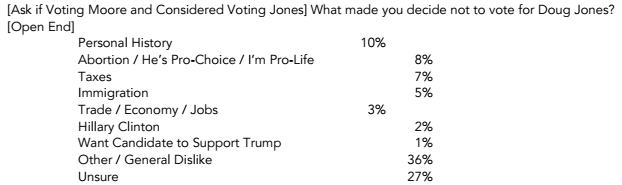
More than one-third of those Republican voters who said they decided not to switch to Jones gave a reason that fell into the category of just generally not liking him. Ten percent said they didn’t like his personal history. (Jones is a former U.S. attorney best known for finally putting Ku Klux Klan members behind bars for blowing up an African-American church back in 1963.) Eight percent cited abortion as the reason.

CLARITY CAMPAIGN LABS

“Of the people who were undecided, they weren’t citing choice as the major driver,” Hagner said. “Of the people who had considered voting for Jones and decided not to, there was a whole range of issues.”

Clarity conducted the poll before women came forward and alleged that Moore had pursued them when they were in their teens and he was in his 30s. Presumably, there are more Republicans giving Jones a second look. But Hagner said he didn’t think abortion would now become a more significant factor in the race.

“If there was a pro-life Democrat running in this race, would he or she be doing better? We don’t see any evidence here that that’s the case,” he added. “There are people who won’t vote for any Democrat because of choice, but those are people who wouldn’t vote for any Democrat. They aren’t inclined, they’re not winnable voters.”

The specific controversy over Jones’ abortion position arose from an MSNBC interview the candidate did on Sept. 27. Host Chuck Todd asked Jones what “limitations” he believes there should be when it comes to abortion.

“I am a firm believer that a woman should have the freedom to choose what happens to her own body,” Jones said. “And I’m going to stand up for that and I’m going to make sure that that continues to happen.”

More from the interview:

TODD: But you wouldn’t legislate ― so you wouldn’t be in favor of legislation that said ban abortion after 20 weeks or something like that?

JONES: No, I’m not in favor of anything that is going to infringe on a woman’s right and her freedom to choose. That’s just the position that I’ve had for many years. It is a position that I continue to have.

But when those people ― I want to make sure people understand that once a baby is born, I’m going to be there for that child. And that’s where I become a right-to-lifer.

Jones later clarified his position in a statement to HuffPost, saying, “Roy Moore and his allies will do anything to distort this race and lie about my position. This is a deeply personal decision. I support the current law on a woman’s freedom to choose, which has been in place for decades, where late term abortions are permitted to protect the life or health of the mother.”

Elizabeth BeShears, a communications consultant in Alabama who has argued that abortion is a big factor in the Dec. 12 special election, said she believes that even if people didn’t point to it, the issue is playing a role in their support for Moore.

“The abortion issue is a check-the-box issue for Republicans,” BeShears said. “It’s something that’s important to them, and it’s like, ‘OK, he’s Republican. Check. He’s pro-life. Check.’ Then they don’t give any more thought to it than that necessarily. So it’s a qualifying attribute and not the deciding attribute.”

Hagner said he thinks the Republicans playing up Moore’s anti-abortion stance are essentially trying to portray him as just an average Republican. Alabama is a Republican state where likely voters oppose legal abortion 62 percent to 28 percent, according to Hagner.

“I think it’s an act of desperation,” he said. “Even before the revelations [about his alleged pursuit of teenagers] came out, choice wasn’t what was determining the race. I have a hard time imagining it’s what’s determining it now. I think what they’re really trying to do is just reframe it as get back to a more generic Republican versus Democratic [race].”

The contest between Moore and Jones is incredibly tight. When Moore beat the establishment candidate in the GOP primary, Democrats suddenly realized they might have a chance at winning. Moore, the former chief justice of the Alabama Supreme Court, has a national reputation for his religiously conservative positions, including his outspoken opposition to same-sex marriage.

Jones’ chances are considered even stronger, not surprisingly, since the accusations about Moore’s past behavior began pouring forth. Democrats in Alabama are working to expand their electorate ― primarily by getting more African-Americans to vote ― and to persuade some disgruntled Republicans to switch sides and vote for Jones (or, at the very least, stay home on Election Day).

https://www.huffingtonpost.com/entry/doug-jones-abortion-poll_us_5a25473fe4b03c44072eca22?utm_campaign=hp_fb_pages&utm_source=women_fb&utm_medium=facebook&ncid=fcbklnkushpmg00000046

“[Republicans] know they cannot achieve this goal of the anti-choice movement in the light of day, since it has failed every time it has been in front of the voters.”

Congressional Republicans can’t use their tax cuts for the rich to define and codify the view that life begins at fertilization, according to the rules of the U.S. Senate.

The GOP’s initial tax proposals in the U.S. House of Representatives and the Senate each conferred 529 college savings plan benefits to an “unborn child…at any stage of development” in an unprecedented attempt to wield the tax code against reproductive rights. Republicans on Capitol Hill have long sought deeply unpopular fetal “personhood” bills that try to classify fertilized eggs, zygotes, embryos, and fetuses as “persons,” and to grant them full legal protection under the U.S. Constitution, including the right to life from the moment of conception. Personhood laws, repeatedly rejected by voters across the United States, would criminalize abortion with no exception and ban many forms of contraception, in vitro fertilization, and health care for pregnant people.

The latest fetal personhood effort ultimately violated rules associated with the fast-track process Republicans are using to pass their tax bill. Under “reconciliation,” Republicans need a simple 51-vote majority in the Senate instead of the 60-vote threshold typically required to bypass a filibuster and pass controversial legislation. But reconciliation is subject to the Byrd rule, which puts the kibosh on provisions that are “merely incidental” to the budget.

In other words, Congress can’t wield the reconciliation process for the sake of a political agenda.

Enter the Senate parliamentarian, a nonpartisan, staff-level position tasked with enforcing the chamber’s rules and procedures. The Senate parliamentarian in July ruled against key anti-choice provisionsdefunding Planned Parenthood and restricting abortion access—in the GOP’s repeated failed attempts to repeal the Affordable Care Act.

Early Friday evening, in the home stretch to the 1:36 a.m. Saturday vote on the tax plan, the Wall Street Journal’s Richard Rubin flagged that the fetal personhood provision violated the Byrd rule.

Sen. Ron Wyden (OR), the top Democrat on the tax-writing Senate Finance Committee, and his staff challenged the personhood provision with the parliamentarian, said a Democratic aide in the chamber. The parliamentarian then “Byrded,” or ruled, the provision out of order, and Senate Republicans removed it to avoid a floor challenge, the aide told Rewire.

Wyden in an email said he “successfully struck several provisions that should never have been wedged into a tax bill, including the misguided Republican attempt to radically change the definition of personhood under the guise of helping parents save for their kids’ college education.”

“Burying personhood language in this tax bill that is primarily a handout for the wealthy is another attempt to carry out the Republicans’ perennial, extremist agenda to limit women’s reproductive autonomy,” he said.

A motion to waive the Byrd rule for the provision would return the threshold for passage to 60 votes, according to the nonpartisan Congressional Research Service. Most Senate Democrats would block the move, although anti-choice groups are using Democrats’ self-inflicted vulnerability on an abortion “litmus test” to end their legislative firewall on such proposals becoming law.

NARAL Pro-Choice America President Ilyse Hogue welcomed the news but remained wary.

“[Republicans] know they cannot achieve this goal of the anti-choice movement in the light of day, since it has failed every time it has been in front of the voters,” Hogue said in a statement. “So, we have every reason to expect they’ll try to do it again, and when they do NARAL members will be ready to fight this again.”

The House is scheduled to vote Monday evening on a motion to go to conference with the Senate and reconcile differences between the chambers’ tax bills. Among the consequences for people with low incomes and other marginalized people, the House and the Senate tax proposals make 529 college savings plans, the vehicle for the fetal personhood language, even more “deeply regressive” by similarly expanding them to K-12 private schools.

https://rewire.news/article/2017/12/04/senate-rules-strike-extremist-fetal-personhood-language-regressive-tax-overhaul/

Tasos Katopodis/Getty Images News/Getty Images

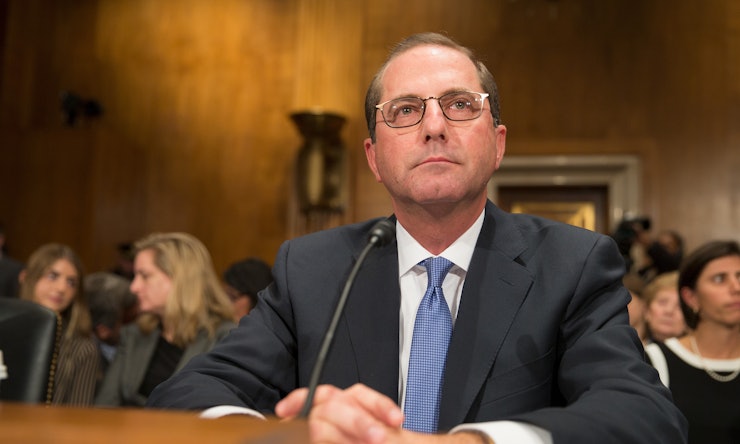
President Trump’s new nominee for health and human services secretary had his Senate confirmation hearing on Wednesday, where lawmakers grilled him about his position on birth control coverage. Trump’s pick, Alex Azar, said the agency should be weighing employers’ consciences against women’s birth control access. This suggests that he is aligned with the Trump administration’s position that companies may stop covering birth control for their employees.

Sen. Patty Murray (D-Wash.) questioned Azar about this crucial women’s health issue. The Trump administration took steps in October to make it easier for employers to limit coverage of birth control in their employees’ health insurance plans. Murray asked if Azar would commit to putting “science and health care access first,” rather than “ideology and extremism.”

“We have to balance a woman’s choice of insurance with the conscience of their employers,” Azar responded. That answer was of great concern to the senator. Murray tells Bustle in a statement that corporations should not be put above women’s health care:

Americans support a woman’s access to birth control regardless of who her employer is. Why doesn’t Alex Azar? https://twitter.com/BridgeProject21/status/935892269294608384 

It was also troubling to abortion rights advocates: NARAL Pro-Choice America President Ilyse Hogue said in a statement that the “Senate should use this opportunity to stand up to Donald Trump’s dangerous, backwards agenda and refuse to confirm Azar.”

Reproductive rights advocates also have noted Azar’s speech to the Islamic Medical Association of North America in 2006, when he thanked them for their “emphasis on protecting the health and well-being of the unborn.” They have taken his contributions to anti-choice politicians as a sign that he would limit birth control access. Before working as the president of major drug company Eli Lilly’s U.S. division, Azar was deputy secretary of health and human services from 2005 to 2007 under George W. Bush.

Alex Azar has donated to anti-choice politicians including Donald Trump, Mike Pence, and Mitch McConnell. Now he’s Trump’s nominee for HHS. http://ampr.gs/2infRvJ  

Why the HHS Secretary Nomination Matters for Women and Families – Center for American Progress

The next U.S. Secretary of Health and Human Services will play a pivotal role in creating a health care system that supports women’s and families’ health care needs.

americanprogress.org

NARAL’s Hogue wrote in the statement:

Azar’s full response to Murray acknowledged that he and the senator have different opinions on how to best carry out HHS programs.

“I’m the secretary for all Americans,” Azar said. “I would faithfully implement [HHS] programs. We may differ in different elements of how those get implemented, but I firmly believe in following evidence and science.”

Murray didn’t let him avoid the issue of birth control access, though, and doubled down on her question. “Do you believe all women should have access to the health care their doctor recommends for them? Yes or no?” she pressed him. That’s when he made his point about balancing employers’ and women’s concerns:

“Not in terms of access, but in terms of insurance,” Azar responded. “To force those very few… I believe it’s less than 200 have come forward, very few employers would be impacted by that conscience exception. To respect, frankly, their rights as well as women’s access through the insurance.”

Murray disagreed, saying, “I think women’s access to health care their doctor requires for them should take precedence.”

https://www.bustle.com/p/trumps-health-secretary-nominee-alex-azar-has-controversial-thoughts-on-birth-control-coverage-6745902

State avoided spending nearly $70 million to care for babies of low-income teens, study says.

The steep drop in teen pregnancies and abortions in Colorado since 2009 is mainly due to one thing: free, low-cost access to IUDs.

Intrauterine devices — tiny, T-shaped pieces of plastic placed in the uterus — are the main reason Colorado’s teen birth rate fell 54 percent and the teen abortion rate declined 64 percent in the last eight years, state health officials said Thursday.

The astounding numbers, capturing the eight-year period since IUDs became an affordable option for low-income health clinics, were released along with a study estimating the state avoided paying nearly $70 millionfor labor and delivery, well-baby check-ups, food stamps and child-care assistance because of fewer births to teen moms.

“This is one of the biggest public-health home runs that I’ve seen in my 35-year public-health career,” said Dr. John Douglas, executive director of the Tri-County Health Department, which has six clinics in Douglas, Arapahoe and Adams counties. “The work that’s happened is really striking.”

Thanks to a grant from billionaire Warren Buffett’s family, Colorado spent $28 million during eight years supplying IUDs to 75 public health clinics throughout the state, several based inside high schools. From 2009 to 2016, the program provided 43,713 contraceptive implants to women, plus trained medical staff on how to insert the devices.

“Because of that, everything changed,” said Jody Camp, who oversees the state health department’s family planning program. “People started hearing about it, saying ‘Wait, I can get one of those (IUDs) that my girlfriends with insurance have?’ It caught on like wildfire in a really important way.”

Before 2009, clinics typically couldn’t afford to spend up to $350 per patient who wanted an IUD, instead offering lower-cost options including the patch, monthly contraception shots or birth-control pills, which cost a clinic as little as $1 per pack. Some clinics, including in Tri-County, had an IUD wait list.

Pills, patches and rings often aren’t reliable birth control for teens and young women, Camp said. IUDs, though, can prevent pregnancy for three, five or even 10 years, depending on the type.

“That can change the trajectory of your life,” she said.

Colorado’s “teen fertility rate,” measured in births per 1,000 by teens aged 15-19, has dropped considerably faster than the national rate, also in decline. From 2009 to 2014, the U.S. rate decreased from 37.9 to 24.2 births. In Colorado, the rate dipped from 37.5 to 19.4.

The program was a “game-changer” for Tri-County’s clinics, said Lauren Mitchell, the department’s family planning nurse coordinator. The health department partnered with a campaign called “Before Play” to advertise, and teens walked in asking for long-term, reversible contraceptives.

“If you’re looking at teens and the way teens lives are, it is a lot more difficult to take a pill every day or to remember to go in during your window to get your shot,” Mitchell said.

Colorado law allows those under 18 to give their own consent regarding birth control and sexual health services.

An analysis by University of Colorado researchers found the state program was responsible for as much as two-thirds of the decline in births to teen mothers from 2009 to 2015. The drop in pregnancies “averted” $66 million to $69.6 million that might have been spent on four state and federal welfare and health care programs for low-income mothers, the researchers found.

The eight-year grant is gone, but Colorado lawmakers increased funding for the family planning program by $2.5 million per year, up to $4.1 million. Also, Colorado health clinics have received more Medicaid funding because of the Affordable Care Act, which expanded eligibility for government insurance for low-income residents. Medicaid reimbursements to the 75 clinics have risen from $500,000 to about $5 million annually.

IUD program leads to big decline in teen pregnancies, abortions in Colorado

The number of protesters were more than enough to drop the clinic’s full Saturday roster to less than half of the typical number of patients it sees—showing exactly what sort of impact a large presence can have outside a clinic, regardless of whether that presence is openly hostile.

For the previous 39 weeks, Love Life Charlotte (LLC)—a local anti-choice group whose mission is “uniting and mobilizing the church to create a culture of love and life that will bring an end to abortion in Charlotte”—has conducted Saturday “prayer walks” at the busiest abortion clinic in North Carolina. On week 40, for its final event, shuttles were arranged to bring as many as 7,000 followers to march a 1.5-mile path looping A Preferred Women’s Health Center.

According to LLC, nearly 4,000 attendees ultimately arrived on Saturday to gather for music and prayer at a site up the street from APWHC, followed by a half hour procession down the street to the clinic and back up again. Charlotte police put the number at closer to 1,500. Regardless, it was more than enough to drop the clinic’s full Saturday roster to less than half of the typical number of patients it sees—showing exactly what sort of impact a large presence can have outside a clinic, regardless of whether that presence is openly hostile.

The hundreds of new protesters joined the usual regular cast of street preachers, “sidewalk counselors,” and other abortion protesters who gather at the driveway on Latrobe Drive six days a week. Over the last year, Calla Hales, the director of APWHC, has seen the number of abortion opponents increase day by day, as Rewire documented in its film Care in Chaos. According to Hales, as of the beginning of November, the clinic had already seen 12,000 protesters this year—with at least two events drawing more than 1,000 protesters each. LLC’s 40 week wrap-up appears to have dwarfed them all.

“This whole year, things have been getting worse,” agreed Angela Anders, a Pro-Choice Charlotte member who organizes escorts for the clinic. “The city is paying less and less attention to us the more noise we make.”

Learning from last year’s LLC event, Hales sought out more assistance in preparation for what was planned to be the largest protest at an abortion clinic since the end of the rescue movement in the early 1990s. Clinic escorts and reproductive rights allies from Kentucky and Alabama drove into town, primarily holding signs to direct patients away from protesters and down the long stretch of circular road that leads to the clinic. Other volunteers dispersed throughout the mile of street, urging cars not to stop to talk to those with anti-abortion leaflets or carrying signs so traffic would flow smoothly while patients were being dropped off for procedures.

“It’s good to have these defenders here,” said Jasmine Sherman of Pro-Choice Charlotte told Rewire. “But we need this many every day, not just on parade days.”

The clinic also reorganized how it would schedule patients in order to minimize their contact with marchers and other abortion opponents. “This morning we are starting appointments earlier in the day than normal, we have twice as many escorts here as normal just to help be a comforting presence, a sign that it’s OK to be here,” said Anders. She told Rewire that patients were warned about the anti-choice presence and asked if they would prefer to come in Friday or Monday instead. “But obviously Saturday is the day you can, if you work,” said Anders.

Clinic staff and volunteers consider LLC’s march to be an aggressive effort to intimidate patients out of terminating their pregnancies. But David Benham, who acted as spokesperson for LLC in a media briefing, claimed otherwise. Benham is the son of Operation Save America’s Flip Benham and founder of Cities4Life, an active sidewalk ministry whose members intercept patients outside APWHC to try to direct them to local “crisis pregnancy centers.”

“Love Life is not here to protest anything. We are here to proclaim that we love Jesus and we love our neighbors as ourselves, and how we show that is providing for their tangible needs,” said Benham, describing the group’s housing and medical assistance for new families, its work in partnership with the state on promoting foster care, and other non-abortion clinic-related advocacy efforts. “We are here as the church to usher in love and life at the clinic in Charlotte. It doesn’t matter who shows [up] against us.  It doesn’t matter what people say against us and the stories that get spun.”

The message from the main stage was one of peace and prayer, but that wasn’t reflected by everyone directly outside the clinic. Approximately 20 minutes before the march began, Flip Benham was arrested for violating a noise ordinance by using a sound system in front of the clinic without a permit. He was released not long afterward, and within 30 minutes of his arrest, that same sound system was again being used as anti-choice leaders urged the marchers now swelling through the street to pray for those in the clinic, patients and doctors alike—words that could be heard clearly inside the clinic walls themselves.

However, there were far fewer patients to hear them than usual. While APWHC often schedules around 80 patients on a Saturday, this week that number was capped at 50 because of the protest, in hopes of having everyone in the clinic before the LLC activists arrived.

Only 28 patients came through the doors.

Clinic staff considered it a victory that it remained open despite the thousands of anti-choice activists, the large police presence, the large sound systems not just at the clinic but also a quarter of a mile up the drive, and the buses shuttling LLC attendees from parking lots to the rally site and back again. But there is little doubt that as many as 20 patients were unable to access an abortion that day simply because they were too confused, too overwhelmed, or too scared to navigate the sea of barricades, officers, and teal-shirted anti-abortion activists—even if those activists were primarily doing nothing but silently walking and praying.

“We have no-shows and drive-bys that happen on a normal day, with 10 to 15 protesters,” said Anders, the clinic escort organizer. “They circle around a few times and drive away, and I’m sure it was a patient who didn’t want to come in, who was intimidated and didn’t want to talk to these street preachers. Today, I can’t imagine.”

“Access is being impeded by groups who come down these small side streets and swarm these clinics, putting them under siege, which blocks access for patients and also confuses patients who don’t know if that clinic is open,” said Jen Ferris, Progress North Carolina, a progressive liberal policies action group out of Raleigh that is working with the clinic. “People should be able to access clinics without fear of harassment.”

Ferris suggests that one thing the city should do to ensure patients don’t face similar situations is to stop issuing parade permits like the one it issued today. “Today they gave a permit for 5,000 people to come down this small street,” she said. “You can see traffic is backing up. They could stop issuing sound permits. You can hear this inside the clinic and there is no reason a patient needs to hear religion shouted at them while they sit inside a clinic.” Rewire has previously reported on noise levels outside of the clinic and the inadequate response of city officials in addressing them.

But getting the city to work with the clinic rather than those who want the clinic closed apparently may be easier said than done. “The city has been fabulous to work with,” David Benham told the press at the rally. “They have worked very well with us. We are thankful that we live here in Charlotte.” The city has not released a comment.

Come Sunday, the group says it will refocus its efforts on church outreach, growing its foster care and adoption ministry, and finding work, homes, and other domestic needs for the pregnant women and their families it encounters. And its members will still spend every Saturday walking the path in front of A Preferred Women’s Health Center, though its crowd size will no longer be in the thousands and the police will no longer be flanking them as they go. But for the patients entering the clinic, even a smaller crowd is an intimidating presence, regardless of its size, aggression or intention. The question is whether the city will address it as the violation of abortion access it is, or continue to condone and contribute to it.

https://rewire.news/article/2017/12/02/thousands-circle-north-carolinas-busiest-abortion-clinic-anti-choice-group-marches/

A spokesperson from the MHRA was quoted as saying they were glad of the change because it would prevent men from buying unregulated pills illegally on the internet. This is the same agency that does week-long raids every year on abortion pills

Great news for Britain: men with erectile dysfunction can now buy Viagra over the counter, so long as a pharmacist agrees. What a fantastic coup this is for a country which has such a huge commitment to reproductive health – huge enough that our rates of death in childbirth still lag far behind many of our European counterparts, including Poland, Belarus and Greece. Huge enough that we still haven’t fully decriminalised abortion despite the recommendations of GPs, gynaecologists and the British Medical Association. Huge enough that Northern Irish women still can’t access abortion where they live (except in certain, extremely restrictive circumstances), and only won the right to access free abortion services in England this year. Doesn’t it feel great to live in real civilisation?

I don’t begrudge anyone access to medication they are in need of, and there’s no doubt that erectile dysfunction is a physical problem with additionally damaging psychological effects. But when men are winning the right to erections sooner than most UK women (bar Scottish women, who won the right a few months ago) are legally allowed to take abortion pills they’ve already been prescribed by a doctor in the comfort of their own homes – rather than being left to bleed and throw up in the street after having to take them in front of someone in a clinic a long way away from home, probably with a couple of screaming protesters outside to compound the trauma – I can’t help but wonder whether the Government has its priorities right.

A spokesperson for the Medication and Healthcare Products Regulatory Agency (MHRA) was quoted as saying, in relation to the Viagra decision today, that they were glad of the change because it would prevent men from buying unregulated pills illegally on the internet. That’s a noble goal indeed, and one which has concerned doctors for decades in relation to women and the abortion pill, sales of which are going up. How do we know they’re going up? Because of seizures done this year during a week-long raid by the same MHRA which just professed its happiness that men can now buy Viagra over the counter.

Despite lobbying by doctors themselves, procuring abortion pills yourself in the UK is covered by criminal law rather than healthcare regulation. In fact, the UK has the most stringent laws for abortion in Europe bar Ireland, and they are not merely dinosaur laws which are no longer practically applied. In 2015, a woman was jailed in Newcastle for two-and-a-half years for terminating her pregnancy using abortion pills she’d bought online. The (male) judge decided she would have to serve a custodial sentence and was quoted as saying during sentencing: “This offence does involve extinguishing a life about to begin.” Hers is not an isolated case.

What the Government has said today is that men can be trusted with their penises, whether or not they’ve consulted their GP, but women can’t be trusted with their wombs.

Viagra began its life as a cardiovascular pill for angina in medical trials when men began reporting an unusual side effect. This is important not just because it makes for a marginally interesting anecdote to impress your friends with but because it affects the heart and blood flow throughout the body – something worth bearing in mind when you’re handing such medication out without a prescription.

People are notorious for discounting medical warnings and sharing the pills they’re given – that’s part of the reason why we’re facing an antibiotic apocalypse. So announcing that Viagra can be bought over the counter is more of a big deal than it first might seem. Even small overdoses can have very serious consequences.

Yes, the release comes with caveats: it shouldn’t be sold directly to people with “severe cardiovascular disorder”, liver or kidney failure, or for those on medication which might react badly in conjunction with it. But all of this relies on a quick chat with a pharmacist and self-disclosure, which can’t be backed up by medical tests or records. If women can’t even be trusted to put a pill in their mouths the right way outside a clinic which has prescribed it to them, I struggle to see why men should be trusted prescription-free with a medicine like Viagra.

There are many medications in the UK which can’t be purchased over the counter in the UK but can be in other countries, because of the dangers of misuse: teeth-whitening strips, melatonin, Valium, many painkillers and sleeping aids come under this umbrella. Britain has extremely strict laws surrounding what its citizens can purchase without the supervision of a doctor. The exception we’re making when it comes to boners is a big one.

Today, men’s health was privileged, in a country where women’s health remains chronically underfunded and defined by unacceptably bad outcomes. It isn’t good enough.

http://www.independent.co.uk/voices/viagra-buy-over-counter-abortion-pill-men-women-compared-a8080851.html

“This is the Trump administration’s true agenda laid bare: restrict and control how women access basic health care for the sake of an extreme political agenda.”

The Trump administration could soon prioritize millions of taxpayer dollars for anti-choice goals rather than providing evidence-based family planning, including contraception and cancer screenings, to a diverse, low-income population.

Advocates expect the U.S. Department of Health and Human Services (HHS) this week or next to open up the grant application process for Title X, the federal family planning program for people with low incomes. Title X is perhaps best known for covering “a broad range of effective and acceptable contraceptive methods” and offers much more in the form of contraceptive education and counseling; breast and cervical cancer screenings; sexually transmitted infection and HIV testing, referral, and prevention education; and pregnancy diagnosis and counseling, according to the program’s 2016 annual report.

HHS solicits Title X providers through a “funding opportunity announcement” that outlines the terms to obtain grant money. The agency hasn’t yet posted the announcement, but it’s coming, according to a grants notice acting as a placeholder on a federal website, grants.gov. The notice lists an estimated $260 million on tap, with grants ranging from $150,000 to $22 million. Applications will be due in early January and awards distributed on April 1.

By all appearances, HHS is following routine procedures for soliciting Title X grants. But matters of reproductive health are anything but routine in the Trump-era HHS, stacked from top to bottom with anti-choice extremists. Among them is Teresa Manning, the deputy assistant secretary of the Office of Population Affairs charged with administering the Title X program despite her beliefs that “contraception doesn’t work” and that “family planning is something that occurs between a husband and a wife and God.”

Under Manning’s leadership, the Office of Population Affairs in July shortened the grant cycles for Title X recipients, forcing them to reapply en masse upon the release of the funding opportunity announcement. Title X providers will now have to meet whatever new terms an avowedly anti-choice administration outlines in the funding opportunity announcement—or risk their future in the family planning arena.

“These are folks who understand women’s health, who’ve been doing it, who get it,” according to Mara Gandal-Powers, senior counsel for reproductive rights and health at the National Women’s Law Center (NWLC).

In an interview, Gandal-Powers underscored advocates’ “huge concern” that the announcement could unlock federal money for grantees that previously wouldn’t have been eligible to apply or otherwise lack women’s health experience.

Like crisis pregnancy centers—anti-choice fake clinics that lie to pregnant people to persuade them against having an abortion?

“Like a crisis pregnancy center, or something that even has an innocuous name that doesn’t actually know what it’s doing on women’s health, or a state that then would try to administer it in a way that would be preferable to this administration but not helpful for women,” Gandal-Powers said.

Wide-Ranging Consequences Threaten Reproductive Justice

Attacks on Title X are an issue not only of reproductive health and rights but also of reproductive justice, a framework created by Black women around core principles: the right to have children, not have children, and parent in safe and healthy environments. Of the 4 million Title X patients, 30 percent self-identified as Black or African American, Asian, Native Hawaiian or Pacific Islander, or American Indian or Alaska Native; 32 percent self-identified as Hispanic or Latino; and 13 percent had limited English proficiency, according to HHS’ 2016 annual report on the program. Many patients live at the intersections of multiple oppressions; for example, 64 percent have incomes at or below the 2016 federal poverty level of $24,300 for a family of four in the 48 contiguous states and Washington, D.C., the report found.

Audrey Sandusky, director of advocacy and communications for the National Family Planning & Reproductive Health Association, which represents Title X providers, voiced concern for the program’s patients.

“We could see restrictions that could really pull the rug out from under the existing Title X network and disrupt health care providers’ ability to deliver high-quality, evidence-based care millions of people rely on,” Sandusky said in an email.

Advocates don’t know exactly what will be in the final call for Title X grants. But the administration’s repeated attempts to undermine the program, and reproductive rights and health writ large, don’t bode well for their best guesses. Could HHS favor “fertility awareness” providers aligned with a leaked White House memo promoting the so-called rhythm method over far more effective forms of birth control? Or will it reinstate the Reagan-era “domestic gag rule” to exclude Title X providers that offer abortion care with their own funds, in accordance with the federal Hyde Amendment, or even those that refer patients for abortion care as part of reproductive health care?

Could HHS officials ban certain patient categories eligible to receive care under Title X in an effort to steer teens and adolescents away from birth control? HHS in October led the administration’s rollback of the Affordable Care Act’s birth control benefit based in part on the claim that no-copay contraception “could, among some populations, affect risky sexual behavior in a negative way.” To the administration, “some populations” include “teenagers and young adults who are not already sexually active and at significant risk of unintended pregnancy.”

Curtailing reproductive health-care access through the funding opportunity announcement is an easier lift than doing so through the federal rulemaking process. There are, however, limits to what the agency can and can’t do in countering federal law. And the Title X statute, posted under the umbrella of the Office of Population Affairs’ Title X information, requires grants to fund “a broad range of acceptable and effective family planning methods and services” for people who otherwise couldn’t afford it.

“From a legal perspective, the idea that you would take the time to write a funding opportunity that is not in alignment with the statute is just ridiculous. It’s a ridiculous way to run an agency,” the NWLC’s Gandal-Powers said. “You’re opening yourself up to lawsuits.”

HHS ultimately may roll substantive Title X attacks into the federal agencies’ larger regulatory war against women’s health-care benefits, which advocates have similarly charged runs counter to the intent of federal law. But don’t discount administration officials using the funding opportunity announcement as yet another last-ditch effort to undermine their sworn enemy: Planned Parenthood.

Planned Parenthood in the GOP’s Crosshairs—Again

Planned Parenthood is an open target on the Title X front. The health-care organization’s affiliates serve about one-third, or 1.5 million, of the program’s 4 million patients, according to data from the end of last year. Could the Trump-era HHS wield the funding opportunity announcement against Planned Parenthood’s Title X funding—about $60 million, according to a nonpartisan Congressional Budget Officeestimate from 2015? 

The first 11 months of Trump’s presidency lean toward the affirmative. Trump in April delivered the final blow to the Obama administration’s federal safeguards intended to stop state-level interference in Title X funding for Planned Parenthood and other providers that offer abortion care with their own funds. Trump’s doomed fiscal year 2018 budget proposal, a “pro-life” wish list, excluded Planned Parenthood from participation in any HHS program, including Title X.

Republicans in the U.S. House of Representatives zeroed out Title X funding in their fiscal year 2018 spending bill, pitting their extreme approach to family planning against the U.S. Senate’s more moderate proposal maintaining the approximately $286 million from the prior fiscal year. Republicans in both chambers repeatedly targeted Planned Parenthood’s Medicaid reimbursements, a separate, and larger, pot of federal money essential to reaching the poor and rural.

Planned Parenthood has already gone on offense.

“A woman’s ability to decide whether and when she becomes pregnant should not be up for debate. We have historically low rates of pregnancy among teenagers, of unintended pregnancy, and of abortion in this country because of expanded access to birth control,” Dawn Laguens, executive vice president of Planned Parenthood Action Fund, said in a statement.

“This is the Trump administration’s true agenda laid bare: restrict and control how women access basic health care for the sake of an extreme political agenda.”

https://rewire.news/article/2017/11/29/trump-administration-dangles-family-planning-cash-anti-choice-priorities/?utm_source=Rewire+Newsletter&utm_campaign=6d05fbdf65-EMAIL_CAMPAIGN_2017_11_30&utm_medium=email&utm_term=0_811d53d1b5-6d05fbdf65-103269133