Outgoing Indiana and Kentucky Planned Parenthood’s Betty Cockrum talks about the changes she’s seen over 15 years and her plans for the future. Kelly Wilkinson/IndyStar
An anti-abortion group known for displaying graphic images of aborted fetuses passed out fliers Friday with the address of what it said is the home of Planned Parenthood of Indiana and Kentucky’s CEO.
“Christie Gillespie murders children. Christie Gillespie lives in our neighborhood,” said the Operation Save America flier that was handed out in the Meridian-Kessler neighborhood.
As many as 50 protesters with the Texas-based organization passed out leaflets and marched with signs on the sidewalks in front of the house and through the neighborhood.
But Gillespie, who became Planned Parenthood’s CEO in July, doesn’t live at that address. She sold the house earlier this year to a couple who has three young children.
“I was surprised that a former residence of mine would be targeted,” Gillespie said. “I’m not sure what kind of research that led them to believe that it was my house, but I hope they didn’t pay for that research.”
The current residents, who didn’t want to be identified, were upset. .
“They certainly don’t want any part of this public mess and don’t support these kinds of tactics,” said Jon Mayes, a representative of the family. “A number of protesters outside and circulating in the neighborhood asking for people to visit their house. This was very alarming and very unsettling for them and still is giving them great worry and anxiety.”
The Operation Save America tactic didn’t surprise Gillespie, who said being a target of anti-abortion groups is an expected part of her job.
“It’s assumed that all the presidents and CEOS of the (Planned Parenthood) affiliates could be named publicly like that,” she said. “You know that when you apply for these kinds of jobs.”
About 75 members of Operation Save America have been in Indianapolis since Wednesday, targeting different locations to protest, leaflet, display graphic imagery and hold prayer services, said Ante Pavkovic, one of the group’s leaders. They plan to leave Sunday.
Pavkovic, who is from North Carolina, said he didn’t know how the organization got the wrong address.
“We’re sorry we didn’t have the right information,” he said. “We don’t want to be wrong about things. It’s just an unfortunate mistake.”
Regina Eaton was driving her 7-year-old son Fenix to school Friday morning when a woman at a stop sign at 42nd Street and College Avenue stepped up to her car’s back window. Eaton thought she was from a nearby church, handing out information. So she rolled down Fenix’s window.
The woman handed the boy one of the fliers.
“Fenix opened it up, and he looked at me,” she said. “… All I saw, which is what my son saw, which was a dismembered fetus.”
Eaton told the woman she was a supporter of Planned Parenthood. She said the woman called her a sinner and that she’d pray for her. Fenix started asking Eaton questions.
“I just started crying, and I drove away,” she said. “He’s asking questions like, ‘Mom did you do something bad? Are you going to hell?’ I didn’t even have time to sit him down to explain to him what it meant because he had to go to school.”
Eaton said she went out later and screamed at the group of protesters to leave her neighborhood. She posted the account to the neighborhood’s Facebook group, which garnered dozens of comments from neighbors expressing concern about the protests.
“They succeeded in their mission today,” she said. “They did. They succeeded in getting people like me emotional today.”
Pavkovic said parents don’t want their children to see the images of bloodied fetuses because “the momentum of the people in our nation is to live in denial.”
“The kids are upset because children are honest and they look at the pictures and they go, ‘That’s a baby. Why would they hurt the baby?'” Pavkovic said. “To be upset with us is an irrational misplaced outrage. We’re not the ones hurting the children.”
Pavkovic compared the photos they distribute to photos of lynchings that were publicized during the Civil Rights movement.
“Those photos began to change the tide and public sentiment,” he said. “They’re not pretty pictures to look at today.”
The Operation Save America protest is a distraction, Gillespie said, and it’s one she plans to ignore.
“Our focus is on providing high-quality reproductive health care to the people who need it,” she said. “That’s what we focus on. We don’t focus on distractions like this.”
“Reproductive rights [are] about having full ability to make your own determination as an American citizen,” Democratic candidate Gretchen Whitmer told Rewire. “It’s about liberty. It’s about freedom.”
Gretchen Whitmer, candidate in Michigan’s Democratic primary for governor, speaks to the crowd during the Women’s Convention in Detroit.
Lauryn Gutierrez / Rewire
Evidence provided to Congress by state attorneys general and health departments proves that abortion is both extremely safe and highly regulated. Searchable by state.
DETROIT–Former Michigan state Sen. Gretchen Whitmer (D) told her sexual assault story in an effort to halt Republican efforts to pass anti-choice legislation. If elected governor, she says she would continue to stand up for reproductive health care amid sustained efforts from the opposing party to limit access.
Speaking to Rewire last weekend at the Women’s Convention in Detroit, Whitmer said Republicans, who hold the majority of the legislature, have “continued to push more and more barriers to women” and their ability to access health care. “You know, it used to be that you had a health plan that covered abortive services, and they’ve created what I call ‘rape insurance,’ where it requires that you pre-purchase an abortion rider for an unplanned event,” said Whitmer, referring to the infamous 2013 Michigan GOP bill requiring insurance riders for abortion care even in cases of rape and incest. Though Whitmer introduced legislation to roll back the law in 2014, it remains in place.
If elected, Whitmer said she would work to stop anti-choice legislation and “continue to protect the investments that we make in our local public health offices—education for young people, access to birth control.” Whitmer expressed hope that Democrats could take back the Michigan House of Representatives but said, “if necessary, I have got the backbone of titanium to hold the line on further attacks eroding women’s health care.”
She added that she is “eager to build any bridge that I can to prevent unwanted pregnancy—and [is willing to partner] with anybody who genuinely has that as a goal.”
When asked what specific actions she would take to expand and protect access to reproductive health care in Michigan, Whitmer said she has “always supported the effort to fund our public health and family planning line in the state budget” and suggested that she would be “a governor who is willing to utilize the rule-making authority within departments and make it easier for women to access birth control.”
Whitmer said reproductive rights are “absolutely” an intersectional issue. “Reproductive rights [are] about having full ability to make your own determination as an American citizen,” she told Rewire. “It’s about liberty. It’s about freedom. It’s about economic security. The biggest decision a woman makes in her lifetime when it comes to her independence and her wealth is when and whether to start a family. So it absolutely transcends many issues when it comes to being viewed as a full-American [with] full rights.”
Michigan’s primary to replace term-limited Gov. Rick Snyder (R) will be held August 7, 2018. Whitmer faces competition for the Democratic nomination from a handful of candidates, including former Detroit health commissioner Abdul El-Sayed and entrepreneur Shri Thanedar.
While checking out the new Republican tax reform legislation, which they’ve invitingly named the Tax Cuts and Jobs Act, you were probably looking at, sensibly, what it means for the more financial aspects of your life. So, chances are, you probably missed the anti-abortion language that’s hidden in the GOP tax plan. Because so-called personhood bills haven’t yet succeeded on their own in qualifying fetuses as people upon conception, the GOP has now apparently decided to adopt a different strategy.
And they’ve gone about it in a roundabout and unanticipated way. After all, who would expect to find anti-abortion language in a tax reform bill? Specifically, the bill contains language explicitly allowing parents to open tax-advantaged college savings accounts, or 529s, in the name of their unborn children.
“On its own, I find it a despicable play to lay the groundwork for “personhood” bills and ending abortion rights,” says Calla Hales, the manager of a clinic that provides abortions in Charlotte, North Carolina. She goes on:
While this new language might serve some purpose if the existing law didn’t allow parents to open 529s for their children until they actually had a baby in their arms, that’s not the case. As it stands right now, parents can open 529s for their future, hypothetical children before they’ve even conceived — one parent just has to be at least 18 years old, and then they can transfer the account to the child’s name as soon as the child actually exists.
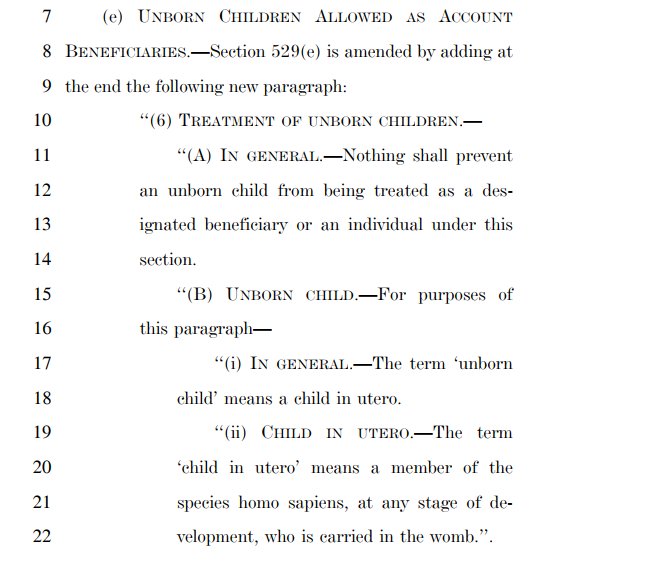
The tax bill, however, inserts language specifying that an unborn child can have a 529. Then it goes on to define what it really means by “unborn child.”
“Nothing shall prevent an unborn child from being treated as a designated beneficiary or an individual under this section,” the bill says, making the infinitesimal change that now parents can open the bill in the unborn child’s name instead of their own. It doesn’t stop there, however. “The term ‘unborn child’ means a child in utero. The term ‘child in utero’ means a member of the species homo sapiens, at any stage of development, who is carried in the womb.’’
This overbearing explanation comes dangerously close to the typical language of a personhood bill. One introduced in the House in January used the phrase “human life shall be deemed to begin with fertilization,” which carries essentially the same meaning as the language in the tax bill. The bulk of the bill, of course, is about something entirely different — but inserting this language could be a strategy to weaken the Roe v. Wade decision that made abortion legal across the country.
GOP officials might have tried to sneak this one in under the radar, but so far they haven’t quite managed.
“The GOP’s tax proposal’s inclusion of ‘personhood’ language makes one thing clear: that their anti-choice ideology knows no bounds or common sense,” said NARAL Pro-Choice America representative Kaylie Hanson Long in a statement. “We know that while they are busy trying to pass this tax proposal into law, they are also turning their backs on kids, women, families, seniors, and the disabled — those who stand to lose the most in this tax bill.”
“This is a back-door attempt to establish personhood from the moment of conception,” Rep. Diana DeGette told Politico. “What’s next, giving a Social Security number to a zygote?””
Anti-abortion advocates, on the other hand, have expressed both surprise and excitement over the personhood language. “We’re thrilled about it, but it wasn’t something that we were specifically calling for,” said Tom McClusky, president of March for Life Action. “We’ll fight to make sure it stays in there.”
So don’t be fooled — this tax bill isn’t just about making people pay more so corporations can pay less. It’s also about limiting women’s reproductive rights. In a way, then, it represents a microcosm of all of the GOP’s recent goals.
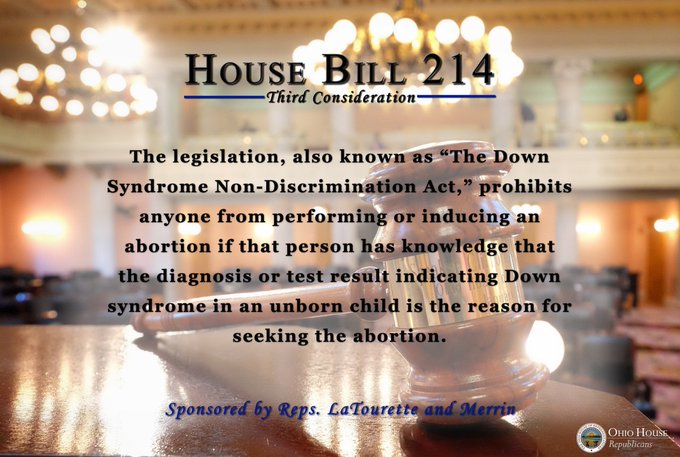
On Wednesday, Ohio’s House of Representatives passed a bill seeking to ban abortion if the fetus might have Down syndrome. HB 214 must still pass the state Senate and obtain Gov. John Kasich’s signature to become law, both of which are entirely possible, but it leaves unanswered questions about how it could affect moms, and how it would even be enforced.
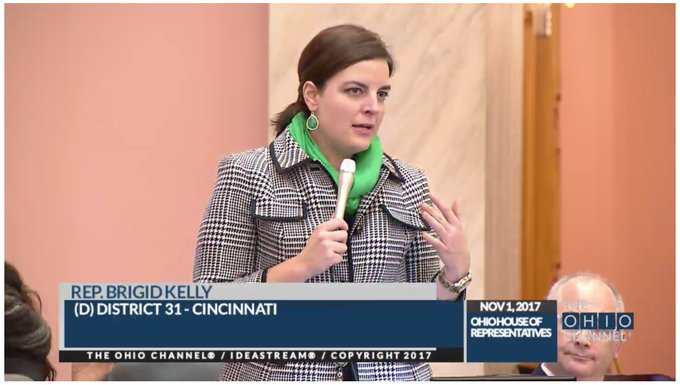
The bill passed in the House by more than 30 votes, with Ohio Rep. Brigid Kelly in the minority.
“Abortion is legal in the United States,” Kelly tells Bustle. “I think that women have every right to make the medical decisions that are appropriate for themselves and for their families.”
One concern that the bill raises is that it could deter women from getting prenatal screening tests to ensure that they have a safe pregnancy in the first place. Banning abortions after a Down syndrome diagnosis could potentially lead to fewer women getting prenatal screening tests, which would in turn put the mother and the fetus in a life-threatening situation that could’ve been avoided.
Opponents of the Ohio bill also say it would hinder open conversations between pregnant women and their doctors, and do nothing to help those with Down syndrome in the state. “This bill will totally offend this relationship,” Ohio Rep. Emilia Strong Sykes said, “not allowing honest discourse between a physician and patient.” According to a 2012 study by the medical journal Prenatal Diagnosis, 50 to 85 percent of American women whose fetus has a Down syndrome diagnosis opt for an abortion, USA Today reported.
Another question is how the state would track women who receive a fetal diagnosis of Down syndrome before seeking an abortion. Kelly tells Bustle her colleague introduced an amendment to HB214 on the House floor stating that no woman should have to disclose why she chose to have a particular medical procedure, but it was tabled. “There are still a few unknowns about practically how this would work,” Kelly says.
Another major unknown is whether or not women who self-induce an abortion would be punished. The bill would, however, punish doctors who perform abortions after a Down syndrome diagnosis with up to 18 months in prison and a $5,000 fine, along with the possibility of losing their medical license.
A similar law passed in Indiana that banned abortions over the fetus’ race, sex, or disability diagnosis was struck down by a federal judge in September. Other states have also tried to pass laws prohibiting abortions in cases of genetic abnormalities, but all have been partially or fully enjoined in court. Illinois is currently the only state with this type of law on the books, and it only applies after a pregnancy is viable.
What’s rare about the Ohio bill is that it focuses solely on Down syndrome and doesn’t name any other genetic abnormalities. “Their right to life should be protected,” Ohio Rep. Derek Merrin, who sponsored the bill, told The Cincinnati Enquirer. “Individuals with Down syndrome are truly treasures.”
But those who oppose it say that distinction is dangerous. While debating the bill on the House floor, Kelly read a letter from a mother in her district who had a 20-year-old daughter with Down syndrome.
“Her concern was about creating a hierarchy of disabilities … and about driving a wedge into the disability community,” Kelly tells Bustle. She adds that the mother said: “It’s not up to us to judge other people and the choices that they make.”
As this debate took place in Ohio, a very similar one was happening in Congress. On Wednesday, the House Subcommittee on the Constitution and Civil Justice held a hearing on a bill that would “prohibit abortion in cases where a fetal heartbeat is detectable.” The so-called “heartbeat” bill would effectively ban abortion at six weeks, before most women even know they’re pregnant.
Making essentially the same argument as Kelly did in her state, Rep. Pramila Jayapal, the only woman invited to speak at the hearing, told Bustle previously: “It restricts the constitutionally protected right for women to make decisions about our own bodies, and similar state bills have already been struck down in the courts.”
Though the future of the federal “heartbeat” bill is still up in the air, Ohio’s abortion ban could pass the majority Republican Senate and be signed into law by Gov. Kasich, who has a history of supporting anti-abortion legislation. As has happened it other states, the constitutionality of the measure could then be challenged in court.
“We won’t let this distract us from the real issue here, which is that there are many more young women like Jane Doe out there who are still unable to get the care they need because of the Trump administration’s unconstitutional policies.”
On October 20, protesters rally in support of Jane Doe during the #JusticeforJane rally outside of the Department of Health and Human Services building in D.C.
Lauryn Gutierrez / Rewire
Abortion is among the safest medical procedures in the United States. Yet, myths about its safety abound. False Witnesses reveals the individuals behind these lies.
The Department of Justice has asked the U.S. Supreme Court to intervene in the case of an unaccompanied pregnant minor the Trump administration went to extraordinary lengths to prevent from receiving abortion care.
Solicitor General Noel Francisco, one of President Trump’s recently confirmed anti-choice nominees, on Friday asked the Court to vacate the the lower courts’ ordersto the federal government to release the teenage immigrant, Jane Doe, from custody and allow her to get an abortion.
The petition asks the Supreme Court to send the case back to the district court and order that court to dismiss claims that additional pregnant unaccompanied minors may have against the Trump administration for blocking their access to an abortion.
According to her attorneys, Jane Doe’s experience with the Trump administration blocking abortion access is not an isolated case, but rather part of a new administration policy to block access to abortion care for all pregnant immigrant minors in detention.
Doe’s attorneys, including ones from the American Civil Liberties Union, have not yet filed a response to the request and their case against the Trump administration’s policy remains ongoing. In a statementissued after the filing, ACLU Legal Director David Cole blasted the Department of Justice, saying “[t]he Trump administration blocked Jane Doe from getting constitutionally protected care for a month and subjected her to illegal obstruction, coercion, and shaming as she waited.”
“After the courts cleared the way for her to get her abortion, it was the ACLU’s job as her lawyers to see that she wasn’t delayed any further—not to give the government another chance to stand in her way,” Cole said.
The Department of Justice took its petition one step further than asking the Supreme Court to intervene in the case; it asked the Court to discipline Doe’s attorney for what the department claims are “material misrepresentations and omissions to government counsel” concerning the release of Doe and the timing of her abortion, claiming those misrepresentations were “designed to thwart this Court’s review” of Doe’s case before she underwent the procedure.
The ACLU called the Trump administration’s filing and claims a distraction.
“We won’t let this distract us from the real issue here, which is that there are many more young women like Jane Doe out there who are still unable to get the care they need because of the Trump administration’s unconstitutional policies,” Cole said.
“They want to outlaw all abortions for everyone, period.”
King is confident the total abortion ban would prevail in the nation’s highest court because, as he falsely claimed, “There’s nothing more precise in its medical definition than a heartbeat …. I don’t know how a court can rationalize their way around that.” Drew Angerer/Getty Images
A proposal to ban abortion care nationwide takes a key first step Wednesday in the “regular order” of how a bill proceeds through the U.S. House of Representatives to become law.
The so-called Heartbeat Protection Act (HR 490) is modeled on a failed Ohio Republican attempt to end legal abortion as early as six weeks into a pregnancy—before many people know they’re pregnant. As technology advances, the ban’s maestro, Faith2Action leader Janet Porter, hopes to end abortion access much earlier. She’s found an ally in Rep. Steve King (R-IA), who introduced the federal ban at her behest in January. King believes the U.S. Supreme Court “unconstitutionally decided” Roe v. Wade, which established the right to an abortion in the United States until fetal viability, determined by doctors to be around 24 weeks’ gestation.
Congressional Republicans’ sudden momentum on banning abortion as early as six weeks into a pregnancy falls in the shadow of an equally unconstitutional 20-week cutoff that the House passed in September. Reproductive health, rights, and justice advocates fear that the GOP might pull off a bait-and-switch to make the 20-week ban appear reasonable.
Could the total abortion ban become law? The ban’s future depends on its history, much of which is repeating itself on a national stage. Here are five important facts to know about the bill and the politics surrounding it.
1. The so-called heartbeat bill is an unconstitutional, medically unsupported, total abortion ban.
Because “heartbeat bills” target abortion care so early in pregnancy, they amount to total abortion bans. They’re wildly misleading and, like many anti-choice bills, based on junk science.
“When you’re talking about a fetus, the term ‘heartbeat’ isn’t even really accurate,” HuffPost‘s Erin Schumaker reported.
A fetal heartbeat is typically detectable at around five or six weeks into a pregnancy, according to Dr. Rebecca Cohen, an assistant professor of obstetrics and gynecology at the University of Colorado.
“It’s not a fully formed heart like you would understand from looking at an adult or even a young child,” Cohen said. “It’s a very early structure. We can see it on the ultrasound, but it’s not a heart, a fully developed organ, by any means.”
Moreover, cardiac activity isn’t a credible measure of fetal viability. This preliminary activity starts at a point in the pregnancy where there’s still a significant risk of miscarriage, and no real guarantee that the pregnancy will continue to be a healthy, uncomplicated one.
Total abortion bans are among the nation’s most extreme anti-choice measures, and federal courts have generally agreed, declaring them unconstitutional. That hasn’t stopped King from pursuing the ban from his position of power in Congress.
The total abortion ban will play out in House Judiciary Committee’s Subcommittee on the Constitution and Civil Justice, a forum for conservative and often racially biased anti-abortion myths. The hearing marks the debut of King, an unabashed white nationalist, as the subcommittee’s chair, and Rep. Karen Handel (R-GA), a longtime Planned Parenthood antagonist, as a potentially potent new voice on the panel.
As a member of the subcommittee, King in 2016 interrogated a reproductive justice advocate over whether killing “partially delivered” puppies would amount to a crime, in an apparent attempt to draw a parallel between dogs and Black babies. He subsequently rebuked Black people for exercising their constitutional right to abortion care in a post-hearing interview with Rewire. Another contentious hearinglast year uplifted legislation to ban sex- and race-selective abortion care—a bill that would have, in the words of reproductive justice advocate Miriam Yeung, perpetuated “the offensive stereotype that Black women are unable to make reproductive health decisions for their own families.”
Wednesday’s hearing will feature three GOP witnesses, one of whom is known for particularly inflammatory takes on abortion rights and LGBTQ rights, according to Right Wing Watch. Another witness, Kathi Aultman, bills herself as an American College of Obstetricians and Gynecologists fellow, even though the College’s companion organization, the American Congress of Obstetricians and Gynecologists (ACOG), condemned the total abortion ban upon its introduction. A spokesperson for the College confirmed Aultman’s affiliation but said she’s not ACOG’s representative at the hearing.
For their sole witness, Democrats selected Priscilla Smith, a clinical lecturer with Yale University’s Program for the Study of Reproductive Justice, in keeping with the fact-based counterstrategy they described to fight the subcommittee’s bluster.
3. Congressional Republicans are following Ohio’s bait-and-switch anti-choice playbook.
State-level tactics to make onerous abortion restrictions seem more politically palatable in the face of a total abortion ban are now in play on Capitol Hill.
What will happen if and when McConnell follows through? Will Republicans paint the 20-week ban as a more middle-of-the-road option than the total abortion ban? Ohio Gov. John Kasich certainly did so. The former Republican presidential candidate, often erroneously portrayed as a moderate, in 2016 vetoed the total abortion ban the same day he signed a 20-week ban into law, reasoning that the 20-week ban would be more constitutionally prudent. It’s not.
Despite Kasich’s veto, anti-choice lawmakers keep reviving the total abortion ban. The Ohio House Health Committee scheduled a hearing Wednesday morning on the latest state-level version hours before the federal version was set to go before King’s subcommittee.And David Forte, one of the GOP witnesses to testify on Capitol Hill, helped draft state-level heartbeat bans, including Ohio’s.
Reproductive rights advocates smell strategy, not coincidence.
“It feels like it’s ripped from the Ohio playbook,” NARAL Pro-Choice Ohio Executive Director Kellie Copeland told Rewire in a phone interview. “That doesn’t mean that I think that the people behind the six-week bans are knowingly being utilized this way.”
“I think they sincerely want to pass their legislation. They want to outlaw all abortions for everyone, period. But so do the people behind the 20-week ban, or in Ohio’s case, now the Down syndrome ban. These are all pre-viability bans, they are all unconstitutional, they are all designed to be challenges to Roe v. Wade. Our opponents are trying to offer the U.S. Supreme Court, which they hope will be further influenced by another Trump appointee—they’re trying to provide that future court with a variety, like a buffet of options to say, ‘Well, you could use this one or this one or this one to overturn or to gut Roe v. Wade.’ That’s what this is really about.”
King is confident the total abortion ban would prevail in the nation’s highest court because, as he falsely claimed, “There’s nothing more precise in its medical definition than a heartbeat …. I don’t know how a court can rationalize their way around that.”
“People down the line, they’re going to say, ‘But it would go before the Supreme Court.’ And I expect it would. And I hope it does,” King told Rewire last week after a separate Judiciary subcommittee hearing.
4. But GOP leaders are following the momentum of the 20-week ban.
King wouldn’t comment on any commitments from GOP leaders to advance the total abortion ban in the House.
“We have a tremendous amount of momentum,” King told Rewire last week after a separate Judiciary subcommittee hearing. “A lot of people thought at the beginning of this Congress that getting that many co-sponsors”—169—”on a heartbeat bill would be impossible …. I expect that number to go up, maybe before the hearing and more likely after the hearing.”
King described the hearing as laying the foundation for a potential committee markup, another next step in increasingly rare regular order on Capitol Hill. “There’s nobody in leadership that has expressed resistance to it,” King said. “They’re philosophically supportive of it, and so I think we have a little ways to go yet to make the case, but I think we can make the case.”
A spokesperson for House Speaker Paul Ryan (R-WI) deferred comment on the total abortion ban to the chair of the full House Judiciary Committee, immigration foe Rep. Bob Goodlatte (R-VA), and on the prospect for a vote to House Majority Leader Kevin McCarthy (R-CA).
Ryan’s spokesperson, AshLee Strong, would not say whether Ryan was “philosophically supportive” of the bill despite the speaker’s anti-choice credentials.
Two spokespeople for McCarthy, who sets the House floor schedule and has led 20-week ban rallying cries, did not respond to an email requesting comment.
Across the Capitol, the total abortion ban doesn’t seem to be on the Senate’s radar either.
“I can’t imagine that we would skip to the next thing if we haven’t got this one done,” Lankford told Rewirein an interview near the Senate floor.“I’m not going to speak for the leader and what he’s going to try to bring up and how that would come up, but our first priority is the five-month piece.”
King won’t be stopped.
“My goal is to have the heartbeat bill on the floor of the House of Representatives January 19—that’s March for Life day,” King said.
5. The White House is on board—but it doesn’t want you to know.
The trio in September lobbied a top White House official in virulently anti-choice Vice President Mike Pence’s office. White House spokesperson Kelly Love declined to comment via email at the time, as did Marc Lotter, a top Pence spokesperson who has since left 1600 Pennsylvania Avenue to promote the Trump-Pence agenda on the political circuit, headlining a GOP fundraiser last week in Buffalo, New York.
Neither the president’s nor the vice president’s public schedules at the time indicated that they were in attendance at the September meeting. But Porter subsequently sent an email to supporters with photographic evidence to the contrary, Right Wing Watchreported.
Photo courtesy of Right Wing Watch.
“The Vice President not only stated that he ‘loves’ the pro-life Heartbeat Bill, he promised to put the letter calling for its passage directly on President Trump’s desk,” Porter said in the email.
Reached by phone Tuesday about the discrepancy, Lotter directed Rewire to a spokesperson in Pence’s office. The spokesperson described what occurred as a staff-level meeting with policy aides. “My understanding is the group ran into the Vice President in the West Wing after a different meeting and he said hello,” the spokesperson said in an email.
The spokesperson ignored Rewire‘s repeated inquiries: Did Pence make any commitments to throwing the power of the White House behind the total abortion ban in Congress—or behind executive action from Trump?
The White House’s latest response, or lack thereof, builds on officials’ pattern of obfuscating meetings with anti-choice leaders. Lotter in July flat-out refused to answer questions about a “private meeting” between Pence and anti-choice advocates, even though some of the advocates—Susan B. Anthony List President Marjorie Dannenfelser and Concerned Women for America CEO and President Penny Young Nance—were clearly identifiable in a photo posted from the vice president’s official Twitter account. A third attendee, March for Life President Jeanne Mancini, retweeted Pence with her gratitude.
Rewire on Tuesday attempted to ask Porter questions about the White House meeting and the politics of the ban, but when reached by phone, she said she couldn’t talk. She agreed to take questions via email but has not yet answered them.
The last word here goes to a person who can comment on the total abortion ban from her lived experiences.
“When the six-week ban was introduced in Ohio, I shared my story of when I had my abortion. I didn’t even know I was pregnant at six weeks,” Mallory McMaster, a storyteller for We Testify project to end abortion stigma, told Rewire.
“I was pretty lucky. There were no barriers keeping me from getting my abortion,” she said.“If we ban abortion at six weeks or when there’s a detectable heartbeat, which might even be before six weeks as ultrasound technology keeps getting better, people are going to lose access to abortion completely, and the impact it’ll have on our lives is disastrous for our society, for our economy, [and] for our economic and educational well-being.”
I didn’t find out I was pregnant until the end of the first trimester. The pregnancy was unplanned, so I attributed my symptoms to polycystic ovary syndrome, which I have. But I learned I was wrong at 12 weeks into my pregnancy. Twelve weeks, by the way, seems to be double the amount of time Republican lawmakers think a person should have to decide if they want to continue with their pregnancy. Case-in-point: A new GOP abortion bill would ban abortion at six weeks — before, as is clear in my case, most women even know they’re pregnant.
According to Teen Vogue, a judiciary committee will hold a hearing on November 1 to discuss H.R. 490, anti-choice legislation introduced in January by notorious abortion opponent Republican Rep. Steve King of Iowa. The proposed bill, entitled the “Heartbeat Protection Act of 2017,” would ban abortions “in cases where a fetal heartbeat is detectable.” It would also make it a federal crime if a health care provider knowingly performs an abortion procedure without first determining “whether the fetus has a detectable heartbeat,” “without informing the mother of the results,” or “after determining that a fetus has a detectable heartbeat.” Teen Vogue reported.
H.R. 490 is the first so-called heartbeat bill to be introduced into Congress, according to Rewire, although it’s certainly not the first of its kind. King’s anti-abortion legislation is modeled after a similar extreme anti-choice bill that failed in Ohio last year. Ohio’s “heartbeat bill” would have also made abortions illegal after six weeks of gestation, which many pro-choice advocates say amount to total abortion bans. Federal courts have declared such bills unconstitutional, Rewire reported.
What happened in Ohio does provide insight into what could happen at the federal level, though. According to the Cut, the same week Republican Gov. John Kasich vetoed the six-week abortion ban, he signed a 20-week abortion ban into law. How does that apply here? Earlier this month, the U.S. House passed its own 20-week abortion ban, titled the “Pain-Capable Unborn Child Protection Act,” that uses junk science to promote debunked claims about fetal pain, Vox reported.
As seen in Ohio, and in other states such as Arkansas, six-week abortion bans have little to no chance of actually becoming law. But legislation prohibiting the procedure at 20 weeks of gestation are far more passable — despite still being unconstitutional and unnecessary. (Abortions after 20 weeks are highly uncommon; according to Planned Parenthood, 99 percent of abortions occur before 21 weeks.) That’s why many abortion advocates view King’s draconian H.R. 490 as a distraction from a more immediate threat to reproductive rights.
This is not to say that you shouldn’t be outraged over H.R. 490. There is, of course, a sliver of a chance that King’s bill will buck the trend of extremely restrictive — and wholly unconstitutional — abortion bans being shot down by more moderate lawmakers. But history has shown that six-week bans and similarly draconian legislation are smokescreens in order for the GOP to pass equally dangerous and life-threatening bills without much fanfare.
According to Vox, abortion activists believe the proposed 20-week ban is unlikely to pass the U.S. Senate. Still, it’s far more palatable to more moderate conservative lawmakers (after all, several states have made such legislation law). That’s why it’s important to not let it fall under your radar.
So, while keeping your eye on H.R. 490, make sure you to protest “Pain-Capable Unborn Child Protection Act.” And there are many ways you can help stop the proposed 20-week abortion ban from becoming a nationwide law. You can call your representatives or write them an email, talk to your peers and share accurate evidence on abortions, debunk junk fetal pain research any chance you get, join or organize an in-person protest, or start a social media campaign across multiple platforms.
The Trump administration in March implemented a revised policy “that allows [shelters] to wield an unconstitutional veto power over unaccompanied immigrant minors’ access to abortion.
The Trump administration in March implemented a revised policy “that allows [shelters] to wield an unconstitutional veto power over unaccompanied immigrant minors’ access to abortion,” according to court documents. Drew Angerer/Getty Images
Abortion is among the safest medical procedures in the United States. Yet, myths about its safety abound. False Witnesses reveals the individuals behind these lies.
Three days after Office of Refugee Resettlement (ORR) Director Scott Lloyd confirmed he personally visited pregnant minors in his agency’s care to dissuade them from seeking abortion care, he has confirmed that ORR’s anti-abortion policy is “under review.”
“We’re taking a look at our policy to see if any changes are needed,” Lloyd told the Christian Broadcasting Network on Monday.
Lloyd, considered by immigrant advocates as one of President Trump’s many religiously ideological appointees, is said to lack the experience and qualificationsnecessary to handle the oversight of some of the world’s most vulnerable children, including young people like Jane Doe, the teen his agency “held hostage” and blocked from accessing abortion care.
Jane Doe fled gender-based violence in Central America and was being held in a Brownsville, Texas, shelter when she obtained the judicial bypass Texas required for her to access abortion care without her parents’ consent, but her care was postponed for weeks because of court proceedings. Jane Doe was finally able to access abortion care this month, but her procedure was delayed because of a controversial—and unconstitutional, as argued by the American Civil Liberties Union (ACLU)—policy put into place by the Trump administration.
The Trump administration in March implemented a revised policy “that allows [shelters] to wield an unconstitutional veto power over unaccompanied immigrant minors’ access to abortion,” according to court documents. This directive prevents unaccompanied immigrant minors in the government’s care from obtaining abortions by prohibiting federally funded shelters from taking “‘any action that facilitates’ abortion access for unaccompanied minors in their care without ‘direction and approval’” from Lloyd.
The federal government has until November 20 to address the larger class action lawsuit on its anti-abortion policy.
Filed in June 2016, the ACLU lawsuit against the federal government addresses the government’s funding of religious organizations tasked with providing care, including access to medical care for unaccompanied immigrant minors. The government allows these organizations “to refuse on religious grounds to follow the law that requires them to provide these young people with access to contraception and abortion, even if the minor has been raped,” the ACLU reported. This includes organizations such as the United States Conference of Catholic Bishops, which has been awarded upwards of $10 million to care for immigrant minors, despite the religious institution’s refusal to allow young people to access abortion services.
The Trump administration wants to replace reliable birth control methods with “fertility awareness,” a dubious family-planning technique that fails nearly a quarterof women every year.
In a leaked memo obtained by Crooked, White House officials wrote that they intend to slash federal funding to the U.S. Agency for International Development’s family-planning budget and require “equal funding” for fertility awareness. The memo further specifies that fertility planning should be the sole birth control method made available to young girls.
Newsweek has reached out to the White House for comment on the memo and hasn’t heard back. Newsweek couldn’t independently verify the veracity of the memo.
Fertility planning, also known as the “calendar method” or “rhythm method,” requires women to diligently track their menstrual cycles, pinpoint the days when they’re ovulating and avoid sex during that time in order to be effective. Because about 30 percent of women experience irregular periods, fertility planning has one of the highest rates of failure of any family-planning method. The calendar method also asks a lot of young girls, who often learn little about sex and reproduction thanks to abstinence-only education across the country.
“I’m quite concerned it could lead to more unintended pregnancy,” Dr. Kristyn Brandi, an OB/GYN based in Los Angeles and a fellow with Physicians for Reproductive Health, tells Newsweek. “It would be especially harmful to girls who don’t have an awareness of their bodies or of other evidence-based methods to prevent pregnancy.”
Rates of unintended pregnancy and teen births have hit record lows over the last two years, as has the abortion rate. Experts agree that access to birth control and more information about effective ways to prevent pregnancy have contributed to this downward trend. Brandi worries the Trump administration’s endorsement of calendar planning could send those rates soaring again.
“If we’re limiting women’s contraceptive choices or not informing them of all of their choices, women could become pregnant more often, which could lead to more abortions,” Brandi says. “If [the Trump White House’s] goal is to decrease abortion, they’re doing exactly the opposite.”
The Trump administration may not have given much thought to the logical outcomes of limiting women’s access to effective birth control. In the section discussing fertility planning, the White House’s leaked memo names Katy Talento, a Domestic Policy Council member who has written about the supposed side effects of hormonal birth control methods, as a point of contact. In a January 2015 column for The Federalist, Talento argued that birth control pills could be “breaking your uterus for good.”
That kind of propaganda only promises disaster for women’s health, Dawn Laguens, executive vice president of the Planned Parenthood Action Fund, wrote in a press release provided to Newsweek.
“This memo reveals not only a disdain for women’s health and lives, but a lack of understanding of the basics of sexual and reproductive health,” she wrote. “This is the Trump Administration’s true agenda laid bare: eliminate women’s basic health care for the sake of an extreme political agenda, no matter how many get hurt along the way.”
President Donald Trump seems largely unconcerned with the consequences of his party’s war on women’s reproductive health. Earlier this month, the Department of Health and Human Services rolled back the Affordable Care Act’s requirement that employers include birth control coverage in their employees’ health insurance plans, a decision that restricts low-income women’s access to contraception, among others. And in the past, Trump’s moves to dismantle women’s access to birth control and abortion have had dire consequences for other basic preventative health care services, like cervical and breast cancer screenings, STI testing and treatment and well-woman exams.
Activists demonstrate outside of the Department of Health and Human Services in support of a pregnant 17-year-old being held in a Texas facility for unaccompanied immigrant children to obtain an abortion on Oct. 20, 2017.AP Photo/J. Scott Applewhite
Scott Lloyd, director of the Office of Refugee Resettlement, was the Trump administration official behind the Jane Doe case, in which the government refused to let an undocumented teen get an abortion.
Lloyd has written op-eds calling for “savvy state legislators” to pass laws requiring women to get permission from the father before they get an abortion.
He faced hard questions from Democrats when he appeared before the House Judiciary’s Subcommittee on Immigration and Border Security on Thursday.
The man behind the Trump administration’s legal battle to keep an undocumented teen from getting an abortion has a long history of campaigning against reproductive rights.
On Thursday morning, Scott Lloydtestified before the House Judiciary’s Subcommittee on Immigration and Border Security. As the director of the US Department of Health and Human Services Office of Refugee Resettlement, he oversees the agency responsible for the children’s center in Texas where the 17-year-old Jane Doe was detained after she entered the US illegally from Central America.
Lloyd sent an email directing government detention centers under his purview not to let minors access abortion services, but instead take them to “pregnancy services and life-affirming options counseling”, according to The Washington Post. Lloyd wrote that the ORR “should not be supporting abortion services pre or post-release.”
‘They put this guy in charge?’
At the hearing, Democratic representatives had hard questions for him — few of which he answered — while the Republicans largely praised him and the other officials present for the Trump administration’s stricter refugee vetting protocols.
Scott Lloyd testifying before the House Judiciary’s Subcommittee on Immigration and Border Security on October 26, 2017.House Judiciary Committee Hearings
Rep. Sheila Jackson Lee of Texas asked Lloyd if he had any direct contact with Doe, or any of the other pregnant minors his agency is responsible for, and he wouldn’t answer, saying he couldn’t comment on individual cases.
When she asked him if he was aware that 60% of female refugees crossing the US border from Central America are raped, and would likely need medical attention including abortions, Lloyd said he “wasn’t aware” of that statistic. It comes from an Amnesty International report, and other investigations have found the number may be even higher.
“It’s disturbing that Director Lloyd didn’t seem to understand the US Constitution and was unable to answer simple questions from members of the committee,” Ranking Member Zoe Lofgren, a Democrat from California, said in a statement to Business Insider after the hearing. “And they put this guy in charge?”
The American Civil Liberties Union also alleges that Lloyd “personally visited a young woman who was seeking an abortion to attempt to dissuade her from her decision.” HHS did not respond to Business Insider’s request for comment.
Jackson Lee told Business Insider that she planned to draft a letter to President Donald Trump asking him to clarify how immigrant women are treated, how pregnant minors like Doe are treated, and how he thinks they should be treated under his policies. Asked about Lloyd’s views on abortion and his actions, Jackson Lee said he was an “example of the leadership of President Trump.”
“The public servants who welcome the offer to serve, they serve,” she said. “It is the policies of this administration that I oppose vigorously, and his persons whom he has selected are in fact representative of what I believe is a truly inhumane policy. It is President Trump who has to change those policies.”
At the hearing, Rep. Pramila Jayapal of Washington asked Lloyd if he was trained to provide counseling or medical services, and what expertise he had to make him qualified to decide whether Doe should end her pregnancy. Lloyd’s agency bio says he is an attorney licensed in Virginia.
“It’s extremely troubling to me, Mr. Lloyd, what’s happening,” she concluded at the hearing. “I think you’re far overreaching over your expertise or your jurisdiction.”
A history of anti-abortion efforts
As right-leaning Breitbart News wrote in April, “Lloyd’s appointment came with little fanfare and almost went unnoticed.”
He came to the Trump administration from the Knights of Columbus, a Catholic organization where he served as an attorney in public policy.
Before that, Lloyd served on the board of directors for a crisis pregnancy center, which offer ultrasounds and counsels women to consider adoptions or becoming a mother, often actively discouraging them from getting abortions. The center in Virginia that Lloyd was involved with mentions a “medical director” and employs a registered nurse, but doesn’t list any doctors or OB/GYNs on staff.
Lloyd worked on Capitol Hill and as an HHS lawyer for the Bush administration, when he co-authored the controversial “conscience rule” in 2008 that allowed healthcare providers to refuse to provide abortions, contraception, end-of-life care, infertility treatments, or family planning care.
When they learned of Lloyd’s interference with women’s decisions to get abortions as ORR directors, Democratic Sens. Patty Murray, Diane Feinstein, Richard Blumenthal, and Bob Menendez sent a letter to the acting HHS secretary on October 20 calling “to immediately cease all undue and improper interference in the health care decisions of young women” under HHS care.
Over 100 organizations, including the ACLU and Planned Parenthood, sent a letter on October 25 denouncing Lloyd’s actions.
“By blocking Jane and others from accessing abortion care, ORR has openly disregarded its legal duty to provide prompt access to safe medical care to those within its charge,” the letter read.
Rep. Lofgren and Rep. Beto O’Rourke of Texas sent HHS a letter on October 16 demanding that ORR stop preventing women from getting abortions and requesting more information about Lloyd’s direct involvement in the reported cases.
“Regardless of the administration’s views on abortion,” they wrote, “the Constitution protects abortion access and it remains the law of the land.”
‘Women must notify the men of their decision to abort’
Lloyd has written extensively on abortion, contraception, and other reproductive healthcare that he opposes on religious grounds.
In a blog post from 2011, which Buzzfeed noted, Lloyd called for “savvy state legislators” to require women to get the father’s permission before getting an abortion, thus restoring “men’s rights” as long as the women didn’t “lie.”
“They could do this by writing a law that says essentially that women must notify the men of their decision to abort, and gain their consent, except in situations where their reasons for aborting relate to the physical realities of pregnancy,” he wrote.
Vice President Mike Pence spoke at the annual March for Life rally in Washington, DC on January 27, 2017.REUTERS/Yuri Gripas
This type of statute isn’t law anywhere yet, but lawmakers in Oklahoma proposed a bill this year that would require the father’s permission for a woman to get an abortion. Non-invasive paternity tests are only available after eight weeks into pregnancy, which would be the earliest women could scientifically confirm who they would need to get permission from before aborting.
In 2011, Lloyd wrote another blog post outlining what constituted as an abortion, including birth control in his definition.
“Our tax dollars are being used to help trick people into aborting their own children, when they would not do so if someone was not lying to them,” he wrote.
Writing about embryonic stem cell research in 2006, Lloyd wrote, “This is just the latest manifestation of a process that began when the medical field sold its healing soul for a new, abortive reality, when medicine taught women to rely on chemicals rather than their wills to avoid pregnancy, and men learned to expect (or even demand) them to do so, and when medicine invited us to trade sex and adoption for the Petri dish.”
That post identified him as the co-founder of “Americans On Call,” a now seemingly defunct grassroots organization with the stated goal of convincing women not to get abortions across the country.
The website is no longer available, but archived web pages show Lloyd likely founded it with other law students in 2006 who “were enjoying a couple beers at a bar and we had an idea.” They wrote that “the end of abortion depends on YOU,” and sold pins and T-shirts to fund their efforts and spread their message.











 Abortion - Abortion Clinics, Abortion Pill, Abortion Information