Anti-abortion lobbyists are gearing up for the fall by putting pressure on Congress to once again go after Planned Parenthood’s federal funds.
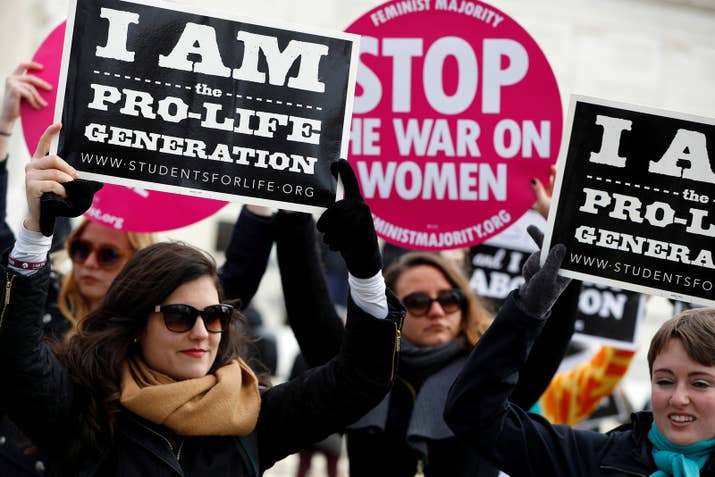
Aaron P. Bernstein / Reuters

Despite suffering the most dramatic in a series of failures in the years-long effort to “defund Planned Parenthood” just last month, anti-abortion advocates and lawmakers aren’t giving up. In fact, they’re reigniting federal efforts and state level work-arounds as lawmakers prepare to return to Washington in the fall.

In late July, when the Republicans’ health care bill failed with a dramatic downward turn of Sen. John McCain’s thumb, abortion rights advocates breathed a sigh of relief. The bill, along with repealing and replacing Obamacare, would have stripped federal funding from Planned Parenthood for a year. That provision was key to GOP Senators Susan Collins’ and Lisa Murkowski’s no votes, giving Senator John McCain the opportunity to torpedo the bill at the last minute.

But now, as Congress’s fall session legislative challenges loom menacingly into view, anti-abortion advocates are bending the ears of sympathetic lawmakers to make sure their cause is not lost in the fray, while abortion rights advocates steel themselves for yet another fight, both with an eye on the 2018 elections.

Four major anti-abortion lobbying groups told BuzzFeed News in August that defunding Planned Parenthood was still in their top priorities for the fall, expressing impatience with Congress on the issue. All of them have the ear of Trump’s administration.

Andrew Guernsey, a lobbyist at the Family Research Council, a conservative Christian group, told BuzzFeed News that the GOP had “no more excuses.” Leaders at the conservative Heritage Foundation and the March for Life, which organizes an annual anti-abortion rally, emphasized that defunding Planned Parenthood was a campaign promise that they expect President Donald Trump and Republicans in Congress to keep.

“Defunding is one of the promises the president made to the pro-life community,” anti-abortion lobbyist Tom McClusky, vice president of government affairs for the March for Life, told BuzzFeed News. “By the 2018 elections they’re going to have to have checked something off that list or they’re gonna be in trouble.”

Mallory Quigley of the anti-abortion group Susan B. Anthony List told BuzzFeed News that, come September, it plans to make it publicly and privately clear to Republican members of Congress that “failure is not an option” in defunding Planned Parenthood.

“How can we have a pro-life president and a pro-life Congress and not have Planned Parenthood defunded?” she asked. “Now it’s time for Republicans to do their job.”

SBA List is a major organizing force for supporting anti-abortion candidates and mobilizing voters. By the end of August it had already knocked on about 50,000 doors of anti-abortion voters in Florida and Ohio who inconsistently turn out to vote, Quigley told BuzzFeed News, adding that this is just the beginning.

If Congress fails to defund Planned Parenthood, Quigley said, “it will make it that much more difficult to engage an otherwise enthusiastic base.”

On the other side, abortion rights groups have spent the dog days of summer steeling themselves for yet another fight, barely taking time to celebrate their narrow escape in July. Planned Parenthood recently announced an on-the-ground, volunteer-driven initiative to protect women’s health care — including funding for the organization. NARAL Pro-Choice America has also spent some of the summer mobilizing their ranks.

“Lawmakers should take note for the 2018 elections,” said Danielle Wells, Planned Parenthood’s assistant director for state policy media relations, indicating that removing funding for what is often the only family planning clinic in the area, according to the nonpartisan research organization National Campaign to Prevent Teen and Unplanned Pregnancy, is not popular. “Voters just don’t want to see attacks on their health care,” Wells said. “It’s as plain as that.”

poll from the nonpartisan Quinnipiac University released in January showed that 61% of voters overall oppose cutting funding from Planned Parenthood. However, it also showed that 63% of Republican voters support the defunding effort.

“How can we have a pro-life president and a pro-life Congress and not have Planned Parenthood defunded?”

“Defunding,” a term that Planned Parenthood claims is a misnomer, refers to ending the federal reimbursements Planned Parenthood gets for providing patients on Medicaid with free or discounted care. Due to a federal law, none of these reimbursements actually go toward providing abortions, but anti-abortion advocates claim that the reimbursements for other services help keep Planned Parenthood alive, enabling it to continue providing abortions. About 60% of Planned Parenthood’s roughly 2.5 million patients rely on either Medicaid or Title X (another federal funding grant) for nonabortion health care services. Removing Medicaid funding would likely cause clinics to close, affecting even those patients who do not rely on the government grants.

“Planned Parenthood has become a symbol for both sides,” McClusky said.

“There is not a lot the Democrats would give up for it,” and there isn’t much that will stop Republicans from trying to insert it into any legislation they can, McClusky added, no matter how doomed they know it may be.

Republican members of Congress have introduced bills to defund Planned Parenthood for years, and some passed easily in the Republican-dominated House when former president Barack Obama was still in office. The closest anti-abortion advocates have gotten was in January when Republicans in the House and Senate passed symbolic legislation to repeal Obamacare and defund Planned Parenthood with the knowledge that it would be immediately vetoed by Obama, who had just two weeks left in office.

Anti-abortion advocates point to that accomplishment as a reason to be optimistic about finally defunding Planned Parenthood under Trump, despite the failure of the health care bill this summer. “In the pro-life movement we’re optimistic to the point of running our heads into a brick wall,” McClusky said.

Opponents of Planned Parenthood are pinning their hopes on Republicans’ plans to try to pass a tax reform bill this fall. They’ll be using what’s known as the “reconciliation process” — the same method they used to try to repeal Obamacare — which allows Congress to pass legislation with only a simple majority of members, meaning no Democrats will need to cooperate. Anti-abortion advocates have been pushing Republicans to include the Planned Parenthood provision in that tax reform package and are confident they will, at least initially.

“If we have the same votes we did in 2016, which I believe we do, I know we can achieve victory in reconciliation,” Guernsey, lobbyist for the Family Research Council, told BuzzFeed News.

However, both Guernsey and McClusky conceded that this is easier said than done, with McClusky acknowledging that the obstacles around tax reform “are even tougher than with the health care bill,” partially because of disparate views among Republicans on tax reform. But McClusky also said reverberations from the health care fight could affect tax reform as well. “[Republican] leadership is now scared of rocking the boat when the boat is already rocking,” he said.

Republicans are still working on writing a tax reform bill, and with so many views among members, the process could easily fall apart, just like the health care bill did. And even if Republicans find a larger agreement on tax reform, they could end up scrapping the Planned Parenthood language in order to get a few, final swing votes on board. Collins and Murkowski have both long opposed defunding Planned Parenthood, for example, and absent their votes Senate Republicans would just have a one-vote margin for error.

There is one other major option on the table, but it’s not one anti-abortion activists are too hopeful about. Republicans have already indicated they will include defunding language in a major spending bill needed to avoid a government shutdown at the end of September, congressional aides and lobbyists told BuzzFeed News. But both sides seem to be in agreement that this is a pipe dream. The bill will need 60 votes — at least eight Democrats in the Senate, none of whom support defunding Planned Parenthood — to pass.

One senior Democratic congressional aide told BuzzFeed News that he thought including Planned Parenthood in these budget processes was “a total waste of time,” while another likened it to “praying for rain in a desert.” Guernsey said he would “prefer not” to have to fight for the defunding effort to be tied to an attempt to avoid a government shutdown, and McClusky more or less ruled it out.

Congress has taken one step toward defunding Planned Parenthood this year — at least at the state level. Back in March, Vice President Mike Pence stepped in to settle a tied Senate vote to enable states to block Title X federal family planning funds from Planned Parenthood. Since, Republican-run states that were blocked or punished financially for attempting to stop funding the organization have felt a new freedom to act. On Friday, South Carolina Gov. Henry McMaster released an executive order barring state funds from going toward any medical practice affiliated with an abortion clinic, specifically calling out Planned Parenthood.

While anti-abortion activists wait for Congress to do more, Texas remains the focus of a lot of the defunding attention. Under the Obama administration, the state gave up its federal Medicaid funding in order to exclude Planned Parenthood and other clinics that offered abortion services from its Medicaid waiver program. (Federal law requires states to fund “any willing provider.”) Now, under Trump, Texas is asking for those funds back. If the administration grants Texas’s request, made in May, it would send a message that any state could kick Planned Parenthood off their Medicaid programs without facing a loss in federal funding. That potential outcome has drawn the battle lines over abortion rights pretty clearly — Planned Parenthood called it “catastrophic for women,” while the March for Life said it was “inspiring.”

For now, the state fights look more promising for anti-abortion advocates, but they’ll keep pushing on the federal level. Even if their plans for legislation in Congress fail this fall, it’s only a matter of time before Republicans bring up another defunding bill and the fight starts all over again.

https://www.buzzfeed.com/emaoconnor/the-fight-to-defund-planned-parenthood-did-not-die-with-the?utm_term=.rmdZ6PYVn#.qhrZd0Eg1

In this July 19, 2017, photo, abortion opponents hold signs during a rally in downtown Louisville, Ky. The protesters are with a group called Operation Save America that is planning a weeklong event at Kentucky's last abortion clinic with the hopes that it will shut down. With its survival on the line, Kentucky's last abortion clinic is bracing for a pivotal legal showdown with health regulators and the state's anti-abortion governor. (AP Photo/Dylan Lovan)
© The Associated Press In this July 19, 2017, photo, abortion opponents hold signs during a rally in downtown Louisville, Ky. The protesters are with a group called Operation Save America that is planning a weeklong event at Kentucky’s last abortion…LOUISVILLE, Ky. — Its survival on the line, Kentucky’s last abortion clinic is bracing for a pivotal legal showdown with health regulators and the state’s anti-abortion governor that could determine whether Kentucky becomes the first state in the nation without an abortion clinic.

The licensing fight, set to play out in a Louisville federal courtroom starting Wednesday, revolves around a state law requiring that EMW Women’s Surgical Center have agreements with a hospital and an ambulance service in the event of medical emergencies involving patients.

State regulators defend those conditions as “important safeguards” to protect women’s health. The clinic in downtown Louisville counters that the requirements lack any “medical justification” and amount to an unconstitutional barrier to abortion.

But the case’s significance goes beyond a debate about state law.

“The stakes in this case couldn’t be higher: the very right to access legal abortion in the state of Kentucky is on the line,” said Dr. Ernest Marshall, who opened the clinic in the early 1980s.

The licensing fight began in March when Republican Gov. Matt Bevin’s administration claimed the clinic lacked proper transfer agreements and took steps to shut it down. The clinic countered with a federal lawsuit to prevent the state from revoking its license. U.S. District Judge Greg Stivers blocked the clinic’s closure until the dispute could be heard at trial.

In its lawsuit, the clinic says it has had agreements with a hospital and an ambulance company on file with state regulators for years. The state’s abrupt “about-face” — finding the clinic non-compliant — came “out of the blue,” the lawsuit said.

Arguing that there’s no medical justification for the standards, the clinic is seeking a ruling that those requirements infringe on constitutional protections. Clinic attorney Donald L. Cox said the requirements have one purpose: “to give the state an excuse to prohibit abortions.”

Complications from abortions are rare, the lawsuit said, but if they occur “ambulance companies will readily pick up patients, and hospitals are required by law to accept patients in an emergency.”

The state’s legal team, in its court filings, conceded that EMW could dial 911 in an emergency, but added: “that does not provide the protection for women deemed necessary by the Kentucky General Assembly and does not satisfy the law of Kentucky.”

The state’s lawyers took aim at claims the requirements aren’t medically essential.

“The plaintiff’s self-serving statements about the rarity of complications from abortion gloss over the fact that such complications do occur and that transport agreements are important safeguards for women’s health in the event of such complications,” they said.

The EMW clinic has been on the defensive since Bevin’s election in 2015. The socially conservative governor calls himself an “unapologetically pro-life individual.”

“The transfer agreements’ requirements in question — which were enacted in 1998 and not questioned for 19 years — are important measures for ensuring women have the proper life-saving procedures in place in the event of an emergency,” said Bevin’s spokeswoman, Amanda Stamper.

“Essentially all health-care facilities in Kentucky are required to have such agreements, and it is telling that the abortion industry believes that it alone should be exempt,” she added.

In another twist, Bevin’s administration added new requirements to transfer agreements amid the legal wrangling. Critics said the changes were meant to make it harder to get a state license for abortions.

The lawsuit is one of two pitting the clinic against the state. The other lawsuit is challenging a new Kentucky law requiring doctors to conduct an ultrasound exam before an abortion, then try to show fetal images to the pregnant woman. The law says she can avert her eyes.

EMW gained an ally in its licensing fight when Planned Parenthood of Indiana and Kentucky was allowed to join EMW’s lawsuit. Planned Parenthood argues that Bevin’s administration has used the transfer agreements to block its requests for a license to provide abortions in Louisville.

EMW’s legal team believes the case “falls squarely” within a 2016 U.S. Supreme Court ruling that struck down Texas regulations that required doctors who perform abortions to have admitting privileges at nearby hospitals and forced clinics to meet certain standards for outpatient surgery. The Supreme Court has found that access to an abortion must be guaranteed, but it remains to be seen whether eliminating every clinic in a single state would pass that test.

“Will we build on the momentum of last year’s Supreme Court decision upholding abortion rights?” Marshall said. “Or will Kentucky be the harbinger of a future where the right to abortion only exists if you live in the right zip code?”

http://www.msn.com/en-us/news/us/kentuckys-last-abortion-clinic-to-face-off-against-governor/ar-AArf4O6

ANDREW COWIE/AFP/Getty Images

Across the country, conservative state lawmakers continue to threaten the right to abortion. Earlier this month, Texas Gov. Greg Abbott, a Republican, signed legislation that prohibited insurance carriers from covering abortion unless the person’s life is in danger. And just this week, South Carolina Gov. Henry McMaster signed an executive order that strips state funding from doctors or groups who help provide abortions (despite the fact that law prevents federal funds from being used for abortions). Now Congress will consider a little-known federal anti-abortion measure that would allow more employers to refuse abortion care.

The Conscience Protection Act of 2017 is an alarming piece of legislation that would severely restrict access to abortion at the federal level under the guise of safeguarding a company’s moral or religious beliefs. In particular, as noted by the American Civil Liberties Union, the bill would further broaden the right to refuse to provide, pay for, cover, or refer for abortion services for employers, insurance companies, and other health care entities, even if a person’s health is threatened.

According to Rewirethe House passed a version of the CPA last July, but the act was not taken up by the Senate. But anti-abortion lawmakers have decided to include the measure as a rider to the House’s Labor, Health and Human Services, and Education spending bill. According to the Hill, Congress will begin its appropriations process next week.

The Conscience Protection Act is far more dangerous than broadening the right to refuse abortion care. It would also give more power to corporations over reproductive rights. The CPA seeks to expand and make permanent the Weldon Amendment, an obscure rider to the Labor-HHS appropriations bill that prohibits entities, including state governments, that receive federal aid from discriminating against providers who refuse to participate in abortion carebecause of religious or moral objections. In recent years, anti-abortion activists have urged fellow anti-choicer HHS Secretary Tom Price to enforce the Weldon Amendment as blue states like California and Oregon pass measures protecting abortion rights.

The CPA would keep the core of the Weldon Amendment, while going a few steps further. In addition to expanding the definition of “health care entities,” it would also create a right to action for any party that opposes pro-choice policies, according to the ACLU. Under the Conscience Protection Act, entities that feel threatened or a “perceived threat” by measures protecting abortion rights would be able to sue states in federal court to block that legislation. Also, the CPA would give the right to deny abortion services or provide information on treatment options even in an emergency situation.

Anti-choice lawmakers will find anyway they can to restrict a person’s right to abortion and reproductive care. And sneaking the CPA — a piece of legislation that has failed before — into an appropriations bill is a sneaky way to achieve that goal.

https://www.romper.com/p/this-federal-anti-abortion-measure-would-allow-more-employers-to-refuse-abortion-care-80246

Patients often have to fight for coverage, even if their plans include the procedure.

Demonstrators show support for Planned Parenthood and reproductive rights in Chicago, Illinois on February 10, 2017.
 Photo by Scott Olson/Getty Images

Erika Christensen’s pregnancy ended at 32 weeks. But her fight to get her abortion covered by insurance had just begun.

In 2016, Christensen found out that the baby she was carrying had abnormalities that doctors called “incompatible with life.” “If it made it through birth, it would choke to death and die,” said Garin Marschall, Christensen’s husband. Christensen, now 36, and Marschall, 39, had very much wanted the child, which would have been their first. But after doctors gave them the bad news, they decided on abortion.

New York state, where they lived, bans the procedure after 24 weeks unless the mother’s life is at risk. Since there was no immediate risk to Christensen, she had to travel to a clinic in Colorado, one of only a few states with doctors who perform late-term abortions, an experience she has described in interviews at Jezebel. Her insurance covered abortion, but the clinic didn’t take it. So Christensen paid $10,000 out of pocket, which her mother withdrew from her 401k.

After the procedure, Christensen requested a reimbursement from her insurance company. She got back about $800. She asked the company to review the decision, which meant months of waiting and hours on the phone.

Ultimately, the insurance company reimbursed her around $3,000. The experience, so soon after the loss of a wanted pregnancy, prolonged her family’s pain and “kept us from being able to just start the grieving process,” Christensen said. “It felt like abuse to have these conversations again and again.”

Christensen’s experience is unusual in some ways — most abortions take place early in pregnancy and cost far less. But her struggle with insurance is surprisingly common — even insurance that ostensibly covers abortion may not actually pay for the procedure. That leaves patients scrambling to pay their bills out of pocket or even trying to do the procedure at home. And it leaves clinics with difficult choices, as Katrina Kimport and Brenly Rowland, researchers from Advancing New Standards in Reproductive Health (ANSIRH), a group at the University of California, San Francisco, note in a study released to the public Thursday. Given the insurance landscape, they write, “facilities might reasonably conclude that they cannot afford to take insurance and keep their doors open.”

Insurance coverage for abortion is often insufficient, even in states that allow it

Most people who get abortions pay out of pocket because they’re uninsured, they don’t want to go through their insurance (sometimes they’re worried an insurance bill could lead to family members finding out about the procedure), or their state restricts insurance coverage for abortion.

The Hyde Amendment bans the use of federal Medicaid funding to pay for abortions except in cases of rape, incest, or a threat to the mother’s life; 22 states have similar restrictions on state Medicaid funds. Meanwhile, 26 states restrict abortion coverage in private plans offered on the insurance exchanges, and 11 restrict abortion coverage in all private plans.

But even if patients have insurance that covers abortion, they or the clinic may end up footing the bill, according to the UCSF study. Kimport, a sociologist, and Rowland, an interviewer, talked to administrators in charge of 64 clinics in 21 states. They found that even in states where Medicaid was legally allowed to cover abortion, some Medicaid insurance providers declined to cover the procedure.

Private insurance presented similar roadblocks. In many states that don’t restrict private coverage of abortion, insurers can still choose whether to offer it or not. And some impose restrictions that conflict with the realities of abortion care.

One insurer would only pay for medication dispensed by a pharmacist, according to a doctor quoted in the study. But the FDA requires medication abortion, which accounts for nearly a third of all abortions, to be administered to a patient by a clinician, not a pharmacist. “I fought and fought” with one insurer to get medication abortion covered, said the doctor. After eight years of trying to challenge the rule, the doctor said, “I finally just gave up.”

Because of the way another insurer’s policies are written, abortion could only be reimbursed for patients over 12 years old, Kimport said. “When they had a patient who was under 12, there was simply not a way to get that reimbursed.”

For patients, insurance problems can have disastrous effects

When insurance companies fail to cover abortion, patients can suffer, especially if they live at or near the poverty line. They may need to delay while they get the money together, resulting in a later and costlier procedure, said Daniel Grossman, director of ANSIRH. The average cost of an abortion at 10 weeks is around $500; by 20 weeks, that rises to around $1,500. Financial obstacles can also push women to try to self-induce an abortion, potentially putting their lives at risk.

For low-income women, abortion costs can mean going without necessities. In her work with an abortion fund in California, Destiny Lopez, now co-director of the group All* Above All, saw women who were forgoing rent or food to pay for their abortions. “I vividly remember the day that I provided literally a tank of gas to a young couple that had to have a termination,” she said.

Even for those who are able to rely on family members for money, the experience of fighting with insurance companies can take a toll. Kate Carson had an abortion at 36 weeks after finding out that her daughter had a fatal brain abnormality. That meant coming up with $25,000 with just a weekend’s notice — her parents took the money out of their retirement account. Carson had insurance through Blue Cross Blue Shield, but since she had to travel out of state, from Massachusetts to Colorado, her insurer only reimbursed her a small amount of the total. “Every bill that came in the mail and every refusal from insurance was like a knife in my heart,” she said.

A representative from Blue Cross Blue Shield of Massachusetts said that employers decide which services their plans cover. If a service is covered and a patient receives it out of state, the reimbursement is typically based on how much a Blue Cross Blue Shield plan in that state would pay.

Patients choose late-term abortion for a variety of reasons. Jenny, who asked that her last name not be used, decided to seek an abortion after she found out her baby had a major heart defect that would likely leave him in a vegetative state, dependent on a ventilator and feeding tube. “I’m a nurse and I know how this stuff goes,” she said. “I didn’t want him to have that quality of life.”

Christensen considered carrying her child to term, even though a previous surgery meant she would have to have a C-section. But she realized that he would probably die soon after delivery “if he even made it that far,” she told Jezebel. Ultimately, she said, “I couldn’t put him through that suffering when we had the option to minimize his pain as much as possible.”

Insurance problems also put clinics at risk

The idiosyncrasies of insurance coverage for abortion also mean clinics may never get reimbursed for the abortions they perform. In states where Medicaid does cover abortion, reimbursement rates for the procedure are typically very low. The Medicaid reimbursement “doesn’t even come close to the expenditures” for an abortion, a counseling manager at one facility told Kimport and Rowland.

Medicaid reimbursements are low for many services, but since patients seeking abortions are disproportionately low-income, abortion clinics see an especially high percentage of patients with Medicaid. That means low reimbursement rates can pose a serious threat to a clinic’s survival. Some clinics have to make an uncomfortable choice between accepting Medicaid — and potentially going out of business — or declining the insurance so they can continue to see patients, Kimport and Rowland note.

Reimbursement rates are generally higher for private insurance, but the many restrictions and quirks involved mean clinics can never be sure if an insurer will pay them. “Providers are always rolling the dice,” said Kimport. Some practices choose not to accept private insurance — the Boulder Abortion Clinic, where Christensen had her abortion, has a contract with Kaiser but does not take other public or private insurance.

Meanwhile, some abortion practices have costs that neither public nor private insurance reimbursements truly reflect. Dr. Warren Hern, who performed Christensen’s abortion, estimates that 50 percent of what his patients pay goes toward security for his practice. “Pediatricians do not have to have armed guards and bulletproof windows,” he said. “We do.”

Changing the insurance picture starts with changing the law — but it doesn’t end there

Since their experience, Christensen and Marschall have become advocates for the Reproductive Health Act, which would make abortion after 24 weeks legal in New York state if the fetus is not viable or if the mother’s health is threatened. That would allow women in Christensen’s situation to stay in New York and get abortions from in-network doctors, making it more likely for insurance to cover the procedure. New York allows state Medicaid coverage for abortion, and most private insurers also cover the procedure, said Liz Krueger, a state senator and sponsor of the bill.

The Reproductive Health Act has passed the state assembly but not yet received a vote in the Republican-dominated state senate. Krueger is hopeful that it might move forward when the senate comes back into session in January 2018. Public opinion is on the bill’s side, she said, and in an election year, senators may be especially motivated to listen to their constituents’ concerns. The Trump administration has created anxiety and an appetite for change on many issues, she said. “There’s real momentum in New York state for voters to say, ‘We don’t trust Washington, we need this done here.’”

A few other states have recently passed similar laws. The Reproductive Health Equity Act, passed in Oregon this year, requires insurers, including the state’s Medicaid program, to cover abortion at no cost to the patient.

But one of the biggest barriers to insurance coverage for abortion around the country is the Hyde Amendment. Though it restricts only federal funding for abortion, it affects the private insurance markets as well, since many private insurers take their cues from the federal Centers for Medicare and Medicaid Services, said Marschall, who has become something of an insurance expert since Christensen’s abortion.

The EACH Woman Act, introduced in the House in January, would repeal Hyde, allowing Medicaid recipients, government employees, and anyone else with government-sponsored health care to receive coverage for abortion. It would also bar states from banning abortion coverage in private plans on the exchanges.

There’s likely little appetite in the current Congress for repealing Hyde. But advocates for the bill are realistic about their approach, said Lopez. “We know that if we’re undoing 42 years of bad policy, it’s not going to take one Congress to fix that,” she explained. “What’s important about the bill is it allows us to have a conversation we haven’t had in this country about public and private insurance coverage of abortion.”

Even repealing Hyde wouldn’t necessarily fix the problem of low reimbursement rates, as Kimport and Rowland note. Simply allowing Medicaid to cover abortion wouldn’t mean that clinics would actually get reimbursed for the full cost of the procedure. But advocates are at work on the state level to try to raise rates, Lopez said. Sometimes that means working with groups trying to raise rates for other services, she added. “Some of these issues are larger than just abortion care.”

The barriers to change are many, but advocates like Christensen remain committed to the fight. Until New York changes its law, “I will feel like I’m not allowed to grieve,” she said. “I’m going to stay acutely angry and rageful until it’s made right.”

https://www.vox.com/policy-and-politics/2017/8/31/16229654/abortion-insurance-hyde-amendment

A federal judge on Thursday delayed for two weeks enforcement of part of a state law that bans the most common second-trimester abortion method

A hallway at the Whole Woman's Health clinic in Austin.
A hallway at the Whole Woman’s Health clinic in Austin.  Callie Richmond

A federal judge has temporarily stopped Texas officials from enforcing a ban on the most common second-trimester abortion procedure, just one day before the ban was set to go into effect.

Judge Lee Yeakel of the U.S. District Court for the Western District of Texas granted a temporary restraining order Thursday, delaying enforcement of the ban until Sept. 14. It was originally set to go into effect Sept. 1.

Senate Bill 8, which passed during the 2017 regular legislative session, banned dilation and evacuation abortions — where doctors use surgical instruments to grasp and remove pieces of fetal tissue — unless the fetus is deceased.

Yeakel’s decision follows a Tuesday morning hearing during which attorneys for the state and reproductive rights groups sparred for an hour and a half about whether the order should be granted. With it in place, Texas doctors and health care providers can continue using the dilation and evacuation procedure – deemed the safest by medical professionals for second-trimester abortions — until a more permanent decision is made by the court.

Another hearing has been set for Sept. 14.

Without Thursday’s restraining order, Yeakel wrote in his decision, women and their doctors would be left “with abortion procedures that are more complex, risky, expensive, difficult for many women to arrange, and often involve multi-day visits to physicians, and overnight hospital stays.”

A spokesperson for the Texas Attorney General’s office said in a statement that the state’s top lawyer would “continue to defend our state’s legal right to protect the basic human rights and dignity of the unborn.”

Though the court’s decision Thursday offers a temporary respite to reproductive rights groups, it’s the latest in a series of legislative and legal challenges to abortion access in Texas. The lawsuit was filed in July by the Center for Reproductive Rights and Planned Parenthood on behalf of several women’s health providers in the state.

Proponents of the ban have called dilation and evacuation “dismemberment abortion.” In court Tuesday, Darren McCarty, an attorney for the state, said the procedure is “brutal, gruesome” and runs counter to the “ethos of a humane and civilized society.” He said SB 8 does not ban the method; it just requires the “humane termination” of the fetus beforehand.

The “state did a good job of clarifying that technical distinction,” and spelling out its interest in protecting fetal life, John Seago, legislative director for Texas Right to Life, said after the hearing.

Lawyers for the health providers countered that making fetal demise a prerequisite would subject women to medically unnecessary and untested methods, and force them to make additional trips to the clinic. Doctors would face criminal charges for violating the ban; the only exception would be in cases of medical emergency.

Already, women seeking an abortion in Texas must have a sonogram performed 24 hours before receiving an abortion, a requirement women’s health advocates say is costly and burdensome.

“The provisions of SB 8 that we’re challenging criminalize a safe and common method of abortion,” said Molly Duane, staff attorney at the Center for Reproductive Rights. “Politicians in Texas are trying to punish doctors who are using their best medical judgment.”

In court Tuesday, McCarty questioned the timing of the lawsuit’s filing, and argued it was a strategy to force the court to “rubber stamp” emergency relief days before the ban was slated to go into effect. Yeakel, agreeing, said he could see no reason why the suit couldn’t have been filed as soon as the governor signed the bill into law, and said its timing was a “real imposition” and put “maximum pressure” on the court to act at the last minute.

Yeakel also asked repeatedly what evidence legislators had considered before passing the law, and how Texas’ provision differs from similar bans that have been contested in other states. Laws like SB 8’s dilation and evacuation ban have been opposed or halted in Alabama, Arkansas, Kansas, Louisiana and Oklahoma, according to a press release from the center. In court Tuesday, neither side pointed to substantive differences between Texas’ law and these others.

Duane said the new law is part of a “coordinated strategy by the state of Texas and by states around the country to ban abortion method by method, one restriction at a time, until it’s practically unavailable for women.”

In May, state lawmakers tacked the dilation and evacuation ban onto SB 8, a broader abortion measure that also prohibits hospitals and clinics from donating aborted fetal tissue to medical researchers, and requires facilities to bury or cremate fetal remains whether from abortions, miscarriages or stillbirths.

Seago, whose organization championed the provision, noted it originated as a separate bill and was discussed extensively by lawmakers. “This is not something that the legislature unknowingly did in the dark of the night,” he said.

This lawsuit is hardly the first time the state’s abortion policies have wound up in court. In June 2016, the U.S. Supreme Court struck down parts of a Texas law that required abortion clinics to meet the same standards as ambulatory surgical centers — including minimum room sizes — and forced doctors performing the procedure to have admitting privileges at nearby hospitals. Days after the high court’s decision, the state put forth a new rule relating to how fetal remains are disposed of.

A federal judge blocked that fetal remains rule in January, noting that it had been proposed “before the ink on the Supreme Court’s opinion” was dry. A month later, that same judge said Texas can’t kick clinics affiliated with Planned Parenthood out of the state’s Medicaid program. The state is appealing both rulings.

Since the SB 8 lawsuit was filed in July, three new abortion-related measures were approved during the summer special legislative session and have been signed by the governor. Those new laws will increase reporting requirements for abortion complications, and require women to buy a supplemental insurance plan if they want coverage for an abortion – called a “rape insurance” policy by opponents.

https://www.texastribune.org/2017/08/31/judge-temporarily-halts-abortion-procedure-ban/?utm_content=bufferfd6f6&utm_medium=social&utm_source=facebook.com&utm_campaign=buffer

Reproductive rights advocates charge that any single-payer health care push that doesn’t include abortion care falls short of real universal coverage.

When Sen. Bernie Sanders (I-VT) and Rep. John Conyers (D-MI) partnered for an overflowing health-care town hall in Michigan over the August recess, they shared more than a stage. The veteran lawmakers are leading the charge in Washington for universal health coverage.

More than 1,000 people packed the meeting that turned into a “rallying cry for progressives,” according to a Detroit Free Press report. Progressives recognize that health care is a human right. But do they recognize abortion care as health care, or will they sacrifice it for the sake of the quote-unquote greater good?

On Capitol Hill, Democrats have increasingly signaled their support for single-payer proposals in which the federal government covers health-care costs, regardless of income, job status, or health status.

The most popular ones propose expanding Medicare, the federal insurance program for people age 65 and older, to all. Conyers introduced his eighth iteration of a Medicare for All bill in the U.S. House of Representatives at the start of the current 115th Congress, and Sanders plans to unveil a U.S. Senate version after lawmakers return to Washington in early September, Rewire reported in July.

Sen. Brian Schatz (D-HI) recently sat down with Vox’s Sarah Kliff and Jeff Stein to discuss his forthcoming bill that would allow anyone to buy into Medicaid, the joint state-federal insurance program for people with low incomes, on the Affordable Care Act (ACA) exchanges.

A policy goal pursued by generations of progressive organizations and lawmakers, a nationalized health care system for all Americans, regardless of age or income, now receives the support of 33 percent of the country across party lines, according to a Pew Research Center poll from June. A full 60 percent broadly believes health care for all is the federal government’s responsibility. Of course, with a GOP-controlled Congress and White House committed to undermining coverage, single-payer health care will remain a dream for now. What proposals from Sanders, Conyers, and Schatz can do is show voters how the world should look when Washington emerges from unilateral rule by a Republican Party fiercely opposed to expanding quality health-care coverage.

There’s one hitch in these best-laid plans: Thanks to the Hyde Amendment, a congressional appropriations rider enacted into law every year since 1976, no federal funds—including the Medicaid and Medicare reimbursements that a doctor receives for providing various health-care services—can cover abortion care except in rare circumstances. Hyde today disproportionately affects people with low incomes and people of color.

Under Medicare for All or another single-payer system, the discriminatory ban could apply to every person who moves off their private insurance into a public option that’s supposed to be more equitable. (Many women with private insurance still pay out of pocket for abortion care, according to a 2013 studyco-authored by the Guttmacher Institute’s Rachel K. Jones. The pro-choice research institute maintains a list of states that restrict private insurance from covering abortion. Vox’s Kliff published a story Thursday about how patients with private insurance that covers abortion “often have to fight for coverage.”)

Sanders is the only lawmaker whose bill addresses Hyde. Conyers is aware of the issue but is banking on Hyde being gone before Medicare for All becomes a reality. He’s involved in a separate effort to put an end to Hyde. Schatz represents the great unknown.

Three Bills, Three Different Approaches

Sanders’ Medicare for All bill will preempt the discriminatory Hyde Amendment, according to an aide.

“It will cover ‘comprehensive reproductive, maternity and newborn care.’ Abortion falls into that bucket,” the aide said in an email. “We are also taking steps to ensure the government could not refuse to accredit an abortion provider as a participating provider simply because they provide abortions.”

Conyers’ version does not.

“I just can’t envision a world where we have the votes to pass Medicare for All but we haven’t repealed the Hyde Amendment yet,” Dan Riffle, Conyers’ senior legislative assistant for health care, told Rewire.

“We agree that that’s important,” Riffle said in a phone interview. “I just don’t think it’s something we should slow down progress on Medicare for All now, today, based on a concern that is almost certainly not likely to be present when the bill is passed.”

Conyers began introducing Medicare for All bills in 2003—more than a decade before Democrats cast off Hyde as the cost of doing business on Capitol Hill and coalesced around the Equal Access to Abortion Coverage in Health Insurance (EACH Woman) Act. The EACH Woman Act replaces Hyde with explicit guaranteed abortion coverage under Medicaid, Medicare, and other health-care plans obtained through the federal government. The legislation protects private insurance companies that cover abortion care from political interference at the federal, state, and local levels.

More than two-thirds of House Democrats, including Conyers, signed on to the 2015 and 2017 versions of the legislation embodying the #BeBoldEndHyde movement. More than half of the chamber’s Democrats have co-sponsored Conyers’ vision for universal coverage.

Conyers’ office considered amending this year’s Medicare for All bill to address Hyde but faced a “tight timeline” prior to introduction, according to Riffle. Although the office is open to amending a future version, the “easiest way” to get co-sponsors to sign onto a bill is to tell co-sponsors from prior years that it’s the same.

“That’s why we try to do it the same every year,” Riffle said. “But, you know, there comes a point where you do have to update it,” whether that’s by eliminating Hyde or “moving away from a fee-for-service to [an] outcome-based payments model.”

“It’s something that we’ll look at, I don’t know if it’s something that we would put in on the first draft, but again, we’re never going to pass a Medicare for All bill that doesn’t cover abortion services.”

Schatz’s Medicaid expansion bill may or may not take Hyde into consideration. A spokesperson, Mike Inacay, asked Rewire to send questions via email but ignored repeated follow-up requests for answers.

The Senate does not have any Hyde-ending legislation comparable to the House’s EACH Woman Act.

#BeBoldEndHyde From the Start

Advocates agree that single-payer bills must tackle Hyde, even as they concurrently work to end the provision.

Destiny Lopez is the co-director of All* Above All, a reproductive justice coalition dedicated to eliminating Hyde, partly through spearheading support for the EACH Woman Act. She maintains that any universal coverage that doesn’t include abortion among the full range of reproductive health services “falls short of accomplishing what the purpose of the law actually is—that everyone can get the health care that they need.”

“Anything that somehow carves out or doesn’t address existing abortion coverage bans is not good enough for us,” Lopez said in a phone interview.

Prominent members of the All* Above All coalition have had positive discussions with Sanders’ office. “The proof will be in the pudding, right, so we’ll see kind of what mechanisms they’re going to use to do that, and we’ll hold our breath until we see the bill,” Lopez said.

As for Conyers’ version, “our wish for that bill would be the same.”

“I think there’s some work we still need to do on the House side to ensure that that bill, again, is a bill that’s putting out our vision.”

Lopez acknowledged that work is a little easier on the House side because of the 122 EACH Woman Act co-sponsors, including Conyers, who have “put their values on this out there.”

Whether Hyde-type restrictions would automatically carry over into a single-payer universe depends on how the bills are written, according to the National Women’s Law Center’s Rachel Easter. Would the bills, for instance, fund health care through mechanisms subject to Hyde?

“What we do know is that members of Congress who are opposed to abortion are constantly trying to eliminate insurance coverage of abortion altogether,” Easter, counsel for reproductive rights and health, told Rewire.

Easter pointed to congressional Republicans’ push to end private insurance coverage of abortion carethrough their Obamacare repeal bill and sundry legislative attempts to expand and codify Hyde. Anti-choice lawmakers will try to hold single-payer proposals hostage as well, she warned in a phone interview.

That’s why the lawmakers behind single-payer bills need to take aim at Hyde from the start.

Abortion Access for All

And just as importantly, they need to be proactive in specifying abortion care within the scope of covered services.

“How does a piece of legislation determine what is and isn’t covered?” Easter asked. “Does it refer to what the ACA requires coverage for? Because if so, that’s not automatically going to include abortion coverage.”

It’s not at all. President Obama in 2010 signed an executive order applying the Hyde Amendment to the ACA. Obama’s executive order followed the unsuccessful Stupak-Pitts Amendment’s attempt to bar the ACA’s tax credits from subsidizing health insurance plans that covers abortion.

Although the Stupak-Pitts amendment ultimately failed, it initially passed the House with the help of 64 Democrats. Only a handful of those Democrats remain in the House. But even vocally pro-choice members of the party have rejected a litmus test on abortioninviting anti-choice Democrats into the fold. Sanders, a progressive icon and former presidential candidate who ran on ending Hyde prior to its inclusion in the Democratic Party platformtold NPR that “you just can’t exclude people who disagree with us on one issue.”

Democrats’ and progressives’ fealty to abortion rights, then, isn’t a given in the upcoming single-payer debates.

“It’s a concern for me at a time when the Democrats are talking about candidates and saying, ‘We’re not too worried about your litmus test here,’” Karen Middleton, NARAL Pro-Choice Colorado’s executive director and a former state legislator, said in a phone interview.

Middleton and other Colorado-based reproductive rights advocates breathed a sigh of relief when a 2016 ballot initiative to add universal health coverage to the state’s constitution failed. The proposal didn’t override Colorado’s pre-existing constitutional ban on state funds for abortion care. “It’s likely that universal health care advocates left out any protections for abortion coverage to ease the initiative’s passage in a somewhat conservative state,” Slate’s Christina Cauterucci reported at the time.

Single-payer advocates in Congress can confront Hyde head-on because it’s part of a statute; were Democrats who support the EACH Woman Act in power, they’d likely choose to stop attaching the ban in the form of riders to the various appropriations bills (and the continuing resolutions that fund the government in the absence of viable appropriations bills), unlike their Republican counterparts.

Middleton encouraged those lawmakers to “at least start with the best version of the bill, not start with the bill where we need to advocate” to override Hyde and cover abortion. Reproductive rights advocates didn’t accept that tradeoff for the supposed greater good in Colorado, and they won’t now.

“The cautionary tale of Colorado was that we had well-meaning allies and advocates who we work with closely all the time who were so committed to wanting to provide universal health care that they missed nuance,” Middleton said. “They were happy to throw this issue [of abortion] under the bus.”

“It was really sad to get into that fight, which is why the idea that they’re even thinking about it [in Congress] ahead of time … would make so much more sense, and it would bring all of us to the table to help fight to support the bill,” she added. “You’re much happier having us as friends than enemies, trust me.”

The ‘Not At Home’ exhibition is an attempt to recreate the experience of the 170,000 Irish women who have travelled abroad for abortions

Waiting room at a British pregnancy advisory service clinic in Liverpool,  where some Irish women travel to access abortion. Photograph: Cliona Ni Laoi
Waiting room at a British pregnancy advisory service clinic in Liverpool, where some Irish women travel to access abortion. Photograph: Cliona Ni Laoi

Last year theatre makers Grace Dyas and Emma Fraser came to me with a big idea. They had plans to recreate the experience of the just over 170,000 Irish women who over the past few decades have had to travel out of Ireland for safe abortion services. It would be a “durational art installation” open to the public. It would feature video and live performances. There was talk of “soundscapes”. I did not immediately fall in love with the big idea.

My abortion, which I had in the 1990s in London, was not art, durational or otherwise. So at first I did not understand why these two women wanted to go all Tracey Emin on a life experience which while very common is private and – especially when it’s illegal in your country – often difficult to speak about. How could they authentically “recreate” this experience? When it came to the ordeal of travelling for a termination, you really had to be there.

Perhaps I should have been more open to the idea. In September 2015, I went public in this newspaper with my own, very ordinary, abortion story. I did so because I hoped speaking out might contribute to a change in the national conversation.

I was fed up with the fact that as a country we were intermittently convulsed by the abortion “debate” but only at certain designated moments: when a raped teenager was being dragged through the courts – “yes, okay, then, let’s talk about her, if we really must”. Or when talk turned to the tragedy of fatal foetal abnormalities – “hmmmm, maybe we better talk about the cruel way we treat those women”. Or when a woman died. Her name was Savita. We had to talk about it then. And afterwards some of us found we could not shut up. Sorry. (I’m not really sorry.)

Us everyday abortion exports/experts didn’t feature much in the national conversation, which is why I and many others have told our stories. And yet even though I had gone public, I wasn’t immediately sure why Dyas and Fraser wanted to make an exhibition out of us abortion travellers.

As anyone who has seen their work to date will know, these are two clever, creative and compassionate young women. Eventually I got the message: Dyas and Fraser believe that even though in recent years more women have spoken about their experiences of travelling for abortions, for many those experiences remain abstract and unseen. So they’ve been collecting our testimonies and travelled to a British Pregnancy Advisory Service Clinic in Liverpool to gather material for the installation: Not At Home is an attempt to draw back the twitching curtain on the experience of women who had to travel for abortions. It’s a space “for her to speak”. A space “for us to listen”

Here’s what I’ve come to love about what they are doing: “We don’t want to preach to the converted,” they told me. “We don’t want to shame people into taking a liberal position. We acknowledge that the issue is complicated and complex. We hope the piece will allow people to witness the reality of the consequences of our abortion laws.”

You had to be there, you see. And now you can. By visiting Not At Home you can travel with us. Sit in the waiting room. Read the magazines. You can hear our voices. Take the taxi. You can listen to the comments of the Liverpudlian cab drivers who, knowing where we were going and knowing we were not at home, acted as surrogate dads to us on the way to the clinic.

At Not At Home you can acknowledge us in all our tiny details. That woman who had a cup of tea in an airport in Leeds which meant she couldn’t get an anaesthetic and would have to be fully conscious for the procedure. The woman who bled on a bathmat in a B&B in Manchester and spent hours trying to clean the stain because she was embarrassed. By visiting Not At Home you can walk in our shoes. See where we bled in tube carriages and on airport seats.

You can look. Or you can look away. It’s your choice. Aren’t you lucky to have one?

Private viewing of ‘Not At Home’

Are you someone who had to leave Ireland for an abortion? Are you one of that vast tribe of Irish women who made a healthcare decision, one that is outlawed in our country by the Eighth Amendment to the constitution?

I want to invite you into The Recovery Room with me for one night only on September 13th, for a private viewing of the Not At Home exhibition before it opens. We will talk. We might hug. We will definitely eat Custard Creams.

Above all else I hope we’ll feel solidarity with one another. We, the women Ireland cannot look in the eye, will stand together and reflect on that lonely, vulnerable time when we were Not At Home.

Not At Home by THEATREclub takes place at NCAD Gallery, Dublin, as part of the Dublin Fringe Festival on Thursday 14th & Friday 15th September, 5pm – 9pm and Saturday 16th & Sunday 17th at 12pm-6pm. It is not ticketed.

Recovery Room, a solidarity evening for women who have travelled for abortion services, takes place in the gallery on September 13th. For tickets visit https://www.eventbrite.ie/e/recovery-room-with-roisin-ingle-connect-and-share-for-one-night-only-tickets-36187116640

https://www.irishtimes.com/life-and-style/people/to-understand-abortion-travel-you-have-to-be-there-1.3198084?mode=amp

The Supreme Court on Friday directed Chandigarh’s legal service authority to disburse a compensation of Rs 10 lakh to 10-year-old rape victim who delivered a baby after being denied abortion.

The bench, comprising of justice Madan B Lokur and Justice Deepak Gupta asked the Chandigarh administration to make the identity of the victim and give her Ra 1 lakh. The balance of Rs 9 lakh will be kept as fixed deposit.

dignity

AFP

The order came after a petition seeking a Rs 10 lakh compensation for the victim whose plea seeking permission to undergo termination of pregnancy was earlier negated by the apex court.

The court also directed that no one should disclose the identity of the newborn baby, the victim’s parents, their place of work and their residence. Any breach in maintaining confidentiality would attract contempt of court and action under the provision of the Indian Penal Code.

http://www.indiatimes.com/news/india/10-yo-rape-victim-who-became-mother-after-being-denied-abortion-to-get-rs-10-lakh-compensation-328592.html

Germantown Reproductive Health Services is under contract to be purchased by the Maryland Coalition for Life, an anti-choice organization that has targeted the clinic with protests.

One of only a handful of clinics in the United States providing later abortion care is closing its doors after the owners reportedly sold the facilities to an anti-choice organization.

Maryland’s Germantown Reproductive Health Services is under contract to be purchased by the Maryland Coalition for Life, an anti-choice organization that has targeted the clinic with protests, reported the Washington Post.  The clinic will be replaced by an anti-choice fake clinic.

The Maryland Coalition for Life operates a fake clinic across the parking lot of Germantown Reproductive Health Services. A fake clinic, commonly known as a crisis pregnancy center, does not provide full reproductive health-care services and seeks to dissuade people from seeking abortion care with anti-choice propaganda.

The owners of Germantown Reproductive Health Services also own Prince George’s Reproductive Health Services, which does not provide abortion care in the later stages of pregnancy. Both Maryland clinics have now been permanently closed, according to the organization’s website.

LeRoy Carhart, one of the few physicians in the United States who provides abortion care in the later stages of pregnancy, has provided abortion services at the Germantown clinic since 2010. Carhart told reproductive rights advocates that he plans to continue to provide abortion care in the area at a new clinic.

Carhart said in a statement to the Washington Post that he would continue to provide care for his patients.

“I am doing everything in my power to keep my practice open, and I am considering options looking toward the future,” Carhart said. “It’s heartbreaking that anyone would want to take health care away from women and families by targeting our clinic.”

Diana Philip, executive director of NARAL Pro-Choice Maryland, said in a statement that the “most immediate concern” is how the clinic’s closure will affect patients’ access to abortion care in the later stages of pregnancy.

“For the last few years, Dr. Carhart has shared his vision with allies to create his own facility in Maryland to address the dearth of training available to medical professionals in later abortion care,” Philip said.

Philip said the Planned Parenthood clinics in the state and Carhart’s new practice should ensure that pregnant people in Maryland will continue to have access to reproductive health care.

Three of the seven Planned Parenthood clinics in Maryland provide abortion services.

https://rewire.news/article/2017/08/29/doctor-vows-continue-providing-later-abortions-anti-choice-group-buys-clinic/