screen_shot_20170825_at_3.12.21_pm
Agusta Ingadottir, one of the few Icelandic children born with Down syndrome in the country.

CBS News/Screenshot

Last Monday, CBS News ran a report on Down syndrome in Iceland. There, since screening tests for pregnant women became available in the early aughts, nearly 100 percent of women who found out their fetuses probably had the chromosomal abnormality terminated their pregnancies. Only one or two babies are born with Down syndrome each year, usually to women who got an inaccurate test or were one of the 15 percent or so who opt not to be screened. The U.S. rate of Down syndrome births is three to six times higher.

Social attitudes toward abortion and toward the disability itself certainly play a role in differing rates of Down-related terminations. The CBS News segment quoted one medical counselor—an employee at the Reykjavik hospital where 7 in 10 Icelandic children are born—who said that these parents have “ended a possible life that may have had a huge complication…preventing suffering for the child and for the family,” a characterization most disability-rights advocates would dispute. In one sense, abortions sought after a positive Down screening could be part of a self-perpetuating cycle: If Icelanders meet few to no people with Down syndrome in their lives, they may be less confident about raising a child with a condition that’s unknown to them, leading to more Down-related abortions and fewer people with Down syndrome for future parents to meet. Advocates contend that a society that encourages women to terminate fetuses with Down syndrome is one that ascribes less value to a child with Down syndrome, which leads to discrimination against people living with the condition.

In the U.S., anti-abortion leaders are hijacking this rhetoric of the disability rights movement to argue against women’s rights to choose their own future for their families and bodies. On Tuesday, the Ohio Senate had a second hearing for a bill that would charge doctors with fourth-degree felonies if they performed abortions on women who sought the procedure because their fetuses had a high probability of Down syndrome. Physicians would have to fill out “abortion reports” after each procedure, certifying that they had no idea whether or not the patient wanted to terminate her pregnancy due to a Down screening. Supporters of the bill have likened Down-related abortions to “eugenics,” saying women who choose abortion after a positive Down screening are engaging in discrimination.

Laws that try to prohibit women from accessing a constitutionally protected medical procedure because of their reasons for wanting to access it are notoriously difficult to enforce. Several states have passed sex-selective abortion bans, which are based on a racist myth that Asian-Americans are aborting their female fetuses at unconscionable rates, but there’s no good way to elicit proof of why a woman is seeking an abortion. That should be a clear sign that the reasons shouldn’t matter: For abortion-rights advocates, there’s no acceptable reason to deny a woman the right to bodily autonomy; for abortion-rights opponents, if abortion truly is murder, as they claim, there should be no acceptable reason to allow it. It’s the same for politicians who boast of their anti-abortion bona fides, then allow for exceptions in cases of rape and incest. If their arguments were consistent, they’d allow for no such concessions—but they know most Americans support such exemptions, so they sacrifice intellectual and moral purity for the popular vote.

Jeanne Mancini, the president of the March for Life, laid out her argument against Down-related abortions in Washington Post opinion piece on Thursday. In it, she claims a medical student told her that his professor taught that doctors have a “responsibility” to encourage abortion after a parent’s prenatal Down diagnosis. She cites surveys that have shown that people with Down syndrome generally report high life satisfaction, and that their families report high levels of “personal fulfillment.” “Not only are people with Down syndrome happy, but they also bring a great deal of happiness to their friends and family members,” Mancini writes. “Indeed, the survey found that 88 percent of siblings of children with Down syndrome feel that they are better people for having had their brothers and sisters.”

Reducing the life purpose of a person with Down syndrome to a learning opportunity for her siblings is just as damaging as assuming that people living with Down are “suffering,” as the Icelandic doctor put it. There is no inherent moral good in increasing the number of people with a given genetic condition, just as there is no inherent moral good in eliminating that condition from the population. Doctors should never press women one way or another on abortion—a fact as applicable to Down-screening counseling as the dozens of state laws that force physicians to tell their patients flat-out lies to discourage them from terminating their pregnancies. The sponsors of the Ohio bill had parents of kids with Down syndrome testify at Tuesday’s hearing, as if the existence of their happy, healthy children justified the curtailing of women’s constitutional rights.

A study of studies conducted between 1995 and 2011 found that between 50 and 85 percent of people who receive a positive prenatal Down screening terminate their pregnancies. For the most part, in other words, the happy lives Mancini describes in her piece are the lives of people who chose to carry their pregnancies to term, especially if Down-related abortions are as pushed upon women as she claims. These are not people who, faced with unwanted pregnancies, are forced to carry them to term against their will. Studies have shown that women denied abortions that they want are more likely to be in poverty, more likely to stay with abusive intimate partners, and more likely to have neutral or negative future outlooks than women who get the abortions they seek. Women turned away from abortion care are also less likely to have “aspirational one-year plans,” an important indicator of hope and confidence, than those who were successfully able to terminate their unwanted pregnancies.

Bills like Ohio’s would introduce a veil of suspicion into the doctor’s office, making medical providers second-guess their patients’ motives instead of giving them non-judgmental care. Women’s rights and disability rights are not mutually exclusive movements; they intersect and inform one another in important ways. Anti-abortion activists are stoking fear in advocates of the latter in hopes that they’ll join an assault on the former.

http://www.slate.com/blogs/xx_factor/2017/08/25/anti_choice_activists_are_using_down_syndrome_parents_to_argue_against_abortion.html

Chile no longer shares the notoriety of being one of the few countries in the world where a young girl can be forced to carry her rapist’s child to term.

Last week, Chile eased its complete ban on abortion. Abortion is now permitted when the pregnant person’s life is in danger, the fetus is not viable, or the pregnancy is a result of rape.

All this means that Chile no longer shares the notoriety of being one of the few countries in the world where the life of a fetus is prioritized over a woman’s life, or where a young girl can be forced to carry her rapist’s child to term.

Those who want to deny women access to abortion—in Chile, the United States, and elsewhere—often claim they are protecting them from so-called trauma resulting from their abortions. As a Chilean-born social psychologist researcher who has been studying the effects of abortion on women for about seven years, I was asked by a human rights lawyer at a university in Chile to submit an amicus brief and to present, in front of Chile’s Constitutional Tribunal, any evidence of such a phenomenon.

In the amicus brief and presentation, I noted that the idea that abortion causes psychological trauma has been systematically refuted. Every rigorous review on this topic, including those conducted by major mental health organizations in the United States and Europe, have found no evidence that abortion leads to mental health harm.

The latest evidence on abortion and mental health comes from the U.S. “Turnaway Study,” which compares the outcomes of women who received abortions to those of women who were denied them. My colleagues and I have authored more than 30 articles using data from this study. We found that women denied an abortion suffered worse mental health outcomes initially. Soon after being denied an abortion, these women had more symptoms of anxiety, lower self-esteem, and less life satisfaction. By six months to a year after the initial denial of access to care, both groups were similar; women in both groups improved over time.

Women who had an abortion were no more likely to experience symptoms of depression or post-traumatic stress, than women denied an abortion.  The most common reason women gave for any symptoms of post-traumatic stress was experience of violence and abuse, not the abortion. Yet, the myth that abortion causes mental health harm is persistent and used to defend laws that restrict women’s access to abortion.

Furthermore, the criminalization of abortion has not eliminated abortion in Chile or anywhere else it has been banned or restricted. In Chile, the prosecution of women who have an abortion has meant that many women, particularly those with few resources, seek clandestine procedures. These women report living in fear of experiencing complications, dying, or being imprisoned—which likely has negative consequences on their mental health. Hundreds have been prosecuted; most have children and are poor.

Chile’s constitutional tribunal opened up its courts last week to hear evidence from more than 135 organizations in support of or in opposition to the constitutionality of the proposed law. The entire country and world were invited to watch the live coverage of the court’s proceedings, a true demonstration of democracy and transparency. After sifting through the evidence, the court’s decision to support this law is a huge victory for the women of Chile. It marks a moment when women’s voices were heard, where the evidence was weighed, and women were trusted to make their own decisions about their bodies.

While this is an important victory to celebrate for women, I will continue to be concerned for the women left to clandestine procedures. The number of women who will directly benefit from this law is sure to be small. Along with overcoming the tremendous stigma that comes with wanting an abortion in a country that has condemned it for nearly three decades, women will have a number of additional barriers to accessing care. First, their desire for abortion will need to fall under these three very narrow circumstances, and Chile is unlikely to consider further relaxing the law. Second, they will need to find a provider that can affirm that their health is really in danger, that the fetus is in fact not viable, or that the pregnancy is the result of rape. For some women, this barrier will be insurmountable, particularly for those living in rural areas where access to clinicians with such specialized expertise is limited. Finally, women will need to find a provider who can perform an abortion, in a country where health professionals have little training or experience in doing so or who may not be willing to offer it.

As a researcher, I believe that consideration of laws restricting the provision of medical care should take into account the effect on women’s health and well-being as determined by sound empirical research. Findings from the Turnaway Study demonstrate that that allowing women to get the abortions they want can help them escape povertyleave violent relationships, and achieve aspirational life goals.

Chile’s constitutional court heard the evidence and voted in favor of allowing women to make their own decisions in the most limited of circumstances. Meanwhile, El Salvador, a country that denies and imprisons women who seek abortion, is considering easing its complete abortion ban as well. Women who are suspected of procuring an abortion are being charged with homicide; some are currently facing prison sentences of up to 50 years. The practice of sentencing women and adolescents who choose abortion due to rape with longer prison sentences than their rapists—as is the case in El Salvador—is inhumane and disrespectful to women’s health and dignity.  It still remains to be seen whether El Salvador will look to Chile as it considers opening its doors to policies that protect women’s health and rights, rather than treating women and children as criminals.

It’s time that policymakers weigh the evidence on the effects of abortion on women and their families, and trust women to make their own decisions.

https://rewire.news/article/2017/08/29/chile-relaxed-abortion-ban-go-far-enough/

Some of the junior high students in Travis County, Texas, break into nervous laughter at the mere mention of sex. Some shyly ask questions.

But most fall silent when Julie Maciel, a health educator, tells them how terrifying it is to become pregnant as a teenager.

Maciel, of Austin, had her daughter when she was only 17. The unplanned pregnancy was largely due to a lack of sex education in schools, she says — something she’s determined to change.

“It’s not just about sex ed. It’s about making decisions about what they want to do in the future. They keep in mind, should I have a baby now, or will that delay my dreams?” said now 21-year-old Maciel, who works for EngenderHealth, a non-profit that depends on federal funding to reach at-risk teens who wouldn’t otherwise have sex ed in school — funding that is now at risk due to deep cuts made by the Trump administration.

Maciel’s work is desperately needed in Texas, which has the fifth-highest teen pregnancy rate in the United States along with the nation’s highest repeat teen pregnancy rate, according to the CDC.

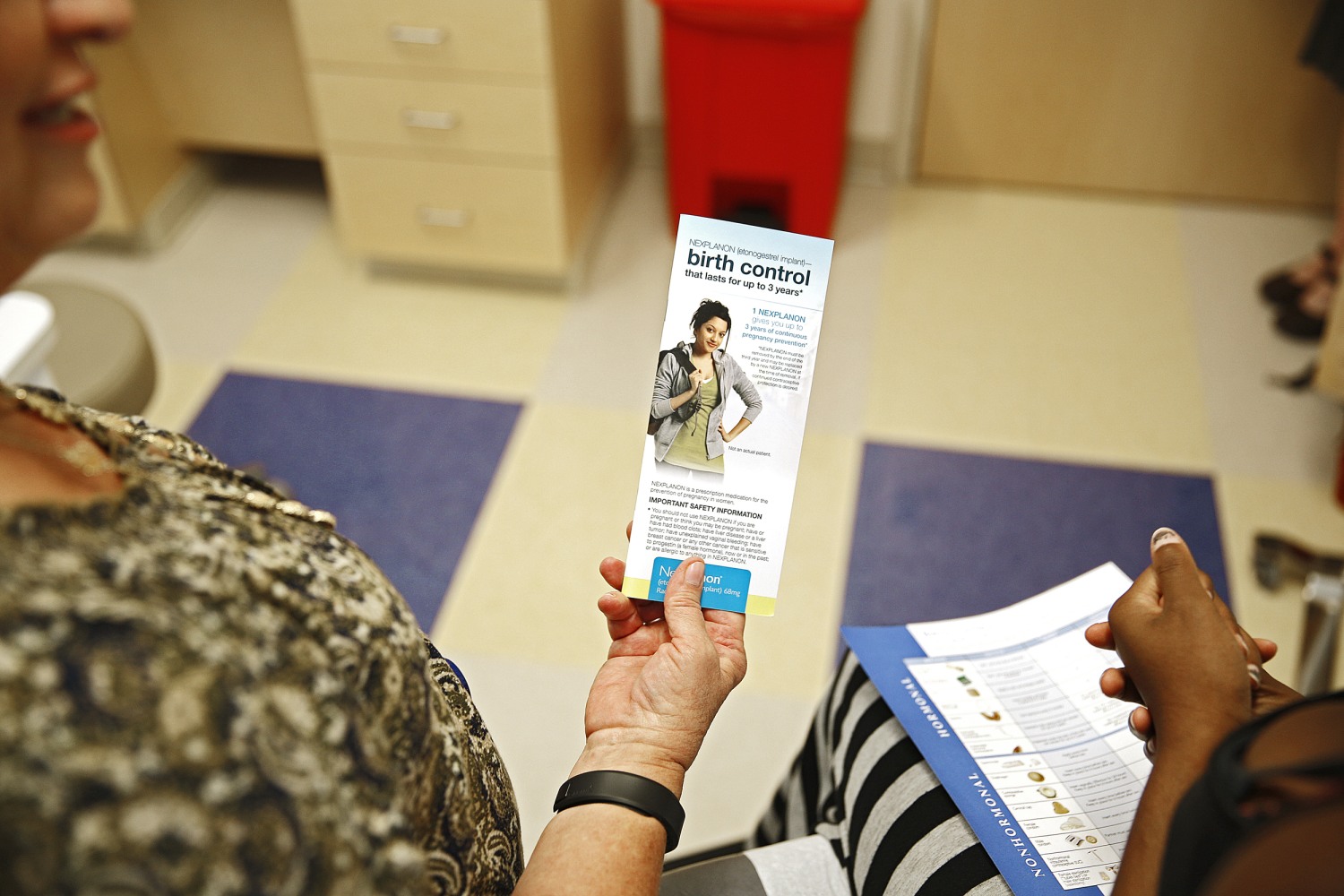
Image: A teenager has birth control options explained to her by a social worker
A teenager has birth control options explained to her at the Children’s Hospital Colorado’s Colorado Adolescent Maternity Program. Marc Piscotty / The Washington Post via Getty Images

But the Lone Star state, like the rest of the country, has experienced a marked drop in teen pregnancies. Last year, teenage births hit a record low in the United States; rates plummeted the most for black and Latina teens, the CDC found, although they’re still up to three times as likely as their white counterparts to give birth.

Many hail an evidence-based, Obama-era federal grant program as the biggest driver behind the dip. Started in 2010, the Teen Pregnancy Prevention Program gives $89 million a year to 81 organizations across the United States, including EngenderHealth.

It was renewed in 2015 for another five years.

That’s why it was so surprising to Maciel and others when, tucked away in a letter from the Department of Health and Human Services dated July 3, bad news arrived: The Trump administration had slashed more than $200 million from the program without warning — meaning funding would now end in June 2018, not in 2020.

The abrupt funding cut to teen pregnancy prevention, at a time when teenage births are at historic lows, has been called “highly unusual” by Senate Health Committee Democrats, especially since Congress hasn’t even voted on the 2018 appropriations bill yet. Legislators have until Sept. 30 to figure out the budget, although they could do a short-term continuing resolution and end up voting in December.

“I’ve worked at the Health Department for 10 years, and I’ve worked in international health for 20 years prior, and I’ve never seen anything like this,” said Rebecca Dineen, Baltimore’s Assistant Commissioner for Maternal and Child Health, which benefits from the grants. “It really was just this notification that your funds are ending.”

Dineen fears it could be catastrophic for Baltimore, where teen pregnancy rates have dropped by a third but are still double the rest of the state of Maryland’s and significantly higher than the national average. The city stands to lose $3.5 million, which Dineen said will affect 100 schools and about 20,000 students.

“What we’re doing is evidence-based work. We have made a 44 percent decrease in teen pregnancy in Baltimore city,” she said. “For us to be in such a position of success, to be very strategic in our work and then to have something like this happen, is very surprising.”

The Department of Health and Human Services said the grants “were subject to a rigorous evaluation” and said there was “very weak evidence of positive impact of these programs” in contrast to “promised results.”

It cited “negative or no impact on the behavior” of teens in 73 percent of evaluation results for 37 of the projects.

That’s baffling to Bill Albert, spokesman at the National Campaign to Prevent Teen and Unplanned Pregnancy in Washington, D.C., who pointed out that the teenage birth rate has declined 41 percent since 2010.

“It would be fanciful to suggest that this program alone is responsible for that 41 percent decline, but it would be nonsensical to not believe that it hasn’t had a profound effect,” he said.

Albert said he suspects Trump’s new hires at the HHS — Valerie Huber, an outspoken abstinence education advocate who was recently named chief of staff to the assistant secretary for health, plus social conservative HHS Secretary Tom Price — could be behind the cuts.

“Maybe they don’t like the content of the program,” he said. “They care more about telling kids to say ‘no’ rather than supporting programs that help teenagers.”

The data cited by HHS doesn’t tell the whole story, said Susan Zief, a senior researcher at Mathematica Policy Research, which was commissioned to evaluate some of the projects by the government.

“The evidence shows that these programs are showing promising results on a range of outcomes,” she said. But, she said, some programs might have only had positive outcomes on at least one of the program goals: for example, knowledge about pregnancy and STDs, or attitudes toward using contraceptives.

While that may not necessarily have an impact now, that type of positive outcome is important “to influencing subsequent sexual behaviors,” she added, noting that longer term research is needed.

In the meantime, health commissioners from 20 large cities have written to Price, pleading for a change of heart.

“Cutting TPPP funding and shortening the project period will not only reverse historic gains made in the U.S. in reducing teen pregnancy rates, but also make it difficult to truly understand what practices are most effective in our communities across the nation,” the letter, from the Big Cities Health Coalition, read.

Senate Democrats wrote a letter, too, calling the move “short-sighted.” They also praised the teen pregnancy prevention program as a “pioneering example of evidence-based policymaking.”

“Despite these successes, HHS has apparently elected to eliminate the final two years of TPP Program grants without cause or a rationale for the termination,” they wrote.

in the meantime, grantees are scrambling to see if they can make up for the loss of funding. In Baltimore, officials are “looking in all directions” to recoup their losses, said Dineen. And they’re hoping that if funds are appropriated back to the program, that they aren’t designated for abstinence-only education.

“I think that would be unfortunate,” she said. “Abstinence-only funding can be helpful for our elementary school grades, but there’s no evidence around abstinence education in middle and high school years.”

https://www.nbcnews.com/news/us-news/trump-administration-abruptly-cuts-funding-teen-pregnancy-prevention-programs-n795321?cid=sm_npd_ms_fb_ai

David Montero

In the latest move by states to curtail abortions, South Carolina Gov. Henry McMaster has signed an executive order to stop giving state money to any doctor or group affiliated with providing abortions.

The move is part of a growing trend. More than four decades after the U.S. Supreme Court deemed abortion legal, states are trying to place restrictions on when and how the procedure may be performed, or to cut off funding for groups that perform abortions.

South Carolina’s move is also another salvo aimed at Planned Parenthood, the largest single provider of abortions in the country, and a popular target among conservatives who oppose abortion. The group was the subject of a bill signed quietly by President Trump in April that allowed states to deny some federal funding to the nonprofit group’s operations.

“There are a variety of agencies, clinics, and medical entities in South Carolina that receive taxpayer funding to offer important women’s health and family planning services without performing abortions,” McMaster said in a statement. “Taxpayer dollars must not directly or indirectly subsidize abortion providers like Planned Parenthood.”

It is already illegal to use federal dollars for abortions except in cases of rape, incest or when the mother’s life is in danger.

Planned Parenthood officials say that abortions make up a small fraction of the services they provide, and that federal funding supports the other healthcare services the group offers.

Planned Parenthood tweeted shortly after McMaster signed the executive order, saying state residents would hold the governor accountable and ending with a one-word admonishment: “Shame.”

Trump’s signing of the bill overturned a regulation that stopped states from denying federal Title X family planning funds to places that also provide abortions. Planned Parenthood — which has three locations in South Carolina, only one of which offers abortions — fell under the scope of that bill, which narrowly passed earlier this year with Vice President Mike Pence casting a tie-breaking vote in the Senate.

South Carolina is just the latest state to take aim at Roe vs. Wade, the 1973 Supreme Court decision that allowed abortion. The executive order follows the state’s decision last year to ban doctors from performing abortions after the 20th week of pregnancy. That law also doesn’t allow for an exemption if the fetus has a fatal defect in the womb, and also makes no exceptions for rape or incest cases.

Carole Joffe, a professor at the Bixby Center for Global Reproductive Health at UC San Francisco, notes that conservatives who oppose abortion rights have been steadily passing restrictive state laws and making abortions almost unattainable in some states.

Some states may only have one abortion provider, making it difficult and expensive for many low-income women to get abortions. The lack of access due to tough state restrictions, Joffe says, has effectively made abortion not an option for some women.

“Trump’s election may change this and the women’s marches may change this, but historically, Democrats have been much more mobilized around presidential elections and congressional races,” she said. “Republicans have done a much better job in bringing people though the pipeline of local races — school board, then state assembly and state senate. Democrats haven’t paid as much attention at this level.”

When Barack Obama was elected in 2008 and Democrats controlled both houses in Congress, Republicans got to work. In the 2010 midterm election, the GOP cashed in at the congressional and state legislative level and among governorships.

State legislatures swung to the GOP as well — with 25 states entirely controlled by Republicans. There are only five states where Democrats are in control of both the governor’s seat and the legislature. Republicans also hold 33 governor’s seats.

The Guttmacher Institute, which advocates for reproductive rights including abortion, reported that since Republicans began dominating at the state level after President Obama’s election, hundreds of state measures have been passed that have choked off access to abortions.

Iowa and Kentucky joined about 16 other states that restrict abortions after 20 weeks — though federal courts have said they violate Roe vs. Wade. Tennessee passed a law requiring that two doctors confirm a fetus is not viable before an abortion can be provided at 20 weeks or later, except in a medical emergency.

Arkansas and Texas joined Mississippi and West Virginia in passing bans on a procedure used in the second trimester referred to as dilation and evacuation — though the courts have stepped in to block the bans. Last week, however, Arkansas appealed that federal court order.

The Guttmacher Institute reported this year that the abortion rate in the United States declined 14% between 2011 and 2014 — a record low as the number of procedures fell below 1 million annually.

McMaster’s executive order was praised by National Right to Life, an antiabortion nonprofit, and the Susan B. Anthony List, which has fought to defund Planned Parenthood.

Carol Tobias, president of National Right to Life, said that until Roe vs. Wade can be overturned — something she is optimistic about if Trump gets to appoint another U.S. Supreme Court justice — the state strategy has been effective, and she applauded McMaster’s executive order.

“There is no reason tax dollars should be used to pay for abortions,” Tobias said. “And organizations that provide abortions or have them offered on site shouldn’t receive those public funds either.”

http://www.latimes.com/nation/la-na-abortion-south-carolina-20170827-story.html?utm_source=nar.al&utm_medium=urlshortener&utm_campaign=FB


In response to steps taken by anti-abortion activists, abortion rights advocates gather outside an independent clinic in Louisville, Ky., in July. (Image courtesy of @NatAbortionFed/Twitter)
Emily Wells
​Emily Wells is an Ear to the Ground blogger at Truthdig. As a journalist, she began as a crime reporter at the Pulitzer-winning daily newspaper, The Press-Enterprise…

A new report by the Abortion Care Network shows that in the past five years, almost one-third of independent abortion clinics have been forced to close.

Independent clinics traditionally provide the majority of U.S. abortion care. “Anti-abortion politicians and extremists are forcing these clinics to close at an alarming rate,” said Nikki Madsen, executive director of the Abortion Care Network.

Rewire writes about the report:

The 12-page report paints a bleak picture of the state of abortion access at the nation’s remaining independent clinics. Fifty-six clinics have closed in the past two years, and 145 have shut down since 2012, leaving 365 left in the United States. Texas, a state leading the nation in harsh anti-abortion restrictions, saw the most independent clinics close: 20. But progressive states like California also had a high number of closures—15 between 2012 and this year.

Today, Kentucky and four other states—Mississippi, North Dakota, West Virginia, and Wyoming—are down to a single independent abortion clinic. In Arkansas, Oklahoma, Georgia, and Nevada, independent clinics are the sole providers of surgical abortions after 10 weeks. Without these clinics, the report suggests, the only option for pregnant people would be a medication abortion. Independent clinics are also more likely to offer abortion at every stage of pregnancy.

For women in need of safe abortion care, the closure of these clinics is disastrous. “Meaningful access would absolutely not be available without these clinics,” Madsen told Bustle. “Independent abortion care providers make the right to abortion a reality, they provide the most abortions in the U.S., and in several states are the only place a woman can go to end her pregnancy. The way that these restrictions are coming out are specifically with the goal to close clinics, and they have nothing to do with women’s healthcare or the wellbeing of women.”

Women often prefer independent abortion clinics over other venues such as hospitals because the clinics charge less. The economic accessibility of these clinics matters: Those hit hardest by the closures come from economically marginalized communities and are more likely to be people of color. Nearly half the women who seek abortions live below the poverty line. Colorlineswrites:

Because they are independent and often for-profit, it’s hard to pinpoint the demographics of the women who go to independent abortion providers. So while we know that, according to 2013 data, 14 percent of Planned Parenthood patients are black, 22 percent are Latina and most are on Medicaid, independent providers can choose whether or not to collect race data about their patients. Women of color, particularly blacks and Latinas, have the majority of abortions in this country, and are therefore likely to be using an independent provider.

Independent clinics are also more likely to provide broader women’s health services—the majority of clinics providing abortions after the first trimester are independent. The Abortion Care Network report estimates that without these independent providers, access to abortion after 16 weeks would decline by 76 percent, and access after 19 weeks would be virtually nonexistent.

While Planned Parenthood is an easy target for anti-abortion activists, it also has more visibility and resources to fight back against TRAP laws aimed at making safe abortion harder for women to acquire. Smaller independent clinics often lack the funds to fight, making them easier targets for shutdowns.

In past months, events in Kentucky have highlighted the nationwide offensive against independent abortion clinics. Anti-abortion activists went to extreme measures to attack the state’s last remaining abortion clinic, harassing patients and providers and projecting an abortion procedure on a 12-by-18-foot screen.

The Kentucky legislature is under Republican control, and Republican Gov. Matt Bevin has been vocally anti-choice. Since Bevin’s election in 2015, the state has passed measures making it more difficult to get an abortion, banning the procedure after 20 weeks of pregnancy and requiring that doctors “narrate ultrasounds in detail,” even to patients who object. The ACLU has filed a challenge to the ultrasound measure, and the case is scheduled for September.

As more clinics close throughout the country, the “healthy ecosystem of abortion care” will be jeopardized, Madsen said. “Abortion care cannot become a monopoly” of clinics that survive.

Nationwide Offensive Devastates Independent Abortion Clinics

Is the United States falling behind in women’s rights? 

Story highlights

  • Stephanie Coontz: Women have made advances since Nixon named Women’s Equality Day in 1973, but it’s far from enough
  • She says progress has been slow on earnings equality, and setbacks on reproductive rights, social and cultural attitudes not encouraging

Stephanie Coontz is director of research at the Council on Contemporary Families, which is hosted by the University of Texas at Austin. She is the author, most recently, of The Way We Never Were: American Families and the Nostalgia Trap. The views expressed in this commentary are her own.

(CNN)In 1973, when President Richard Nixon proclaimed August 26 Women’s Equality Day — commemorating the day in 1920 that women won the right to vote — a woman could still be denied housing by a real estate broker or credit by a bank, simply because of her gender.

Employers could fire a woman who became pregnant. Many states had “head and master” laws giving husbands final authority in the family, and in no state was marital rape a crime. As late as 1977, two-thirds of all Americans still believed that men should earn the money and women should take care of the home.
So it was something of an understatement when Nixon noted that “much remains to be done” to attain “full and equal participation of women” in society. Indeed, the events of the last year and a half — from the “Access Hollywood” video in which the man who is now president uses vulgar words about women’s genitals, to challenges to women’s reproductive rights, to the routine, vicious online attacks on women by what sometimes seems to be an army of trolls — suggest that, 44 years later, much still remains to be done.
But a review of the changes in gender relationships since the 1970s suggests good reason for confidence in our ability to move forward, though certainly not for us to become complacent.
Today the blatant discrimination described above, for example, is illegal, and Americans overwhelmingly support, at least in principle, the ideal of gender equality. In one recent survey, 93% of adults said women should have equal rights.
But the very popularity of the ideal of gender equality, combined with the fact that inequalities are now perpetuated in more subtle ways than in the past, has led some people to conclude that there is nothing more to strive for. The same poll above found that fully 20% of respondents believed gender equality has already been achieved and no more work is needed.
This view ignores the minority of Americans who deeply resent the women’s movement, falsely claiming that women’s gains have come at men’s expense. And it overlooks some serious recent setbacks for women.

Still, it’s worth emphasizing the good news

Some of the most dramatic improvements for women have been in personal relationships. Rates of intimate partner violence have fallen steadily since the early 1970s, a decline that has accelerated since the early 1990s. Rape, sexual assault, and sexual harassment are still too widespread, but women have new options to expose the perpetrators and fight for justice.
Marriages are more equal. In the 1970s, a woman with more years of formal education or higher earnings than her husband faced an increased chance of divorce. Today, the extra divorce risk associated with women’s higher achievements has disappeared.
Fathers have doubled the time they spend interacting with their children, and tripled the routine physical care, such as changing diapers, that many men used to shun. That carries a bonus for both sexes: Couples who share housework and childcare equally now report the highest levels of marital and sexual satisfaction.

More remains to be done

Ivanka Trump has proposed a paid parental leave policy, but it is nowhere near as comprehensive as the work-family policies that are standard in most advanced nations and include flex time, universal health care, and affordable, quality child care. In the absence of such support systems, it’s no accident that American parents report much lower happiness compared with non-parents than in any other of 22 countries recently studied.
Similar limits exist to the very impressive gains American women have made in education and earnings. In 1973, women earned just 57 cents for every dollar earned by men — a gap of 46 cents. By 2015, the gap had fallen to 17 cents — even lower for childless women, who earn 96 cents for every man’s dollar.

Not yet equal

Indeed, women have “caught up” in their earnings largely because of their high rates of college completion, which allow them to pull ahead of less-educated men and women. But they still lag behind men with the same education.
Today, according to sociologist Philip Cohen, the average female with a BA makes much more than a male high school graduate, but 28% less than the average man with a BA.
This reversal is confusing to many men who grew up seeing their low- or middle-earning fathers making more money than almost any woman. As a result, some men blame their economic plight on the increase in gender equality rather than on the real culprit — the acceleration of wage inequality.
Meanwhile, although women on the higher rungs of the pay ladder are doing much better than middle and low wage-earners of both sexes, they actually face a wider gender wage gap in comparison to their male counterparts than in the past. In consequence, some high-powered women focus on the glass ceiling rather than the sinking floor that holds back so many men and women alike.
Racial disparities add more complexities to the gender equality picture. Despite the rise of an affluent African-American and Hispanic middle class, minorities continue to fare worse than their white counterparts, even as white low wage workers also lose ground.
Between 1980 and 2015, white women narrowed the gap in hourly wages with white men by 22 cents, but black and Hispanic women narrowed the gap with white men by only 9 and 5 cents respectively.
And the wage gap between white men and black and Hispanic men didn’t budge at all.

Nixon called it

There’s no question that women’s lives and options are better than when Women’s Equality Day was first proclaimed. But progress has been slow on the earnings equality front, and there have been some recent big setbacks in politics and culture.
In 1964, two former presidents, Dwight Eisenhower and Harry Truman, were proud to co-chair a fund-raising committee for Planned Parenthood. Today, the very existence of Planned Parenthood is under attack. And even though two-thirds of voting age adults support wide access to reproductive health care and pregnancy prevention, the Trump administration plans to defund a national teen pregnancy prevention program, returning to abstinence-only sex education.
In 1973, the Supreme Court ruled that the right to privacy included a woman’s right to decide whether or not to terminate a pregnancy. Yet over the last six years, states have passed 369 laws aimed at restricting women’s access to abortion.
The new administration has seemed singularly uninterested in recruiting and promoting women, and it recently repealed the Fair Pay and Safe Workplaces Executive Order, scrapping two rules that are essential protections for women workers.
The Fair Pay order required wage transparency, so people can actually see if they are being paid less for the same job than a colleague. The Safe Workplaces order prohibited forced arbitration for sexual-harassment cases, which often protect perpetrators by keeping proceedings out of the public eye.
And our President has used “the bully pulpit” more to encourage than to stop bullying. On top of this comes the surfacing of a newly-invigorated white supremacy movement, which is also a male supremacy movement that claims the “only real duty” of a white woman is to reproduce, while black and Hispanic women should be discouraged from doing so.
The good news here is that this retrograde movement is small and, according to a recent Quinnipiac poll, most Americans (64%) realize it poses a threat to the US. Unfortunately, more than a third (34%) believe it does not — representing yet another way in which it is abundantly clear that, as Nixon said, much remains to be done for women’s equality.


GERMANTOWN, MD – Sarah Singer (holding a crucifix) from Gaithersburg, MD winces as she was listening to a speaker give details about what a late-term abortion entails. A memorial, prayer vigil, and a press conference was held by various anti-abortion groups in February 2013 after the death of a 29 year-old woman who apparently died from abortion complications at Germantown Reproductive Health Services . Photo by Michael S. Williamson/The Washington Post (Michael S. Williamson/THE WASHINGTON POST)
A Maryland abortion clinic, one of only a few that provides late-term abortions to women in the United States, plans to close its doors and is under contract to be purchased by an antiabortion group that has worked for many years to shut it down, according to an official with the coalition that has plans to buy it.

If the sale goes through this fall, the new owners of the Germantown clinic will soon be owned by the Maryland Coalition for Life, a grass-roots organization that has staged regular protests at the clinic and, in 2011, opened up a crisis pregnancy center across the parking lot to counsel women against choosing abortion.

“It’s a miracle. You fight for something for seven years, and all of a sudden it’s handed to you,” said Dennis Donnelly, media director for the coalition. He said that a donor came forward this summer, and the group raised additional funds to make an offer to buy out the owners of the facility.

The clinic — Germantown Reproductive Health Services — has been operating for more than 20 years, but it became a central target for antiabortion activists nationwide when LeRoy Carhart, a Nebraska doctor who performs late-term abortions, came to work there in late 2010.

The owners of the property declined to comment for the story, under an attorney’s advice. The Washington Post is not publishing their names due to their privacy concerns. They also own an abortion clinic in Prince George’s County that does not provide late-term procedures. The fate of that clinic is unclear.

Three other members of the Maryland Coalition for Life did not respond to interview requests, and one who is closely involved with the deal declined to comment.

Carhart issued a statement Thursday that said the clinic will continue to provide care for patients “until we’re forced to close our doors.”

“I am doing everything in my power to keep my practice open, and I am considering options looking toward the future,” he said. “It’s heartbreaking that anyone would want to take health care away from women and families by targeting our clinic.”

Local abortion rights activists said that Carhart had assured them Thursday that he would continue to provide late-term abortions at a new clinic he was in the process of opening somewhere in the region.

“I have spoken to Dr. Carhart and he is in the process of trying to get his facility operating,” said Diana Philip, executive director of NARAL Pro-Choice Maryland. “It will be the same clinic staff and they are hoping not to have any interruption in providing this service.”

The new clinic could be operating this fall, she said.

Carhart is one of a few physicians in the country who offers abortions in the later stages of pregnancy, usually defined as beyond 26 weeks after a woman’s last menstrual period. Many states have banned surgical abortions after 20 weeks, and not many doctors have experience with the technique.

Advocates for abortion rights say there is an unmet demand for late-term abortions, particularly from women who learn late in their pregnancies about fetal abnormalities and sometimes from women, who are young or living in stressful circumstances and do not find out they are pregnant until late.

The Germantown clinic was one of three facilities where the procedure was regularly performed, Philip said, with the others in Boulder and Albuquerque.

The Maryland clinic has drawn patients from a huge portion of the country. “Without it, you’re talking about people in the eastern United States traveling to Colorado and New Mexico,” Philip said.

Carhart, a retired Air Force surgeon, began providing late-term abortions at his clinic near Omaha in 2009 after George Tiller, a mentor who performed the procedures, was assassinated while attending church in Wichita.

Carhart, now 75, began commuting long-distance to Maryland to work at the Germantown clinic after Nebraska made it illegal to perform most abortions beyond 20 weeks.

Protests were organized as soon as he arrived. Picketers were a regular presence near the clinic. They launched letter-writing campaigns and candlelight vigils.

Some activists picketed outside the Montgomery County middle school attended by the daughter of one of the clinic’s landlords during back-to-school night, waving a large banner that showed the owner’s photo, name, phone number and the words “Please STOP the Child Killing.”

A few months after Carhart arrived, the coalition opened a crisis pregnancy center across the parking lot from the clinic to counsel women to choose alternatives to abortion. As part of the coalition’s “Kick Out Carhart” campaign, the organization has attempted to document the number of women who came and go each day. The website also has posted pictures of ambulances outside the facility.

In 2013, a 29-year-old woman died after having a late-term abortion at the clinic. The case garnered national attention from antiabortion activists and intensified calls to close it down. Maryland health officials who investigated the case ultimately found “no deficiencies” in her care.

Troy Newman, president of Operation Rescue, said the clinic’s closure represents a hard-won victory, after years of protests against Carhart. “We were there the first day the dreadful Mr. Carhart showed up. And we are delighted to see him leave,” Newman said.

He said the closure is another example in a long line of clinics that have been shuttered because “we forced them out of business.” Newman said the Wichita headquarters of the antiabortion organization he works for is located in a former abortion clinic that was put up for sale after it fell behind in rent.

Since 2012, 145 independent abortion clinics — nearly a third — have closed, according to a report released this week by the Abortion Care Network, an association of abortion providers that are not affiliated with doctor’s offices, hospitals or Planned Parenthood.

The closures have coincided with a wave of strict new laws favored by antiabortion politicians, but that’s not the only reason the clinics are being shuttered. Even in blue states, clinics are struggling to keep afloat as physicians retire and as they struggle to make ends meet.

The U.S. abortion rate in 2014 fell to the lowest level since Roe v. Wade, the 1973 Supreme Court decision that legalized abortion nationally, according to a report published in January by the Guttmacher Institute, a research organization that supports abortion rights.

https://www.washingtonpost.com/local/social-issues/maryland-provider-of-late-term-abortions-under-contract-to-be-purchased-by-antiabortion-group/2017/08/25/78f91b94-89ac-11e7-a50f-e0d4e6ec070a_story.html?utm_term=.c912283755f9

20 years after The Vagina Monologues, I’d like to say that feminists have won. But patriarchy is a virus and we are in the midst of a massive outbreak

Brooke Sheilds and Gloria Reuben perform Eve Ensler’s The Vagina Monologues on V-Day 2001.
 Brooke Shields and Andrea Martin perform Eve Ensler’s The Vagina Monologues on V-Day 2001. Photograph: Scott Gries/Getty Images

The first time I ever performed The Vagina Monologues, I was sure somebody would shoot me. It might be hard to believe, but at that time, 20 years ago, no one said the word vagina. Not in schools. Not on TV. Not even at the gynaecologist. When mothers bathed their daughters, they referred to their vaginas as “pookis” or “poochis” or “down there”. So when I stood on stage in a tiny theatre in downtown Manhattan to deliver the monologues I had written about vaginas – after interviewing over 200 women – it felt as if I were pushing through an invisible barrier, and breaching a very deep taboo.

But I did not get shot. At the end of each performance of The Vagina Monologues there were long lines of women who wanted to talk to me. At first, I thought they wanted to share stories of desire and sexual satisfaction – the focus of a big part of the play. But they were lining up to anxiously tell me how and when they had been raped, or assaulted, or beaten, or molested. I was shocked to see that once the taboo was breached, it released a torrent of memories, anger and sorrow.

And then something I never could have expected took place. The show was picked up by women all over the world who wanted to break the silence in their own communities about their bodies and their lives.

Memory one. Oklahoma City, the very heart of the Republican heartland. A tiny warehouse. The second night, word has gotten out about the play and there are too many people and not enough seats, so people arrive with their own lawn chairs. I am performing under what is essentially a light bulb. In the middle of a monologue, there is a great scuttling in the crowd. A young woman has fainted. I stop the play. The audience takes care of the woman, fanning her and getting her water. She stands up and declares what the play has emboldened her to say, for the first time: “I was raped by my stepfather.” The audience hugs her and hold her as she weeps. Then, at her request, I continue with the show.

Memory two. Islamabad, Pakistan. The The Vagina Monologues is banned. So I attend an underground production where brave Pakistani actors are performing the play in secret. There are women who have come all the way from Taliban Afghanistan in the audience. Men are not allowed to sit in the audience, but instead sit in the back, behind a white curtain. During the performance, women cry and laugh so hard their chadors fall off.

Memory three. Mostar, Bosnia. The performance is to commemorate the restoration of the Mostar Bridge, which was destroyed in the war. The crowd is comprised of both Croats and Bosnians, who had been slaughtering each other so recently, and there is tension and uncertainty. Women read a monologue about the rape of women in Bosnia. The audience weeps, wails, screams out. The actors stop. Audience members console each other, hold each other and weep together – Croats holding Bosnians, and vice versa. The play resumes.

Memory four. Lansing, Michigan. Lisa Brown, a state representative, is reproached and silenced by state legislature for using word “vagina” in protesting a proposed bill restricting abortion. You are not allowed, she is told, to say that word. Two days later I fly to Lansing and join Lisa Brown and 10 female house members on the steps of the Statehouse for an emergency performance of The Vagina Monologues. Close to 5,000 women attend, demanding that our body parts be named and recognised in our own democratic institutions. The taboo is broken. We can speak and be seen.

Shortly after the play was launched, with a group of other feminists, I helped form a movement called V-Day, to stand with all the women (cisgender, transgender and gender non conforming in all our colours) who were carrying out these fights across the world. Since then V-Day activists, through their productions of the monologues have raised more than $100m to support centres and shelters for rape and violence survivors, to fund hotlines, to confront rape culture.

And now, 20 years later, I wish for nothing more than to be able to say that radical anti-racist feminists have won. But patriarchy, alongside white supremacy is a recurrent virus, like herpes. It lives dormant in the body politic and is activated by toxic predatory conditions. Certainly in the US, with an openly racist and misogynist predator-in-chief, we are in the midst of a massive outbreak. Our job, until a cure is found, is to create hyper-resistant conditions that build our immunity, and will make more outbreaks impossible. It starts where The Vagina Monologues, and so many other acts of radical feminist resistance, begin – by speaking out. By saying what we see. By refusing to be silenced.

They tried to stop us even saying the names of some of the most precious parts of our bodies. But here’s what I learned. If something isn’t named, it is not seen, it doesn’t exist. Now more than ever it’s time to tell the crucial stories and say the words, whether it’s vagina, “my stepfather raped me” or the president is a predator and a racist.” When you break the silence you realise how many other people have been waiting for permission to do the same thing. We will not be silenced again.

https://www.theguardian.com/commentisfree/2017/aug/24/20-years-after-the-vagina-monologues-breaking-silence-is-still-a-radical-act

Councillor Sarah Doucette is fighting back against the young anti-abortion protesters who’ve taken to the streets of Toronto.

Anti-abortion activists have ramped up signage in some of Toronto's high-traffic intersections. Here, activists hand out flyers on Wednesday at the corners of Yonge St. and St Clair Ave.
Anti-abortion activists have ramped up signage in some of Toronto’s high-traffic intersections. Here, activists hand out flyers on Wednesday at the corners of Yonge St. and St Clair Ave.  (RANDY RISLING / TORONTO STAR) | ORDER THIS PHOTO  

As Toronto’s increasingly young anti-abortion movement ramps up its graphic on-street displays, at least one city councillor is fighting back.

On Saturday, Councillor Sarah Doucette (Ward 13, Parkdale-High Park) joined concerned families in her neighbourhood of Swansea to counter-protest against what she calls “vulgar” signs imposed on people in her community against their will.

After neighbourhood residents filed complaints with Toronto police about those carrying graphic billboards in their busiest intersections, they were told protesters weren’t breaking any laws.

So long as they don’t block traffic or harass people, the posters aren’t technically illegal.

Now Doucette, after talking to police several times, is taking her cause to city council to pass a bylaw that ban these types of signs.

The group calls itself the Canadian Centre for Bioethical Reform. With an office in Mississauga, it hired 19 high school and university “interns” this summer to spend four months spreading its message on street corners.

In Calgary (home to the group’s other office), bylaws like the one Doucette hopes this city will pass have already been enacted.

“We’re not stopping them from standing on the street, talking to people or handing out flyers, but we’re just stopping them being in people’s faces. You really cannot get away from them. That’s where people are feeling it is harassment,” said Doucette, who insists they are a distraction to drivers.

Parents in the Swansea area use a Facebook group to warn each other about the whereabouts of the signs.

Sometimes, police will visit the protesters to tell them not to harass people. But that’s difficult when they frequently change intersections.

“I don’t think anyone is against freedom of speech,” Doucette said. “Women find them very upsetting if you have lost a baby, this is very hard to see these sorts of images. Residents are just saying to me, ‘We don’t want to be going about our day-to-day lives and be confronted with these giant images.’”

The protests target busy intersections during Toronto’s lunch-hour rush, leaning over their chest-high posters as crowds of people — and children — impatiently wait to cross the street.

On Wednesday, nearly a dozen of the group’s interns stood on both of the south corners at Yonge St. and St. Clair Ave.

Many stopped to argue with the protesters. Others shielded their children’s eyes or shut the front of their strollers. Some yelled at them to turn their boards around, or stopped their cars at red lights to yell profanities about the vulgarity of the images. While most bypassed them or ignored their handouts, some stopped to talk to them.

“If you’re going to argue that this is a person, you can’t treat them like an object in the image,” said Sarah Hamilton, who is anti-abortion but still stopped to argue with the protesters over their tactics.

“Using their image to display is objectifying them.”

The protesters call abortion a human rights violation and claim “300 children are dismembered, decapitated and disemboweled” every day in Canada. They are ultra-polite in the face of anger and tell passersbys that if the images offend them, that they should be offended by abortion — not the signs.

“I think it’s a lot worse to bring a child into the world that’s going to be unloved than to not bring it into the world,” said Shoshana Abramovitz, who stopped for nearly half an hour to talk with one of the protesters. “You should have the right to choose. It’s pretty hard (to look at).”

On Wednesday, 22-year-old Oriyana Hrychyshyn was in charge of the interns and stood behind a sign of her own. The night before, on a phone call, her boss Devorah Gilman was reciting the same lines.

“We want to put an end to abortion in our country,” Hrychyshyn said. “They’ve been trained to go out day-in-day-out on the street and expose the realty of abortion and what it does to pre-born children.”

They are backed by Westminster Chapel at High Park’s senior pastor Rev. Joseph Boot, who calls the group one of Canada’s “most important educational organizations” and says they are re-educating the country on “the true nature of this hidden atrocity.”

But Kathi Ziolkowski said the group doesn’t represent Christian values. She is a 47-year-old mother of two who grew up in a deeply religious family, and has tried to explain to the protesters the impact of their images on her community.

“If they did want people to understand the sanctity of life, that might not be the way that’s going to win people over,” she said. “Maybe if there were other ways, rather than trying to use shock and sensationalism, they might be more successful.”

https://www.thestar.com/news/gta/2017/08/23/torontos-anti-abortion-protests-grow-as-city-councilor-moves-to-make-vulgar-signs-illegal.html

“This kind of act, which is intended not only to intimidate abortion providers and Planned Parenthood … is also intended to intimidate people who support Planned Parenthood.”

Planned Parenthood mailers defaced with threatening messages were found last week in the mailboxes of several residents in Apple Valley, Minnesota. The mailers were defaced with the words “death” and “die,” and reproductive rights advocates view the incident as part of an escalating attack on abortion providers.

The U.S. Postal Service is reportedly investigating the incident.

Nika Davies, a resident of Apple Valley, told KMSP that she found the mailers “disconcerting” because she could not identify who had sent the mailers. “I didn’t feel threatened until later and then thought, ‘I don’t like getting anything that says “death” on it,’” Davies said.

Planned Parenthood operates 17 reproductive health care facilitiesthroughout Minnesota, including Apple Valley, a suburb of the greater Minneapolis-Saint Paul metropolitan area. The Planned Parenthood Apple Valley clinic does not provide abortion services.

These threats come as abortion providers across the United States face increased levels of harassment and threats of violence, which has affected the ability of pregnant people to access abortion care.

duVergne Gaines, director of the Feminist Majority Foundation’s National Clinic Access Project, told Rewire that abortion providers have long been a target of intimidation and harassment, but the apparent targeting of Planned Parenthood supporters is especially troubling.

“This kind of act, which is intended not only to intimidate abortion providers and Planned Parenthood … is also intended to intimidate people who support Planned Parenthood. I think that is something I find very insidious about this particular act,” Gaines said.

Gaines believes that the increasingly hostile rhetoric from lawmakers opposed to abortion rights and misinformation campaigns that have been propagated by conservative media have contributed to a hostile climate for abortion care providers.

“I think that the rhetoric by some of these lawmakers is irresponsible and reckless,” Gaines said. “It places physicians and women’s health care providers in the scope of these extremists, and helps declare an open season on them.”

State Rep. Erin Maye Quade (D-Apple Valley), told KMSP that her parents received one of the defaced mailers, and it seems like a “targeted attack” on the people who received the mailers. “We know there is heavy rhetoric surrounding the issue of pro-choice, anti-choice, so having ‘die’ on your mail is not only a crime, but it is very scary,” Quade said.

Gov. Mark Dayton (D) in May vetoed a pair of anti-choice bills passed by the Republican-controlled state legislature.

This year abortion clinics have been subjected to large scale protests and threats of violence. Radical anti-choice activists descended on Louisville in May and laid siege to Kentucky’s last remaining abortion clinic, and an abortion clinic in Virginia received a bomb threat in April.

Abortion clinics throughout the country face an unrelenting and increasing amount of anti-choice harassment and threats, according to a report by the National Abortion Federation (NAF).

In 2016, clinics across the country reported nearly 43,000 incidents of hate mail and internet harassment, compared to nearly 26,000 incidents in 2015. Clinics reported nearly 62,000 instances of picketing during 2016, compared to around 22,000 instances in 2015.

“There are providers in every state of the union that are experiencing this rise in extremely virulent protests whose conduct is crossing the line from free speech into possibly stalking, trespassing, threatening,” Gaines said. “That is happening now on such a large and wide scale that it is incredibly concerning.”

Planned Parenthood of Minnesota, North Dakota, South Dakota told Rewire that the organization could not comment on the incident due to the ongoing investigation.

The USPS confirmed that there is an investigation into the incident, and said in a statement to KMSP that it is unknown whether the threats were from a postal service employee or another person.

https://rewire.news/article/2017/08/25/planned-parenthood-mailers-defaced-minnesota/