Our vision for a healthy, thriving society—with access to and support for the health care we need—requires it.

Lauryn Gutierrez / Rewire
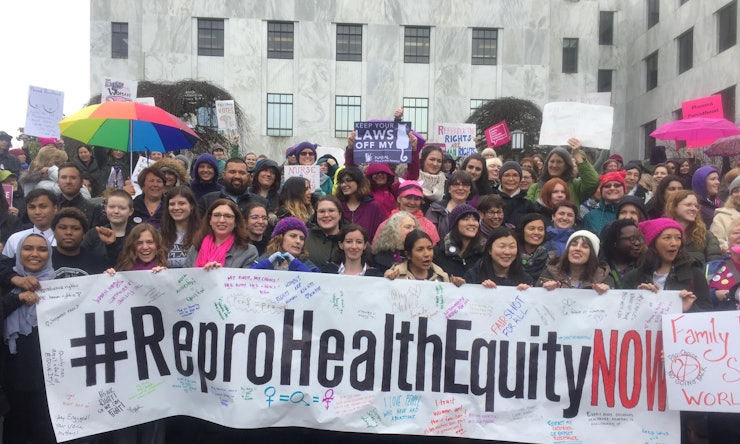
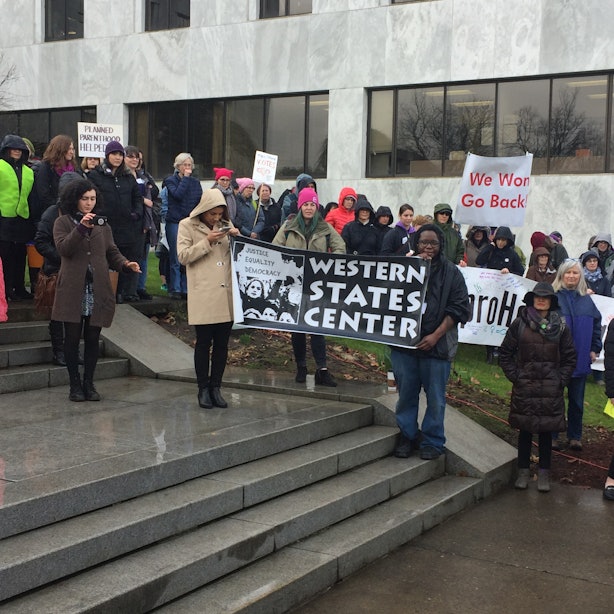
Over the past several years, the country has seen a steady drumbeat of bad news out of state capitols when it comes to reproductive health and rights. That trend continued in 2017, as conservatives possessed historic control over state legislative chambers nationwide.
The good news: There’s now widespread recognition of the power of states and the need to channel resistance efforts toward reclaiming progressive control from the ground up. State leaders are pushing back against the Trump administration’s agenda on a variety of fronts, and women are at the center of these efforts. As progressives rebuild, and as debates that ought to be settled threaten to resurface, we must make sure that the voices of those most affected by anti-choice efforts are heard—and that reproductive autonomy continues to be a central tenet of the progressive agenda. As the director of the State Innovation Exchange’s (SiX) new Reproductive Rights Program, I’m committed to making this goal a reality.
Conservatives’ drive to roll back reproductive rights is nothing new. States have been laboratories for testing anti-abortion policies for decades. But since 2010, conservatives have accrued a historic number of state legislative majorities, and anti-abortion legislation is at a fever pitch. In 2017 alone, 1,257 provisionsrelated to reproductive health were introduced at the state level. And since 2010, state legislators have enacted more than 350 abortion restrictions across the country. Restrictions have included unnecessary clinic regulations intended to shut down providers, biased counseling requirements, mandatory delays before receiving care, and more.
This avalanche of abortion restrictions at the state level was no mistake. It was a calculated, purposeful strategy driven by national anti-abortion organizations capitalizing on well-funded conservative state legislators. When conservatives won back so many majorities in 2010, they were prepared to act—thanks to a years-long financial investment to the tune of hundreds of millions of dollars from huge donors like the Koch brothers. Republicans’ party platform has explicitly called for a constitutional amendment outlawing abortion, and they now control more than 30 governorships, the majority of state attorney general offices, and two-thirds of all state legislative chambers. The consequences are clear.
The effect of conservatives’ try-everything strategy extends well beyond the impact of the policies themselves. Even when abortion restrictions don’t pass, legislators learn from them. State lawmakers who push these restrictions gain real-time feedback on how to message them from their constituents, the press, and their colleagues. They learn who their legislative allies and opponents are—and how strongly they will or will not fight back. They also learn whether and how the media will cover their efforts, and they can gauge the public’s willingness to accept junk science and outrageous claims. Additionally, the sheer volume of abortion restrictions and the resulting media coverage contribute to a culture of abortion stigma.
And though the results are expensive and outrageous, state legislators who repeatedly introduce restrictive legislation learn how to better advance their anti-women agenda. They become part of a pipeline of elected officials who know how to enact these restrictions. In fact, some of Congress’ leading proponents of criminalizing abortion, like U.S. Reps. Trent Franks (R-AZ) and Matt Gaetz (R-FL), began their careers pushing abortion restrictions in their own statehouses.
Meanwhile, progressive legislators have historically been under-resourced and under-supported, lacking training opportunities and access to the messaging and policy resources they need, even though public opinion—not to mention the medical community—is on our side. Seven in ten women and mencontinue to agree that Roe v. Wade, the U.S. Supreme Court case legalizing abortion, should not be overturned, and major medical organizations throughout the country continue to recognize that abortion is health care and ought to be treated as such.
So what can we do to address this gap?
The rebuilding of our state progressive infrastructure and the shoring up of our pipeline of progressive elected leaders must include explicit attention to and training around issues of reproductive health, rights, and justice. State lawmakers and leaders must boldly embrace and understand how crucial these issues are to their constituents’ well-being, and they must articulate how connected reproductive health, rights, and justice are to virtually every other part of the progressive platform. SiX’s new Reproductive Rights Program will prepare legislators for this task by helping them identify and articulate their own values around reproductive freedom, as they learn how to move the conversation beyond the four corners of their statehouse and into the hearts and minds of their communities and constituencies.
From the Stupak amendment during the 2010 health care reform fight, to the rights of D.C. residents, to ongoing debates among Beltway insiders, abortion is historically one of the first issues up for negotiation. Let’s learn from these mistakes and work to holistically incorporate issues of reproductive freedom as we invest in rebuilding our progressive movement from the state and local level up. After all, our vision for a healthy, thriving society—with access to and support for the health care we need—requires it.
https://rewire.news/article/2017/08/10/dont-leave-abortion-rights-rebuilding-state-power/














 Abortion - Abortion Clinics, Abortion Pill, Abortion Information
It’s a fairly large number, 100,000, but nice and round. Easy to compute. Most of us could even divide it by 10, at a push. Apparently it is this convenient roundedness that led the Advertising Standards Authority (ASA) this week to dismiss complaints about recent claims on a billboard that Northern Ireland’s abortion laws have saved “100,000” lives. In its statement, the ASA said: “We considered that 100,000 was a large, round number that readers would typically associate with estimates” – and was therefore unproblematic.
Funded by a campaign called Both Lives Matter, the billboard prompted 14 complaints, but the ASA decided that its assertion was not misleading – despite the campaign admitting that it is not possible to calculate an exact figure, although its estimate is both “credible” and “conservative”.
It is not just the advertisement that is misleading and offensive, but also the very name of the campaign behind the billboard.
Describing itself as “pro-women and pro-life”, Both Lives Matter is a recent addition to the Northern Ireland anti-choice landscape, where abortion is permitted only if a woman’s life is at risk or there is a very serious risk to her mental or physical health. Fatal foetal abnormalities and pregnancies resulting from sexual crime such as rape or incest are not included.
And yet, somehow, in all its talk of “both” lives mattering during a crisis pregnancy, the campaign fails ever to mention the pregnant woman. What is happening to that person’s life – their body, their dreams, their finances, their mental health – is, for a campaign seemingly more intent on oppressing women than liberating them, nothing more than a word association game meant to draw a provocative parallel with a real struggle for civil rights.
Playing on Black Lives Matter is not just cynical, it’s offensive. A campaign started by three black women – Patrisse Cullors, Alicia Garza and Opal Tometi – to highlight the gross injustice and racial dimensions of police brutality in the US, it owes much of its strength not only to the mothers of the men and women killed by police, but to women of colour writ large, who bear the brunt of America’s institutionalised racism and sexism. The concept of reproductive rights and reproductive justice, which goes far beyond the simple right to choose whether or not to continue with a pregnancy, is integral to Black Lives Matter, because it also means the right to parent your child in a safe environment without fear – something consistently denied to black families by police and institutional injustice.
Defined by the Sister Song Women of Color Reproductive Justice Collective as “the human right to maintain personal bodily autonomy, have children, not have children, and parent the children we have in safe and sustainable communities,” reproductive justice as a concept was developed by women of colour who saw many of their communities challenged not just by an absence of accessible abortion, but by poverty, racism and discrimination.
It is often poor women of colour whose access to reproductive healthcare is most affected by anti-abortion laws in states such as Texas, where the recent HB2 law increased the distance to the nearest abortion clinic by more than 100 miles in some places. This can be an insurmountable burden for women with low incomes, often women of colour, and is a pattern being repeated across America.
Concepts such as reproductive justice and campaigns such as Black Lives Matter are a response to oppression and domination. There are parallels to be drawn with abortion access in Northern Ireland, but it is not the one that anti-abortion protesters attempt to make. Rather, it is an understanding of how human rights might be used to liberate communities, rather than excuse and justify their oppression.
The hijacking of such a powerful concept by the Both Lives Matter campaign is a cynical attempt to spin the language of human rights into froth to hide their true agenda – the subjugation of women. An appropriation of intersecting oppressions, Both Lives Matter neither cares about women’s lives, nor shares an affinity with Black Lives Matter – beyond using a powerful rallying cry for human rights as a cover to maintain the marginalisation of women in Northern Ireland.
It is perhaps beyond the remit of the ASA to name this for what it is. But it is not beyond ours.
https://www.theguardian.com/commentisfree/2017/aug/04/anti-abortion-hijack-black-lives-matter-both-lives-matter-advert-northern-ireland?utm_source=esp&utm_medium=Email&utm_campaign=GU+Today+USA+-+Collections+2017&utm_term=238146&subid=15007573&CMP=GT_US_collection