Pro-choice advocates hope to to replicate the successful litigation of another anti-choice omnibus bill passed by Texas’ GOP-held legislature.
President of The Center for Reproductive Rights Nancy Northup, alongside Amy Hagstrom-Miller, speaks to the public outside of the U.S. Supreme Court on June 27, 2016 in Washington, DC. Pete Marovich/Getty Images
The GOP-backed bill was priority legislation for Texas Right to Life, the state’s most prominent anti-choice lobby. The organization praised the bill’s signingas the “most significant Pro-Life victory” of the 2017 legislative session.
Elizabeth Nash, senior state issues manager for the Guttmacher Institute, told Reuters that Texas Republicans have passed legislation replicated by GOP lawmakers in other states. “Texas legislation on abortion is typically amplified because the state can be a beacon for restrictions nationwide,” Nash said.
Reproductive rights advocates are preparing to challenge the law, hoping to replicate the successful litigation of another anti-choice omnibus bill passed by Texas’ GOP-held legislature.
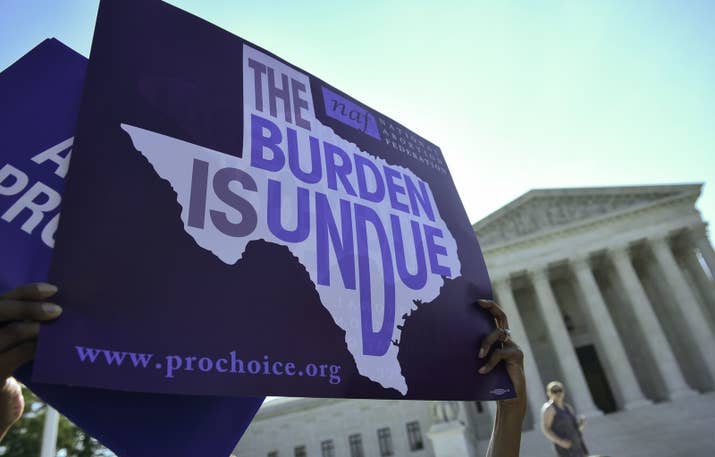
The U.S. Supreme Court last year struck down portions of the omnibus anti-choice bill known as HB 2. The Center for Reproductive Rights filed the lawsuit challenging the law on behalf of Whole Woman’s Health, and the organization has promised to challenge similar anti-choice laws. Texas faces a $4.5 million legal bill after fighting for years in defense of HB2.
The state is facing a legal challenge to the implementation of regulations on fetal tissue; SB 8 includes a provision that would codify the regulations into law. A federal judge in January issued a preliminary injunction blocking the state from implementing the regulations.
Nancy Northup, president and CEO of the Center for Reproductive Rights, said in a statement that Texas lawmakers “haven’t learned their lesson” and continue to pass legislation to restrict access to abortion care.
“The Center for Reproductive Rights has long stood with Texas women to ensure their constitutional rights are respected and protected,” Northup said. “We took Texas all the way to the Supreme Court last year and won—and will continue to challenge any laws which rob women of their rights and freedoms.”
Amy Hagstrom Miller, CEO and founder of Whole Woman’s Health, said in a statement that the Supreme Court ruled that “women deserve better” than laws that erode access to abortion care.
“Whole Woman’s Health, as always, stands with and for all Texans and we will continue to do so even after this new attempt to harm our communities,” Hagstrom Miller said. “We will also continue to challenge injustice in the courts to ensure Texas women have the same rights to quality health care our constitution promises to everyone in this country.”
Imagine an Emmy-winning showrunner inviting you into the writer’s room of a critically acclaimed TV series and asking to you to play a character based on your life story. Unheard of, right? Well, that’s exactly what happened when Jill Soloway took a shine to Ian Harvie on the set of Amazon’s Transparent in 2014.
With numerous TV guest starring roles, years spent touring at international comedy festivals and as Margaret Cho’s opening act, and now “the first trans comic special” on NBC’s digital network Seeso, interest in Harvie’s unique experience and perspective continues to grow.
Recently, Harvie was invited by yet another female entertainment visionary, Lizz Winstead, co-creator of The Daily Show and the force behind Lady Parts Justice League, to perform in the “Vagical Mystery Tour.” LPJL’s comedy tour hits 16 cities over 8 weeks this summer, serving laughs and giving support to independent abortion providers and their local communities.
“As a trans man, with a proud female history, I believe where I intersect with women on abortion rights is that all women should have the right to do whatever they need with their bodies to have a healthy, prosperous life,” Harvie tells PEOPLE. “Body autonomy should be a right for all women and all trans people. That is our shared space, and in large part, why I’m so passionate about abortion rights. I will always stand with my sisters on this issue.”
Although he has physically transitioned, the change has not tamped down his belief in promoting and protecting women’s rights. He’s firm on his stance that he didn’t transition to become part of the patriarchy or any boys club, yet Harvie is quick to acknowledge that male privilege can sometimes apply to him.
“I transitioned to feel better in my body, [but] walking through the world now, in my current body, I am generally perceived as straight, white, and male,” he says. “I don’t have to think twice about racial, gender or homophobic violence, because of my (perceived) straight, white, male privilege, and it’s something that I have to remind myself to think about regularly. I don’t want to forget it and misuse it, although I will likely falter. I know it’s difficult to deny privilege that is being given and the only way I know how to deny it, is to whenever possible, and safely do so, out myself as transgender to the people around me.”
MIKI VARGAS
Feeling comfortable in his own skin is a subject that Harvie has clearly thought about at length, and then some.
“When you have something about your body that consumes nearly all of your headspace, every day, and leaves you in discomfort, it changes how you move through the world. You wake up thinking about it, walk through the day thinking about it, you attempt intimacy with your partner or friends thinking about it, you go to bed thinking about it — it consumes a huge amount of your life,” he explains. “I used to wake up every morning and think about how to conceal my chest, which is a tall order considering I had triple D’s!”
Harvie came out to his family as trans in his early thirties, but as he tells a young fan on his website, “I knew I was different at a very early age, I just didn’t have a language for it, no one I knew did either.” This recognition was not without anxiety.
Trans Activist Juliet Evancho Opens Up About Her Sex Reassignment Surgery
Singer Jackie Evancho’s sister Juliet explains how she knew from a very young age that she was transgender.
“Everyday events could cause a major fashion dilemma or straight-up meltdown. I would go to bed hoping to wake up flat-chested or to win the lottery so I could finally afford my chest surgery. I now know I’m not the only one that goes through this, and trans people are not the only people to go through this,” Harvie says. “It took me a minute to realize that, but when I did, it was really helpful to me to not feel isolated — that there was this intersectionality with others that I hadn’t thought of before. “
In this way, Harvie is especially successful at connecting with audiences. “Personally, I will talk about anything on stage and in public spaces,” he says. “It helps erase stigma around less familiar subjects. You can’t change things if you don’t talk about them, which is another area where I think I align with Lady Parts Justice League and abortion rights.”
But that’s not all. Harvie seems to have a natural, empathic ability to relate to people from all walks of life, no matter their specific troubles or issues. “We’d all have horribly boring stories if we didn’t have struggles,” he tells PEOPLE.
“Our common ground is that we all are struggling. Eating disorders and issues with weight and food, for a lot of people, are symptomatic of something else going on. I know lots of people that use food, alcohol, drugs, sex, etc. to cope with deeper issues,” Harvie says. “We’re all in various levels of discomfort. No one feels 100% okay about their body … and if you do, then you’re the weirdo.”
Harvie backs up this point with an all-too relatable philosophy about his own “gym body,” as well as some good advice for anyone who is body-obsessed to their own detriment.
“I spent 30-something years being consumed with thoughts of concealing my body,” he says. “[Now] I want to be fit in all aspects of body wellness, which includes hitting the gym and hiking. It also means not saying mean things to myself about my own body … As a trans person, I try to remember that we all endure a lot of comments about our bodies as if they’re not our own. There are enough people in the world who make judgments about my body, I don’t need to take part in that.”
However, Harvie does take part in educating and speaking out against those who criticize, bully or harm the trans community through both his activism and his comedy.
“Until trans women of color and trans women as a whole are not being murdered or attacked for simply being who they are, or until trans people are not being disowned by their families, or until trans people are no longer fired from their jobs for needing to transition, or until trans folks are no longer denied access to housing or healthcare, there will be no ‘post-trans’ era,” he says.
We can’t cow to the notion that abortion is a hard but necessary option for a few “unfortunates.” Saying that abortion is a devastating choice or “should be rare” implies that abortion signals a personal, moral, or physical failing—and that it’s not the best decision for many women.
Dr. Lealah Pollock, a Bay Area physician and abortion provider, held this “Make Abortion Great Again” sign at the Women’s March on Washington. It sparked supportive statements but also criticism, even from pro-choice allies who balked at the sentiment.
Courtesy of Dr. Lealah Pollock
Texas has seen some of the nation’s most regressive abortion restrictions in recent years. This series chronicles the fall-out of those laws, and the litigation that has followed.
On January 21, I had the joy and privilege of marching in Washington, D.C., alongside half-a-million other people crying out for equal rights for all women. Amid a sea of pointy-eared pink knit hats, I proudly carried a sign that read “MAKE ABORTION GREAT AGAIN.”
People pointed and giggled, gave me high fives, or stared in confusion. On social media, my sign received some mixed responses. Even some pro-choice friends said that the sentiment was a counterproductive joke and that abortion was never meant to be great, only necessary.
I disagree. My sign and the idea it expressed were not jokes, and I do think abortion is great when it is a safe, legal, and accessible option for all people.
As a family physician and abortion provider in the Bay Area, I see patients choose abortion for many different reasons. A woman who desperately wanted a child chose to have a later abortion when she learned that her baby would be born, and quickly die, without a fully formed brain. Another woman who had a 6-month-old child with Down syndrome chose to have an abortion when her highly effective birth control failed. There was also a woman who was trying to leave her abusive husband and was scared of what he would do if he found out she was pregnant; she chose to end her pregnancy with medication abortion. A pregnant 16-year-old didn’t want to finish high school with a child. And a mother with two kids chose to have an abortion simply because it was not the right time in her life to have another baby.
Because I work in a state that doesn’t single out abortion for unnecessary restrictions and in a practice where medical care isn’t dictated by religious affiliation, I could provide each of these women with nonjudgmental and fact-based pregnancy options counseling. They could make an appointment at a clinic close to home. My patients could get their counseling, ultrasound, and abortion all in the same day, often covered by Medicaid or private insurance.
For each of these women, abortion was indeed great. Abortion spared the first patient the emotional and physical pain of having to deliver a baby who wouldn’t live. The second patient was able to focus her limited resources on meeting the needs of the baby she already had, a child with significant physical and developmental disabilities. For women experiencing intimate partner violence, pregnancy can be an especially dangerous time. Being forced to continue this pregnancy would likely have trapped my third patient in her abusive relationship. The 16-year-old and the mother of two were both able to decide the best path for themselves and their current or future families.
For some of my patients, choosing abortion is a hard and sad decision. But for many others, it is simply a decision—and that’s okay, too.
This is not what abortion opponents tell us. They would have us believe that abortion plummets women into depression and a lifetime of negative consequences—which simply isn’t true.
Those same anti-abortion forces have made sure that not all women are as lucky as my patients. According to the Guttmacher Institute, more than half of U.S. women of reproductive age live in states that are hostile or extremely hostile to abortion rights. Because of targeted restrictions on abortion providers, an increasing number of states, including my home state of West Virginia, are left with only one abortion clinic.
Combined with an increasing number of laws that impose waiting periods, mandate parental notification, limit the gestational age for abortion, and ban insurance coverage for abortion, the dearth of clinics means that many women are essentially left without access to abortion. For these women, Roe v. Wade is meaningless. Abortion might as well be illegal. And this is exactly what the anti-choice movement wants. They are winning.
In order for women to have full economic and social equality, we must have access to the tools needed to decide how, when, and if we parent. We must fight back against the onslaught of state-level and federal restrictions on abortion.
We can start by not being swayed or cowed by the notion that abortion is a hard but necessary option for a few “unfortunate” women. This rhetoric has been adopted even by legislators neutral to or supportive of reproductive choice. This language isn’t neutral. Saying that abortion is a devastating choice or “should be rare” ignores the oft-cited fact that one in three women in the United States will have an abortion by age 45, and it also implies that abortion signals a personal, moral, or physical failing.
This stigma affects women who consider or choose abortion. My patients may feel a lot of emotions—sadness, relief, guilt, happiness, anger—but societally imposed shame should not be one of them.
Abortion is great! And a United States where women are forced into unsafe abortions or unwelcome (or unsafe) childbirth is not great at all.
The law includes burying or cremating a fetus, potentially jailing doctors, and banning some abortion procedures altogether.
Mandel Ngan / AFP / Getty Images
Under a sweeping new law, women in Texas will be virtually unable to get the most common type of second-trimester abortions and legally required to bury or cremate their fetal remains.
On Tuesday, Texas Gov. Greg Abbott signed several anti-abortion measures into law that further restrict abortion rights, nearly a year after the Supreme Court ruled that much of the state’s abortion restrictions were unconstitutional. Portions of the bill are slated to take effect this September.
The newly passed Texas Senate Bill 8 bans the most common type of second-trimester abortion, dilation and evacuation, or D&E, along with other regulations that abortion rights advocates argue reflect a new, harsher strategy to target focus on the fetus instead of the health of the mother to make it more difficult to safely get an abortion.
The Center for Reproductive Rights vowed to fight the law and expects other rights groups to follow, again pitting Texas in the center of a national battle over how far states can go in restricting abortion.
“No state has put together a host of restrictions in one package like this before,” said Amanda Allen, the Center for Reproductive Rights’ senior state legislative counsel. “It’s the most sweeping piece of anti-abortion legislation this session.”
Texas Alliance, a group who helped draft the bill, said in a statement to BuzzFeed News that the motivation for the legislation was “to respond to the videos from the Center for Medical Progress that exposed Planned Parenthood’s sale and donation of tissues and organs harvested from the bodies of babies who died from elective abortion.”
Multiple investigations have not found any evidence that Planned Parenthood sold tissue from aborted fetuses for profit.
Texas is known for enacting strict, sweeping abortion laws that have made it increasingly difficult for the vast state’s 5.4 million women of reproductive age to access abortion services.
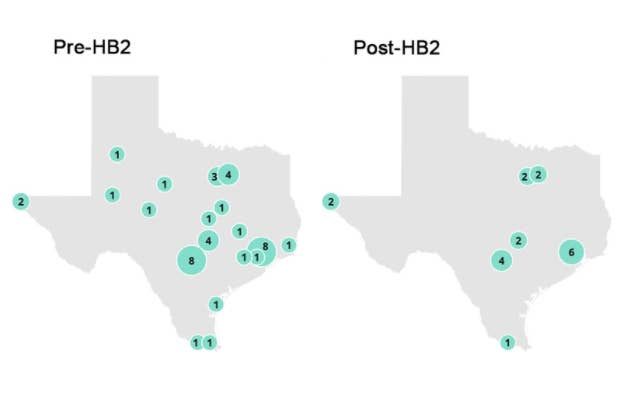
In 2013, lawmakers passed one of the nation’s strictest abortion laws, known as HB2, which shuttered about half of the nearly 40 abortion clinics scattered across the state. Although the Supreme Court struck down much of that law last year, only three abortion clinics have reopened, according to the Associated Press.
Banning the D&E surgical procedure, which abortion rights and medical groups say is the safest and most accessed, effectively eliminates second-trimester abortions in the state.
That means women who might not have had access to a clinic or could not afford to travel hundreds of miles to get one until about 12 weeks could no longer have an abortion, Allen explained.
The new law bars a woman from getting a D&E procedure even if she was a victim of rape or incest, allowing it only in cases of a medical emergency.
While Arkansas’s D&E ban is set to start in August, courts have blocked similar attempts in Alabama, Kansas, Louisiana, and Oklahoma.
Joe Pojman, Texas Alliance for Life’s executive director, also thinks his state’s attempt won’t survive a court challenge, noting that “we don’t think the day has come” when a federal court will uphold banning such a common procedure.
Map showing open abortion clinics in Texas and nearby states.
And while a woman won’t be prosecuted over a now-illegal abortion procedure, her doctor will. Under the new law, any physician in Texas who performs such a procedure could go to jail.
Clinics are also mandated to bury or cremate any embryonic and fetal remains, a regulation Texas enacted before but never went into effect because a judge deemed it unconstitutional in January, concluding that its burdens “substantially outweighed” its benefits.
On Thursday, Whole Women’s Health asked a judge to expand that block to include SB8’s burial requirements, arguing that it’s basically the same unconstitutional requirement.
Providers and rights advocates say these burial costs would spike clinics’ operation costs, which could be passed down to patients and result in even more facilities closing.
“These regulations mean they might have to work with third parties, like disposal companies, to keep their doors open,” Allen explained. “Such burdens could force more remote ones to close.” However, the law does include a “burial or cremation” assistance provision that could help alleviate some of the costs.
Pojman said the purpose was to require the “humane disposition of the bodies of babies” and ban the “grinding and flushing in a sewer system and incineration and burying in a landfill.”
However, cremating or burying fetal tissue does not improve or benefit public health, according to the Texas Association of Obstetricians and Gynecologists, which argued last year that it “could become a cruel mandate on a woman who is experiencing the grief and trauma of losing a very wanted pregnancy.”
Women who have abortions are also not allowed to donate fetal tissue for scientific research, another rule that rights advocates say unfairly stigmatizes women who get abortions. A woman who had a miscarriage has the choice to do so.
Texas’s renewed battle against abortion reflects an intensified effort nationwide to crack down on clinics and limit access to abortion services.
In Missouri, Republican Gov. Eric Greitens just announced a special legislative session next week aimed at imposing stricter regulations on abortion clinics and targeting a law in St. Louis that he says made it an “abortion sanctuary city.”
“It’s a crusade against a woman’s right to a safe and legal abortion,” Allen said. “This is about stigmatizing. It’s never really about women’s health and safety.”
Before 18-year-old Maddy Rasmussen launched the Safe Place Project, there was no comprehensive list of every provider in the country—a crucial and harmful lack of information, especially given the alarming rate of clinic closures in the past five years.
Amid a nationwide attack on reproductive rights, even finding an abortion clinic in your state can prove infuriatingly difficult. Anti-abortion groups intentionally post misinformation online in an attempt to trick women, posing as legitimate clinics to lure women into so-called “crisis pregnancy centers.” In the states that have been hit particularly hard by abortion restrictions, it can be difficult to tell which providers are still open; there are seven states with just one provider remaining, and some American women aren’t even sure if abortion is still legal where they live.
Eighteen-year-old Maddy Rasmussen wants to change that. While interning at a women’s rights organization called Legal Voice during her junior year in high school, the Des Moines, Washington–based teen realized that there’s no comprehensive, user-friendly database of abortion clinics in the US. In late May, after six months of work, she launched The Safe Place Project, a website that aims to provide women with safe, unbiased information about where they can get a safe and legal abortion, as well as what obstacles they can expect to face in doing so.
“I’ve always had an interest in women’s rights, but it wasn’t until I started this project that I realized how difficult it can be for women to receive abortion care,” says Rasmussen. (Both Planned Parenthood and the National Abortion Federation (NAF) have extensive clinic lists, but Planned Parenthood’s only includes their own clinics, while NAF only lists providers who are members of the organization.) “I wanted to ease that burden by creating a simple, easy-to-use website where women could get the information they need.”
The Safe Place Project contains a physical map of clinic locations throughout the US; a list of the clinics that contains the name, address, and phone number of each one; and the date on which Rasmussen last verified that the center was open. That latter piece of information is vital: “There were some clinics that, before I was even able to post and update the website, had closed,” she tells Broadly. Often, she adds, the websites for these closed clinics remain un-updated—which can be devastating to women traveling hours to arrive at clinics, only to find they’re no longer open.
Along with listing providers, the Safe Place Project outlines the various legal restrictions on abortion access in each state. These laws include in-person counseling requirements, waiting periods, and parental notification laws. One of the most surprising things she learned in the course of creating the website, Rasmussen says, is how long many women must wait to access abortion care: In 27 states, a woman must wait at least 24 hours between receiving mandatory counseling (which often contains biased information) and returning to the clinic to undergo the actual procedure.
“South Dakota has a really long waiting period, 72 hours. But none of the 72 hours will count if they fall on a weekend or a holiday,” she says disapprovingly. “The state only has one clinic at this time, so it’s extremely difficult to access abortion already, and the regulations that are placed around abortion are just crazy.”
The map on the Safe Place Project homepage reveals a severe dearth of providers nearly splitting the US down the middle, from North Dakota to the Texas/Mexico border line. It serves as a visual representation of just how far some women must travel to visit their nearest abortion clinic: Across the country, multitudes of women face drives of five hours or longer just to access reproductive care.
Though abortion clinics have been under attack for decades now, Rasmussen believes that the current administration’s pointed fight against women’s access to healthcare has made her project more vital than ever. She began her work while President Obama was still in office; after the election, Rasmussen admits to being frightened. “I was really worried about even having my name on the project at all,” she says. “I was afraid [that] I would have to face a reality that many abortion providers have to deal with: stalkers, harassers, having to fear for their lives.”
However, after some careful thought and consideration, Rasmussen realized that those very feelings are what make her work more necessary than ever. “I realized that this project was more important than my fear,” she affirms.
Raemussen will be starting college in the fall, at Western Washington University, where she will pursue a double major in theater and political science. Because she knows this transition is sure to keep her busy, she’s decided to include a contact form on her site in hopes that people will alert her of any changes to the statuses of the abortion clinics on her list.
So far, she has received messages from both trolls and those looking to offer help and praise. On the phone she laughs over one particularly ridiculous response to her project: The anti-abortion site Life News recently published an article on Rasmussen called “Teenager Creates Web Page Celebrating Abortion by Promoting Every Abortion Clinic Nationwide.”
“It was very interesting to read how they painted me,” she says. (“Rasmussen… missed a larger fact in her pro-abortion project,” the article reads. “An abortion is never safe for the unborn baby or the mother.”) “I knew while there would be a positive reaction to it, there would be a negative reaction as well, [but] I realized that all the time and fear that I had in this project would pay off if it would even help just one woman.”
The anti-choice legislation, supported by both Republicans and Democrats, was described by critics as unconstitutional, cruel, and shortsighted.
The new legislation would require that Louisiana minors who seek a court order to obtain abortion care undergo an evaluation and counseling session; the counselor would be required to verify that the minor is not a victim of coerced abortion. Shutterstock
Texas has seen some of the nation’s most regressive abortion restrictions in recent years. This series chronicles the fall-out of those laws, and the litigation that has followed.
Louisiana lawmakers on Thursday passed legislation to create more restrictions on minors’ access to abortion care, reported the Associated Press.
Under state law, an unmarried pregnant minor must provide a notarized statement from a parent or legal guardian before a doctor can perform an abortion. The only alternative for a pregnant minor is to obtain a court order to terminate a pregnancy, a process known as judicial bypass.
SB 111, sponsored by state Sen. Beth Mizell (R-Franklinton), would require the parent or legal guardian to provide “evidence of identity” such as a valid and unexpired driver’s license or another type of government-issued identification.
The legislation amends the state’s law regarding judicial bypass.
Under current law, Louisiana minors who seek a court order to obtain abortion care may be required to undergo an evaluation and counseling session with a state-employed mental health professional.
The new legislation would make that evaluation mandatory; the counselor would be required to verify that the minor is not a victim of so-called coerced abortion and to determine if the pregnancy is the result of rape, incest, or human trafficking.
If the counselor determines the pregnancy resulted from rape, incest, or human trafficking, the court may appoint a child advocate attorney. The court-appointed advocate must evaluate “how well the minor is informed about pregnancy, fetal development, abortion risks and consequences, the indicators of human trafficking, and abortion alternatives.”
Any person who is not the pregnant minor’s parent or guardian and attempts to provide consent for an abortion could be criminally charged and face up to a $5,000 fine and three years in jail. An employee of an abortion clinic who “knowingly aids and abets a person” who attempts to provide consent for a minor could be criminally charged, and face up to a $1,000 fine and two years in jail.
Speaking on the state senate floor, Mizell claimed the current law was not being applied correctly. “There are people who are posing as parents or guardians of the girls, sometimes for malicious reasons,” Mizell said, though she provided no evidence for her claims.
Megan Snider, a New Orleans attorney who has represented minors seeking judicial bypass, wrote that the legislation is “not only unconstitutional and cruel but also shortsighted,” and would prevent some minors seeking abortion care from reporting abuse.
“Adding more barriers is unnecessary, burdensome and humiliating,” Snider wrote in a letter to the Times-Picayune. “Because the process is already stressful, a new mandate for counseling could harm a teen’s emotional well-being. SB 111 underscores that many of Louisiana’s lawmakers are oblivious to the real-life consequences of their paper proposals.”
SB 111 was passed in the house by Republicans and Democrats in a 93-0 vote; the state senate passed the bill in a 29-6 vote on May 16. The bill now goes to Gov. John Bel Edwards (D), who has signed several anti-choice bills into law.
JEFFERSON CITY • Missouri Gov. Eric Greitens wants lawmakers to make good on his promise that “crazy liberals” won’t be allowed to create “abortion sanctuary cities” so long as he’s in office.
In an announcement Wednesday, the first-year Republican governor ordered the House and Senate to return to the Capitol for the second special session this year to take action on an ordinance approved by St. Louis aldermen in February banning employers and landlords from discriminating against women who have had an abortion, use contraceptives or are pregnant.
He also is calling for stricter laws on abortion clinics, including annual inspections and additional planning for handling patients with complications.
“And we’re proposing a fix that will stop abortion clinics from interfering with emergency responders,” he said in a video released on Facebook. “If a woman needs help, abortion clinics shouldn’t be able to tell an ambulance to come slowly — to not use their lights and sirens — or to go around to the back gate, just because they are worried that an ambulance arriving might make their abortion clinic look bad.”
The session is scheduled to begin Monday, but not before Greitens holds at least three campaign-style rallies in support of his initiative. Former Arkansas Gov. Mike Huckabee will join the governor in Springfield, Mo., and Joplin, Mo., for events on Friday. A third rally that day is expected to be held in St. Charles.
The push comes on the heels of a special session called by Greitens to approve a plan aimed at securing lower electric rates for an aluminum smelter and a steel mill looking to open in the Bootheel region.
The GOP-led Legislature, which adjourned its regular session on May 12, failed to approve a proposal during the spring that would have in effect nullified the city ordinance on the grounds that it inhibits the First Amendment rights of alternatives to abortion agencies, or clinics that counsel women against abortions.
Even though St. Louis officials exempted religious organizations under the ordinance, alternatives to abortion agencies and religious groups argue the updated ordinance could force them to hire employees who support abortion, or face fines.
Plaintiffs in the federal suit are seeking an immediate injunction against enforcement of the ordinance and its eventual invalidation as unconstitutional. Archbishop Robert Carlson vowed that the archdiocese wouldn’t adhere to the law even if that effort failed.
Greitens also wants the Legislature to address issues arising out of a separate federal case that invalidated requirements for the state’s abortion clinics to meet certain standards.
U.S. District Judge Howard Sachs said abortion rights of Missouri women were guaranteed by the U.S. Supreme Court in last year’s landmark decision in Whole Woman’s Health v. Hellerstedt, which struck down similar restrictions in Texas.
The state laws are at the center of an ongoing legal challenge brought by Planned Parenthood affiliates in Missouri.
For Greitens, the special session offers the political newcomer a chance to sharpen support from conservatives after an expensive four-way GOP primary last year that saw him beat more well-established anti-abortion candidates.
Greitens was the only Republican in the race not to be endorsed by Right to Life in the election. In March, at a rally at the Capitol, he vowed to overturn the St. Louis ordinance, calling supporters of the law “crazy liberals.”
In a statement issued Wednesday, Greitens said, “I’m proud to support life — the lives of mothers, their children and the innocent unborn.”
Sen. Bob Onder, R-Lake Saint Louis, praised the governor’s order.
“I know the governor weighs very carefully the decision to call the General Assembly back for a special session. But I believe that no greater issue fits the category of extraordinary than the safety of Missourians and the protection of life and the protection of our fundamental rights as Americans,” Onder said.
Abortion rights groups said the special session would waste taxpayer dollars during tight budget times.
“Missouri families want our leaders to focus on creating jobs and improving education, not wasting time and money on an ideological fight over abortion,” said Alison Dreith, executive director of NARAL Pro Choice Missouri.
In a statement, St. Louis Mayor Lyda Krewson said, “The city of St. Louis doesn’t support discrimination of any kind. We don’t discriminate based on whether someone is pregnant or uses birth control.”
Despite some clashes this year on ethics reform and other issues, Greitens is likely to have support for his effort from the Legislature, which has a long history of backing stringent abortion restrictions.
Earlier this year, House Speaker Todd Richardson and Senate President Pro Tem Ron Richard, both Republicans, vowed to Right to Life advocates that there would be no “abortion sanctuary cities” in Missouri, a term coined by conservatives to describe cities with discrimination ordinances similar to St. Louis’.
But during the first special session convened by Greitens, some senators warned against calling another, arguing that some bills simply don’t make it through the regular session but aren’t urgent enough to justify a second look at taxpayers’ expense.
The most recent special session cost an estimated $67,000 in daily expense money for lawmakers, mileage and additional staff.
The special session marks the latest attempt by Republicans who control Jefferson City to target initiatives in the Democratic stronghold of St. Louis. In one of their final acts before adjourning in May, the House and Senate voted to overturn the city’s minimum wage increase.
A new study reveals that Texas legislators were perfectly content to let mothers die in childbirth while obsessively passing laws that restrict abortion access.
A recent study found that the state of Texas has the highest rate of maternal mortality (deaths due to complications from pregnancy or childbirth) in the US and the rest of the developed world, and now, state legislators have all but voted to keep it that way.
The World Health Organization cites the US as the only developed country in the world where maternal deaths increased between 1993 and 2013. And according to a study from the University of Maryland published in September, the rate of Texas women who died from complications related to pregnancy doubled from 2010 to 2014—the same period in which legislators passed the state’s most draconian abortion restrictions. Despite being made aware of these findings, Texas legislators did not enact any public policy to address these alarming rates during the state legislature’s 140-day working period, and will now have to wait until 2019 to do so, reports the AP.
Published in the journal Obstetrics and Gynecology, the study noted that “in the absence of war, natural disaster, or severe economic upheaval, the doubling of mortality rate within a two-year period in a state with almost 400,000 annual births seems unlikely.” But exactly that has happened in the Republican-controlled state of Texas—notorious for the most restrictive abortion laws in the country and the mass closure of women’s health clinics—with the study concluding that rates in Texas increased from 18 deaths per 100,000 births in 2006 to 36 deaths per 100,000 births in 2014. The findings also revealed that women of color were more vulnerable to maternal mortality, with black women constituting 11 percent of births in Texas but 28 percent of the deaths.
Eugene Declercq, Assistant Dean of Doctoral Education at Boston University School of Public Health and one of the study’s authors, told Broadly, “The changes in Texas were so profound in such a short time we didn’t feel comfortable using them in a national estimate. There was just such a rapid increase,” said Declercq. “The larger message of the study is we aren’t doing a good job of measuring maternal mortality and by reasonable estimates, the rate is higher than has been reported generally and should be a matter of concern.”
According to the Guardian, reproductive health advocates have responded to the study by pointing to the increase of “Republican-led budget cuts that decimated the ranks of Texas’s reproductive health care clinics.” Marsha Jones, executive director of the Afiya Center, a reproductive justice organization founded by and for black women in Texas, told the AP, “When you do things like making access to abortions almost impossible, the impact that’s going to have on our state’s most vulnerable population is worse and worse.”
Declercq believes that to improve these numbers, advocates and legislators should be focusing on changing the focus from maternal deaths during childbirth to women’s health overall. “To focus on women’s health instead of just their ability to deliver a safe baby, will result in covering women generally. Then they will enter the pregnancy healthier, with a medical home, and ensure they will have a medical home after the pregnancy,” he explained. “Texas recently made Medicaid cuts. Which proves what I’m talking about. You’re not going to improve maternal outcomes if you don’t pay attention to women’s health.”
While some Texas legislators did attempt to introduce new measures to combat the study’s startling findings on maternal mortality rates, many did not make it to a vote. “We had a chance to move the needle and we really failed to do so,” Republican Senator Lois Kolkhorst told the AP after the closing of this year’s legislative session. “I’m disappointed.”
As the battle over abortion rights continues to spread from Washington to state capitals, Delaware lawmakers have taken the lead in ensuring that abortion remains legal if Roe v. Wade is ever overturned.
The state House on Tuesday gave final approval to a bill eliminating restrictions on abortion in current Delaware law, which has remained on the books despite being superseded for decades by federal law.
Democratic Gov. John Carney said he will sign the measure, for which Planned Parenthood lobbied.
Passage of the bill comes as similar attempts in other Democratic-leaning states to codify abortion rights have stalled.
In Connecticut, which already has a “legislative declaration” protecting a woman’s right to choose abortion, a bill did not get out of committee. A measure in New Mexico to decriminalize abortion by statute also failed to get a floor vote.
In Rhode Island, bills seeking to codify abortion rights have been held for further study.
In New York, a measure protecting abortion access in the event that federal restrictions arise passed the Democratic-led Assembly but has yet to be considered in the Republican-led Senate.
Meanwhile, Illinois Republican Gov. Bruce Rauner has threatened to veto legislation that strikes language in current Illinois statute indicating the state’s intent to criminalize abortion except to preserve the life of the mother if Roe v. Wade is ever overturned. The bill also would expand abortion coverage to state workers and Medicaid recipients.
In Iowa, Republican Gov. Terry Branstad, recently confirmed as ambassador to China, signed a bill last month banning most abortions after 20 weeks of pregnancy. Tennessee’s Republican governor also has signed a strict ban on late-term abortions. Similar laws are in effect in at least a dozen other states, and President Donald Trump has promised to sign a federal 20-week ban if it gets through Congress.
Delaware’s current law allows abortions only if the mother’s health is at risk, if there is a substantial risk the child would be born with serious disabilities, or if pregnancy results from rape or incest.
The law also prohibits abortions beyond 20 weeks of pregnancy and requires parental consent for girls under 18. It requires a woman to provide written consent and wait 24 hours after receiving a full explanation of the abortion procedure and effects, the facts of fetal development, and an explanation of reasonable alternatives.
The legislation approved Tuesday removes those restrictions and allows abortion without restriction before a fetus reaches viability. It defines viability as the point in a pregnancy when, in a doctor’s “good faith medical judgment,” there is a reasonable likelihood that the fetus can survive outside the uterus without “extraordinary medical measures.”
The bill also allows abortion after viability if a doctor determines that an abortion is necessary to protect the woman’s life or health, or that the baby is not likely to survive without extraordinary medical measures. That provision led critics to say the bill opens the way to late-term abortions.
In introducing an unsuccessful amendment to prohibit abortion after 20 weeks, Rep. Timothy Dukes, R-Laurel, described a late-term abortion procedure known as dilation and evacuation, in which a fetus is dismembered and removed from the womb.
“The methodology of the actual medical procedure is not germane to the bill,” interjected Rep. Sean Lynn, a Dover Democrat.
“Yes it is!” some abortion opponents cried from the gallery, drawing a loud gavel and sharp rebuke from House Speaker Pete Schwartzkopf, who threatened to clear the chamber.
A Democratic aide warned that HHS appointees’ “history of spreading misinformation” about abortion care and birth control “could be replicated now that they’re working in these official capacities.”
Sen. Patty Murray (D-WA) circulated a memo about two HHS appointees: Charmaine Yoest, who makes the evidence-free charge that abortion causes breast cancer, and Theresa Manning, who has said “contraception doesn’t work.” Zach Gibson/Getty Images
Religious imposition laws are designed to shield private individuals and businesses from complying with nondiscrimination laws based on a religious objection to that service.
Democrats in the U.S. Senate are hoping they have the receipts to stop the anti-choice extremists in the nation’s top public health roles from spreading misinformation about reproductive health care.
Sen. Patty Murray (D-WA) on Monday circulated an 11-page staff memo about the U.S. Department of Health and Human Services’ Charmaine Yoest, who has made the evidence-free claim that abortion causes breast cancer, and Teresa Manning, who has said “contraception doesn’t work.” Murray, the top Democrat on the Senate Health, Education, Labor, and Pensions Committee, flagged Yoest’s and Manning’s track records for other Democrats on the committee.
“Their appointments heighten my serious concerns about efforts taken thus far by the Trump administration on women’s health,” Murray said in a letteraccompanying the memo.
“President Trump’s appointments are a clear signal that we can unfortunately expect these efforts to continue—and a reminder of the need to stay vigilant in our oversight,” Murray said.
Yoest and Manning are not the only anti-choice extremists rising to power under HHS Secretary Tom Price, who believes “there’s not one” woman who can’t afford birth control. The Trump administration won’t stop filling HHS with purveyors of anti-choice misinformation, including, most recently, former GOP Colorado Lt. Gov. Jane Norton, former Family Research Council Chief of Staff Shannon Royce, and former GOP Rep. Renee Ellmers (NC).
A senior Democratic aide warned that Yoest’s and Manning’s “history of spreading misinformation” documented in the memo “could be replicated now that they’re working in these official capacities.”
“It’s particularly important to make sure that people have the information to take that context into consideration, should the administration make dramatic policy changes or provide information that’s misleading,” the aide told Rewire in an interview.
Democrats can harness that information to make what could be easy political victories for Republicans and the White House anything but. The aide, for example, pointed to Democrats’ public resistance to shredding Title X family planning protections, requiring two tie-breaking votes from Vice President Mike Pence to pass the Senate.
Credible information could help Democrats counter habitual GOP-led efforts to wield the appropriations process against Title X and rebut any potential misinformation in Price’s scheduled budget testimony this week before the Senate Finance Committee.
“Having this sort of information is really important when you’re faced with threats like that,” the aide said.













 Abortion - Abortion Clinics, Abortion Pill, Abortion Information