Take a lesson from Louisiana.

 As the Democratic Party continues soul-searching for how to rebuild after 2016, the debate regarding the centrality of abortion rights to progressive economic politics has reared its ugly head. Progressive leaders like Bernie Sanders and Democratic Party leaders like Nancy Pelosi and Chuck Schumer have dismissed the critical importance of abortion access, seemingly without a thought for what that means for the women who need it. If you want to know what happens when the Democratic Party embraces politicians who want to deny women access to abortion, look no further than here in Louisiana.

For years, Louisiana Democrats have joined their Republican colleagues in passing anti-choice legislation that has had the cumulative effect of putting abortion access all but out of reach for low-income women. Time and again, state politicians who think they know what is best for women have refuted scientific studies with junk science, ignored expert testimony, and dismissed the experiences of the women who have had abortions in order to champion anti-choice legislation and further their political careers.

Following eight years of the failed policies of Republican Gov. Bobby Jindal, there was hope that the election of Gov. John Bel Edwards in 2016 might bring some progress. His support for raising the minimum wage and equal pay for women was lauded by state progressives. Yet, like so many Democrats before him, Edwards ran on an anti-choice platform. True to his word, Edwards began his term in office by being the only Democrat to sign an amicus brief to the U. S. Supreme Court in support of Texas’s restrictive abortion law House Bill 2, becoming bedfellows with Republican governors from Texas, Mississippi, Alabama, and Kentucky. Though H.B. 2 was eventually struck down, that same year, Edwards signed into law seven new abortion restrictions that shame and punish women for personal health care decisions.

Under Edwards’s leadership, Louisiana has been in a race to the bottom to make abortion a right in name alone — and it is poor women who are paying the price.

Certain Democratic leaders believe issues like abortion and access to reproductive care are distracting from what should be the party’s real focus: economics. But what this strategy fails to recognize is that for women, access to abortion drives their economics, and it is economics that often drives the need for abortion. If a woman is able to access an abortion, she is likely to be able to continue employment, continue earning an income. If a woman can’t access employment, she might not be able to afford raising a child and therefore seek an abortion. To ignore abortion in the debate about economic security and freedom ignores these cyclical realities and will only diminish Democratic enthusiasm among the party’s biggest voting bloc.

The economic burdens of not having access to abortion can negatively impact women’s economic trajectory for a lifetime and affect generations down the road. Studies show women who are denied an abortion are three times more likely to wind up in poverty after two years, compared to women in comparable financial situations who were able to get one. These long-lasting economic burdens placed on women cannot be overstated.

Today, Louisiana is facing a fiscal cliff that will result in further cuts to essential services for women and families when our situation is already dire. Nearly 1 million Louisiana women are of reproductive age, yet there is only one ob-gyn per 13,000 women. Louisiana has the seventh highest teen pregnancy rate, but legislators refuse to pass legislation that would mandate comprehensive sex education or even allow high school students to take a voluntary survey assessing their sexual risk behaviors. When it comes to abortion access, Louisiana has only three clinics left, down from seven in 2011, according to data from the Guttmacher Institute.

Edwards may claim to support women’s equality — a foundational promise of the Democratic Party — but the unfortunate state of women’s access to reproductive health care, including abortion, in Louisiana makes it clear his progressive priorities have run astray.

The Democratic Party is based on a shared set of values and principles — those cannot be abandoned. Democrats like Edwards are welcome to their personal beliefs but they are not welcome to impose those beliefs on the women of this party. Abortion is part of a continuum of reproductive health care, and health care is a human right. If Democrats want to maintain their claim to be the party that represents women’s interests, nothing less than a bold, united stance supporting reproductive rights and justice as a human right is acceptable.

Nancy Pelosi, Bernie Sanders, and Chuck Schumer should reconsider their embrace of anti-abortion Democrats. Take it from the women of Louisiana — that strategy comes at an enormous cost.

http://www.cosmopolitan.com/politics/a9976221/anti-abortion-pro-life-democrats-louisiana/

Anti-abortion groups are opening fake clinics near actual reproductive health care providers across the country in an attempt to shame and scare women into staying pregnant.

On an overcast Saturday morning in late May, several protesters had gathered outside of Hartford GYN Center, an abortion clinic in Connecticut. Many of them were clutching rosaries, and some bore signs decorated with images of beatific infants, with the implication that similar infants were in immediate danger of being murdered. They were, by their own description, facing down “the Evil One;” later in the day, a protester would tell me that an acquaintance of hers had once seen the devil himself crouched atop a different clinic and mistaken it for a gargoyle.

At one point, one of the protesters abandoned her post on the sidewalk to vigorously spray the clinic’s sign with holy water. “I’m a prayer warrior,” she explained when asked what she was doing there. “I pray outside, and if a woman goes by, I ask her if she’s pregnant. If she’s pregnant, I give her one of these cards and tell her about the Hartford Women’s Center.”

She handed me one such card as she spoke; it was emblazoned with an image of a distraught-looking white woman slumped on a nondescript staircase. “Pregnant? Scared?” it inquires. “You’re not alone.” It directs women to St. Gerard’s Center for Life, a Hartford-based Catholic organization that aims to help women facing crisis pregnancies “make life-affirming decisions.” On the back, a slew of official-sounding services are advertised: free pregnancy tests, free limited obstetrical ultrasounds, abortion pill reversal, and assistance in “recovering from post-abortive trauma.”

Hartford Women’s Center, which opened its doors for the first time this month, is the newest St. Gerard’s location. It’s a mere 30 feet from Hartford GYN Center, in the same office complex, with nearly identical signage. This is very confusing, and intentionally so. Hartford Women’s Center is what’s known as a crisis pregnancy center (CPC), a term used to describe anti-abortion organizations whose sole purpose is to convince women to carry pregnancies to term, oftentimes by posing as legitimate reproductive health care providers.

CPCs typically employ a variety of deceptive tactics, including posting misleading ads and establishing locations next to clinics and hospitals, with the intent of luring women into their offices. Once women are in their clutches, they bombard them with spurious information: that abortions are extremely painful and perilous, that ending an unwanted pregnancy may result in permanent psychological damage, that an abortion might not even be necessary because miscarriage is so common. In some cases, staff will even lie about the fetus’ gestational age in order to push the pregnancy past the legal window for termination. There are currently over 3500 CPCs operating in America, compared with around 800 abortion clinics.
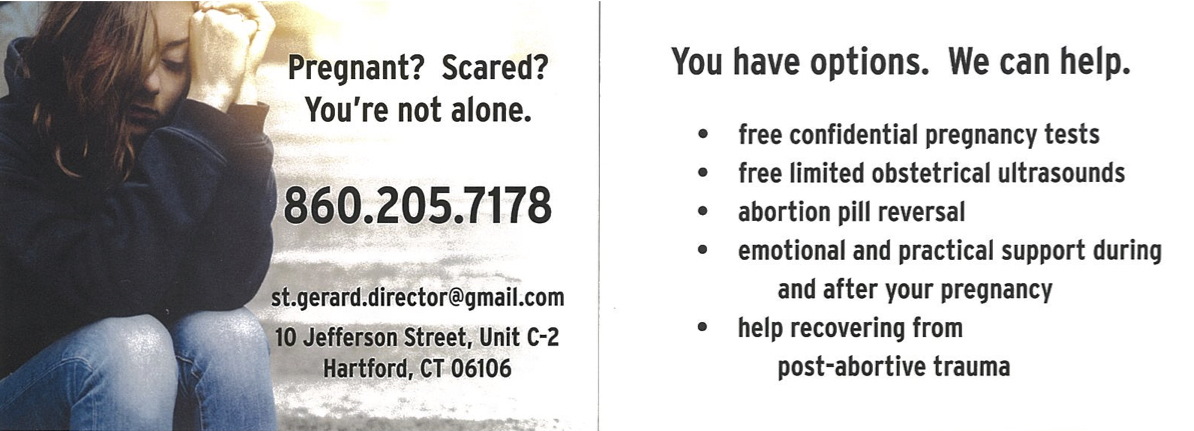
The card St. Gerard’s volunteers hand out outside of Hartford GYN Center

“The idea of a crisis pregnancy center being in your neighborhood is one thing,” said Amanda Kifferly, the director of patient advocacy at Hartford GYN Center, which has been providing abortion care and reproductive services to its patients since 1981. “And then for it to be in the same complex as an already licensed institution within the community—I think it increases the potential risk and damage that can happen.”

Although Hartford Women’s Center resembles a legitimate family planning clinic on its surface, it offers basically none of the vital health care services women can access next door at Hartford GYN Center: no STI testing, no well women exams, no prenatal care, no birth control. Women who end up in the center are told that abortion is murder, that several forms of contraception are also murder, and that choosing to terminate a pregnancy could have ruinous repercussions, including PTSD, breast cancer, and infertility. They’re urged to carry their pregnancies to term and promised financial and emotional support if they choose to do so. (In addition to the services advertised on its card, St. Gerard’s currently offers free baby clothing and diapers for women who enroll in its education program, social service referrals, and baptism preparation for infants and mothers alike.)

“We want to give these women support to give birth to their children,” Leticia Velasquez, the director of St. Gerard’s, told me. “Whatever it takes to have a woman give birth, we’re there for them.”

A CPC… has a single aim, and that aim is make sure that the woman carries her pregnancy to term.

According to the employees of Hartford GYN Center and pro-choice groups in the state, “whatever it takes” often involves unethical and deceptive tactics. “They’re obviously setting up in our complex as an opportunity to mislead our patients specifically,” said Kifferly. “And they’re appearing to look legitimate by taking our name.”

The proprietors of Hartford Women’s Center don’t deny that they’re trying to intercept Hartford GYN’s patients, though they insist that the help they offer women is sincere and substantial, lasting up to the baby’s second birthday. According to Velasquez, about 75 percent of the women they serve start out trying to go to Hartford GYN Center, and she expects that number to rise given their new proximity to their adversary. “That’s why we’re here,” she said. “We want to offer a choice at the door of the abortion clinic.”

A 2015 report from the pro-choice group NARAL investigated 27 crisis pregnancy centers in Connecticut, and found “a consistent pattern of misinformation, deceptive advertising, and blatant lies about reproductive health.” This is tantamount to a public health crisis, the organization warns. “If you’re an individual who is not used to receiving medical advice from a licensed medical practitioner… there’s no red flag for you,” said Sarah Croucher, the executive director of NARAL Pro-Choice Connecticut. “You think that you’re getting medical advice, and you’re not.”

“What’s really dangerous about someone walking into a CPC is that CPC has a single aim, and that aim is make sure that the woman carries her pregnancy to term,” she explained. “And that’s not an aim that’s about caring about women and what’s in their best interests and helping them make decisions that are right for them. [Crisis pregnancy centers] will give whatever garbage information they want to achieve their aim.”

On Saturday, May 20, the Hartford Women’s Center held its inaugural event. Its door, which is about 10 feet from the ramp leading to Hartford GYN Center, was propped open invitingly, revealing a waiting room decorated with several framed photographs of landscapes, as well as a florid print of the words “You are loved.”

When I first encountered Leticia Velasquez, she was reclining genially in an armchair in the corner of this makeshift reception area, greeting each new arrival with enthusiasm. On the collar of her blazer was a minuscule opal pin in the shape of two baby feet; beside her was a large sign that read, in bright marker, “WELCOME to our Open House.” There is something very maternal and comforting about Velasquez. She speaks effusively and rapidly, switching with adeptness between religious, personal, and scientific arguments against abortion. Whenever logical inconsistencies threaten to undermine her wholehearted appeal—which is frequently—she shifts gears, speaking from personal experience and emphasizing the suffering she’s witnessed due to sex outside of marriage.

When asked about her organization’s stance on contraception, for instance, her response was assured. “Most women who come in here are here because the contraception didn’t work, OK?” she said. “One woman had a Norplant: It’s supposed to work! I said, ‘Well, obviously it didn’t.’ Because it was three years old, the last month, she got pregnant.”

“Pregnancy is sex working,” Velasquez said. “That’s the whole reason we have it, physically speaking. Now, that might not be your intention,” she added, likely recalling an incident a few minutes earlier in which I’d asked her if a statue of the pregnant Virgin Mary was St. Gerard, exposing myself as a true heathen (St. Gerard, as it turns out, is a man). “But the mistake we make is to go into it very casually, thinking that this one-night encounter won’t affect the rest of my life. It will. It can.”

Like Dr. Janet Smith, Velasquez seems to believe that sex outside of marriage is inherently calamitous. “Contraception gives you that false feelings that sex has nothing to do with procreation, and it also kind of shields you from making dumb moves: sleeping with someone with a disease, sleeping with crazy person that’s gonna haunt you and stalk you,” she clarified. “There’s a lot of hurt in society now, and people say depression and suicide, it’s increasing. All the things that contraception was supposed to cure… a lot of them were caused by contraception.”
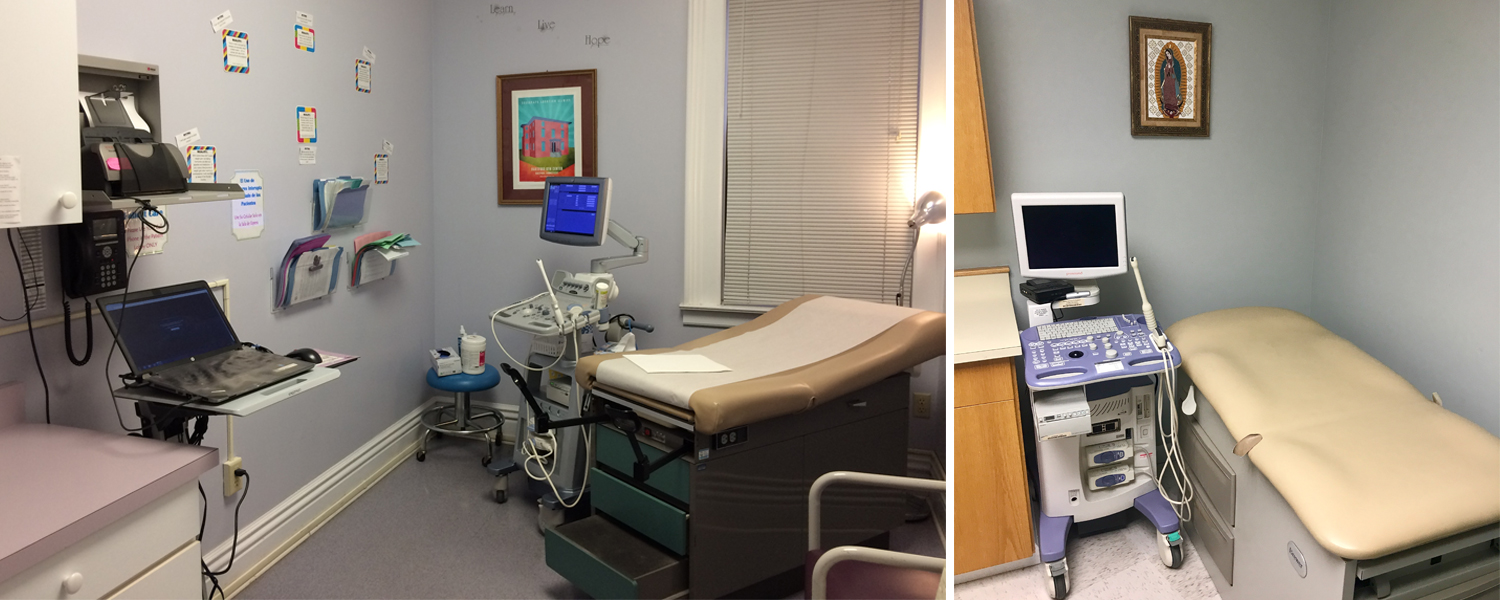
The exam room at Hartford GYN Center, left, and Hartford Women’s Center’s ultrasound machine

The Hartford Women’s Center is equipped to give women “limited medical ultrasounds,” Velasquez told me, in order to “acquaint the mother with her child, and [ascertain] that it’s a healthy pregnancy” —she paused, nearly imperceptibly, then corrected herself— “not a healthy pregnancy, but that it’s in the right place.” If the pregnancy is not in the right place, the Center can refer women elsewhere, but that’s about it. “We don’t do surgery,” she said. “Our medical doctor is not an [obstetrician]. She’s a family practice. She reads the scans.” (Hartford GYN Center has two licensed ultrasound technicians on staff, as well as numerous licensed OB/GYNs.)

It’s unclear what a “limited medical ultrasound” is. It’s not a term used in the medical community, according to Croucher of NARAL Pro-Choice Connecticut. It also doesn’t seem to appear in any reputable, legitimate sources, save for one: In 2005, the American Institute of Ultrasound in Medicine released a statement condemning the practice of performing ultrasounds for “bonding and reassurance purposes.” Scans should only be performed by licensed medical professionals who have been trained to recognize medically important conditions, the organization warned: “Any other use of ‘limited medical ultrasound’ may constitute practice of medicine without a license.”

Despite this, Velasquez is quick to criticize Hartford GYN Center for their lack of services. “As far as I know, their tagline is ‘Abortion is 100 percent of what we do,'” she said. (Their tagline is “Unsurpassed excellence in women’s health care.”)

Pregnancy is sex working. That’s the whole reason we have it, physically speaking.

“I don’t see job counseling, I don’t see looking for housing or paying first month’s rent, or parenting classes or adoption plans,” she added. “I don’t see that listed as ‘services.'” Under the “other services” section of the Hartford GYN Center’s website, several things are listed: pregnancy testing, ultrasound exams, birth control, STI testing and treatment, emergency contraception, colposcopies, and gynecological care. They also offer education and support, including options counseling and adoption counseling and services.

In her role as patient advocate at Hartford GYN Center, Kifferly constantly fields calls from women who are considering abortion care. When someone is solid in their decision, she respects their autonomy. “If someone calls me and says, ‘I’m calling to make an appointment for an abortion,’ I’m not going to say, ‘Oh, well, let’s take a step back. Have you thought about motherhood?'” she said. If that same caller were to express doubt, however, she says she would offer them comprehensive options counseling, including discussing the potential of motherhood and adoption.

“I’ve absolutely witnessed patients come into the clinic, and I’ve assisted in them having pregnancies and carrying to term and choosing parenthood, and I’ve assisted in adoptions. All of those things are pretty common,” she continued. “As a woman, I have been in the situation of pregnancy scares and pregnancy, and I know that you know what’s in your heart, and you also know your body well enough to articulate that.”

St. Gerard’s is an affiliate of Heartbeat International (HBI), the biggest crisis pregnancy center network in the world. HBI has over 2000 affiliated organizations in 50 countries, and they also operate Option Line, a deceptively secular-looking 24-hour pregnancy helpline that answers over 600 calls and chats a day. In March of 2017 alone, Option Line volunteers offered counseling to over 28,000 women. The organization is experienced in using Google’s AdWords program to boost their visibility, especially in conjunction with abortion-related searches—in their 2014 annual report, HBI boasted that “a woman who makes a Google search such as ‘pregnant and scared’ finds a local Heartbeat International affiliate or Option Line in her search.”

Although there are no explicitly religious references on the Option Line website, it agenda is obviously and extremely Catholic—which is to say, staunchly anti-abortion and anti-contraception. “Last year alone, 50 million babies—created in the image of God—were silently put to death before they were even born,” laments the HBI website, on a page dedicated to Option Line. “You probably know someone who has had an abortion. Was there something you could have done to prevent it?”

Option Line is rife with misinformation about abortion and contraception, though it has the appearance of a legitimate medical service, at least aesthetically. (Its logo suspiciously resembles that of Plan B, the emergency contraceptive pill.) On every single informational page, visitors are referred to HBI-affiliated crisis pregnancy centers in their area, though the true goal of these centers is only vaguely alluded to, often after a wall of official-seeming medical platitudes. “These centers don’t perform or refer for abortions, but they have a lot of information about all your options,” reads a cheery disclaimer at the bottom of a page entitled “Considering Abortion.” “Many of them are even able to give you a free ultrasound.”

https://broadly.vice.com/en_us/article/how-anti-abortion-zealots-pose-as-medical-professionals-to-trick-pregnant-women

The girl’s mom says he objected due to “personal beliefs.”

A 13-year-old in Albuquerque was prescribed an IUD to treat menstrual issues when other forms of birth control didn’t work, according to Yahoo! Beauty. Her doctor also prescribed her an anxiety medication, a pain reliever, and the hormone misoprostol, which softens the cervix to make IUD insertion easier. But when her mom went to Walgreens to fill these three prescriptions, the pharmacist allegedly agreed to fill the first two but said he couldn’t give her the misoprostol because of his “personal beliefs,” telling her to try another Walgreens.

The mother, known as M.S. in two complaints filed by the American Civil Liberties Union of New Mexico and the Southwest Women’s Law Center, told the Albuquerque Journal that she began driving to another Walgreens before turning around to protest the pharmacist’s decision. She told him that “he was discriminating against me, that he should be ashamed for judging us, that he didn’t know my daughter’s medical history or her complications or conversation with her doctor. That he didn’t know what the medication was for,” she said. “And he just looks at me and says, ‘Oh, I have a pretty good idea.‘” He may have been referring to the fact that misoprostol can induce abortions.

In June of 2012, another Walgreens pharmacist refused to give a woman named Susanne Koestner birth control pills, the Albuquerque Journal reports. As a result of her complaint, the store agreed to fill prescriptions for birth control — and everything else — “as efficiently as other prescriptions without imposing any burden on the customer.”

However, a Walgreens representative told Yahoo! Beauty that its policy lets pharmacists “step away from a transaction to which they may have a moral objection.” But it also “requires the pharmacist or other employee to refer the transaction to another employee or manager on duty to complete the customer’s request.”

The ACLU’s complaint points out that traveling to another pharmacy can be difficult for many people, particularly those without cars or other nearby options. It also asks Walgreens to prevent this from happening again.

“Religious liberty does not mean the right to discriminate against others,” it reads. “Walgreens should take reasonable steps to accommodate employees’ religious beliefs and practices, but it cannot do so by imposing additional discriminatory burdens on women.”

http://www.teenvogue.com/story/walgreens-pharmacist-iud-hormone-complaints

 Margaret Atwood has an eerie prediction about the outcome of abortionrestrictions, one that bears an uncanny resemblance to the dystopian future depicted in her hyper-relevant novel, The Handmaid’s Tale.

Speaking at New York City’s Book Con on Saturday, Atwood argued that when states obligate women into childbearing, they institute “a form of slavery,” Insider reported. State-mandated reproduction has two outcomes, she said: That women die, and that orphanages fill up.

Atwood referred specifically to Texas, where Gov. Greg Abbott is poised to sign Senate Bill 8. The legislation not only requires abortion providers to bury or cremate fetal remains, but also bans the most common second trimester abortion procedure — dilation and evacuation — as well as dilation and extraction, the typical procedure for late-term abortions. Dilation and extraction abortions are, generally speaking, only performedwhen the mother’s life or health is in danger.

“I’m waiting for the first lawsuit,” Atwood said, explaining that she expected families of women who died to sue the state. “I’m also waiting for a lawsuit that says if you force me to have children I cannot afford, you should pay for the process,” she added.

Author Margaret Atwood speaks after being introduced for the Ivan Sandrof Lifetime Achievement Award at the National Book Critics Circle awards ceremony on Thursday, March 16, 2017.

Source: Julie Jacobson/AP

Texas’ long-fought war on abortion access correlates with two trends that bear out Atwood’s theory: Since the Lone Star State began purposefully funneling federal money away from abortion providers in 2011, both maternal mortality rates and birth rates have spiked, mostly among women who rely on government funds to get medical care.

The reality of Texas’ abortion restrictions, Atwood said, is state-mandated reproduction without a safety net — and that’s a problem:

They [Texas] should pay for my [a woman’s] prenatal care. They should pay for my, otherwise, very expensive delivery, you should pay for my health insurance, you should pay for the upkeep of this child after it is born. That’s where the concern seems to cut off with these people. Once you take your first breath, [it’s] out the window with you. And, it is really a form of slavery to force women to have children that they cannot afford and then to say that they have to raise them.

Her assessment looks a lot like the picture painted in Atwood’s 1985 novel, The Handmaid’s Tale. It’s currently experiencing a surge in popularity thanks to a Hulu show and a political climate in which abortion is demonized. Critics have drawn parallels between real life attacks on reproductive rights and female existence in the book’s fictional society, Gilead, where fertile women are conscripted as sex servants in the houses of powerful men. Their sole purpose is bearing children.

 The difference between women in Gilead and women in Texas, though, is that the former are provided for. Atwood thinks Texas should, at the very least, do that.

“If you’re drafted into the army, the other situation in which the state seizes control of your body, at least you get three meals a day, clothing, and a place to sleep,” she said. “So, if you’re going to do that to women, pay up.”

https://mic.com/articles/178888/margaret-atwood-says-its-a-form-of-slavery-to-force-women-to-have-children-they-cant-afford#.XJ3dzmpPI

If Roe falls, women may not face the same kinds of physical dangers from seeking abortion as in previous decades. Instead, however, I predict there will be far more criminal prosecutions of those involved in illegal abortion.63512

The prospect of the overturn of Roe v. Wade—which the U.S. Supreme Court confirmation struggle over Judge Neil Gorsuch is highlighting—is terrifying to many, especially to those who remember the notorious pre-Roe days. It is also a real possibility, should President Donald Trump have the opportunity for another nomination, one that would replace a liberal judge with a “pro-life” one, as he pledged to do during the campaign. But if Roe falls, women may not face the same kinds of physical dangers from seeking abortion as in previous decades. Instead, however, I predict there will be far more criminal prosecutions of those involved in illegal abortion.

If Roe is overturned, the most likely immediate consequence would be that individual state legislatures would decide whether or not to allow abortions. According to legal analysts at the Center for Reproductive Rights, some 34 states are at risk of banning abortions, largely in the Midwest and South. About 40 million women live in those states. Predictably, many women seeking abortions will have to travel, paying not only for the procedure, but for transportation, lodging, and babysitters (nearly 60 percent of abortion patients already have children). These travelers, of course, may also lose wages for the time spent away from their jobs. One can safely assume that many won’t be able to afford an out-of-state option, as abortion patients are disproportionately among the poorest women in society.

Therefore, there will likely be a considerable increase in self-induced abortion. (In fact, such an increase is already occurring in the United States, as access to abortion is so difficult in many areas due to restrictive legislation and clinics being closed.)

What might we expect then? Will the abortion landscape resemble the pre-Roe days, when some scholars estimate that approximately 5,000 women per year died from illegal abortion in the 1960s, and tens of thousands more were injured?

If there is a second large wave of illegal abortion, a similar kind of danger is questionable. This is because of changes in abortion technology that have occurred since legalization. Pre-Roe, many women attempted to self-induce abortion by drinking dangerous substances such as turpentine and lye, and inserting various objects into their cervixes, including the infamous coat hangers. When they went to others—whether a medical provider or layperson—one of the main methods used was dilation and curettage, or the scraping of the uterus. In untrained hands, this was very risky.

Today, however, there is another method of pregnancy termination: “medication abortion,” which is in wide use in the United States and elsewhere. This method actually involves two drugs: mifepristone, formerly known as “RU-486,” which causes a fetus to stop growing, and misoprostol, a drug with several medical uses, which causes the cervix to open and the uterus to contract. Medication abortion is used both legally and extra-legally: Both mifepristone and misoprostol can be obtained over the internet, and misoprostol is available over the counter in many pharmacies in Latin America (and in flea markets in the United States).

 To be sure, these drugs are not always 100 percent effective in ending a pregnancy. When they are ordered over the internet, the products are not always authentic or reliable, and misoprostol, often used alone because it is easier to get, is not quite as effective as the two-drug regimen. But even when ineffective, they are not usually dangerous. Some tragedies will inevitably happen with a large-scale return of illegal abortion, particularly among the young and most desperate, and among those who discover their pregnancies too late to use the medication abortion regime, which is largely recommended for use only through 10 weeks of pregnancy. Overall, though, women will not face the same kinds of death and injury as occurred before the Roe decision.

What will likely be different, however, is the degree of criminalization facing both women who attempt illegal abortions, and any providers or advocates who try to help them. Given the number of illegal abortions that took place before Roe (slightly more than 1 million per year in some estimates), it is striking in retrospect how relatively few prosecutions and jail sentences there were. This is not to suggest, however, that women who sought abortions and doctors and others who provided them were not terrified of being caught, as there was always the possibility of jail time, the loss of medical licenses for doctors, and public shame for both.

Today, though, anyone involved in illegal abortion would face a very different legal and political environment. In fact, even as Roe remains the law of the land, women have recently been jailed for attempting self-induced abortions. The Self-induced Abortion Legal Team has identified 17 known arrests or convictions in connection with alleged self-induced abortion since 2005.

There is already intense scrutiny and sometimes criminalization of pregnant women in the United States—and not only of those seeking abortions. This surveillance is made shockingly evident in a 2013 reportby researchers from the National Advocates for Pregnant Women and Fordham University, which tabulated hundreds of cases of pregnant women arrested since Roe for various reasons. In a particularly bizarre 2010 case, an Iowa woman who accidentally fell down a flight of stairs and sought help at a hospital was reported to police and arrested for “attempted fetal homicide.”

The main reason for this predicted difference in punishment before and after Roe is that in the earlier era, there was not in place anything resembling the national anti-choice movement of today. Prosecution before Roe was very idiosyncratic, dependent on local factors. But if Roe falls, criminal justice officials, from the virulently anti-choice Attorney General Jeff Sessions on down to local police and district attorneys in many jurisdictions, can be expected to avidly pursue those who break the law.

When Donald Trump, shortly after his election, was asked by a journalist about what the possible overturning of Roe would mean for American women who sought abortions, he casually answered, “Well … they’ll have to go to another state.”  Yes, Mr. President, some will go to other states, but many others might go to jail.

https://rewire.news/article/2017/04/06/roe-v-wade-falls-women-will-go-jail/

What’s alarming about the administration’s plan – and how women should prepare

Contraception access advocates in front of the Supreme Court in 2014. Alex Brandon/AP

On Wednesday, Vox published a leaked draft of the regulation the Trump administration plans to use to gut the Obamacare contraception mandate – that is, the rule currently ensuring that most women’s insurance covers contraception without a copay.

Put simply, the Trump administration is planning to make it more difficult for women to use the insurance they earn and pay for to afford birth control pills, IUDs and other forms of contraception. In 2017. In America.

The administration’s plans fly in the face of public opinion, not to mention common sense and decency. The Obamacare mandate is supported by 71 percent of Americans, has caused out-of-pocket costs for contraception to plummet and has coincided with an acceleration in the decline in the abortion rate.

Still, contraception opponents who claim the rule infringes on their religious freedom have fought it for years, and the Obama administration bent over backwards to try to appease them. But what Trump’s leaked rule shows is that opponents’ ultimate goal was never to win exemptions from the law for religious groups – it was to block the government from expanding access to contraception altogether by freeing all corporations, no matter how secular, from requirements to provide equitable health coverage to women.

The long, often mind-boggling, battle over the Obamacare mandate is worth revisiting, to illustrate how we ended up here.

The first version of the rule exempted houses of worship from providing health plans that cover contraception. This was based on a “church autonomy” rationale – the idea being that someone who works for a church likely shares its beliefs and has consented to religious governance, voluntarily forgoing the protections employees enjoy under generally applicable law.

But the exemption for churches wasn’t good enough for contraception opponents. They insisted religiously affiliated groups like universities and hospitals should also be exempt. The problem with that idea is obvious: Accepting a job at a university, hospital or social service organization is not at all like joining a church. Despite the prevalent stereotyping of religiously affiliated institutions as places where one should expect bishops or other religious authorities to make the rules, they are in fact able to recruit employees and receive government funding precisely because they present themselves as largely secular institutions that are welcoming to people of all or no faiths.

So there’s no church autonomy rationale when it comes to these institutions, but the Obama administration came up with an accommodation to try and make them happy anyway – while still ensuring that women’s health care services would be covered, as men’s are. The workaround allows such institutions to opt out of providing contraceptive coverage by sending a two-page form to their health insurers self-certifying that they have a religious objection to insurance that covers birth control. The third-party insurer is then obligated to provide separate coverage to the employee, for which it is reimbursed by the government. Women get their birth control but not through the health plans of the religiously affiliated non-profits they work for. Everybody wins, right?

Nope. The Obama administration made the mistake of thinking the objectors were negotiating in good faith for a religious accommodation – when their real goal was to torpedo expanded access to contraception altogether. The attempts to appease the objectors came back to bite the administration in an unprecedented litigation campaign led by right-wing Christian legal groups like the Alliance Defending Freedom and the Beckett Fund that involved more than 100 lawsuits. Secular for-profit corporations like Hobby Lobby sued to be given the same accommodation as religiously affiliated non-profits, and won at the Supreme Court. The non-profits also sued, claiming that filling out the form to get the accommodation – literally just filling out a form – violated their rights under the Religious Freedom Restoration Act since their employees would still end up getting contraceptive coverage in the end.

The Supreme Court wasn’t willing to go so far as to allow employers to block their employees from getting coverage from a third party through the government’s workaround. But the administration that Trump has filled with some of the nation’s premiere anti-contraception zealots is poised to give the objectors what the courts wouldn’t. When the coverage rule was first proposed, Cardinal Timothy Dolan explained the only outcome he would accept: “All Washington has to do is say, ‘Any entity that finds these mandates morally objectionable is not coerced to do them,’ and leave it there.”

Laws do not generally work this way – you don’t get to only follow the ones you agree with. But that’s precisely what Trump’s contraceptive regulation would do. Any employer that decides it has a religious or moral objection would be able to prevent its employees from obtaining contraceptive coverage – even employees currently receiving it through a third party. It’s an exemption that swallows the whole rule.

This is an example of a larger strategy by right-wing religious groups to attack legal protections that should be applied generally under the guise of “religious exemption.” For example, they’ve claimed that laws protecting the rights of LGBTQ people to adopt children violate religious organizations’ rights, only to admit they’re really objecting to any kind of organization having to abide by anti-discrimination laws.

These religious warriors against anti-discrimination laws will surely be emboldened if Trump implements the new regulation as written. However, women should not assume they are no longer entitled to contraceptive coverage. Despite the Hobby Lobby decision, most women – including those who work for religiously affiliated institutions – are currently entitled to birth control without a copay via the workaround. So this is a good time to get one’s birth control situation sorted out, before the Trump administration issues the new rule or otherwise dismantles Obamacare. In particular, women interested in long-acting removable birth control (like an IUD), which is more effective – and more expensive – than birth control pills, should take action pronto.

But even if the new rule goes into effect, don’t assume coverage is gone. Obamacare has strengthened the norms around birth control coverage, and we can expect most plans to voluntarily continue covering it. Furthermore, there is reason to believe the Trump rule won’t survive court review. It doesn’t comply with procedural requirements for issuing new rules – and, worse, it’s discriminatory. So as with many of Trump’s legally dubious policies, expect it to be tied up in court for a long time.

http://www.rollingstone.com/politics/features/the-trump-administration-is-going-after-birth-control-access-w485155

https://www.bustle.com/p/trumps-budget-throws-millions-toward-shame-based-abstinence-only-programs-60343?utm_source=facebook&utm_medium=FB&utm_campaign=Bustle_Traffic_Swap

Adding to the plentiful criticism of his controversial 2018 proposed budget, President Donald Trump’s proposed budget also allots millions to abstinence-only education programs — $227 million to be exact. While it’s unfortunately not an unheard of move for a Republican administration to support these sort of programs, investing in education policies that seek to shame and discourage sexual activity rather than providing information that allows young people to protect themselves remains deeply unsettling and insulting.

As concluded by countless studies over the last 25 years alone, these sorts of programs — which vehemently oppose promoting or even mentioning forms of contraception while discouraging all sexual contact “until marriage” — are considered aggressively ineffective. Research also shows that the states that rely on “wait until marriage” philosophies and policies actually have higher rates of teen pregnancy and sexually transmitted diseases. And it makes complete sense when you consider the fact that they’re straight-up refusing to tell young people about the tools available to prevent those things. But, more anecdotally, students who encountered these programs (and the few stray parents who sit in on lessons) report that the culture of shame surrounding sex adds yet another layer of insult to the injury of state-sanctioned ignorance.

lacigreen on YouTube

As they tend to tie one’s virginity (a social construct, at best) with their virtue, much has been written on horror stories of misinformation and terribly offensive analogies presented in abstinence-only classrooms. Armed with claims that a person having sex outside of marriage is like a piece of chewed gum, used tape, or a cup of spit, these lessons generally operate in a way that put the burden of sexual gate-keeping on women, promising that non-married sex is an inexcusable evil while refusing to address the realities of contraceptives, reproductive choice, or even consent.

With nearly 95 percent of Americans engaging in that sweet, sweet premarital sex on the reg, arguments claiming that having sex out of wedlock makes a person lesser remain fundamentally flawed. However, that still hasn’t stopped the steady flow of federal funding to these programs.

El Salvador has one of the worst records on reproductive rights in the world. Since 1998, Article 133 of the Penal Code has made abortion illegal in all circumstances, without exception, punishable by up to eight years in prison. Sentences of up to 30 years have been handed down when a judge determined that “homicide” rather than abortion had occurred. The Alliance for Women’s Health and Life has reported that 147 El Salvadorian women were charged with crimes relating to abortion between 2000 and 2014.

Because our laws are so draconian, so tilted in favor of the rights of fetuses over those of living women, pregnant women experiencing difficulties may not feel safe in El Salvador’s hospitals. We’ve all heard about Maria Teresa Rivera, who was sentenced to 40 years in prison after she miscarried. (She was released after serving four.) We are terrified of having medical problems during pregnancy as there is an underlying presumption of guilt. So women often suffer in silence, which causes further complications.

International attention to the problem is growing and recently the United Nations Committee on the Elimination of Discrimination Against Women urged El Salvador to review Article 133 and related aspects of the Penal Code, at least in cases of rape, incest, threats to the life and/or health of the pregnant woman or severe fetal impairment.

The U.N. committee stated that the country violates the basic human rights of women and girls, including their right to life, health, nondiscrimination, human dignity and the right over their own bodies.

Those who call for continued restrictions on safe and legal abortion in El Salvador fail to realize that making the procedure illegal does not reduce its prevalence. (The country’s Ministry of Health has estimated that 19,290 abortions took place between 2005 and 2008.) Lack of choice means that women tend to seek out dangerous covert methods, which put their lives at risk. These women are also reluctant to seek post-operative medical care after their abortions have taken place.

The World Health Organization estimates that 68,000 women die around the world every year as a result of unsafe and illegal abortions, and millions more are living with health complications. The vast majority of these are in the economically developing world in countries such as El Salvador.

El Salvador is not supportive of women’s rights. The power of the Catholic Church and right-wing conservatives here and throughout Latin America has meant that our laws are not secular, but are heavily influenced by subjective interpretations of religion. The Trump administration has further exacerbated the problem by making it illegal for U.S. organizations providing international aid to so much as help women access information about reproductive rights, let alone provide abortions.

El Salvador is one of the most dangerous countries in the world for women. We have the highest rate of femicide in the entire world: A woman is murdered every 15 hours. A 2010 law made femicide a specific criminal category, but most perpetrators still evade arrest. The levels of gang violence and other forms of civil unrest are extremely high, and women bear the brunt of it both inside and outside our homes.

The bill, believed to be the first of its kind in the country, would require abortion clinics to provide patients with printed information detailing doctors’ educational history, disciplinary and malpractice record, and when they started working at the clinic.

Doctors would also have to disclose whether they have malpractice insurance and admitting privileges at a local hospital, and if they are Kansas residents. Critics argue that such admitting privileges — which many states have sought to mandate — are not only difficult to obtain but medically unnecessary, as abortion clinic patients rarely have to go to a hospital. And due to a number of factors, including a lack of trained and willing local doctors, abortion providers often live far from their clinics or even out of state.

“I think this is a bill that will help women make the right choice or an informed decision,” Republican Sen. Rob Olson told the Kansas City Star.

Republican state Sen. Mary Pilcher-Cook added, “Women don’t leave abortion clinics whistling and jumping up and down…. They are in a very vulnerable state because the nature of abortion is ugly and is evil because it kills a human being.”

But other lawmakers condemned the bill as “simply harassment” and “discriminatory,” arguing that doctors who perform other medical procedures doctors are not held to the same standard. And Democratic state Sen. Marci Francisco pointed out that the state legislature routinely uses 10-point font on its bills.

“We should not ask to have someone provide something in a larger font than we provide the information to ourselves and our constituents on bills that are very important,” Francisco told the Associated Press.

The bill is still awaiting the signature of Republican Gov. Sam Brownback, who has signed every abortion restriction that has crossed his desk since he took office in 2011.

According to the Guttmacher Institute, a nonprofit that researches and supports abortion rights, Kansas already has a number of abortion restrictions on the books, including:

  • Women must wait 24 hours after getting counseling that describes the details and risks — a requirement critics argue is meant to discourage abortion — before they can receive an abortion.
  • Women must also receive ultrasounds of their fetuses, and the provider must offer to show them the ultrasound image.
  • Except in medical emergencies, abortion is prohibited at 22 or more weeks after a woman’s last period. Supporters say this is because fetuses can feel pain at this point in their development, a statement that is not backed up by medical research. According to the American College of Obstetricians and Gynecologists, fetuses generally become viable at 24 weeks.

Source: Vice

https://news.vice.com/story/kansas-wants-abortion-providers-to-use-12-point-times-new-roman-font?utm_source=nar.al&utm_medium=urlshortener&utm_campaign=FB

A proposal in the U.K. Parliament would change a 19th-century criminal law that allows prosecution of people who end their own pregnancies. And in New York state, a bill moving through the legislature would remove abortion, including self-induced abortion, from the penal code.

No one should face jail or arrest for having an abortion, especially in places where abortion is legal and generally accessible. That is exactly the scenario that politicians in the United Kingdom are trying to address by moving antiquated criminal abortion laws off the books. Legislators in the United States should follow.

Abortion is legally available in the United Kingdom, with the exception of Northern Ireland (where the procedure is only allowed when the pregnant person’s life is in danger). But even under the 1967 Abortion Act that is in effect in England, Wales, and Scotland, two doctors must agree that a woman’s continued pregnancy poses a greater risk than ending that pregnancy. Though doctors typically interpret the law liberally so that getting the signatures does not significantly delay most abortions, the law also requires that abortions much take place in a hospital or other clinical premises that have government permission to perform the procedure. That means family doctors cannot supply medication and women cannot use it at home, even when it is legally prescribed.

The result: Women who use abortion pills without doctors’ permission can face jail terms—which criminalizes patients in a way that doesn’t apply to any other health care procedure.

In March, U.K. Member of Parliament Diana Johnson introduced a bill that took the first steps toward decriminalizing abortions‎ in the first two trimesters in England and Wales. Under the proposal, abortion would be regulated in the same way as other clinical procedures and women would not face jail for inducing their own abortions.

“There is no other medical procedure in this country governed by legislation this old, this out of step with medical developments and public attitudes,” she said.

Johnson was referring to the U.K.’s 1861 Offences Against the Person Act, which she proposes amending. This law made ending one’s own pregnancy a crime punishable by life imprisonment throughout the U.K., with the same penalty applying to anyone who assists. The 1967 Act did not overturn this 1861 law; rather, it created exemptions to prosecution for women and their doctors when certain criteria were met.

But both the Offences Against the Person Act and the 1967 exemptions were drafted at a time when no one could imagine safely and effectively ending a pregnancy with pills.

Medication abortion is increasingly preferred by women in the U.K.—and in Northern Ireland, where only 16 legal abortions were performed in 2015-2016. And women are increasingly obtaining pills online. While the choice for women in Northern Ireland used to be starkly positioned between finding the funds for travel to England for abortion care or having a baby, today women can find a safe solution on the internet.

But while Irish women who have used mail-order medications from organizations such as Women on Web report relief and satisfaction with the process, they face a serious danger that’s not medical in nature: punishment by the state.

In the last two years, women have been dragged through the courts in Northern Ireland, and police in Belfast raided activists’ homes looking for pills while they attended International Women’s Day rallies in March. In Northern Ireland’s two-tiered system where abortion is punishable under criminal law, some people seek abortion care under the looming threat of jail time.

And even where the Abortion Act does apply and lawful abortion is accessible, any U.K. woman who uses abortion medication purchased online could be sent to prison for life under the same 1861 Act used against women in Northern Ireland. For women with work and child-care commitments, the fact that lawful medical abortion can require multiple appointments and that pills cannot be taken at home at the time that best suits them makes unlawful online supply attractive.

Those of us in the United States, where Roe v. Wade remains the law of the land, might wonder: How is it possible that a legally protected medical procedure can be a crime? We need look no further than New York for an answer.

New York has long been a leader in ensuring reproductive rights, liberalizing its abortion laws in 1970—three years before Roe. But, as in the U.K., change came in the form of exceptions to a criminal law. To this day, even though abortion is generally accessible in urban areas and may be covered by Medicaid, abortion remains in the state’s penal law. In fact, any attempt to end one’s own pregnancy–even if it is unsuccessful, and even if the person isn’t actually pregnant–may be prosecuted as criminal self-abortion, which can carry a sentence of up to a year in jail.

Having such an outdated law lingering on the books is no idle threat: A handful of New Yorkers believed to have ended their own pregnancies have been arrested, most recently in 2011. Even if they weren’t convicted, the women were invasively interrogated about their sexual and reproductive lives, separated from their families, and shamed in the media. These prosecutions follow the usual pattern of criminalization in the United States, falling disproportionately on women of color and low-income women who are most likely to come under scrutiny of law enforcement or social services agencies.

But, like U.K. lawmakers, New York legislators have an opportunity to make a long-overdue change to the law. Propelled by concerns about federal rollbacks of abortion rights, New York lawmakers have proposed the Reproductive Health Act (AB 1748/SB 2796), currently awaiting consideration by the state senate after having been approved by the assembly months ago. This proposal would repeal abortion and self-abortion from the penal law, finally making good on Roe’s promise of decriminalization of abortion.

The experiences of people seeking abortions from the U.K. to New York teach us that access to affordable clinic-based abortion is critical, but is not enough to ensure that no one goes to jail for ending their own pregnancy. Nowadays, people may be pushed toward self-directed care by clinic closures and unnecessary restrictions, or pulled toward it by the private and personalized experience promised by abortion with pills.

At a time when aggressive, regressive anti-abortion forces are on the rise, it is tempting to batten down the hatches, defend the gains we have made, and make the best of the laws we do have. But it is also not enough that the law insulate certain types of people with certain types of abortions from criminalization. It should not create a threat in the first place.

Source: Rewire

https://rewire.news/article/2017/05/30/threat-outdated-abortion-laws/