An anti-abortion bill being offered by Republicans in Iowa would effectively ban all abortions and give parents rights over the bodies of unmarried adult daughters.

A state House panel on Wednesday voted to send SF 471 — the so-called “personhood” bill — to the full committee. The bill states that life begins at conception, giving fetuses the same rights as people.

Anticipating that the “personhood” provision of the bill will likely be struck down by courts, the GOP bill also provides criminal punishment for anyone who performs an abortion more than 20 weeks after conception. The bill makes exceptions if the life of the mother is at risk. However, it does not make exceptions for rape or incest.

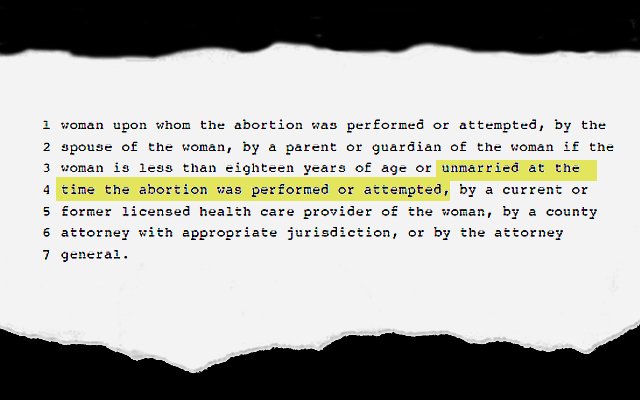
Iowa House Democrats noted on Wednesday that HF 53, to which SF 471 is a successor, also gives parents the legal right to prevent unmarried adult daughters from having an abortion.

View image on Twitter
The GOP’s 6 wk abortion ban dropped & it actually allows the parents of an adult unmarried women to make medical decisions for her.
The bill states “injunctive relief to prevent a physician from performing abortions” may be obtained “by a parent or guardian of the woman if the woman is less than eighteen years of age or unmarried at the time the abortion was performed or attempted to be performed.”

The Iowa House Human Resources Committee was scheduled to debate Senate File 471 on Wednesday.

Source: Raw Story

http://www.rawstory.com/2017/03/iowa-gop-abortion-bill-will-grant-parents-of-unmarried-women-rights-to-control-adult-daughters-bodies/

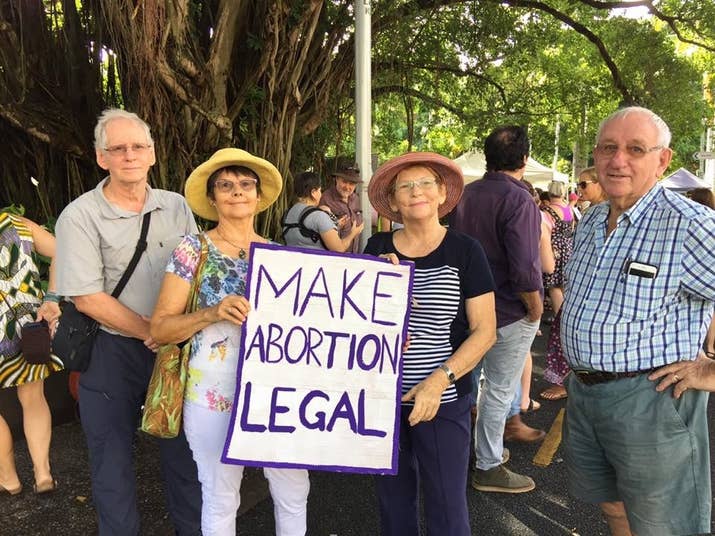
For the past 18 years Dr Michael Carrette has been one of the few doctors providing surgical abortions in Cairns.

Getty

When he retired late last year, after performing nearly 9000 abortions, women with unwanted pregnancies in Far North Queensland were left in the lurch.

The Cairns and Hinterland Hospital and Health Service (CHHHS) told BuzzFeed News: “Until recently, surgical terminations were provided in Cairns by a private doctor. Cairns Hospital patients who required this procedure were referred to this doctor who recently retired.”

Abortion remains in Queensland’s criminal code. If it is performed for reasons other than to “prevent serious danger to the woman’s physical or mental health” a woman and her doctor are technically open to being prosecuted.

Pro Choice Cairns/Facebook

The procedure is mostly performed by private clinics – Queensland Health estimates only 1% of abortions are performed in public hospitals.

Now the CHHHS is flying women as far as Sydney, 2400km away, to access abortions.

“Currently, patients who require a surgical termination are referred to providers in Townsville, Southport or Sydney,” a spokesperson for the CHHHS told BuzzFeed News.

“Medical termination options are still available locally and these are accessible for women who are considered suitable for this form of termination.”

Carrette, Cairns obstetrician and gynaecologist professor Caroline de Costa, and Cairns doctor Heather McNamee, have called on the state government to address the “immediate need” for surgical abortion services in Far North Queensland.

“It is costing taxpayers around $2000 per woman if they are going to Sydney, and that is a conservative estimate for a cheap airfare and a private surgical abortion,” de Costa said.

“That is without factoring in escorts, which you need if you’re having a general [anaesthetic].”

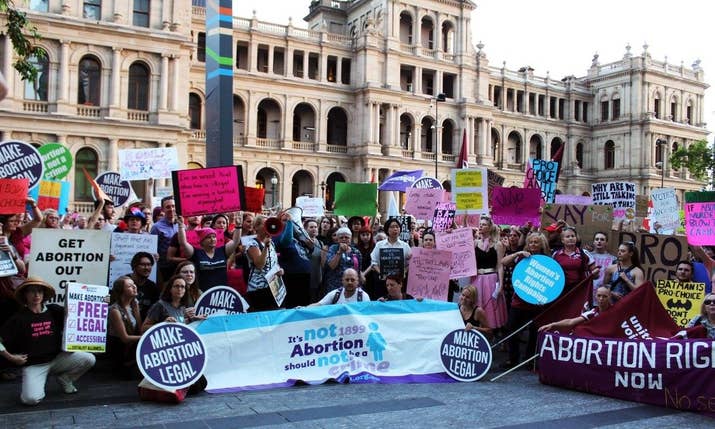
The doctors, along with 16 other Queensland obstetricians, gynaecologists, surgeons and GPs, have called on Queensland premier Annastacia Palaszczuk to speed up the push to decriminalise abortion.

De Costa said the government “tacitly, but not overtly” acknowledges the importance of access to reproductive healthcare by funding medical abortions in Cairns.

Shari Birse/Pro Choice QLD

The government also bailed out clinics in Townsville and Rockhampton when they nearly shut due to the prohibitive cost of flying doctors in and out to perform abortions for regional and rural women.

“Queensland Health itself refuses to establish effective and accessible public services and the result is a very fragile and piecemeal service everywhere north of Nambour, and no service at all west of Brisbane,” said de Costa.

Legislation to decriminalise abortion was withdrawn from the state’s parliament last month after every single member of the Queensland Liberal National opposition vowed to vote against it.

Religious-affiliated groups are testing misleading mobile tools.

Imagine you’re pregnant, and you don’t want to be. You type “abortion pittsburgh” into Google, and the first result is the Pittsburgh Women’s Clinic, offering “free abortion consultations.” “Only you know what’s best for you,” the Google ad reads. “Same-day appointments available. Call now!” You click and come face-to-face with a photo of a smiling woman with a stethoscope. “Looking for an abortion?” she asks in 65-point font. But you won’t get one from her or from the Pittsburgh Women’s Clinic. No clinic with that precise name exists.

The site is a landing page for a network of 41 pregnancy centers seeking to deter women from getting abortions. These centers, located in what they say are America’s “most abortion-dense cities,” are affiliated with or owned by Human Coalition—formerly Online for Life, sometimes going by the name Media Revolution Ministries—a Texas-based nonprofit that reaches “abortion-determined women” via ad campaigns shaped by search engine optimization (SEO) and search engine marketing (SEM). If you call the number on the landing page or initiate an online chat, you’re connected with Human Coalition’s national call center and, eventually, a nearby pregnancy center. The Google ad showed up because you were within 15 miles of one.

In Pittsburgh, 30 percent to 40 percent of women who got abortions last year first spoke to a representative “working to rescue the child and the mother,” says Human Coalition co-founder Brian Fisher, based on his own data and numbers from the Centers for Disease Control and Prevention. Operators tell callers the centers don’t provide or refer for abortion, Fisher says. Nationwide, 1 in 3 women who connect with a Human Coalition representative visit one of the group’s pregnancy centers. “The technology backbone undergirds it all,” he says.

The U.S. has more than 3,000 pregnancy centers explicitly steering women away from abortions, compared with only 1,671 facilities that perform the procedure. Pregnancy centers are typically 501(c)(3) nonprofits backed by religious donors, though nine state governments also subsidize them. Human Coalition has been funded in large part by Farris Wilks, the Texas fracking billionaire and evangelical pastor, whose $2.2 million donation in 2012 increased the organization’s revenue 30-fold, according to IRS disclosures.

 Targeting ads with SEO and SEM is becoming standard practice for pregnancy centers, overseen by umbrella groups such as Human Coalition, Heartbeat International, and Care Net. Several rally support and solicit donations through apps, pinging users to pray when a woman visits a center and, later, updating them on her decision. A chain of centers in California is testing telemedicine. Another chain has geofenced abortion clinics, meaning it has paid to show ads on the smartphones of people in waiting rooms.

“These centers are bullies,” says Amy Everitt, state director of Naral Pro-Choice America for California. “They’re sanitizing their image, but the goals and tactics are the same.” Her group has published reports documenting undercover investigators at pregnancy centers being routinely given false medical information and shamed for seeking abortions.

Pregnancy centers using SEO and SEM buy Google ads for keywords and phrases including “abortion” and “abortion clinic.” Like the Pittsburgh network, many don’t immediately make clear what they’re advertising. “The more ‘pro-life’ we are in our marketing, the more we drive away those who need us,” reads a post on Pregnancy Help News, a website for which Heartbeat International acts as the publisher. “If Jesus blurted out, ‘I am the Christ!,’ [nonbelievers] would have likely run.”

Everitt says this tactic amounts to false advertising and that her group works with Google Inc. to flag misleading search results, which violate the company’s ad policies, for removal. Pregnancy centers say their ads aren’t inherently misleading. “A lot of people search for abortion information,” says Human Coalition’s Fisher. “It doesn’t mean they want an abortion.”

Sometimes, though, pregnancy centers say they’ve gone too far. Allison Poosawtsee, digital marketing director for the 100-location nonprofit Bethany Christian Services, says her organization, which also provides adoption services, has stopped targeting ads to women inside abortion clinics, a practice that prompted public outcry. “We didn’t feel right about it,” she says, because women seeing the ads had likely made up their minds. Bethany’s geofencing campaign, which ran for three months in 2015, generated 16,652 sessions on the organization’s landing page, impregnant.org.

Baltimore, New York, and San Francisco have passed ordinances requiring centers to disclose that they don’t provide or refer for abortion, and Oakland, Calif., levies fines if ads imply they do. Naral helped draft a 2015 California law that requires centers to refer. (This compares with more than 1,000 restrictions on abortion clinics across the U.S., 30 percent passed in the past seven years.) The California rules have withstood court challenges, but lawyers for centers fighting the statewide law say they plan to appeal to the Supreme Court as early as this fall.

Pregnancy centers say they’re expanding beyond counseling and ultrasounds with an eye to supplanting Planned Parenthood. Some offer parenting classes and financial assistance. Obria Medical Clinics, the California chain testing a telemedicine app at its six centers, delivered primary-care services to about 4,000 patients last year. “We’ll provide an alternative,” says Obria founder Kathleen Eaton Bravo, who regrets getting an abortion decades ago. “I started this organization not to take away options, but to provide them.” Her centers offer testing for sexually transmitted diseases but no forms of contraception.

The stakes of confusing one kind of facility for the other can be high for pregnant women, whose options for terminating a pregnancy become fewer and costlier over time. Molly Spadt, 30, of Lincoln, Neb., once visited an Omaha pregnancy center she mistook for an abortion clinic. The billboard and radio ads she saw didn’t disclose its religious affiliation, and she only figured it out after a sonogram. “The words ‘choice’ and ‘options’ were what made me feel comfortable,” she says. “It’s incredibly deceptive.”

Source: Bloomberg

https://www.bloomberg.com/news/articles/2017-03-24/beware-google-ads-for-abortion-consultations

They’re probably not.

GEORGE FREY VIA GETTY IMAGES
Utah Gov. Gary Herbert (R) signed into law a bill that requires doctors to tell women that medication abortions can be reversed midway through the procedure. The American Congress of Obstetricians and Gynecologists does not recommend women do so.

NEW YORK― Utah Gov. Gary Herbert (R) signed a bill into law this weekend that requires doctors to tell women that medication abortions can be reversed midway through the process ― a claim that is unsupported by science.

Medication abortions involve taking two separate medications, mifepristone and misoprostol, within two days of each other. The first drug blocks progesterone and sheds the uterine lining, and the second causes a full miscarriage. The Utah law, passed by the GOP-controlled House and Senate, claims that a woman can stop her abortion after taking the first pill by ingesting the hormone progesterone. Doctors’ groups dispute that theory.

“Claims of medication abortion reversal are not supported by the body of scientific evidence,” the American Congress of Obstetricians and Gynecologists said in a statement, “and this approach is not recommended in ACOG’s clinical guidance on medication abortion.”

The author of the bill, Rep. Kevin Stratton (R), said it helps women be more “educated” about their decision. “If you’re pro-choice, I would say that it helps you be educated in making the choice,” he said in an interview with the Deseret News. “If you’re pro-life, it gives an opportunity to look at the options if a decision is made to reverse course.”

Republicans in five states have passed or tried to pass “abortion reversal” bills, and a federal judge in Arizona blocked a similar law in 2015 after ACOG called it “tantamount to quackery.” The legislation is based on a single study of six women who had taken a dose of mifepristone and then tried to reverse their abortions. Four of the women in the study were able to continue their pregnancies. But mifepristone alone only works 30 to 50 percent of the time to end a pregnancy, so researchers say there is insufficient evidence to claim that it was the dose of progesterone that halted the abortions.

The Utah bill is the latest in a trend of state legislatures encouraging doctors to give women false or incomplete information about abortion. Last week, the Texas Senate approved a bill that would permit doctors to lie to women about fetal abnormalities in order to discourage them from choosing abortion. And Republican lawmakers in Texas and Kansas have passed legislation requiring doctors to tell women that abortion is linked to breast cancer ― another medically unsupported claim.

But “abortion reversal” laws could actually put women’s health in danger by encouraging them to take a hormone that “can cause significant cardiovascular, nervous system and endocrine adverse reactions as well as other side effects,” according to ACOG. The doctors’ group recommends that instead of listening to politicians, women who change their minds halfway through a medication abortion have the same chance of success by “doing nothing and waiting to see what happens.”

Source: Huffington Post

http://www.huffingtonpost.com/entry/utah-bill-medication-abortions-reversible_us_58d96c6be4b00f68a5c96c25?ewa3cmsmscbx1or

Tennessee woman Hadleigh Tweedall shares her abortion story.

Hadleigh Tweedall and her husband had long been hoping for a second child to join their son, born in January 2014. Tweedall got pregnant just a few months after her son turned 1, but she experienced a miscarriage at the 11-week mark. “After that, it took us a while to start trying again,” Tweedall tells SELF. “It was obviously very devastating.” So when Tweedall found out she was pregnant again at the end of summer 2015, she was ecstatic. She and her husband were hopeful this pregnancy would be a successful one.

“Baby Grace,” she says. “That was the baby we ended up terminating.”

When Thanksgiving came around, Tweedall was 12 weeks pregnant. She’d just had a checkup and an ultrasound, and had been told everything looked normal with her pregnancy. She went in for some noninvasive prenatal testing, per a suggestion from her doctor. These tests could tell her the sex of the fetus, and they could alert her doctor to the presence of trisomies—chromosomal abnormalities that could lead to fetal anomalies or miscarriage. Tweedall and her husband were excited to find out the sex, so they went in and completed the tests right before Thanksgiving. The doctors said they would hear back about their results just 10 days later.

“We did Thanksgiving with our families,” she says. “We announced our pregnancy to our extended families, and it was a really exciting time.” But when they got back from Thanksgiving, Tweedall and her husband still hadn’t gotten their results. The couple called the office repeatedly over the next three weeks, until a doctor finally told them they needed to come in. “I was hysterical, because I knew something was wrong,” she says. “She would have just told us everything was fine over the phone, but she wanted to see us.” At that point, Tweedall knew her fetus likely had a trisomy—though she had no idea which one.

Tweedall and her husband soon learned their fetus was female, but the tests also found trisomy 21—more commonly known as Down syndrome. “It was a lot of information coming at us all at once,” Tweedall says. She learned there was a small chance that there was a false positive—meaning her fetus wouldn’t actually have a trisomy. Tweedall was only 30 years old, so her risk of conceiving a child with Down syndrome was 1 in 940. Her doctor recommended more tests to confirm the results, and the couple agreed.

“It was Christmas,” Tweedall says. “Everything was booked, and every sonogram place was closed for the holidays.” The couple got the earliest appointment available to them on December 28. In the meantime, Tweedall did some research. She reached out to the director of the Down Syndrome Association of Middle Tennessee, and connected with a family who had children with Down syndrome. “I wanted to get a better idea about the condition,” she says. “It could lead to multiple surgeries and a very short suffering life for the child. Or the child could be very high-functioning and prosper. You just don’t know.”

For Tweedall and her husband, the next two weeks dragged on. “I don’t think I got out of bed very much,” she says. “You just feel really lost with a diagnosis like that.” When the couple finally went in for tests on December 28, they learned the fetus had both Down syndrome and hydrops fetalis—a condition in which the body fills with fluid. “It was a terrible day,” Tweedall says. “Her legs had stopped growing due to fluid. Our doctor told us there was no way this baby would survive more than a month or two of pregnancy.” Tweedall explains that if the pregnancy had been farther along, the doctor could have induced labor and tried to save the fetus. But Tweedall was only 17 weeks in. “At that point, there’s not much you can do when there’s that much fluid in the baby’s body,” she says.

The doctor told Tweedall that the pregnancy would become increasingly high-risk if she decided to carry it to term. “‘If she passes away, your body might take a while to realize she’s no longer living,'” Tweedall was warned. This increased Tweedall’s risk of hemorrhaging or contracting an infection.

“So my doctor recommended that I terminate the pregnancy—from a safety standpoint for me,” she says. Tweedall notes that many laws restricting abortion access are written to include exceptions for cases that endanger the life of the mother. “But it’s a hard thing, because that’s based on opinion,” she says. “Nobody told me I was going to die. My risk of death and hemorrhaging and infection increased if I continued—but it’s such a fine line. I’m a wife and a mother to a little boy—I want to be around for that.”

Tweedall’s doctor said the closest place that would perform a late-term abortion was a clinic in Atlanta. “It wasn’t even a conversation to see if anyone would do it here,” she says. “But I didn’t want to be away from everyone, sleeping in a hotel, and not even knowing or trusting the medical staff.” So Tweedall didn’t really look into going to Atlanta. Instead, she decided to take a trip to her hometown—Chicago—because she felt more comfortable being in a place where her parents still lived. “It’s scary enough that you’re going through all this,” she says. “To think you’re going to be in a clinic somewhere you aren’t familiar with is a lot to take in.” And Tweedall felt disappointed by the lack of support she was receiving from her medical staff in Tennessee. “Everyone just sorted of washed their hands of it and walked away,” she says.

So Tweedall planned to travel to Chicago to receive the medically necessary procedure. Beforehand, she had to fax over her medical records and send ultrasounds showing that the fetus had severe hydrops fetalis. “But I had to follow up with my doctor three or four times just to get her to send over the paperwork,” she says. “I called her office numerous times—and never got a call back.” Tweedall grew concerned. The Chicago hospital would only perform abortions on pregnancies under 20 weeks, and Tweedall was already at 17.5. “We were leading up to the new year,” she says. “It was the holidays—everyone was out of office. No one was responding, and the longer you wait, the more your risks increase and the more difficult the procedure becomes.”

Tweedall ended up terminating her pregnancy five days into the new year—on January 5, 2016. “It was the hardest thing of my entire life,” she says.

Tweedall says that after she came home to Tennessee, people kept trying to reassure her by saying that what she did “wasn’t an abortion.” “But I kept saying, ‘No—it is,” she says. “I wanted to reclaim the word abortion, because the stigmatized image people have of abortion isn’t always what it is.”

Tweedall later learned that she could have had her abortion at a Tennessee hospital, after all. The state’s laws permit women to have abortions at clinics until they’re 15 weeks pregnant. Then, between 15 weeks and fetal viability (20 to 22 weeks), a woman can have an abortion at a hospital. These medical facilities have the right to deny patients, meaning they’re not required to perform the procedure—they’re just permitted to. If Tweedall had been more aware of Tennessee’s laws, she might have avoided traveling 491 miles just to receive a safe, legal medical procedure she needed.

“It was just interesting to find out that technically my doctor should have fought for me,” she says. “But nobody did. Nobody fought for me. And that’s disheartening. You rely on your doctors—especially in a crisis situation—to give you accurate information. On top of it, you’re grieving the loss of your daughter. And it’s just—I don’t know—the regulations and the way I was treated by the medical team here in Tennessee didn’t make the situation any easier. I even had to call and follow up about our paperwork. Thank God for my husband, because he was doing most of it while I was on the floor crying. So to find out later that I technically should have been able to go home to my bed that night is just awful.”

And though reliving these experiences brings back negative feelings, Tweedall says it’s only getting easier to talk about. When I spoke with her in early January, she was about to give birth to another child. After three years, one miscarriage, and one abortion, she and her husband are finally welcoming a second child into their family. “It’s been a long nine months,” she says. “It’s been so long, and we’ve had to go through so much crap to get to this point.”

And whether her tragic experience is effecting change, inspiring open-mindedness, or making someone feel less alone, she’s happy to share it. “At least if my story can help somebody, it’s worth telling,” she says.

Source: Self

http://www.self.com/story/tennessee-abortion

Here’s a look at 90 of them.

Joseph Silk, David Brumbaugh, Matthew Hill, Mark Chelgren, Justin Humphrey, and Brad Klippert—just six of the many legislators who have introduced anti-abortion bills so far in 2017.

We’re just three months into the new year, and lawmakers—a handful of whom are pictured above—have already proposed 168 anti-abortion bills at the state and federal levels.

Why does this matter? More than four decades ago, Roe v. Wade affirmed a person’s constitutional right to privacy, effectively legalizing abortion nationwide. But lawmakers have continued proposing and passing bills that make abortion—a medical procedure—harder to access.

Yet these anti-abortion legislators persist—in spite of research that shows that countries with the strictest anti-abortion laws actually have some of the highest rates of abortions in the world, and that there’s a correlation between defunding Planned Parenthood and an increase in maternal mortality rate. Overwhelming evidence indicates that smarter, more humane ways to actually lower the abortion rate involve improving healthcare and healthcare access—such as by making contraception and family planning services more available, not less. But in our country, (overwhelmingly male) politicians continue proposing and passing laws that impede access to safe and constitutionally protected medical care.

Here are 90 of the 168 anti-abortion bills that have been proposed so far in 2017.

There’s a bill that says patients have to receive permission to have an abortion from the person who impregnated them.

Oklahoma Representative Justin Humphrey introduced a bill that would prevent people from having abortions until they’ve received official permission to do so from the people who impregnated them.

“I believe one of the breakdowns in our society is that we have excluded the man out of all of these types of decisions,” Humprey said, explaining his bill. “I understand that [women] feel like that is their body. I feel like it is a separate—what I call them is, is you’re a ‘host.’ And you know when you enter into a relationship you’re going to be that host and so, you know, if you pre-know that, then take all precautions and don’t get pregnant. So that’s where I’m at. I’m like, hey, your body is your body and be responsible with it. But after you’re irresponsible then don’t claim, well, I can just go and do this with another body, when you’re the host and you invited that in.”

There’s a bill that requires medical providers to interfere with an abortion if the fetus shows any signs of life.

The Arizona Senate has passed a bill that requires medical professionals to try to resuscitate aborted embryos and fetuses if they show any signs of life—whether the embryo or fetus is viable or not. Right now, doctors only perform these measures on a case-by-case basis when the chance of survival is high. One doctor told CBS that attempting medical interventions at early stages in gestational development is “cruel” to the parents and would inflict unnecessary harm on a fetus or embryo that likely wouldn’t survive anyway.

There are eight bills that force medical providers to bury or cremate fetal remains—or otherwise specify how medical providers should dispose of fetal remains.

Doctors already have established protocols for how they sanitarily dispose of medical waste. But these eight bills would require them to treat fetal tissue differently. “Many doctors and medical organizations have said that [these laws] do nothing for any public health purpose,” David Brown, senior staff attorney at the Center for Reproductive Rights, previously told SELF. “It’s a way of putting additional pressure on clinics in the hopes that some won’t be able to withstand the pressure and close. It’s one more potential obstacle to them having to keep their doors open.”

There are five bills that allow patients to sue their abortion providers, even decades later.

These bills would allow patients to sue their abortion providers for emotional distress—even years after receiving the procedure. And while some, like Iowa Senator Mark Chelgren, see bills like these as a way to protect people seeking abortions, legal experts say the consequences could be severe. “When you look at it more carefully, it’s a threat to the woman because it creates deterrents for doctors to do this,” Mark Kende, J.D., director of the Constitutional Law Center at Drake University, told the Associated Press. In other words, the threat of being sued retroactively could scare doctors out of providing abortions at all—which ultimately hurts people who are seeking them.

There are seven bills that ban abortion entirely.

Some of these bills recognize life as beginning at conception, and view abortions at any state of gestational development as murder. Others seek to criminalize medical providers who perform abortions. All seven view abortion as unlawful in some form or fashion, and all would ban the procedure entirely (with select exceptions, depending on the bill).

There are 10 misleadingly named “Heartbeat Bills” that ban abortions after fetal cardiac activity is detectable—usually around the six-week mark.

So-called “Heartbeat Bills” ban abortions from the moment fetal cardiac activity is detectable. This typically happens around the five- or -week mark—before many people even realize they’re pregnant. (Learn more about what it means to be six weeks pregnant here.) Nine of these bills have been introduced at the state level, but Iowa congressman Steve King proposed the first federal six-week abortion ban: the “Heartbeat Protection Act of 2017.”

Other states, like North Dakota and Arkansas, have attempted to pass similar bills in the past—but their efforts were blocked in higher courts for being unconstitutional.

There are 18 bills that ban abortions after 20 weeks, based on the unsubstantiated claim that fetuses can feel pain at this point.

Twenty-week abortion bans are based on the idea that fetuses can feel pain at this stage in development—despite there being no medical evidence to support that reasoning. These bills are similar to laws already in place in 16 states and to two that were blocked for being unconstitutional.

Worth mentioning: Almost 99 percent of abortions occur before the 20-week mark, according to Planned Parenthood. Often, people who seek late-term abortions do so because they’ve discovered serious fetal anomalies that weren’t apparent earlier. “These are often desperately desired pregnancies that have gone wrong,” Lauren Streicher, M.D., an associate professor of clinical obstetrics and gynecology at Northwestern University Feinberg School of Medicine, previously told SELF.

There are 12 bills that ban abortions through dilation and evacuation, the safest and most common way for a woman in her second trimester to have an abortion.

Dilation and evacuation abortions—or D&E abortions—involve two steps. First, a woman’s cervix is dilated. Second, a doctor surgically removes the contents of the patient’s uterus. The American Medical Association recognizes this as the safest way a woman can terminate a pregnancy beyond the 14-week gestational mark. It’s also the most common way for people in their second trimesters to end pregnancies, as D&E is used in 95 percent of second-trimester abortions.

There are 12 bills that require patients to be offered ultrasounds, have ultrasounds, or listen to sonograms before they can have the abortions they’re seeking.

Ten different states have introduced bills that would require patients to jump a series of hoops before they can have the abortions they’re seeking. (Both New Jersey and New York have introduced two.) Some of these bills require people to have ultrasounds, and others require them to listen to sonogram results. Some just require medical providers to offer to perform ultrasounds on people seeking abortions. If passed, all of them would force people to take additional steps to have the abortions they want or need.

There are 16 other bills that make patients undergo counseling or wait a certain period of time before they’re allowed to have abortions.

State legislators have also introduced bills that would require patients to undergo specific kinds of counseling or wait a certain period of time before they can actually have the abortions they’re seeking. Sometimes, these bills result in people having to make more than one appointment, which can be especially difficult for people who live in rural areas and have to drive long distances to get to a medical provider in the first place.

Source: Self

http://www.self.com/story/anti-abortion-bills

GOP Politician Says Pregnancy from Rape or Incest Is Like 'Beauty from Ashes'

PHOTO VIA OKHOUSE.GOV

Invoking God, the Oklahoma House of Representatives just passed a bill outlawing abortion in cases of fetal abnormality—with no exception for rape or incest.

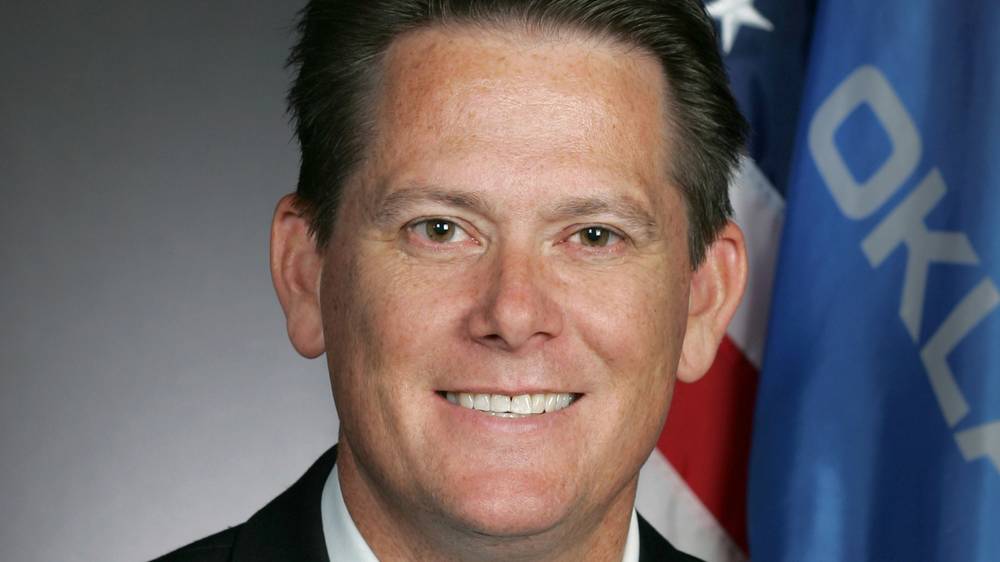
Republican politicians frequently have to say dumb and vile things to justify abortion bans that don’t allow exceptions under any circumstances—including pregnancies resulting from rape or incest, or if the woman’s life is in danger. The latest example comes from an Oklahoma state representative, George Faught, who introduced a bill that would ban abortions due to fetal genetic abnormalities or Down syndrome. The bill would make it illegal for doctors to perform abortions under that criteria; those who refuse to comply could have their licenses suspended or revoked and face fines of up to $100,000.

Defending the fact that the ban would have no exceptions, Faught suggested that “rape and incest could be part of God’s will,” according to the Huffington Post. And when Democratic members of the state’s House challenged him, asking him directly if rape was the will of God, he seemed to imply that, since rape was in the Bible, it’s just a natural part of life that women have to deal with.

“If you read the Bible, there’s actually a couple circumstances where that happened, and the Lord uses all circumstances,” Faught said. “I mean, you can go down that path, but it’s a reality, unfortunately.” Regarding incest, he said, “Same answer.”

When Faught added that the line of questioning from the Democrats “doesn’t deal with this bill,” they made clear to him that it does. “You won’t make any exceptions for rape, you won’t make any exceptions for incest in this, and you are proffering divine intervention as the reason why you won’t do that,” Rep. Cory Williams said. “I think it is very important. This body wants to know, myself personally, whether you believe rape and incest are actually the will of God.”

Faught responded by doubling down on his claims that rape and incest are part of God’s grand design, and victims of rape and incest can “use” the experience. “It’s a great question to ask, and, obviously if [rape and incest] happens in someone’s life, it may not be the best thing that ever happened,” he said. “But, so you’re saying that God is not sovereign with every activity that happens in someone’s life and can’t use anything and everything in someone’s life, and I disagree with that.”

 Apparently the floor was moved by this testimony, as the bill passed in the House with 67 votes. In a statement to a local NBC station after the vote, Faught spoke of the “beauty” of pregnancy that results from rape or incest. “Life, no matter how it is conceived, is valuable and something to be protected. Let me be clear, God never approves of rape or incest. However, even in the worst circumstances, God can bring beauty from ashes,” he said.

Even in the worst circumstances, God can bring beauty from ashes

Faught’s statement, and the the bill—which was authored at the request of an anti-abortion group—have been condemned by doctors and healthcare advocates. “This bill is a deeply damaging to reproductive healthcare, as well as the doctor-patient relationship,” the Oklahoma Coalition for Reproductive Justice said in a statement. “Further, we find it absolutely unacceptable and inappropriate that the bill’s author, George Faught, argued on the House floor that sexual assault is the will of God. Oklahoma women and families deserve better than a politician that uses his personal dogma to explain away violent crimes against women.”

Faught tried to pass a bill like this last year, but it failed after Senate amendments. According to the Guttmacher institute, only one other state—North Dakota—has a law that bans abortion on the basis of fetal abnormalities. Two other states have attempted to institute similar legislation, but federal courts have intervened, temporarily blocking the laws from taking effect; pro-choice advocates say Oklahoma will face similar legal challenges if the bill becomes law.

“It’s interesting that the bill is drawn so that it only impedes access for one group of people, and, frankly, folks who have fetal abnormalities are in desperate situations themselves,” Julie Burkhart, the founder and CEO of one of only three abortion clinics in the state, told a local news outlet. “So it really works to penalize women, their partners, their families for just trying to make good decisions for themselves.”

Indeed, there are many reasons women choose to terminate their pregnancies when they learn the fetus they are carrying has a genetic abnormality. In some instances, the abnormality may be so severe that it will be incompatible with life. It’s also often the case that severe conditions are detected late in pregnancy, so many late-term abortion restrictions already pose hurdles to women in these situations. But no matter the circumstance, bills like the one proposed in Oklahoma tell women that they don’t have the right to decide what’s best for their families and their own bodies—only God and old white men do.

Source: Broadly

https://broadly.vice.com/en_us/article/gop-politician-says-pregnancy-from-rape-or-incest-is-like-beauty-from-ashes

The activists were protesting several anti-abortion measures.

On Monday, the Texas Senate considered several abortion-related bills, including Senate Bill 415, a regulation that would effectively ban a safe and common procedure used for second trimester abortions, which anti-choice legislators have taken to calling a “dismemberment abortion ban.” It passed and will now head to the House.

The Senate also inched forward with SB 25 ― a bill that would effectively allow doctors to lie to pregnant women if they detect a fetal anomaly and are concerned their patients might opt for abortion. It will likely head for a final vote on the floor this week.

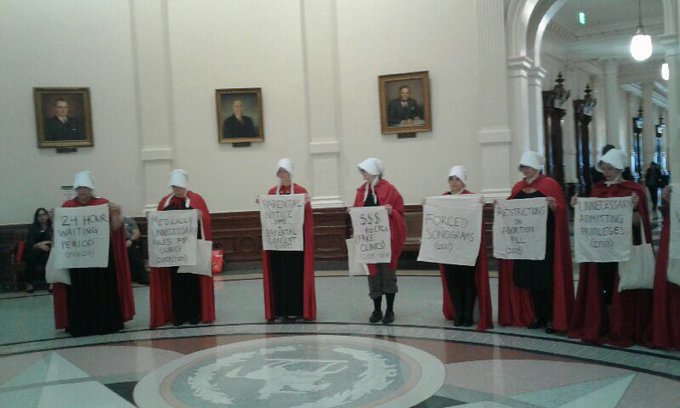
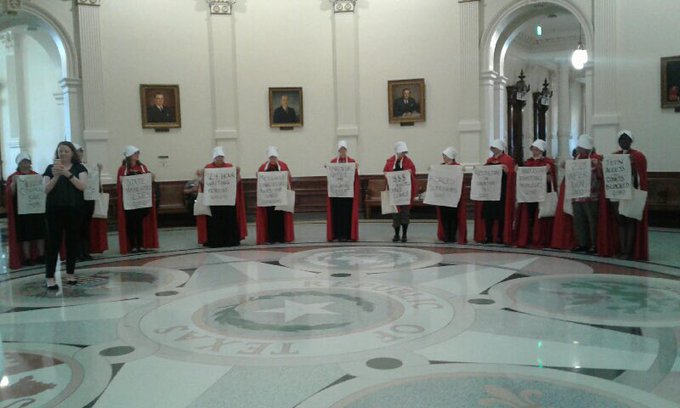
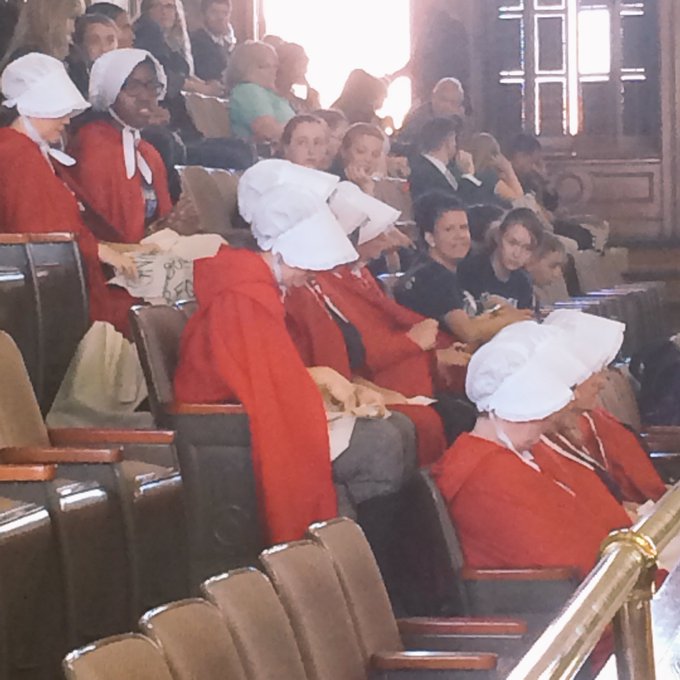
But in the Senate chambers on Monday, a group of Texas women were having none of it. The activists arrived decked out in full red robes, an homage to characters in “The Handmaid’s Tale,” Margaret Atwood’s classic (and distressingly relevant) feminist tome.

View image on Twitter
 The scene in Texas sent a quiet warning to legislators that women are ready to push back against the recent increase in anti-choice legislation in states across the country. Pictures of the sheroes quickly made the rounds on Twitter with the hashtag #FightBackTX.

It’s not the only recent example of women using clothing to broadcast a message in legislative quarters. Democratic women wore white to hear President Trump’s first address to Congress last month, a nod to the suffragists and a rebuke of misogynistic policies.

A pro-choice protest On International Women’s Day in London.
A pro-choice protest On International Women’s Day in London. ‘It is time for women to be treated as autonomous adults capable of making their own decisions,’ writes Wendy Savage. Photograph: Wiktor Szymanowicz/Barcroft

We congratulate Diana Johnston for introducing her bill (New bill to challenge UK’s Victorian-era abortion law, 14 March) and are delighted it was passed by 172 to 142 votes. As a 10-minute rule bill, it has no chance of becoming law, but it is important in starting the debate about whether, after 50 years, it is time to revisit the 1967 Abortion Act. It is time to treat abortion like any other medical procedure, and control it with regulation and the GMC. It is wrong that three women have been jailed or had a suspended sentence, and that doctors responding to women’s requests may face criminal prosecution. Many people (and even some gynaecologists) do not realise abortion is a criminal offence unless it conforms with the conditions set out in the Act. Up to 80% of people polled believe the woman should make the decision in consultation with her doctor and 90% of a random sample of gynaecologists surveyed in 2015 said that the woman should make the decision to end her pregnancy. It is time for women to be treated as autonomous adults capable of making their own decisions about continuing a pregnancy, a view that the some tabloid newspapers seem incapable of understanding.

Source: The Guardian

https://www.theguardian.com/world/2017/mar/20/women-are-capable-of-choosing-whether-to-continue-a-pregnancy

Wellington High School students protesting outside Wellington Hospital in support of women wishing to have abortions in 2014.

KEVIN STENT/FAIRFAX NZ

Wellington High School students protesting outside Wellington Hospital in support of women wishing to have abortions in 2014.

 EDITORIAL: Abortion law in New Zealand seems to be one of those areas where Government thinking is observably out of step with public opinion. Recent polling by Curia, carried out for the Abortion Law Reform Association of New Zealand, found majority public support for the legality of abortions in a range of situations. Support was as high as 77 per cent if a pregnant woman was likely to die without an abortion, down to 54 per cent if the woman cannot afford another child and 51 per cent if she simply does not want to be a mother.

These numbers reveal the existing law is archaic and farcical, and that most agree that abortion should be considered a health issue not a criminal one. Abortion is covered by laws that have not been updated for 40 years. They say that two consultants need to agree that the woman’s mental or physical health is at risk or the baby would be seriously disabled before an abortion can be approved.

In most cases, it is merely a rubber-stamping exercise. Of the 13,000 abortions that were performed in New Zealand in 2015, nearly all were approved on mental health grounds (in 2014, that covered 97 per cent of abortions). Does anyone believe that more than 12,000 New Zealand women risked severe mental health outcomes if their pregnancies went full-term?

Bill English and Paula Bennett hold different views on abortion, but his view will prevail for the time being.

CAMDERON BURNELL/FAIRFAX NZ

Bill English and Paula Bennett hold different views on abortion, but his view will prevail for the time being.

 That said, abortions are sometimes declined. It was reported that 252 “not justified abortion” certificates were issued in 2016. It is a reminder that while our system appears to operate as abortion on demand as long as doctors agree to bend the rules, they still have the authority to deny abortions without giving reasons.

The fact that one in four New Zealand women have had an abortion suggests it has become mainstream, though it is a difficult personal decision that is rarely taken lightly and often at times of considerable distress. Some noted that even the language of the law reflects earlier, less enlightened times. Doctors are routinely referred to as “he” and the abhorrent term “subnormal” is used in a mental health context. This is what Abortions Supervisory Committee chair Dame Linda Holloway meant when she told Parliament last week that parts of the law seem “offensive” to us now. It also uses outdated medical terminology.

The committee’s appearance before the Justice and Electoral Select Committee put the otherwise dormant issue of abortion law under the spotlight. It made it political. For Opposition, there is the happy coincidence of having a conservative Catholic Prime Minister, Bill English, who refuses to back liberalisation and a Deputy Prime Minister and Women’s Affairs Minister, Paula Bennett, who has said she is “pro-choice” but is toeing the party line this time.

Act leader David Seymour identified that the current law is a “charade” from his party’s liberal perspective. But it is a charade we will keep playing for the time being. Despite such pressure, there is little political will for change and it is unlikely English and Bennett will be embarrassed into reversing their public positions on what remains a private and morally subjective area.

Source: Stuff

http://www.stuff.co.nz/the-press/opinion/90539750/editorial-is-it-time-to-update-new-zealands-abortion-law