People encouraged to take day off to protest restrictive abortion laws or show solidarity by wearing black, posting on social media and staging walkouts

Women and pro-choice campaigners in Ireland are going on strike to protest the country’s strict anti-abortion laws.

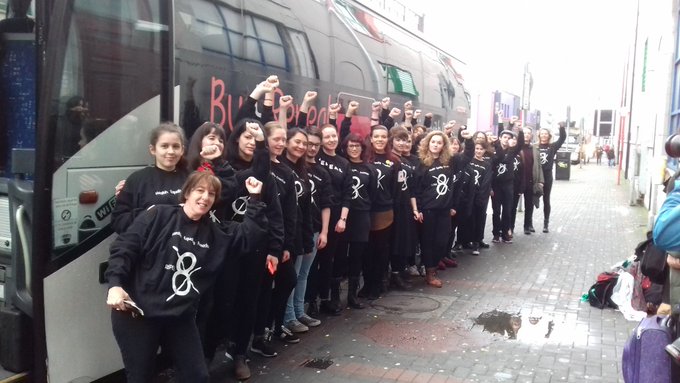
Protesters will gather at O’Connell Bridge in central Dublin and in other cities across Ireland and worldwide to demand a referendum on abortion, which is a criminal offence under the Irish constitution.

Organiser Avril Corroon told The Independent the event was not a form of industrial action but a ‘social strike’, inspired by mass protests in Poland that led the government to reject proposals for a near-total ban on abortion.

She said people had been encouraged to take a day off to take part in demonstrations, but those unable to do so could show support for the cause by wearing black, posting on social media and staging coordinated walkouts at 12pm.

“Abortion is a workplace issue,” said Ms Corroon. “Not everyone is in a position to take a day off work, which is why we need new reproductive health laws.”

It is estimated that 12 women travel from Ireland to Great Britain every day to access a safe and legal termination.

Women who have abortions in the Republic of Ireland face up to 14 years in prison.

This is the case for all pregnancies, including those conceived as a result of rape or incest, or where the foetus cannot survive outside the womb due to a fatal abnormality.

Ms Corroon said protesters were calling for a referendum on whether Ireland should repeal the 8th amendment of its constitution, which recognises the right to life of an unborn child.

The Citizens’ Assembly, a group of 99 unelected representatives, are currently debating the future of the amendment. The results of a ballot next month will be given as a recommendation to parliament.

But Ms Corroon said this was not good enough: “Why would you ask 99 people when you could ask all of us?”

Student walkouts and demonstrations have also been planned at Irish universities including University College Dublin, where Kim Harte is a student.

Ms Harte, dressed in black for the protests, told The Independent she and her classmates planned to walk out of lectures at 12.30 to join a rally on campus, before travelling to the city centre for the march.

“Women should have access to free, safe and legal abortion. Bodily autonomy is a right,” she said. “The 8th has already caused women, such as Savita Halappanavar, to lose their lives and this is why it must be repealed.”

Ms Halappanavar died in October 2012 at a hospital in Galway after she was refused an abortion despite complications to her pregnancy.

Similar protests have also been planned at universities in the UK such as Royal Holloway, Oxford and Cambridge and in other cities across the world, including Melbourne, Berlin, Lyon and at the Irish embassy in London.

Around 100,000 women dressed in black staged an all-out strike and joined protests in more than 60 cities around Poland last October.

Women in the US are also taking part in a ‘day without women’ on International Women’s Day, following mass protests on 21 January, the day after Donald Trump’s inauguration as President.

Abortion has been a divisive issue for decades in Ireland where, after large street protests from both sides of the debate, a complete ban was only lifted in 2013 when terminations were allowed if a mother’s life was in danger.

However governments have been reluctant to tackle an issue they fear may alienate conservative voters, despite a waning of the influence of the catholic church.

In 2015, Ireland became the first country to adopt gay marriage by popular vote.

Icelandic women first staged a strike in 1975, with 90 per cent of the country’s female population refusing to work, do childcare or housework as they demanded equal rights with men.

Source: The Independent

http://www.independent.co.uk/news/world/europe/irish-women-abortion-ban-strike-international-day-2017-republic-ireland-consitutional-amendment-a7617461.html

Dutch politician Lilianne Ploumen is taking on President Donald Trump’s ban on providing federal money to international organizations that perform or provide information about abortion.

In his first few days in office, President Trump reinstated the Mexico City Policy, which prohibits the United States from giving federal aid to any nongovernmental organization abroad that performs or informs peopleabout the procedure. Ploumen, the Dutch Minister for Foreign Trade and Development Cooperation, subsequently said she wanted to set up an international fund to help expand contraception and abortion access to women in developing countries.

“This is a time to really act. We hear a lot of talk about what President Trump does or doesn’t do and his decisions,” Ploumen told Refinery29 in an interview published this week. “But if we all just listen to that and not act, many women will suffer because of those decisions. I didn’t want to let that happen.”

Ploumen’s fund, called She Decides, has since raised over 200,000 euros in donations alone, according to Refinery29. She’s also gotten the support from Canada, Denmark, Estonia, Sweden, Belgium and Norway, which pledged to donate roughly $10 million to the initiative. Ploumen is now working to get more countries to sign on to support She Decides.

“To be able to decide if you want to have sex, with whom and have babies, these matters all define who you are as a person,” she said. “In many countries of the world, there’s a lack of services to help women make those decisions for themselves, which is why these health organizations are so crucial.”

Source: Motto

http://motto.time.com/4685806/dutch-abortion-fund-mexico-city-policy/

5-march-17

The abortion pill is safe and easy—and it could give American women unprecedented reproductive autonomy. Its political opponents have spent over a decade ensuring this doesn’t happen.

Over 16 years ago, the United States stood on the brink of a reproductive rights revolution. The FDA was in the final stretch of approving mifepristone, a drug already available in Europe in China, which was said to make ending a pregnancy within the first 10 weeks as easy as taking a pill. Reproductive health advocates stateside anticipated that this move would radically change the landscape of abortion access.

Even after the victory of Roe v. Wade, hospitals shied away from providing abortion services due to intense stigma and political maneuvering by anti-abortion activists. As a result, surgical abortion had been confined to some of the only spaces willing to help women: stand-alone reproductive health clinics, which were scarce, not to mention vulnerable targets for protesters. In the late 90s, the abortion pill was set to change that.

“If and when mifepristone does become available, it will remove many of the political and practical barriers that have made it difficult for US women to get abortions—and for many physicians to perform them,” a Mother Jones article claimed in 1999. A survey of doctors earlier that year, the article went on to note, “found that 54 percent of all obstetricians and gynecologists, including 45 percent of those who don’t currently perform abortions, said they would offer mifepristone if it were available.”

Later-term surgical abortions would still be necessary for a lot of women, but mifepristone (in combination with an existing drug called misoprostol, which increases uterine contractions) was poised to bring abortion into the mainstream by widening the pool of providers willing to provide abortion services at all: They would be able to simply write a prescription for a pill.

With RU-486 termination of early pregnancy will be done medically, not surgically, under conditions that will make it largely impossible to stop.

Mifepristone was supposed to give women more control over their bodies, their families, and their health by expanding their choices and privacy. It was seen as the holy grail that would thwart abortion foes, who, as always, had been working hard to overturn Roe v. Wade and complicate abortion access: “With RU-486,” as the pill was known at the time, “termination of early pregnancy will be done medically, not surgically, under conditions that will make it largely impossible to stop,” a Chicago Tribune article from 1992 professed. Some advocates had hoped the abortion pill would be available directly through pharmacies and eventually over-the-counter, like Plan.

Clearly, this hasn’t been the case. Over a decade later, abortion access has hardly expanded beyond the clinic setting, and in states across the country, those clinics are being forced to shut down. As of 2014, the abortion pill accounted for 43 percent of abortions in the US; however, it’s still not the easy-to-access alternative that reproductive health advocates thought would be possible over a decade ago. What happened?

The history of the abortion pill is fraught from the start. In 1980, a French pharmaceutical company, Roussel-Uclaf, developed the medication abortion drug, which works by blocking the effects of progesterone, a hormone essential to maintaining pregnancy. After a series of clinical trials in 1988, it was approved by the French Ministry of Solidarity, Health, and Social Welfare for distribution. The anti-abortion backlash within the country was swift. Anti-abortion protests and threats of boycotts for other products caused Roussel-Uclaf’s parent company to halt the production of mifepristone out of fear that it would hurt their bottom line. Thankfully, just two days later, the French government intervened and ordered the company to resume production of the drug in the interest of public health, calling it “the moral property of women.”

Here in the US, however, the intense anti-abortion political climate stopped Roussel-Uclaf from bringing the abortion pill to market, despite the efforts of feminist groups like the Feminist Majority Foundation. And under George Bush, the FDA banned importation of mifepristone—though that didn’t stop women from trying to smuggle it in.

In 1993, all that changed: Although the Hyde Amendment still passed in Congress that year and the “Freedom of Choice Act,” which would have codified abortion access into law, was defeated, the Clinton administration ushered in a new era of executive support for reproductive rights and requested that the FDA reconsider the importation ban. The following year, Roussel-Uclaf donated the rights to mifepristone to the Population Council, a New York-based nonprofit research institution, and they began US-based clinical trials on its safety and efficacy. By 1995, the Population Council had filed a FDA New Drug Application for mifepristone.

But the battle to get the abortion pill approved in the US would still take years. The anti-abortion lobby, along with Republican politicians, tried to delay it as long as possible; in 1996, the public hearings on the abortion bill got underway, and the proceedings essentially became a debate between women’s health providers and abortion foes. Documents from the advisory committee for the drug’s approval show a letter that discusses the purported “psychological effects” of the abortion pill and goes on to say that “the practice of birth control in any of its forms is an evil” was submitted for consideration alongside the preliminary results of the Population Council’s year-long clinical trial, which showed that the abortion pill was safe to use, and that women favored the method.

The committee also heard testimony about the link between abortion and breast cancer, a widely used anti-abortion misinformation tactic. “However safe this drug regimen may appear in short term testing, there is too much hard evidence that, in the long term, many thousands of women will get breast cancer because they took these drugs,” Dr. Joel Brind, one of the main religious advocates for the anti-abortion pseudoscience, told the committee. The National Cancer Institute, the American Cancer Society, and the American College of Obstetricians and Gynecologists (ACOG) have all conducted scientific reviews of the literature on the subject and concluded that there is no link between abortion and breast cancer.

…The political climate is really interfering in the science.

Simultaneously, congressional Republicans, who controlled the majority of both Houses, led by Speaker Newt Gingrich, attempted to stymie the process, though they were unsuccessful. Despite their opposition, the FDA advisory committee recommended mifepristone for approval and ultimately approved it in 2000, following the Population Council’s long search for a willing manufacturer. In the years in between the first hearing about mifepristone and its eventual approval, states across the US were busily passing parental consent laws and working to make late-term abortion illegal.

But the abortion pill wasn’t out of the clear yet. In June, the New York Times reported the agency was considering additional regulations. These included “restricting prescribing privileges to doctors who perform surgical abortions,” which would largely defeat the hope of mifepristone expanding abortion access beyond dedicated clinics.

The medical affairs vice president for Planned Parenthood of America, Dr. Michael Burnhill, said at the time that the FDA was also proposing requirements that “prescribing doctors be trained in mifepristone’s use, be trained in reading ultrasound scans, and maintain admitting privileges at hospitals with emergency facilities no more than an hour from their offices, in case women experience complications.” The last of these requirements bears a striking similarity to some of the unnecessary, burdensome regulations passed in 2013 by the Texas government, which shut down the majority of abortion clinics in the state and were deemed unconstitutional last year.

”To encumber a drug like this is extremely unusual for the FDA,” Dr. Wendy Chavkin, a professor of public health at Columbia University, told the New York Times. ”We have Viagra [which was patented in 1996 and approved in 1998] that went out in widespread fashion even though there was some suggestion that it might cause serious cardiovascular events. In contrast, [mifepristone] is a highly studied drug where the safety and efficacy have been demonstrated. That indicates how the political climate is really interfering in the science.”

Indeed, anti-abortion activists insisted that mifepristone was dangerous, but the actual clinical trials suggested otherwise.

Negotiations between the FDA and the drug’s manufacturer, Danco, concluded with regulations that were not quite as extreme. Still, the abortion pill still ended up being highly restricted: The FDA mandated that mifepristone fall under a set of added regulations known as a Risk Evaluation and Mitigation Strategy (REMS), which are typically only required for drugs that cause severe adverse effects. Only 74 of the approximately 1750 prescription drugs and ingredients approved by the FDA have REMS protocols. For the abortion pill, those requirements include mandating that prescribers become certified to distribute mifepristone, that patients are made to review an agreement of the potential risks, and that the drug can only be dispensed in clinics or medical offices—meaning that the prescribing health care provider cannot simply write a prescription for their patient to pick up in a pharmacy.

Over the past 16 years, we’ve seen that these rules haven’t made the abortion pill safer for women—just harder to obtain. Some reproductive health advocates argue that these REMS protocols—like TRAP laws or “informed consent” brochures that require doctors to lie to their patients to discourage them from terminating their pregnancies—were based in politics, not research.

“When the mifepristone application was first submitted to the FDA, we had high hopes that this new form of abortion would greatly improve access for women, including taking it beyond the often controversial abortion clinic setting. Indeed, there were numerous family practice clinicians who were excited about expanding their services,” Elisa Wells, the co-director of the Plan C campaign, which promotes information about the abortion pill, wrote in an email. “So, it was a huge disappointment when the FDA approval process for mifepristone was driven by politics not science. This resulted in medically unnecessary restrictions that have greatly reduced access and diminished the potential of this very safe and effective form of abortion.”

To this day, the REMS protocols are in place, preventing true, unburdened access to the abortion pill. Coupled with harsh, anti-abortion state laws, this is devastating for women. The FDA recently modified the label for mifepristone to cut out the unnecessary additional clinic visit for the second dose of medication, allow it to be used longer into pregnancy, and to allow medical providers, like nurses, to administer the drug. But researchers and advocates say this doesn’t go far enough.

In a paper recently published in the New England Journal of Medicine, researchers under the banner of the Mifeprex REMS Study Group (Mifeprex is the brand-name for mifepristone) have called for the REMS protocol to be removed. Noting that the rate of deaths associated with medication abortion is 0.00063 percent—which is 14 times less than the rate of women who die due to childbirth in the US—and that its side effects are “minor and transient,” they write that the restrictions on the pill make no clinical sense.

“We now have huge amounts of clinical data [on mifepristone], and there’s nothing exceptionally dangerous about it. Many other drugs have far greater risks,” said Beverly Winikoff, one of the paper’s authors. “And, in any case, there’s also no specific way that the REMS mitigates these supposed risks.”

Lifting the REMS protocols would make it easier for both providers and women, though it’s uncertain if Danco, the pill’s manufacturing company, will file to do so. (The REMS protocol also happens to give the company a monopoly on the drug.)

We now have huge amounts of clinical data [on mifepristone], and there’s nothing exceptionally dangerous about it.

Currently, a provider must become certified to distribute the pill by completing and sending a form that says they can assess pregnancy duration, diagnose ectopic pregnancy, and provide surgical intervention if needed. Once they’ve done that, they have to make the decision to stock the pill in their office or clinic—and, if they decide not to, they have to order it on a case-by-case basis, meaning the patient has to wait for it to come in, delaying care.

Winikoff explained that she has spoken with individual providers, who have told her that this is a huge deterrent to offering the abortion pill in their practices. “There’s really no objective reason why this drug should not be in pharmacies like every other medication,” she said.

Even if some healthcare professionals refuse to write prescriptions for mifepristone, due to the stigma that still exists around abortion, removing the REMS protocols would allow for the drug to be prescribed by willing providers via telemedicine to a wide range of patients. This would greatly expand access to women who cannot get to a clinic or doctor’s office, or who don’t have any in their area. Widening access to the abortion pill would also reduce the rate of late-term abortions.

In the future, perhaps, if mifepristone goes the way of Plan B, women won’t need to be in contact a health care provider at all. “It is high time the REMS requirements are removed to allow women the access they deserve to these pills,” Wells told me. “In many other countries, women can buy these very same pills directly off a pharmacy shelf, which we hope will be the eventual level of access in the US.”

Source: Broadly

https://broadly.vice.com/en_us/article/the-abortion-pill-was-supposed-to-revolutionize-abortion-access-what-happened
A political maternity shoot with an important message.

Reproductive rights are under attack. 

For some, the issues involved are abstract. But for women who are currently pregnant, constant rhetoric about legislating female bodies hits extremely close to home.

So we invited six pregnant women to participate in a special kind of maternity shoot ― one that shows their politics on their bodies. These moms-to-be say the experience of pregnancy has only made them more pro-choice. Because women who choose to carry a child to term are seen by pro-lifers as having made the “right” decision, but the point is that it was a choice. And the women in this shoot all fiercely defend the rights of other women to make their own right choice, whatever it may be.

The women who are pictured here have all chosen to have a child, so they know firsthand the dedication required to do so ― the toll taken on bodies, minds, hearts and wallets. They intimately understand what we’re asking of a woman when we ask her to give up her body for nine months.

Read on or click play to hear in participants’ own words why they support a woman’s right to choose. Then get involved by sharing your own reasons you are (or were) #pregnantandprochoice using the hashtag on Twitter.

***

“In order for women to be able to make informed choices in their lives, they need to have access to education.”

Laura Tiktin-Sharick, Teacher, 36 weeks pregnant

“In order for women to be able to make informed choices in their lives, they need to have access to education. So when I think about reproductive rights, it’s not just about the right to choose. It’s about having education as a young woman and a girl, and then being empowered to be able to make really important life decisions yourself.”

DAMON DAHLEN/HUFFINGTON POST ILLUSTRATION BY JI SUB JEONG

“If men could get pregnant, this wouldn’t be a conversation. There would be abortion clinics like there are Starbucks.”

Amanda Stephen, Actress, 30 weeks pregnant

 “Everybody should have control over their own body. It’s very simple… People aren’t jumping in lines to get abortions. Nobody wants one. People aren’t getting pregnant to get abortions. That doesn’t happen.

… Going through [pregnancy], especially for the first time makes me realize how absurd it is not to have a choice. If men could get pregnant, this wouldn’t be a conversation. There would be abortion clinics like there are Starbucks.”

DAMON DAHLEN/HUFFINGTON POST ILLUSTRATION BY JI SUB JEONG

“When I was growing up, I was a dancer, and was taught at a very young age that my body is my temple and that I own it and it’s mine to do with what I want.”

Emelyn Ocampo, Client Solutions, 36.5 weeks pregnant

“When I was growing up, I was a dancer, and was taught at a very young age that my body is my temple and that I own it and it’s mine to do with what I want … I hope to instill the same thing in my daughter ― that her body is her own and no one can tell her what to do with it.”

DAMON DAHLEN/HUFFINGTON POST ILLUSTRATION BY JI SUB JEONG

“[My mother-in-law] got arrested [for performing illegal abortions] right around the same time as Roe vs. Wade. She really went out there and did what she needed to do to fight for those beliefs which I find really inspiring.”

Mallory, Fundraising Professional, 35 weeks pregnant 

“…After getting married, I heard about all the things that [my husband’s] mom did to support a woman’s right to choose. She got arrested [for performing illegal abortions] right around the same time as Roe vs. Wade. She really went out there and did what she needed to do to fight for those beliefs which I find really inspiring.

I heard her tell the stories about the women who came to them, and what they needed, and how there was no other option … A lot of these were ladies who for one reason or another their husbands refused to allow them to have birth control. They already had six kids, they were sick, they were injured, something happened where if they had another kid they’d die. That she did that in that time period was really inspiring.”

DAMON DAHLEN/HUFFINGTON POST ILLUSTRATION BY JI SUB JEONG

“Even a good, healthy, normal pregnancy that carries to term a healthy baby is a very violent process. So to be forced to do that against your will? I kind of think it would be like being raped for 9 months.”

Priya, Writer, 22 weeks pregnant

“I think having had a baby made me even more pro-choice than I ever was before, because pregnancy is violent. Your whole body changes in such fundamental ways. Your pelvis pulls apart, your ribcage pulls apart, your breasts swell and ache, every part of you hurts. Your joints loosen, your hair changes, your feet change, your organs go crazy. It’s such a violent process ― even a good, healthy, normal pregnancy that carries to term a healthy baby is a very violent process. So to be forced to do that against your will? I kind of think it would be like being raped for 9 months. It’s horrifying to think about.”

DAMON DAHLEN/HUFFINGTON POST ILLUSTRATION BY JI SUB JEONG

“A woman has a right to choose whatever they want to do with their body, whenever they want to do it.”

Karmela Herrera Billones, Education Consultant, 31.5 weeks pregnant

“A woman has a right to choose whatever they want to do with their body, whenever they want to do it. …Until you’re in it, you don’t know the power of creating a human being in your body. And then the honor of raising that child in the world! It’s only underscored my belief that it’s your choice, and why would anyone in the world be able to tell you what you should do with your body?”

DAMON DAHLEN/HUFFINGTON POST ILLUSTRATION BY ISABELLA CARAPELLA

The belly paintings were done by Ji Sub Jeong and Isabella Carapella. All photography by Damon Dahlen. 

Source: Huffington Post

http://www.huffingtonpost.com/entry/6-women-strip-down-to-declare-theyre-pregnant-and-pro-choice_us_5894b94ae4b0c1284f25ad09

Australia has turned up empty handed to a major international conference which has pledged more than a quarter of a billion of dollars for women affected by President Donald Trump’s reinstatement of the “global gag rule”, which has stripped international non-government organisations that provide abortion services, advice or referrals of US funding.

The order was one of Mr Trump’s first actions as President and restricts US funding not only for family planning organisations but to other health service providers. It is estimated it will leave aid organisations short of $US600 million (or around $790 million), which campaigners say will put millions of women’s lives at risk.

To make up for the shortfall, the Dutch Minister for Foreign Trade and Development Cooperation, Lilianne Ploumen, established the She Decides movement to raise money from both through private sources and other governments.

Ministers from Belguim, the Netherlands, Sweden and Denmark organised today’s pledging conference. It raised ???181 million or around $251 million.

“When I launched the idea of gathering in Brussels four weeks ago, I never had hoped so many would come to voice their support,” Belgium’s Deputy Prime Minister Alexander De Croo said.

“It is a very powerful signal to the rest of the world that the fundamental right of women and girls to decide over their own lives must be respected,” said the Dutch Minister Lilianne Ploumen.

“Investing in women’s rights is not only the right thing to do, it’s a rational thing to do,” said Ulla T??rn??s minister for development cooperation of Denmark.

Australia’s Ambassador for Women and Girls Sharman Stone attended the She Decides conference in Brussels and said Australia was a “strong champion” of sexual health services.

“Empowering women and girls is a central objective of our foreign policy focus,” Dr Stone, a former Liberal MP, said.

“Access to sexual health and reproductive services, particularly family planning remains critical to women’s empowerment – we’ve all been saying this,” the Ambassador said.

But she did not commit any funding on Australia’s behalf.

She was was applauded though when she read out details of previously announced $9.5 million in funding Australia has committed to respond to sexual health needs during humanitarian disasters in the region.

By contrast, Canada pledged $26 million, as did the Bill and Melinda Gates Foundation. One anonymous donor contributed $66 million.

Opposition MPs in Australia had called on Foreign Minister Julie Bishop to contribute on Australia’s behalf.

Labor Senator Lisa Singh wrote to the Foreign Minister two weeks ago urging Australia support the movement.

“Pledging of funds to the initiative is in line with Australia’s ongoing support to the Sustainable Development Goals,” Senator Singh wrote in the letter dated 14 February.

The Minister did not respond. Fairfax Media has confirmed the government will not be committing any funding.

Senator Singh called on Ms Bishop to rethink her decision.???

“Women’s lives are at stake,” Senator Singh said.

“This is a missed opportunity. It is critical that donor countries like Australia support the She Decides Fund.

“This was an opportunity to stand by women and girls in some of the poorest countries to safeguard them from losing access to contraception, HIV prevention and vital maternal healthcare to prevent maternal deaths.

“It is short-sighted and places gains we have made in reducing maternal mortality at risk,” she said.

Michael Sheldrick from Global Citizen presents Australia's Ambassador for Women and Girls Dr. Sharman Stone with a petition of 20,000 signatures.

Michael Sheldrick presents Sharman Stone with a petition of 20,000 signatures. Photo: Supplied

Michael Sheldrick from the global social impact organisation Global Citizen says Australia’s attendance at the conference was nevertheless “critical” and had been keenly noted.

“While there were many governments represented, many also chose not to participate out of a fear of being perceived as anti-the US. Therefore having Australia, a close US ally, present sent a powerful message around the seriousness and importance of funding women’s health and family planning.”

“Julie Bishop’s name was mentioned to me several times as someone known internationally for her strong support of family planning. So it’s good this support was made public, even if there were was no new funding accompanying it,” he said.

At the She Decides conference, Mr Sheldrick presented Ambassador Stone with a petition of 20,000 signatures calling for leadership and funding to plug the funding gap created by President Trump’s order.

Source: New Castle Herald

http://www.theherald.com.au/story/4505199/australia-pledges-nothing-to-counter-trumps-abortion-order/?cs=4219

BRUSSELS (AP) – Nations started pledging tens of millions of dollars Thursday at an international family planning conference in Brussels aimed at making up for a gap left by President Donald Trump’s ban on U.S. funding to groups linked to abortion.

Some 50 governments are attending the hastily convened one-day conference. Early on, total pledges were already closing in on 100 million dollars, with Sweden and Finland each promising some 20 million euros ($21 million dollars.)

One of Trump’s first acts as president was to withhold an estimated half billion dollars a year in funding from international groups that perform abortions or provide information about them. The Trump administration said the ban is necessary because it doesn’t want to provide funds for something it considers morally wrong. Officials in many European nations and around the world say the move will hurt women and girls who need family planning most.

Belgium's Deputy Prime Minister and Minister for Foreign Development and Cooperation Alexander De Croo, right, and Dutch Minister for Trade and Development Cooperation Lilianne Plouman, left, address a media conference, She Decides, at the Egmont Palace in Brussels on Thursday, March 2, 2017. Nations are pledging tens of millions of dollars at an international family planning conference in Brussels aimed at making up for the gap left by President Donald Trump's ban on U.S. funding to groups linked to abortion. (AP Photo/Virginia Mayo)

Belgium’s Deputy Prime Minister and Minister for Foreign Development and Cooperation Alexander De Croo, right, and Dutch Minister for Trade and Development Cooperation Lilianne Plouman, left, address a media conference, She Decides, at the Egmont Palace in Brussels on Thursday, March 2, 2017. Nations are pledging tens of millions of dollars at an international family planning conference in Brussels aimed at making up for the gap left by President Donald Trump’s ban on U.S. funding to groups linked to abortion. (AP Photo/Virginia Mayo)

“The purely ideological decision of one country” can push women and girls back “into the dark Ages,” said conference host and Belgian Deputy Premier Alexander De Croos.

“We will start with making something great again,” he said of the drive to boost family planning policies in developing nations, riffing off Trump’s “make America great again” campaign slogan.

Belgium, Denmark and the Netherlands had already committed to contributions of at least 10 million euros each. Canada, African and Asian countries will also be at the conference, as well as officials from the European Union and the United Nations. Philanthropists and private donors will be asked to contribute as well.

Finnish Development Minister Kai Mykkanen said the U.S moves “threaten to suspend a large number of projects helping to defend the health of millions of girls, even helping to save their lives. We respond to the situation fraught with distress by investing in the improvement of women’s and girls’ rights even more than before.”

U.S. bans on funding international groups that perform or even talk about abortions have been instituted by Republican administrations and rescinded by Democratic ones since 1984. Former President Barack Obama last lifted it in 2009. But under Trump, the ban has been massively expanded.

Participants said that instead of decreasing abortions, the move would increase dangerous pregnancy terminations. They said that when bans were in place, the number of involuntarily pregnancies and abortions increased.

“The number of abortions will not fall, they will rise,” because of an increase in unwanted pregnancies, said Dutch Development Minister Lilianne Ploumen.

De Croo insisted that he was not defending abortion.

“To be clear, any abortion that takes place is one too many.” he said. “But if it has to take place then I think it should be available and it should be available in a safe way.”

Belgium's Deputy Prime Minister and Minister for Foreign Development and Cooperation Alexander De Croo, right, and Dutch Minister for Trade and Development Cooperation Lilianne Plouman, left, address a media conference, She Decides, at the Egmont Palace in Brussels on Thursday, March 2, 2017. Nations are pledging tens of millions of dollars at an international family planning conference in Brussels aimed at making up for the gap left by President Donald Trump's ban on U.S. funding to groups linked to abortion. (AP Photo/Virginia Mayo)

Belgium’s Deputy Prime Minister and Minister for Foreign Development and Cooperation Alexander De Croo, right, and Dutch Minister for Trade and Development Cooperation Lilianne Plouman, left, address a media conference, She Decides, at the Egmont Palace in Brussels on Thursday, March 2, 2017. Nations are pledging tens of millions of dollars at an international family planning conference in Brussels aimed at making up for the gap left by President Donald Trump’s ban on U.S. funding to groups linked to abortion. (AP Photo/Virginia Mayo)

Cuba's Ambassador Norma Goicochea Estenoz, sitting right, attends a conference, She Decides, at the Egmont Palace in Brussels on Thursday, March 2, 2017. Nations are pledging tens of millions of dollars at an international family planning conference in Brussels aimed at making up for the gap left by President Donald Trump's ban on U.S. funding to groups linked to abortion. (AP Photo/Virginia Mayo)

Cuba’s Ambassador Norma Goicochea Estenoz, sitting right, attends a conference, She Decides, at the Egmont Palace in Brussels on Thursday, March 2, 2017. Nations are pledging tens of millions of dollars at an international family planning conference in Brussels aimed at making up for the gap left by President Donald Trump’s ban on U.S. funding to groups linked to abortion. (AP Photo/Virginia Mayo)

Source: Daily Mail
http://www.dailymail.co.uk/wires/ap/article-4274348/Nations-pledge-millions-counter-US-family-planning-ban.html#ixzz4aARmAGIQ

1-march-17

A blood test which reveals the sex of a baby after nine weeks should be banned for routine use because it promotes sex-selective abortion, a Government-backed think tank has said.

The Nuffield Council on Bioethics has warned that unscrupulous private clinics are offering non-invasive prenatal testing (NIPT) to parents who only want to find out whether or not they are having a boy.

It comes amid fears some doctors are unlawfully performing abortions purely on the basis of sex.

We strongly believe there should be a ban on NIPT use to find out the sex of the fetus, as this could lead to sex-selective abortionsProfessor Tom Shakespeare, Nuffield Council on Biomedical Ethics


NIPT uses a blood sample taken from the pregnant woman and is seen as a major breakthrough in prenatal screening for a range of serious conditions because it negates the risk of miscarriage caused by conventional invasive tests.

From next year, the NHS will offer the test to expectant mothers to screen for Down’s, Patau’s and Edwards’ syndromes if doctors already fear their baby has a higher than average risk.

The test can also predict the sex of the baby, however, and the Nuffield Council says private doctors are selling it to couples without asking them to demonstrate they are at risk from a serious medical condition.

Professor Tom Shakespeare, chair of the body’s working group on NIPT, said: “We strongly believe there should be a ban on its use to find out the sex of the fetus, as this could lead to sex-selective abortions.”

Sex selection is not a lawful grounds for abortion in the UK, however prosecutors have been accused of leaving the door “wide open” to the practice after blocking attempts to bring charges against doctors caught agreeing terminations based on the sex of unborn baby girls.

Pro-life campaigners brought a private prosecution against two doctors, Prabha Sivaraman and Palaniappan Rajmohan, after they were exposed by the Daily Telegraph in 2012, however the Crown Prosecution Service subsequently used its powers to quash the case.

As well as a ban on the use of NIPT for determining sex, the Nuffield Council is also demanding a moratorium on using the test to map out a baby’s whole genetic blueprint.

“We support the introduction of this test for Down’s syndrome on the NHS next year, so long as it is accompanied by good balanced information and support,” said Professor Shakespeare.

“But, if the test is used without limits for other kinds of genetic conditions and traits, it could lead to more anxiety, more invasive diagnostic tests, and could change what we think of as a healthy or normal baby.”

He said NIPT should only be generally used where there is a risk of significant medical conditions that would affect a baby at birth or in childhood.

Today’s report says that many clinics which offer genome sequencing are not able to properly explain the significance of the information they diagnose

Dr Louise Bryant, another member of the council’s working group, said information given in private clinics was often “unsubstantiated, inaccurate or misleading, and sometimes uses emotive language”.

But the report was criticised by Genetic Alliance UK, a charity for patients affected by genetic disorders, which described it as “poor quality”.

The group believes restricting the availability of NIPT would “reduce and delay access to information which could inform reproductive choice”.

A spokesman said parents should have the right to screen not just for neo-natal conditions and those which occur in early childhood, but also for early onset dementia and neuromuscular condition such as Parkinson’s and Muscular Sclerosis.

The British Pregnancy Advisory Service also rejected the report, which it said was “permeated by a mistrust of women and the reproductive choices they make”.

Source: The Telegraph

http://www.telegraph.co.uk/news/2017/03/01/ban-early-pregnancy-blood-test-curb-abortion-baby-girls-ethics/


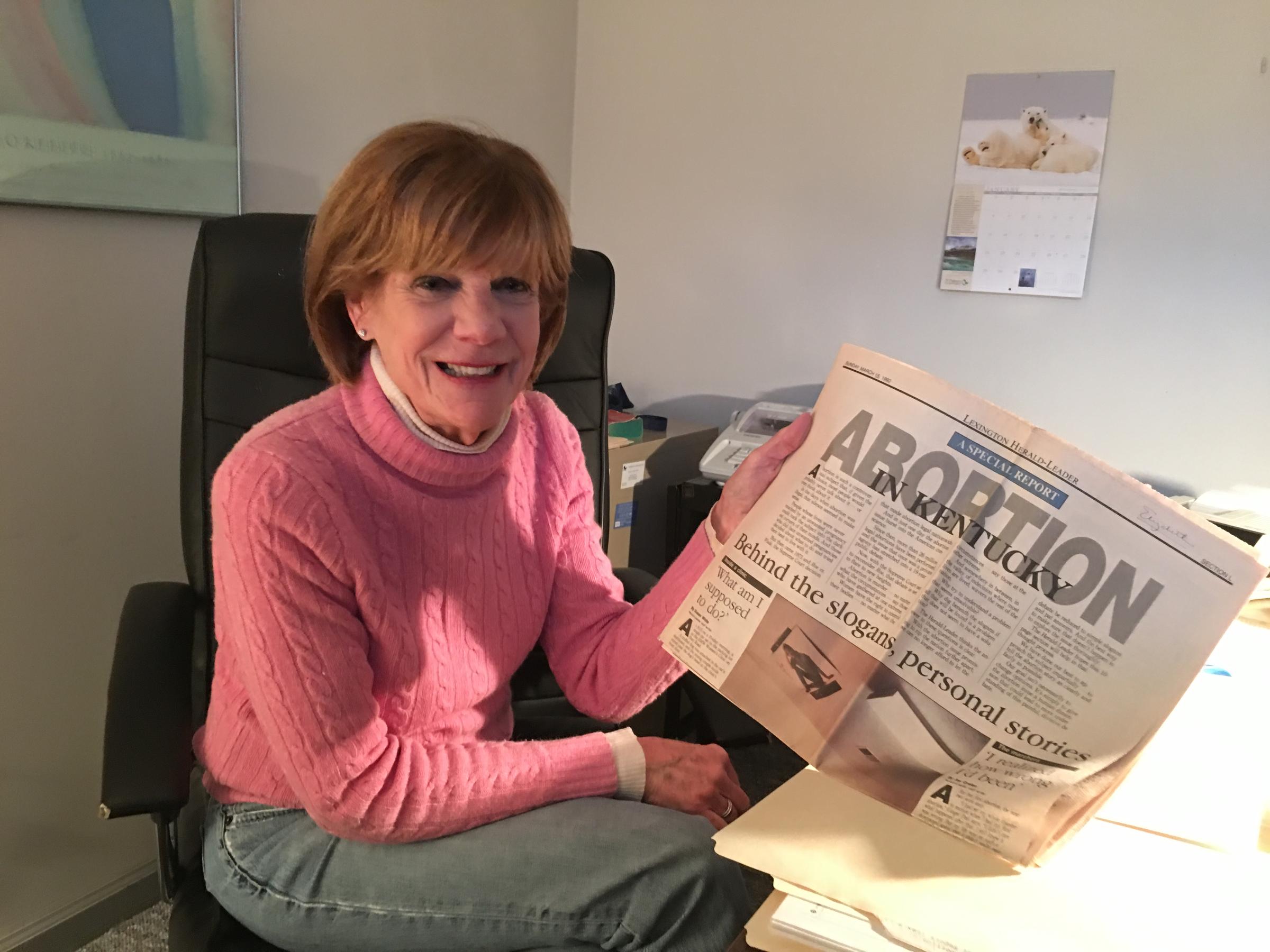
Dona Wells walked through what’s left of the EMW Women’s Clinic in Lexington, Kentucky. Boxes fill what use to be offices. Sterilized medical supplies are in disarray. A light flickers on and off in the back hallway. She doesn’t see a point in fixing it. At 75, she still runs 25 miles a week, but Wells is tired.

“I was going to retire anyway, probably this year,” she said. But I wanted to do it on my terms, not Gov. Bevin’s terms.”

That would be Kentucky Gov. Matt Bevin, who recently signed two bills into law further restricting abortion services: one requiring an ultrasound as part of abortions and another prohibiting the procedure after 20 weeks of pregnancy. The final straw for Wells came in the form of a new license requirement from the state. Wells has been battling restrictive rules for most of the clinic’s 28 years, but the battle is over now. She’s closing the clinic.

Dona Wells holds a newspaper from the 1990s with a story that focused on abortion providers.
CREDIT MARY MEEHAN / OHIO VALLEY RESOURCE

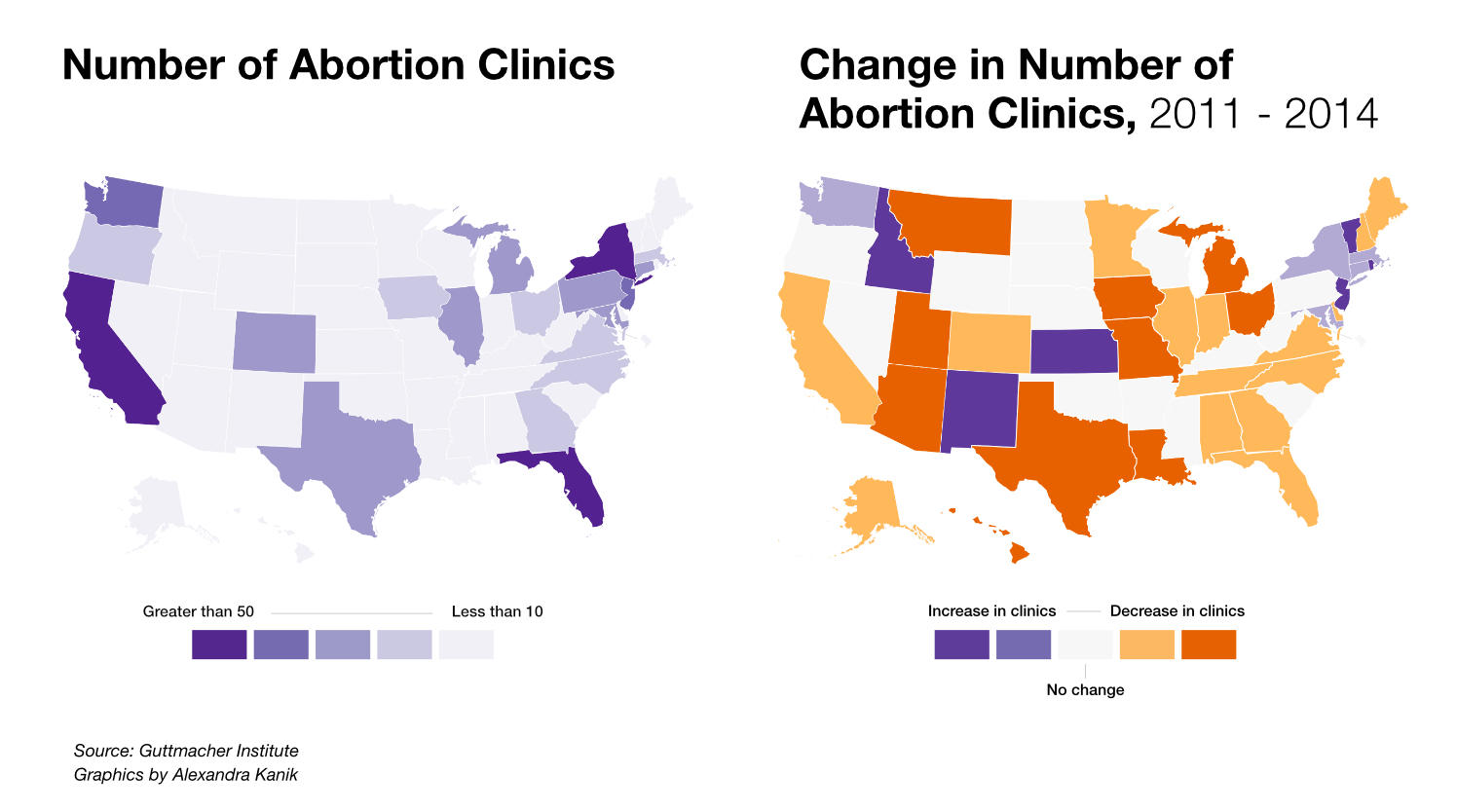
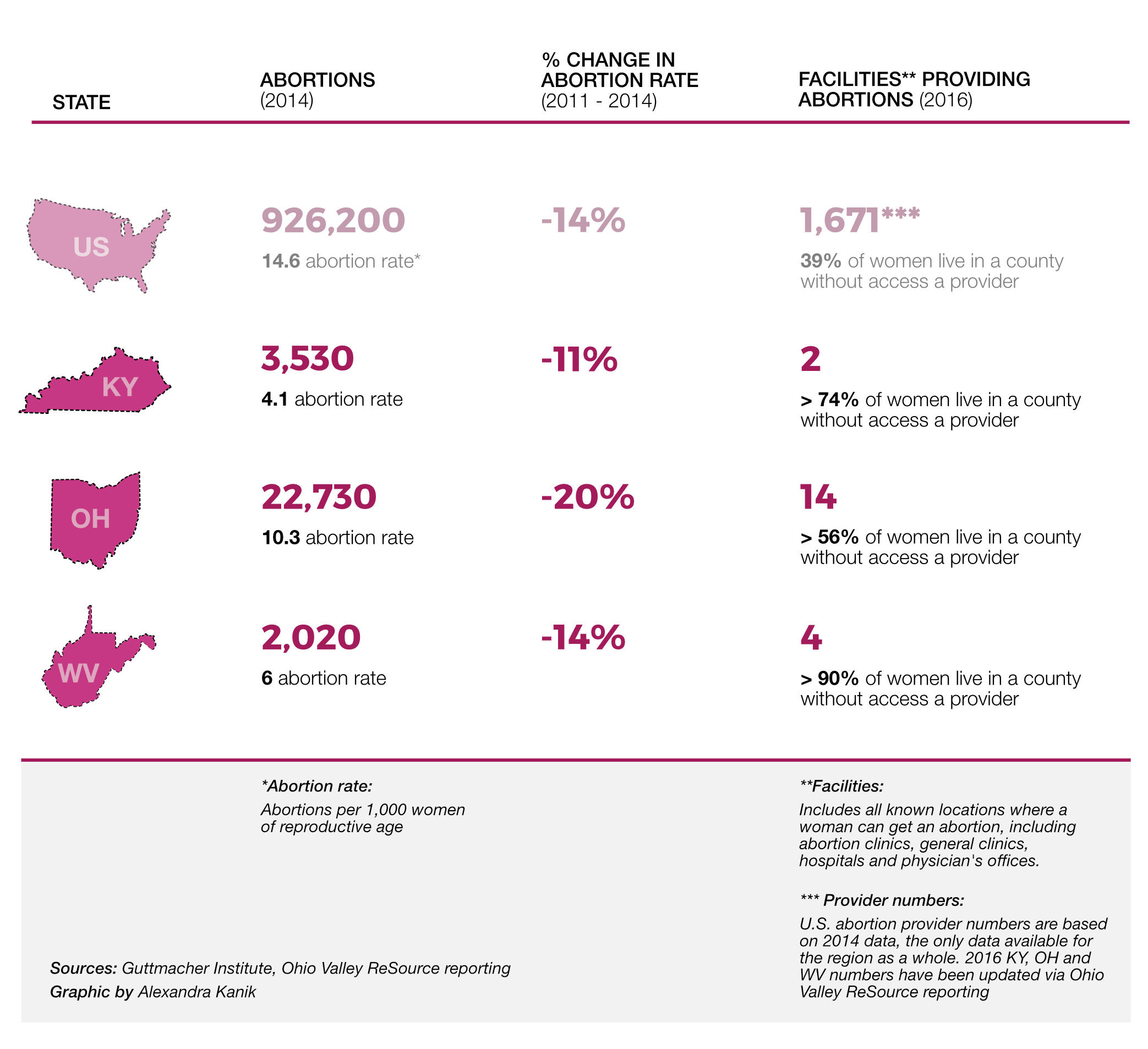
That leaves Kentucky with a single abortion clinic. A few weeks later, a clinic closed in West Virginia, leaving that state, too, with a single clinic. In Ohio, there are now 9 abortion clinics, down from 18 in 2011, according to the Guttmacher Institute, a nonprofit research center that gathers reproductive health data.

CREDIT ALEXANDRA KANIK / OHIO VALLEY RESOURCE

  Explore the interactive maps >>

For all the talk of potential changes in the Supreme Court’s view of the landmark Roe v. Wade ruling on abortion, Wells said an effective erosion of the rights that decision established is already underway at the state and local level.

“Roe v. Wade — it doesn’t matter if they overturn it or not, if they have enough restrictions on abortions that people are unwilling or unable to meet,” she asked, “what’s a right if you can’t access it?” Then she went back to packing up her office.

State Restrictions

The Roe v. Wade decision in 1973 established abortion rights. By the 80s, Wells said, abortion was widely viewed as a medical option, one performed by many private doctors. Health departments made referrals. There were a half dozen clinics in Lexington and Louisville.

But the public protests, going back to the mid-80s when protesters routinely chained themselves to clinic doors, had an impact.

Slowly, Wells said, the number of doctors who were willing to perform abortions shrank. There were in turn fewer doctors who were being trained to perform abortions. Changes in available medicines had an effect as well. The “morning after” pill became available, and more women had access to longer-lasting contraceptives.

While the medical landscaped broadened, the political landscaped narrowed. Over the same stretch of time, legislatures across the country enacted laws restricting abortion.

In Kentucky, Ohio, and West Virginia, there is a 24 hour waiting period between making contact with an abortion provider and having the procedure, according to the Guttmacher Institute. A woman must also receive information discouraging her from abortion.

Wells said that in 2016 the state asked that her clinic obtain a license to perform abortions. The clinic had previously acted as an independent doctor’s office that doesn’t require such a license.

The sterilization room in the EMW clinic, which opened in 1989

Wells said she tried to comply with the state request. But, she said, “there was always something wrong with the paperwork.”

For much of the last year, she has not been able to provide surgeries. In January, the Kentucky Attorney General denied her license application. At the same time EMW also lost the lease it had held since 1989.

Wells said fighting back didn’t make sense.

Celebrating Closures

Pastor Jared Henry leads a congregation of 200 at Lafayette Church of the Nazarene, less than 2 miles from the EMW clinic.

When Wells lost her fight, Henry celebrated.

“All that they did was kill babies there,” he said. “I think that our city, our state, our world is better off even if it is one less (clinic), praise be to God.”

Soon after he became pastor, Henry discovered the protesters gathered at EMW each Thursday and Friday. Henry said he often prayed with women who were willing to pray with him and prayed for those women who were not. Members of his small congregation gave money to the cause and contacted lawmakers to express their views.

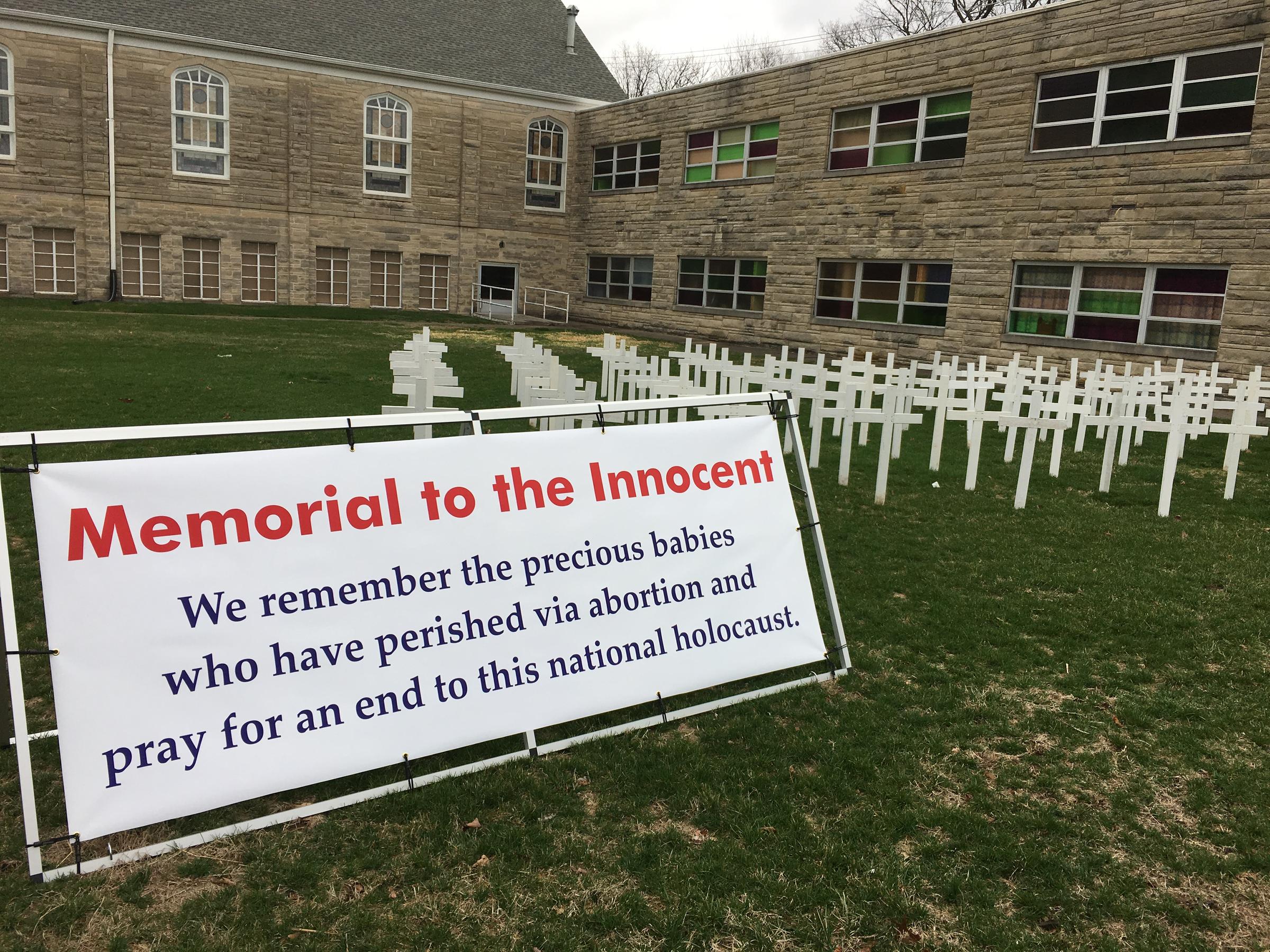
An anti-abortion display at the Lafayette Church of the Nazarene
CREDIT MARY MEEHAN / OHIO VALLEY RESOURCE

An anti-abortion display at the Lafayette Church of the Nazarene.

Henry said supporting life is crucial to the mission of the church, including ending abortion but also supporting adoption and foster care. That, he said, is critical.

“It’s not just saying, ‘this is wrong.’ That’s kind of like a doctor saying, ‘you’re sick.’ I want him to tell me what to do about it,” he said.

Although he said he and his congregation have contacted political leaders about abortion, he thinks the issue has gotten too politically charged.

“My biggest problem it that sometimes politicians use it to garner votes on one end of the spectrum or the other. Politicians very rarely ease anything, it usually gets it more fired up,” he said.

Limiting Access

Wells declined to talk about the protesters at her clinic. But, she said, the tone of the debate has become more vicious over the years. The language has become more graphic. And, she said, “alternative facts” more rampant.

“I just don’t have time to dispute all the misinformation the, quote, government, unquote, comes up with,” she said.

CREDIT ALEXANDRA KANIK / OHIO VALLEY RESOURCE

Sharon Lewis is executive director of Women’s Health Center of West Virginia, that state’s sole abortion clinic. She said as a provider she will find a way to comply with new rules. But she said limiting access — making people have to find transportation to go farther, to find money to pay for child care and possibly two days in a hotel — that makes a legal medical service too expensive for many.

“What it could do is send us back to the days when women died because they had unintended pregnancies,” she said.

Long Term Impact

Earlier this year the Centers for Disease Control and Prevention issued a reportshowing a leap in maternal mortality. Dr. Caitlin Gerdts is Vice President for Research at Ibis Reproductive Health, a nonprofit group that advocates for reproductive rights. She said it’s difficult to find a firm cause and effect between that maternal mortality data and the decreased access to abortion.

For example, she said, the CDC points to the effects of chronic diseases such as heart disease. But, she said, research has shown that restricting abortion does have health effects.

“There is a substantial physical health, mental and economic health of being denied a wanted abortion,” she said.

Pastor Henry said in his experience the women he counsels suffer from emotional pain. He said the closing of the Lexington clinic allows for a shift in focus of his church’s pro-life ministry.

Paster Jared Henry leads a congregation of 200 at Lafayette Church of the Nazarene in Lexington
CREDIT MARY MEEHAN / OHIO VALLEY RESOURCE

“Maybe this will allow us to focus more on issues of adoption and foster care,” he said.

“We are not hear to beat people up,” he said. “You did wrong and it was a serious wrong, but God can forgive, so let’s move forward.”

However, members of his congregation also took a recent road trip to Louisville. There they demonstrated in front of Kentucky’s sole remaining clinic.

Kara Lofton, Appalachia Health News Coordinator for West Virginia Public Broadcasting, contributed to this report.

Source: http://wvpublic.org/post/closing-clinics-abortion-rights-increasingly-out-reach#stream/0

27-feb-17

Abortion clinics are facing more violent threats than they have in 20 years, NBC News reports, as anti-abortion legislators are appointed to cabinet positions in Washington and some states continue to introduce restrictive abortion bills.

The number of abortion providers who reported being targeted for “severe violence or threats of violence” nearly doubled from 19.7% in the first half of 2014 to 34.2% in the first half of 2016, according to a study published by the Feminist Majority Foundation.

The organization conducted the survey via mail and online in July last year, with 319 providers responding to questions about anti-abortion activity and violence targeting their facilities.

“The most commonly reported types of severe violence and threats of violence in 2016 included blocking clinic access, bomb threats, facility invasions, stalking, and death threats,” the report reads.

The report connects the uptick in violence at the beginning of last year to the release of anti-Planned Parenthood videos purporting to show providers talking callously about trading fetal body parts. The videos, released by the Center for Medical Progress (CMP), were found to have been heavily edited and in at least one case fraudulently tried to pass off photos of a stillborn baby as fetal remains. The study authors write:

This incident and countless anecdotes of increasing levels of violence against providers across the country in the fall of 2015 led us to fear that anti-abortion extremists had been emboldened by the release of these videos. The results of the 2016 National Clinic Violence Survey, the first quantitative measure of nationwide violence recorded since the release of the CMP videos, corroborate these fears.

The report found that clinics have not experienced this level of violence since the early to mid-90s–a time when anti-abortion shooters targeted and killed providers, including Dr. David Gunn in 1993, Dr. John Bayard Britton and James H. Barrett in 1994, and more around the country in the following years. The National Abortion Federation writes of that time:

In the early 1990s, anti-abortion extremists concluded that murdering providers was the only way to stop abortion. The first provider was murdered in 1993. Including the recent attack in Colorado, there have been 11 murders and 26 attempted murders due to anti-abortion violence. Several of the doctors were attacked in their own homes. In 2009, NAF member Dr. George Tiller was shot and killed in his church in Wichita, Kansas. In 2015, a police officer and two people at a clinic were killed when a gunman entered a clinic in Colorado Springs, Colorado.

Most recently, in November 2015, a shooter killed three people outside a Planned Parenthood clinic in Colorado Springs. The shooter, Robert L. Dear Jr., told police officers, “No more baby parts” as an explanation for his actions, an apparent reference to the doctored CMP videos.

Providers can expect the antagonistic rhetoric to continue to intensify from Washington. Last week, the Senate confirmed Tom Price, a vocally anti-choice candidate, as Secretary of Health and Human Services. That came days after the confirmation of another openly anti-abortion legislator: Attorney General Jeff Sessions, whose Justice Department could be responsible for overseeing investigations into violence against providers.

Source: Fusion

http://fusion.net/story/386735/abortion-clinics-violence-study/

25-feb-17

The Guatemalan authorities say they are expelling members of a non-profit “abortion boat” docked on its shores.

Officials said they had lied when they applied for tourist visas and would not be allowed to work in Guatemala.

The Dutch group, Women on Waves, offers free abortion services to women in countries where the procedure is banned.

It takes women in the early stages of pregnancy out to international waters, where the abortion is performed.

Abortion is only allowed in Guatemala when the mother’s life is at risk.

A spokeswoman for Women on Waves confirmed that they had been told to leave the country immediately, but she said its lawyers had appealed against the decision.

La Prensa Libre newspaper said the four crew members being expelled were US citizens.Members of the Dutch organization Women on Waves can be seen on the group's

It is not clear if other members of the group have also been ordered to leave the country.

‘Fundamental right’

The Army said on Thursday it had been instructed by President Jimmy Morales to act, and would defend “human life and the laws of our country” by preventing the group from carrying out abortions.

The Women on Waves’ boat docked on the Pacific Ocean port of Quetzal, in the city of San Jose, on Wednesday.

The group says it had a legal permit to sail in Guatemalan waters and the boat was being illegally “detained” by the authorities.

The group says more than 60,000 illegal abortions are performed in Guatemala every year, and most of the women who put their lives at risk at the hands of untrained professionals are poor.

“We respect religious beliefs but this [abortion] is a fundamental right in a democracy,” spokeswoman Leticia Zevich told La Hora Newspaper.

However, Guatemala’s Catholic Church, other religious leaders and politicians protested against the presence of the boat.

In most Latin American countries, abortion is either illegal or only allowed to save the life of the woman.

Source: BBC

http://www.bbc.com/news/world-latin-america-39084503