2-feb-17

Apparent draft decree reflects conservative Christian stances on controversial social issues

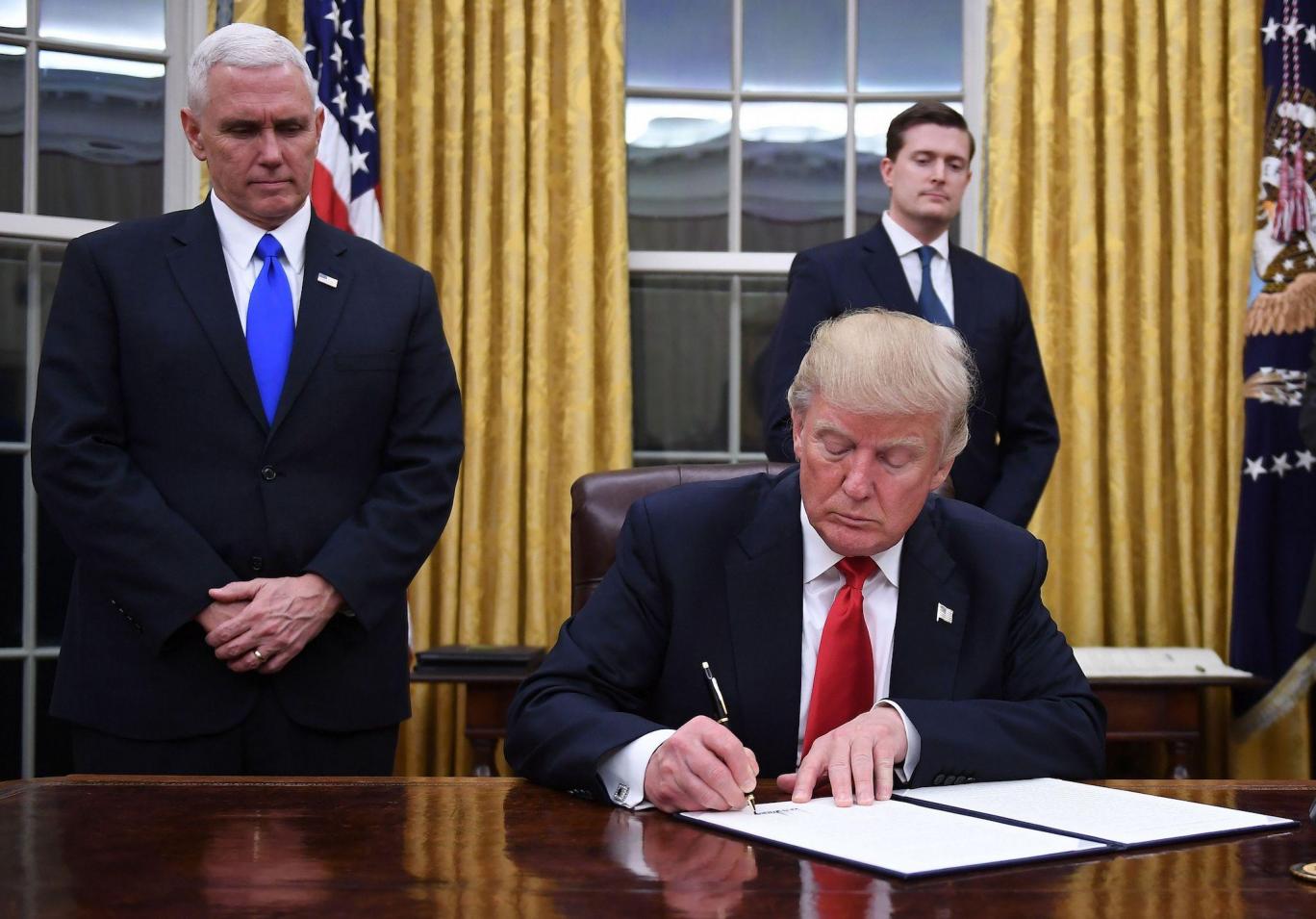
The Donald Trump administration is preparing to enshrine specific religious beliefs in executive policy—including that premarital sex is wrong, that marriage “is or should be recognised” as between a man and a woman, that life begins at conception and that the words “male and female” refer to “immutable biological sex” assigned at birth.

A leaked document that purports to be a new executive order claims to “respect religious freedom” and appears to reflect conservative Christian and Catholic beliefs. If signed, it will seek to shield people or organisations receiving federal funds that espouse and act on such beliefs, even if they are made in the course of their employment or contract, from punitive government action. It is likely to worry the country’s LGBT community, which has fought for protection from discrimination.

The draft order seeks to protect the tax-exempt status of organisations that propound those beliefs, as well as to block “adverse action” against groups that discriminate, on religious grounds, in the provision of adoption and fostering services. White House spokesman Sean Spicer declined to get “ahead of the executive orders that we may or may not issue”. “We have nothing on that front now,” he added.

It further provides for total exemption on religious grounds for people or groups who object to providing employee health insurance that includes contraception, currently mandated under the Affordable Care Act. Some limited exemptions did already exist.

Legal experts told The Nation, which first published the leaked draft in conjunction with The Investigative Fund, that if signed by President Trump the order would likely violate the Establishment Clause of the US Constitution, commonly referred to as the separation of church and state.

Marty Lederman, a professor from Georgetown University’s Law Centre, told the magazine: “This executive order would appear to require agencies to provide extensive exemptions from a staggering number of federal laws—without regard to whether such laws substantially burden religious exercise.”

In full, the specific beliefs that are among those the order looks to protect from action under tax exemption rules are: “the belief that marriage is or should be recognised as the union of one man and one woman, sexual relations are properly reserved for such a marriage, male and female and their equivalents refer to an individual’s immutable biological sex as objectively determined by anatomy, physiology, or genetics at or before birth, and that human life begins at conception and merits protection at all stages of life”.

The Treasury Secretary is charged with ensuring that penalties are not imposed for a “person or organisation [that] believes, speaks, or acts (or declines to act) in accordance” with those positions.

The order’s provision on the point at which human life begins chimes with the beliefs of Vice President Mike Pence, who last Friday attended the anti-abortion March For Life, for which Mr Trump also tweeted his “full support”.

Mr Pence told marchers: “This administration will work with Congress to end taxpayer funding of abortion and abortion providers.”

“Life is winning again in America,” he added.

The draft order would also require the Health Secretary “to ensure that the federal government shall not discriminate or take any adverse action against a religious organisation that provides federally-funded child-welfare services, including promoting or providing adoption, foster, or family support services for children, or similar services, on the basis that the organisation declines to provide, facilitate, or refer such services due to a conflict with the organization’s religious beliefs”.

Source: The Independent

http://www.independent.co.uk/news/world/americas/donald-trump-executive-order-christian-pre-marital-sex-same-sex-marriage-abortion-wrong-religious-a7558691.html

1-feb-17

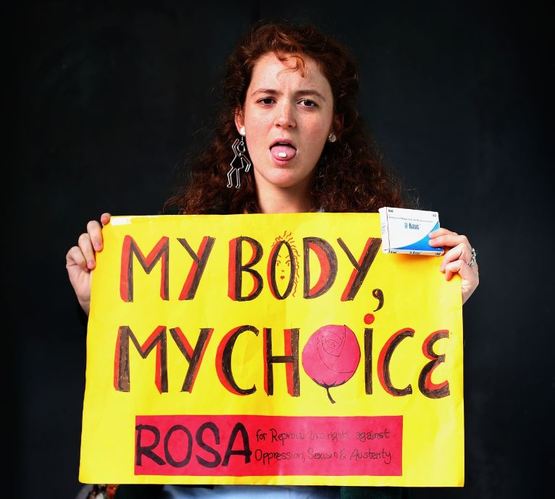
ROSA IRELAND IS planning to distribute abortion pills to cities and universities around Ireland.

The organisation is part of the movement calling for the Eighth Amendment of the Constitution, which gives equal status to the unborn and the mother, to be repealed.

The ‘Bus 4 Repeal’ will start its journey in Dublin on 6 March before travelling to a number of cities and universities, and returning to the capital on 8 March.

In a statement, Rosa said the purpose of the tour is “both to provide direct assistance to those in need of safe abortion pills and to campaign for the repeal of the Eighth Amendment to legalise abortion in Ireland”.

The planned route is as follows:

Monday 6 March
University College Dublin
Waterford IT
Cork City

Tuesday 7 March
University College Cork
Limerick City
Galway City

Wednesday 8 March
NUI Galway
NUI Maynooth
Dublin City

The Citizens’ Assembly, made up of a chairperson and 99 citizens, has held a number of hearings about abortion and is expected to deliver a report in the coming months on whether or not a referendum on repealing the Eighth Amendment should take place.

The assembly received over 13,000 submissions about the issue. Both pro- and anti-amendment groups had encouraged members of the public to submit their views for consideration.

Source: The Journal IE

http://www.thejournal.ie/abortion-pills-bus-3216154-Feb2017/


29-jan-2016

Donald Trump’s pro-abortion funding ban has infuriated many global health organisations as they say it will unintentionally lead to more abortions and more deaths in Africa.

The US president signed the executive order to stop federal money going to international groups which perform or provide information on abortions during his first week in office.

Known as the “Mexico City Policy”, or global gag rule by critics, it was no surprise that he reinstated it. First introduced by Ronald Reagan in 1984, it has been become a game of policy ping pong between Republican and Democrat presidents.

Supporters of the ban say it protects the fundamental right to life.

But some health workers in Africa say when it was last put in place under George W Bush in 2001, it had far-reaching consequences.

“Women could not have access to contraceptive services and so they were getting unintended pregnancies and that increased the number of unwanted pregnancies and as such they went to the backstreet to do unsafe abortions,” says Kenyan gynaecologist Dr John Nyamu.

The policy blocks US funding to overseas organisations that “support or participate in the management of a programme of coercive abortion or involuntary sterilisation”.

It even affects countries like Kenya – where abortion is illegal unless a mother’s life is at risk – as some family planning clinics or organisations get their funding from US pro-abortion groups.

‘Malaria and HIV care in danger’

The Trump order goes even further than previous Republican administrations, which only targeted reproductive health services, by extending the ban to cover all global health assistance provided by all departments or agencies.

“By removing funding from organisations that also deal with malaria and other child health issues, the policy could threaten progress on many fronts, including efforts to reduce HIV-related deaths and new infections, and decrease childhood mortality through malaria prevention and treatment initiatives and immunisation programs,” Medecins Sans Frontieres (MSF) said in a statement.

The medical charity does not receive US government funding – so is not affected by the policy – but it fears that women’s lives could be endangered.

Unsafe abortion is one of the five main causes of maternal mortality, accounting for 13% of cases, according to the World Health Organization (WHO).

The Mexico City Policy is based on the US Republican party’s pro-life position, which has resonance with much of socially conservative Africa, where abortion is largely illegal.

Abortion on demand can only be offered in four out of 54 African countries, according to the UN’s World Abortion Policies report.

But the continent carries the biggest burden of unsafe abortions, according to the WHO.

Clinics may close

Marie Stopes International’s projections for Nigeria suggest the policy will have a big impact on women’s health in Africa’s most populous country.

“Without US funding, from 2017 to 2020, over 1.8 million unintended pregnancies will probably occur; more than 660,000 abortions will happen and over 10,000 maternal deaths will not be averted,” says Effiom Effiom, country director for Marie Stopes in Nigeria.

The International Planned Parenthood Federation (IPPF) regional office in Africa says it will lose up to $100m (£80m) in US funding meant for sexual and reproductive health services for millions of women and girls who would otherwise go without these vital services as it refuses to abide by the gag rules.

“Over the years USAid has been a huge supporter of family planning – with a budget of over $600m per year. Reinstatement will mean that years of progress to increase access to essential services globally, will be lost,” it said in a statement.

IPPF works with affiliates in 30 African countries including at least a dozen clinics in Kenya, five of which shut down the last time the Mexico City Policy was reinstated.

But it has struck a defiant note, saying it will work to bridge the funding and services gaps as the Dutch government has done with plans for an international fund to finance access to birth control in countries hit by the cuts.

“We cannot and will not – deny life-saving services to the world’s poorest women,” IPPF said.

http://www.bbc.com/news/world-africa-38768901

Source: BBC

28-jan-17

AMSTERDAM, Jan 28 (Reuters) – The Netherlands has committed $10 million for an initiative to replace funding for abortion services in developing countries that will be lost due to U.S. President Donald Trump’s ban on financing foreign groups that provide abortions.

Trump reinstated a policy on Monday requiring overseas organizations that receive U.S. family-planning funds to certify they do not perform abortions or provide abortion advice as a method of family planning.

The Netherlands, which has some of the world’s most liberal laws on reproductive health, said earlier this week the fund would seek donations from other governments, charities and companies as well as individuals.

Dutch officials estimate that the U.S. ban, which was condemned by women’s rights and health campaigners, will cause a funding shortfall of $600 million over the next four years. Campaigners say that will endanger women’s lives.

Liliane Ploumen, Dutch minister for international development cooperation, said she was confident after early discussions that fundraising would go a long way towards plugging the gap.

“Of course more money is needed,” Ploumen said. “According to the signals we have been getting I am confident we will go far. The Dutch have not named other possible donor countries, but Canada has said it is considering contributing.

On Friday, Ploumen, for whose Labour party women’s rights have long been a signature issue, launched a website, http://www.shedecides.eu, telling the public how they could contribute to the fund. Officials said the Dutch had been inundated with queries from individuals around the world asking how to help.

For Labour, the junior party in the governing coalition, the issue could help rally support among its urban, progressive voter base ahead of a March 15 election. Polls show such supporters have deserted the party in droves after years of painful austerity.

Source: Reuters

http://news.trust.org/item/20170128171028-40iac/

27-jan-17

Should we journalists use the word “lie” to describe President Trump’s most manifest falsehoods?

That debate has roiled the news world. The Times this week used the word “lie” in a front-page headline, and I agreed with that decision, but there’s a counterargument that lying requires an intention to deceive — and that Trump may actually believe his absurd falsehoods.

So in 2017 we reach a mortifying moment for a great democracy: We must decide whether our 45th president is a liar or a crackpot.

Yet the costliest presidential falsehoods and delusions are not the ones that people are talking about, such as those concerning the inauguration crowd or electoral fraud. The most horrific chicanery involves Trump’s new actions on women’s health that will cause deaths around the globe.

It followed the weekend’s stunning women’s marches: At least 3.2 million people apparently participated in all 50 states, amounting to 1 percent of the U.S. population. In a slap at all who marched, Trump this week signed an order that will cut off access to contraception to vast numbers of women, particularly in Africa.

It will also curb access to cancer screenings and maybe even undermine vaccination campaigns and efforts against H.I.V. and the Zika virus. The upshot: Thousands of impoverished, vulnerable women will die.

Americans have focused on the executive actions about building a wall, or expediting oil pipelines, but nothing is more devastating than the edict on women’s health (signed in front of a group composed almost entirely of smiling men in suits).

In fairness, Trump probably thought he was doing a good thing; that’s a measure of his delusion. He reinstated what’s called the Mexico City policy, which stipulates that family planning funds cannot go to foreign aid groups that ever discuss abortion. (Federal funds already don’t go for abortions.)

Presumably Trump thought this policy would reduce abortions, and was thus “pro-life.” In fact, this is a “pro-death” approach that actually increases abortions, as well as deaths among women.

How can that be? Many groups, like Marie Stopes International and Planned Parenthood International, lose funding in poor countries from this policy. In 2001, when President George W. Bush imposed a more limited version, 16 developing countries lost shipments of contraceptives from the U.S.

Stanford University researchers found that the Bush version of the policy reduced contraceptive use in Africa — and increased abortion rates.

This all sounds wonkish and antiseptic, but in poor countries, the most dangerous thing a woman can do is become pregnant. I’ve seen too many women dying or suffering in filth on stained cots in remote villages because of childbirth.

I wish Trump could see them: a mother of three in Cameroon dying after her birth attendant sat on her stomach to hasten delivery; a woman in Niger collapsing from a common complication called eclampsia; a 15-year-old girl in Chad whose family dealt with her labor complications by taking her to a healer who diagnosed sorcery and burned her arm as she lay in a coma.

With this new order, Trump will inadvertently cause more of these horrific scenes. Maybe “war on women” sounds hyperbolic, but not if gasping, dying women are seared in your memory.

Worse, Trump expanded this “global gag rule” — as critics call it, because it bars groups from mentioning abortion — so that it apparently will cover all kinds of health services, including efforts to tackle polio or Zika or H.I.V., even programs to help women who have been trafficked into brothels. (The White House didn’t respond to my inquiries.)

I hope all of the marchers call the White House, 202-456-1111, or their members of Congress, 202-224-3121, to protest.

Marie Stopes alone estimated that if it cannot find replacement funding, the new policy will result in 6.5 million unintentional pregnancies, 2.2 million abortions and 21,700 women dying in pregnancy or childbirth.

The victims invariably are among the most voiceless, powerless people in the world. When Bush imposed his version of the policy, it meant that no contraceptives reached a village in northern Ghana. As a result, a young woman named Kolgu Inusah became pregnant.

She tried to abort the pregnancy herself using herbs, but something went wrong and she suffered terrible abdominal pains. She was rushed to a clinic, but doctors couldn’t save her. Her two children now have no mom.

President Trump, you may think you are “pro-life” and preventing abortions, but that’s a lie or a delusion. In fact, you are increasing the number of abortions and of dying women.

And to those women and men who marched last weekend, remember that this isn’t about symbols, speeches or pussy hats. It’s about the lives of women and girls.

Please, please, keep on marching, keep on calling.

Source: NY Times

26-jan-17

Th

e U.S. abortion rate has hit its lowest point since the landmark Roe vs. Wade Supreme Court ruling made the procedure legal nationwide in 1973, according to a new study.

Researchers at the Guttmacher Institute, a New York-based think tank that supports legalized abortion, estimated that there were 926,200 abortions in 2014, or 14.6 for every 1,000 women of reproductive age. That was down from a peak of just over 29 out of every 1,000 women in 1980 and 1981.

The institute is considered an authority on the abortion rate, having tracked it since 1973 by conducting a census every few years of all known abortion providers. Its counts do not include abortions done outside medical settings.

Activists on both sides of the contentious abortion policy debate welcomed the findings but did not agree on what is causing the decline.

Since 1982, abortion rates have dropped steadily, even as public opinion about the procedure has remained relatively consistent. In 2016, 57% of those surveyed by the Pew Research Foundation said that abortion should be legal in all or most cases.

What do abortion defenders say?

Reproductive rights advocates say the study shows that increased access to family planning services and contraception is paying off, reducing the number of unintended and teen pregnancies.

“We don’t think it’s because people are having less sex,” said Dr. Diane Horvath-Cosper, an obstetrician with the New York-based group Physicians for Reproductive Health. “It’s because people are protecting from pregnancy better than they used to.”

Research has shown a large increase in the use of intrauterine devices and implants that release hormones — highly effective, long-acting methods that in recent years have become more affordable and been deemed safe for use in adolescent women.

Under the 2010 Affordable Care Act, which President Trump and the Republican leadership in Congress have vowed to eliminate and replace, insurers are required to cover a wide variety of contraception methods without charging a copayment or coinsurance. Doctors say that requirement has helped their patients access new methods of contraception or stay on birth control without missing doses.

“Women and families are healthier, and people are better able to plan their lives, their families, and their futures,” said Amy Rosenfeld, a spokeswoman for Planned Parenthood Los Angeles, in a statement. “This report underscores that we need more access to birth control and preventive care, not less.”

What do abortion foes say?

Some abortion opponents express reservations about the report’s findings because they are based on information provided by physicians who offer abortions.

“There is no national abortion reporting law, making it impossible to know the true number of abortions,” said Kristi Hamrick, a spokeswoman for Americans United for Life.

The group hopes that there has indeed been a decline in the number of abortions in the U.S. but disputes the reasons offered by abortion rights activists.

“The abortion industry wants to claim that the abortion rate may be lower because of another product that they sell — birth control. But birth control is widely available and has been around since the 1950s,” Hamrick said in an email.

She pointed instead to a wave of state laws passed over the last five years that imposed increasingly stringent regulations on abortion providers and their patients, including a requirement that women have an ultrasound before undergoing the procedure.

“Such pictures are worth more than a thousand words when it comes to helping people understand whose lives are on the line,” said the group’s acting president, Clarke Forsythe, in a statement.

What do the study’s authors say?

The study did not investigate the causes of the decline, but researchers said both greater use of contraception and increased restrictions on abortions may have played a role.

From 2011 through 2015, Guttmacher recorded 288 laws passed in 31 states that limited abortion access for minors, required counseling or a waiting period, imposed regulations on providers or targeted funding for family-planning services, among other restrictive measures.

“Abortion restrictions and clinic closures mean that patients may need to travel greater distances to access services,” said Rachel Jones, lead author of the study. “The majority of abortion patients — 75% — are poor or low-income, and nearly two-thirds are already parents. It can be very difficult for them to arrange for time off from work, transportation and child care.”

Dr. Daniel Grossman, an obstetrician at UC San Francisco who has studied the effect of abortion laws in Texas, doubts that the decline in abortions in that state has much to do with changes in contraception use.

In 2013, the Texas Legislature passed House Bill 2, which made it harder for patients to receive abortion-inducing medications, required abortion providers to have admitting privileges at a local hospital, banned abortions after 20 weeks of pregnancy and required all abortions to take place in hospital-like settings known as ambulatory surgical centers. Almost overnight, more than half of the state’s 41 clinics closed.

Grossman and his colleagues at the Texas Policy Evaluation Project found that, while the total number of abortions in the state dropped after the law took effect, the number performed during the second trimester rose. That suggested to the researchers that women were struggling to find abortion providers, resulting in delays and procedures that are riskier and more expensive.

A colleague of Grossman at UCSF, Diana Greene Foster, says there is “zero evidence” that laws aimed at changing women’s minds — those requiring ultrasounds, waiting periods or counseling, for example — are affecting abortion rates. “But clinic closures and gestational limits — those certainly have an effect on women with limited resources,” she said.

By 2014, 90% of all U.S. counties — accounting for 39% of women of reproductive age — had no clinic that provided abortions, the study found.

But the majority of the decline in abortions occurred in states that did not have major new restrictions in place. Six states saw increases in the abortion rates: Arkansas, Kansas, Michigan, Mississippi, North Carolina and Vermont.

Foster and other experts credited the Affordable Care Act with making contraception more affordable and convenient. They worry that the abortion rate could rise if Congress, in its effort to repeal the law, does not preserve mandated insurance coverage for birth control.

http://www.latimes.com/nation/la-na-abortion-rate-2017-story.html

Source: LA times

24-jan-17

After a weekend of inspiring protest, we had to watch the world’s most powerful man sign away the reproductive rights of women in developing countries

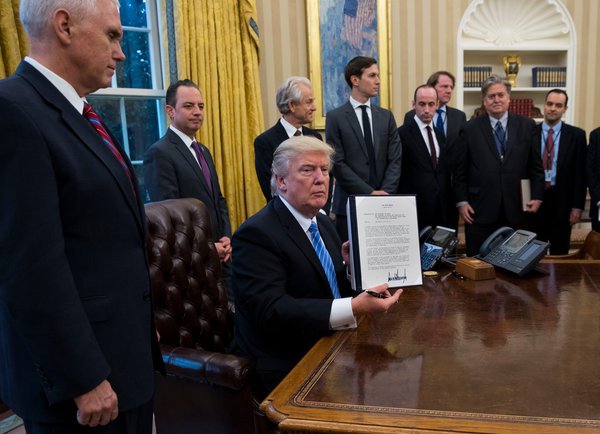
ook at these men. Look at them. Gathered around the most powerful man in the world – a man who has openly bragged of sexual assault, who refers to a vulva as a woman’s “wherever” – as he signs away the reproductive rights of women in developing countries. In reimposing the global gag rule, Donald Trump is removing US funding to any overseas organisation that offers abortions, even if the organisation provides those specific services with their own funds. It means that doctors, midwives, nurses and volunteers cannot so much as mention the word “abortion” to their patients and service users without risking the loss of the US funding they receive for services including the supply of contraceptives.

If there is a woman present in this room, as this executive order is being signed along with two others, she is not included in the shot. This photograph is what patriarchy looks like – a system of society or government in which men hold the power and women are largely excluded. Nothing quite says powerlessness like the removal of your right to bodily autonomy, at the behest of a group of people who will never – can never – know what that feels like. There’s a reason women are using the word patriarchy again, that it featured on so many signs during the Women’s Marches, and it is not, as ridiculous outrage automaton Piers Morgan asserts, because they are rabid feminists intent on emasculating men. Because – and I hate to break this to Piers – if you are emasculated by the notion of a woman making her own reproductive choices, then you were never much of a man to begin with.

What do any of these men know of women? I doubt the men in that room have ever so much as held a tampon. I doubt they’ve made their wives or girlfriends a hot water bottle, or changed her bloody sheets, or volunteered to go down to the drugstore to buy her maxi pads when she’s doubled up in pain and cursing her ovaries. If you left an IUD on the president’s desk, he’d probably assume it was a tiny little pen made especially for him. He’d pick it up and attempt to use it to sign his name, no doubt at the bottom of some other piece of legislation that will profoundly and irreversibly affect women’s lives.

The smirks on some of their faces may say it all. Call me paranoid if you like, but the fragility of the president’s ego does not exclude the possibility that he is enjoying an act of petty revenge against an entire gender, millions of whom took to the streets over the weekend because the very fact of this man’s unmatched global power says more about women’s continued oppression than a feminist treatise ever could. Look who’s in charge now, this picture says.

The stupidity of the blinkered, religiously motivated agenda on display here is that no matter what legislation these men implement, they will never succeed in banning abortion, per se, only safe, legal abortion. Marie Stopes estimates that, as a result of the reimposition of the global gag order, the loss of their services alone could result in 6.5m unintended pregnancies during Trump’s first term, 2.1m unsafe abortions, and 21,700 maternal deaths. In passing this law, these patriarchs have fathered millions of unwanted children, helping to create lives that could very well turn out to be painful and potentially motherless.

The rage I feel towards these men is white-hot. I want to force them to carry an unwanted pregnancy to term, so they can understand. But they never will. As my colleague Martin Belam has said, as long as you live you will never see a photograph of seven women signing legislation that defines and controls what men can do with their reproductive organs. It is unimaginable.

The global gag rule has long been used as a political football. It was introduced by Ronald Reagan in 1984, revoked by Bill Clinton, reinstituted by George W Bush, then revoked by Barack Obama. According to the Guttmacher Institute, reporting on the findings of a research initiative by NGOs, when George W Bush reimposed the global gag rule, the US agency for international development was forced to cut off shipments of contraceptives to 16 countries in sub-Saharan Africa, Asia and the Middle East. At the time, one in four women in Lesotho were infected with HIV. The contraceptive shipments to Lesotho Planned Parenthood – the only available conduit for condoms in the country – ended as a result of Bush’s actions. He created more unwanted pregnancies, and more babies with HIV. Trump’s act is likely to do the same.

After a weekend of euphoric, inspiring feminist solidarity, this is a heavy blow for women, and I have no doubt the men who marched alongside us will feel the same. But we will not give up the fight. We can help to plug the funding gap with donations, and UK readers can take part in the 10 actions being suggested by the Women’s March on London over the coming days – the first of which involves writing to Theresa May to ask her to reaffirm the UK’s commitment to human rights when she meets Trump. Remember that hope is not lost, that the events of this year will help to politicise a whole generation of future activists who believe in the human rights of women and girls. To quote The Handmaid’s Tale: “Nolite te bastardes carborundorum. Don’t let the bastards grind you down.” They will not win.

Source: The Guardian

https://www.theguardian.com/commentisfree/2017/jan/24/photo-trump-womens-rights-protest-reproductive-abortion-developing-contries

24-jan-17

The ‘global gag rule’ strips funding from vital reproductive services around the world. For many women, that will mean a return to life-threatening practices

In the mass of protesters thronging the National Mall in Washington DC on Saturday, one sign stood out to me. It was a wire clothes hanger mounted on cardboard, held by a young woman of color in pigtails. “Never again,” it read.

As it turns out, for poor women overseas, never was only as far away as Monday.

Donald Trump used his first full day as president to reinstate a Reagan-era executive order that will have a devastating impact on those with the fewest resources: women and girls in impoverished parts of the word. The order, best known as the “global gag rule,” will strip funding from any international NGO that provides abortions services, or even discusses abortion with patients seeking educational materials or referrals.

Study upon study has shown eliminating access to abortion services doesn’t eliminate abortions, it just forces women underground into dangerous situations.

For a guy who has been billed as a populist, it’s perhaps surprising that having roughly half a million people – three times the number that attended his inauguration – flood the streets of Washington has done nothing to alter his policy.

It did, however, do something else: it hurt the president’s feelings.

Trump’s defining qualities as a child, according to multiple biographers I spoke with, is that of a schoolyard bully. And it’s the rare thing about him that hasn’t changed. That’s why the fact that he dedicated one of his first acts in office to undermining the rights of women seems to me like something close to tit for tat.

Because Trump has been outspoken with regard to the other executive orders he signed off on Monday – instituting a federal hiring freeze, and withdrawing from the Trans-Pacific Partnership. But he hasn’t made a point of talking about abortion access unless asked. While it’s true executive’s implementation of the “global gag rule” has historically been reversed as soon as the opposite party takes over the White House, previous proponents – Ronald Reagan and George W Bush – ran on platforms of social conservatism. Trump was less easy to pin down. As he told Howard Stern of his stance on abortion in 2013: “it’s never been my big issue.”

Trump seemed to have outsourced the question to his running mate Mike Pence, a staunch anti-abortion advocate whose selection by Trump was widely seen as a peace offering to evangelical voters alienated by Trump’s lifestyle. The peace offering workedand Trump won evangelicals in a landslide.

But illusions Trump would, as he put it in a fleeting election night gesture, “be the president of everybody,” just went out the window. “The president, it’s no secret, has made it very clear he’s a pro-life president,” his spokesman Sean Spicer said in the first White House press briefing. “He wants to stand up for all Americans including the unborn.”

It’s quite the way to describe the gutting of a policy that’s spared an estimated 289,000 women from pregnancy- or childbirth-related deaths, according to the World Health Organization.

And it’s not just about abortion. Service providers denied funding under the gag rule could be stripped of the ability to carry out even the most basic women’s healthcare, as global family planning group Population Action International (PAI) has previously reported, resulting in the collapse of entire healthcare networks. WHO estimates 21 million unsafe abortions are performed globally each year, resulting in nearly 13% of all maternal deaths globally. And Marie Stopes International, a major global family planning advocacy group, estimates the loss of its services alone could mean 6.5 million unintended pregnancies, 2.1 million unsafe abortions, and 21,700 maternal deaths in Trump’s first term alone.

PAI puts it even starker terms: “The only goal the policy will achieve is to punish women in already challenging circumstances by blocking access to essential care.”

If Trump’s desire to “punish” women sounds familiar, that’s because, well, it should. In March of last year he said those seeking abortions should endure “some form of punishment” for doing so. And while yes, he walked back his tone-deaf statement in the explosive political aftermath, his actions Monday spoke louder than words.

Source: The Guardian

https://www.theguardian.com/commentisfree/2017/jan/24/trump-once-said-women-should-be-punished-for-abortion-t


23-jan-17

Women are forgoing food and delaying bills to pay for abortions as costs remain in the hundreds of dollars despite the introduction of an abortion drug, a national study reveals.

Researchers led by La Trobe University’s Judith Lumley Centre delved into the experiences of women who had medical or surgical abortions through a private group of clinics and found a third suffered financial difficulties as a result.

The study published on Monday in the Australian and New Zealand Journal of Public Health comes as the federal government reviews rebates payable on surgical abortions and the Victorian government prepares to introduce a new scheme to make abortion more accessible.

When abortion drug mifepristone, known as RU486, was included on the Pharmaceutical Benefits Scheme in 2013, reducing its price to under $15 for healthcare card holders, the hope was more women, particularly the disadvantaged and those in regional areas, could access abortion through their local doctor.

But up to two years later – when the women were surveyed in the six months to April 2015 – only 35 per cent of those eligible had chosen a medical abortion, with one in 10 saying they had not even known about it.

The study also revealed that related tests and medical care associated with the drug, which is distributed in Australia through the Marie Stopes Foundation, still added up to about the same price as a surgical abortion, an average cost of $450 to $500 out of pocket for early terminations. Medical abortion cost more upfront than the surgical option.

Some 2326 women were surveyed after attending one of 14 Dr Marie Clinics located in NSW, Victoria, the ACT, Queensland and Western Australia, where public abortion lists are limited, restricted to exceptional cases or don’t exist.

The Dr Marie clinics are estimated to perform a third of all abortions in Australia, according to the study, co-written by Dr Marie medical director Philip Goldstone, as well as researchers from Monash and Sydney universities.

“These results indicate that the potential for medical abortion services will remain limited unless knowledge, financial and geographical barriers to obtaining early care are adequately addressed,” they wrote.

While a third of the total survey group reported difficulty paying for an abortion, 1500 women answered a question about whether they had to forgo necessities to meet the cost. Thirty-five per cent said they had. Among those, 71 per cent had delayed paying bills and 35 per cent said they had skipped food and groceries.

On top of direct costs of the service, 41 per cent of the women faced significant added expenses for travel, accommodation, childcare and GP referrals.

“We thought that offering medical abortions would make it more accessible and more affordable and what this study shows is that neither of those things are happening to the degree we thought they would,” Professor Angela Taft, from the Judith Lumley Centre said.

A requirement that women must attend two medical appointments, the second to check the pregnancy had terminated, may also be a deterrent, she said, adding there was growing evidence women could test themselves with a pregnancy kit, while the drug could be provided through nurses.

“We have consistently lost beds for surgical abortion in this state [Victoria] because the hospitals have been contracted out to religious organisations who refuse to do vasectomies and abortions,” she said.

“There ought to be public options available for women seeking abortions and allowing nurses to do that safely and in public facilities is going to reduce that financial burden and make it more accessible.”

Dr Susie Allanson from the Fertility Control Clinic, another private clinic in Melbourne, said while access needed to be increased, clinical care should not be compromised.

She said the introduction of a Medicare item number for medical abortion, increasing the rebate on the surgery and steps to ensure more public hospitals were offering the services would help.

A federal Health Department spokeswoman said the rebates payable for surgical abortions, set in 2012, were among those being re-evaluated by the Medicare Benefits Schedule Review Taskforce.

The Victorian government is expected to announce this year a statewide sexual and reproductive health strategy to improve access to contraception and termination services.

A spokeswoman for Health Minister Jill Hennessy said the strategy would

“focus on what action the government can take to increase access to reproductive services in primary and community care settings, as well as in public hospitals.”

http://www.thecourier.com.au/story/4418847/women-going-without-food-to-pay-for-abortions-study/?cs=24

Source: The Courier

Crowds in hundreds of cities around the world gathered Saturday in conjunction with the Women’s March on Washington.

Source: New York Times