10-jan-17

The Canadian judge also said that children could be at risk

Last week, a Canadian judge banned an anti-abortion group from airing graphic ads on transit buses in the city of Grande Prairie, Alberta.

The proposed advertisement in question displays images of fetuses and reads, “Abortion kills children. End the killing.” In the ruling, Judge C. S. Anderson explained that the city’s decision was made to protect women and children who could be negatively affected by witnessing the public advertisement.

“They may not be familiar with the word abortion, but they can read and understand that ‘something’ kills children,” the judge wrote in the decision, according to the Canadian Press. “Expression of this kind may lead to emotional responses from the various people who make use of public transit and other users of the road, creating a hostile and uncomfortable environment.”

The judge argues that the ads can potentially cause psychological harm to women who have had abortions or are thinking about having one.

Joyce Arthur of the Abortion Rights Coalition of Canada told the news agency that she believes the ruling will inspire communities to reject ads that carry the potential of confusing and instilling fear in children.

Before the ruling, an anti-abortion group called the Canadian Center for Bioethical Reform appealed the city’s decision to decline running the ads. Now, they’re criticizing the judge’s decision.

“If government can tell its citizens what’s upsetting and what isn’t upsetting in their speech, then democracy is threatened and, indeed, progress is threatened,” legal counsel for the group told reporters. That might sound like a nice argument, but progress is actually threatened when women can’t go out in public without being confronted and criticized for the choices they make about their reproductive health.”

http://www.independent.co.uk/news/world/americas/canada-judge-bans-anti-abortion-ads-transit-buses-psychological-harm-to-women-a7518471.html

Source: The Independent UK

9-jan-17

The Citizens Assembly appears to be leaning towards a change in Ireland’s abortion laws.

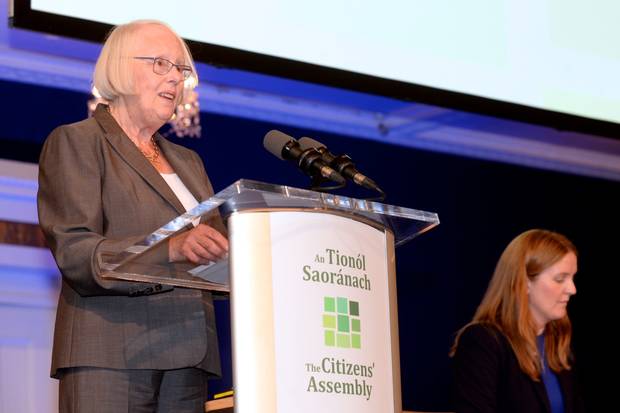
The chair of the Assembly said a “heavy burden” had been placed on the 99 volunteers as they discuss the matter.

Ms Justice Mary Laffoy said the group would sit for an extra weekend due to the complexity of the issue.

The Assembly’s work is now expected to be completed in mid-April. It will then feed back into the Oireachtas for further direction.

It was envisaged the highly divisive issue would be explored over four weekend sessions of the Assembly.

But at the close of the January meeting in Malahide Ms Justice Laffoy said it had agreed to timetable an extra weekend.

Mental

The Assembly, which is hearing evidence in public sessions from a wide range of experts and interest groups, has been deluged with more than 13,500 submissions on the matter.

During this weekend’s meeting, it appeared the Citizens Assembly is leaning towards change in the abortion laws.

One member said her table felt Ireland’s abortion legislation “was not fit for purpose”.Another spoke of mental health issues, feeling the Eighth Amendment was “too restrictive, degrading, prohibitive and inhumane”. Another said the amendment should be repealed.

The 99 Assembly members were chosen at random from across Ireland and their views on abortion were not known in advance.

One said the constitution “should continue to represent the rights of the unborn” while others said “clarity was needed” to direct GPs and so that their personal beliefs did not take precedence.

Others wanted to know more about the consequences of repealing the Eighth Amendment.

Those opposing abortion in Ireland said they were concerned about the prevalence in Iceland of the termination of foetuses with Down syndrome.

The Assembly heard no baby had been born with Down syndrome in Iceland for the past four years since DNA tests had been widely introduced for pregnant women.

But the overall tone of the viewpoints expressed will concern the Pro Life Campaign, which said the Assembly was “given an impossible task by the Government from the outset”.

Nonsense

“It is nonsensical to expect us to consider 13,000 submissions over a weekend or two, then report back to the Oireachtas with well argued and carefully considered recommendations. It won’t happen,” said Assembly spokesperson Cora Sherlock.

Ms Justice Laffoy later announced that Assembly meetings would be extended. She spoke after a private discussion was held with members.

“We imposed a heavy burden on the members to get their heads round what we were putting before them… all we could do is a preliminary view of what the members responded to the questions.”

Among the questions put to the group were whether Ireland now needed to regulate abortion, whether rules and standards would have to be adopted, and how would regulation be effected.

Ms Justice Laffoy said, although the assembly meetings would be extended, “it was important to note this does not affect my previous commitment to complete the work in respect of the Eighth Amendment within the first half of 2017”.

“I am determined to deal swiftly and comprehensively with this matter,” she said.

In Ireland, a pregnancy can be terminated under the Protection Of Life During Pregnancy Act if there is a risk to a woman’s life, including suicide.

The procedure can involve a medical or surgical termination or an early delivery by induction or Caesarean-section.

Figures from the Health Service Executive showed 26 terminations were carried out under the legislation in 2014 and the same number again in 2015. In both years, 14 arose from a risk to the life of the mother from physical illness, three in relation to suicide and nine following emergencies arising from physical illness.

http://www.herald.ie/news/assembly-needs-more-time-as-it-leans-towards-change-in-abortion-law-35350792.html

Source: Herald IE

8-jan-17

A French pharmaceutical company will apply for FDA approval to make a progestin contraceptive pill available over the counter in the US. It’s about time.

Over-the-counter birth control is very likely to become a reality in the United States, Vox has learned. It will be several years, at least, before the Food and Drug Administration actually approves an oral contraceptive pill for use without a prescription — but the first steps of the process are underway.

The best way to prevent unwanted pregnancy is to make it as easy as possible for women to access birth control. But in most states, women can only get hormonal contraception with a prescription from a doctor — which requires time and money for doctors’ visits that some women just don’t have. And since oral contraceptive pills are incredibly well-studied and incredibly safe, many advocates and experts think it’s time to make them available over the counter without a prescription.

The American College of Obstetricians and Gynecologists, the American Medical Association, and the American Academy of Family Physicians agree that oral contraceptives are appropriate for over-the-counter use. The idea even has bipartisan support in Congress, although there are sharp disagreements over issues like whether and how insurance should pay for it.

The problem with making over-the-counter birth control a reality hasn’t been evidence, or even necessarily politics. The problem has been finding a pharmaceutical company that is actually willing to go through the long slog of getting one of its own drugs approved by the FDA for over-the-counter use.

But now that company has been found. HRA Pharma in Paris is partnering with advocates and experts from Ibis Reproductive Health, an international nonprofit research organization for reproductive health, to start the process of bringing an over-the-counter oral contraceptive to the US market.

“At HRA, we are proud of our pioneering work to expand access to contraception for millions of women,” the company told Vox in a statement. “Oral contraceptives are some of the best-studied medicines on the market today and enjoy longstanding support from medical and public health experts.”

Ibis president Kelly Blanchard told Vox that she doesn’t want to speculate on how long it will take to bring the pill to market, and that the exact name or chemical composition of the pill isn’t public yet. But their aim is to submit an application to the FDA “within a few years,” she said, and some pieces of the application and research are already underway.

The first OTC pill will be progestin-only, not combined estrogen and progestin

There are two major types of oral contraceptives, progestin-only and combined pills that contain both progestin and estrogen. Ibis and HRA plan to seek FDA approval for a progestin-only pill.

Progestin-only pills present the fewest barriers for the broadest population, Blanchard said. Both types of pills are equally effective, but combined pills with estrogen cause potential problems for women who smoke or have high blood pressure, for instance, that progestin-only pills don’t.

The other benefit is that emergency contraception, which is already FDA-approved, is also a progestin pill. That means it will probably be easier to get the progestin-only oral contraceptives approved.

But Blanchard said that after the first OTC pill is approved, it shouldn’t be difficult to get other forms of birth control approved, too. That’s important so that women can have more than one over-the-counter option, since not every pill or every birth control method is right for every woman.

What about the politics of it all?

While it’s true that OTC birth control is a bipartisan idea, there’s a bit of a catch.

A major legacy of the Affordable Care Act (ACA) was making health insurance cover contraception at no additional cost to women. Not making women pay extra on top of their insurance premiums makes birth control much more accessible.

But Republicans, of course, say they want to repeal the ACA, and the birth control benefit along with it. Republicans proposed legislation in 2015 to speed up the FDA’s over-the-counter approval process for contraception — but Democrats and women’s health advocates criticized that bill as a cynical ploy to undermine the ACA while only appearing to support birth control and women’s health.

That bill would have imposed an 18-and-over age restriction, which Blanchard said was completely unnecessary; women’s health advocates have already had a similar fight with the FDA over age restrictions for emergency contraception (which is even more politicized than regular birth control because of the false belief that it can cause abortion).

“Unfortunately, it seems that no matter what you do around birth control in the US, there is going to be some kind of political backlash,” said Krishna Upadhya, an assistant professor at the Johns Hopkins University School of Medicine and a member of the Oral Contraceptives Over-the-Counter Working Group, which Ibis convened in 2004 to study and advocate for OTC birth control. “But I actually think this is one of the great reasons to support having over-the-counter access,” she added.

When women don’t have to go through doctors or pharmacies to get birth control, they are less subject to the whims of regulation changes, religiously objecting pharmacists, or other potential hassles and headaches. And the FDA’s decision-making process is based on evidence, not partisanship.

As for whether Trump’s appointees could cause political problems for approving over-the-counter contraception, Blanchard said she hopes that the FDA “will follow their process and judge it on its merits. And we think the merits are strong.”

http://www.vox.com/2016/12/30/14120874/birth-control-over-the-counter-fda-ibis-hra-pharma

Source: Vox


7-jan-17

On Saturday, a United States district judge ruled that doctors may turn away women who have had abortions and transgender patients on the basis of religious freedom.

In his order, Judge Reed O’Connor argued laws that would otherwise forbid gender-based discrimination require doctors “to remove the categorical exclusion of transitions and abortions (a condition they assert is a reflection of their religious beliefs and an exercise of their religion) and conduct an individualized assessment of every request for those procedures.” In other words, doctors would have to argue on an individual basis their refusal of a patient.

This requirement, O’Connor said, “imposes a burden” on doctors’ ability to exercise their religion.

O’Connor cited 2014’s Burwell v. Hobby Lobby ruling, which allowed family-owned corporations to refuse insurance coverage for birth control under the Affordable Care Act if it went against their religious beliefs.

At the time, the New York Times predicted the 5-4 Supreme Court decision would “[open] the door to many challenges from corporations over laws that they claim violate their religious liberty.” And, given O’Connor’s interpretation of the decision, it seems the outlet was right.

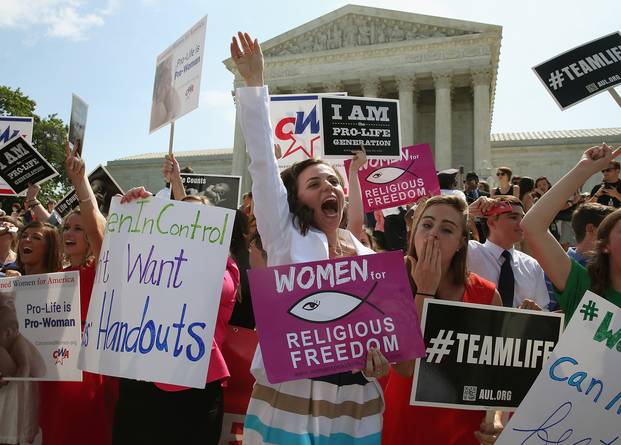
Anti-abortion activists celebrate the Supreme Court’s Burwell v. Hobby Lobby ruling in June 2014.Source: Mark Wilson/Getty Images

Slate‘s Mark Joseph Stern called O’Connor’s ruling “an extreme extension of the dubious logic” behind Burwell v. Hobby Lobby, as it flouts the nondiscriminatory guidelines of the Affordable Care Act and the Department of Health and Human Services.

Whereas they both include discrimination based on “gender identity” and “termination of pregnancy” under the umbrella of sex discrimination, O’Connor’s ruling only acknowledges a more rudimentary definition of gender discrimination — “hostility against a man or woman for being a man or a woman,” Stern wrote.

O’Connor also justified his ruling by claiming that individual doctors’ refusal to treat trans patients or women who have had abortions does not limit their access to health care and coverage. He argued that the government doesn’t seem to be too concerned about specifically trans people’s access to health care anyway.

The government’s own health insurance programs, Medicare and Medicaid, do not mandate coverage for transition surgeries; the military’s health insurance program, TRICARE, specifically excludes coverage for transition surgeries,” O’Connor wrote in his judgment.

O’Connor’s ruling, though, will only continue to limit options for trans people and add fuel to the fire in terms of punishing women for their reproductive choices — objectives conservatives have been steadily working toward with the trans bathroom bill in North Carolina and a number of anti-abortion laws in other states.

With his ruling, O’Connor paved the way for even more discrimination on the grounds of religious freedom.

https://mic.com/articles/164234/judge-rules-doctors-can-refuse-trans-patients-and-women-who-have-had-abortions?utm_source=dailydot&utm_medium=social&utm_campaign=partner#.XSbeUAhgJ

Source: Mic


6-nov-2016

Kentucky’s new Republican House majority took the first step on Thursday toward requiring women seeking an abortion to undergo an ultrasound, acting swiftly to capitalize on winning control of the chamber for the first time in almost a century.

The 83-12 vote on the bill came on the third day of the state’s 2017 General Assembly session, the first in which the Republican Party has led the House of Representatives since 1921.

The bill requires a physician or qualified technician to perform the ultrasound and position the screen so the woman may view the images. The medical staff will be required to describe what the images show, including the size of the fetus and any organs or appendages visible.

Sponsors say the bill will better protect the health of women and provide the materials necessary for women to make an informed choice. Abortion rights advocates contend such laws are designed to frighten and shame those seeking an abortion.

Some 25 states have laws regarding ultrasounds and abortions, but only three states require medical staff to display and describe the images, according to the Kaiser Family Foundation, a non-profit group focusing on health issues.

While Kentucky’s bill passed easily, some supporters criticized the new House leadership for pushing the legislation through so quickly that it might open the state to a lawsuit if, as expected, the bill becomes law.

“I think that had we had a chance to discuss this bill, we might have come up with something that was not going to open this state up to millions of dollars in litigation” costs, said Democratic state Representative Angie Hatton.

The state’s Republican-controlled Senate passed another measure that would outlaw abortions after 20 weeks of pregnancy. After passing the ultrasound bill, the House approved two measures strongly opposed by labor groups. The first was a proposal that would allow workers in union shops to receive union benefits without having to pay dues, The second measure would repeal prevailing wage laws Republicans say add expenses to state and local construction projects.

Leaders in both chambers plan to meet this weekend to pass bills to be sent to Republican Governor Matt Bevin for approval, House Republican Caucus spokeswoman Daisy Olivo said.

http://uk.reuters.com/article/us-kentucky-abortion-idUKKBN14P2IW

Source: Reuters

5-th-jan-17

The issue of “late stage” abortions is being considered by ministers after new powers were devolved to Holyrood.

Scottish women wanting terminations for non-medical reasons from 18-20 weeks gestation must usually travel to England for the procedure.

A recent study also found wide variations in practice between health boards.

The Scottish government said it was working with health boards to improve services.

The 1967 Abortion Act made it legal for women to have an abortion up until 24 weeks gestation in England, Scotland and Wales.

The Scotland Act 2016 has since devolved power over abortion law to the Scottish Parliament.

Campaigners say women sometimes choose to have an abortion after 18 weeks because of a change of circumstances, or because they only discovered at a very late stage that they were pregnant.

But while it is legal to have an abortion at this stage of pregnancy, several academic studies have suggested such terminations are rarely carried out in Scotland.

Instead, patients are referred to hospitals in England, with the treatment paid for by NHS Scotland.

‘Complex area’

The reasons for this are unclear; some have suggested it reflects negative attitudes towards late-stage terminations, while a lack of specialist training has also been put forward as an explanation.

A spokesperson for the Scottish government said: “The Scottish government is continuing to work with NHS Boards to look at how improvements can be made to abortion services in Scotland.

“This includes considering the complex area of later gestation abortion services.

“Abortion is provided to all women in Scotland who require it within the legal limits.”

In November First Minister Nicola Sturgeon said she would look into giving women from Northern Ireland access to NHS abortions in Scotland without facing prohibitive costs.

Abortions are illegal in Northern Ireland except for cases where the woman’s health is at risk.

http://www.bbc.com/news/uk-scotland-scotland-politics-38513328

Source: BBC

4-jan-17

A new study from the Pew Research Center has found the majority of Americans do not believe the Supreme Court should overturn the historic 1973 Roe v Wade ruling that established abortion as a right for women.

As the US shifts into a Republican presidency, the issue of Roe v Wade and abortion rights continues to be a contentious issue where neither pro-life nor pro-choice advocates can make concessions. But, as the poll indicates, the majority of US citizens do not want to see a woman lose her right to an abortion.

The research found that 69 percent of Americans do not want to see Roe v Wade completely overturned.

Most Americans have supported the Roe v Wade since the ruling 43 years ago, and that support has been growing, despite an increasing amount of restrictions placed on abortion providers. The Pew Research Center conducted a similar survey in 2013 and that study found that 63 percent of Americans did not want to see Roe v Wade overturned.

Support for Roe v Wade is traditionally determined along party lines, with Democrats often being defenders of a woman’s right to choose with Republican lawmakers pursuing legal moves which threaten the court’s ruling. But the Pew Research Center found that the issue is not as clear as it may seem. While 84 percent of Democrats and those who lean Democratic say the Supreme Court should not completely overturn the ruling, 53 percent of Republicans agree.

The Supreme Court case highlights some of the nuances within the Republican Party. As a candidate, President-elect Donald Trump seemed to support overturning the ruling, saying in an interview with 60 Minutes that he would appoint pro-life justices to the bench who would possibly overturn the 1973 ruling, making it a state issue. Fifty-seven percent of conservative Republicans would agree with that line of thinking, but only 27 percent of moderate and liberal Republicans would be on board.

The level of education also appears to play a big role as 88 percent of those with postgraduate degrees did not want to see abortion cease being a federally protected right. Only 62 percent of those with a high school diploma or less feels the same.

Religion is also a large factor – particularly for Protestants. In general, 63 percent of Protestants do not support completely overturning the ruling, but when that group is further divided into white Protestants, that number shifts dramatically to 49 percent who do not think it should be overturned, while 47 percent do.

https://www.rt.com/usa/372614-roe-v-wade-support/

Source: RT

3-jan-17

Speculative move by two religious lawmakers to change the 40-year status quo regarding abortion has sparked furious backlash.

Abortion may be one of the most politically charged issues in the world related to religion – but you’d never know it in Israel. While Israelis are eager to furiously debate nearly anything else involving religion and politics – from kosher standards in the army to buses on Shabbat, to women’s prayer at the Western Wall – there is near-silence on the issue of when life begins in the womb.

The status quo that is clung to so tightly has allowed invasive but relatively permissive abortion laws to remain in place nearly undisturbed for 40 years.

This week, though, in a rare occurrence, a proposal was floated that would invite religious input into abortion decisions – and the reaction was explosive.

What happened? Two lawmakers – one an Orthodox Jew, Yehudah Glick (Likud); the other an observant Muslim, Abd al-Hakim Hajj Yahya (Joint List) – dared raise the idea of including a member of the clergy (a rabbi or an Islamic “qadi,” responsible for interpreting Islamic Sharia law) on the state committees that Israeli women seeking abortions must consult before obtaining one.

Simply the news that the idea was being discussed by the Knesset Committee on the Status of Women sparked a furious backlash. As soon as word got out about the hearing, a female cry swept across Hebrew social media to “keep the rabbis out of our uterus!”

In a preemptive strike, numerous Knesset members came out strongly against it on their Facebook pages even before the Knesset panel met. The very idea was “dangerous and scandalous,” wrote Meretz Chairwoman Zehava Galon, who spearheaded opposition to the proposal. The very existence of the abortion panels, which she called a “black, shameful stain on Israeli society,” was bad enough. But to insert the clergy into an already “humiliating” process was intolerable, she added.

“Two male legislators, each one extremely religious, want to invade women in their most intimate space, their bodies,” wrote MK Revital Swid (Zionist Union). “Who are you, my male friends, to invade a place that is so personal – physically, emotionally female – and try to invade it, forcing in your religious considerations? Every woman makes her own decision and if religious issues are important to her, she will weigh them herself and act accordingly. Why at that moment, which is already so uncomfortable and embarrassing, force a man of religion to be present? As a kosher inspector?”

At the Knesset hearing itself, the idea was criticized by female lawmakers from both the governing coalition and the opposition, who agreed that they would oppose the idea if it became proposed legislation.

The strong reaction to such a relatively toothless proposal revealed the delicate nature of this powder-keg issue in Israel.

The current status quo has something for everyone: It offers the semblance of regulation for those conservatives who want abortion to be discouraged, while in reality almost any woman who wants an abortion is able to obtain one – and an estimated 40,000 Israelis obtain them every year.

The existing abortion law was passed in 1977. Under the law, the procedure is nearly automatically legal if women are aged under 18 or over 40; the fetus has a serious mental or physical defect; if the pregnancy is the result of rape, incest or adultery; or if it threatens the woman’s physical or mental health. For teenagers and soldiers serving in the Israel Defense Forces, abortions are fully funded by the state.

In practice, this means that legal abortion is easy to obtain except for those who are married and of standard childbearing age – between 18 and 40.

A healthy married woman who wants an abortion in a public facility must face a committee composed of social workers and doctors in order to have her abortion approved.

Often, those who fall into that category resort to white lies, saying they are single, mentally unstable or pregnant out of wedlock, in order to eliminate obstacles – which is the reason why more than 96 percent of women who seek legal abortions are able to have them.

It is to this committee that the two lawmakers proposed adding a religious authority, in order to “help explain” any religious issues she might have.

In reality, if a woman has several hundred dollars, obtaining a private abortion in a doctor’s clinic and sidestepping the panels is much more efficient. Though technically such physicians are breaking an unenforced law, the practice is common and widespread, allowing any woman – regardless of marital status, age or personal situation – to obtain an abortion discreetly and far more quickly than the official process.

Before Monday’s Knesset hearing, Glick told Haaretz that he found the lack of accountability troubling. He complained that the authorities didn’t release abortion statistics regularly, and that it was problematic that nearly every woman who went before an abortion panel was approved for the procedure, and also that private abortions were regularly performed with no consequences.

Hajj Yahya said the purpose of the hearing was to explore the issue and find members of the coalition who would be willing to support introducing clergy onto the abortion panels – “not to pressure, but to explain.”

Before the hearing, the two lawmakers released statistics they had obtained. These showed that although the rate of legal abortions had dropped among the overall Israeli population, the number in the non-Jewish sector had climbed. It was notable, though, that the chairwoman of the committee, Aida Touma-Suliman – also a Joint List member – opposed the proposal as strongly as her counterparts in other parties.

And so it seems that, ironically, in a country where religious identity is central, and where the observant and secular, and Jews and Muslims clash so frequently, a quiet consensus seems to exist on the hot-button issue of abortion.

Attempts to rock the boat are few and far between. The last time a serious attempt was made to change the status quo was 2006, when a bill introduced by Galon – which would have eliminated the abortion committees – was soundly defeated by an overwhelming majority. Then-Health Minister Jacob Edery said that the government, led by Prime Minister Ehud Olmert, opposed the bill because it did not believe “now is the time to reopen this complicated and problematic discussion. We must remember that the termination of pregnancy is a complicated and sensitive social issue, and every change is a change in the status quo between different worldviews.”

Abortion also briefly hit the headlines in 2013, when the country’s two chief rabbis issued a letter in support of the Efrat antiabortion organization, saying they wanted to make “the wider public aware of the extreme seriousness involved in killing fetuses, which is like actual murder.”

Abortion in Israel is an area in which neither extreme is completely satisfied, but any movement toward real change is viewed with nervous suspicion.

Jewish and Muslim clerics don’t want abortion banned outright – neither religion utterly forbids it – but they surely wish that the committees weren’t so liberal in permitting abortions and that they weren’t so commonly obtained. And women’s advocates who believe in autonomy over their own bodies would clearly prefer it if the abortion panels didn’t exist at all, and showed this week that they deeply fear – and will fight furiously against – any new obstacles put in the way of a woman’s choice.

http://www.haaretz.com/israel-news/.premium-1.762711

Source: Haaretz


2

COEUR D’ALENE, Idaho – Anti-abortion advocates in northern Idaho say they are collecting signatures for a ballot initiative that would outlaw abortion in Idaho.

The Coeur d’Alene Press (http://bit.ly/2hUWDIF) reports that Abolish Abortion Idaho, a grassroots citizen group, wants to change Idaho law to make people who perform or have an abortion face a penalty of first-degree murder. The petition would ban any exceptions for cases of rape, incest or when the mother’s health is in danger.

Scott Herndon, an activist with the group, says that supporters want Idaho to ignore federal law that recognizes a constitutional right to an abortion.

“If a woman faces the very real consequences of a first-degree murder penalty, we are confident it will act as a deterrent to abortion,” he said.

Herndon added that he was unsure of how many signatures he collected so far as of Friday.

Statewide ballot initiatives must have signatures from 6 percent of the total of those who voted in the last presidential election from 18 out of Idaho’s 35 legislative districts. That means Abolish Abortion Idaho must have at least 56,000 verified signatures to make it on the 2018 ballot.

The ballot would need a simple majority to pass if it makes it on the ballot.

Chuck Wilkes Jr., lead pastor at True North, a Church of the Nazarene in Hayden, said he had concerns over the legal challenges the proposal faces.

“The use of criminal sanctions simply compounds a bad situation,” he wrote in an email to The Press, adding his comments are his own and not a reflection of his pastoral position. “The use of first-degree murder charges is not appropriate for these situations.”

By Associated Press

http://www.heraldtribune.com/news/20170101/idaho-group-pushes-proposal-to-outlaw-abortion

Source: Herald Tribune

U.S. President Barack Obama listens as he participates in his last news conference of the year at the White House in Washington, U.S., December 16, 2016. REUTERS/Carlos Barria

(Reuters) – A federal judge in Texas on Saturday issued a court order barring enforcement of an Obama administration policy seeking to extend anti-discrimination protections under the Affordable Care Act to transgender health and abortion-related services.

The decision sides with Texas, seven other states and three Christian-affiliated healthcare groups challenging a rule that, according to the judge, defines sex bias to include “discrimination on the basis of gender identity and termination of pregnancy.”

In granting an injunction one day before the new policy was to take effect, U.S. District Judge Reed O’Connor held that it violates the Administrative Procedure Act, a federal law governing rule-making practices.

The judge also ruled that plaintiffs were likely to prevail in court on their claim that the new policy infringes on the rights of private healthcare providers under the Religious Freedom Restoration Act.

As explained in O’Connor’s 46-page opinion, the plaintiffs argued that the new regulation would “require them to perform and provide insurance coverage for gender transitions and abortions, regardless of their contrary religious beliefs or medical judgment.”

The same judge issued a similar court order in August blocking a separate Obama administration policy that would have required public schools, over the objections of 13 states, to allow transgender students to use restrooms of their choice.

It was not immediately clear whether the Obama administration, which has just 20 days left in office, would seek to appeal the latest injunction.

White House spokeswoman Katie Hill decried the ruling.

“Today’s decision is a setback, but hopefully a temporary one, since all Americans – regardless of their sex, gender identity or sexual orientation – should have access to quality, affordable health care free from discrimination,” she said.

The Affordable Care Act (ACA), also known as Obamacare, was passed in 2010 with an anti-discrimination section designed to prevent insurers from charging customers more or denying coverage based on age, race, national origin, disability or sex.

The rule in dispute on Saturday was adopted by the U.S. Health and Human Services (HHS) Department to implement those provisions, including definitions for sex discrimination that encompassed transgender and abortion services.

According to the court opinion, gender identity was defined under that rule as “an individual’s internal sense of gender, which may be male, female, neither, or a combination of male and female, and which may be different from an individual’s sex assigned at birth.”

The state of Texas has led a string of legal cases brought by Republican-controlled states contesting various social policies advanced by President Barack Obama, most notably his 2014 executive action to protect millions of immigrants in the United States illegally and give them work permits.

That plan, challenged by Texas and other states, has been barred by the courts. But the U.S. Supreme Court in 2012 and 2015 issued rulings that kept the Affordable Care Act, his top legislative achievement, intact.

http://af.reuters.com/article/worldNews/idAFKBN14L0OV

Source: Reuters