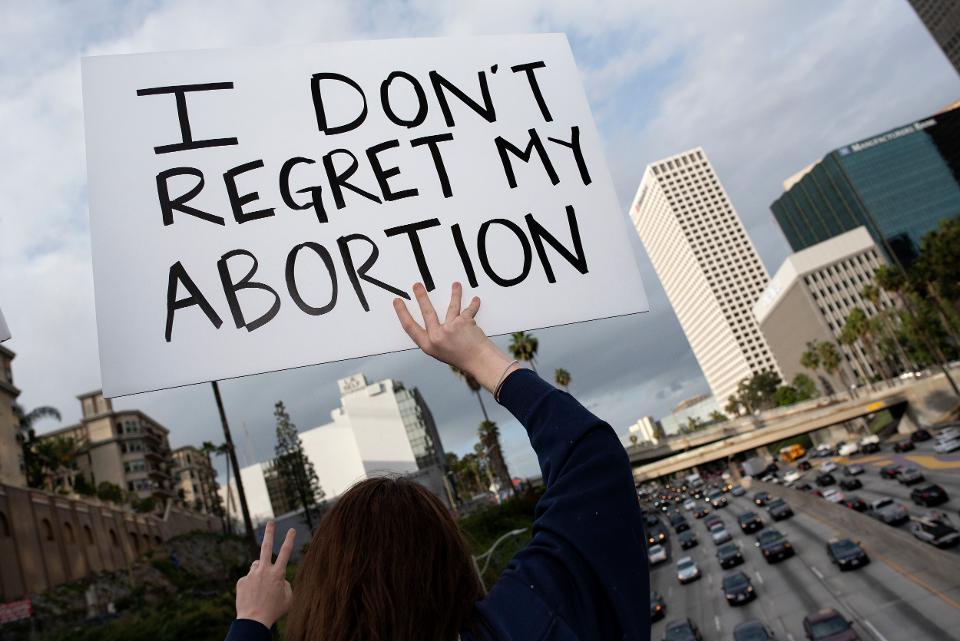
LOS ANGELES, CA, UNITED STATES – 2019/05/21: An activist seen holding a placard that says I Don’t … [+] LIGHTROCKET VIA GETTY IMAGES

In some ways, reproductive health and medicine are facing greater threats today than ever before, including a fast-approaching Supreme Court fight that could ultimately deny care to millions of US families. Meanwhile, experts in this field are also making major strides, including landmark research on abortion outcomes over time, which debunks numerous common anti-abortion claims.

In January, researchers at the University of California, San Francisco’s Advancing New Standards in Reproductive Health (ANSIRH) center published the third and final paper based on their groundbreaking Turnaway Study, which tracked the experiences of 1000 women who either received an abortion or were denied one, recorded at one week after the event and then semiannually for five years.

Overall, researchers found that women and their families saw long-term harms when they were denied wanted abortions, including dips in extant children’s developmental progress and women’s income and credit scores. They also concluded that some of the most popular arguments to restrict abortion — suggesting that women will regret their abortions, or that the procedure may be bad for women’s mental health — just don’t line up with the data.

The team’s latest article tackles this point head-on: despite frequent popular rhetoric arguing otherwise, their longitudinal study found that women who received abortions overwhelmingly said that they primarily felt relieved, and continued to feel their decision had been right in the five years that followed.

“We found no evidence of emerging negative emotions or abortion decision regret; both positive and negative emotions declined over the first two years and plateaued thereafter, and decision rightness remained high and steady,” they explained last month in an article for Social Science & Medicine. “At five years postabortion, relief remained the most commonly felt emotion among all women.”

The negative emotions that women did experience seemed to correspond most to perceived levels of decision-difficulty and stigma in their communities, but also petered out over time. “These results add to the scientific evidence that emotions about an abortion are associated with personal and social context, and are not a product of the abortion procedure itself,” researchers wrote.

Dr. Corinne Rocca, the study’s first author and one of the Turnaway Study’s lead researchers, noted in a phone interview that women who were denied abortions reported raised levels of anxiety, but women who received them reported feeling the kind of positive-and-negative emotional mix you’d expect “during any big life event” (such as changing jobs, moving, or ending a relationship).

“Feelings were most mixed during week after, with some sadness, but also happiness and relief; relief was the most common,” Rocca said. “Experiencing negative emotions during a big life event is completely normal; I don’t find that concerning. What I would find concerning would be if that persisted, or if women looked back [months or years later] and felt tremendous guilt,” but that just wasn’t the case. “And a very-high-to-overwhelming proportion said they felt they made the right decision, which held out over five years.”

The data also showed that women’s consistent feeling of ‘decision rightness’ continued “even under difficult circumstances,” Rocca said — for example, if they had chosen to have a late-term abortion, or had self-reported that they live around abortion stigma. “Even they still felt this was the right decision.”
This kind of evidence about women’s emotions and perspectives after abortions hadn’t previously existed, Rocca said — for one thing, because it wouldn’t make sense to compare data on women who had abortions with that of women who experienced miscarriages, or who carried a wanted pregnancy to term.

Now that it is available, Rocca and her colleagues hope lawmakers will start taking this and other scientific evidence into account more often when legislating our reproductive health. In numerous states already, she said, “There have been multiple of these targeted regulation of abortion providers (TRAP) laws — a family of them, really — all centered around the regret claim.”

Sometimes such laws will require patients to wait 72 hours before getting the procedure, or require two separate visits (one for ‘counseling,’ one for the abortion), or have ultrasound-viewing requirements. “They’re all really targeting the idea that women will regret abortion,” Rocca said.

“But data suggest those policies are wrong, and that those policies won’t work,” she continued. “My desire for this research is really that we just base our policies on evidence. These are needless policies, and probably create the outcome that they are claiming to protect people from.” In terms of providing meaningful support to pregnant persons in the moment of their decision-making, Rocca added, “A better idea would be to offer solutions for dealing with stigma.”

Regarding the oft-used argument that abortion is or may be bad for women’s mental health (or that they’ll come to regret it), Rocca commented, “I think in part it’s because people who are against abortion don’t want to be anti-women, and the claim that they want to protect women from this decision has seemed appealing.” It’s far from the only misconception (or misrepresentation) out there, however. And usually the problem isn’t that research hasn’t been done.

“Some of the biggest gaps in people’s knowledge about abortion, and in the public’s knowledge, aren’t things we haven’t answered yet. They’re things that are out there, and firmly established,” Rocca said.

According to Rocca, the biggest knowledge gap has to do with “just how safe abortion is,” she said. “Far safer than a colonoscopy, or many other common procedures that people routinely get.” That includes surgical as well as medication abortions, “despite [the latter] being heavily regulated by the FDA.”

“The second [gap] is how common it is: people think abortions are rare, but one in three or four women have them in their lifetime,” Rocca said. “People may think they don’t know somebody that’s had one, but they’re wrong.”

Source: https://www.forbes.com/sites/janetwburns/2020/02/29/women-overwhelmingly-dont-regret-abortions-research-finds-but-denying-them-costs-a-ton/#5efd2c021604

Welcome to Pennsylvania, birthplace of the anti-choice movement

South Philly-based writer, activist and model Jessa Jordan models her ‘Everyone Knows I Had an Abortion’ T-shirt. | Image: Elizabeth Rudge

“I’ll walk you through a common experience when accessing abortion in PA,” says Dr. Lin-Fan Wang, a Philly-based family physician and an activist for reproductive health access.

She describes the average person who seeks an abortion in America as “a Christian woman in her 20s with a child, [who] was using birth control when she finds out that she’s about six weeks pregnant,” citing data from the Guttmacher Institute. Pennsylvania’s Department of Health statistics confirm that nearly 60 percent of abortions in PA are sought by women in their 20s, and over 60 percent are eight weeks pregnant or less.

When this pregnant person calls to schedule an appointment, “that’s when she encounters the restrictive state laws in PA,” says Wang. “She is told that even though she made her decision, that at least 24 hours before her abortion, she must have counseling from a physician about her pregnancy options and the risks of abortion, and she is offered a booklet written by the state to persuade them against having an abortion. She goes through the mandated counseling, but then her appointment is scheduled two weeks out instead of 24 hours out.”

After that, Wang says this person will likely have to “take time off work and make child care arrangements. She also has to save up money, because PA law prevents her insurance from covering her abortion.”

If she doesn’t live in Philadelphia, Allegheny, Northhampton or Delaware counties, the counties where 80 percent of PA abortions are performed, she will likely have to travel nearly two hours to reach a clinic, and one that may only provide abortion care once a week.

As of April 2017, Pennsylvania passed a number of restrictions that made abortion harder to access, including requiring the “state-mandated counseling” Wang mentioned, installing a waiting period, and requiring medically unnecessary tests be performed on the patient.

These new rules also make the procedure more costly. For people whose health-care plans were purchased in the ACA exchange or who are public employees, insurance can’t cover abortion, except in the case of danger to the pregnant person’s life, or unless they happen to have an optional rider for such coverage, which comes at additional cost.

Additionally, minors seeking abortions are required to have parental consent, clinics must conform to a number of arbitrary hallway and room-sizing regulations, and patients seeking hormonal birth control implants must wait for a subsequent visit now, all due to these new laws.

Activist and model Jessa Jordan plans to work with Shout Your Abortion to organize Abortionpalooza, a daylong arts festival. | Image: Elizabeth Rudge

The future looks even more difficult, as anti-abortion legislation increases across the nation, clinic funding is attacked, and the Supreme Court is filling with judges antagonistic to reproductive freedom. As recently as January, eight U.S. senators, and eight GOP House of Representative members from Pennsylvania sent a brief to the Supreme Court asking for Roe v Wade to be overturned, which would reverse abortion rights nationwide.

Locally, Targeted Regulation of Abortion Providers (TARP) laws attempt to make it impossible for clinics to operate, while so-called fetal heartbeat bills set deadlines for abortions before most women can realize they’re pregnant, effectively banning the procedure. The Pennsylvania House of Representatives introduced such a bill in 2018, which failed in committee. But in 2019, the state passed a ban on abortions after 24 weeks, despite the procedure being almost entirely performed for the health of the pregnant person at that point.

“The current state is horrific – both in PA and nationally. PA is really the birthplace of the anti-choice movement nationwide,” says Elicia Gonzales, executive director of Women’s Medical Fund, an organization that provides financial assistance to women seeking abortion.

On top of the increasing legal obstacles, “cost is a primary barrier to someone being able to access abortion care,” Gonzales says. She says last year Women’s Medical Fund was “able to provide financial support to just over 3,200 people. All of the folks we help are living in poverty, earning around $8K a year. (Some) 72 percent of folks calling our Help Line are already parenting one or two children at home.”

There doesn’t seem to be a dearth of funds for trying to talk people out of abortion, though. Gonzales says Real Alternatives, a Harrisburg-based anti-abortion group, has received $90 million in state funds, including Temporary Assistance for Needy Families (TANF) money, to run anti-abortion centers, which she says, “lie to and manipulate pregnant people out of having an abortion.”

“We heard one story of a pregnant person seeking abortion care who was told she had miscarried – only to find out weeks later she was still pregnant,” Gonzales says.

It wasn’t always this difficult.

“I had planned to spend a weekend out of town visiting my sister, so I didn’t have to ask for time off work,” says Katie, a barista who was living in Center City when she had an abortion in 2011. “I went to the Planned Parenthood clinic that’s right in Center City – I felt very lucky that there were no protesters outside the clinic and I experienced no harassment. I chose a medication abortion – so they did an exam and an ultrasound and then sent me home with the medication. My boyfriend went with me to the clinic and paid for half of the expense, which I think was $300 with my insurance.

Both men and women have differing opinion on abortion. But apparently so does the state of Pennsylvania, which has been stringent on its exercise of laws to protect women. | Image provided

“The medication basically induces a very heavy period which happens over the course of a single day – so I spent the day feeling nauseous and bleeding pretty heavily. It was a fairly uncomfortable experience for the one day, but afterwards all I felt was relief. I’ve never regretted my decision,” she says.

Since then, Katie says, “I’ve felt compelled to speak about my experience to normalize abortion and be an advocate. I’ve been working the last few years with PP and NARAL as much as I can, doing everything from lobby days to organizing marches to volunteering at events.”

Jessa Jordan, a South Philly-based writer, activist and model, has felt similarly motivated to share her experiences.

“I had an abortion when I was 20. The easiest part was the immediate decision to have one,” she says. “I’m extremely lucky that very little about my experience was challenging. I could afford the procedure and didn’t have to travel out of my city or state for it.

“Planned Parenthood made everything as comfortable and calming as they could,” she says, and supplied her with information about the medications involved in the abortion as well as those that can would help with subsequent pain and nausea. The hard part, she says, was the stigma.

“Even though my family and friends supported me through my abortion experience, I felt a lot of societally imposed shame and guilt for choosing to abort my pregnancy. Up to that moment, I never thought I’d be in that position,” Jessa says. She internalized blame even though the pregnancy was a result of a partner removing a condom during sex without telling her.

“When I happened upon Shout Your Abortion,” the movement to normalize abortion, she says, “I felt compelled to share my story to set myself free from that shame. I’ve been trying to be authentic and unapologetically myself and aim to empower others to do the same.” She is now in the process of working with Shout Your Abortion to organize Abortionpalooza, a one-day film and arts festival.

“We heard one story of a pregnant person seeking abortion care who was told she had miscarried – only to find out weeks later she was still pregnant.”

– ELICIA GONZALES, EXECUTIVE DIRECTOR OF WOMEN’S MEDICAL FUND.

What accounts for this stigma and these increasing legislative attacks on abortion rights? Nationwide, support for abortion rights has remained steady and over 60 percent of Americans believe abortion should be legal in all or most cases.

“Anti-choice folks have seeped into the hearts and minds of folks seeking abortion care,” says Gonzales. “Stigma has resulted in folks wondering if they are going to hell or questioning if the fetus will feel pain. It’s important to note that these are sentiments that were not expressed a decade ago.”

“There is still so much stigma regarding abortion, even though it is one of the most common outpatient procedures,” adds Wang. “We need to break the silence and see the people having abortions as the thoughtful, complex, and loving people that they are.”

“Abortions are safe medical procedures and everyone who desires an abortion should be able to have one and not have to go through extremes to have one,” says Jessa. “The stories of people who have abortions should be told by those who have that experience, not a narrative of control, fear and propaganda.”

Source: https://philadelphiaweekly.com/the-current-state/?fbclid=IwAR0YWjblKXnVLbK274r7QXCR_YAEcS4aKLbvAr8bT84Tn8NwJrse7wzbVKU

Even though HB 481 has yet to take effect, Georgia clinics have been inundated with calls from people who worry abortion is illegal or that they’ll be criminalized for obtaining one.

Roxanne Sutocky, the director of community engagement at Atlanta Women’s Center, said the center has used the passage of HB 481 as an opportunity to educate the public on why abortion bans and abortion stigma are harmful and on how to get involved in protecting reproductive rights.
John Ramspott / Flickr

With a stroke of his pen, Georgia’s Republican governor Brian Kemp incited anxiety, confusion, and fear in people who need abortion care in his state when he signed HB 481, a near-total abortion ban, into law in May 2019. The law would prohibit people in the state from accessing an abortion as early as six weeks into pregnancy, before most know they are pregnant.

While HB 481 wasn’t slated to take effect until January 1, 2020, clinics that provide abortion services in Georgia were immediately inundated with phone calls inquiring if abortion was illegal. Despite a temporary injunction halting the ban from taking effect—thanks to a lawsuit to strike down the ban filed by the American Civil Liberties Union, the Center for Reproductive Rights, and Planned Parenthood on behalf of abortion care providers, advocates, and patients—the calls still haven’t stopped.

“When Kemp signed the law last summer, our call center got flooded,” Staci Fox, the president and CEO of Planned Parenthood Southeast (PPSE), told Rewire.News. “We had to set up a separate number in our call center just for information about where the law and the litigation stood so that patients and anyone, really, could stay informed.” (PPSE operates four health centers that provide abortion care in Georgia and is one of the lawsuit plaintiffs.)

Since HB 481, one of Fox’s priorities has been informing people who need an abortion in Georgia that the procedure is still safe, legal, and available up until a pregnant person reaches 20 weeks (later in special cases), mainly through social media and on-the-ground campaigns. She’s far from alone in this mission—many of PPSE’s fellow plaintiffs are undertaking similar efforts to ensure that people receive accurate information.

Kwajelyn Jackson, the executive director of Feminist Women’s Health Center (FWHC), told Rewire.News it was their duty to join the lawsuit as a reproductive justice-centered clinic that serves patients from marginalized communities. FWHC has been receiving the same nervous calls from abortion-seekers as PPSE.

“We made a banner shortly after the bill was signed to put outside of our clinic that said, ‘This clinic stays open,’ just so that people would have a visual representation of reassurance that we’re here, we’re open, we’re accepting appointments, we’re seeing patients every day—that we don’t have any plans on going anywhere,” Jackson said.

Roxanne Sutocky, the director of community engagement at Atlanta Women’s Center (AWC), another plaintiff, said that after an uptick in calls due to HB 481, their advocacy center staff began tracking the concerns of callers. They found that callers asking about Georgia’s ban were from both inside and outside the state and were generally afraid of being criminalized for accessing an abortion—including callers who’d already had one.

Callers also reported being given misinformation by anti-choice pregnancy centers (also known as “crisis pregnancy centers,” or “fake women’s health centers”). These organizations, of which there are 91 in Georgia, intentionally confuse pregnant people, claiming to offer “abortion pre-screenings” that are really ploys to persuade people from terminating their pregnancies.

“In our call tracking, we actually did talk to folks who said they went to crisis pregnancy centers and were told that because the fetus had a heartbeat, they would go to jail if they got an abortion. So crisis pregnancy centers are absolutely manipulating and taking advantage of folks and their level of understanding of the law and where it stands,” Sutocky said.

When people visit AWC’s website, the first thing they see is a banner: ‘’Yes, abortion care is still legal in Georgia.” This message is all over the center’s social media, as well as on posters and in handouts at the clinic. AWC has used the passage of HB 481 as an opportunity to educate the public on why abortion bans and abortion stigma are harmful and on how to get involved in protecting reproductive rights, Sutocky said.

The anti-abortion measure has inadvertently resulted in opportunities for abortion care providers: PPSE has attracted more clinicians to their staff who provide abortion care. Meanwhile, FWHC has partnered with medical schools to introduce residency programs for a new generation of family planning physicians to be trained to provide abortions. Due to an influx of donations following the signing of the law, their clinic has been able to expand their capacity by hiring new nurses, nurse practitioners, and administrators.

Last week, lawyers for American Civil Liberties Union, the Center for Reproductive Rights, and Planned Parenthood filed a motion for summary judgment in their lawsuit, asking the judge to permanently block the abortion ban.

The abortion care providers Rewire.News spoke with believe that they will win—“both in the long-term and in the short-term,” Jackson said. She noted that every pre-viability abortion ban (a ban against abortions before a fetus is developed enough to survive outside the uterus) in the United States has been deemed unconstitutional and struck down. Jackson said she deeply believes in the brilliance of the reproductive health, rights, and justice activists who are fighting the abortion ban, and also in the expertise of the attorneys fighting bans and other anti-choice legislation in Georgia and across the country, sentiments echoed by both Sutocky and Fox.

Still, clinics that provide abortion care in Georgia are working together to develop a contingency plan and are part of a national strategy to assess which states are most at risk of losing access to abortion care and which states have the fewest abortion restrictions in case people aren’t able to get the services they need in their home state.

They’re also focused on both national and statewide elections this year, since Republican state legislators were the architects and champions of the ban.

“Let’s be honest: We would not have this abortion ban if it were not for voter suppression tactics. We would have had a different governor in the governor’s mansion who would have vetoed this bill,” Fox said.

Georgia’s abortion care providers are looking forward to being able to focus on issues beyond the ban, such as the state’s high maternal mortality rate. Fox lamented that PPSE wouldn’t be able to devote its full attention to actual reproductive health crises until Republican lawmakers stop “playing politics with people’s lives.”

“They act and say words like ‘we care about women,’ ‘the safety of women,’ and ‘we’re pro-life,’ but their actions do not reflect that,” Fox said. “They’re wasting tax dollars, and they’re wasting Georgia’s time while they’re not focused on real problems.”

Source: https://rewire.news/article/2020/02/26/how-georgias-blocked-6-week-abortion-ban-is-already-affecting-clinics/

I know from personal experience that it’s already very hard to get an abortion in Louisiana. The Supreme Court could make things even worse.

Protesters march down Bourbon Street in the French Quarter of New Orleans, in 2019, to protest a proposed anti-abortion bill. Emily Kask / Getty Images

Next month the Supreme Court will hear arguments in a case that could leave just one abortion clinic open in the entire state of Louisiana and pave the way for anti-abortion politicians in other states to do the same — effectively abolishing the protections of Roe v. Wade, 47 years after the case was decided.

I had just started working my first job with a decent salary and benefits in 2015 when I discovered I was pregnant. When I told my boyfriend, he apologized and said he needed to focus on his future, and this would mess that up. He offered to send money to compensate me.

I made two decisions after that. First, if I was to go through with this pregnancy, I would do it on my own. Then I thought about my future and what the best choice was for me. That’s when I made my second decision. I decided to get an abortion.

In Louisiana, that’s easier said than done.

First, I wasted three weeks going back and forth, an hour each way, to what I believed was a health center that could help me get an abortion. It turned out to be an anti-abortion crisis pregnancy center — one of more than 2,500 across the country, multiplying while abortion providers are being regulated out of existence. There, I was asked deeply personal questions, made to sit through two ultrasounds, watch a video of complete lies tying abortion to breast cancer and other health risks, and told multiple times that if I just came back for one more appointment, they could schedule my abortion. At one point, someone told me that I wasn’t “the type to get an abortion.”

One in four women in the US has an abortion in their lifetime. There is no type.

The state of Louisiana is trying to paint abortion providers as not having their patients’ best interests at heart. In reality, abortion providers were the only people I found who weren’t manipulative and coercive.

It wasn’t until I went to Planned Parenthood that I finally got the information I needed. I was told where I could get an abortion and what the process would be like. I traveled 250 miles each way to Hope Medical Group in Shreveport, home to one of the three remaining abortion clinics in the state: once for state-mandated counseling, and once for my procedure.

Both times, the doctors and staff at the health center made me feel supported, not judged. I was asked multiple times to confirm that this was what I wanted and that I was not being pressured into ending my pregnancy. They empowered me to make my own decision. Unlike the crisis pregnancy center. Unlike the state government.

In early January, 207 anti-abortion politicians wrote an amicus brief to the Supreme Court regarding the upcoming Louisiana case, arguing that the right to abortion is “unworkable.” The threat has never been more clear.

As a woman in Louisiana, my opinion should carry more weight than these 207 mostly male politicians who are not women in Louisiana (That’s right: None of the brief’s signers are Louisiana women who would be affected by the ruling. And only 13 of them are women.)

What I know from personal experience is that it’s already very hard to get an abortion in Louisiana. The state has put up a series of hoops women must jump through — including state-mandated counseling designed to convince you not to have an abortion, and a waiting period designed to put you in time out and make you travel back and forth to multiple appointments. I jumped through their hoops and more. I don’t wish my experience on anyone.

Like most women, I do not regret my abortion. I was able to keep my livelihood, without worrying about whether having a child would make me an undesirable employee or about how I would make ends meet. Today I am still working in that job, helping low-income residents with housing.

There are 1 million women of reproductive age in Louisiana. Our choices about our bodies and our futures are individual decisions.

Politicians in Washington and in Baton Rouge can write their opinions about abortion in legal briefs, in newspapers, in speeches to their donors. They’re entitled to those opinions. But they are not entitled to use their position to make my decision for me.

Source: https://www.buzzfeednews.com/article/jasminerivers/let-louisiana-women-decide-abortion-supreme-court?fbclid=IwAR2UCakrP6UAtsGnVMcp4Shbtpv5BNmkXfFDjyCqesAT5tMsgU_GWIn3B6U

The ordinances labeled some abortion advocacy groups as “criminal organizations.”

Over the last eight months, seven towns across east Texas have declared themselves “sanctuary cities for the unborn,” which effectively banned abortion and organizations that advocate for the right to the procedure.

Now, those towns are being sued for their new rules.

On Tuesday, the national ACLU and ACLU of Texas announced a lawsuit against the seven Texas towns on behalf of the abortion rights advocacy groups Lilith Fund and Texas Equal Access Fund. Under the ordinances, both of those groups were labeled “criminal organizations,” according to the lawsuit, which was filed in U.S. district court.

As “criminal organizations,” they were forbidden from operating within the towns’ limits, which banned them from offering services, renting or buying property, or “establishing a physical presence of any sort,” the lawsuit alleges. Getting or performing an abortion was also deemed illegal, as was helping anyone get an abortion, though that restriction wouldn’t actually take effect unless Roe v. Wade, the 1973 Supreme Court decision legalized abortion nationwide, is overturned.

The ordinances also declare abortion to be an “act of murder with malice aforethought.” Under Texas law, that’s not true: Abortion remains legal; it’s legal in all 50 states.

“Abortion is legal and constitutionally protected in these cities — officials there just do not want their residents to know it,” the ACLU lawsuit alleges.

The lawsuit accuses these seven Texas cities of unconstitutionally limiting the Lilith Fund and Texas Equal Access Fund’s rights to free speech and free association and discriminating against their pro-abortion rights viewpoints. (Neither the Lilith Fund nor the Texas Equal Access Fund actually perform abortions.)

“A major part of our work is to make sure every Texan knows their rights and can find legitimate, fact-based information about getting an abortion — regardless of income or zip code,” said Amanda Beatriz Williams, executive director of Lilith Fund, said in a statement. “These would-be abortion bans are deliberately designed to confuse people about their rights and push safe abortion care further out of reach.”

The ordinances first appeared in Texas in Waskom, a town of about 2,200 people near the Louisiana border. When the all-white, all-male city council voted unanimously to pass the measure last June, Waskom Mayor Jesse Moore acknowledged that the town would probably face an expensive lawsuit over it.

“Y’all save your nickels and pennies,” Moore joked, to laughter from the packed room.

But a local news outlet reported that the townspeople weren’t worried, because “they say God will take care of them.”

Source: https://www.vice.com/en_ca/article/4agq8n/aclu-sues-texas-town-abortion-sanctuaries-cities-for-unborn?fbclid=IwAR2lYkrzPN27wlNdGlB5VQi4AAGyPhnqJN6k4FJ5JoupVn-RYx_MR2zsk8k

Activists outside the Supreme Court in January voiced their support for abortion rights nationwide

If you received a diagnosis of a horrific pregnancy problem, would you want access to an abortion? Or would you want your options to be limited to stillbirth, miscarriage, or a suffering child, who would most likely die within a year?

At a press conference at the Capitol last week, proponents of Initiative 120, a campaign to place an initiative to ban abortion after 22 weeks on Colorado’s November ballot, argued that women in these circumstances are better off having miscarriages or stillbirths, or delivering a baby that will soon die, than having an abortion late in pregnancy.

“Miscarriage is a natural process that happens,” said Lauren Castillo, a spokesperson for the campaign, called Due Date Too Late. “With perinatal hospice, it’s giving them a healing way to really have that journey of a late-term miscarriage, and that’s what we’re advocating for women who may receive a fatal fetal diagnosis where the baby might not live after the birth.”

The initiative takes aim at the Boulder Abortion Clinic, which specializes in serving patients from all over the world who chose to terminate a pregnancy rather than suffer a miscarriage or stillbirth, or deliver a child that would have a low quality of life due to fetal anomalies that often aren’t detected until late into a pregnancy.

Perinatal hospice has become a common messaging tool used by abortion opponents as an answer to what women should do in the event that a wanted pregnancy goes awry.

Several states, including Oklahoma, Mississippi, and Kansas, have laws mandating that doctors provide women with information about perinatal hospice if they’re considering abortion after receiving a lethal fetal diagnosis. Such a law was implemented in Indiana in 2016 under the leadership of then-Gov. Mike Pence, who called it “a comprehensive pro-life measure that affirms the value of all human life.”

Pressed by another reporter on whether Initiative 120 would provide funding for perinatal hospice care, Castillo responded that it would not, but that the campaign is taking a “robust educational approach” to “let people know what resources and support are available in their communities.”

It’s not clear, however, what that educational approach entails. The Due Date Too Late website contains no information about perinatal hospice care, nor any other resources for women with wanted pregnancies who are choosing whether to terminate due to a life-limiting fetal anomaly.

Castillo added that “late-term abortion” can be “very traumatic to the mother psychologically and in a medical way.”

That sentiment was shared by Deacon Geoff Bennet, a spokesperson for Catholic Charities of Denver, who claimed that “abortion causes more trauma on a woman than delivering the baby.”

There isn’t, however, good medical or scientific research to back up the assertion that having an abortion results in adverse mental health outcomes compared to carrying a pregnancy to term.

In fact, a comprehensive study from the American Psychological Association (APA) found no significant correlation between abortion and mental health. The study did, however, reveal that perceptions of stigma, need for secrecy, and low social support for the decision to have an abortion can be a predictor for the very small portion of those who do end up having negative psychological side effects following an abortion. Similarly, a different study found that women are more likely to experience mental health issues if they’re denied access to an abortion than if they’ve received one.

Dr. Tom Perille of Democrats for Life of Colorado acknowledged what he referred to as the “controversy” around links between mental health and abortion, but suggested that research indicates a higher likelihood for adverse mental health outcomes in women who abort wanted pregnancies due to fetal anomalies compared with those who don’t choose to terminate.

Dr. Tom Perille

Asked to provide that research, Perille pointed to two studies that echo his claim, one from the anti-abortion Catholic University of America and another from the Life Institute, an anti-abortion advocacy organization in Dublin.

These studies are in conflict with the APA’s research, which showed no difference in mental health outcomes between women who choose abortion late in pregnancy after being diagnosed with a fetal abnormality and those who have a miscarriage or stillbirth, or experience the death of a newborn. One study, however, did show a higher occurrence in adverse mental health outcomes for women who deliver a baby with severe abnormalities. Another study from the University of California, San Francisco’s Bixby Center for Global Reproductive Health also found no higher prevalence in mental health problems for women who chose abortion due to a fetal anomaly.

The press conference at Colorado’s Capitol took place before state lawmakers considered two Republican-backed bills that took aim at abortion: one that promotes scare tactics about abortions later in pregnancy, and one that’s identical in concept to the ballot initiative that would ban abortion at 22 weeks.

Lawmakers and other anti-abortion advocates were quick to acknowledge the fact that no anti-abortion legislation would move forward in Colorado’s Democratically-controlled legislature.

“The only way we are going to get a fair hearing is with the public at the ballot box,” said House Minority Leader Patrick Neville (R-Castle Rock).

Proponents have asserted they’re confident they’ll be able to get the 124,632 signatures needed to qualify for the 2020 ballot.

Castillo wouldn’t say how many signatures they’ve collected thus far, but said that they “anticipate having way more” signatures than are needed to reach their goal.

Still, questions remain over whether a split in the pro-life movement could hurt Due Date Too Late’s chances.

For one, Colorado Right to Life, a key player behind multiple failed ballot initiatives that would have banned all abortion in the state by defining life as beginning at conception, opposes a 22-week ban based on its opinion that it doesn’t go far enough.

It isn’t clear, however, how deep the divide among anti-abortion conservatives runs.

Asked whether she knew of other organizations or churches who shared their view, Colorado Right to Life spokesperson Susan Sutherland said, “Sadly, no, I’m not aware of any others in our state who would oppose this flawed measure.”

“Denver Bible Church, led by Bob Enyart, is the only church I know of which completely understands that abortion murder, just as any murder, should be abolished rather than regulated,” she continued.

Proponents of Initiative 120 have until March 4 to turn in signatures.

Source: https://coloradotimesrecorder.com/2020/02/proponents-of-22-week-abortion-ban-recommend-miscarriage-stillbirth-instead-of-abortion/21312/?fbclid=IwAR1dpnbugu8M7wXMvSCLo_ZwHo6quuyfYa6t08la5YVBN1v4SUiOsgFoeuI

Imagini pentru Florida legislature passes bill requiring parental consent for minors to have abortion

The Florida legislature passed a state bill requiring pregnant minors to get consent from a parent or legal guardian for an abortion, sending the bill to the governor’s desk.

Senate Bill 404, introduced by Republican senators, passed its final legislative hurdle Thursday when the Florida state House voted 75-43 to approve the bill.
The measure now heads to Republican Gov. Ron DeSantis, who has previously signaled his support for the bill.
The Florida bill comes as several other conservative-led states have sought to restrict access to abortion, with some bills passed in the hopes that it would be challenged before the US Supreme Court to eventually overturn Roe v. Wade.
The bill would require physicians to obtain written consent from a parent or legal guardian before performing or inducing the termination of a pregnancy of a minor. The consenting parent or legal guardian would have to give the physician a copy of a government-issued proof of identification, and the parent must certify in a notarized document that they consent to the termination of the pregnancy of the minor.
Under the bill, any doctor who performs an abortion on a minor without consent from a guardian could face up to five years in prison for a third degree felony.
Exceptions for consent includes in cases of medical emergency or if the minor petitions the circuit court where she resides for a judicial waiver.
Under current Florida law, a parent or legal guardian must be notified before a minor has an abortion.
DeSantis said in January at his State of the State address that he hoped the parental consent bill would make its way to his desk during the session. CNN has reached out to the governor’s office.
If DeSantis signs the bill, it will go into effect on July 1.
On Thursday, five state House Democrats voted with their Republican colleagues to pass the bill, while two Republican female lawmakers voted “no” on the bill with Democrats.
GOP state Rep. Erin Grall, one of the main sponsors for the House version of the bill, said in a statement that the bill will give a “child” the “support system she needs when she is in her most vulnerable state.”
“A child cannot simply tell their parents they are going on a field trip or even playing a school sport. So, why would we accept that a child can simply inform their parents they intend to have an abortion?” Grall said.
During the House floor debate before Thursday’s vote, Republican state Rep. Heather Fitzenhagen, who voted against the bill, said that she wants an end to abortion, but she argued, “Terminating a pregnancy is an incredibly difficult decision, a very personal one, and one that I believe should remain a private one without government involvement.”
An attorney, Fitzenhagen described how it could be nerve wracking and humiliating for a minor to seek a judicial waiver.
“Sadly, I foresee a scenario where teenagers are going to try to subvert this law. They may try to run away. They may resort to crude and dangerous termination methods, or even suicide,” she said.
Democratic state Rep. Kim Daniels, the other co-sponsor of the House companion bill and who voted in favor of SB 404, shared that she had an abortion when she was 15 without her mother’s consent.
“Everything in my culture, everything in my faith, and the majority of my constituency puts a mandate on me that I support this legislation,” Daniels said Thursday.
The bill was introduced in the Senate by GOP state Sen. Kelli Stargel in September and passed the chamber earlier this month by a 23-17 vote.
The Florida Supreme Court in 1989 struck down a similar parental consent law, ruling that the state’s constitutional right to privacy protects a woman’s choice to have an abortion and those protections extend to minors, according to The New York Times.
In a statement, Terrie Rizzo, the chair of the Florida Democratic Party, accused DeSantis and Republicans of not caring that the bill violates the state constitution, “because they expect conservatives on Florida’s Supreme Court to overturn the court’s previous 1989 decision.”
Grall argued during Wednesday’s House debate that the bill does not infringe upon a minor’s right to privacy, pointing to the bill’s revised judicial waiver process.
Thirty-seven states currently require the involvement of a parent in a minor’s decision to have an abortion, according to the Guttmacher Institute.
Florida would join five states — Oklahoma, Texas, Utah, Virginia and Wyoming — that currently require both parental notification and consent for a minor to have an abortion.
The US Supreme Court in its 1989 decision in Planned Parenthood v. Danforth said parents of minor, unwed girls cannot be given an absolute veto over abortions.

When I provide patient-centered counseling to people seeking abortion care, I have to undo the damage from biased counseling mandated by the state.

Even though having an abortion is 14 times safer than giving birth, some abortion providers have to inform patients about risks of death, infertility, and even breast cancer—talking points deployed by the powerful anti-choice movement in Texas and nationwide.
Shutterstock

I’m a counselor at an abortion clinic in Texas, where patients have to navigate roadblocks to care every day, including forced counseling against abortion.

Over the past year, I’ve counseled hundreds of people. Although I do provide some state-mandated counseling 24 hours before the procedure, most patients visit me separately on the day of their abortion. It isn’t unusual for people to enter my counseling room with their guard up, viewing it as yet another barrier imposed by the state before they can continue with their health-care decision. In reality, clinics that offer abortion counseling do so in order to provide patient-centered care that considers people’s unique experiences. But patients were confused so often that, eventually, I changed the way I began every interaction.

Before providing patients with an overview of what to expect from our counseling sessions, I now let them know that I won’t question their decisions. Recently, I told a patient who seemed uncomfortable after I introduced myself that I don’t need her to convince me that her reasons for having an abortion are good enough. While I wanted to make sure it was her decision to be there, I reminded her that she’s in control of what she shares with me. “Oh, thank God,” she told me, explaining that she had dreaded meeting with me because of what she expected counseling to be like. We talked about her life, her reasons for being there, and her goals for afterward. We developed a rapport. As she walked out, she thanked me for being “so nice” and not at all what she had expected.

Thirty-four states require that patients receive state-mandated counseling before an abortion can be performed, according to the Guttmacher Institute. Twenty-seven of those states also have mandatory waiting periods, forcing people to wait 24 to 72 hours after counseling before receiving the health care they have sought.

Typically, state-mandated counseling includes providing resources on alternatives to abortion (like adoption and continuing the pregnancy), inaccurate information and terminology about fetal development (such as the presence of a “heartbeat,” the ability for a fetus to feel pain, and language like “baby”), and the medical risks of abortion and of continuing the pregnancy.

Even though having an abortion is 14 times safer than giving birth, some abortion providers have to inform patients about risks of death, infertility, and even breast cancer—talking points deployed by the powerful anti-choice movement in Texas and nationwide.

Because of the “Texas Woman’s Right to Know Act,” we have to tell patients all of those things before their 24-hour waiting period can begin. We have to give them printed materials with that information, too. A separate booklet we’re forced to provide includes a list of anti-choice pregnancy clinics that offer free sonograms but don’t discuss abortion care. The idea behind state-mandated counseling is that people need “ample” time to make a decision based on the dubious information doled out by the state.

Here’s the thing: No other medical procedure requires this kind of biased counseling, which until 1992 the U.S. Supreme Court had found unconstitutional. The patients I speak to are capable of making informed decisions without state interference.

Part of my job includes providing these state-mandated materials and reciting a script about alternatives to abortion—a script that includes how the patient’s partner in the pregnancy is responsible for child support regardless of whether they’ve offered to pay for the abortion. It’s frustrating for me as a provider, and as someone who’s had an abortion, because we deserve to be trusted to make family planning decisions. Much like the patients I speak to, I knew I had the options of continuing the pregnancy and of adoption, but I showed up to an abortion clinic for a reason.

Forced counseling and waiting periods devised by lawmakers who oppose abortion rights disproportionately affect low-income families and people in rural areas without an abortion clinic nearby. Patients in Texas who live more than 100 miles from the nearest abortion provider may receive the counseling over the telephone; otherwise, they must make two trips on separate days. That means missing work and losing income, securing transportation and child care multiple times, and sometimes not paying rent or utilities because of all the costs added to abortion care by these onerous regulations.

The anti-choice counseling creates confusion for patients who receive separate counseling on the day of their abortion, which generally includes reviewing consent forms, checking for understanding, assessing for coercion, describing the abortion process, answering patient questions, and providing a space to discuss emotions and thoughts surrounding their decision without shame or judgment.

Some patients fear they won’t be able to have children later on if they want them. When I ask if that’s because of the information we had to provide them earlier, the answer is almost always yes. It’s times like these I’m reminded why patient-centered counseling is so valuable, even though not all clinics are able to offer it. Texas policymakers wants patients to fear they won’t be able to have children later, and it’s a privilege to be able to talk them through those fears. I always let patients know that although the state makes us tell them it’s a risk, the American Congress of Obstetrics and Gynecology says abortions without complications (that’s the overwhelming majority of abortions, since complications are very rare) do not affect fertility—a comforting fact for many.

Dr. Jessica Rubino, an abortion provider in Texas, said that while she complies with the law by providing state-mandated counseling, she also makes room in each visit to offer patients actual facts.

“It has the effect of exhausting me and confusing my patients. When you go to the doctor, you expect your physician to give you expert, sound medical advice. That’s why you go,” she told me. Dr. Rubino said this should be “exactly the same” when accessing abortion. “If I don’t lie, it’s illegal. If I don’t tell them the truth, I’m a bad doctor and committing malpractice—also illegal. It’s a lose-lose [situation]. Which is exactly what the Republicans who pass these draconian laws want. They don’t want patients to have the correct information.”

Even though most people who have abortions are confident in their decision by the time they come to the clinic, state-mandated counseling is grounded in the myth that people feel conflicted. Research shows most abortion patients aren’t conflicted—and that even experiences accompanied by complicated emotions don’t result in regret.

But it’s no surprise that after going through various political hoops to receive abortion care, some people find more counseling overwhelming. Abortion providers deserve the ability to provide patients with accurate, evidence-based care, and people who have abortions deserve to be trusted to make these decisions in the first place.

Source: https://rewire.news/article/2020/02/19/if-i-dont-lie-its-illegal-how-forced-counseling-affects-abortion-patients/

The proposal would provide about $3 million for Planned Parenthood and Maine Family Planning, which lost federal Title X funding when they refused to accept restrictions on discussing abortion with their clients.

Lawmakers are considering a bill to provide about $3 million to the state’s family planning network to replace more than $2 million in federal funds that providers rejected in a dispute over abortion counseling.

Planned Parenthood and Maine Family Planning withdrew from the federal Title X program last year after the Trump administration adopted rules that prohibit them from discussing abortion with their clients.

The state bill, sponsored by House Speaker Sara Gideon, D-Freeport, would replace federal Title X funds with state funding and fill a budget gap for Planned Parenthood and Maine Family Planning. The two organizations provide family planning and other reproductive health services to 23,000 women at 50 sites across Maine.

The bill calls for $2,035,670 in annual funding for the network and a one-time appropriation of just over $1 million to replace lost Title X funds for the period beginning Jan. 1 and ending June 30 of this year.

At a briefing on the measure at the State House on Thursday, Gideon said that she relied on Planned Parenthood for part of her health care needs when she was a young woman.

“Make no mistake,” Gideon said, “for many of these patients this is the only health care provider that they are seeing. I was once one of those patients when Planned Parenthood was my primary and only health care provider at a certain time in my life.”

The services run the gamut, from birth control to testing and treatment for sexually transmitted diseases, cancer screenings, pregnancy tests and wellness exams and counseling, Gideon said.

The $2 million in federal funds that Maine Family Planning rejected represents about 25 percent of its annual $8 million budget, and the organization has said the loss threatens its ability to provide a full range of clinical services.

The bill, like the Title X funds it replaces, also prohibits any of the funding from being used to pay for abortions. That has been a chief concern of opponents.

Dozens of supporters turned out to testify on the measure, L.D. 1613, in a public hearing before the Legislature’s Health Coverage, Insurance and Financial Services Committee Thursday.

Among the supporters was Sonny Shouse, a transgender man, who said if it were not for Planned Parenthood’s support and medical care, he did not think he would be alive. He said the organization offered him non-biased access to health care services, counseling on hormone therapy and health care he had no other way to obtain.

“The reason I am still standing here is because Planned Parenthood saved my life,” Shouse said. “In that office, in roughly 45 minutes, I was given a future where I could love myself, and that’s all it takes to save a life. That’s all it took to save mine. The knowledge that we are not alone, we are not without support, we are not without care and we are not without hope.”

Opponents of the measure included the Christian Civic League of Maine. The league’s policy director, Mike McClellan, a former Republican state representative from Raymond, said members of the league are strongly opposed to taxpayer funds being used for abortion, and said some of the health care services Planned Parenthood provides are available at other publicly funded, federally qualified health care centers across the state.

“I’ve also heard from people that these monies won’t be used for abortions – if you look at budgets you know that’s not really a legitimate argument,” McClellan said. “If women did not have health care options and we knew that women were at risk, my organization would actually be fighting you guys to get something.”

McClellan said the members of his organization do not believe abortion is health care.

Karen Vachon, another former Republican state representative from Scarborough and the executive director of the Maine Right to Life Committee, echoed McClellan’s views.

“Abortion is not health care,” she said in her testimony against the bill. “It does not bear fruit. Today the abortion lobby is all about loud and proud, abortion on demand without apology.”

She also pointed to statistics that show teen abortions in the United States and in Maine are on a decline. “From 2007 to 2017 teenage abortions have declined 52 percent,” Vachon said. “This bill is overkill.”

Only one lawmaker spoke in opposition to the bill Thursday. State Rep. Kathy Javner, a Republican from Chester, said the shortfall in Maine Family Planning’s budget was based on a decision it made, not because the funds had been taken away.

“The funding is out there, they simply said, ‘No thank you,’” Javner said, noting that the bill would grow the state’s budget by $2 million a year and would be paid for by state taxpayers.

But several lawmakers backing the bill said they, like Gideon, had depended on Planned Parenthood for part of their health care needs earlier in their lives.

Sen. Marianne Moore, a Republican from Calais, said that Planned Parenthood was the only option for birth control services. She said without the organization, many people from all age groups in her district would have to travel great distances or go without some of the basic health care services provided by Maine Family Planning.

The funding in the bill also would support family planning services and counseling at the state’s five school-based health centers, which are located in high schools from Calais to Portland and are funded in part through the state’s general fund. Those centers provide medical care to low-income students who may have not other health care access, Moore said.

She reiterated that none of the money in the legislation would be used directly to provide abortions

Sen. Cathy Breen, D-Falmouth, also said that Planned Parenthood was her only source of health care when she was younger. Breen said she paid what she could, but having access to affordable health care when she was younger allowed her to complete high school and college, start a career and become financially stable.

The committee is likely to vote on the measure at a work session scheduled for 1 p.m. Thursday.

Source: https://www.pressherald.com/2020/02/13/bill-would-replace-federal-funds-lost-in-maine-abortion-gag-rule-dispute/?fbclid=IwAR1QEbuYyluo2Bje6l5F9XVnXTrEOFNychIzKP5GzIP5DD57HzuhupBsf8o

June Medical Services v. Russo presents the Supreme Court with the power to green-light extremely restrictive abortion laws.

This story was updated on February 13, 2020 at 10:06am.

Next month, the Supreme Court will hear a high-stakes abortion case, June Medical Services v. Russo. I would summarize the question presented as Now that Justice Kennedy is gone at last, do his old precedents still apply?June Medical Services presents the identical issue as a 2016 case, Whole Woman’s Health v. Hellerstedt. In Hellerstedt, the Court struck down a Texas statute that—supposedly in the name of health—would have closed half of the clinics in Texas that offer abortion services. The Fifth Circuit, dominated by conservative judges, had held that states that say abortion-related laws provide health benefits need not show that they actually do provide them. Thus, the law’s requirement that abortion providers have admitting privileges at nearby hospitals could go into effect, even though this was basically irrelevant to patient safety. Similarly, the state could require abortion facilities to qualify as ambulatory surgical centers, even though the multimillion-dollar cost of attaining that status results in no additional safety for a woman getting an abortion there.

In a 5–3 decision written by Justice Stephen Breyer, the court majority said that Roe and its successor, Planned Parenthood v. Casey, “require that courts consider the burdens a law imposes on abortion access together with the benefits those laws confer.” The facts as found in the district court showed that “there was no significant health-related problem that the new law helped to cure,” so the law was invalid.

Breyer was joined by Justices Ruth Bader Ginsburg, Elena Kagan, Sonia Sotomayor—and Anthony Kennedy. (Because Justice Antonin Scalia had died that winter, only eight justices were serving on the Court at the time.) Hellerstedt was the first Supreme Court decision in nearly a generation that struck me as real case law, providing a rule that lower courts could apply, rather than incoherent ad hoc rationalization. The rule it announced, if properly applied, would protect the right to choose abortion from most of the “health” statutes that red-state legislatures have passed since 2010.But the game changed: Republicans had already blocked the nomination of Merrick Garland. Then Donald Trump took office and gave that seat to Neil Gorsuch. Kennedy resigned, and Brett Kavanaugh, who seems skeptical of abortion rights, was confirmed to the court in a right-wing coup de main. Louisiana, meanwhile, had enacted a statute that was in all respects identical to the Texas law invalidated in Hellerstedt. A district court heard detailed evidence of its effects on the availability of abortion and applied Hellerstedt to strike it down.

Not so fast, said the Fifth Circuit. This case is totally, completely, unquestionably, definitely, and in every way different from the one in Texas. Why? Well, because in this case the doctors supposedly hadn’t really tried to get admitting privileges (the district court heard evidence that they had) and so the law was a-okay. (Besides, look at a map—Louisiana is a whole different shape than Texas.) The barely concealed subtext was: Kennedy’s gone, we own the courts now, and all that silly “precedent” is void.

The point of this outright defiance, of course, was to require the Supreme Court to take up the case and thus allow the justices who had voted to uphold the earlier Texas law (Clarence Thomas, Samuel Alito, and Chief Justice John Roberts) to join the new appointees, Gorsuch and Kavanaugh, to reverse or neuter Hellerstedt, and maybe even Roe and Casey.

But some of these justices (especially Roberts) may not be cynical enough to reverse a four-year-old precedent solely because of two new appointments.

Louisiana has thus chosen to present the Court with a new argument—a sort of off-ramp that would allow the majority to dodge the Hellerstedt precedent and give the green light to abortion-restricting laws across red America. Louisiana is mounting an attack on doctors’ “standing to sue.” All the Court has to do is say that doctors who provide abortions to pregnant women can no longer go to court to challenge regulations that would put them out of business.

This move involves what the late Ella Fitzgerald might have called “the dipsy doodle” —when words suddenly mean their opposite. Louisiana (joined now by the Trump administration) argues that the physician-plaintiffs in June Medical Services would not really be injured by a law that would put them out of business. The injury, if any, would be to pregnant women, Louisiana and the Solicitor General argue. Thus the doctors are trying to exert “third-party standing” (disfavored in federal litigation) by asserting their patients’ rights rather than their own. And the facts, Louisiana claims, are even worse than that: Abortion providers are not kindly doctors at all—they are mercenary exploiters of pregnant women, and they ought to be viewed as women’s enemies.

“Abortion providers and their patients have an obvious conflict in the inevitable tradeoff between cost and safety,” the state argued in its brief: “Women have an interest in ensuring their own health and safety when they choose to obtain an abortion … But plaintiffs’ interest is to reduce compliance costs and government oversight while providing as many abortions as possible.”Trump’s solicitor general, Noel Francisco, charged in an amicus brief that “the law creates compliance costs without any personal benefits for abortion providers,” giving them “every incentive to see the law invalidated.” Women, meanwhile, “may see [the law’s] benefits as quite significant.” This means that doctors shouldn’t be allowed to speak for patients. If the Court agrees, the case goes away, and suing to block similar laws becomes much harder—without creating the negative publicity of overturning Hellerstedt.

There are a few problems with this argument. First and most important, the established law of “standing” requires only that a plaintiff him- or herself have a “particularized injury” that is “traceable” to the defendants’ actions and “redressable” by a federal court order. As Stephen Vladeck of the University of Texas and Leah Litman of the University of Michigan pointed out on SCOTUSblog last week, the plaintiffs in June Medical Services have injury to spare: Under the Louisiana law, if they continue to provide abortions without admitting privileges, they could be fined up to $4,000 per violation and imprisoned for up to two years, and lose their medical licenses.

No sane person would question that criminalizing previously legal professional conduct creates an “individualized injury” to the professionals. That’s not “third-party standing.” It’s just good old regular standing, and it ought not to be in question.

The second problem is that it asks the Court to decide the case before hearing it. The question is whether the law advances women’s health; the state is asking the Court to assume that it does. That is, to put it politely, intellectually dubious.

The third problem is that it is asking the Court to create a new morality element of standing for abortion providers and only abortion providers. Here, the doctors are engaged in a practice of medicine that is, under the past half century of Supreme Court precedent, wholly legal. But, the state and the Trump administration now argue, abortion providers should not have standing anymore, because, well, we all know that they are really bad, immoral people who kill babies and fool women to allow them to kill more babies, and they do it for filthy lucre, and they no more belong before the Court than pedophiles or sexual predators. Louisiana and the federal government want not just to win the case but to mark the other side with a permanent scarlet A.

The Court respectfully hears cases from tobacco death merchantscorrupt public officials, and corporate human-rights offenders—as it should. There is no special “we don’t like your kind” doctrine of standing, and there shouldn’t be.For all these reasons, third-party standing offers only illusory refuge from the grim truth that the Fifth Circuit has raised a judicial middle finger to the Court. If the five conservative justices let the lower court manipulate them this time, other conservative lower-court majorities will be back again and again, the appellate tail wagging the meek Supreme Court dog.

Source: https://www.theatlantic.com/ideas/archive/2020/02/supreme-court-abortion/606475/?fbclid=IwAR2w5eVt6o6Pil5KaHqXlDMM3oq5PWmXEIpri8IKMELQ2j5ZzLCzCZSH41Q