For nearly a decade, as male politicians have repeatedly sought to chip away at our reproductive rights, female legislators have responded with bills of their own, meant to regulate theirs. In 2012 we had a whole slew of them — Rep. Kelly Cassidy of Illinois proposed adding an amendment to a bill requiring those who get abortions to watch an ultrasound beforehand that would also require men who get Viagra to watch a graphic video about its potential side effects; Sen. Janet Howell of Virginia thought men who wanted Viagra should probably get a rectal exam first; and Ohio state Sen. Nina Turner felt that the best way to show men who feel they need a drug for erectile disfunction “that we care” about them would be to require a psychological examination beforehand, and then a cardiac test every 90 days after that, and that they should also be required to sign a form saying they understand the side effects.

Then, in 2017, Texas state Rep. Jessica Farrar “A Man’s Right To Know Act” proposed fining men $100 for masturbating (every sperm is sacred!), allowing doctors to refuse to perform vasectomies or prescribe Viagra if they feel they have a religious objection to it, and requiring all men to read an informational booklet before getting Viagra or a vasectomy or a colonoscopy. So good! All of them!

The latest of these bills comes from Alabama state Rep. Rolanda Hollis (D-Birmingham), who on Thursday filed a bill (HB 238) that would require men to get a vasectomy prior to their 50th birthday or after their third child. Naturally, this would be at the man’s own expense. And Ted Cruz is positively outraged!

This, according to Cruz, is just another example of “big government” trying to take things away from people … like their reproductive rights. As we all know, advocates of “smaller government” would never.

Wow, it sure is incredibly surprising that he doesn’t “get” this at all, even though it is literally explained in the second sentence of the very article he shared. The bill is a response to an especially Draconian bill passed last year in Alabama that would pretty much ban abortion entirely.

The unusual thing about this bill, however, is that Rep. Hollis isn’t actually all that pro-choice.

Via AL.com

“The vasectomy bill is to help with the reproductive system, and yes, it is to neutralize the abortion ban bill … it always takes two to tango,” she said. “We can’t put all the responsibility on women. Men need to be responsible also.”

Hollis explained that she is “both” pro-life and pro-choice.

“I do not believe that women should use abortion as a birth control, but I do believe that if a women is raped or if it’s incest or anything like that, then she has the choice to do what she wants to do.”

Women, of course, are not using abortion as “birth control” (though really — if someone were just gonna have a whole bunch of abortions instead of using a contraceptive, is that the kind of person we want to be a parent?) and this is a choice that must be available regardless of the circumstances of conception.

Who would have expected Ted Cruz, of all people, to be so daft? (Everyone. Everyone expects Ted Cruz to be that daft.) Given that so many people have responded to this tweet by explaining to him what it is about, he will decide that maybe it actually is a bad idea for the government to interfere with people’s reproductive choices and turn around and support the right to abortion!

Yeah, he won’t. But at least now he knows what a big ol’ hypocrite he is. (No, he does not.)

Source: https://www.wonkette.com/ted-cruz-positively-outraged-that-the-government-would-interfere-with-his-reproductive-rights?fbclid=IwAR0-MrhZvagkIf13WRGi_UP3Zz9gE1uhYDTNROzZBjE5r4qn99oH7xGEkyM

The effort to change state constitutions, making it easier for Republican lawmakers to end legal abortion, continues apace in Iowa and Wisconsin.

Iowa Republicans are trying to change the state constitution to undermine a state supreme court ruling they call “illegitimate.”
Shutterstock

Iowa

Taking a page out of the Kansas GOP’s playbook, Republicans in the Iowa Senate last Thursday approved a proposed amendment that would ensure the state’s constitution doesn’t protect the right to abortion care.

The amendment is in response to a 2018 Iowa Supreme Court decision declaring the right to abortion guaranteed by the state’s constitution.

Republican lawmakers called the amendment necessary to counter an “illegitimate” decision by “judicial activists.” But senate Democrats point out the proposal would give anti-choice lawmakers the green light to further restrict and ban abortion without fear of judicial interference (like the unconstitutional near-total abortion ban Iowa passed in 2018, which was blocked a year later by a state judge).

The proposed amendment passed along party lines in the Republican-majority state senate, the Des Moines Register reported. An identical resolution passed the Iowa House’s judiciary committee the previous day. If the amendment passes the house, the full legislature will have to approve it again in 2021 or 2022 before it can go before voters in a statewide election.

A similar strategy by Kansas Republicans fell short in the first week of February, when four Republicans in the state house voted against the effort to undermine a Kansas Supreme Court decision protecting abortion rights. Kansas Republicans are expected to revive the anti-choice constitutional amendment later in the session.

While the Iowa Senate was busy voting on the amendment bill last week, Republicans in a house subcommittee approved legislation that would force doctors to tell medication abortion patients about so-called abortion reversal, a dubious—and potentially dangerous—practice not recognized by mainstream medical organizations.

Wisconsin 

Unlike in Kansas or Iowa, the Wisconsin Supreme Court hasn’t established a state constitutional right to abortion—but the possibility has some Republicans so spooked that they’re once again pushing a “personhood” amendment that would outlaw abortion care and many kinds of contraception by giving full constitutional rights to a fertilized egg. The measure would amend the state constitution to make sure Wisconsin’s pre-Roe abortion ban can go into effect if the U.S. Supreme Court strikes down Roe v. Wade.

The Wisconsin House committee on health held a public hearing last Thursday to consider the proposed amendment. Testifying in support of the measure, state Sen. Andre Jacque (R-De Pere) said he wants to prevent the Wisconsin Supreme Court from ever issuing a ruling like in Kansas or Iowa.

“The proposal faces no chance of getting through the Republican-controlled legislature this spring,” according to the Milwaukee Journal-SentinelThough the amendment has the backing of Pro-Life Wisconsin, it’s opposed by the state’s largest anti-choice group, Wisconsin Right to Life.

Jacque proposed a similar amendment in 2011, when Republicans controlled both legislative chambers and the governor’s office. They still hold the house and state senate, but Gov. Tony Evers (D) broke the GOP trifecta in 2018.

Abortion rights advocates said the “personhood” bill was an extreme measure that would strip people of their bodily autonomy. “The message Republicans are sending women by bringing this bill forth in Wisconsin is chilling,” Sara Finger, executive director of the Wisconsin Alliance for Women’s Health, said in a statement. “To give full legal protection to a zygote at the risk of denying women autonomy over their bodies and their lives is wrong on so many levels.”

Wyoming

Wyoming could be the next state to pass a near-total ban on abortion, otherwise known as a “fetal heartbeat” ban. Such legislation outlaws abortion around six weeks into pregnancy—before most people know they’re pregnant, at a point when there is no heart or fetus, and the only thing that can be measured is electrical activity in an area of the embryo called the fetal pole.

The near-total ban was introduced in the state senate on Friday and referred to the senate labor committee. It would go into effect July 1 if passed and signed into law by Gov. Mark Gordon (R), though a legal challenge is almost guaranteed. The bill has ten co-sponsors across the house and state senate. Meanwhile, the Wyoming House agreed to consider a bill that would impose a forced 48-hour waiting period on people seeking abortion care.

West Virginia

With the help of Democratic lawmakers, West Virginia’s legislature is aiming to become the latest to stigmatize later abortion care with an inflammatory “born alive” bill.

The Republican-majority state senate passed the anti-choice legislation unanimously last week, the Associated Press reported. Twelve Democrats in the state senate voted for this bill. State Sen. Mike Romano (D-Harrison) told the AP that the legislation “isn’t going to change anything” since murder is already illegal—but he ended up voting for the bill anyway.

The West Virginia House, which already passed the bill in January, now has to approve the senate’s amended version.

Attacking later abortion care with misinformation has become a staple of the anti-choice movement, leading to legislation based on the myth that babies are born during so-called attempted abortions. U.S. Senate Republicans held a hearing last week based on this myth.

Source: https://rewire.news/article/2020/02/17/republicans-push-anti-choice-constitutional-amendments-to-circumvent-courts-spotlight-on-the-states/

This year, the Supreme Court will hear its first abortion-related case since Trump’s appointees took the bench. That doesn’t worry this team.

PHOTO BY HEATHER STEN.

PHOTO BY HEATHER STEN.

It was January 2017 and Meagan Burrows’ first week on the job as a lawyer with the ACLU and the Reproductive Freedom Project (RFP). Along with her colleagues, she was scrambling to file a preliminary injunction on a mandatory ultrasound law that had passed in Kentucky. Without it, abortion providers would be legally forced to show and describe ultrasound images to their patients and play the fetal heart tones prior to performing an abortion, regardless of the patient’s wishes. A heavy workload wasn’t anything new for Burrows — she had spent two years at a corporate law firm to pay back student loans — but fighting this hard for continued access to abortion care wasn’t what she thought she’d be doing when she interviewed for the job.

“I applied to and was interviewing for this job the summer leading up to the election, when many of us anticipated a Clinton presidency,” Burrows, 30, tells InStyle. “We were discussing all of our plans for proactive work, what we were going to do to expand abortion access, and our vision for a Supreme Court with a seat filled by a Democratic president.”

Meagan Burrows
Meagan Burrows by Heather Sten.

The nature of Burrow’s potential workload shifted dramatically when Donald Trump was elected, but that didn’t scare her off from joining the ACLU.

“It’s not as though the White House flipped and suddenly abortion rights were at stake — it’s a battle that the reproductive rights movement has been waging at the state level for a long time,” Burrows says. “So when they said, ‘We’d still love to have you if you are still interested in coming’… well, the refrain that many of us have said in the movement since Trump was elected is: Yes. More than ever.”

After taking office, Trump fulfilled his campaign promise to appoint Supreme Court justices who’d overturn Roe v Wade, the 1973 decision that solidified abortion as a Constitutional right. Then, conservative lawmakers passed a record number of abortion bans.

In 2017, 19 states passed 63 laws restricting access to abortion. In 2019, 58 abortion restrictions passed, and 12 states passed some kind of ban. Georgia, Kentucky, Louisiana, Missisissipi, and Ohio moved to ban abortion at six weeks, before most people even know they’re pregnant, and Alabama passed a total abortion ban. And while none of these have gone into effect — abortion is still legal in all 50 states — these laws represent a shift in the anti-abortion movement’s gameplan. Instead of chipping away at access with restrictions, the GOP is putting forward blatantly unconstitutional bills knowing they’ll trigger a legal challenge, which they hope will reach the Supreme Court (which is now lopsided enough to overturn Roe v Wade).

So far, all is going according to their plan. This September, the Supreme Court will hear June Medical Services LLC v Gee, the first abortion case since Justices Neil Gorsuch and Brett Kavanaugh joined the bench. If the court rules in favor of the Louisina abortion law that requires providers to acquire hospital admitting priveleges — which mimics a 2015 Texas law that shut down more than half of the state’s 42 clinics before being struck down by the Supreme Court in 2016 — Roe v Wade will essentially be gutted. And on Jan. 2, 2020, more than 200 members of Congress urged the Supreme Court to instead overturn the decision entirely.

“Their goal has always been to prevent people from getting abortions, but they had been using this sort of incremental approach,” Jen Dalven, 48, Director of the ACLU Reproductive Freedom Project, tells InStyle. “But when they saw the new Supreme Court Justices they decided to just go for broke.”

Jennifer Dalven
Jennifer Dalven by Heather Sten. Sweater: La Ligne.

The ACLU is currently handling 17 abortion-related cases at the state and federal levels across the country. The five women interviewed here are waging that fight alone but represent a team of 14 lawyers who make up the RFP. (They tell us there is one man on the team, and he’s wonderful.)

“It has really hit a fever pitch,” Dalven says. “But we take a lot of strength from our clients: the folks who’re fighting these laws on the ground and trying their best to serve their patients in very hostile states — the Alabamas and Kentuckys of the world, places where there’s real sacrifice on the parts of their professional and personal lives. We have it pretty easy being here in New York City.”

Of course, what Dalven and her team consider “easy” is anything but. They’re working long nights, evenings, and weekends. They’re missing vacations with family or working during their increasingly rare “time off.” They’re missing bedtime routines with their kids, time with friends, and nights with their partners.

Brigitte Amiri
Brigitte Amiri by Heather Sten.

“It’s been really intense for us,” Brigitte Amiri, 45, Deputy Director of the ACLU’s RFP, tells InStyle. “This is probably the hardest we’ve all worked at a concentrated period of time. There’s always been an ebb and flow to our work, but now we’re at a constant [flow] — there hasn’t been a lot of downtime. We’re just non-stop running breathless, and that’s been unusual, to have this kind of onslaught.” Amiri, who has a 6-year-old daughter, says she hasn’t been around as much as she’d like, and has had to pass on family and friend get-togethers as a result of her caseload. “But everyone understands and really supports my work,” she says. “I feel very fortunate that I have that support system to be able to do this — and hopefully we will have some down time at some point.”

That down time isn’t on the horizon just yet, and that’s regardless of what happens in November.

Alexa Kolbi-Molinas
Alexa Kolbi-Molinas by Heather Sten. Sweater: La Ligne.

“When there’s a Democratic president in office, people assume that everything is going to be fine, and don’t really understand that so much of this happens at the state level,” Alexa Kolbi-Molinas, 40, Senior Staff Attorney with RFP, tells InStyle. “Obviously a president can do bad things — we’re fighting on the federal and state level — but it doesn’t necessarily get easier or make the fights go away when there’s a Democrat in office.”

That’s because a fight to keep abortion accessible isn’t just about keeping Roe v. Wade on the books. It doesn’t matter what federal law says if people across the country still can’t get the care they need. And many already can’t. A reported 90% of counties in the United States do not have an abortion provider, and six states are down to just one provider each. This is largely as a result of “TRAP” laws, or Targeted Restrictions on Abortion Providers, which put requirements on clinics that don’t have much to do with health or safety (such as: the layout of a janitor’s closet). When a provider can’t afford to comply, they are forced to shut down.

“I think Kentucky is a perfect example of what happens in a state where the attacks have been just one on top of another,” Amiri says. “Shortly after Roe was decided in 1973, there were 17 places where you could get an abortion in Kentucky. Now, there’s only one — and they’re our client, EMW Women’s Surgical Center.”

The preliminary injunction the newly hired Burrows and her colleagues filed in January of 2017 was on behalf of EMW against a TRAP law. A federal trial judge struck down the law, but it was upheld in the court of appeals. On the day InStyle interviewed the RFP team, the Supreme Court announced that it wouldn’t hear the case, allowing the law to immediately go into effect.

The lawyers were tasked with the heartbreaking job of calling their clients and telling them that now, in Kentucky, abortion providers must administer medically unnecessary ultrasounds, show those ultrasounds to their patients, describe them, and play fetal heart tones — even if their patients say no. They did this while each awaiting their turn in the hair and makeup chair, before and after sitting for these photos.

“It’s really rough to have to explain to a clinic what they’re going to have to do now for nonsensical reasons — for political reasons that have nothing to do with science and medicine,” Amiri says. “And as health care providers their first response is, ‘Why? Why do we have to do something that has nothing to do with making sure our patients get the care that they need?’ And that disconnect — between what health care providers know to be true and the politics of it — is just really hard to have to live with and to break the news.”

The team wins more cases than it loses, though. So any disappointment in defeat, while palpable, is swiftly followed by action.

Elizabeth Watson
Elizabeth Watson by Heather Sten.

“We prepare for these things all the time, so even though we’re disappointed that the Supreme Court didn’t take up this case, we knew that it was a possibility,” Lizzy Watson, 31, Staff Attorney with RFP, tells InStyle. “Most patients just want care, so even though they have to jump through all these hoops to get it, they’re going to do what they have to do. We’re just trying to minimize the effect on them.”

The team has also found ways to de-stress, refocus and reprioritize as they move on from a disappointing ruling and look toward the many cases ahead.

“I meditate every day,” Watson says. Kolbi-Molinas says she leaves the house at 7:30 every morning to swim before work.

“It’s such a labor-intensive job,” Watson continues. “So making sure we appreciate each other and making sure we all hear from each other [is important].” And of course, for every lawyer on the team, perspective helps.

“I’m not a martyr and I’m not a workaholic, and I also recognize that there are people on the front lines of this battle that have such a higher level of stress in their life,” Amiri says. “So I put things into perspective and I appreciate the support system and the other ways that I’m able to do my job and still sleep and see my kid.”

By the end of our day on set it’s clear the team shares that almost-frustrating level of humility. In moments of intense stress or letdowns that would seem heartbreaking, they buck up and keep at it.

“There are so many other people who are part of this ecosystem,” Amiri says. “There are the abortion funds that make sure people who don’t have enough money can access abortion — whether it’s for travel, child care, paying for the abortion itself. There are the volunteers outside the clinic who make sure patients can get in without being harassed by protestors. We all work really hard to make sure people aren’t going to go without care in these crisis moments.”

But in many parts of the country people already are going without care, and Black, brown, and poor people bear the brunt of that crisis. According to the Guttmacher Institute, Black and Hispanic people are more likely to experience unintended pregnancy than white people, due in no small part to a lack of contraception access and hurdles to reproductive health care. For Watson, whose Black father and white mother met in a Louisiana high school shortly after schools began integrating, and who left the state to find a home where they’d feel safe, it is the ability to serve these communities that fuels her tireless work.

“I wanted the movement to be more representative of the people that we’re serving,” she says. “And it’s very important to me to be in the reproductive justice spaces where we’re taking about all the things that the community needs, that Black people need and Black women need and Black families need, and not just abortion.”

The ACLU lawyers of the Reproductive Freedom Project all had incredibly different plans heading into the 2016 election. From expanding access to care to working with a more liberal-leaning Supreme Court, the future they envisioned on Nov. 7, 2016, in no way included a flagrant assault on the Consitutional right to access abortion care. As a result, it’s difficult for many of them to even take a shot at envisioning the future now.

“I can’t imagine how busy it’s going to be in 2020,” Watson says. “Because it was so busy in 2019.” From flying to various states to meet with the abortion providers they represent, to filing emergency briefs for individual immigrant women in need of care, the work was overwhelming and emotionally taxing. But Watson says that because it’s work in which they’re wholeheartedly invested — morally, ethically, professionally, and politically — it’s work they gladly run toward.

“How can they possibly make it worse than it already is for patients?” Watson continues. “I mean, that’s not a challenge — please don’t try. But the Constitution is the floor not the ceiling, and states are always trying to lower the floor.”

And now, in 2020, anti-abortion lawmakers in those same states are working to demolish the floor entirely. Passing as many abortion restrictions as possible is a noted Republican goal for 2020, so the ACLU is responding accordingly. The team is preparing for the first hearing for the Women’s Health Protection Act on Feb. 12, arguing at the 9th Circuit on the Title X case on Feb. 27, arguing at the 6th Circuit Court of Appeals on an Ohio law March 11, and preparing to file an AMICUS brief in an upcoming Supreme Court birth control case sometime in April.

“We are so privileged to work at an organization that enables us to be able to say, ‘Whatever you need that lawyers can do, we are going to do it,’” Kolbi-Molinas says. “[Our clients’] work is so important, and what they’re up against on a daily basis —  regardless of who is in office, regardless of what’s happening at their state legislatures — is so heroic.”

To be clear, this work is done in service of what the majority of American people want and need. Support for abortion is the highest it has been in nearly two decades — 71% of American voters support Roe v Wade and don’t want it overturned. For the lawyers fighting against party politics, laws being passed in opposition of the will of the people is infuriating. “I am someone who is often filled with rage, as they say,” Kolbi-Molinas says. “But it’s motivating.”

And as for Burrows, who is beginning her fourth year as an ACLU lawyer, as (she hopes) Trump begins his final year in office, the team’s successes are just as motivating as their righteous indignation.

“I would say what pushes us forward is that we are winning a lot, despite what is happening in the world, despite the fact that it feels like sometimes we’re fighting an uphill battle and as soon as we get one law blocked there’s another crazy law on the table that makes no medical sense and is completely contrary to judicial precedent,” she says. “But we are winning.”


Photographs by Heather Sten, assisted by Flaminia Fanale. Hair by Yohey Nakatsuki. Makeup by Angela Davis Deacon. Styled by Samantha Sutton and Kristina Rutkowski, assisted by Alexis Bennett and Copelyn Bengel. Art direction and production by Kelly Chiello.

Source: https://www.instyle.com/news/aclu-lawyers-abortion-supreme-court?fbclid=IwAR2TRmPWKxqPTm15rC6kDUQ4U3SY1i2j7x1RCRabdxcuU2bTLPSa81u0fw4

Activists reiterate call on government to liberalise abortion laws

A total of 82 women have contacted the Abortion Support Network (ASN) for help since its services were extended to Malta a year ago today.

In a joint statement, the Voice for Choice and ASN said out of the 82, ASN has funded travelling, consultations and abortion care for 10 women. The women contacting ASN were aged between 19 and 46.

The vast majority wanted unbiased information about the options available to them. The majority were seeking information on reputable providers of early medical abortion pills. Several callers could afford the cost of the abortion and travel and just needed guidance on how to make arrangements.

Those who needed financial help were given a total of £8,882.74 (€10,700.34) in grants from the charity, £2,263.52 (€2,726.69) towards the cost of travel and accommodation and £6,619.22 (€7,973.66) towards consultations and abortion care services, or an average of £888.74 (€1,070.60) per client.

A few callers stopped contacting the charity after their initial email or call, a few were unable to travel due to lack of childcare or immigration status, and some decided, after considering their options, to continue with the pregnancy.

ASN founder Mara Clarke said: “While we are unhappy that people from Malta need to contact our charity for help in order to receive factual information about pregnancy options and help with abortion care, we are glad to be of service to anyone in Malta who wants or needs to terminate a pregnancy and lacks the information or funding to do so.

“We long for the days when our services are no longer necessary, not only for people in Malta, but anywhere else. Until then, ASN remains committed to supporting people in Malta in any way we can, for as long as our services remain needed.”

Christopher Barbara, on behalf of Voice for Choice said: “These numbers continue to confirm that women from Malta have had to rely on other countries and NGOs to receive the healthcare they need, because of the inability of policy makers in Malta to put evidence-based medicine and human rights before personal beliefs.

“It is a shame that Malta continues to deliberately digress from what is internationally considered good medical practice when it comes to abortion care. We do not digress like this in any other medical field, and it is a symptom of women being treated as second class citizens in our country.”

Source: https://timesofmalta.com/articles/view/82-women-in-malta-contacted-uk-charity-for-help-with-abortion.770753?fbclid=IwAR2gtSUwql9Gm1Uq-VtcUc3SP7tTCZV29MgMTzGtqsBxbsHY-brrLKzJ3HI


As an obstetrician-gynecologist, I have a busy obstetrics practice where I provide prenatal care, deliver babies and treat mothers after they give birth.

I also provide abortion care. I believe patients deserve the full spectrum of reproductive healthcare options.

I came to this work because of my passion for young people, one that is deeply connected to my personal experience with teen pregnancy. Prior to finishing high school, I learned I was pregnant. As a result of fear and lack of resources, by the time I confided in my mother and grandmother, I had no choice—I was going to be a mother.

Becoming a mother as a teenager came with many harsh realities. I love my children with all my heart, but I know that everyone should be able to make the decision to parent for themselves. I have been in the shoes of many of the young people I see in my clinic, and it’s important for them to know that regardless of their decision, that I am here to support them.

I support the Women’s Health Protection Act because it would help ensure that access to care does not look differently depending on your zip code.

(Copyright NARAL Pro-Choice America)

(Copyright NARAL Pro-Choice America)

In states like California or Maryland, today a patient can access abortion care without the state forcing medically inaccurate information on them, or making them endure a medically unnecessary waiting period.

This is what care should look like. Unfortunately, today that is not the case for my patients in Alabama. Just last year, the legislature passed a near total ban on abortion; under that ban, a physician could be sent to prison for 99 years for performing an abortion.

This law, should it ever go into effect, would threaten doctors like myself with prison for providing ethical, medically appropriate care. There is no other area of medicine where politicians threaten physicians with prosecution for doing their jobs. Thankfully, the ban was blocked, and abortion remains legal in Alabama, as it is in every other state. I am proud to continue to provide patients with compassionate, quality care when they enter our doors, but I know all too well that getting to our doors is too hard, as a result of decades of medically-unnecessary restrictions that have slowly chipped away at access.

It is not unusual for patients to travel up to eight hours, or from as far away as Louisiana and Florida—because so many other providers have been forced to shut their doors. Then, they are required to wait an additional 48 hours before I can provide the care they need due to a state-imposed waiting period. I know of people who have slept in their cars as a result of this mandatory delay period, because they had no other options.

The state also requires that my patients receive outdated materials as part of so-called “counseling” that are filled with misinformation that I then need to correct. We are required to do ultrasound examinations, even when they are unnecessary and provide no medical value.

These restrictions only add needless costs and delays. Their effects on my patients are painful for me to see.

Alabama also bans abortion after 20 weeks post-fertilization; patients needing care after that point have to travel out of state, making care even more expensive. Young people in Alabama have to navigate an onerous, time-intensive process to have an abortion if they cannot involve a parent. I have cared for a 12-year-old victim of incest who faced many delays before finally getting judicial approval for the abortion she needed. Even though I met her in her first trimester of pregnancy, she was nearing Alabama’s legal limit by the time she navigated all of these hurdles.

Additionally, over the years, Alabama Women’s Center has been forced to comply with onerous, medically unnecessary building requirements. For example, we were forced to outfit our clinic as an ambulatory surgical center having to install 24-hour lighting. Having 24-hour lighting does not make abortions safer, as we do not see patients after 5 p.m. What it does is make abortion care expensive to provide.

Because I practice full spectrum obstetrics and gynecology, I have hospital admitting privileges like the ones at issue in June Medical Services v. Gee, currently before the Supreme Court. I can say unequivocally that admitting privileges are unnecessary for provision of abortion care and nearly impossible for an abortion provider to obtain. For admitting privileges, hospitals require a provider to maintain a certain number of hospital admissions and major surgical cases.

Given the fact that abortion is incredibly safe, hospital admissions are rare making these numbers nearly impossible to meet. On the rare occasion that a patient requires hospitalization following an abortion procedure, there are already procedures in place to facilitate transfer and ensure continuity of care. The transferring physician calls the receiving physician, gives pertinent background information and arranges transport. This is no different than the protocols followed by pediatricians or other medical professionals who do not have privileges to admit patients to a hospital.

I currently have a highly qualified board-certified physician who works with me who cannot get admitting privileges because they will never attain the number of admissions or major cases in a two-year period to meet the hospital’s requirement. In fact, in 2018, the National Academies of Sciences, Engineering and Medicine (NASEM) published a comprehensive study affirming that abortion is extremely safe and the biggest threat to patient safety is the litany of medically unnecessary regulations that raise costs and delay procedures, ultimately putting women’s health at risk.

They confirmed what we already know: that access to safe abortion care all too often depends on where you live and how much money you have.

Alabama is a state with unconscionably high maternal and infant mortality rates. According to the Alabama Department of Public Health (ADPH) nearly two-thirds of Alabama counties lack hospitals that offer obstetrical care. Moreover, the number of pregnancy-related deaths across the country has steadily increased. In Alabama, Black women are nearly five times more likely to die from pregnancy-related causes than white women.

There are many pre-existing conditions that can be made worse by pregnancy, and other serious health conditions can be caused by pregnancy. We know that racial disparities in health care are exacerbated by policies that make accessing health care more challenging. Without access to abortion, maternal mortality rates will rise even more.

By attempting to criminalize practitioners who provide abortion care, the abortion bans we have seen enacted in Alabama and other states, threaten those women and communities that are already suffering from lack of health care providers, and compound the complex scenarios that obstetricians routinely balance as they try to make the best decisions they can about managing complicated pregnancies.

Every patient, regardless of where they live or how much money they have, deserves access to abortion care. Though Alabama’s all-out abortion ban has not taken effect, patients are already suffering from the cumulative effect of years of medically unnecessary restrictions.

I wish you all could hear how worried patients are. One told me of the nightmares she had prior to coming to the clinic about being turned away and denied services because of these restrictive laws.

The bottom line is this: Abortion care is healthcare! The Women’s Health Protection Act would bring needed federal protection for my patients and safeguard their right to abortion care. Health care in any specialty should be patient-centered, and medical decisions should remain between the patient and her physician—without political interference.

The following is the testimony of Dr. Yashica Robinson, Physicians for Reproductive Health Board Member and Medical Director of Alabama Women’s Center, from this week’s House Energy and Commerce Health Subcommittee hearing on the Women’s Health Protection Act, which would protect access to abortion and other reproductive health care nationwide.

Source: https://msmagazine.com/2020/02/12/abortion-care-is-health-care-and-we-must-protect-it/?utm_source=facebook&utm_medium=post&utm_campaign=actionfacebook&utm_content=ms-feb2020&fbclid=IwAR0FJzSGyztbsumxBaAh71NhI2f1J2dUlP6o9R8b-FoHHVAAc_xkVg-Iu9s

A bill that would reinstate a parental consent law declared unconstitutional 30 years ago — requiring minors seeking abortions to first get consent from a parent or guardian — is just a House vote and pen stroke away from becoming law.

The Florida Senate on Thursday pulled off what it couldn’t in 2019, when the parental consent bill stalled in committee. The House version of the bill, which was fast-tracked through a single committee stop, is set to go before a floor vote next week in the majority Republican chamber, where it is expected to pass. Soon after, Gov. Ron DeSantis will sign it into law, as he promised in his State of the State speech last month.

Florida law currently requires that parents or guardians are notified if a minor gets an abortion. Minors can also obtain a judicial waiver to bypass that requirement.

The Senate bill — SB 404 — passed 23-17 along party lines.

Senate bill sponsor Sen. Kelli Stargel, R-Lakeland, said her legislation is “not a pro-choice or pro-life bill.”

“This is about whether or not you’re going to have adults involved in difficult decisions with children,” she said.

Stargel, who had a child as a teenager herself, said the purpose of the bill is to “strengthen” families by requiring that parents and children have conversations before minors make the decision to get an abortion.

When she learned she was pregnant and told her mother, she said, her mother told Stargel she thought it was best to have an abortion. Stargel thought otherwise and had the baby.

Stargel’s bill also makes not caring for an infant born alive during an abortion punishable as a third-degree felony, rather than a first-degree misdemeanor, as state law currently maintains.

In his annual State of the State address, DeSantis challenged the Senate to pass the bill off the floor this year.

“I hope that the Legislature will send me this session the parental consent bill that last year was passed by the House but not by the Senate,” he said. In a meeting with the Herald/Times, Senate President Bill Galvano said he wouldn’t be surprised if the parental consent bill was the first one to make it onto the governor’s desk.

Just five states require both parental notice and consent — Oklahoma, Texas, Utah, Virginia and Wyoming.

The bill drew heated debate during the 2019 legislative session and passed in the House but failed to clear a more moderate Senate after stalling in committees.

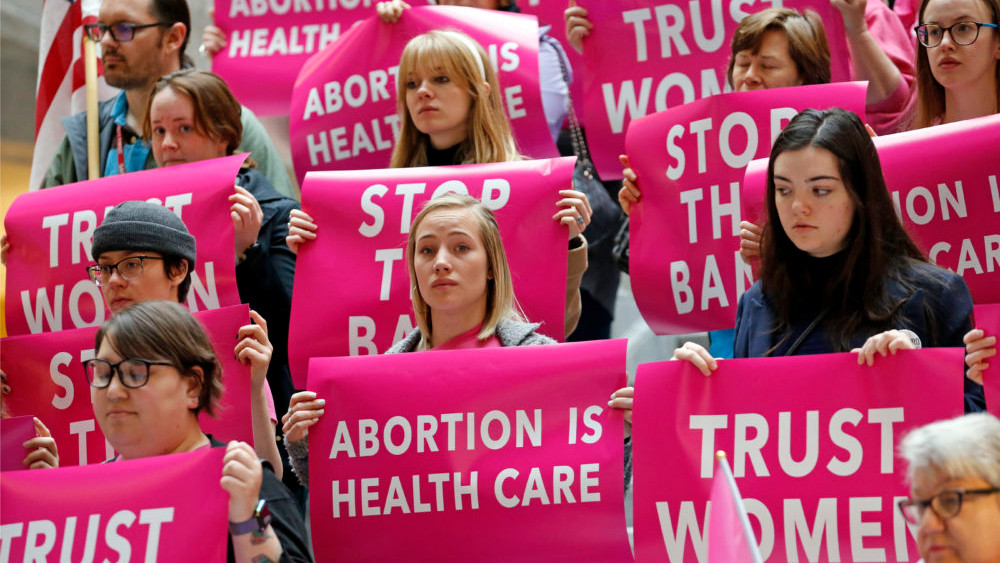
The debate remained heated in 2020, bringing clashing pro-life activists clad in black and pro-choice activists in pink to cleave the Capitol rotunda in a striking visual divide. Activists on both sides of the issue packed meeting rooms and presented emotional testimony in front of the committees.

On the Senate floor, debate also got personal.

Sen. Gayle Harrell, R-Stuart, spoke of the 4,000 babies delivered while her husband was an obstetrician. She said parents must be involved with “children having children” because minors cannot make such choices for themselves.

“We have delivered 13-year-old children having children,” Harrell said. “How can a 13-year-old make decisions … they can’t even decide what they are going to wear tomorrow. We need parents to be part of that decision.”

Sen. Bill Montford, D-Tallahassee, a former school principal, held up his own conservative leanings toward abortion with his experience with young, pregnant women confiding in him. He noted that not all parents are willing to put their daughters’ best interest first.

“I’m not sure there’s anyone in this room who has dealt with more young people facing this issue. This issue has been brought to my attention more than you could imagine” he said. “A young lady would say, ‘I am afraid of my parents.’ There are some parents who are not parents.”

Plantation Democrat Sen. Lauren Book, who filed a slew of amendments that failed during the bill’s first hearing, kept her comments short. She listed the medical associations that have come out against the bill, and emphasized, “My body, my choice. My voice, my vote,” she said. “Today, I’m going to use both.”

Of about 70,000 abortions done in the state yearly, about 1,500 are performed on minors. In 2018, 193 minors petitioned the court for a judicial waiver.

Stephanie Pineiro, president of Florida Access Network, a group that supports payment and logistics for abortions, said the judicial waiver process is not an easy one.

Pineiro first had an abortion when she was 16, after she was sexually assaulted at a party. Her father reluctantly took her to get the procedure after her mother wouldn’t go. He threw away her birth control after the family returned home, and their relationship deteriorated.

“He signed a notarized statement. Even though he didn’t agree, he didn’t have to consent or approve it,” she noted. Current Florida law requires that parents or guardians be notified in writing when their minor daughters seek an abortion.

Stephanie Pineiro, president of Florida Access Network, an opponent of SB 404, known as the “parental consent” bill, speaks at a press conference at the Capitol, Wednesday, Jan. 22, 2020, in Tallahassee, Fla. The bill requiring that girls under the age of 18 get a parent’s consent before having an abortion was approved Wednesday in its final committee stop. On Thursday, it was passed by the Senate. Aileen Perilla AP

The next year, when she was 17, Pineiro got pregnant again. Her boyfriend, who was 18, tried to buy her Plan B, an emergency contraceptive pill, but could not purchase it for a minor. She knew this time she had to hide the pregnancy from her parents, with whom she no longer had a stable relationship.

“I felt shame and that my parents would force me into parenthood,” said Pineiro, now 28. “I wasn’t ready for that.”

She called a hot line that set her up with a lawyer, and Pineiro built a case to show a circuit court judge in Duval County a compelling reason for allowing her the abortion. Three weeks after she learned she was pregnant, she had her abortion.

Pineiro said her judicial bypass gave her what she needed to keep attending high school and taking classes at Florida State College in Jacksonville.

Had she needed parental consent, she says she would have been forced into a situation that would have changed the course of her career path.

“Aside from its real purpose, which is to undermine abortion access in Florida and restricting the right to privacy, this impacts real people,” Pineiro said. “This impacts young people.”

Abortion in Florida has long been a controversial issue. Laws around access to abortions have regularly sparked dispute, even though the state’s courts have held that a broader right to privacy applies to a woman’s pregnancy in Florida.

In 1989, the state Supreme Court struck down a previous law requiring parental consent for abortion. In 2003, courts struck down a law requiring parental notification, but voters in 2004 approved a constitutional amendment to recreate a similar law.

In 2015, the Legislature passed a bill that would create a 24-hour waiting period before abortions. The law quickly became the subject of several court decisions and appeals.

Opponents have decried the bill as a “Trojan horse” that is meant to put the issue — protected in Florida by a constitutional right to privacy — before a more conservative state Supreme Court.

Not just opponents see it that way.

Sen. Joe Gruters, a Sarasota Republican who doubles as the state GOP chair, said the abortion bill will be the “first test” of the new Supreme Court, reshaped by like-minded DeSantis appointments.

“I think the abortion bill that will pass this year, parental consent, that’s directly attributable to the changing of the guard of the Florida Supreme Court,” he told the Herald/Times. “It will be interesting to see what happens after this year.”

Herald/Times Tallahassee Bureau reporter Emily L. Mahoney contributed to this report.

Source: https://www.miamiherald.com/news/politics-government/state-politics/article240035053.html?fbclid=IwAR3DYonVKaFlPwcJATq9pXajcko3XjyL2_eGsn08Lfd8AKBriZC7igqsEjA

On February 6, Republican lawmakers — with Governor Ron DeSantis’s blessing — moved forward on a draconian piece of anti-abortion legislation. It is all but certain that DeSantis will sign the parental consent bill and put into law the requirement that minors must obtain parental consent prior to obtaining an abortion.

Terrie Rizzo, chair of the Florida Democratic Party, blasted DeSantis and Republican lawmakers:

“Governor Ron DeSantis and Florida Republicans have just set into motion their plan to dismantle abortion rights in Florida. We know they will not stop with this bill, flimsily masked as a bill to protect children, in their desire to rob women of our rights to our own bodies.

As long as Republicans are in power, they work to take away abortion rights. The only way to protect the rights of women now is to vote the Republican party out of office in November and make DeSantis a one-term governor.”

Floridians Demand A Right To Privacy: In 1980, Florida voters created a state constitutional right to privacy. Nine years later, the Supreme Court of Florida ruled the state’s newly enacted parental consent law on abortion was unconstitutional — it violated our state constitution’s privacy rights.

In 2012, voters were asked to weaken their own rights on privacy and, unsurprisingly, flatly rejected the idea. Now the State Senate continues to move a new parental consent bill that Republican lawmakers’ hope will finally undo the will of the people. Floridians believe that women have the right to make decisions about their own bodies and our laws should reflect it.

Source: https://www.floridadems.org/news/the-republican-plan-to-dismantle-abortion-rights-in-florida-has-begun?fbclid=IwAR0V5Z83CXcJHhlHCKmbx9VqwGEgGTqn7ENDUALu0YuFFvvL9eCiDBmg1QQ

Anti-choice legislation advanced in Oklahoma and Arizona last week, and a Mississippi Republican proposed a bill even more extreme than the state’s near-total abortion ban.

The Oklahoma bill stipulates that a doctor would lose their license for one year if they’re found to have provided abortion care. Shutterstock

This week, we take a look at an Oklahoma bill that would punish doctors for providing abortion care, Arizona legislation to funnel taxpayer money to anti-choice groups, and a total abortion ban in Mississippi. 

Oklahoma 

The Oklahoma House passed legislation last Thursday that would strip doctors of their medical licenses if they provide abortion care. The bill’s sponsor called it part of the ongoing effort to end legal abortion in the state, the Associated Press reported.

The bill, HB 1182, stipulates that a doctor would lose their license for one year if they’re found to have provided abortion care, with an exception for when a patient’s life is at risk. The 71-21 vote to approve the bill came after four hours of debate, according to the AP. Oklahoma Rep. Cyndi Munson (D-Oklahoma City) called the anti-choice legislation “dangerous.”

The legislation, if passed by the state senate and signed into law by Gov. Kevin Stitt (R), is likely to face a court challenge.

Mississippi 

Less than a year after Mississippi passed a near-total abortion ban that’s been blocked by the courts, a Republican lawmaker has introduced a total abortion ban. According to the “Human Life Protection Act,” or HB 627, a physician who provides abortion care would be subject to up to two years in prison and $10,000 in fines.

The legislation shares a name with the total abortion ban passed by Alabama last year, and like that ban, it would end legal abortion, with an exception to prevent a serious health risk to the pregnant person. (The health risks would need to be confirmed by two doctors.) Rep. Randy Boyd (R-Mantachie) filed the legislation in the state house last Thursday, and it has been sent to the judiciary committee; the bill has no co-sponsors yet.

Arizona 

Arizona Republicans advanced a proposal to fund anti-choice organizations’ efforts to dissuade people from abortion care. The legislation, which was approved last week by committees in the state senate and house, promises $1.5 million dollars a year to set up a “family health pilot program” to “support childbirth as an alternative to abortion”

The legislation, SB 1328 and HB 3288, would require the department of health to contract with a nonprofit to run a statewide system to provide “direct services, support services, social services case management and referrals to the biological or adoptive parents of children under two years of age, including unborn children.” Money dedicated for the program “may not be used for abortion referral services or distributed to entities that promote, refer or perform abortions,” according to the bill.

A similar bill, pushed by the right-wing Center for Arizona Policy, failed in the senate last year after two Republicans opposed it. The center describes the proposal as similar to the Texas Alternatives to Abortion program, which gives taxpayer money to deceptive anti-choice pregnancy centers.

The legislation would also provide funds to maintain Arizona’s information and referral telephone line—on the condition that the service is barred from giving information about abortion, or referrals to any entity that provides abortion services. Although the service received only three calls in 2018 related to abortion, according to the Arizona Mirror, the Center for Arizona Policy and its allies in the legislature have blocked funding the last few years.

Michigan

In late January, Michigan House Rep. Beth Griffin (R-Mattawan) and 30 co-sponsors introduced a bill that would force doctors to tell patients about the unproven concept of “abortion reversal.” Such legislation is based on the medically dubious—and potentially dangerous—idea that a person can stop a medication abortion after they have already taken the first pill in the two-pill regimen.

HB 5374 is now in the house committee on families, children, and seniors. Michigan Gov. Gretchen Whitmer (D), a supporter of abortion rights, would likely veto the bill if it reaches her desk. Republicans control both chambers of the Michigan legislature.

Dr. Sarah Wallett, chief medical officer for Planned Parenthood of Michigan, said the idea is “pseudo-science, and it is a demonstrated danger to patients to even suggest it as a ‘reversal’ option,” in a statement to the Holland Sentinel.

“Legislators under the guise of helping women want to force physicians like myself to do something that (as a highly trained medical professional) I know to be harmful,” Dr. Wallett continued. “This is infuriating. Legally requiring physicians to lie to and endanger their patients is abominable.”

Lawmakers in five states (North Dakota, Nebraska, Oklahoma, Kentucky, and Arkansas) passed “abortion reversal” laws last year.

Source: https://rewire.news/article/2020/02/10/oklahoma-republicans-want-to-suspend-abortion-providers-medical-licenses-spotlight-on-the-states/

Fighting for the Right to Make Decisions About Your Own Body

Credit: Courtesy

As the 47th anniversary of Roe v. Wade approaches on January 22, our attention should be directed toward maintaining and enhancing reproductive and sexual health care that best addresses the needs of diverse people. Anti-abortion movement advocates and politicians anticipated the 1973 U.S. Supreme Court decision that legalized abortion, and the movement has successfully worked to create obstacles to both abortion care and contraception.

Roe itself, often shorthanded as providing “the right to choose,” faces significant threats. But reflecting on how we arrived at the current state of reproductive policy reveals that the crisis of access to reproductive care is widespread and experienced unequally. According to the Guttmacher Institute, an “unprecedented wave of bans” on abortion in 2019 resulted in 25 new laws, mainly in the South and Midwest. I advocate for defending Roe and intervening in the policies and practices that continue to erode this landmark decision and intentionally institute reproductive inequalities.

Historically in the U.S., reproductive- and sexual-health-care policies have been shaped by social, political, and legal contests over gender, class, race, sexuality, immigration, and religion. Abortion care may be legal, but for many women and girls, it is effectively inaccessible.

Some barriers have high media visibility, such as the 2003 federal law prohibiting a medical abortion-care procedure when then-President George W. Bush approved the Partial-Birth Abortion Ban Act. Also highlighted were the bombing of abortion clinics, the murder of doctors and clinic workers, and the installment of anti-abortion U.S. Supreme Court judges. But innumerable low-visibility practices and policies in many states curtailed abortion-care access, including a lack of abortion-care providers in many regions, insurance bans, government-mandated waiting periods, and medical procedure limitations. Low-income women and women of color are most affected by these constraints and have fewer resources to work around them.

A range of federal funding restrictions contribute to unequal access to reproductive information and care. The Global Gag Rule, established in 1984 as the Mexico City Policy, prohibits U.S. funding for organizations that provide or even discuss abortion. This logic is now applied within the U.S. to restrict Title X funding. The nonprofit Planned Parenthood and other holistic reproductive-care providers have turned down this federal funding to avoid complying with the silencing of abortion-care information. By so doing, they provide safe, legal, low-cost reproductive care.

Federal bans on Medicaid funding for abortion care, with exceptions to save the life of the pregnant woman or in cases of rape and incest, were established by the 1976 Hyde Amendment and are reenacted annually. The amendment also applies to women in the military, Native Americans, Alaskan Natives, federal prisoners, and Peace Corps employees, and it is meant to shrink the reach of Roe. A movement to repeal the Hyde Amendment has been led by women of color for decades, and in 2016, the Democratic National Committee Platform supported it. This is expected to be featured during the 2020 presidential election.

This is a critical time to resist policies that restrict reproductive options. Public health decision-makers, voters, and everyday women and girls, by joining coalitions, can raise their voices. Legal collaboration can look like the multistate coalition of 22 attorneys general, including California’s Xavier Becerra, who filed a December 2019 amicus brief in the U.S. Supreme Court. They support a constitutional challenge to a Louisiana law that requires abortion care providers to have local hospital admitting privileges; an identical Texas law was struck down by the Supreme Court in 2016.

Collaboration for women’s rights is also supported by reproductive justice advocates. The SisterSong Women of Color Reproductive Justice Collective defines reproductive justice as the human right to maintain personal bodily autonomy, have children, not have children, and parent the children we have in safe and sustainable communities. This framework requires that equitable policies be built by working from the grassroots with those who have the least access to reproductive health care. The Intersection of Our Lives, formed by the National Latina Institute for Reproductive Health; In Our Own Voice: National Black Women’s Reproductive Justice Agenda; and National Asian Pacific American Women’s Forum found in a 2019 poll that “84 percent of women of color voters believe that candidates should support women making their own decisions about their reproductive health.”

Reproductive justice, as a theory, strategy, and set of practices, acknowledges the decisions that women, men, gender nonbinary, and transgender individuals make about their bodies and lives, setting their options within families and communities. This framework mobilizes us to focus on how power operates: U.S. policies have not applied evenly to all people, and appeals to “choice” do not reach the majority of low-income women and women of color or address the disparities in our society.

Activists for reproductive justice, in coalition with allies, provide dynamic ways to enhance our reproductive rights and health. The personal and political stakes are high, and there are many ways to raise awareness of the threats to women’s rights and support reproductive justice. March, protest, lobby, educate, collaborate, and, above all, vote.

Laury Oaks chairs UC Santa Barbara’s Department of Feminist Studies.

Source: https://www.independent.com/2020/01/14/threats-to-roe-v-wade/?fbclid=IwAR2qJQDMkeQy9eHvpf9pSTmT1yRZJ6VRrR185ij2GuWjHRfKlgg0ehVTrd8

The answer: Republicans expect a conservative state Supreme Court will ignore precedent and uphold a parental consent law.

State Sen. Kelli Stargel, R-Lakeland, speaks during a Senate Rules Committee hearing regarding SB 404, known as the “parental consent” bill, at the Capitol, in January in Tallahassee. The bill requires girls under the age of 18 get a parent’s consent before having an abortion (Associated Press I Aileen Perilla) [AILEEN PERILLA | AP]

The Florida Senate is poised to approve legislation this week that would require minors to obtain parental consent before receiving an abortion — even though the Florida Supreme Court decided decades ago that restriction violates the Florida Constitution. Why pass legislation that is unconstitutional? Because Gov. Ron DeSantis and Republican lawmakers are confident the conservative justices who now dominate the court will ignore precedent and uphold an abortion restriction that will jeopardize the safety and health of some pregnant teenagers.

This assault on abortion rights is an election-year effort by Republican lawmakers to energize conservative voters without embracing more extreme restrictions. For example, legislation that would ban abortions after a fetal heartbeat is detected is not moving. But Gov. Ron DeSantis mentioned his support for the parental consent bill last month in his State of the State address. And the Senate, which last year stalled similar legislation that passed the House, is going first this time and expected to vote along party lines Thursday to approve SB 404. Expect a court fight, but don’t count on the Florida Supreme Court to protect the constitutional rights of pregnant teenagers this time.

This issue has been long settled. The Legislature passed a similar parental consent law in 1988, and a year later the Florida Supreme Court ruled it was unconstitutional and violated the state Constitution’s right to privacy. That privacy right has not changed. What has changed is the court is more conservative, and it has demonstrated it has no qualms about going off in a new direction. Already this year it has decided it was wrong for the court to consider the intent of the voters when evaluating constitutional amendments, and it concluded the court also was wrong to require juries to unanimously recommend death sentences.

There is no need for the state to interfere with this most personal of decisions. Florida already has a parental notification law, and there is no indication that the abortion rate is significantly rising. There were 12,000 fewer abortions in 2018 in this state than there were a decade ago, and more than nine of every 10 abortions were in the first trimester. Requiring parental consent will put more teenagers who do not have close relationships with their families in a more desperate situation.

The supporters of the legislation note pregnant teens who can’t seek their parents’ permission can seek a judicial waiver to obtain an abortion and that a lawyer may be appointed to represent them. But going to court can be intimidating for anyone, particularly for a teen who already is in crisis. Abortion rights supporters also point out that clerks for many circuit courts are not particularly prepared to help a teen inquiring about the judicial waiver process.

One by one, the Senate already has rejected virtually every change proposed by Democrats such as Sens. Janet Cruz of Tampa and Darryl Rouson of St. Petersburg that would have made the parental consent legislation marginally more workable. Expect Thursday’s debate to be vigorous, but don’t expect minds to change. This attack on abortion rights is on the fast track to the governor, who will sign it into law. The question is whether the conservative justices on the Florida Supreme Court will decide those rights are still protected by the privacy amendment to the state Constitution. What was once a given is no longer certain.

Source: https://www.tampabay.com/opinion/2020/02/03/why-would-the-florida-senate-approve-an-unconstitutional-abortion-restriction-editorial/?fbclid=IwAR2g7gE8LKtr5CDmDAoJWnCJmWau8k1w67yryA2F_MXtHTHDC3cm5ZWTS4s