From remaking the judiciary to repealing Hyde to removing the global gag rule, Trump’s successor has their work cut out for them.
Hogue-SCOTUSprotest_ap_img

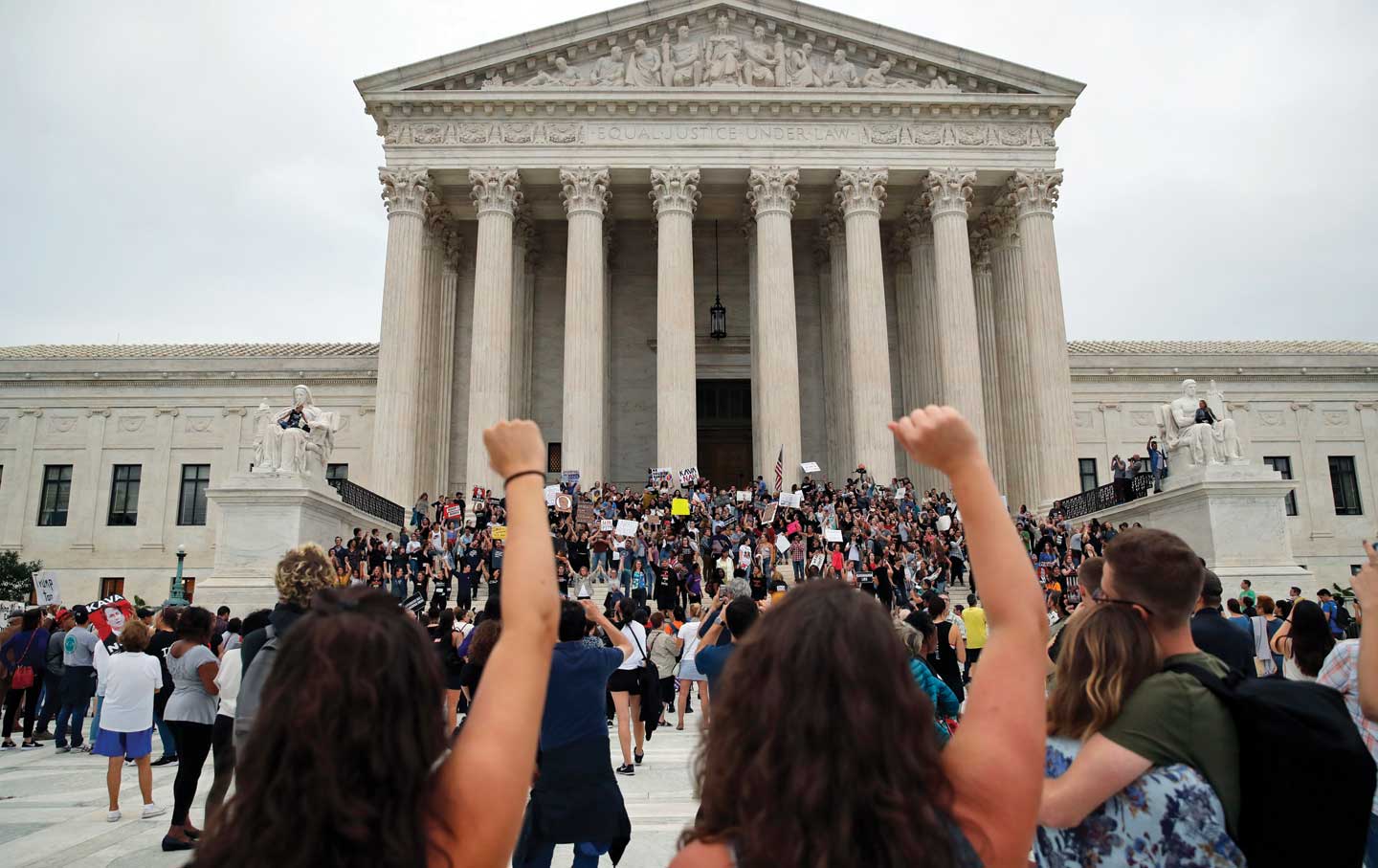
Supremely unjust: Protesters raise their fists outside the Supreme Court after the confirmation vote of Brett Kavanaugh, who was accused of sexual assault. (AP Photo / Alex Brandon)

In Los Angeles in early May, I woke up at 5:30 am to a barrage of texts and phone calls. The day before, the Alabama Legislature had passed a law banning abortion completely. This move came on the heels of the Georgia General Assembly criminalizing abortion after the sixth week of pregnancy. I was in LA with former Georgia gubernatorial candidate Stacey Abrams to talk to film industry leaders about how they could challenge that law, given their extensive investments in her state. The Alabama ban was a tipping point, and women across the country were rising in anger, frustration, and disgust over the attacks on our reproductive freedoms.

Among the calls were several from presidential contenders who wanted to put together plans to address the erosion of reproductive rights by the Trump administration and the state-level attacks that started years ago in the form of 20-week bans, mandatory waiting periods, forced ultrasounds, and much more. In all, 20 presidential candidates spoke out that day.

It hadn’t always been so. In 2016, when reproductive freedom and justice groups pushed debate moderators to ask then–presidential primary candidates Hillary Clinton and Bernie Sanders about the threats to reproductive rights as a part of the #AskAboutAbortion campaign, we were mostly dismissed by the media and the political elite. Despite the attacks on reproductive freedom that were well underway, many in the Democratic Party and the progressive movement didn’t understand the toll of these escalating assaults on the ability of women to access abortion, birth control, and prenatal care—not coincidentally, assaults that are primarily felt by poor women, rural women, immigrant women, and women of color. Given the complacency of many at the top, including in the media, only one question was asked about abortion rights during the primary debates—the very last one.

Clinton and Sanders were both pro-choice, so people scoffed, “Why should we waste our time on that?” Having our concerns minimized came as no surprise to those of us who do the work. We explained again and again that pro-choice values are great, but we expect plans.

To their credit, Clinton and Sanders didn’t shy away from the issue. When asked, they were aggressive in response, and as the nominee, Clinton led the charge to insert in the Democratic Party platform a call to repeal the Hyde Amendment, which prohibits federal funding for abortion services. Still, the conversation existed on the margins for most pundits and observers.

That brings us to today. Through fiat in the federal agencies and an unapologetic takeover of the judicial system, President Donald Trump has thrust the question of access to abortion—and all it represents about control and freedom—to the center of the 2020 presidential election.

So far, the Democratic field has risen to the occasion. Candidates have advanced explicit positions on abortion rights, and all the major ones support the repeal of the Hyde Amendment and the decades-long discrimination it embodies. That commitment was tested this year when Joe Biden reversed his stance on the issue—vowing to lift the ban on abortion funding for low-income women after quick and severe public criticism.

This progress is due to the painstaking work of those raising the alarm year after year, even when too few listened. In 2014, All Above All, a leader in the reproductive justice movement, began educating people on the evils of the Hyde Amendment and calling for its repeal. Six years ago Wendy Davis, then a state legislator, mounted her famous filibuster against Texas’s 20-week abortion ban. The backlash against that law was enormous, and it planted seeds of resistance against today’s bans. Legislators in the anti-choice movement knew their agenda was unpopular and that they were living on borrowed time. So they moved quickly and quietly to introduce bills designed to outlaw certain kinds of abortions, shame women out of choosing the procedure, and shut down clinics. These lawmakers used every trick available to jam these bills through, convening special legislative sessions and hijacking unrelated legislative efforts. In North Carolina, a bill to impose restrictions on abortion clinics was even attached to a motorcycle safety bill.

Trump’s victory heralded the end of this stealth approach. But as state-level bans sweep the nation, so does an awareness of what’s at stake. The vast majority of American adults—77 percent, according to a 2019 NPR/PBS NewsHour/Marist poll—support legal access to abortion, an increase even from last year. Support is overwhelming among Democratic voters, who have had it with the reproductive oppression enabled by misogyny. It’s undeniable that left and liberal candidates must take these issues seriously if they are to be competitive. People who understand that the freedom to access abortion is inextricably part of our fight for gender equity are marching and resisting in record numbers.

This is an inflection point, and it’s crucial to treat Roe v. Wade as the floor of what we need and not the ceiling. The next president will have massive challenges in digging our nation out of the hole we find ourselves in. Fortunately, the contenders for the Democratic nomination have some ideas. The crisis requires dedicated resources and attention, which would be part of Cory Booker’s call for a White House Office of Reproductive Freedom. The crisis requires nominating judges to all levels of the federal judiciary, including the Supreme Court, who would protect reproductive freedom, as promised by former candidates Kirsten Gillibrand and Beto O’Rourke and current contenders Pete Buttigieg and Julián Castro, among others. The crisis requires innovative thinking about the relationship between state and federal government, like the proposal put forward by Kamala Harris, whose plan models the preclearance process in the Voting Rights Act, stipulating that the most regressive states get permission from the Justice Department before a new abortion law takes effect. The crisis requires a health care plan that includes coverage of comprehensive reproductive care, like the one proposed by Bernie Sanders. And the crisis requires us to address the increased threats to and violence against abortion clinics, as proposed in Elizabeth Warren’s plan. And of course, the next president must push to codify Roe into statute; repeal the Hyde Amendment permanently; remove the global gag rule, which bars giving federal funds to any foreign health organization that provides abortion or even discusses it as an option; and reinstate Title X funding for Planned Parenthood and other full-service reproductive health care providers.

These plans—and the fact that several presidential candidates vowed during the Democratic debates to restore reproductive rights, even when they weren’t asked about them—are a good start. Still, all of that should be the minimum. To adequately confront this moment, we have to elect pro-choice champions. Congress will be instrumental in safeguarding our reproductive rights, and perhaps more than anything, we need a national leader who can convey with moral clarity and conviction what’s at stake. The Trump administration is a manifestation of a radical anti-choice movement’s deep misogyny and racism. Extremists in the White House have used this opportunity to move an anti-​science agenda and force their narrow moral code on all Americans. We need the exact opposite in our next president.

In a dystopian move, the Trump administration has tracked the periods and pregnancies of migrant women being held in Immigration and Customs Enforcement centers to prevent them from having abortions—a move that implicitly acknowledges the sexual violence experienced by these women on their travels and in detention. This White House has put people in charge of our family planning programs who do not believe in contraception and have pursued a strict abstinence-only, sex-shaming agenda. This administration moved funds away from Planned Parenthood and other comprehensive health care providers to fake clinics that lie about everything from abortion to contraception.

Of course, the crowning achievement of this administration is to install justices on the Supreme Court dedicated to gutting Roe and criminalizing abortion. The nomination of Brett Kavanaugh, who has been accused of multiple sexual assaults, to the nation’s highest court by a president who is an alleged serial sexual predator himself sent a clear message: We will have no rights to, no ability to feel safe in our own bodies. This president and the anti-choice movement that put him over the top in 2016 see our personal agency as something to gleefully extinguish.

This spring, emboldened by a president who said women should be punished for seeking abortion, Texas held a hearing on a law that would allow prosecutors to impose the death penalty on women who terminate their pregnancies. And in many states, women are fodder for test cases to establish the statutory rights of a fertilized egg over those of the person carrying it. In Alabama, Marshae Jones was charged with manslaughter after being shot in the stomach and losing her pregnancy. Although the charges were dropped, the message was clear: Our ability to reproduce can and will be wielded as a weapon to keep us in our place. Left unchecked, this is the future for all women, just as it is the present for the less powerful voices among them.

So therein lies the challenge. The mantle of leadership is not in seeking a return to a pre-Trump status quo that was already victimizing so many. It’s certainly not in treating the anti-choice movement as a benign force that we have a mild disagreement with. The leader we need will realize that he or she has a mandate to move policy that recognizes reproductive rights for what they are: the nucleus of gender equity and a fundamental guarantee without which women will never be free.

Source: https://www.thenation.com/article/abortion-trump-kavanaugh-hyde/

A gavel sits on a desk inside the Court of Appeals at the new Ralph L. Carr Colorado Judicial Center, which celebrated its official opening on Monday Jan. 14, 2013, in Denver. Photo by Brennan Linsley/AP

It’s not just the quantity of Donald Trump’s judicial nominees who’ve been confirmed by Senate Republicans; as regular readers know, it’s also the quality that’s striking.

Sarah Pitlyk, for example, received a “not qualified” rating from the American Bar Association, and the ABA’s rationale is quite persuasive: “Ms. Pitlyk has never tried a case as lead or co-counsel, whether civil or criminal. She has never examined a witness. Though Ms. Pitlyk has argued one case in a court of appeals, she has not taken a deposition. She has not argued any motion in a state or federal trial court. She has never picked a jury. She has never participated at any stage of a criminal matter.”

So why in the world did she get a judicial nomination from Donald Trump? It probably has something to do with Pitlyk being a Federalist Society member, a former Brett Kavanaugh clerk, and a fierce opponent of reproductive rights who’s argued that fertility treatments and surrogacy have “grave” adverse effects on society. Jennifer Bendery explained this week:

In private practice and as special counsel at Thomas More Society, Pitlyk established a clear record of attacking reproductive rights. She defended anti-abortion activist David Daleiden, who broke federal and state laws by secretly recording and deceptively editing videos that falsely claimed to expose Planned Parenthood’s illegal sale of fetal tissue. She defended Iowa’s six-week abortion ban that was later struck down as unconstitutional. In another case, Pitlyk argued that it is “scientific fact” that “human life begins at the moment when a human sperm fertilizes a human egg.” (It is not scientific fact.)

After losing that case, Pitlyk lamented that “the trial court’s judgment treated the embryonic children as inanimate objects, not human beings with the same interests as other unborn children.”

It’s against this backdrop that the Trump White House chose Pitlyk for a lifetime appointment to the U.S. District Court for the Eastern District of Missouri. This afternoon, the 42-year-old conservative was confirmed by the Republican-led Senate on a 49-44 vote.

Sen. Susan Collins (R-Maine) was the only Republican to oppose her nomination, and no Senate Democrats broke ranks to support her.

I’ve long believed the lasting effects of the Trump era can be boiled down to the three C’s: the climate, the nation’s credibility, and the federal courts. Health care benefits can be restored, alliances can be rebuilt, and tax breaks can be scrapped, but the lost years on dealing with the climate crisis are tragic; it’ll be a long while before the world forgets that we’re a country capable of electing someone like Trump; and with Republicans confirming young, far-right ideologues to the bench at a brutal clip, we can expect a generation’s worth of conservative court rulings.

Postscript: For those keeping score, as of this afternoon, the GOP-led Senate has confirmed 120 of Trump’s district court nominees, 48 of his circuit court nominees, and two of Trump’s Supreme Court nominees. (These figures have been corrected since original publication.)

Source: http://www.msnbc.com/rachel-maddow-show/gop-confirms-fierce-opponent-reproductive-rights-federal-bench

A study examining 17 years of patient data has found absolutely no evidence that having an abortion increases the risk of suicide, despite many women being told the opposite.

Examining years of data collected from over half a million women in Denmark, researchers conclude that heightened suicide attempts are not caused by abortion. Instead, pre-existing health issues, like the use of psychiatric services and anti-depressants, are far better at predicting suicide risks.

“The view that having an abortion leads to suicidal thoughts, plans, or even suicide attempts has been used to inform abortion policies in some regions of the world, particularly laws requiring women seeking the procedure be informed of this view,” says reproductive health scientist Julia Steinberg from the University of Maryland.

“The evidence from our study does not support this notion.”

Nevertheless, in many places, doctors are obliged to tell patients unvalidated information about abortion’s negative psychological or emotional effects, which can include that it increases the risk of having suicidal thoughts.

The warning is based on studies fraught with limitations and flaws, and in recent years, several researchers have tried to reproduce these findings with more rigorous methods.

Instead of looking simply at mental health after an abortion, the new studies compared mental states before and after, while also accounting for histories of psychiatric illnesses and other confounding factors.

Last year, a five-year analysis of nearly 1,000 women found that levels of suicidal ideation were similarly low among those who had abortions and those who were denied abortions.

At the same time, it also revealed that women who seek abortions at a later gestational age are at no higher risk of suicidal thoughts. Instead, the authors say a history of mental health conditions and intimate partner violence are much more predictive.

“Policies requiring women to be warned that they are at increased risk of becoming suicidal if they choose abortion are not evidence based,” the study concluded.

Other reviews on the safety and efficacy of abortion have also found it does not increase the risk of depressionanxiety, or post-traumatic stress.

The most recent research from Denmark draws upon a particularly long data bank with its 17 years’ worth of patient records, and it once again agrees with the previous results. Using data from national patient registries, it examined non-fatal suicide attempts and self-harm among women with first-time abortions in the first trimester.

Unlike previous research, which failed to consider prior mental health issues and the downsides of self-reporting on abortion and suicide, the new study follows its patients from the year before the abortion to the year after.

Adjusting for age, year, the history of childbirth, mental health, physical health, and socioeconomic status, the team concluded abortion could not be causing or increasing the risk of suicide attempts.

“When we examined the monthly incidence rates of suicide attempts in the year before and after an abortion for all women who had an abortion,” the authors write, “women with a previous psychiatric contact, and women with no previous psychiatric contact, we found no changes in incidence rates from the year before to the year after the abortion for all three groups.”

To be fair, the study did not look at the effect of later abortions or multiple abortions on mental health, but the findings suggest that at least in the case of early first abortions, suicide is not a risk stemming from the procedure.

The authors argue any policies based on that notion are therefore “misinformed”.

“The increased risk of non-fatal suicide attempts in women who have had an abortion might be related to other co-occurring risk factors around the time of the unwanted pregnancy and abortion, such as intimate partner violence, unstable relationships, or other negative life events, for which Steinberg and colleagues could not adjust,” explains social and behavioural scientist Jenneke van Ditzhuijzen from the University of Amsterdam in the Netherlands, who was not involved in the study but is the author of a commentary published alongside it.

“This does not mean that having an abortion is an indication that women are going through a difficult time, or that the symptoms of mental disorders are attributable to the abortion, but rather that some women are at an elevated risk of multiple adversities at a certain period in their life, which could include an unwanted pregnancy and abortion.”

The study was published in The Lancet Psychiatry.

Source: https://www.sciencealert.com/women-are-being-fed-false-information-about-abortion-and-suicide?fbclid=IwAR2y4ROfB0I2A7EYuIROeK8KT_gZE0Qqw3DbqGMCnpX6IHVeUU3cVWR0dN8

Just under 30 amicus briefs were filed for June Medical Services v. Gee on Monday, urging the Supreme Court to protect access to abortion and strike down a Louisiana law that could effectively eliminate abortion in the state. The “friend of the court” briefs represented about 200 organizations and more than 700 individuals.

Though many of the briefs came from pro-abortion rights advocates like Planned Parenthood and the American Civil Liberties Union, a handful came from non-partisan groups including the American Bar Association, the American Medical Association, the American College of Obstetricians and Gynecologists and the American Academy of Pediatrics. Medical groups argued that the law in question – which requires doctors providing abortions to have admitting privileges at a nearby hospital – is medically unnecessary, while legal scholars wrote that there is already precedent that covers the issue: the 2016 Supreme Court decision in Whole Woman’s Health v. Hellerstedt that struck down a similar law out of Texas.

Religious groups, representing Christian, Muslim and Jewish communities, also submitted amicus briefs Monday, arguing that “religious traditions recognize women’s moral right to decide whether to terminate a pregnancy.”

“This diverse and unprecedented array of expert voices, individual women, and advocates paints a compelling portrait of the immense stakes in this case,” said Nancy Northup, president and chief executive officer of the Center for Reproductive Rights. “It’s clear that support for abortion access and the rule of law spans all political parties, all professions, and all walks of life.”

In Whole Woman’s Health v. Hellerstedt, 45 amicus briefs were filed in opposition to Texas’s admitting privilege law. Amicus briefs supporting Louisiana’s law are due on January 2.

“It is hypocritical for abortion providers and their supporters to claim the lawsuit is helping women when its end goal is to decrease the standard of care women receive from Louisiana abortion providers who have a long documented history of medical malpractice, disciplinary actions, and violations of health and safety standards,” said Louisiana Solicitor General Liz Murrill in an email to CBS News on Tuesday.

Last week, the Supreme Court announced it would hear oral arguments for June Medical Services v. Gee on March 4, 2020, devoting an entire day to it.  At the center of the case is Act 620, Louisiana’s “Unsafe Abortion Protection Act,” a 2014 state law not currently in effect. Similar to the Texas law that was struck down by the Supreme Court in 2016, Louisiana’s law requires doctors performing abortions to have admitting privileges at a hospital no more than 30 miles away. If the law is allowed to be implemented, all of Louisiana’s abortion clinics would close, as first reported last month by CBS News.

June Medical Services v. Gee is the first abortion-related case to be heard by the Supreme Court since the appointments of conservative Justices Neil Gorsuch and Brett Kavanaugh.

Last week, the Center for Reproductive Rights (CRR), the law firm representing June Medical, filed its opening brief, the first of four to be filed ahead of oral arguments. CRR outlined its argument against Act 620, identifying two reasons why it believes the regulation should be struck down by the high court. First, CRR argued that since the Supreme Court struck down the same type of restriction in Whole Woman’s Health v. Hellerstedt in 2016, Louisiana’s restriction should also be deemed unconstitutional. Second, the law in question “is unconstitutional even assuming the burdens here are less than in Whole Woman’s Health,” according to the brief.

Previous Supreme Court precedent says abortion restrictions cannot create an “undue burden” for women seeking the procedure.

Louisiana’s opening brief is due December 26.

Source: https://www.cbsnews.com/news/abortion-supreme-court-case-amicus-briefs-filed-for-june-medical-service-v-gee-louisiana-abortion-case-2019-12-03/?fbclid=IwAR05LKn1gIIP0lOt6Vln5Rh7CE0DrrQPGYRm_YkZagr81IurcccstIIJFbg

Women often required to visit multiple clinics for routine procedures, says report

The Better for Women report calls for a reshaping of fragmented NHS systems. Photograph: Alamy Stock Photo

One-stop shops should open in the high street, where women can go to get contraception, screening services, menopause advice and help with other health needs, while the morning-after pill should be sold off the shelf without consultation, say leading UK experts.

The Royal College of Obstetricians and Gynaecologists, which has been working on a blueprint for women’s health services for more than a year in conjunction with other groups and government, says services for women need to be completely overhauled to give them far more control over their health.

Its report launched today in the House of Commons, called Better for Women, says women with busy lives struggle to get the healthcare and advice they need. It sets out a strategy for reshaping the present fragmented NHS systems that require women to see different nurses and doctors in a variety of specialised clinics, as well as their GP practice, for procedures that should be routine.

A survey of 3,000 women shows that large numbers find it hard to get advice and care near home. More than a third (37%) said they could not get contraception services locally and 60% could not easily access unplanned pregnancy services, including abortion care.

The all-time high level of abortions is connected to the unmet contraceptive needs of women, says the report. In 2018, there were 200,608 abortions across England and Wales – an increase of 4% on the previous year.

Over a third (34%) of women did not attend their last cervical cancer smear test, the survey shows. Only half had locally available sexually transmitted infection services, 56% struggled to get help for painful periods and 58% could not get menopause services locally.

It’s not just special pleading for women, said Lesley Regan, president of the college. Many are carers and mothers and they influence the healthcare behaviours of everyone else. “If you get it right for women, you get it right for lots of other people,” she said.

Many of the services women need are preventive, such as cancer screening and contraception. Many are paid for from the public health budget, through local authorities, and have been cut because of the 40% reduction in that budget, said Regan.

“Women are falling through the cracks of very basic services that should be very easy to prevent or access,” she said. “This is not rocket science. We are not suggesting an expensive new solution. We’re just saying we need to think about women across their life course because so many of the things that affect women, for which they need the NHS, are predictable.

“We’re not delivering what women need where they need it,” she said. A smear test, contraception and an STI check could all be done by the same person in 15 minutes, she said. “But at the moment, girls and women are being pushed around from pillar to post because a nurse or the health practitioner or the GP that they visit hasn’t got the commission to actually do the other things as well.”

Some 45% of pregnancies are now unplanned, she said. “What we do know is that when they’re not planned, they have much more complex outcomes often, and that means they are more expensive to deliver, and we see the abortion rate is not going up in girls – the teenage-pregnancy strategy has worked very well – it’s in the 40-year-olds who can’t access contraception.”

Women should not have to go back to the GP for a new prescription for the pill every three months when it has been heavily researched for the last 60 years. “It’s far more dangerous to get pregnant than it is to be on the pill,” she said. Girls and women should be able to get the very safe progestogen-only pill from a pharmacist or online, the report says. The morning-after pill should be sold straight off the shelf without the need to speak to a doctor or pharmacist.

The report says all young people should be educated from an early age about women’s health, and health issues such as the support during menopause should be embedded in workplace policies.

The college says the changes would save money by enabling women to stay in better health. Sexual health experts from the faculty of sexual and reproductive healthcare and the Royal College of Midwives (RCM) voiced support.

Gill Walton, chief executive of the RCM, backed its findings, including those on abortion, which she said should be regarded as just another medical procedure. “This is an important report that puts women at the centre of health improvement that needs governments and those running our health services to take notice. Our whole health service needs to focus much more on prevention of ill health, and to invest in our health and social services to support that,” she said.

Source: https://www.theguardian.com/society/2019/dec/02/one-stop-shops-needed-for-womens-health-services

If we’re only fighting to codify Roe—and not to address the racist, classist disparities that have failed to make the full spectrum of reproductive health-care services a reality for so many—then we’re leaving people behind.

Unsurprisingly, political representation for women changed the game, as moderators finally asked detailed questions about abortion and reproductive rights, such as whether candidates think there is room in the Democratic Party for anti-abortion Democrats.
Alex Wong / Getty Images

Last week, for the first time this election cycle, all of the moderators at a presidential debate and almost half of the participants on stage were women. Unsurprisingly, political representation for women changed the game, as moderators finally asked detailed questions about abortion and reproductive rights, such as whether candidates think there is room in the Democratic Party for anti-abortion Democrats. Additionally, Sen. Amy Klobuchar (MN) was asked whether she would intervene as president if Roe v. Wade were overturned by the U.S. Supreme Court, and states were allowed to outlaw abortion as a result.

Klobuchar’s promise to codify Roe into federal law was met with resounding applause from the audience in Atlanta, where Gov. Brian Kemp (R) signed a six-week abortion ban into law earlier this year. Codifying Roe has become an increasingly popular campaign promise in the Democratic field at a time when the president has put into place Supreme Court justices who are expected to overturn the precedent and many states are peddling one extreme abortion ban after another. But with so much at stake, it’s critical that Democratic presidential candidates recognize enacting a federal law to keep abortion legal must be the floor, not the ceiling.

Since 1973, the precedent of Roe has meant abortion access is dependent on socioeconomic status and ZIP code. As a result of the more than 1,200 state and federal laws that have been enacted since Roe—over a third of which were enacted in the last decade alone—abortion access has been decimated, even though abortion is still legal. One major hurdle to unfettered access to abortion is the Hyde Amendment, a federal budget rider that since 1976 has banned Medicaid insurance from covering abortion and rendered abortion a privilege based on income. Hyde, like the many state-level laws that similarly restrict insurance coverage of abortion, unjustly affects women of color. Due to a complicated “perfect storm” of racism, discrimination, and economic inequality, women of color are disproportionately enrolled in Medicaid and are therefore more likely to be harmed by Hyde than their white counterparts.

Our next president must do so much more than protect a legal precedent that simply does not function as it should to ensure each of us can access the health care we need. Democratic presidential candidates must challenge restrictions like Hyde, and promise to proactively ensure coverage for abortion and all reproductive health care. Further, more than simply promise to end Hyde, candidates should offer specific plans for how they would do so, and make it clear that they would not compromise on this in pursuit of policy gains in other areas.

Candidates must also take action on other existing state laws—from mandatory waiting periods, to parental involvement requirements, to mandated anti-choice counseling, to explicit abortion bans, to targeted regulations of abortion providers (TRAP) laws. These state laws block access to health care, stigmatize abortion, and punish and endanger anyone who may need an abortion but is marginalized by our health system. This includes people struggling financially, women of color, young people, immigrants, transgender men, and non-binary people.

And candidates must outline comprehensive plans to achieve real abortion access for all, and they should be asked about them at every debate.

We already know the toll of Democrats’ inaction and passively playing defense, all while anti-choice extremists enact barrier after barrier on reproductive rights. Georgia, where last week’s debate was held, has the highest maternal death rate in the nation, and it is especially high for Black women. When politicians block access to crucial health care like abortion and other reproductive health services, low-income people, and especially women of color, are the ones who pay the price. And if we’re only fighting to codify Roe—and not to address the racist, classist disparities that have failed to make the full spectrum of reproductive health-care services a reality for so many—then we’re leaving people behind.

The threat of losing Roe is serious. If the precedent is overturned in the coming years, both patients and abortion providers could face criminalization and many other dangerous, costly outcomes. And we know that means women of color would likely be targeted most harshly. We must fight to protect Roe—but we must also fight to expand it.

Since 1973, economic barriers, as well as other geographical and identity-based restrictions, have reduced abortion rights to the theoretical for far too many people. With the coming elections, we have the chance to fight for so much more than the status quo: We have a real opportunity to fight for reproductive justice for all. And we need to elect a president who’s going to lead the way, and seize that opportunity.

Source: https://rewire.news/article/2019/11/27/codifying-roe-isnt-a-plan-to-ensure-abortion-access/

Ohio introduces one of the most extreme bills to date for a procedure that does not exist in medical science

Ohio abortion law: the Ohio governor, Mike DeWine, signs the ‘heartbeat bill’, one of the nation’s toughest abortion bans, on 11 April 2019.

Ohio abortion law: the Ohio governor, Mike DeWine, signs the ‘heartbeat bill’, one of the nation’s toughest abortion bans, on 11 April 2019. Photograph: Fred Squillante/AP

A bill to ban abortion introduced in the Ohio state legislature requires doctors to “reimplant an ectopic pregnancy” into a woman’s uterus – a procedure that does not exist in medical science – or face charges of “abortion murder”.

This is the second time practising obstetricians and gynecologists have tried to tell the Ohio legislators that the idea is currently medically impossible.

The move comes amid a wave of increasingly severe anti-abortion bills introduced across much of the country as conservative Republican politicians seek to ban abortion and force a legal showdown on abortion with the supreme court.

Ohio’s move on ectopic pregnancies – where an embryo implants on the mother’s fallopian tube rather than her uterus rendering the pregnancy unviable – is one of the most extreme bills to date.

“I don’t believe I’m typing this again but, that’s impossible,” wrote Ohio obstetrician and gynecologist Dr David Hackney on Twitter. “We’ll all be going to jail,” he said.

An ectopic pregnancy is a life-threatening condition, which can kill a woman if the embryonic tissue grows unchecked.

In addition to ordering doctors to do the impossible or face criminal charges, House Bill 413 bans abortion outright and defines a fertilized egg as an “unborn child”.

It also appears to punish doctors, women and children as young as 13 with “abortion murder” if they “perform or have an abortion”. This crime is punishable by life in prison. Another new crime, “aggravated abortion murder”, is punishable by death, according to the bill.

The bill is sponsored by representatives Candice Keller and Ron Hood, and co-sponsored by 19 members of Ohio’s 99-member House.

Mike Gonidakis, the president of the anti-abortion group Ohio Right to Life, declined to comment on the bill, and said he was still reading the legislation because, it’s “approximately 700 pages long”. He said his office is “taking off the rest of the week for Thanksgiving”.

The Guardian also contacted the Susan B Anthony List, a national anti-abortion organization. The organization did not reply to a request for comment.

Keller, Hood and eight of the bill’s 19 co-sponsors did not reply to requests for comment. The Ohio Prosecuting Attorneys Association also did not reply to a request for comment.

Ohio passed a six-week abortion ban last summer. The “heartbeat bill”, as supporters called it, banned abortion before most women know they are pregnant. Reproductive rights groups immediately sued, and the bill never went into effect. Abortion is legal in all 50 US states.

In May, researcher Dr Daniel Grossman argued reimplanting a fertilized egg or embryo is “pure science fiction” in a Twitter thread that went viral in May, when the bill was first introduced.

“There is no procedure to reimplant an ectopic pregnancy,” said Dr Chris Zahn, vice-president of practice activities at the American College of Obstetricians and Gynaecologists. “It is not possible to move an ectopic pregnancy from a fallopian tube, or anywhere else it might have implanted, to the uterus,” he said.

“Reimplantation is not physiologically possible. Women with ectopic pregnancies are at risk for catastrophic hemorrhage and death in the setting of an ectopic pregnancy, and treating the ectopic pregnancy can certainly save a mom’s life,” said Zahn.

Source: https://www.theguardian.com/us-news/2019/nov/29/ohio-extreme-abortion-bill-reimplant-ectopic-pregnancy?CMP=share_btn_fb&fbclid=IwAR2862_gWbIqyD927FOc6ZThI9_csxyShFXth6zLaeBxtF9cdlilLAqDsHY

Almost half of UK abortions in 2018 were not the woman’s first. Rebecca Reid asks why a second abortion comes with more stigma than the first.

There was shock from all corners of the internet today, at research that found that a small number of UK women have had more than six abortions in their lives. The research was presented without any extenuating circumstances about these women, nor explanations about their lives and the coverage, which has been barely concealed horror, belies the enduring stigma that comes with having had more than one abortion.

As with so much of my education about the adult world, it wasn’t until the episode of Sex and the City where Carrie wrestles with telling Aidan that she had an abortion in her twenties, that I realised having more than one abortion was even possible.

‘I’ve had two,’ says Samantha, as they sit around the table discussing who has and who hasn’t had one before. It was the only thing Samantha Jones, famous for discussing semen and sex swings, ever said that shocked me.

The idea that abortions should be a one-off occurance seems to be pervasive across the board. Imogen, 28, tells Grazia: ‘I had an abortion in my mid-twenties and regretted nothing. But when I had a pregnancy scare a year later (a false alarm) I thought, almost before I realised I was thinking it, I have to have this baby because I can’t have two abortions. Because it was a false alarm I never had to make the decision, but I know that not wanting to have ended two pregnancies would have been part my thought process, which is ridiculous because I am pro choice.’

‘I felt fine about my first abortion’ says Daisy, 30. ‘I was a teenager, I was at school, it seemed like a no brainer that I shouldn’t become a mum. But then I got pregnant again in a long term relationship in my late twenties and I felt like I should have known better. I was on the pill and it was a freak accident, but I still felt like the most irresponsible person in the entire world. I didn’t want to tell the people at my appointment that this was my second one, as if they were going to think that I was stupid. I even found myself thinking of the word “slutty”, something I would never say to anyone out loud.’

Despite the entrenched stigma of having more than one abortion, multiple abortions are extremely common. Last year in the UK 84,258 abortions took place. That’s not far off half of the UK total (205, 295). So why is admitting to having had two abortions so much more shocking than having had one?

There are still all sorts of internalised rules about having an abortion. If you’re very young, single or a rape victim then you’re having the ‘good’ kind of abortion. If you’re lax with your contraception, old enough to look after a baby or on your second abortion, it’s the ‘bad’ kind.

In reality, the most common age range to seek an abortion is 25-29, and 20% of women who have had an abortion are married at the time. 56% of women who have an abortion have already had at least one child.

Alongside misconceptions about who has abortions, there is a ‘fool me once’ sort of attitude, which makes one abortion acceptable while two or more carries an enormous stigma. As women we’re allowed to make one mistake, but making two takes it away from the realm of mistake and into the arena of irresponsibility.

Until I watched that episode of Sex and the City, I had subconsciously assumed that women who had abortions were so chastised by the whole experience that they should swear off sex until they were ready to give their husband 2.4 children. But that’s just not how it works. Women go back to having sex after abortions, and sometimes accidents happen. Two in every 100 condom usages fails, the pill isn’t foolproof and the morning-after pill only really works if you’re yet to ovulate. There is also the fact that women are subjected to rape and reproductive coersion.

If you’re sexually active for a long period of time, the chances of you having an unplanned pregnancy more than once aren’t exactly negligible.

I dislike my own shock towards people who discuss having had multiple abortions, because I know where it comes from. It’s a deeply repressed well, mostly filled up during my Catholic education, which believes on some level that abortions are punishments for having extra-martial sex, and that getting pregnant means you are irresponsible. I, like so many women, still struggle to shake the shame associated with ending an unplanned pregnancy.

It’s easy to feel that we’ve finished destigmatising abortion, because famous women talk openly about having them and they’re broadly speaking avalible to women in the western world. But that’s not the case.

Abortion is not the preferable way to manage pregnancy because it is invasive, time-consuming and painful, but it is an essential aspect of female reproductive healthcare, and whether you have had one, two or five, it should remain a choice, and a choice made free from judgement and stigma.

Source: https://graziadaily.co.uk/life/in-the-news/multiple-abortions/?fbclid=IwAR3QfyOKZSPHGbesAxUCYxzpCaQXUjCkfQjc9hcF-yd9QptKmLwuxVj4cU8

Activists said to serve the people most affected by abortion restrictions, the Atlanta Reproductive Justice Commission will have to tackle ways to make health care more accessible.

[Photo: City hall sign near state capitol building in Georgia,]

The Atlanta City Council approved a resolution last week to create a Reproductive Justice Commission designed to mitigate the effects of the state’s near-total ban, which outlaws abortion care six weeks into pregnancy. Andriy Blokhin / Shutterstock.com

Atlanta officials are seeking ways to improve access to reproductive health care for the city’s most marginalized, six months after Georgia Republicans passed an unconstitutional six-week abortion ban.

The Atlanta City Council approved a resolution last week to create a Reproductive Justice Commission designed to mitigate the effects of the state’s near-total ban, which outlaws abortion care six weeks into pregnancy, before many know they’re pregnant. Georgia is one of several states with Republican-majority legislatures that passed a near-total abortion ban this year.

The Georgia law was temporarily blocked by a federal judge in October.

The Atlanta commission will research policy and recommend ways to “increase awareness around access to reproductive care as well as public and private resources.” It will focus on how to improve health outcomes “related to reproductive, maternal and infant health, and abortion access in Atlanta.”

Council member Amir Farokhi, who introduced the Reproductive Justice Commission resolution, said Atlanta’s charter does not allow the commission to “get involved with public health or social service work,” since that is the county’s purview. Instead, the commission can examine zoning and potential improvements to transit routes and locations for reproductive health-care facilities. The commission, Farokhi said, could also make sure city workers have access to reproductive health care.

Although the Atlanta Reproductive Justice Commission may point out opportunities for better funding of reproductive health-care services, there will be no public funds allocated to the commission, Farokhi said.

Kenyetta Chinwe, a project coordinator for the Atlanta-based reproductive justice group SisterSong, said to better serve the people most affected by abortion restrictions, the commission will have to tackle ways to make health care more accessible.

“People who are marginalized and disenfranchised from society are already feeling the effects of access to health care in general and reproductive health care,” Chinwe said. “Georgia has a high maternal mortality rate, and that disproportionately affects women and trans and nonbinary people of color in the state, so any time you implement something that is going to restrict health care it’s going to impact the groups already affected.”

Atlanta is a majority Black city. Four percent of the population is Asian, and 4.6 percent are Latinx, according to the U.S. Census Bureau. In 2015, Gallup found Atlanta had the 19th highest LGBTQ population among major metropolitan areas, at 4.2 percent of the population. Twenty-two percent of people in Atlanta live in poverty, compared to 12.3 percent across the United States.

High rates of maternal death for Black women in Georgia are at a crisis level, and reproductive justice activists say abortion restrictions and other barriers to health care only exacerbate the problem. The maternal mortality rate for Black women in Georgia is 66.6 deaths per 100,000 live births, compared to 43.2 for white women. Georgia has the highest maternal mortality rate in the United States. Research shows that states with more abortion restrictions have worse health outcomes for parents and children, and that racism can play a motivating role in these restrictions, according to a 2018 Center for American Progress report.

Atlanta is the latest city to push back against Republican-backed near-total bans on abortion. City councils in  ToledoCleveland, and Columbus have passed resolutions opposing Ohio’s near-total ban. Meanwhile, local officials in states like New Mexico and Texas have passed anti-choice resolutions that reproductive rights advocates say could confuse those seeking abortion care.

The Atlanta commission is supposed to ensure marginalized groups have a say in the recommendation process. The commission, which will meet for three years, will have seven members. Two will be appointed by the mayor, one by the district health director of the Fulton County Board of Health, one by the council president, and the rest by council members from districts across Atlanta. None of these appointments had been made by the time Rewire.News spoke to Atlanta officials.

“It’s important that those appointees are knowledgeable about reproductive justice and health-care issues but also demographically representative of the populations most affected. A lot of this is up to politics. People will appoint who they want to appoint and we’ll see how this plays out,” Farokhi told Rewire.News. “But my sense is that at least the members of council who care about this issue are likely to choose someone under the guidelines in the resolution. We’ll be very mindful that the commission is appropriately diverse [and has] representatives of everyone who is affected by this issue.”

Advocacy groups, including SisterSong, approached Farokhi after he introduced a resolution in May opposing the state’s near-total abortion ban. SisterSong is part of the Amplify campaign, a project of six Georgia-based reproductive justice organizations to advocate for the protection and expansion of abortion access.

“We will do our best to advocate and make sure there are community members on the commission as well as people who have the best interest at heart for the most marginalized in the city,” said Chinwe, SisterSong’s project coordinator for Amplify Georgia.

Beyond the blocked near-total abortion ban, Georgia has a long list of abortion restrictions. Patients are required to receive counseling that aims to discourage them from having an abortion and wait 24 hours before receiving an abortion; an abortion must be performed before 20 weeks post-fertilization; there is a forced parental notification requirement; and health plans under the state exchange for the Affordable Care Act—also known as Obamacare—can only cover abortions in the most severe health cases. Abortion is only covered in insurance policies for public workers when the life of the pregnant person is in danger.

Farokhi said the commission’s goal of increasing awareness of reproductive health-care options is particularly important in the South, where abortion clinics have closed due in part to medically unnecessary anti-choice laws designed to shutter facilities.

“Often times, because the legislative steps taken by [the] Republican legislature have been fairly draconian and being near a major city, there’s either confusion or absence of knowledge that there are reproductive health-care resources available in the state,” he said. “So we have to make sure that one, people know that abortion is legal and that two, you have access to it in Georgia in a number of different manners.”

He said it was important for Atlanta to lead on this issue as the capital of the state, the state’s most populous city, and “the economic and cultural hub of the Southeast.”

“I think there is symbolic importance of Atlanta placing a flag in the sand on the side of access to health care and to women’s bodily autonomy and bodily autonomy generally regardless of gender,” Farokhi said.

Source: https://rewire.news/article/2019/11/26/atlanta-wants-to-blunt-the-impact-of-georgias-near-total-abortion-ban/

President Trump speaks next to Brett M. Kavanaugh at a ceremonial swearing-in at the White House on Oct. 8, 2018. (Jim Bourg/Reuters)

It was a historic moment in April 2017 when Supreme Court justice Anthony M. Kennedy presided over the ceremonial Rose Garden swearing-in for the court’s new member, Neil M. Gorsuch: the first time a sitting justice was joined on the nation’s highest court by one of his former law clerks.

But a secret meeting moments later in the White House was just as significant, according to a new book by Ruth Marcus, a Washington Post deputy editorial page editor.

Kennedy requested a private moment with President Trump to deliver a message about the next Supreme Court opening, Marcus reports. Kennedy told Trump he should consider another of his former clerks, Brett M. Kavanaugh, who was not on the president’s first two lists of candidates.

“The justice’s message to the president was as consequential as it was straightforward, and it was a remarkable insertion by a sitting justice into the distinctly presidential act of judge picking,” Marcus writes in “Supreme Ambition: Brett Kavanaugh and the Conservative Takeover.”

Kennedy announced his retirement 14 months later, after Kavanaugh’s name indeed had been added to Trump’s public list of potential Supreme Court picks. But if the octogenarian Kennedy was envisioning an orderly succession, what the nation got instead was one of the most wrenching, contentious and closest Supreme Court confirmation battles in history.

Kavanaugh’s career-long ambition was nearly derailed by allegations from California professor Christine Blasey Ford that a drunken teenage Kavanaugh had assaulted her at a party in the Washington suburb where both grew up. There were additional reports about Kavanaugh drinking to excess while a student at Yale and exposing himself.

Kavanaugh vehemently denied the accusations and said they were part of a hit job orchestrated by Democrats and liberals desperate to sink his nomination and keep the court from having a conservative majority.

Marcus’s book, to be published Dec. 3, is at least the fifth to examine Kavanaugh’s nomination and confirmation. It does not attempt to prove or undermine the allegations against him, although she interviewed Ford and Debbie Ramirez, a contemporary of Kavanaugh’s at Yale, who said he exposed himself to her at a drunken party. Kavanaugh is not quoted in the book, and Marcus does not write that she talked to him.

“Supreme Ambition” is more focused on the opening conservatives saw in a Kennedy retirement, and the opportunity it presented for locking in a right-leaning majority on the Supreme Court that could last generations.

The Trump administration got good news on that front just days after the inauguration, Marcus writes. White House adviser Kellyanne Conway reported to Trump and her colleagues that she had spoken with Kennedy’s son Gregory Kennedy at the annual white-tie Alfalfa Club dinner.

No one was happier about the outcome of the election than his father, Gregory Kennedy said, according to the book. Anthony Kennedy had been nominated by President Ronald Reagan in 1987, and Marcus writes he wanted to be replaced by another Republican.

“That’s good to know,” Conway replied, according to the book. “That happiness has consequences.” (In a footnote, Marcus says that Gregory Kennedy denied in an email this summer that he talked to Conway that night about his father.)

No consensus

Trump came into office with one Supreme Court vacancy to fill. Justice Antonin Scalia died unexpectedly in February 2016, and Senate Majority Leader Mitch McConnell (R-Ky.) had blocked the body from considering the replacement that President Barack Obama had nominated — Judge Merrick Garland, who happened to be Kavanaugh’s senior colleague on the U.S. Court of Appeals for the D.C. Circuit.

Trump’s choice of Gorsuch, a respected judge on the U.S. Court of Appeals for the 10th Circuit in Denver, for the Scalia seat was widely interpreted as a sign Trump’s un­or­tho­dox governing practices did not extend to judicial selections, and might put Kennedy at ease.

After Kennedy’s recommendation of Kavanaugh to the president, Donald McGahn, then White House counsel, made sure the then-52-year-old judge’s name was added to the public list of candidates from which Trump had vowed to make any selection.

When Kennedy met with Trump on June 28, 2018, to say he was retiring, Kennedy suggested Kavanaugh as his replacement, Marcus reports, although she says there are conflicting reports from those familiar with the meeting as to whether he also mentioned another former clerk, Judge Raymond Kethledge.

McGahn, the architect of Trump’s successful efforts to transform the federal judiciary, was Kavanaugh’s most aggressive advocate, according to the book. President George W. Bush, for whom Kavanaugh had served in various positions, was an important behind-the-scenes supporter.

Although his endorsement might boomerang with Trump, Marcus says Bush told his presidential library to spend whatever it took to produce the papers relating to Kavanaugh’s work in the White House; the research price tag ran into the millions of dollars.

She writes that a “delegation” of former Kavanaugh clerks made a presentation to the influential Leonard A. Leo of the Federalist Society to try to persuade him that Kavanaugh was sufficiently conservative.

Still, the nomination was not in the bag. Leo continued to advocate for a more conservative candidate, although his well-publicized role in the process annoyed Trump, the book says. “That [expletive] Leonard Leo yapping his mouth,” the book quotes Trump as telling an adviser after seeing Leo on television. “Everybody should just keep quiet. I make the decisions here.”

Another Kavanaugh detractor was Michael Davis, the chief counsel to Senate Judiciary Committee Chairman Charles E. Grassley (R-Iowa), who has since gone on to establish an advocacy group for Trump judicial nominees.

Davis pronounced Kavanaugh “too Bushie, too swampy, too Chiefy” — a reference to Kavanaugh’s ties to the Washington establishment and Chief Justice John G. Roberts Jr., Marcus writes.

But Kavanaugh had plenty of friends. Senate Democratic Leader Charles E. Schumer (D-N.Y.) did not mean it as a compliment when he once called Kavanaugh the “Zelig of young Republican lawyers” who had found himself “at the center of so many high-profile, controversial issues in his short career, from the notorious Starr Report to the Florida recount, to [Bush’s] secrecy and privilege claims, to post-9/11 legislative battles . . . to controversial judicial nominations.”

Marcus writes that Kavanaugh put those connections to work. She quotes an anonymous White House official as saying he “had the most intense lobbying campaign inside and outside the White House. He had the biggest batch of fierce defenders I’ve ever seen in any kind of political fight in my life.”

‘Too big to fail’

He would need them after Ford’s allegations came to light. Marcus reports that the president’s daughter Ivanka Trump and son-in-law Jared Kushner advocated finding another candidate, as did Leo.

McGahn was adamant about sticking with Kavanaugh; Marcus writes that he refused to take Trump’s calls after Ford’s testimony to the Judiciary Committee for fear the president wanted to pull the plug on the nomination before Kavanaugh could deliver what turned out to be a white-hot response.

Davis, the onetime Kavanaugh doubter, also saw no choice but to fight. Marcus said he argued to wavering Republican senators: “He’s too big to fail at this point. If he fails, we lose the Senate, Trump loses reelection, we lose the Supreme Court, we lose the country.”

Some of the Kavanaugh books have pointed out that those who Ford has named as being at the party where the assault occurred have disputed her recollections or said they have no memory of the event, as does Marcus.

Marcus says that on the morning after the confirmation vote, Kavanaugh’s father received an email from Ford’s father — they are country club friends — saying he was glad the vote had gone Kavanaugh’s way.

Marcus is sharply critical of the last-minute FBI inquiry launched at the insistence of wavering Republican senators, which she said could have provided more answers.

Although Trump had declared the FBI would have “free rein” to investigate, McGahn imposed strict limitations, Marcus writes.

“The FBI did not have free rein, far from it,” she writes. “McGahn set the narrow parameters of the investigation. He would authorize the FBI to do only what the Republican senators asked for and no more.”

She picks up on the revelation from another book, “The Education of Brett Kavanaugh,” by New York Times reporters Robin Pogrebin and Kate Kelly, that there was an allegation of a second episode at Yale.

It involved a report that a Yale classmate was prepared to tell the FBI that he had seen a drunken Kavanaugh with his pants down and his friends pushing his penis into the hands of a similarly inebriated young woman.

That might have been seen as corroboration of Rameriz’s story, Marcus writes, but there was a significant problem: The woman allegedly involved “had told friends she didn’t recall any such incident and she refused to speak with reporters chasing the story.”

Still, Kavanaugh’s classmate Max Stier, now head of a bipartisan Washington nonprofit, was prepared to tell the FBI that he had witnessed the event, but he could not break through. Sen. Christopher A. Coons (D-Del.), to whom Stier confided, was similarly frustrated in connecting Stier and the FBI. (Marcus writes that Stier had a Supreme Court clerkship the year after Kavanaugh’s and that he litigated against Kavanaugh when Stier’s law firm “was representing the Clintons and Kavanaugh was working for Starr,” a reference to former independent counsel Kenneth Starr.)

As the vote approached, Coons tried to send the information about Stier to his colleague Susan Collins, the Republican from Maine who was on the fence about supporting Kavanaugh. But Collins was so deluged that she had opened a new email account, and Coons’s message had gone to her old one. She did not discover it until Marcus asked her about it when researching the book.

But Collins also indicated it would not have made a difference with her. “If the person who allegedly is harmed has no memory of the incident, then I don’t know how you can evaluate the memory of a bystander,” she said.

Marcus concluded in the book that she doubts further fact-finding will be productive, or that liberal calls for perjury investigations of Kavanaugh or impeachment proceedings would succeed.