The new U.S. Ambassador to the United Nation (UN), Kelly Craft, takes up the United State’s seat at the Security Council at UN headquarters on September 12, 2019 in New York City.SPENCER PLATT/GETTY

Shortly after a unanimous vote in the UN Security Council to pass a resolution on women, peace and security, the U.S. Mission to the UN, headed by Ambassador Kelly Craft, released a press statement criticizing references to “sexual and reproductive health.”

The resolution referenced previously passed resolutions including the term, which Craft deemed unacceptable. “I must note that we cannot accept references to ‘sexual and reproductive health,’ nor any references to ‘safe termination of pregnancy’ or language that would promote abortion or suggest a right to abortion.”

The statement continues, “The U.N should not put itself in a position of promoting or suggesting a right to abortion, whether it is humanitarian or development work.”

Other countries in the open debate spoke strongly of including references to sexual and reproductive health, including the United Kingdom and Belgium.

This is not the first time that that the U.S. has pushed back against including these rights in Security Council resolutions.

In April 2019, a draft resolution circulated prior to the Security Council vote included the term. The U.S. Mission responded by threatening to veto, thereby killing the resolution, if the term was not taken out.

The resolution, which centered on sexual and gender-based violence in conflict, was passed without the inclusion of any reference to sexual and reproductive health.

In an article on International Peace Institute’s Global Observatory, Siri May from Center for Reproductive Rights wrote, “It is arcane to suggest that providing sexual and reproductive health (SRH) services to survivors of conflict-related sexual violence is even up for debate.”

May also noted that quality sexual and reproductive health can address issues such as, “unsafe abortion, maternal and low birthweight, miscarriage, premature labor and sexually transmitted infections for women and girls.” These quality health services are particularly difficult to access in conflict situations, May said.

Representatives of the Trump administration at the UN have been consistent with the position, pushing back on the inclusion of sexual and reproductive health not just in the Security Council, but across the UN.

In September, US Health and Human Services Secretary Alex Azar spoke at the General Assembly, saying, “We do not support references to ambiguous terms and expressions such as ‘sexual and reproductive health and rights’ in U.N. documents, because they can undermine the critical role of the family and promote practices like abortion in circumstances that do not enjoy international consensus and which can be misinterpreted by U.N. agencies.”

Source: https://www.newsweek.com/-1468541

Buried inside a new Supreme Court case is a “wrecking ball” that could devastate abortion access.

What if it were virtually impossible to fight an abortion ban in court?

On Tuesday, the American Civil Liberties Union got a judge to block one of the most extreme pieces of anti-abortion legislation the country has ever seen: a near-total abortion ban that Alabama’s governor signed in May and was set to go into effect in November. It’s the seventh abortion ban the ACLU has gotten struck down in court in recent months, meaning the organization has now blocked nearly every early abortion ban passed in 2019. The plaintiffs in these cases are clinics, like Planned Parenthood, or abortion providers, like Yashica Robinson, whom the ACLU is representing in the Alabama suit.

For decades, this is what it has looked like to challenge abortion restrictions in court. Rather than pregnant patients challenging the laws that prevent them from accessing their abortion rights, organizations like the ACLU, Planned Parenthood, and the Center for Reproductive Rights argue against the laws with providers and clinics as their clients.

That’s because those abortion providers and clinics have what’s known as “third-party standing,” the legal standing to advocate on behalf of their patients. Without it, lawyers would instead have to find a pregnant person willing to go through years of court proceedings and litigation, a demand that experts say would prevent cases from getting to trial in time to stop anti-abortion laws from taking effect—even blatantly unconstitutional ones like Alabama’s.

A measure hidden within June Medical Services v. Geethe abortion case the Supreme Court will rule on in the next year, would target third-party standing. When Supreme Court justices agreed to hear Louisiana’s law requiring abortion providers to have hospital-admitting privileges—which is identical to a Texas law the court struck down in a landmark 2016 ruling—they also agreed to rule on a cross-petition from the state that argues doctors and clinics can’t speak for their patients.

The court’s ruling on the admitting privileges law could severely undermine Roe v. Wade, and lead to clinics shutting down across the country. But a ruling that overturned third-party standing would be equally, if not more, catastrophic for the future of abortion rights, said T.J. Tu, one of the lead attorneys for the Center for Reproductive Rights who’s arguing the Louisiana case before the Supreme Court.

“If providers don’t have standing, it’s a looming question of whether blatantly unconstitutional criminal statutes would even get into court, and certainly whether we’d get into court in time to prevent such a flagrantly unconstitutional law [like Alabama’s] from going into effect,” Tu told VICE. “These sorts of cases for all practical purposes will go away because there will be no one left to bring them.”

Crucially, a ruling to overturn third-party standing would also work retroactively, which means all of the court challenges to abortion bans currently winding their way through the appeals process that don’t have a pregnant person as the plaintiff would be wiped out. And it could go even further than that: Getting rid of the federal court procedure would also call into question every past abortion case that did not have a patient plaintiff—that is, nearly every major case since Roe v. Wade was decided in 1973. (“Roe” was a pseudonym for the pregnant woman in the landmark case.)

“It would take a wrecking ball to 40 years of abortion jurisprudence,” Tu said.

One of the vital precedents these cases helped establish was the “undue burden” test, which says that states can’t pass restrictions on abortion that create an unnecessary barrier to the procedure.

Third-party standing was established in 1976 in Singleton v. Wulff, a case that had to do with whether Missouri’s Medicaid program could exclude covering abortion; it was brought against the state by two Missouri physicians. As part of the ruling, then-Justice Harry Blackmun asserted that those physicians—and physicians in general—had the ability to speak for their patients. “Aside from the woman herself, the physician is uniquely qualified…to litigate the constitutionality of the State’s interference with, or discrimination against” her abortion rights, he wrote.

Blackmun also pointed out that there are significant obstacles that would make it difficult for someone seeking an abortion to take up the additional task of fighting for their rights in court. Legal experts emphasize that pregnant people who want abortions have more pressing interests—like accessing the procedure they may have been denied because of unconstitutional restrictions. Low-income women, who made up half of all women who got an abortion in 2014, would have an especially hard time entering into a lengthy legal battle, experts say.

“Abortion providers have more resources than individual pregnant women,” said Mary Ziegler, a professor at Florida State University College of Law. “Pregnant women are pregnant, which makes it harder to launch lawsuits when they may have other concerns—like their own health.”

Anti-choice advocates say eliminating third-party standing would protect women, because they believe abortion providers’ interests are diametrically opposed to their patients’.

“It would take a wrecking ball to 40 years of abortion jurisprudence.”

Steven Aden, the chief legal officer and general counsel at Americans United for Life, the country’s largest anti-abortion legal organization, argues that restrictions on abortion are designed to protect women from the doctors who provide them, because those doctors are performing a “medical procedure for non-medical reasons.” AUL is the architect of the Louisiana abortion law at the center of the Supreme Court case; state legislators hoping to replicate it were once able to find a fill-in-the-blanks form on the AUL’s site called “The Abortion Providers’ Privileging Act.” (The legislation template has been taken down, though Aden said there is “no particular reason” for its removal.)

AUL also filed an amicus brief in support of the Louisiana cross-petition in June, arguing that abortion providers “do not have a close relationship with their patients and should not have third-party standing.”

“We think it’s time for the court to re-examine the cases that have given a path—a carte blanche—to abortionists to go into court and claim they stand for women when in many cases they don’t,” Aden said. “Health and safety laws are designed to protect women from their dirty and dangerous operations.”

Tu says Aden’s argument would require the justices to ignore overwhelming evidence that shows abortion is safe and effective, and disregard findings that show anti-abortion restrictions—like requiring clinics to have hospital admitting privileges, for example—are medically unnecessary and can even make the procedure less safe by forcing people to have abortions later in pregnancy. In addition to the decades of precedent that supports third-party standing, Tu believes this medical consensus strengthens arguments in favor of the federal court procedure.

“If you acknowledge the facts, it’s obvious that patients’ and providers’ interests are aligned,” Tu said. “They’re both walking in lockstep to prevent the state from imposing dangerous and unnecessary regulations on their relationship.”

Still, anti-choice officials across the country are rallying together to insist otherwise. A dozen states have signed onto an amicus brief arguing in favor of eliminating third-party standing. (Senator Josh Hawley of Missouri filed his own brief as well.) Tu said it’s no coincidence that these states—Alabama, Idaho, Indiana, Kansas, Mississippi, Nebraska, Ohio, Oklahoma, South Carolina, Texas, Utah, and West Virginia—are also known for their hostile abortion policies. They see a new path to advancing their anti-abortion agenda, one that would leave little room for recourse from their pro-choice opposition, experts say.

So, why isn’t the third-party standing element of this case getting more attention?

Ziegler said the highly legalistic nature of the concept can make it difficult for the public to understand, especially since it doesn’t seem to apply to Roe v. Wade directly. People have also been hyper-focused on “headline-grabbing” abortion bans like Alabama’s, Tu added, because they’re so boldfaced in their attempts to criminalize abortion.

“We should be deeply troubled by the bans,” Tu said. “But many of the things anti-choice advocates are doing have the practical effect of banning abortion even if they’re not banning it outright, whether it’s TRAP laws that put abortion out of reach for most or all women or whether it’s changes to the law that prohibit … advocates from bringing these cases to court.

“This is all part of a strategy,” he said. “This all has the same goal.”

Source: https://www.vice.com/en_us/article/yw8zqj/new-york-reproductive-health-act-passed?fbclid=IwAR1HPZfNWoRJOb6fvz-HdarZ065ziac7OutXbz_9ZpzT4e2U4C-bQO1uknQ

I am a family doctor who provides abortion care in the Philadelphia suburbs. While that may sound like a bit of an oxymoron, the reality is that abortion is just like any other health care decision. Prenatal care and abortion care comprise the full spectrum of reproductive health care. Sometimes the decision to have an abortion is complex and full of emotions, sometimes it’s straightforward, and sometimes it’s heartbreaking and full of grief. No matter how easy or difficult, the only person who knows what the right decision is for the woman sitting in front of me is that woman herself.

What do my patients want when they decide to have an abortion? They want the same type of information and support as any other patient. They want honesty from their physician. They want clear and accurate information. They want support to make decisions that are right for them and assistance to navigate a complex health care system.

Last week, Pennsylvania became the latest state to introduce a ban on abortions when a baby’s heartbeat is detectable. While Gov. Tom Wolf has promised to veto such a ban, House Bill 1977 will create a climate of uncertainty and fear for the people I care for. If passed, the bill will ban abortions as early as six weeks into pregnancy, when most women don’t even know they’re pregnant.

HB 1977 would prevent me from offering essential medical advice to my patients. When it comes to abortion, women are likely to receive misinformation bordering on deception and outright lies. I’ve had women ask me if they were going to be cut up with metal instruments, making them infertile. I had to reassure them that abortion is a safe, medical procedure.

Apart from HB 1977, Pennsylvania already restricts abortion access through laws that have nothing to do with safety. If you want an abortion, the state mandates that you receive counseling designed to discourage you, and wait a full 24 hours before the procedure. What’s worse, about 85 percent of our counties lack a health care clinic that provides abortion care. From 2014 to 2017, our state saw a 10 percent decline in the number of abortion clinics.

The numbers are troubling, and my experiences concern me. I once saw a 30-year old woman who struggled with many years of opioid use. She was finally recovering in a program and taking suboxone, medication that has proven to be successful at helping people stay sober. We had a conversation about the benefits and risks of suboxone during pregnancy, and how pregnancy could impact her recovery. After much discussion, after learning about all of her health care options, she decided that an abortion was the best decision for her. But due to Pennsylvania’s laws, I could not provide her with an abortion right in my office. I had to refer her to another clinic.

Another woman, a 26-year-old mother of two young children, came to see me about her miscarriage. We were able to discuss all of her treatment options: she could wait and let her body naturally take care of the miscarriage; she could take medication to help her uterus pass the pregnancy; or she could have a suction procedure and shorten the entire process. She didn’t want to worry about bleeding, working, and caring for her children, so she decided on the suction procedure, which I was able to do in my office. But due to Pennsylvania’s laws, I would not have been able to provide the same exact procedure had it been her abortion.

I have the skills, the knowledge, and the trust of my patients. As a physician, I want to be in a position to help people when they need it most. Pennsylvania’s laws, however, make it difficult for family doctors like me to provide all forms of care, including abortion care. HB 1977 would be yet another nail on the coffin for women’s health in our state.

Lin-Fan Wang is a family physician who practices in the Greater Philadelphia Area. She is a member of Eastern PA’s Reproductive Health Access Project Cluster and fellow with Physicians for Reproductive Health.

Source: https://www.inquirer.com/opinion/commentary/pennsylvnia-heartbeat-bill-abortion-laws-access-20191031.html

  • A federal judge on Tuesday ruled that an Alabama abortion law considered the strictest in the country will not go into effect.
  • “Enforcement of the ban would yield serious and irreparable harm, violating the right to privacy and preventing women from obtaining abortions in Alabama,” District Judge Myron Thompson wrote
  • Supporters of the Alabama law hope to use it to spur the Supreme Court to revisit its reproductive rights precedents, including the landmark decision Roe v. Wade.

Pro-choice supporters protest in front of the Alabama State House as Alabama state Senate votes on the strictest anti-abortion bill in the United States at the Alabama Legislature in Montgomery, Alabama, U.S. May 14, 2019.
Chris Aluka Berry | Reuters

A federal judge on Tuesday ruled that an Alabama abortion law considered the strictest in the country will not go into effect, citing Supreme Court precedents that forbid bans on abortion prior to fetal viability.

Supporters of the Alabama law hope to use it to spur the Supreme Court to revisit those reproductive rights precedents, including the landmark decision Roe v. Wade. They expected lower courts to block the law.

The law criminalizes providing an abortion at any stage during a pregnancy, threatening doctors with prison sentences up to 99 years. It was set to take effect Nov. 15. The law provides no exception for rape or incest victims, but allows the procedure in cases where the patient’s life is at risk.

“Enforcement of the ban would yield serious and irreparable harm, violating the right to privacy and preventing women from obtaining abortions in Alabama,” District Judge Myron Thompson wrote. Thompson issued a temporary injunction that will prevent the law from going into effect until the court resolves the case in full.

Gov. Kay Ivey signed the law in May, acknowledging at the time that it was illegal under federal law and likely unenforceable.

The law came amid a flurry of other abortion restrictions passed in states led by Republicans attempting to test the Supreme Court’s new conservative majority.

The nine-judge panel has five Republican appointees, including Justice Brett Kavanaugh, whom President Donald Trump selected to replace Justice Anthony Kennedy. Kavanaugh is generally seen as more conservative than his predecessor.

The ACLU, which has challenged a number of those laws, said in a statement that none of those measures have survived legal scrutiny.

“With this federal court ruling, it’s official: None of the state abortion bans passed earlier this year are in effect,” the group wrote in a post on Twitter.

In a statement, Attorney General Steve Marshall said that the district court’s decision was “not unexpected.”

“As we have stated before, the State’s objective is to advance our case to the U.S. Supreme Court where we intend to submit evidence that supports our argument that Roe and Casey were wrongly decided and that the Constitution does not prohibit states from protecting unborn children from abortion,” he said.

Planned Parenthood v. Casey was a 1992 Supreme Court decision that affirmed the central holding of Roe v. Wade.

The lawsuit was brought by Planned Parenthood and the American Civil Liberties Union in the United States District Court for Middle Alabama.

The Supreme Court will hear a case this term challenging a Louisiana abortion law that opponents say will limit the state to one provider. The law requires doctors who perform abortions to have admitting privileges at hospitals within 30 miles of their clinics.

Source: https://www.cnbc.com/2019/10/29/federal-court-strikes-down-alabama-abortion-law.html

The state could become the first without an abortion clinic since Roe v. Wade.

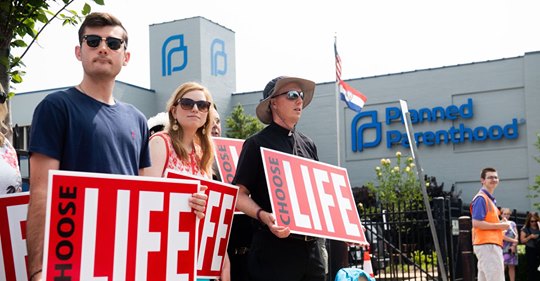
Anti-abortion demonstrators outside Reproductive Health Services of Planned Parenthood of the St. Louis region in St. Louis, Missouri, on May 31, 2019. Saul Loeb/AFP/Getty Images

The last abortion clinic in Missouri is battling for its existence.

Reproductive Health Services of Planned Parenthood of the St. Louis region has been operating for 46 years, serving thousands of patients annually for STI testing, cancer screenings, and abortions. But it might have to stop offering abortion care thanks to a months-long dispute with state regulators.

The controversy started after an audit earlier this year, when officials say they found “deficient practices” at the clinic. While they haven’t been very specific about what those practices are, officials requested interviews with doctors working at the clinic. Some of the doctors agreed, but others did not, possibly fearing that the state would launch criminal proceedings against them. Meanwhile, officials said that if they couldn’t interview all the doctors, they would revoke the clinic’s license to perform abortions.

Beginning Monday, representatives from the clinic and the state will testify at a weeklong series of hearings to determine if the facility can keep its license. If the clinic loses, Missouri residents — including more than a million people who can become pregnant — will have to travel across state lines if they want to end a pregnancy. Advocates say this will increase the already significant obstacles that patients — who are disproportionately low-income — face when trying to get the procedure.

The outcome of the hearing could also signal the end of an era in abortion access: if Missouri loses its clinic, it will become the first state with no provider since Roe v. Wade, the landmark 1973 Supreme Court decision that established the right to an abortion in America.

While near-total bans on abortion grabbed headlines earlier this year, states have also been engaged in quieter, more incremental efforts to restrict abortion. Some, including Missouri, have passed restrictions on abortion doctors, laws similar to one in Louisiana that will go before the Supreme Court this term. But Planned Parenthood says it is also using the clinic licensing process as a roundabout way of shutting the clinic down. If the facility has to stop providing abortions, advocates say, it could be the biggest success yet for the strategy of eliminating access without banning the procedure outright.

“It is the moment that we have long been warning about,” Bonyen Lee-Gilmore, director of state media campaigns at Planned Parenthood Federation of America, told Vox: “the day that abortion access is eliminated without ever overturning Roe.”

State regulators say they have concerns about the clinic. It’s not clear what the concerns are.

The clinic that is now Reproductive Health Services of Planned Parenthood of the St. Louis Region was founded in 1973, the year Roe was decided. Planned Parenthood bought the facility in 1996. Over the years, the clinic has been inspected a number of times, and inspectors were always collegial and professional, Dr. David Eisenberg, the clinic’s former medical director who still provides abortions and other care there, told Vox. But things started to change after the appointment of a new director, Dr. Randall Williams, to lead the Missouri Department of Health and Senior Services in 2017.

Williams, an OB-GYN, was appointed by former Missouri Gov. Eric Greitens, a Republican, and has spoken little publicly about his position on abortion. In an interview with the St. Louis Post-Dispatch earlier this year, he said only, “Abortion is legal in Missouri, and I want it to be safe.”

But soon after his appointment, Eisenberg said, state regulators essentially started saying, “We have reinterpreted the rules and regulations and found what you do to no longer be compliant.” (The health department has not yet responded to Vox’s request for comment.)

The department conducted an audit of the clinic in March, and said it had found “deficient practices,” according to Planned Parenthood, but it didn’t clarify what practices it found deficient. In a statement in June, the department said it was “reviewing incidents with significant medical evidence which point to troubling instances and deviations from the standard care, resulting in serious patient harm.”

To further investigate the deficiencies, the health department said it needed to interview all the doctors who practice at the clinic. The two doctors who are Planned Parenthood employees agreed to the interviews — but others, who were medical residents affiliated with a St. Louis hospital, did not do so.

The state said the results of the interviews could include “board review” or “criminal proceedings,” a spokesperson for Planned Parenthood said earlier this year. And Planned Parenthood said it could not force the residents to sit for interviews because they were not employees, according to the Kansas City Star.

The clinic was threatened with closure at the end of May, when its license was scheduled to expire and the health department declined to renew it. But a judge issued a preliminary injunction allowing the clinic to stay open.

Since then, the case has been referred to the state’s Administrative Hearing Commission, which handles disputes between state agencies and private individuals or groups. The commission will hold all-day hearings in the case this Monday through Friday.

It’s not clear when the commission will issue a decision, but the process could take months, Gilmore said.

Planned Parenthood says the state’s goal is simple: shut the clinic down

Throughout the process, the state has maintained that there are safety issues at the clinic. According to the statement issued by the health department in June, officials are “concerned by the refusal of physicians to provide explanations for the deeply troubling instances of patient care and conduct under investigation.”

Details about the department’s concerns have been difficult to obtain — the statement of deficiencies was not made public. But a conference call between state officials and anti-abortion activists in May suggests that the state wanted to investigate “failed” abortions, in which a patient remained pregnant, and the number of ambulance visits to the clinic, according to the Kansas City Star.

Planned Parenthood, meanwhile, says the concerns about patient care are essentially a ruse, and the state’s real goal is simply to shut down the clinic. “The state of Missouri has waged political theater in order to ban abortion,” Gilmore said.

The organization points to the May conference call between Steele Shippy, then-communications director for Missouri Gov. Mike Parson, a Republican, and Republican legislators and anti-abortion activists. The email invitation to the call ended with the phrase “#shutthemdown,” the Kansas City Star reported.

On the call, Shippy said that media would ask whether the state’s goal was to shut the clinic down. “While some of us, yes, it’s a main goal, but it also should be our main goal to protect the health and safety of women,” Shippy said.

The governor’s office declined to comment to Vox for this story. Shippy, who is now Parson’s campaign manager in his reelection campaign, has said that the call was nor arranged by the governor’s office. He is scheduled to testify at the hearings this week.

The closure of the clinic would mark a new era for abortion in America

Ahead of the hearings, Planned Parenthood said the stakes could not be higher. Even with the clinic open, “there’s over a million women” of reproductive age “in the state of Missouri with one freestanding health center providing abortion care,” Eisenberg said. If the clinic no longer provides abortions, any of those people facing an unwanted pregnancy would have to go to another state for care.

The majority of people seeking abortions in America are low-income, which means that traveling added distances can be a real financial hardship, especially if it means extra time off work. Last week, Planned Parenthood opened a new clinic just across the Mississippi River from St. Louis, in Illinois, which could see Missourians if the Missouri clinic cannot. But other neighboring states, like IowaKentucky, and Kansas, are restricting abortion access, not expanding it.

Meanwhile, the battle with state regulators is already having an effect, according to Eisenberg. “There’s a lot of confusion,” he said. “People think that abortion’s no longer available, when it is.”

And the outcome of the hearing will have implications outside Missouri too. In the last year, states around the country have passed strict bans on abortion. A Missouri law, for example, bans the procedure at eight weeks into pregnancy, with no exceptions for rape or incest. But all these laws, including Missouri’s, have been blocked by courts.

Another, quieter movement against abortion, however, may be coming to fruition. Since 2010, states have been passing restrictions on abortion clinics and providers that have had the effect of shutting clinics down. A 2016 Supreme Court decision, Whole Woman’s Health v. Hellerstedt, found several such restrictions in Texas unconstitutional and struck a major blow to them nationwide. But since then, President Trump has appointed two conservative justices, Brett Kavanaugh and Neil Gorsuch, to the court.

And earlier this month, the court announced it would hear the case June Medical Services v. Gee, which concerns a law in Louisiana very similar to those at issue in Whole Woman’s Health. Many abortion-rights advocates fear that the court will rule in favor of Louisiana, essentially giving states a green light to pass more and more onerous restrictions on clinics until abortion is impossible to access, even if it’s not banned outright.

The conflict in Missouri right now is about health department regulation and inspections, not laws. But, Gilmore said, the situation is still similar to the one in Louisiana — officials are “using the regulatory process under the guise of health and safety” to try to stamp out abortion in the state.

If the clinic does stop providing abortions, it will likely be seen as a sign by advocates on both sides of the issue that the strategy of restricting or regulating abortion out of existence is working.

That could have the effect of keeping doctors from entering the field of abortion care, Eisenberg said, exacerbating an existing shortage of abortion doctors in many places. Faced with increasing restrictions, they may feel that “this is ridiculous, I’m going to go find something else to do where the government’s not going to get in my way,” he said.

But, he said, the situation in Missouri should also galvanize activism around abortion rights: “for anyone who cares about the rights of people who can become pregnant in this country, now is the time to get up and fight back.”

Source: https://www.vox.com/identities/2019/10/28/20932235/planned-parenthood-missouri-abortion-clinic-roe-wade

Democratic politicians used to say abortions should be rare. Here’s how that changed.

Protesters in favor of abortion rights gathered in New York’s Times Square as part of a national day of action against recent abortion bans on June 4, 2019. LightRocket via Getty Images

“I agree with Hillary Clinton on one thing,” Rep. Tulsi Gabbard said at the Democratic presidential debate on Tuesday night. “Abortion should be safe, legal, and rare.”

Clinton used this language in her 2008 presidential campaign; Bill Clinton, meanwhile, had introduced it into Democratic politics back in 1992. The language was likely meant to appeal to people who supported the right to an abortion in principle but still felt morally conflicted about the procedure — a large group, according to some polling. But many abortion rights advocates argued that calling for the procedure to be “rare” placed stigma on people who seek it.

“There’s a fundamental notion of bodily autonomy that we’ve been fighting for as advocates and activists on this issue for years,” Destiny Lopez, co-director of the All* Above All Action Fund, a nonprofit that works to expand abortion access, told Vox. Saying abortion should be rare “completely negates all the work that we’ve done to really make this about the ability to decide what’s best for your body, for your family, for your community,” she said.

Over the years, Democrats have become more sympathetic to this view. By 2016, Hillary Clinton had changed her message, saying only that abortion should be “safe and legal.” It was part of a broader shift in the party toward more full-throated support of abortion rights. During the 2016 primaries, both Clinton and Sen. Bernie Sanders called for a repeal of the Hyde Amendment, which bans federal funding for most abortions. Today, all the Democratic presidential candidates, including Gabbard, support allowing federal funding for the procedure — along with a slate of other reforms aimed at increasing access.

But as Gabbard showed, the framing of “safe, legal, and rare” isn’t gone. Her comment, and the conversation surrounding it, were a reminder not just of how much the Democratic Party has changed in recent years on abortion rights, but of the divisions that still remain.

Democratic politicians have been moving away from “safe, legal, and rare” since 2012

The phrase “safe, legal, and rare” entered common usage during the 1992 campaign, when Bill Clinton frequently used it, according to the New York Times. “We have to remind the American people once again that being pro-choice is very different from being pro-abortion,” he told the Congressional Women’s Caucus that year.

During her 2008 presidential campaign, Hillary Clinton echoed her husband’s message, emphasizing that “by rare, I mean rare.”

But over the years, abortion rights advocates have pushed back against the phrase. “Safe, legal, and rare” implies that getting an abortion is something that “you should be apologetic for,” reproductive justice activist Renee Bracey Sherman told Vox. “It places the blame on the person who’s had an abortion, as if they just did something wrong to need one, rather than addressing the systemic issue as to why someone might not be able to have access to consistent health care or contraception.”

The push to destigmatize abortion has been part of a larger rise in people who have had abortions being open about their experiences.

“Prior to 2016, we did not have a lot of people publicly saying the word abortion” or talking about their first-hand experiences, Lopez told Vox. But “there has just been this seismic shift” in the last few years “where we’ve seen more public conversations about the realities of abortion access in this country.”

Those realities have changed a lot since 1992. Opponents of abortion have long sought to restrict the procedure, but after 2010, when Republicans took over many state legislatures, they successfully passed a slate of restrictions on abortion clinics that caused many facilities in the South and Midwest to close. Between 2011 and 2017, half of the clinics in Arizona, Kentucky, Ohio, and Texas shut their doors. In 2017, 89 percent of counties had no abortion clinic, and six states had just one.

That made it much harder for many Americans to get an abortion, especially if they couldn’t afford to travel to a far-away clinic.

Meanwhile, Trump’s election in 2016 was soon followed by the appointment of Justices Neil Gorsuch and Brett Kavanaugh to the Supreme Court. Many advocates on both sides of the issue believe that conservatives on the Court now have enough votes, if not to overturn the landmark abortion decision Roe v. Wade, then at least to significantly weaken it. Earlier this month, the Court announced it would take a case that could give states the green light to pass even more clinic restrictions, possibly legislating clinics out of existence.

In a time when access is dwindling and Roe is at risk, advocates have argued that calling for abortion to be “rare” just makes it even harder for people who already struggle to get the procedure — who are disproportionately likely to be poor, people of color, LGBTQ, immigrants, or belong to more than one of these groups — to push for their right to get it.

“If there are barriers put in front of a person,” the “safe, legal, and rare” framing implies “that it does not matter because that procedure should be rare,” Lopez said. “So it essentially is denying these folks the ability to really access the care that they deserve.”

For that reason, the All* Above All Action Fund says that abortion should be “safe, legal, accessible, and affordable,” not rare, Lopez said.

Democratic candidates have been listening to concerns like these, and in recent years, they’ve moved away from “safe, legal, and rare.” The word “rare” was removed from the Democratic party platform in 2012, Bracey Sherman said, and in 2016, Clinton no longer used it on the campaign trail.

A discussion of abortion in her 2017 book What Happened showed how much the former candidate’s language had changed on the issue. “We can debate the morality of abortion forever,” Clinton wrote, “but at the end of the day, who decides whether a woman gets or stays pregnant?”

Her answer: “I say let women decide.”

Clinton’s shift was part of a bigger move in the Democratic Party toward more outspoken and less equivocal support of abortion rights. In particular, advocates had been calling for a repeal of Hyde for years because the amendment, first passed in 1976, blocks Medicaid coverage for almost all abortions. As a result, many low-income Americans are blocked from getting the procedure or forced to go into debt or forego necessities to pay for it.

In 2016, the Democratic Party added a call to repeal Hyde to its official platform. Today, all the Democrats running for the 2020 presidential nomination say they support allowing federal money to pay for abortions. Even former Vice President Joe Biden, who earlier this year supported leaving Hyde in place, now calls for its repeal.

The move to repeal Hyde and the move away from “safe, legal, and rare” are linked, Bracey Sherman said. “This is just a general shift in moving away from stigmatizing people who need and have abortions.”

Despite the shift, divisions on abortion remain among Democrats

But “safe, legal, and rare” isn’t completely gone. Gabbard — who once identified as pro-life but now says she supports abortion rights — used the phrase at the fourth presidential debate on Tuesday night, when she was asked how she would stop states from restricting abortion access.

“We see how the consequences of laws that you’re referring to can often lead to a dangerous place,” Gabbard went on. “I do, however, think that there should be some restrictions in place. I support codifying Roe v. Wade while making sure that during the third trimester, abortion is not an option unless the life or severe health consequences of a woman are at risk.”

Many abortion rights advocates criticized her response, but one — former Planned Parenthood president Dr. Leana Wen — praised her, arguing that “we should reduce the need for abortions by investing in prevention.”

Wen broke with other abortion rights advocates some time ago. When she was removed as Planned Parenthood’s president in July, she said in a statement that, “I believe that the best way to protect abortion care is to be clear that it is not a political issue but a health care one.” Some said the group ousted her because it was looking for “a more aggressive political leader” on abortion rights, while others said she had management issues.

Since she left Planned Parenthood, Wen has argued that the best way to build public support for abortion rights is to seek common ground with people who may be uncomfortable with the procedure, but want it to remain legal. She wrote in a New York Times op-ed shortly after her departure that while leading the group, “I reached out to people who wrestle with abortion’s moral complexities, but who will speak out against government interference in personal medical decisions.”

“We need to stop treating those whose views differ from our own with scorn and suspicion, and instead work together to safeguard our health, our rights and our future,” she concluded.

And after Tuesday’s debate, Wen made clear that she saw the “safe, legal, and rare” framing as a way to reach out to people with different views on the issue. “Pro-choice & progressive movements will lose unless we allow more people to join who do not agree 100% with the most extreme ideology,” she tweeted. (Wen declined, through a representative, to be interviewed for this story.)

She isn’t the only abortion-rights supporter to use “safe, legal, and rare” in recent months. In an interview with NPR’s Sarah McCammon earlier this year, Pamela Maraldo, a former president of Planned Parenthood who resigned in 1995 under circumstances similar to Wen’s, said that she wanted Planned Parenthood to return to that framing.

“I think that people that are pro-choice are afraid of stigmatizing abortion when they say it should be rare,” she said. But “that’s not where I’m coming from. I’m coming from a place that too many trips to the doctor’s, medical procedures, surgical procedures, could be and should be prevented.”

In general, those who argue on behalf of prevention say that better access to contraception would naturally lead to abortion becoming rarer. Indeed, the abortion rate has hit an all-time low in recent years, and experts say better access to long-acting reversible contraceptives like IUDs is likely the reason why.

But moves by the Trump administration, like increased restrictions on Title X family planning funding and a weakening of the mandate that employer-based insurance cover birth control, could threaten access to contraception, especially among low-income Americans.

Even if access were perfect, “contraception is not foolproof,” Lopez said. “People will always need abortion care in this country, period.”

The disagreement between Wen and other activists, and among Gabbard and other candidates, is a reminder that even among people who generally support abortion rights, there are a lot of differences in approach and priorities.

That’s why advocates like Bracey Sherman, who started the hashtag #AskAboutAbortion in 2016, have been pushing for moderators to ask questions about abortion rights in Democratic debates. Tuesday was the first time in four presidential debates (two of them spread across two nights) that moderators asked anything about abortion, Lopez noted.

“For so long we heard, ‘well, they’re all pro-choice, it doesn’t really matter,’” Bracey Sherman said. On Tuesday night, though, “it was clear: they actually don’t all have the same stance.”

Source: https://www.vox.com/2019/10/18/20917406/abortion-safe-legal-and-rare-tulsi-gabbard?fbclid=IwAR2yFhhQy5jE7rHTzDgbVAwE8e41vofMgXNGBZnE2gt0uy4GSnx6s6xUSH8

The Fifth Circuit refused to dismiss a challenge to a web of anti-choice restrictions in Louisiana. But don’t call it a win for abortion rights.

It’s good news that last week the Fifth Circuit denied an emergency request by the State of Louisiana to dismiss a lawsuit challenging a web of abortion restrictions in the state. Louisiana’s request for the Fifth Circuit to effectively end the lawsuit at its earliest stages was extreme, even by anti-choice advocates’ standards, and the panel of judges considering the request seemed dangerously close to granting it.
Shutterstock

When the U.S. Court of Appeals for the Fifth Circuit rules against a state defending some outlandish anti-abortion regulation, it’s usually a moment to celebrate. Wins for abortion rights are exceedingly rare in the conservative appellate district, after all, and they should be savored.

In that spirit, it’s good news that last week the Fifth Circuit denied an emergency request by the State of Louisiana to dismiss a lawsuit challenging a web of abortion restrictions in the state. Louisiana’s request for the Fifth Circuit to effectively end the lawsuit at its earliest stages was extreme, even by anti-choice advocates’ standards, and the panel of judges considering the request seemed dangerously close to granting it. That they didn’t should be commemorated given the circuit’s historic hostility to abortion rights. But the win manages to serve as a warning: If the Fifth Circuit gets its way, it is going to be much harder for plaintiffs challenging abortion rights regulations to have their day in court.

In June 2017, reproductive rights advocates filed a lawsuit challenging a host of anti-abortion restrictions in Louisiana that regulate everything from what documents abortion providers must provide the state to what information—true or not—providers must disclose to patients. The lawsuit builds off the 2016 abortion rights victory in Whole Woman’s Health v. Hellerstedt that struck two Texas abortion restrictions as unconstitutional. In particular, the lawsuit seeks to build off the part of Whole Woman’s Health that recognized that abortion restrictions can cumulatively add up to unduly burden abortion rights, opening up new pathways for plaintiffs to challenge networks of abortion restrictions that work together to squeeze off abortion access.

Shortly after advocates filed their lawsuit, attorneys for the State of Louisiana filed a motion to dismiss the allegations that would have thrown out the case at its earliest stages and before any discovery on the factual allegations in the complaint had taken place. When a court is considering a motion to dismiss, it is required to take all the facts alleged in the complaint and assume them to be true at that stage in the proceeding. If a defendant disputes a particular factual claim, then the routine course is not for the court to grant the motion to dismiss and toss the case out of court, but to deny the motion to dismiss and allow the case to proceed to discovery. That’s because discovery is the “fact-finding” stage of litigation, where any evidence to settle a factual dispute, if it exists, is disclosed.

Defendants routinely file a motion to dismiss as a way to try and get plaintiffs to more clearly articulate the case they are trying to make and as a way to help refine defense strategy early on in the litigation. Because they happen early in the litigation process, courts routinely deny motions to dismiss and allow plaintiffs the opportunity to develop the factual evidence to support their claims with the understanding that if the plaintiffs are unable to do so, the court will likely toss their case close to trial.

And that is exactly what the district court did when it denied Louisiana’s motion to dismiss in March 2018. The case proceeded with the plaintiffs amending their complaint to further refine their claims and the State of Louisiana filing another motion to dismiss that was also denied.

That’s when things in the case got weird. Instead of proceeding to discovery and forcing the challengers to develop evidence to support their claims or risk summary judgment against them, attorneys for the State of Louisiana filed an emergency request with the Fifth Circuit asking it to dismiss the case. And the Fifth Circuit seriously considered doing so.

Thankfully it did not and instead turned away Louisiana’s request—but not without spending over 30 pages explaining why it would have liked to rule in Louisiana’s favor.

“This is an extraordinary case,” the opinion opens. But the three-judge panel was not talking about Louisiana’s request that the appeals court take the extreme measure of dismissing the challenge to the web of abortion restrictions. Rather they were referencing that the plaintiffs articulated a “cumulative effects” theory, an argument built off Whole Woman’s Health that abortion restrictions can work in concert and in their totality unduly burden abortion rights. Yes, individual restrictions can unduly burden abortion rights, the plaintiffs claim, but so too can networks of restrictions when taken together, as is the case in Louisiana.

What makes this case “extraordinary,” from the Fifth Circuit’s perspective, is that that the plaintiffs had the audacity to rely on Whole Woman’s Health to bring it at all.

In denying Louisiana’s request, the Fifth Circuit ordered the case back to the lower court to determine if the plaintiffs have legal standing to bring all of the claims in their complaint, suggesting that there wasn’t enough evidence that each of the challenged restrictions were causing the plaintiffs any legal harm or injury. That means that the lower court must now go through each individual regulation identified in the lawsuit and determine if the plaintiffs have a legal basis to bring a challenge to that regulation, despite the fact that the plaintiffs are alleging the cumulative harm of these regulations working in concert to restrict abortion access. The Fifth Circuit just demanded the plaintiffs be able to assert why they should be able to bring any of these individual claims at all.

“The plaintiffs’ theory, as we understand it, is that Louisiana’s various laws and regulations regarding abortion cumulate to an undue burden,” the opinion states. “But before any federal court can analyze the ‘cumulative effects’ of Louisiana’s laws, we must know which laws Plaintiffs have standing to challenge.”

“Perhaps they lack standing in ways not explored here,” the opinion states. “Perhaps they have standing in others. We leave that for the district court to decide on a provision-by-provision basis.”

The question of who has standing to bring legal challenges to abortion restrictions and what that legal standing requires plaintiffs to show is a very live legal question, now that the Roberts Court has agreed to review standing later this term when it takes up a different abortion rights case out of Louisiana, June Medical Services v. Gee. Conservatives have been trying to narrow the scope of legal standing in abortion rights cases for decades, in part because if fewer people or organizations have the ability to bring claims against laws restricting abortion rights, the more likely those laws are to go unchallenged.

That’s not unlike what the Fifth Circuit is setting up with last week’s order.

The plaintiffs in this case challenge numerous regulations and restrictions, including a variety of reporting and record-keeping requirements. Individually, a requirement that abortion clinics enact “safeguards” to protect patient-privacy may not harm providers enough to create an undue burden on abortion rights. But when considered alongside all the other reporting and record-keeping requirements Louisiana requires of abortion providers, those requirements cumulatively create the kind of harm that does amount to an undue burden.

The Fifth Circuit essentially wants plaintiffs to tease out each instance of individual harm at the earliest stages of litigation—before a court should allow them to proceed with claims that the entire system unduly burdens abortion rights. It’s a way to try and short-circuit cumulative effects claims based off Whole Woman’s Health v. Hellerstedt before the theory can effectively undermine state regulatory networks that have historically targeted abortion providers for heightened restrictions as a means to roll back abortion rights. It’s also a way to limit challenges to abortion rights generally by suggesting a different, more difficult pleading standard in early litigation for abortion rights challenges than for other types of claims. And it just might work.

The case now heads back to the district court, where the plaintiffs will have to engage in that “provision-by-provision” analysis mandated by the Fifth Circuit for their case to proceed. Should the district court rule against the plaintiffs on standing grounds, it could unravel their combined claims against Louisiana—which is likely the outcome the conservative panel of Fifth Circuit judges hope to see.

Source: https://rewire.news/article/2019/10/23/did-the-fifth-circuit-just-try-to-make-it-harder-to-bring-an-abortion-rights-challenge/

Northern Ireland has long been the dirty little secret of the UK. Out of sight and out of mind across the Irish Sea, the UK’s most far-flung region has always been a place apart not just geographically, but also psychologically. Consumed by the Troubles, the violent civil conflict that raged between 1968 and 1998, our recent history can be confusing and bewildering to many. As a result, many in Britain unfairly view Northern Ireland as a dark and unruly place where bad things happen, like an embarrassing distant relative who shouldn’t be acknowledged unless strictly necessary.

Here, the treatment of minority and marginalised groups that would not have been tolerated elsewhere in the UK become a settled status quo, dismissed as a quirk of life in the little understood region, and not something for the rest of the nation to concern itself with. However, as the clock struck midnight on Monday night, that finally changed. Westminster finally acted to overturn Northern Ireland’s bans on abortion and equal marriage with much-needed and long overdue reforms.

Pro-choice supporters pose as they gather at Parliament buildings on the Stormont Estate in Belfast on October 21, 2019.

© Paul Faith/Getty Images

On the steps of Stormont yesterday, the region’s parliament, pro-choice and pro-marriage equality activists gathered for the historic moment when a new Northern Ireland was ushered into being. The momentous changes are the result of decades of campaigning by women and LGBTQIA+ rights groups, who have often risked everything to tell their personal stories and put a face to the suffering the bans caused.

Although abortion was effectively legalised in England and Wales in 1967, the legislation was not extended to Northern Ireland after local politicians objected on grounds of Christian morality. Instead, the region retained the 1861 Offences Against The Person Act, a piece of Victorian-era legislation that pre-dates the invention of the light bulb and amounts to some of the harshest abortion restrictions in the world, making it a criminal offence with a penalty of life in prison to have an abortion – unless a woman’s health is at risk of serious imminent harm. It forced countless women to travel to England by air or sea for terminations instead.

Members of pro choice group Alliance for Choice make their way to Stormont on October 21, 2019 in Belfast, Northern Ireland.

© Charles McQuillan/Getty Images

Similarly, while equal marriage for same-sex couples was legalised in 2013 in England, with the first ceremonies taking place in 2014, the legislation was not extended to Northern Ireland after resistance from local politicians. As each year has gone by, Northern Ireland has slipped further behind the rest of the UK. Rallies and protests were organised as part of passionate grassroots campaigns, but often with a weary sense that few people outside of the region knew or cared.

Social media gave women and the LGBTQIA+ community a platform to speak out about their experiences and be heard, and with each story, the stigma slowly began to erode, and Northern Ireland’s outdated laws became increasingly impossible to ignore. In 2014, the journalist Lyra McKee, who was murdered by the IRA earlier this year, wrote a moving open letter to her younger self about growing up gay in Northern Ireland, and the intense psychological toll of being forced to feel “other” and “less than” the rest of society. The article struck a chord with many people here and quickly went viral, later being turned into a short film.

A newly painted mural featuring murdered journalist Lyra McKee, whose death sparked a new round of political talks chaired by the British and Irish Governments.

© Paul Faith/Getty Images

The previous year, a young woman called Sarah Ewart spoke openly about her experiences of having an abortion after she was told her unborn child would not survive birth. Rather than suffer in silence, Ewart contacted a local BBC radio station and told of her devastation at the loss of a much-wanted pregnancy, compounded by the distress of having to travel to England for a termination.

In 2016, a woman was put on trial for an abortion. The court was told the woman was just 19-years-old when she experienced a crisis pregnancy. She had tried to save money to travel to England for a termination but ran out of time. Instead, she performed an abortion on herself at home. Her flatmates found bloody remains in a kitchen bin and reported her to the police. The woman pleaded guilty and was given a suspended sentence.

As these stories emerged, the harsh human reality of the laws became impossible to ignore not just in Northern Ireland but also across Britain. Another key moment came when, following their failure to secure a majority government in 2017, the Conservatives entered a confidence-and-supply arrangement with the Democratic Unionist Party. The pact shone a spotlight on the previously obscure Northern Irish party, members of whom had been among the chief opponents of abortion and LGBTQIA+ rights. Years of intensive Brexit talks have also highlighted the ways in which Northern Ireland is treated the same as, or differently to, the rest of the UK – and resulting disparities in social justice.

Abortion-rights demonstrators march through the streets of Belfast ahead of a meeting of the Stormont Assembly on abortion rights and gay marriage on October 21, 2019.

© Charles McQuillan/Getty Images

In addition, following a breakdown in relations between nationalist and unionist politicians, the Northern Ireland government collapsed in January 2017 as the parties could no longer agree to govern together. As a result, the parliament has lain empty for almost three years, increasing pressure on Westminster to take responsibility in the absence of a local government.

In July of this year, MPs at Westminster decided to finally act. Labour MPs Stella Creasy and Conor McGinn tabled motions demanding that if the government had still not returned by midnight on 21 October, then abortion would be decriminalised and equal marriage would be legalised.

As the date drew nearer, local activists waited nervously to see if politicians would set aside their differences and return to block the changes from happening. However, as the clock hit midnight on Monday, the long overdue changes were secured. Within minutes, couples across Northern Ireland were celebrating engagements – many having waited years or even decades for the right to marry. Many pro-choice activists were left speechless, able only to sob with relief.

As a journalist from Belfast specialising in social inequality issues, I have come across many harrowing stories throughout my career of the impact of the laws. Teenagers struggling with suicidal feelings due to the fear they could be outed and ostracised for their sexuality. Women who performed abortions on themselves at home – alone, vulnerable and terrified of a knock on the door from police. Couples who had been engaged for years, forced to contemplate a civil partnership for fear older family members might not live to see the law change. Girls who have made up excuses about a “spa trip” or holiday to see a long lost cousin in England and then boarded a lonely flight to Britain to have a termination in secret.

As the law changed at midnight, I thought of their stories and how they might be feeling at that moment. I thought, too, of the untold stories that exist in every village and city in Northern Ireland, which cut across all age groups and walks of life. Today’s changes won’t undo the trauma they endured, but may go some way in healing some of that hurt. Crucially, a new generation may now grow up never knowing the pain of living under the bans. In years to come, they may come to hear about the cruelty that was once enshrined in law and be bewildered that the bans ever existed.

Due to Northern Ireland’s complex history as a post-conflict society and the painstaking rate of progress towards issues which have been long resolved elsewhere, it can be hard for people here to feel hope that change is possible. However, these changes are positive proof of what can come about through decades of determined refusal to merely accept things as they are, but to instead insist on what could be.

Source: https://www.vogue.co.uk/news/article/northern-ireland-legalising-abortion-and-same-sex-marriage?fbclid=IwAR27yqfa83q1iiPJ6P2HKxpFQ6yJ4fOh4rN0VlO4FnK0MsPCNwNIfTpTDLc

Abortion-inducing medications can be taken at home.

Misoprostol is one of two drugs used to induce abortions. George Frey / Reuters file

Women living in states with more restrictive policies on abortion are turning to online sources for medications that can be used to induce the procedure, a study published Thursday found.

The study in the American Journal of Public Health examined data from a European online service called Women on Web. The service mails women early in their pregnancy two drugs — mifepristone and misoprostol — after a doctor reviews an online form filled out by the women.

The women can then take the pills at home, without having to go to a clinic or other abortion provider.

Over a period of 10 months — October 2017 to August 2018 — 6,022 people in the U.S. sought out Women on Web for access to the abortion pills, the study found. Of those, 76 percent were living in states with added restrictions on abortion, such as mandatory counseling and ultrasounds.

The highest demand was in Mississippi, Louisiana, Alabama, Tennessee and Texas, though requests came in from every state in the country — even those with the fewest restrictions, like New Hampshire. The only stipulation in that state is aimed at minors, who must notify a parent before having an abortion.

Reasons why women turned to an online source for abortion pills varied, but cost was a big factor.

“We know that requiring people to come for two ultrasounds or have a waiting period makes the abortion cost more,” said the study’s lead author, Dr. Abigail Aiken, an assistant professor of public affairs at the University of Texas at Austin.

“In supportive states, the biggest barrier was fear of harassment by protesters,” Aiken said.

previous study by Aiken and her colleagues found that using medications to induce an abortion is as safe as going to a clinic, as long as the medications are taken early enough in pregnancy.

Mifepristone and misoprostol have been used since 1988 in some countries to induce early abortions. (Initially, the Women on Web program was meant only for women in countries where abortion was illegal, and as a result, didn’t ship to the U.S. But that didn’t stop American women from reaching out anyway.)

Women who use the drugs may experience side effects, though, such as pain, heavy bleeding and fever.

Experts say that’s why it’s critical women have access to doctors for information and follow-up care if needed.

“It’s important to think about the role other providers and clinics can play in supporting people who are accessing abortion medication online,” said Megan Donovan, a senior policy manager at the Guttmacher Institute, which studies reproductive rights.

“We should always be pursuing policies that support a range of options for care,” she told NBC News. “If you want to turn up to a clinic or to your doctor for abortion care, you should still be able to do that.”

The Food and Drug Administration approved the use of abortion medication in 2000, and today it’s used in up to a third of all abortions in the U.S.

However, FDA rules stipulate that the drug must be dispensed in clinics or a doctor’s office. The FDA’s website warns consumers against buying abortion pills online, saying “drugs purchased from foreign internet sources are not the FDA-approved versions of the drugs, and they are not subject to FDA-regulated manufacturing controls or FDA inspection of manufacturing facilities.”

But the American College of Obstetricians and Gynecologists supports lifting barriers to accessing such medication, calling the FDA rules “outdated” because they “substantially limit access to this safe, effective medication.”

Indeed, the new data illustrates how women seek to manage their own abortion care.

“Just because we restrict access and we put barriers in the way of people when it comes to abortion access,” Aiken said, “it doesn’t mean people won’t find ways of having abortions.”

Source: https://www.nbcnews.com/health/womens-health/people-are-going-online-abortion-pills-especially-states-more-restrictions-n1068036?fbclid=IwAR23fRPs8ugrg4QZFOXKKCpjwT2Btl8l3l4dT462bP3PC0PizRXcCKWwOXk

The collapse of local government allowed Parliament to step in and bring the territory’s laws in line with Britain’s principles of human rights.

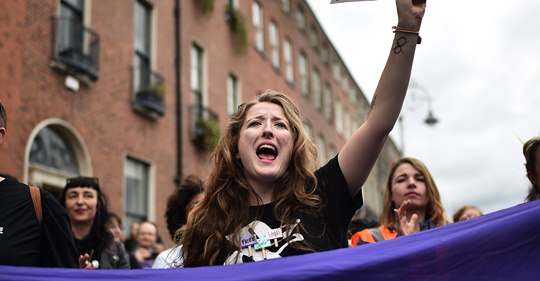
Protesters supporting the legalization of abortion in Belfast, Northern Ireland, on Sunday.CreditCharles Mcquillan/Getty Images

BELFAST, Northern Ireland — Traditionally conservative Northern Ireland is about to legalize both abortion and same-sex marriage, a head-snapping about-face that was imposed on the territory by the British Parliament.

The changes, bitterly resisted by anti-abortion and church groups, were mandated in an amendment to a routine bill on governance of Northern Ireland that Parliament passed in July amid a power vacuum created by the collapse of the region’s governing assembly nearly three years ago.

The amendment will go into effect at midnight on Monday, weeks after the High Court in Belfast rebuffed a legal challenge, ruling that Northern Ireland’s 158-year-old abortion laws are incompatible with the United Kingdom’s human rights commitments.

The judgment was a major victory for women’s rights activists, who had felt left behind after the Republic of Ireland voted to legalize abortion last year. Although Northern Ireland is a part of the United Kingdom, and the majority of its people say they would like abortion to be made available, the regional power-sharing government had blocked abortion reform before collapsing in 2017 over sectarian divides.

British lawmakers saw the political paralysis as an opportunity, and, during a Parliamentary sitting in July, overwhelmingly voted to legalize same-sex marriage and abortion. While both have been hot-button issues in the United States and other countries, same-sex marriage has not stirred the intense reaction in Northern Ireland that the lifting of the abortion ban has.

At the Northern Ireland Assembly’s mammoth building in Stormont on Monday, lawmakers reconvened for the first time in nearly three years in a last-ditch and almost certainly futile attempt to prevent the new abortion law from going into effect.

As they met, groups of activists from both sides of the issue faced off on the grounds outside. “Pro-life, that’s a lie — you don’t care if women die,” one group chanted as opposing protesters held up pictures of fetuses emblazoned across signs that read “Save me, be my voice, please let me live.”

“We are not going to stick with the guilt and the shame any longer,” said Dawn Purvis, a prominent women’s rights activist and former independent member of the Northern Ireland Assembly. “Tomorrow the law changes in this place, and for the first time in Northern Ireland, women will be free.”

As the women chanted, Martin Power, an activist from Belfast who opposes the legalization of abortion, hung his head in disapproval.

“I can’t believe they are here celebrating a law which will allow women to indiscriminately kill our Lord’s children,” he said. “The people of Northern Ireland are being forced to adhere to a law we weren’t even allowed to vote for. It’s undemocratic and vile.”

Pro-life demonstrators held signs in front of pro-choice campaigners who had come to celebrate at Stormont in Belfast, Northern Ireland, as the country is about to legalize abortion.
CreditMary Turner for The New York Times

For activists who support making abortion legal, the change was long overdue.

“For too long, women and girls in Northern Ireland have been left behind their counterparts in the rest of the U.K. when it comes to their human rights,” said Stella Creasy, a British lawmaker for the main opposition Labour Party, who put forward the amendment to extend abortion rights to Northern Ireland.

“Today, women can know that their houses will not be raided for abortion pills,” Ms. Creasy said. “They will not be reported to the police if they seek aftercare at the doctor’s, and they will not be dragged through the courts and threatened with prison just for accessing basic health care.”

Before now, Northern Ireland had one of the world’s most restrictive abortion laws, prohibiting the procedure in almost every circumstance except for when the mother’s life is in danger. In cases of rape, incest or fetal abnormalities, women have had to either carry the pregnancy to term or travel outside the territory for the termination. Violations of the ban carry severe penalties, including life imprisonment.

When the Marie Stopes family planning clinic opened in Belfast in 2012 and started providing abortions for women eligible under the law, hundreds of anti-abortion activists staged protests, which continued on a smaller scale until the clinic shut down in 2017.

“They blocked the entrance. They stood in front of them. They tried to lure them to their own place down the street,” said Dawn Purvis, the former director of the clinic. “They showed them plastic fetuses in buckets of blood and held posters and placards outside.”

Activists who favor legalizing abortion now worry that the decriminalization will embolden the anti-abortion movement and propel them to use the same aggressive tactics they have employed in the Republic of Ireland — opening fake abortion clinics and help lines designed to obstruct abortions.

“Now that the police and courts won’t be able to do anything, the pro-lifers are going to step in harder and try and traumatize us at every opportunity,” said Milly Cunningham, a Northern Ireland native who traveled for an abortion when she was 19 and now lives in London, where she volunteers as a host for Northern Irish women seeking abortions.

“They receive all their funding and training from the U.S., so we are expecting quite a strong response from them, which can be quite scary, especially when you are pregnant and vulnerable,” she said.

Precious Life, the biggest anti-abortion group in Northern Ireland, has organized protests and vigils as part of a “fight back” campaign against the amendment. Its leaders say they will continue to lobby against allowing abortions.

“When Gods warriors go down on their knees, their battle is not over it has just begun,” the group’s director, Bernadette Smyth, wrote in a Facebook post on Sunday.

Under the government’s new abortion guidelines, all existing investigations and prosecutions against women who have sought abortions will be dropped from Tuesday. That includes charges brought against a woman who helped her 15-year-old daughter obtain abortion pills after the teenager became pregnant from an abusive partner.

Pro-choice activists carrying suitcases around bus and train stations to highlight women who are forced to travel for an abortion, in Belfast last month.
CreditCharles Mcquillan/Getty Images

A public consultation on the proposed legal framework for abortion will open after Tuesday, and full services are scheduled to be rolled out in Northern Ireland by March 31. Until then, all health professionals there who are approached by women considering terminations must provide information about state-funded abortion services.

The government said it recognized that during the interim period women may continue to try to buy medical abortion pills, which cannot be obtained legally without a prescription. However, those who require medical help after using such pills bought online will be able to seek assistance in Northern Ireland, and health professionals will not be obliged to report the offense.

Over all, the guidelines for the interim period have been welcomed by experts, though some questions remain.

Fiona Bloomer, an abortion policy researcher at Ulster University, said that women who cannot travel for abortions have not been given specific consideration, and that it was not clear whether the funding for travel covers partners and carers who may wish to accompany them.

The main priority for activists and experts now is to ensure that the consultation on providing services will be rolled out without restrictions or delays.

Even after the provisions are rolled out, activists say that the battle against stigma and the deep divisions surrounding the issue will continue. For women who had painful experiences under the restriction laws, the next few months will also be about processing it all.

“I had a horrendous experience with the pills,” said Kellie Turtle, a women’s rights activist who attempted a self-administered abortion at her home in Northern Ireland in 2016. “I didn’t find it liberating or empowering to be taking the matter into my own hands. It felt like you were totally on your own, you were dumped, basically, to go away and deal with this thing and silence and shame.”

Ms. Turtle spent days in bed in excruciating pain, and after three doses realized that the pills were not working. That night she booked flights to Liverpool, England, for an abortion at a clinic.

“I think the reason I had such an amazing experience in Liverpool was because it contrasted so much to walk into a place where everyone treated you with respect and understood what you were going through,” she said. “It was clinical, which isn’t what everyone wants, I know, but for me, it just felt safe after the experience I’d just had of lying in my bed for two days in excruciating pain knowing that I couldn’t tell anyone.”

Source: https://www.nytimes.com/2019/10/21/world/europe/northern-ireland-abortion-same-sex-marriage.html?fbclid=IwAR2i67LRJwBpPozZ3jfLo4CdDH_Wpv0-fN-_P4gSgbsOZ7i-b6WX_CdnqSM