The law requires abortion providers to have admitting privileges at nearby hospitals.
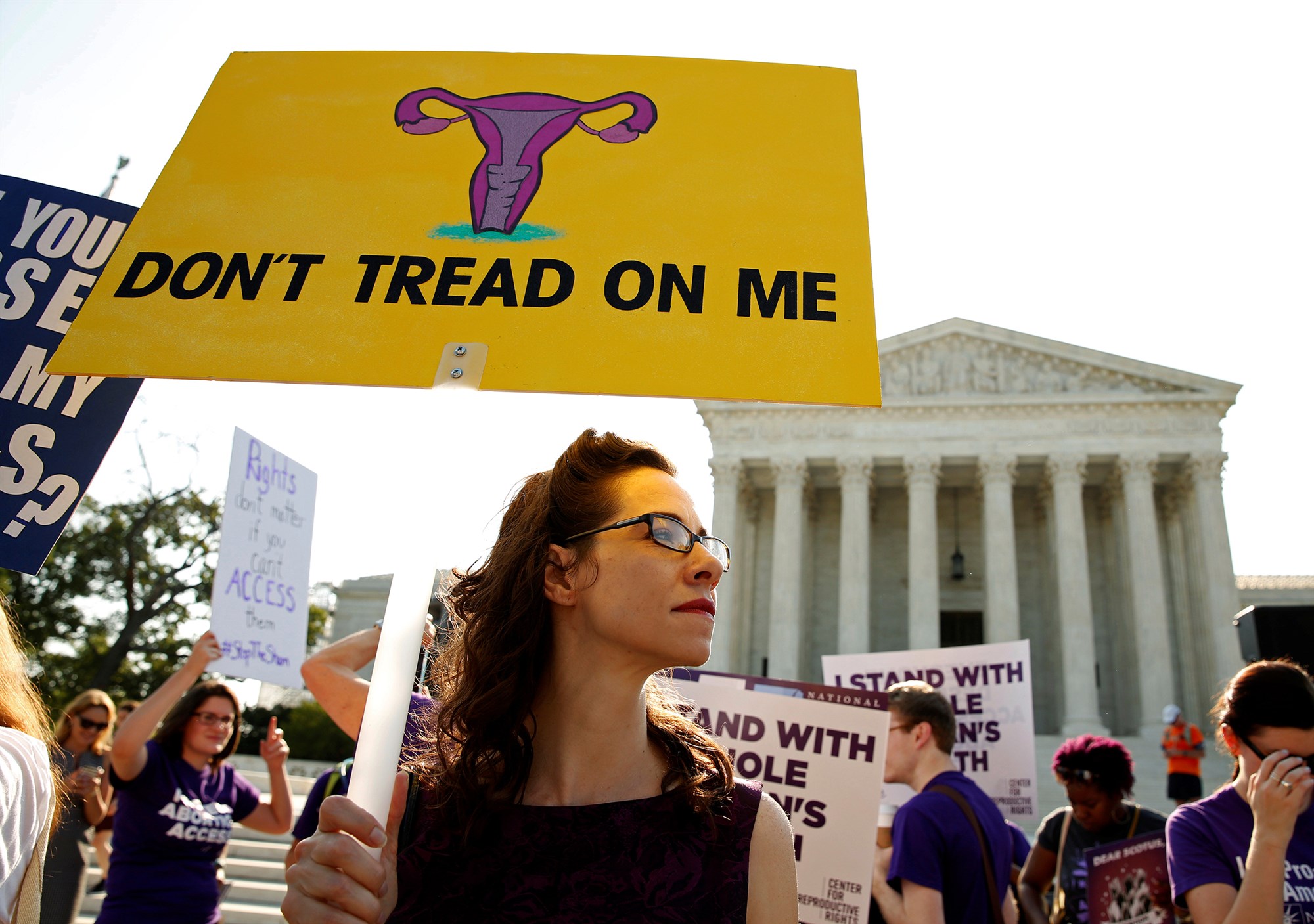
Demonstrators outside the U.S. Supreme Court on June 27, 2016.Kevin Lamarque / Reuters file

A Louisiana abortion clinic is asking the Supreme Court to strike down regulations that could leave the state with just one clinic.

A divided high court had previously agreed to block the law pending a full review of the case.

An appeal being filed with the court Wednesday says the justices should now take the next step and declare the law an unconstitutional burden on the rights of women seeking an abortion. The Louisiana provision is similar to a Texas law the court struck down in 2016.

If the justices agree to hear the Louisiana case, as seems likely, it could lead to a decision on the high-profile abortion issue in spring 2020, in the midst of the presidential election campaign.

The case presents a swirling mix of the changed court’s views on abortion rights and its respect for earlier high court decisions.

Louisiana’s law requires abortion providers to have admitting privileges at nearby hospitals. The justices said in 2016 that a Texas law provided “few, if any, health benefits for women.”

But the composition of the court has changed since then. President Donald Trump has put two justices, Neil Gorsuch and Brett Kavanaugh, on the court. Kavanaugh replaced Justice Anthony Kennedy, who voted to strike down the Texas law. Trump had pledged during the campaign to appoint “pro-life” justices, and abortion opponents are hoping the more conservative bench will be more open to upholding abortion restrictions.

Louisiana abortion providers and a district judge who initially heard the case said one or maybe two of the state’s three abortion clinics would have to close under the new law. There would be at most two doctors who could meet its requirements, they said.

But the appeals court in New Orleans rejected those claims, doubting that any clinics would have to close and saying the doctors had not tried hard enough to establish relationships with local hospitals.

In January, the full appeals court voted 9-6 not to get involved in the case, setting up the Supreme Court appeal.

In February, the justices split 5-4 to keep the law on hold. Chief Justice John Roberts, a dissenter in the 2016 case from Texas, joined with the court’s four liberal justices to temporarily block the Louisiana measure.

For Roberts, it was a rare vote against an abortion restriction in more than 13 years as chief justice, perhaps a reflection of his new role since Kennedy’s retirement as the court’s swing justice and his concern about the court being perceived as a partisan institution.

Gorsuch and Kavanaugh, along with Justices Samuel Alito and Clarence Thomas, would have allowed Louisiana to begin enforcing the clinic regulations.

The Hope Medical Group clinic in Shreveport, Louisiana, and two doctors whose identities are not revealed said in their appeal that the justices should strike down the law without even holding arguments because the decision so clearly conflicts with the Texas ruling from 2016.

But the Supreme Court typically won’t consider a summary reversal of a lower court ruling unless at least six justices are on board. A decision about whether to hear the case should come before the court completes its current term in June. Arguments probably wouldn’t take place before late in the fall.

Source: https://www.nbcnews.com/politics/supreme-court/supreme-court-asked-void-louisiana-law-could-leave-state-one-n995526?fbclid=IwAR0-215zZnFpuR986J0yzYiV6XZsb-IGuydmhzER8dJ_ibIeXedBD3Ab-24

Viability has been a legal bright line in judging abortion restrictions. Will it stay that way?

Shortly after Bryant signed the near total abortion ban into law, reproductive rights advocates sued to block the measure, arguing it is an unconstitutional pre-viability abortion ban.
WJTV 12 News / YouTube

Anti-choice advocates in Mississippi recently upped the ante in overturning abortion rights, telling a federal court it should replace the “vague and constantly shifting concept of viability” with the detection of a “fetal heartbeat” as a point where states can begin to ban abortion.

The declaration came in court documents filed in opposition to a motion to block SB 2116. Signed into law by Gov. Phil Bryant (R) on March 21, it prohibits abortion after a “fetal heartbeat” has been detected. The statute defines “fetal heartbeat” as “cardiac activity or the steady and repetitive rhythmic contraction of the fetal heart within the gestational sac” and would ban abortion as early as six weeks into pregnancy, amounting to a near total abortion ban since many don’t know they’re pregnant at that point. 

Attorneys for the state concede they have been unable to identify medical research or data that show a fetus has reached the “point of viability” during the time period in which S.B. 2116 would operate. That’s why they’re urging the court to reject viability as the only proper consideration in determining the law’s constitutionality.

The law, scheduled to take effect July 1, contains an exception for instances when the life of a pregnant person is at risk, or to prevent “a serious risk of the substantial and irreversible impairment of a major bodily function” to the pregnant person.

Shortly after Bryant signed the near total abortion ban into law, reproductive rights advocates sued to block the measure, arguing it is an unconstitutional pre-viability abortion ban.

In its court filings, attorneys for the state concede that viability is a critical marker by which courts judge abortion restrictions. But, the attorneys argue, the time has come to change that standard. “Defendants dispute that viability is the only proper consideration” in determining the constitutionality of SB 2116, the attorneys argue.

“As a matter of science and medicine, life begins at conception,” the brief states. “As opposed to a vague and constantly shifting concept of ‘viability,’ detection of a fetal heartbeat is an objective milestone, and also an extremely accurate indicator of the likelihood a fetus will survive until birth,” the brief said. 

The anti-choice legal argument picks up on the political argument supporters of the near total abortion ban made when the bill first passed. “The heartbeat has been universally hallmark of life since man’s very beginning,” Bryant told supporters in the Mississippi capitol rotunda moments before he signed the GOP-backed measure.

Mississippi isn’t the only state to argue that courts should replace the viability standard with detection of a “fetal heartbeat.” “Sometimes, the evolution of the law requires bold steps,” Ohio Attorney General Dave Yost said in a statement regarding SB 23, a Republican bill that bans abortion at six weeks. Gov. Mike DeWine (R) signed the legislation into law.

“In the last 46 years, the practice of medicine has changed,” Yost continued. “Science has changed. Even the point of viability has changed. Only the law has lagged. This law provides a stable, objective standard to guide the courts.”

Attorneys challenging Mississippi’s near total abortion ban will have an opportunity to file a response before the court considers arguments and issues a ruling, likely before the July 1 deadline for the measure to take effect. 

Source: https://rewire.news/article/2019/04/17/mississippi-asks-federal-court-to-replace-fetal-viability-with-junk-science/

In Rwanda, girls below 18 years now have a right to terminate a pregnancy before it is 22 weeks old – a new law has been gazetted to the effect.

A ministerial order N°002/MoH/2019 issued on Monday details all necessary requirements to enable a physician to perform an abortion.

This ministerial order is pursuant to the constitutional provisions articles 120, 122 and 176.

The new ministerial order is also in line with article nº 68/2018 gazetted on 30/08/2018.

Clause 6 in the new ministerial order outlines what would be contained in a request on behalf of a patient seeking to carry out an abortion.

For example if the pregnant girl is a very young, the request is made by a guardian or the persons legally representing her.

This clause also provides that incase of disagreements between persons legally representing the patient, the final decision will be that of the patient.

Some of the determinant reasons to seek for an abortion include; in case the pregnant person is very young, in case the pregnancy is a result of incest (up to second cousins), in case the pregnancy is a result of rape and also in case the pregnancy was a result of forced marriage.

Also a patient may seek abortion if the pregnancy poses a health risk to their lives.

However, clause 11 of this ministerial order provides for cautions against anyone seeking abortion.

The pregnant girl seeking an abortion is not required to prove anything about her reasons for seeking this abortion.

But after the abortion is carried out and it is discovered that the reason provided was false, the girl will be prosecuted by the existing laws.

For example if anyone legally representing the girl proves that the girl’s pregnancy resulted from rape and it is actually found out and determined that it wasn’t rape, then the girl would be prosecuted.

According to cluse 4 in this ministerial order, the abortion can only be requested for when the pregnancy is not above 22 weeks.

The ministerial order also provides that only a qualified physician working at a public hospital or recognized clinic can perform an abortion.

Shortly before the new ministerial order came into effect, President Paul Kagame, last week, pardoned 367 persons convicted for the offences of abortion, complicity in abortion and infanticide.

According to Munezero Claudine, a single mother working as a ticketing officer in Rwamagana District, told Taarifa that she was happy with the relaxed law that decriminalizes abortion.

“My cousin sister is among those pardoned recently by the head of state. She had illegally carried out an abortion and was arrested last year but now she is back home. Sometimes people need to understand the pain we women go through especially with an unwanted pregnancy,” Munezero said.

However, Patrick Mushimire, a secondary school teacher in Gatsibo district, has reservations about the new abortion law, saying it is likely to scale up promiscuity among the youth well knowing they would lie about reasons for terminating the pregnancies.

“The government should have first consulted widely with the public before adjusting the law. We already have reckless girls and boys indulging in unprotected sex and now pregnancies will scale up,” Mushimire said, adding that he wouldn’t wish any of his two daughters to get pregnant before they are mature and married.

Abortion in cases of rape, incest, forced marriage or the health of the woman or fetus has been legal since 2012, although a court and two doctors are needed to sign off on the procedure.

Parliament revised this law in 2018 to remove the requirement for a court and additional doctor’s permission.

Source: https://taarifa.rw/2019/04/11/rwanda-legalises-abortion-with-conditions/?fbclid=IwAR1FlwnXFgiUkDeNYtJxzFuKPrC1L4UD6M4nBl4du2eDvGS9XLkr-BTXZW8

Ashley Judd continues to take a strong stance in the pro-choice movement as a three-time rape survivor.

Judd, 50, shared at a Women in the World panel discussion Thursday that one of the times she was raped, she became pregnant.

“I’m very thankful I was able to access safe and legal abortion,” she told moderator Katie Couric and the audience. “Because the rapist, who is a Kentuckian, as am I, and I reside in Tennessee, has paternity rights in Kentucky and Tennessee. I would’ve had to co-parent with a rapist.”

Couric noted that Judd was one of 50 Hollywood actors who boycotted Georgia’s Living Infants Fairness and Equality Act, also known as the “heartbeat” bill. The legislation bans abortions after a heartbeat is detected, which can be as early as six weeks into a pregnancy.

“Democracy starts with our skin,” Judd, who is also a #MeToo advocate, said at the panel. “We’re not supposed to regulate what we choose to do with our insides.”

In March, Alyssa Milano tweeted the full list of actors who have signed on to oppose the bill, which included both men and women in Hollywood like Judd, David Arquette, Debra Messing, Mandy Moore, Amy Schumer, Ben Stiller and Don Cheadle.

Source:

This article originally appeared in the New York Post

https://www.foxnews.com/entertainment/ashley-judd-abortion-decision?fbclid=IwAR1w7X3RfwnV_qS7RaeLF1hMly8FYxWlqtcMrLnNIoboPTSjqXBa2p6VpLw

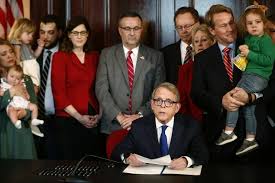
COLUMBUS, Ohio (AP) — A bill imposing one of the most stringent abortion restrictions in the nation was signed into law in Ohio on Thursday, banning abortions after a detectable heartbeat in a long-sought victory for abortion opponents that drew an immediate constitutional challenge.

In signing the heartbeat bill, Republican Gov. Mike DeWine broke with his predecessor, Republican John Kasich, who had vetoed the measure twice on grounds that it was clearly unconstitutional.

But DeWine defended Ohio Republicans’ decision to push the boundaries of the law, because “it is the right thing to do.”

“Taking this action really is a kind of a time-honored tradition, the constitutional tradition of making a good faith argument for modification or reversal of existing legal precedents,” he said. “So that is what this is.”

He said it’s the government’s job to protect the vulnerable.

Ohio’s closely divided politics had slowed the progress of the bill as it has caught momentum elsewhere , forcing years of debate in the state where the movement originated. Of five previous states that have passed heartbeat bills, three have seen their laws struck down or blocked by the courts, another faces a legal inunction and the fifth is awaiting governor’s action.

“Victory!” exclaimed Faith2Action, the Ohio-based anti-abortion group that first introduced the heartbeat concept in 2010.

DeWine’s action came a day after the latest version of the bill, which outlaws abortions once a fetal heartbeat is detected, cleared the Republican-controlled Legislature. Doctors say a fetal heartbeat can be detected using transvaginal ultrasound technology as early as five weeks into pregnancy, before many women know they are pregnant.

Even before the bill was signed, the ACLU of Ohio said it was preparing a constitutional challenge to the law on behalf of Pre-Term Cleveland and three other Ohio abortion clinics.

The legal challenge is what the bill’s backers have always wanted. They hope to provoke a legal challenge with the potential to overturn the U.S. Supreme Court’s 1973 Roe v. Wade ruling that legalized abortion up until viability, usually at 22 to 24 weeks.

“The heartbeat bill is the next incremental step in our strategy to overturn Roe v. Wade,” said Ohio Right to Life President Mike Gonidakis. “While other states embrace radical legislation to legalize abortion on demand through the ninth month of pregnancy, Ohio has drawn a line and continues to advance protections for unborn babies.”

Kellie Copeland, director of NARAL Pro-Choice Ohio, said lawmakers and the governor have plunged the state into “a dystopian nightmare where people are forced to continue pregnancies regardless of the harm that may come to them or their family.”

The law makes no exceptions for pregnancies resulting from rape or incest.

EMILY’s List, a national group that supports candidates who favor abortion rights, also decried the Ohio bill, as did the Democratic National Committee.

DNC CEO Seema Nanda called it “the latest example of how the Trump administration’s extremist, anti-women policies have emboldened legislators across the country to attack women’s access to health care.”

DeWine said his administration is committed to supporting pregnant women.

“I just want to make it very, very clear, our concern is not just for the unborn, our concern is for all individuals who need protection,” he said. “It is our duty, I believe, and an essential function of government, to protect those who cannot protect themselves.”

The latest version of the bill passed out of an Ohio House committee Tuesday. The full House approved it Wednesday and, that same day, the Senate agreed to House changes and sent it to DeWine.

During Wednesday’s House debate, State Rep. Michele Lepore-Hagan, a Democrat, shed tears as she talked about the harm the bill could do.

“I’m concerned that our kids are going to leave, that we’re going to lose a large amount of young people who don’t want to live in an oppressive atmosphere,” she said.

State Rep. Candice Keller, a Middletown Republican, called the legislation “the most compassionate bill we’ve ever passed.”

Prohibiting abortions at the first detectable heartbeat means prohibiting virtually all abortions, said Dr. Michael Cackovic, a specialist in maternal fetal medicine at Ohio State University Medical Center. He said current standard practice, which involves transvaginal ultrasound, can reliably detect a heartbeat five to six weeks into pregnancy.

“Essentially, that’s three to four weeks after conception, or one to two weeks after a missed period,” he said.

(Copyright 2019 The Associated Press. All rights reserved. This material may not be published, broadcast, rewritten or redistributed.)

Source: https://www.stuff.co.nz/national/health/111923827/i-had-an-abortion-at-19-and-it-gave-me-my-life-women-need-the-power-to-choose?fbclid=IwAR23AGneOywsn_ml-I7al4GWwWcR6f5VBsTLHOsQFWK6E7ySE3flOPfuPRY

A protest against South Korean abortion laws in Seoul, the capital, last year.CreditCreditEd Jones/Agence France-Presse — Getty Images

South Korea’s Constitutional Court on Thursday ruled as unconstitutional a 66-year-old law that made abortion a crime punishable by up to two years in prison, calling for an amendment to the law.

The court gave Parliament until the end of 2020 to revise the law. If legislators do not meet that deadline, the law will become null and void. It currently remains in force.

The verdict represented a landmark, if tentative, victory for abortion rights advocates, who have campaigned for the law’s abolition as a major step in bolstering women’s rights.

Polls show that allowing abortion has broad support among South Korean women of childbearing age. In a government-financed survey of 10,000 women ages 15 to 44 last year, three-quarters called for liberalizing abortion regulations.

In its ruling, the court called the anti-abortion law “an unconstitutional restriction that violates a pregnant woman’s right to choose.” But it left it to Parliament to decide whether to restrict abortions in the late stages of a pregnancy.

In South Korea, abortion is widespread despite the ban, which allows exceptions such as in cases of rape or when a woman’s health is at risk. Under the country’s criminal code, a woman who undergoes an abortion can be punished with up to a year in prison or a fine of up to 2 million won, about $1,750. A doctor who performs an abortion faces up to two years in prison.

But the ban on abortion has rarely been enforced. In 2017 alone, 49,700 abortions took place, nearly 94 percent of them illegally, according to estimates released in February by the government-run Korea Institute for Health and Social Affairs. Between 2012 and 2017, just 80 women or doctors went to trial for their involvement in abortions, and only one of them served time in prison, with the rest receiving fines or suspended jail terms, according to court data.

Until recently, abortion carried little of the emotional or religious significance in South Korea that it does in many Western countries.

In the 1970s and 1980s, as the government struggled to curtail population growth, it told families that “two children are one too many” and looked the other way as abortions became widespread.

In more recent years, however, the country has tried to reverse its falling birthrate, which is one of the lowest in the world, with an average of less than one child per woman. The government’s attitude toward abortion has also shifted, with officials often calling it unpatriotic and threatening to crack down on the procedure.

Women’s rights groups have recently started to push back against what they called the government’s tendency to regulate a woman’s right to choose.

“When there were too many people, they told us ‘not to produce babies’ in the name of family planning, and when they thought there were not enough people, they then told us ‘to produce babies’ or face punishment,” a coalition of women’s groups campaigning for abortion rights said in a statement in February. “We can no longer put up with this deceitful frame.”

At the same time, some obstetricians and Christian activists have pushed a morality-based campaign against abortion in recent years, running a hotline for people to report doctors who perform illegal abortions.

Last week, Cardinal Andrew Yeom Soo-jung, the Roman Catholic archbishop of Seoul, the capital, repeated his church’s opposition to repealing the anti-abortion law, calling on South Korea to “protect women and fetuses from abortion.”

But both camps were on the same page in denouncing the hypocrisy of having a rarely enforced abortion ban on the books while the procedure remains widespread.

“The ruling marks an important stride in strengthening gender equality and women’s right to make choices for themselves,” a civic group, People’s Solidarity for Participatory Democracy, said Thursday in a statement.

The Catholic Bishops’ Conference of Korea said that it “deeply deplores” the court’s decision. “It denies a fetus its basic right to life,” the group said in a statement. “Abortion is the crime of killing an innocent life during pregnancy.”

In 2012, the last time it ruled on the issue, the Constitutional Court found the anti-abortion law to be constitutional, recognizing a fetus’s right to life.

The number of abortions has been dropping in South Korea, from 342,000 in 2005 to 49,700 in 2017 among women of the same age group, according to estimates from the Korea Institute for Health and Social Affairs. A majority of women surveyed by the institute said they chose abortions because they feared that raising children would interrupt their educational pursuits or professional careers or because they did not have enough money to raise children.

The institute attributed the drop in abortions to the declining number of childbearing-age women and the increasing use of contraception. But doctors and experts have said that the actual number of abortions could be much larger than the official estimates.

The office of President Moon Jae-in had no immediate reaction to the court’s ruling on Thursday.

The government’s Ministry of Gender Equality and Family had called for the abolition of the anti-abortion law, which it called a “dead document” because it had seldom been enforced. They said the law had forced abortions underground, exposing women to medical accidents.

The Ministry of Justice has defended the ban on abortions, saying, “It is the state’s duty to protect a fetus’s right to life.”

Source: https://www.nytimes.com/2019/04/11/world/asia/south-korea-abortion-ban-ruling.html?fbclid=IwAR1nAoQPALWt9GXN-pxf1I8yfa_QtojZplmU6PBNak48sbilvZzw_quDLQI

The bill was introduced by Republican Rep. Tony Tinderholt in January, but had its first committee hearing this week.

Texas lawmakers are considering a bill that would ban abortion in the state and charge women who have abortions with homicide, which can carry the death penalty in the state.

Rep. Tony Tinderholt, a Republican, introduced the “Abolition of Abortion in Texas Act,” or House Bill 896, in January to “protect the rights of an unborn child” but it was granted its first committee hearing on Monday and Tuesday.

Nearly 500 people testified, with 54 people testifying against the bill, according to The Washington Post.

“A living human child, from the moment of fertilization on fusion of a human spermatozoon with a human ovum, is entitled to the same rights, powers, and privileges as are secured or granted by the laws of this state to any other human child,” the text of the bill reads.

Republican Rep. Matt Krause, who sits on the Texas House Committee on Judiciary and Civil Jurisprudence, which heard the bill, said in a statement on Facebook before the hearing that it was “the first legislative hearing since 1973 on this topic.”

Tinderholt introduced a similar bill in 2017, but it failed to leave committee. He was placed under state protection because of death threats he received after proposing the bill, according to The Texas Tribune.

Tinderholt did not immediately respond to a request for comment.

Democrats on the committee excoriated the bill, calling the provisions hypocritical.

“I’m trying to reconcile in my head the arguments that I heard tonight about how essentially one is OK with subjecting a woman to the death penalty … to do to her the exact same thing that one is alleging she is doing to a child,” Democratic Rep. Victoria Neave said during the hearing, according to The Washington Post.

Tinderholt defended the bill, according to Fox 9, a Texas television station.

“I think it’s important to remember that if a drunk driver kills a pregnant woman, they get charged twice. If you murder a pregnant woman, you get charged twice. So I’m not specifically criminalizing women. What I’m doing is equalizing the law,” Tinderholt said.

The bill would ban abortion at any stage of pregnancy and would criminalize women who have abortions and the physicians who perform them, even in cases of rape, human trafficking or incest. The bill directly conflicts with the landmark Roe v. Wade decision, which outlawed criminalizing abortion.

Before the bill goes to the full Texas House for debate, it faces a challenge in committee.

Republican Rep. Jeff Leach, chairman of the House Committee on Judiciary and Civil Jurisprudence, told The Dallas News that he would not allow the committee to advance the legislation with provisions that penalize women.

“I cannot and will not support nor will I let come out of this committee any bill on [abortion] which targets the woman with either civil or criminal liability,” he told the paper.

Leach did not respond to a request for comment.

Source: https://www.nbcnews.com/politics/politics-news/texas-lawmakers-consider-death-penalty-women-who-get-abortions-n993171

Reproductive rights advocates expect Gov. Ned Lamont (D) to sign the legislation if it clears the Democratic-majority legislature.

Providers at reproductive health clinics have long complained about how these anti-choice pregnancy centers poach on and distract their patients with false advertising.
Shutterstock

Connecticut legislators advanced a bill that would curb deceptive advertising by the state’s anti-choice pregnancy centers.

The legislation, known as An Act Concerning Deceptive Marketing Practices of Limited Service Pregnancy Centers, passed the Public Health Committee on March 29.

Conservative justices on the U.S. Supreme Court ruled last year that a California effort to regulate anti-choice clinics, commonly known as crisis pregnancy centers, was unconstitutional, though the Connecticut legislation isn’t nearly as far reaching. The Connecticut bill would ban advertising “any statement concerning any pregnancy-related service … that is false, misleading or deceptive.”

Reproductive rights advocates expect Connecticut Gov. Ned Lamont (D), a strong proponent of abortion rights, to sign the bill if it clears the Democratic-held legislature. Around 25 anti-choice pregnancy centers operate in Connecticut, which has only 18 licensed family planning clinics, according NARAL Pro-Choice Connecticut.

“I’m really excited about the momentum we have for this,” Sarah Croucher, executive director of NARAL Pro-Choice Connecticut, told Rewire.News. “We found that we have pro-choice Republicans in Connecticut who understand that the centers are a problem in the way they present themselves to people. So we are excited about this moving forward with strong political support, including some bipartisan support, and we are excited that Connecticut can set policy for the nation on this issue.”

Croucher testified in favor of the bill, which is aimed at limited service pregnancy centers (CPCs) that use deceptive practices, like appearing to offer unbiased counseling and abortion services when they do not. Cases like this often pit right-to-know health-care advocates against anti-choice activists who claim free speech. This measure is modeled after San Francisco’s 2011 truth-in-advertising law, advocates said.

Providers at reproductive health clinics have long complained that these anti-choice pregnancy centers distract their patients with false advertising. In Hartford, for example, an anti-choice center opened up 30 feet from the Hartford GYN, a licensed abortion clinic operated by The Women’s Centers, and often tried to block and redirect patients headed to the licensed clinic.

“At all of The Women’s Centers locations, including Hartford GYN, we have seen firsthand the dangers that fake women’s health centers pose when deceiving patients and delaying their access to time-sensitive medical care in their efforts to convince them not to have an abortion,” Roxanne Sutocky, director of community engagement at The Women’s Centers, said in an email. “At Hartford GYN Center, we frequently care for patients [who] report experiencing confusion and delays because they were deceived into going to the wrong office or were given misleading information about their pregnancy options—occurrences which have notably increased since the St. Gerard Center for Life opened as Hartford Women’s Center just 30 feet from our Hartford GYN Center’s front door. We have also experienced an increase in aggressive protester activity outside of the Center.”

Hartford officials responded to the complaints by rolling out an ordinance last October prohibiting deceptive advertising practices and requiring the centers to disclose if they do not have licenses medical provider on staff, or face a $100 fine per day.

Baltimore and Montgomery County, Maryland were the first to enact ordinances requiring signs in the waiting rooms of limited-service pregnancy centers, telling patients that such centers do not provide or make referrals for abortion or birth-control services. Both ordinances were later blocked by courts.

As the assault on reproductive rights continues, so has the proliferation of anti-choice clinics, many of which are funded by Republican lawmakers sympathetic to their cause: tricking people out of seeking abortion services. There are more than 4,000 of these anti-choice clinics across the United States, and 32 states allow “Choose Life” license plates that siphon public money towards anti-choice clinics or adoption services. A 2018 Rewire.News analysis found anti-choice clinics in 14 states were set to receive more than $40 million in taxpayer dollars. The Trump administration, staffed with anti-choice activists turned government officials, has funneled millions in taxpayer funds to anti-choice pregnancy centers.

One anti-choice clinic allegedly went as far as locking a patient in an exam room, according to a social media post from a clinic receptionist. In 2015, an undercover investigation by NARAL Pro-Choice confirmed that anti-choice pregnancy centers in California routinely lied to pregnant people.

Legislators in several states have taken steps to make people aware of the deceptive practices used by these clinics, which are staffed with people who often claim to have medical backgrounds and pretend to provide abortion services.

New York rolled out a public campaign and website called “Know Your Options” last summer to educate residents about anti-choice clinics. But California’s abortion services disclosure law, or the Reproductive FACT Act, was struck down last summer by the Supreme Court in a 5-4 decision. The California law required licensed centers to disclose to pregnant people that the state provides access to reproductive health care including abortion, and required unlicensed centers to disclose that they are unlicensed. A similar law was also struck down in Hawaii.

Connecticut’s bill still needs to pass the house and senate, both controlled by Democrats. A majority of the Public Health Committee voted in favor; Hartford Mayor Luke Bronin and state Attorney General William Tong both gave testimony in favor, advocates said.

“Whether someone is seeking abortion care, prenatal services, or contraception, fake women’s health centers cause unnecessary delays that needlessly imperil a patient’s health by deceptively diverting patients away from legitimate reproductive health care providers,” Sutocky said. “Unfortunately, the deceptive advertising practices employed by fake women’s health centers do a great deal to undermine the patient-provider relationship, making it more challenging for pregnant people to access the care they need.”

Source: https://rewire.news/article/2019/04/08/connecticut-lawmakers-bar-anti-choice-clinics-from-lying-to-pregnant-people/

In four yellowing pages, she outlined her struggles with the question, and the pivotal role the death of her daughter Robin played in forming her views.

In 1980, when George H. W. Bush was making his first bid for the presidency, Barbara Bush covered four sheets of lined paper with her bold handwriting, then tucked the pages into a folder with her diary and some personal letters. She was trying to sort out what she believed about one of the most divisive issues of the day.

She was sure to be asked what she thought about abortion, and she wanted to have an answer.

This article was adapted from The Matriarch: Barbara Bush and the Making of an American Dynasty, by Susan Page.

The former first lady never released the pages or detailed the reasoning she outlined in them, not in hundreds of interviews she gave over the decades that followed nor in her two memoirs. But in February 2018, two months before she died, she gave me permission to read her diaries as I researched a biography of her. (The Matriarch: Barbara Bush and the Making of an American Dynasty is being published by Twelve on April 2.) She had donated the diaries to the George H. W. Bush Presidential Library, in College Station, Texas, with the restriction that they be held private until 35 years after her death—as it turns out, until 2053. Only the historian Jon Meacham had been given permission to see them before, when he was working on Destiny and Power: The American Odyssey of George Herbert Walker Bush.

When I began reading her diaries, she and I planned to have another interview, our sixth, in March 2018. (I was allowed to read her papers and to make notes, but not to photograph them.) But she fell the night before and ended up in the hospital; she never recovered enough for us to meet again before she died, a month later. I never had a chance to ask her about what I found.

As I worked my way through an archival box filled with accounts of her endless, exhausting campaign travel that year, I pulled out the yellowing pages, unfolded them, and discovered what was in effect a conversation with herself.

“Thoughts on abortion,” she wrote across the top of the first page, underlining the words.

Her deliberations might astonish cynics who assume that, for those who operate in the world of elective office, the calculations on such contentious topics are always political. The notes provide a window into how seriously she took the issue, and how she saw it as a moral question. The careful thought process they reflect may be the reason she never wavered in her views.

Her husband would, modifying his stance on abortion after Ronald Reagan chose him as his running mate at the Republican National Convention that summer. Before then, George Bush had tried to navigate a position down the middle. He opposed abortion but also opposed passing a constitutional amendment to ban it. He was against federal funding for abortion in general but supported exceptions in cases of rape or incest, or to preserve the health of the mother.

When Reagan asked him to join the GOP ticket, though, Bush promised to support the party platform, which endorsed a constitutional amendment that would overturn the 1973 Roe v. Wade Supreme Court decision recognizing abortion rights. By 1988, when Bush was the presidential nominee himself, the GOP platform would go even further. It asserted that “the unborn child has a fundamental individual right to life which cannot be infringed.”

Barbara Bush had no reservations about embracing her husband’s positions on the economy and foreign affairs, and most of all about extolling his virtues as a person and a leader. But on cultural and social issues, she often found herself at odds with the GOP and its increasingly conservative tilt. “In all our years of campaigning, abortion was the toughest issue for me,” she said later.

At the 1980 Republican convention, in Detroit, when George Bush’s prospects to be picked as Reagan’s running mate seemed to have faded, Barbara Bush arrived at a luncheon hosted by the National Federation of Republican Women sporting a pro-choice button. With her husband’s political ambitions apparently vanquished, she felt free to make her own stance on the issue clear.

That burst of independence was over almost before it began. That night, after negotiations with former President Gerald Ford to join the ticket collapsed and Reagan tapped Bush, her pro-choice button disappeared. She didn’t change her views, but she did stop talking about them, saying that only the opinion of those on the ballot mattered. While many assumed she still supported abortion rights—a reassuring thought to some moderate and liberal Republicans—she would rebuff attempts by reporters and activists to engage publicly on the issue until she published her White House memoirs 14 years later.

“Both George and I felt strongly about our positions but respected each other’s views; there was no point in discussing it every time it came up,” she wrote in 1994, in Barbara Bush: A Memoir. While she said the law permitting abortions had been “abused” and called the number of abortions “unacceptable,” she added, “For me, abortion is a personal issue—between the mother, father, and doctor.”

It was in this early memo that she crystallized the issue in her mind.

“When does the soul enter the body is the #1 question,” she wrote. “Not when does life begin, as life begins in a flower or an animal with the first cell. So the question is does the life begin (soul entering the body) at conception or at the moment the first breath is taken? If the answer to that question is at conception, then abortion is murder. If the answer to that question is the moment the first breath is taken, then abortion is not murder.”

As with many profound questions, she thought about the lessons she had taken from the life and death of her daughter Robin. Her beloved 3-year-old had died of leukemia in 1953, after six months of brutal treatments and dashed hopes. The tragedy would shape everything from Bush’s views on big issues to her impatience with prattle.

“What does Barbara Bush feel about abortion,” she wrote in the memo, referring to herself in the third person. She decided that Robin had answered the question she posed.

Judging from both the birth and death of Robin Bush, I have decided that that almost religious experience, that thin line between birth, the first breath that she took, was when the soul, the spirit, that special thing that separates man or woman from animals + plants entered her little body. I was conscious at her birth and I was with her at her death. (As was G.B.) An even stronger impression remains with me of that moment, 27 years ago [when she died]. Of course, extreme grief, but that has softened. I vividly remember that split second, that thin line between breathing and not breathing, the complete knowledge that her soul had left and only the body remained.

She had sensed Robin’s soul entering her body at the moment of her birth, she decided, and she had felt it leave her at the instant of her death.

“What do I feel about abortion?” Bush continued in her distinctive handwriting, almost no words crossed out or reconsidered. “Having decided that the first breath is when the soul enters the body, I believe in Federally funded abortion. Why should the rich be allowed to afford abortions and the poor not?” She said she could support limits on the timing of abortions—“12 weeks, the law says”—but she wrote it was “not a Presidential issue,” underlining not twice. “Abortion is personal, between mother fathers and Dr.”

She considered what public policies might make sense. “Education is the answer,” she wrote. “I believe that we must give people goals in life for them to work for—Teach them the price you must pay for being promiscuous.”

Along the side margin of the last page, she wrote, “Needs lots more thought.”

SUSAN PAGE is the Washington Bureau chief of USA TODAY. This essay is drawn from her book, The Matriarch: Barbara Bush and the Making of An American Dynasty, being published on April 2 by Twelve.

This is some really weird Handmaid’s Tale stuff.

Illustration by Erin Lux

We still don’t know where 1,488 migrant children are. The U.S. government lost them. They admit as much. Even though the court ordered a halt to the policy of family separation, 245 more children have been taken from their parents. So they can’t figure out where children separated from their parents are, but by God, they can keep track of teenage migrant girls’ menstrual cycles.

There are 28 pages detailing the periods, pregnancies and reason for the pregnancy (whether by rape or not) of teen girls in custody, some of whom are as young as 12. There may well be reasons for the government to track whether or not a woman is pregnant, and how far along in her pregnancy she is, but there’s no reason to track the cause of her pregnancy. It’s pretty fair to assume that they’re not doing this because they want to ensure women know all the options regarding their pregnancy. It’s almost certainly an attempt to bar them from getting abortions.

We know that, because the tracking was done by the anti-abortion advocate Scott Lloyd, the head of refugee resettlement at the height of the children separation (he has since been removed from that post). Lloyd declared he needed to sign off on all abortion requests (this was previously not the case) and in one instance, attempted to use a migrant girl as a way to test an “abortion reversal” method.

Lloyd has admitted to pressuring these young women to keep their pregnancies. Seemingly, he was quite strenuous in his insistence. In one email, Lloyd relates that a pregnant woman in his care who was seeking—and being kept from having—an abortion mentioned suicide. In response to that, he writes: “The clinician describes her demeanor as ‘obnoxious’ and that ‘the unborn child is in our care so the medical team should continue with standard prenatal care.'” If she continued to want an abortion after “spiritual counseling,” Lloyd continues, she’d have to obtain parental consent. Because deciding to terminate a pregnancy seemingly takes more maturity than motherhood. And, if you think they did not take into account how difficult it might be for teenage migrants to obtain consent from parents they might not be traveling with—oh, don’t worry. They took that into account.

This tracking continued well after the ACLU intervened to stop government interference with immigrant women seeking abortions.

And what happens when these children are born? Well, that’s hard to say. However, we know that many migrant children have gone to Bethany Christian Services, an organization that has received hundreds of thousands of dollars from Trump’s education secretary, Betsy DeVos. It is also an agency that allegedly won’t place children with LGBTQ couples. Asylum-seekers are separated from their children, and then told by officials that if they don’t “behave” they will put their children up for adoption.

And once those children have gone to foster homes, they may well be gone for good. The AP reported back in February:

Jonathan White, who leads the Health and Human Services Department’s efforts to reunite migrant children with their parents, said removing children from ‘sponsor’ homes to rejoin their parents ‘would present grave child welfare concerns.’ He said the government should focus on reuniting children currently in its custody, not those who have already been released to sponsor homes.

All of this in spite of that fact that the first goal of foster care is supposed to be “family reunification.”

Now, why would there be a benefit to creating a supply of children to be adopted by Christian, heterosexual families? Well, partly for money. As Kathryn Joyce notes in her book The Child Catchers, “Hefty adoption fees provide lots of incentive to increase the ‘supply’ of adoptable children, recruiting ‘orphans’ from intact but vulnerable families.” Anyone who has looked into adoption has probably found that, despite what This is Us leads you to believe, it is not generally the case that you find an abandoned baby peacefully waiting for adoption in the hospital ward. Instead, adoption through agencies is a lengthy process that costs, on average, $39,966, a cost that can make it prohibitively expensive for many families. For all the talk of how adoption is great because there are “so many unwanted babies in the world” there’s actually an enormous market of prospective parents looking for a baby—however, white and Hispanic babies cost about $8,000 more to adopt than black babies.

Beyond that, moving children to a family that government officials prefer is what authoritarian regimes all through history have done. It’s a textbook way to reward your followers, terrify marginalized people into submission, and ensure that a new generation of children are raised to support your regime.

It’s not even in the distant past. From 1977 to 1983 the military junta in Argentina took the children of dissidents, and, after killing or “disappearing” their parents, placed the orphans with childless families friendly to the regime. In some cases, pregnant women being held by the regime were made to give birth specifically for this purpose. The Asociación Civil Abuelas de Plaza de Mayo (Grandmothers of the Plaza de Mayo) still gather in Buenos Aries to look for the grandchildren that were taken by the regime after their parents were murdered (thus far 128 out of 500 have been found.)

“It’s a textbook way to reward your followers, terrify marginalized people into submission, and ensure that a new generation of children are raised to support your regime.”

Moving children from marginalized people to people in power has a basis in American history, too. In 1958, the “Indian Adoption Project” stole Native American children from their homes (even if there was no evidence of any neglect or abuse) and gave them to non-Native families to raise. Roger St. John, one of the children who was taken, claimed, “We were brought up without our culture, which took a terrible toll on our lives. I grew up angry and miserable.”

And now, here we are again, with pregnant women being tracked to ensure they’ll give birth to babies that a 13-year-old mother may not find themselves equipped to raise. We have plenty of reason to suspect where the babies will end up.

If the government can compel marginalized women to have children to give to the government’s preferred people, then you don’t need to make jokes about how America is turning into The Handmaid’s Tale anymore. We’re already there. We just don’t have the bonnets.

Source: https://www.harpersbazaar.com/culture/politics/a26985261/trump-administration-abortion-period-tracking-migrant-women/?fbclid=IwAR1hi1-0iYyP_M18FQFF-rnsNl0zMFwxz3v-avxVaLIUUapmO1VGz3_c37o