Trump cheered on the GOP’s overhaul of the federal judiciary and piecemeal attacks on the Affordable Care Act, but he failed to acknowledge their human cost. Here, Rewire accounts for it.
Trump and Republicans in the U.S. Senate have partnered to remake the federal judiciary in their anti-choice, anti-LGBTQ image. Chip Somodevilla/Getty Images
President Trump’s Friday morning address to the Conservative Political Action Conference (CPAC) included a series of conservative dog whistles lauding his administration’s regressive victories at the expense of reproductive health.
Trump cheered on his overhaul of the federal judiciary and piecemeal attacks on the Affordable Care Act (ACA), or Obamacare. But he failed to acknowledge their human cost. Here, Rewire accounts for it.
What Trump said:
“We’ve confirmed a record number—so important—of circuit court judges, and we are going to be putting in a lot more, and they will interpret the law as written.”
What’s really happening:
Trump and Republicans in the U.S. Senate have partnered to remake the federal judiciary in their anti-choice, anti-LGBTQ image. Leonard Steven Grasz, an abortion rights foe and “conversion therapy” ally, was “so far outside the judicial mainstream” that the American Bar Association rated him as “not qualified” to serve on the U.S. Court of Appeals for the Eighth Circuit, Rewire’s Jessica Mason Pieklo noted in an analysis.
Senate Judiciary Committee Chair Chuck Grassley (R-IA) nevertheless pushed through Grasz and other radical nominees, including birth control benefit opponent Amy Coney Barrett, to the Senate floor for final confirmation. Senate Republicans have easily confirmed these nominees to lifetime slots on the federal bench, thanks to a rule change under the chamber’s former Democratic majority leader, Sen. Harry Reid (NV), who “nuked” the filibuster and allowed a simple 51-vote majority to confirm most presidential picks.
What Trump said:
“And we’ve confirmed an incredible new Supreme Court justice, a great man, Neil Gorsuch.”
Trump had promised to appoint Supreme Court justices who would overturn Roe v. Wade, the court’s 1973 decision that established the right to abortion care until fetal viability. Conservative leaders worked with Trump and his senior advisers on Gorsuch’s nomination, per White House pool reports.
Those leaders included National Rifle Association Executive Vice President and CEO Wayne LaPierre, a CPAC headliner who addressed the conference little more than a week after a mass shooting at a Parkland, Florida, high school left 17 students dead, and Concerned Women for America CEO and President Penny Nance Young, who addressed a CPAC panel that revealed conservative divisions in anti-choice legislative strategy. Senate Majority Leader Mitch McConnell (R-KY) then triggered the nuclear option to pave the way for Gorsuch’s confirmation with just 51 votes. (McConnell blocked President Obama’s nominee, Merrick Garland, allowing Trump to later fill the open seat.)
What Trump said:
“I think we may be better off the way we’re doing it. It’s piece by piece by piece. Obamacare is just being wiped out.”
After congressional Republicans were unable to defund Planned Parenthood through repealing Obamacare, HHS coordinated with a prominent hate group to undermine family planning access for people with low incomes, the majority of whom are women of color and women in rural areas.
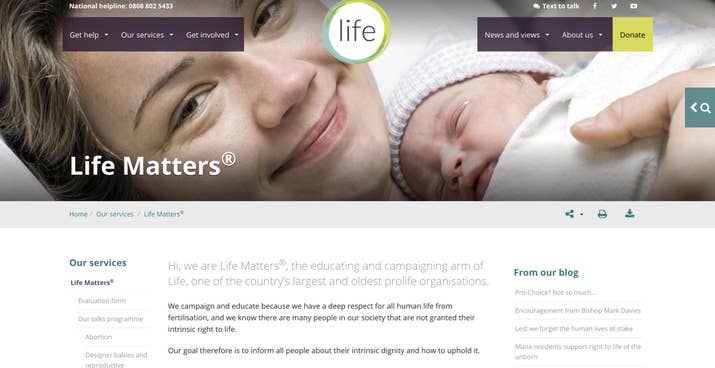
Life, an organisation which has incorrectly linked abortion to breast cancer, ranks highly in several searches relating to seeking abortion services.
Jacob Sacks-Jones for BuzzFeed
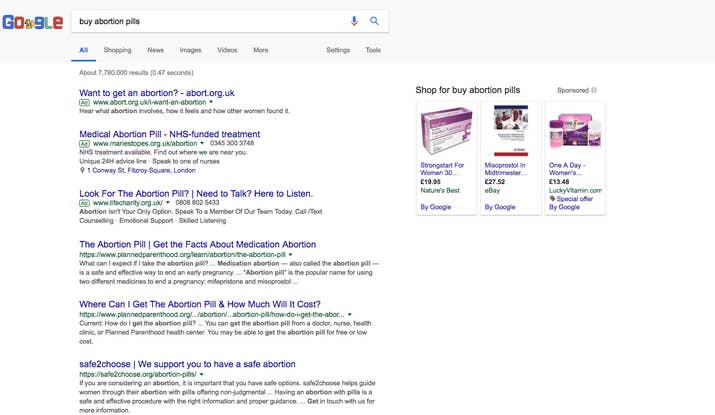
Anti-abortion groups that have incorrectly linked abortion to breast cancer, infertility, depression, and drug abuse have paid to appear in the top results for common Google searches seeking abortion services.
A search for “buy abortion pills online” conducted by BuzzFeed News this week produced sponsored links for religious anti-abortion group Abort.org and Life, an anti-abortion group that offers accommodation to women facing crisis pregnancies. Marie Stopes – one of the UK’s leading abortion providers – also appeared in the top three results.
Google says the wording of the links that appear in the search results, and the information contained on the landing pages they lead to, means that the anti-abortion groups are not in breach of any of their policies.
Non-sponsored links for international sexual health group Planned Parenthood; another of the UK’s leading abortion service providers, BPAS; and Women on Web, which provides abortion pills to women in countries where abortion is illegal, appear further down in the results for “buy abortion pills online”.
While it is illegal to access the drugs for medical abortion outside of licensed settings, the number of women in the UK seeking to buy them online has increased steadily in recent years.
BuzzFeed News
BuzzFeed News analysis found sponsored links for Life also appeared in the top three results for the following searches: “abortion pills”, “I need an abortion now”, “I need an abortion asap”, and “abortion pills price”. In 2017, Life received £250,000 of government funding from the “tampon tax”, after it was confirmed that funds raised by the 5% levy on sanitary products would be used to support women’s charities.
Sponsored and unsponsored links to BPAS and Marie Stopes also regularly appeared in the top three results for those searches. An unsponsored link for NHS abortion guidelines appeared as the third result for “I need an abortion now” – but ranked lower on the other searches.
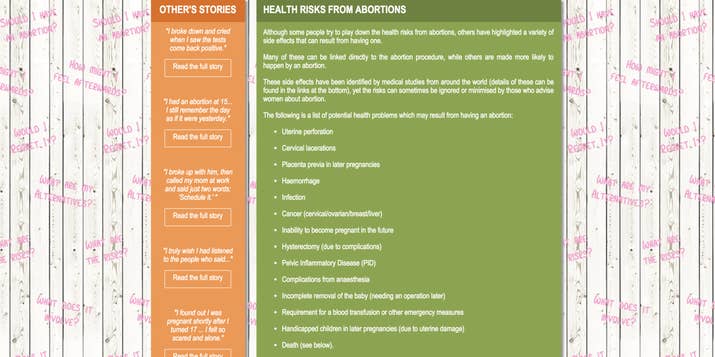
One sponsored search result for Abort.org that reads “want to get an abortion?” leads to a page offering to “tell you more about what an abortion actually involves, and to share others’ experiences with you”.
The page offers links to stories from women, all of whom either regretted their abortion or chose not to go through with it and encouraged those reading to do the same, and a “help page” that states abortion could lead to depression, anxiety, low self-esteem, flashbacks, and eating disorders.
The search result for Life reading “Look for the abortion pill” leads to a page with contact links to its counsellors, who offer “a safe place for you to explore your situation and talk through your feelings – free and in complete confidence”.
On a page describing its services, Life states an outright opposition to abortion. “Our goal therefore is to inform all people about their intrinsic dignity and how to uphold it,” the page reads. In educational materials designed to be distributed in schools, Life also claims that an abortion could lead to a decline in mental health.
Elsewhere on its website, Abort.org lists infertility, cancer, and death as risks of abortion, and in 2011 Life published material that claimed abortion can lead to breast cancer. NHS guidance states that risks of infertility following abortion are small, and only likely if the procedure results in an infection that is left untreated. NHS guidance also disputes any link between abortion and cancer.
Both Life and Abort.org say they offer women facing unwanted pregnancies impartial advice, and say abortion providers such as Marie Stopes and BPAS will only ever encourage a woman to have an abortion. They also claim that abortion providers fail to support women who may be pressured into a termination by a coercive partner.
A disclaimer on Abort.org, however, states that information on its site “does not constitute medical advice, and is not a substitute for medical consultation or treatment”.
“We would always recommend that you consult a qualified health professional straight away for advice on your individual health needs, and would never endorse delaying such a consultation for any length of time,” the disclaimer adds.
Marie Stopes and BPAS told BuzzFeed News that Care Quality Commission regulation requires them to offer pre-procedure counselling, from registered practitioners, which explores options including abortion, adoption, fostering, and continuing with the pregnancy, and that around 1 in 20 women who book appointments for abortion do not go ahead with it.
Both organisations say they also work to identify when women are experiencing domestic violence and signpost them to the relevant support services.
“Informed choice is at the heart of our charity’s mission, and every woman we serve is talked through her options before booking an appointment and once again at the clinic,” a spokesperson for Marie Stopes told BuzzFeed News.
Marie Stopes was last year accused of incentivising staff to encourage women to go ahead with abortions after a CQC report suggested staff’s pay was linked to performance targets. Marie Stopes said that targets were linked to encouraging women to have IUDs – considered to be one of the most effective forms of contraception – fitted following abortion procedures.
A Marie Stopes spokesperson added that options discussed with women “include whether to continue with the pregnancy and raise the child, continue with the pregnancy and opt for adoption or fostering, or to end the pregnancy with an abortion”.
“In 2017, around 1 in 22 of our clients did not proceed with a procedure after booking an appointment, either because she changed her mind or because we weren’t assured that she was certain of her decision,” the spokesperson continued.
“If a woman makes the decision not to continue with her pregnancy, our staff will explain the medical and surgical options available to help her make the decision that is right for her.”
Life
A spokesperson for BPAS also emphasised the impartiality of their service. “BPAS clinics, unlike crisis pregnancy centres, are regulated by the CQC,” the spokesperson said.
“The CQC provides a series of standards against which it inspects the quality and safety of an abortion service, and the CQC has the power to enforce improvements, suspend services and ultimately pursue criminal prosecutions against providers for failing to provide treatment or care in a safe way.”
BPAS’s spokesperson said that a trained member of staff would discuss several options, including continuing the pregnancy and becoming a parent, having the child fostered or adopted, or ending the pregnancy by abortion, with anyone who made an appointment at one of their clinics.
“Women who remain undecided will be given all the time they need to arrive at a decision, and offered additional time to discuss their options further with a trained member of staff if they wish,” they added.
“As part of standards set by the CQC, abortion services must be able to prove they have processes in place to ensure that all women and girls are seeking services voluntarily.”
A spokesperson for Google did not believe that Life or Abort.org’s sponsored ads and associated landing pages were in breach of their advertising policies.
“In order to protect people from misrepresentative or misleading ads, we have a strict set of policies that govern the types of ads that we allow on Google,” they said in a statement to BuzzFeed News. “If we discover an ad that breaks our policies, we quickly take action.”
While Google’s spokesperson did recognise a grey area around whether a sponsored ad could be considered a health risk when the page it linked to led to incorrect information published by the organisation elsewhere, they said that verifying health claims made by an organisation as a whole was beyond the remit of ensuring a specific ad and its landing page adhered to its advertising polices.
They did, however, say that it could consider revising its guidelines in future.
“Our polices aren’t static; in order to be useful and relevant, we ensure they remain fluid and adaptable,” the spokesperson added. “So we constantly review our policies and work with industry experts to better understand the key issues.”
A spokesperson for Life said that where their sponsored ads ranked in searches was down to Google.
“We have no control over how Google search algorithms work but we are entitled to reach out as best as we can to vulnerable women facing crisis pregnancy including those considering abortion, with offers of counselling and support,” the spokesperson said.
The spokesperson said that while they would never support abortion as an option in the event of an unwanted pregnancy, they said their service was impartial.
“Life is an associate member of the British Association of Counselling and Psychotherapy and is bound by their professional code of practice,” the spokesperson said.
“Our counselling service is client-led. We provide a safe space for women to explore all their options and empower themselves in their decision-making process.
“It is true that we do not refer people for abortion or give information on abortion providers and this is made clear in our terms of service.”
Abort.org did not respond to a request for comment by the time of publication.
Anti-choice leaders at a Conservative Political Action Conference panel had conflicting opinions on whether Senate Republicans should do away with the filibuster to force through bills to restrict or end abortion access.
The four activists gave their input on Senate rules that have so far stood between them and their legislative victories during the late Thursday afternoon “Are Conservatives Serious about Defunding Planned Parenthood?” panel. Alex Wong/Getty Images
High-profile women at the annual Conservative Political Action Conference (CPAC) didn’t convey a unified strategy about how to pass anti-choice bills in the absence of a GOP supermajority in the U.S. Senate.
The four activists gave their input on Senate rules that have so far stood between them and their legislative victories during the late Thursday afternoon “Are Conservatives Serious about Defunding Planned Parenthood?” panel.The Senate’s 60-vote threshold in January stopped an unconstitutional 20-week abortion ban from advancing to a final vote and onto President Trump’s desk for his promised signature into law.
The CPAC panelists had different takes on the filibuster in response to a question from the white nationalist publication Breitbart News.
Concerned Women for America CEO and President Penny Young Nance took a measured approach.
“I’m a survivor of the Obama years, and we stopped a lot of bad stuff [thanks to Senate rules],” Nance told the audience. “As much as I’d like to think that Republicans, and conservatives in particular, will hold the Senate forever—probably not. And so, I don’t know. I don’t know what the answer is. It’s a hard one.”
Nuking the filibuster was seemingly not a priority for Kelly Marcum, a government affairs office coordinator for the Family Research Council, a Southern Poverty Law Center-designated anti-LGBTQ hate group.
“There’s frustration, but there’s also a lot of strategy obviously that goes on in those conversations about what merits that decision,” Marcum told the audience.
While Marcum said she shared the frustration that Breitbart News referenced in its filibuster question, she lauded McConnell’s “very useful, very strategic move” to bring up the 20-week ban, forcing red-state Senate Democrats to “have that negative vote on record” as they head into the midterm elections.
The strategy Marcum outlined doubled down on one that Susan B. Anthony (SBA) List President Marjorie Dannenfelser detailed to Rewire in 2017. The groups hope to increase Republicans’ Senate majority and end the legislative firewall between a nationwide prohibition on legal abortion care at 20 weeks, further eroding access as they work to do away with it entirely.
At CPAC, Marcum name-checked Sen. Heidi Heitkamp (D-ND), falsely claiming that she high-fived Senate Majority Leader Chuck Schumer (D-NY) over her nay vote on the 20-week ban. Marcum also mentionedSens. Claire McCaskill (MO) and Sherrod Brown (OH); both, along with Heitkamp, are targets ofSBA List ad campaigns against the pro-choice Democrats in states that Trump won in 2016.
“We’re kind of just bringing these bills, and [the] Senate is putting these bills on the floor, so that we can actually get that bigger majority.”
That plan, however, could just as well backfire, according to a Rewireanalysis following the failed Senate vote on the 20-week ban. Recent polling indicates that Democrats across the board could benefit at the ballot box from embracing abortion rights, rather than running from them.
Day Gardner, founder and president of the National Black Pro-Life Union and associate director of the National Pro-Life Center, was the only CPAC panelist to endorse nuking the Senate’s filibuster for the sake of immediate anti-choice victory.
“In understanding that you can’t get the 60 votes right now, my first thought was then, ‘Let’s just kind of go nuclear,’” Gardner said.
Americans United for Life President and CEO Catherine Glenn Foster didn’t remark on the filibuster.
Lawmakers in more than a dozen states with TRAP laws have imposed no regulations on office-based surgeries like liposuction, breast augmentation, and vasectomies.
Pro-Choice activists rally outside of the U.S. Supreme Court during Decision Day on June 27, 2016.
Lauryn Gutierrez / Rewire
Nearly two years ago, the U.S. Supreme Court decision in Whole Woman’s Healthheld that outfitting abortion clinics like mini-hospitals did nothing to improve patient’s health and safety, although the backers of the Texas provisions had argued otherwise.
The Texas law, Justice Stephen Breyer wrote, targeted abortion care for harsher treatment than far riskier forms of health care. “Childbirth is 14 times more likely than abortion to result in death, but Texas law allows a midwife to oversee childbirth in the patient’s own home,” Breyer wrote.
Breyer’s example illustrated a stark and unexplored divide between laws governing abortion and other health care. A paper published Thursday in the American Journal of Public Health is the first to systematically examine the disparity.
“I was interested to see: Where there any other laws that singled out particular procedures for regulation?” said lead author Bonnie Jones, an attorney and senior policy advisor with the research group Advancing New Standards in Reproductive Health (ANSIRH) at the University of California, San Francisco. “The results on this are very emphatic. What we’re seeing is there is separate and unequal treatment of facilities that provide abortions and facilities that provide services other than abortions.”
The study team included Sara Daniel of ANSIRH and Lindsay K. Cloud of the Policy Surveillance Program of the Center for Public Health Law Research at Temple University. By combing through laws in all 50 states and the District of Columbia, the authors found more than twice as many TRAP laws compared to laws regulating office-based surgeries. Some 34 states have enacted 55 TRAP laws.
In contrast, lawmakers in more than a dozen states with TRAP laws have imposed no regulations on office-based surgeries (OBS), such as liposuction, breast augmentation, and vasectomies. The laws in these states only regulate abortion procedures, the authors found.
“It’s very stark how clear the discriminatory treatment of abortion is,” Jones noted.
Abortion care, the authors suggest, is subject to strict laws even when no surgical procedure is involved. Eighty-percent of TRAP laws apply to clinics that dispense abortion pills, which does not require surgery. Only 12 percent of OBS laws apply to non-surgical procedures.
“It just so clearly is not connected to the nature of the procedures involved,” Jones said.
TRAP laws predominate in states with Republican-majority legislatures in the deep South and Midwest, but can also be found in states like New York, the authors noted. Nearly 40 percent of states have both TRAP and OBS laws on the books. Close to a third have only enacted TRAP laws.
The team compared architectural and facility requirements in TRAP laws and OBS laws. They found TRAP laws subject abortion clinics to stricter physical requirements than OBS facilities. By comparing a sample of TRAP and OBS laws, the team found 36 percent of TRAP laws required specific widths for doors and hallways, while only 8 percent of OBS laws did. More than 90 percent of TRAP laws required a facility license and 51 percent required a separate recovery room, compared to 16 percent of OBS laws.
TRAP laws impose harsher penalties when facilities fail to meet state standards, the authors noted. Ninety-five percent of TRAP laws imposed criminal penalties, fines, or licensing sanctions, compared to 28 percent of OBS laws.
“To the extent that TRAP laws reduce access to health care services in the absence of countervailing benefits, they threaten to undermine public health,” the authors observed.
HB 2, the strict Texas GOP law that was partially struck down in Whole Woman’s Health, is a testament to this, Jones told Rewire. “In the case of Texas laws, we know from some existing evidence that TRAP laws … stop some women from getting abortions and delay others,” Jones said.
Northern Irish women who have been raped, are victims of incest or have fatal foetal abnormalities are not allowed abortions.
Image:Northern Ireland abortion laws are violating women’s human rights, the UN has said
The United Nations has accused the UK of violating women’s human rights by restricting access to abortions in Northern Ireland.
While abortions are provided for free in the rest of the UK, they are only allowed in Northern Ireland if a woman’s life is at risk or there is a serious risk to her mental health.
Women who have been raped, are pregnant due to incest or whose baby has a fatal foetal abnormalities cannot have a legal abortion.
Many Northern Irish women travel to England, Scotland and Wales to have legal abortions on the NHS.
The UN Committee on the Elimination of Discrimination Against Women said the law causes “great harm and suffering” to “women and girls who carry pregnancies to full term against their will”.
In a report published by the 23-expert committee, it said: “The committee assesses the gravity of the violations in Northern Ireland in light of the suffering experienced by women and girls who carry pregnancies to full term against their will due to the current restrictive legal regime on abortion.
“It notes the great harm and suffering resulting from the physical and mental anguish of carrying an unwanted pregnancy to full term, especially in cases of rape, incest and severe foetal impairment.
“The situation gives Northern Ireland women three deplorable options: (a) undergo a torturous experience of being compelled to carry a pregnancy to full term; (b) engage in illegal abortion and risk imprisonment and stigmatisation; or, (c) undertake a highly stressful journey outside Northern Ireland to access a legal abortion.
“Women are thus torn between complying with discriminatory laws that unduly restrict abortion or risk prosecution and imprisonment.”
Image:In 2015, it was ruled the Northern Ireland Assembly was responsible for abortion laws
The report makes 13 recommendations, including repealing the criminalisation of abortions in the 1861 Offences Against the Person Act.
It said terminations should be allowed in Northern Ireland in cases of fatal foetal abnormality, sexual crime and when there is a threat to a woman’s health that is not permanent.
UN Human Rights Commission chief commissioner Les Allamby said the situation in the devolved country was wrong and violated women’s human rights.
Mr Allamby said: “Today’s report is timely as the commission is waiting for the outcome of our own legal challenge.”
The report comes as the UK’s Supreme Court is considering whether abortion laws in Northern Ireland are incompatible with international human rights.
Grainne Teggart, Amnesty International’s campaigns manager in Northern Ireland, said: “This damning report from the United Nations confirms what Amnesty has long said, Northern Ireland’s draconian abortion laws are a daily violation of the rights of women and girls.
“The UN committee is very clear that it is the UK Government which is responsible for ensuring that our laws are in line with the state’s international human rights obligations.
“Devolution, even if functioning, does not relieve the UK Government of their responsibility to uphold human rights in Northern Ireland.”
Nola Leach, chief executive of Christian Action Research and Education said the current laws provide “support for the unborn child” and that protection should not be undermined or removed.
In 2015, Belfast’s Court of Appeal ruled it was not up to courts to decide on the country’s abortion law, but up to the Northern Ireland Assembly.
A year later, the Assembly voted against legalising abortion in cases of fatal foetal abnormality by 59 votes to 40 and in cases of sexual crime by 64 votes to 30.
Last June, Westminster announced women from Northern Ireland were entitled to free NHS abortions in England.
“I want to make UC Berkeley the first college in the country to provide medication abortion.”
Phil Walter/Getty Images
In this op-ed, Marandah Rain Field-Elliot explains how she’s working to make the abortion pill available on college campuses in California.
On a February afternoon in 2016, I sprinted from my sophomore seminar through the pouring rain to a coffee meeting with Adiba Khan, the co-founder of the new campus group Students United for Reproductive Justice (SURJ). We quickly threw our soaked denim jackets on the floor, and she glanced around the room. She came in close and whispered, “I want to make UC Berkeley the first college in the country to provide medication abortion.” I haven’t looked back since.
As a student, I’ve seen firsthand the struggles my friends and classmates face when trying to get an abortion. Right now, no public university student health centers in our state provide abortion care — even though students live, work, and learn on campus. Offering abortion care at student health centers would help to make sure these services are available to all students who might need them, wherever they live or go to school or however much money they make. Students should not have to leave campus to see a provider they’ve never met, missing school and work shifts, when the abortion pill could be provided on campus.
Starting from nothing in the spring of 2016, SURJ built a campaign to bring the abortion pill to our student health center. Ultimately, we were able to obtain signatures of support for our initiative from more than 2,000 students and nearly 100 professors. But when we met with the director of our college health center in fall of 2016, we were told that the proposal was too costly. Undeterred, we applied for and were awarded a grant to cover the costs of medication abortion implementation — we were ecstatic. But we soon confronted another roadblock.
After meeting with the university administrators, also in fall of 2016, we got the impression that there seemed to be hesitation about implementing medication abortion on campus, perhaps due to the potentially polarizing political nature of the issue, not because it would be logistically difficult to do. Eventually we realized that we needed a legislative remedy.
At that moment, the efforts of a few dedicated students to get the abortion pill on our campus ignited a statewide effort to get the abortion pill in every public university student health center in the state. Today, students are working side by side with reproductive justice organizations, funders who’ve come forward to cover the costs of implementation, other supporters, and lawmaker champions to make this goal a reality.
Senate Bill 320, the College Student Right to Access Act, sponsored by Senator Connie M. Leyva (D-Chino), would implement medication abortion at every University of California and California State University campus. On January 29, I sat in the back row of my political campaigns lecture class with the California Senate livestream on mute on my laptop and audibly gasped as I watched SB 320 get passed there. I witnessed something that started as a wild idea turn into a legitimate piece of potential legislation.
The power of SB 320 lies, of course, in the tangible benefit it would have for college students in California who need medication abortion. Students who seek medication abortion currently have to contend with significant burdens to accessing this procedure, including travel times, cost, and the difficulty in finding an appointment. SB 320 would help to eliminate those burdens by empowering students to receive medication abortion at a student health center that is accessible, affordable, and comfortable for them. That is the primary motivator for our work. However, the potential national precedent our bill would set cannot be understated. In the age of TRAP laws, attempts at 20-week abortion bans, and a president who vigorously speaks out against abortion, we are constantly fighting for the rights we already have. Understandably, the current rhetoric in the battle for reproductive freedom echoes cries of “we won’t go back” and “protecting our rights.” This response is politically necessary, but we can and must demand more.
As a queer youth, I am part of growing movement built on the important work of feminist activists before me to better include the multitude of experiences of people who seek an abortion. We understand that even when the opposition to abortion is presented through a distinctly misogynistic lens, we choose to fight for abortion access inclusively and without apology.
If SB 320 is signed into law, we will prove that medication abortion can be provided at student health centers. We will demonstrate that access to reproductive health is worth investing in. And, most powerfully, we will show once again that what started as a small group of young activists with a far-fetched idea can turn into something that changes the course of students’ lives.
A measure that made “pregnancy service centers” tell clients if the facilities have medical staff, or don’t offer or refer for services such as abortion or birth control, was hampered by lack of clear, accessible information about how to report violations.
An EMC Pregnancy Center in New York City was among the first facilities to be penalized under a two-year-old law that requires “crisis pregnancy centers” to disclose whether there are medical staff on site and what kinds of services they offer.
Claire Tighe/Rewire
The New York City Department of Consumer Affairs (DCA) issued its first fines to an anti-abortion fake clinic this winter, even though it adopted a rule almost two years ago saying it would do so. In December, the city issued $1,500 worth of fines to EMC Frontline for failing to post required signage and disclosures at their facility and online.
The signage is meant to alert clients seeking abortion and emergency contraception about what services they can and can’t receive at a “pregnancy service center” (PSC), which try to convince women out of getting abortions and spread false information about the procedure. The confusion is especially precarious for pregnant women who want an abortion—a time-sensitive procedure. Planned Parenthood NYC estimates that there are about 12 of these centers in New York City. EMC Frontline, based in the Bronx, operates facilities in four New York City boroughs.
In 2011, the city passed Local Law 17, creating specific restrictions for “pregnancy services centers”—facilities that aren’t regulated by the Department of Health but provide ultrasounds, pregnancy tests, and “counseling.” The law requires that these centers clearly disclose whether there is a licensed medical provider on site; whether they provide abortion, emergency contraception, and prenatal care; or if they provide referrals for these services.
In May 2016, the city passed a rule requiring this disclosure be made on an 11 x 17 inch sign posted at the entrance and in any area where clients receive services; shared orally with their clients; and included on every page of their website, each post on social media, and in their advertisements. According to the rule, the fake clinic must state in English and Spanish: “This facility does not have a licensed medical provider on-site to provide or supervise all services.” If the facility failed to post the disclosure, it would be fined by the city.
“The rulemaking was very specific,” said Danielle Castaldi-Micca, director of political and government affairs at the National Institute for Reproductive Health (NIRH). “You shouldn’t be allowed to hide a really important disclosure.”
Violating the rule can cost clinics between $200 and $1,000 the first time, and between $500 and $2,500 for subsequent violations. Three fines in two years could temporarily close the facility for up to five days. After paying the fine, the fake clinic has the opportunity to appeal in a hearing in the DCA’s administrative court. The court will determine whether or not the fake clinic is guilty, and the facility has the right to appeal a second time.
According to Castaldi-Micca, members of the public can report lack of proper signage and information by calling the city’s 311 nonemergency number or completing an online form. She explained that, after a significant volume of complaints, the DCA would likely investigate.
In the almost two years since the rule took effect, only two fines—the ones for EMC Frontline—have been issued. EMC Frontline was fined twice, for failures to post the signage disclosure in person and include it online. Three notices of violation were issued to another well-known facility, Avail NYC. Two violations are for signage and one is for failure to keep client information confidential. As of this writing, Avail’s hearing is pending, and whether it’s guilty or not guilty has yet to be determined by DCA’s administrative court.
Elizabeth Adams, director of government relations at Planned Parenthood of New York City, said that between the original passing of the rule and the first fines being issued, the Department of Consumer Affairs wasn’t receiving complaints from 311, which could have prompted an investigation.
“In the period since the law was enacted, several complaints had been made that hadn’t gotten to the investigation staff,” Adams said. “From what the Department of Consumer Affairs has said, there was an internal disconnect between complaints made and investigations that went out.”
The Department of Consumer Affairs said in an email statement that “as of November 2017, DCA has received 23 complaints alleging that pregnancy service centers are failing to post the licensed medical provider disclosure. As of January 2018, DCA conducted 26 inspections, including all locations reported by the complaints.” Two of the inspections resulted in the EMC fines.
But many patients—and even health-care professionals—don’t even realize they can complain about an anti-choice fake clinic in the first place.
“A lot of doctors and nurses who are providing abortion don’t even know that there is such an ordinance or what options we have for reporting,” said Dr. Anne Davis, consulting medical director at Physicians for Reproductive Health. “There is so much stigma about abortion. People don’t want to call up and say, ‘Oh, this happened to me.’”
The number of complaints may be relatively low because affected people don’t know the law and because the online form to report can be difficult to find.
During a phone complaint, the 311 representative has to be familiar with Local Law 17 and understand that the complaint should be sent to the Department of Consumer Affairs. That can be confusing, since the complaint is about a center that calls itself a clinic or can be perceived as a health center.
Castaldi-Micca said that until at least September 2017, complaints about the centers were likely not getting logged to the Department of Consumer Affairs for this reason. Chances were that the complaint was being logged to the Department of Health or another agency instead.
“I think there were some stumbles with the keyword process,” she said. “In the legislation, [the centers] are called limited service pregnancy centers, so that was the original keyword. But that is legislative language, not language the general public uses. We worked with DCA and 311 to get what we think are more logical keywords to help ping that more appropriately. 311 is an enormous system, and it’s hard to do.”
The organization she works for, NIRH, worked to ensure that other keywords, like “crisis pregnancy center,” “abortion,” and “free pregnancy test” in combination with words like “deceived” or “fake” or “confused” were recognition words for the 311 complaint.
DCA did not respond to a comment on whether their inspectors and 311 staff have training on Local Law 17.
EMC Frontline founder and President Chris Slattery, in the meantime, plans to appeal his charge in the DCA’s administrative court.
DCA can also enforce Local Law 17 through proactive inspections, which prompted the fining of EMC Frontline last fall.
In a December administrative hearing and a recent Rewire interview, Slattery said his facilities are exempt from Local Law 17 because they do not meet the legal definition of pregnancy services centers (which includes multiple factors such as offering pregnancy tests and having medical supplies or examining rooms) when he doesn’t have medical supervision at his center.
“We were providing medical supervision of the medical services we were providing,” Slattery said. “On the days that we did not have medical supervision, we were exempt from the law.”
He said that when his center performs ultrasounds, he has medical supervision and therefore doesn’t need to post the disclosures saying there is no medical supervision. When there aren’t clinicians, he claimed, the facilities still don’t meet the criteria to be classified as pregnancy services centers.
The hearing officer did not accept Slattery’s defense. EMC Frontline was found guilty on the two charges. After the inspections last fall, Slattery said that the DCA inspectors told him that the EMC Frontline “would be inspected on an every two-month basis.”
“It is my understanding that the problem at that clinic has not been rectified,” said Castaldi-Micca. “That says to me that there should, in fact, be more fines.”
The question of whether many of these facilities meet the legal definition of a “pregnancy services center” may be another reason the number of fines has been low.
An email statement from the DCA said about their inspections that “the majority of the facilities visited do not provide ultrasounds, sonograms, or prenatal care, meaning they must be analyzed for the appearance of a licensed medical facility. After careful consideration of the relevant factors, it was determined most of the facilities did not meet the legal definition and were therefore not required to post the disclosure.” Documents gathered from several other centers are currently under review by the DCA attorneys to determine whether the sites met the legal definition of a pregnancy services center.
But Elizabeth Adams isn’t sure that tells the full story. She says that in a New York City Council hearing on the matter in November 2017, DCA General Counsel Michael Tiger stated that DCA hadn’t gone past the front room in some of the facilities to assess if they meet the full definition of a pregnancy services center.
“I would challenge the notion that a lot of these places don’t meet the legal definition of crisis pregnancy centers,” Adams said. “They didn’t conduct a full investigation. They asked to have access into the facility and were told [by the centers], ‘No, you can’t go beyond here.’”
Adams says she thinks it’s quite possible that the facilities inspected had rooms and equipment that would have required them to follow Local Law 17 and post the required signage.
Reproductive health groups say that this kind signage is important because it helps women who might not know that the center isn’t a medical center. For women seeking abortions, the difference between a sign and no sign can be carrying an unwanted pregnancy to term.
The disclosures about services were specifically designed to protect consumers from deception. But it is also an effort to look out for women who are especially vulnerable to misinformation.
Davis, of Physicians for Reproductive Health, says that women of color, lower-income women, recent immigrants, and people with limited English and health literacy are most likely to be vulnerable to the confusion between an abortion clinic and a fake clinic.
“They are more likely to need abortion because they are more likely to have fewer resources.”
Adams said that while many fake clinics are still not in compliance, the recent fines show that the government is taking a step toward oversight.
“The fact that we have seen violations of this law issued shows that it is enforceable and that these facilities are violating the law.”
Although teenage pregnancies and birthrates in the United States have been declining steadily since 1990, the nation still leads the developed world in these challenging statistics.
I say challenging because 82 percent of teen pregnancies and births are unplanned and nearly always unwanted. They often disrupt a girl’s education and life goals and sometimes result in shotgun marriages with poor long-term survival.
The falling pregnancy rate is not a result of a decline in teenage sexual activity, which experts say has remained steady for decades. Nor does abortion, which has dropped along with pregnancies, account for fewer teen births.
Rather, the data indicate that more teens now use contraception when they have sex. Still, too many fail to use the most effective methods or use them incorrectly or inconsistently, resulting in ill-timed or unwanted pregnancies. Even informed teenagers may have trouble accessing contraceptives: A new report by the Guttmacher Institute found that 24 states do not allow minors to receive contraceptives without parents’ permission.
Condoms, sold over-the-counter and sometimes distributed free in schools, are the most frequently used contraceptives by teens. But while key to preventing sexually transmitted infections, in practice condoms are among the poorest means to prevent pregnancy — better only than withdrawal. Currently, the most effective methods — so-called long-acting reversible contraceptives — are least often used by adolescents.
“Teens today get much more information about sexually transmitted diseases in school health ed classes than they do about pregnancy prevention,” according to Dr. Philippa Gordon, a pediatrician in Brooklyn, N.Y., who treats many adolescent girls and boys. “They don’t realize how very easy it is for a teenager to become pregnant. Just five to eight acts of unprotected sex would result in pregnancy. A girl can get pregnant even without having intercourse. Our biology is set up to foster it.”
Talking with adults about sex is often embarrassing for teenagers and challenging for their parents, who may leave it up to teachers and doctors to provide the necessary details. Indeed, some may be getting their information surreptitiously from watching pornography. Although schools may recognize the importance of preventing teenage pregnancy, they are often hampered by the mistaken belief that informing youngsters about contraception can encourage them to become sexually active.
However, Dr. David L. Hill tells parents, “Talking to kids about sex and even giving them condoms does not make them have sex any sooner. It does, however, lower the chances you’ll become a grandfather before you’re ready.”
The fact is, with or without sex ed, about half of high school seniors have already become sexually active and need accurate, up-to-date information and access to effective contraception. Furthermore, teenagers who are not adequately informed about pregnancy prevention, or are told only about abstinence, are more likely to become pregnant than those told about birth control options, including emergency contraception, and how to get them. Cost may be a factor.
Many adolescents planning on abstinence do not remain abstinent. As Dr. Hill wrote on the website healthychildren.org, “The best studies of adolescents who take a ‘virginity pledge’ suggest that these kids have sex just as early as those who don’t pledge, but that they are less likely to use birth control when they do have sex.”
Dr. Karen Gerancher, author of a recent ACOG opinion article on counseling adolescents about contraception, said, “When we’re able to reach patients before they become sexually active, or early in their sexually active life, we empower them to take control of their reproductive health, and prevent sexually transmitted infections and unintended pregnancies that could permanently impact the future they’ve envisioned for themselves.”
Although many adolescent girls choose birth control pills, as typically used they are not most effective in preventing pregnancy. Here’s what teens should know about contraceptive options, in order of effectiveness.
The implant. This long-acting reversible contraceptive is a matchstick-size flexible plastic rod that a doctor inserts under the skin, usually in the upper arm, where it can prevent pregnancy for at least three years, at which time it should be replaced. It contains a progestin hormone that blocks the release of an egg from the ovary. It is the most effective means of birth control, with a one-year failure rate significantly less than one in 100 (0.05 percent). Fertility typically returns quickly once the implant is removed.
An IUD. This other long-acting reversible contraceptive has a slightly higher failure rate of 0.2 to 0.8 percent. A doctor inserts the small T-shaped device into the uterus, where it prevents sperm from fertilizing an egg. There are two types: the Copper T IUD that has no hormone and needs to be replaced only once in 10 years, and a progestin-containing IUD that is replaced every three to five years.
Progestin injection. This shot of a progestin prevents the release of an egg from the ovaries for three months. Its failure rate is six in 100 within the first year.
Vaginal ring. This hormone-containing ring is placed once a month by the user into her vagina, where it prevents release of an egg for three weeks. It is then removed for one week to permit menstruation. During one year of use, about nine women in 100 will get pregnant with this method.
The patch. The patch contains a hormone that is absorbed through the skin to block release of an egg. It is replaced weekly for three weeks, followed by a week off to allow for menstruation. Like the ring, it has a 9 percent failure rate.
The pill. This too has a 9 percent failure rate within the first year of use. The pill must be taken daily, and inconsistent use is the usual reason it fails. There are two types, but only the one containing two hormones, an estrogen and a progestin, is usually prescribed for teens.
Condom. This is the only method that can prevent sexually transmitted infections and should always be used with any of the other methods. The male condom, a thin sheath that slips over the penis, has a pregnancy rate of 18 percent. The female condom, or vaginal pouch, has a failure rate of 21 percent, comparable to that of withdrawal, which has a 22 percent failure rate.
Emergency contraception. These progestin-containing pills, to be taken within five days (the sooner the better) when contraception is not used or a condom breaks, are available over-the-counter, even for teens.
ACOG recommends that teens keep emergency contraception on hand “just in case” to maximize its effectiveness.
A video of the protesters chasing away a woman from the New York clinic is “probably one of the sharpest examples of protesters interfering in a patient’s ability to enter the clinic.”
Choices Women’s Medical Center developed a weekly clinic escort program to address harassment.
MANDEL NGAN/AFP/Getty Images
It was a busy Saturday in September 2012 outside the Choices Women’s Medical Center in Queens, New York. There were a couple staffers by the door and a half-dozen anti-choice protesters gathered on the sidewalk. A patient stepped pastthe pack of abortion rights foes, heading toward the clinic door, when the protesters blocked her. They surrounded her, forcing her to back up against a parked car and then against the clinic wall.
The patient never made it to the door. She eventually walked away. The anti-choice protesters were seen celebrating her departure, having blocked her access to health-care services.
This was one of several videos played in court last week in hearings for Schneiderman v. Griepp, an anti-harassment federal lawsuit brought by New York Attorney General Eric Schneiderman against anti-choice protesters at Choices.
Founded by Merle Hoffman, a well-known women’s rights activist and writer, Choices was one of the first women’s ambulatory health centers in the United States when it opened in 1971, two years before the Supreme Court’s landmark Roe v. Wade decision legalized abortion care. Forty-seven years later, the president and CEO of Choices continued to defend a person’s right to choose during her testimony in the United States District Court for the Eastern District of New York in Brooklyn.
“The right to choose is a fundamental human andcivil right codified by Roe in 1973. Yet as we approach the 40th anniversary of this decision, women in this city have to run a vicious gauntlet through what are called demonstrators and protesters. I call them bullies and the American Taliban,” Hoffman said at a 2012 City Council press conference in New York, according to a video clip that was played Thursday in the courtroom.
Defense attorneys implied she was using the attorney general’s office to bring a lawsuit that would benefit her health-care clinic. Hoffman denied the allegation. She said she has thought about suing the protesters herself but didn’t think she could. “Justice costs money,”she said.
Roger Gannam attacked Hoffman’s choice of words in the 2012 press conference, asking if she sees protesters outside the clinic as terrorists, if she believes they have the right to protest, and whether she believes hyperbole is an appropriate tool in politics. Gannam is an attorney with the Liberty Counsel, a group that has been flagged by the Southern Poverty Law Center for its anti-LGBTQ extremism. He is defending one of the 14 anti-choice protesters named in the suit, Scott Fitchett Jr.
“You see their conduct outside Choices as a terrorist attack, don’t you?” Gannam asked.
“No,” Hoffman said.
Gannam referred to Hoffman’s deposition, which has not been made public, where she reportedly said she sees the protesters’ actions as a terrorist act.
Hoffman replied that, as a writer, she often uses “colorful language” to grab attention. What she meant, she said, was that the anti-choice protesters and the Taliban both share the same “fundamentalist misogyny and hatred” toward women, and that such attitudes have led to attacks on doctors and clinics across the United States.
Gannam referred to an email Hoffman had sent in which she said protesters should be “bridled,” pointing out that she used to ride horses and knows what “bridled” means: to control.
“Restrain, curb and guide,” Hoffman shot back. “What I had in mind was, protesters and bullies have to be controlled, restrained or curbed before they get out of control … at the door, around the patients, and all over the sidewalk.”
Sandra Pullman, assistant attorney general in the state’s Civil Rights Bureau, played video clips from outside the Queens clinic before it developed an official escort program. In one clip, protesters preached loudly at a group of women waiting to get into the clinic before it opened for the day. One of the patients sang loudly and told the protesters to keep quiet and go away. The protesters all continued their activities until the clinic opened and the patients filed in. Kenneth Griepp, the lead defendant and a pastor at the Church at the Rock in Brooklyn, an evangelical Christian congregation that organizes the protests, was heard telling the protesters that they have to be louder next time, “much louder.”
The 2012 video of the protesters chasing away a woman is “probably one of the sharpest examples of protesters interfering in a patient’s ability to enter the clinic,” Mary Lou Greenberg, a longtime activist who runs community outreach and directs the escort program at Choices, said in her testimony Thursday.
Such aggressive anti-choice activity was the reason Choices came up with the escort program on Saturdays, when protester activity peaks each week, she said.
“Protesters would line both sides of the sidewalk with very large signs or aborted fetuses and big words,” she said. “They would step up to patients, buttonhole them, and try to talk to them whether they wanted to hear it or not. It was very upsetting to patients.”
The clinic went from having two or three staffers outside to a robust clinic escort program with 12 to 20 trained volunteers on site every Saturday, wearing identifiable vests to distinguish them from the protesters. At least two escorts meet each patient on the sidewalk and try to whisk them safely into the clinic with minimal disruption despite the presence of the protesters’ graphic signs and offensive chants, said staffers, whom protesters sometimes call “death escorts.”
Pearl Brady, a former clinic escort and escort leader, also described some of the anti-choice protest tactics at Choices last week in her testimony. Brady has maintained detailed records on the protesters and their activities amid a marked uptick in violence against abortion providers and clinics.
The preliminary injunction hearing continues Wednesday.
“If we accept a law that bans abortion after 20 weeks, we’re saying that abortions are not okay for women who need more time to pay for them.”
iStock
Next week, on Tuesday, the house will vote regarding whether or not to ban abortions at 20 weeks.
The Bill being proposed is called the “Pain-Capable Unborn Child Protection Act.” That name is derived from a belief that at 20 weeks, fetuses can feel pain. Researchfrom many of the doctors that anti-choice advocates cite do not support that claim. A ban would also be wildly, infuriatingly, unconstitutional.
But the fact that it is unconstitutional and based on faulty science will not matter to a great many people. There are going to be people who say, “well, why can’t women just get abortions before 20 weeks?” The vast majority of them are performed before then. Indeed, 20 states already prohibit abortion after 24 to 28 weeks. But those extra weeks matter.
Amanda* was one of those women who couldn’t get an abortion until around the 20-week mark when she was 22.
“The cost was the major factor. Saving up enough to pay for the abortion took another two months.”
“My one friend who I told was like, ‘why didn’t you take care of this earlier?’” she says, “But you don’t know you’re pregnant that first day! It takes a full missed period or two for you to realize and get to a doctor.”
She explains, “My period was late by a month and [at first] I thought I must have just skipped it because of stress and losing weight.”
When she realized she was pregnant, Planned Parenthood couldn’t see her for three weeks. So, by the time she got to a doctor, her pregnancy was nearing three months. Once she was there, the doctors told her that an abortion costs $800. “At the time, that was an INSANE amount of money,” she replies.
The cost was the major factor. Saving up enough to pay for the abortion took another two months. Putting it on her credit card wasn’t an option. “I was right out of college and the limit on my credit card was literally $500.” She recalls, “I ended up saving by walking everywhere and spending literally nothing on anything.”
For most Americans, especially young ones, it’s easy to picture Amanda’s situation. $800 is an insane amount of money. According to Forbes, as of 2016, 63 percent of Americans don’t have $500 saved to cover an emergency. In March of 2017, CNBCreported that, according to a study by the health care information firm Amnio, more than one-third of Americans said they could not afford an unexpected medical bill for more than $100 without going into debt. Sixty percent claimed receiving a medical bill they could not afford would be as bad or worse than being diagnosed with a serious illness.
Researchers from the University of California–San Francisco found that, “85 percent of women who had difficulty obtaining an abortion reported their reason for not
getting one was the cost.”
Amanda had the abortion. Today, years later, she feels she made the right choice, is thriving and remarks that, “I’m such a different person now, and it’s hard to even picture being so broke.”
“Restricting young women’s options for abortion is to Republican’s advantage—people with college and post-graduate degrees are more likely to vote liberal.”
Many other women won’t get that opportunity, and they’ll suffer for it. Forced birth has been shown to decrease women’s advancement. Studies reported by the Guttmacher Institute state that the “proportion of women who had some formal education beyond high school was 29 percent for those who had children in their teens, 41 percent among those who waited to become mothers until their early 20s and 70 percent for women who waited until their late 20s.” To this end, restricting young women’s options for abortion is to Republican’s advantage—people with college and post-grad degrees are more likely to vote liberal.
Studies by the Guttmacher Institute also remark, rather unsurprisingly that, “Delaying the birth of one’s first child has been widely found to contribute to a family’s strengthened economic stability.”
Additionally, researchers from the UCSF found that,“women who were denied an abortion because they couldn’t afford one and subsequently had a child were more likely to be unemployed, relying on public assistance programs, and living below the federal poverty line than women who obtained an abortion—even when there was no economic difference between the women a year earlier.”
Creating a climate where the women who have the least financial resources are forced to continue unwanted pregnancies give birth ensures that those same women—and, later, their families—are more likely to remain economically disadvantaged throughout their lives. It robs them of their chance at a better, brighter future.
In one way, Amanda was fortunate. She was able to easily access an abortion provider in her state. That is no longer the case for many women in America. In 2008, North Dakota was the only state to have just one abortion provider. In 2017, six states have only one (West Virginia, Mississippi, Missouri, North Dakota, South Dakota and Kentucky). Driving across state, and possibly having to stay overnight in a different town, can mean the difference between keeping or losing a job.
“We are saying that rich women are the only ones whose futures matter. The rest? They are just breeding stock.”
Amanda recalls that at the time she was working at a temp agency and, “The temp agency would let you go if you couldn’t be available at a moment’s notice.” Immediately following her abortion, “I just went back to work and just had bad cramps.”
That’s not an option if you’re facing a three-hour drive across state back to your place of work.
If we accept a law that bans abortion after 20 weeks, we’re saying that abortions are okay for women who have the resources to get one immediately. We’re saying they’re not okay for other women, who might need more time to pay for them. We are saying that abortions are for rich women. We are saying that rich women are the only ones who might have dreams and opportunities that could be deterred by having a child. We are saying that rich women are the only ones whose futures matter.
The rest? The rest are just breeding stock.
That is an ugly way to the look at the world, and that is what this law further restricting abortion access will do. Because this isn’t a bill about children or their pain—if the members of the GOP were okay with abortion pre-20 weeks, they wouldn’t have enacted so many restrictions on women obtaining funding for them earlier. This isn’t even a bill about the morality of abortion—if that were the case, the GOP would be looking to outlaw all abortions. This is a bill that is just enacted to ensure that abortions are harder to get for the people who are most vulnerable and who are least able to speak up. But not, of course, to stop any of those reps own daughters from getting an abortion if they need one.
Every woman’s life matters. Every woman’s dreams matter. Every woman’s future matters.
*Amanda asked to have her name changed for professional reasons.
![[Photo: President Donald Trump speaks during the Conservative Political Action Conference.]](https://rewire.news/wp-content/uploads/2018/02/GettyImages-923442522-740x525.jpg)



![[Photo: A bowl of 'Pro-Freedom Pro-Life' buttons.]](https://rewire.news/wp-content/uploads/2018/02/GettyImages-923141744-740x525.jpg)


.jpg)

![[Photo: a pregnancy services center in new york city]](https://rewire.news/wp-content/uploads/2018/02/TIG_2018_2_PregnancyCentersIMG_3964-740x525.jpg)


![[Photo: Anti-abortion activists protest outside D.C. Planned Parenthood].](https://rewire.news/wp-content/uploads/2018/02/GettyImages-53298193-740x525.jpg)




 Abortion - Abortion Clinics, Abortion Pill, Abortion Information