A bill by state Rep. Mandie Landry, D-New Orleans, to expand mail-in voting failed Tuesday, May 19, 2020, in a House committee. Photo provided by Rep. Mandie Landry

All eyes were on Louisiana as the U.S. Supreme Court released its decision in June on Medical Services vs. Russo, striking down a clearly unconstitutional law passed by the Louisiana Legislature several years ago.

The case in question involved an admitting privileges requirement for abortion health care providers which, had it taken effect, would have left Louisiana with a single clinic, leaving only one doctor to provide needed abortion care for nearly one million of our residents. In a state with high rates of poverty and limited access to health care, the effects would have been devastating for many. Politically motivated, medically unnecessary abortion restrictions are always harmful, and this one would have hurt pregnant people throughout our entire country had it been upheld.

As a lawyer who has represented one of our state’s last three remaining abortion clinics, and now as a state representative elected on a strong pro-choice platform, I join hundreds of local and state officials in working to protect abortion care and reproductive freedom in our communities. All of us — no matter where we live or how much money we have — must be able to make our own decisions about our bodies and families, free from coercion and stigma.

Like all modern abortion restrictions, the law that was challenged had nothing to do with the safety of women, and everything to do with making abortion access inaccessible and burdensome, particularly for poor women and women of color. Since the passage of Roe v. Wade, Louisiana has passed 89 abortion restrictions, more than any other state in the nation. This long, oppressive list includes burdens such as requiring a medically unnecessary ultrasound and forcing a patient to undergo an in-person “counseling” session with patently false and stigmatizing information prior to receiving a medication or surgical abortion. Notably, these barriers are not required for any other medical service.

Louisiana’s admitting privileges law, the focus of the June Medical case, was yet another deceptive ploy by politicians whose goal is to politicize health care and eliminate access to abortion care completely. The fact that a nearly identical law out of Texas was struck down by the Supreme Court in 2016 makes it clear that their intention was to harm. The court’s commitment to upholding precedent and striking down this bad law is important, but it’s not the end of the story for women in Louisiana or for lawmakers in this country.

Research shows that states with the most abortion restrictions have fewer supportive policies in place for women and families. As elected officials in Louisiana, we should ask ourselves: Have we done everything we can to ensure better maternal and infant health? What are we doing to promote pay equity and paid family leave for working families? Louisiana has no minimum wage requirement; not surprisingly, two-thirds of the people in our state who make the federal minimum wage of $7.25 an hour are women. Why aren’t we working toward a living wage instead of creating imaginary problems about abortion care, which is already extremely safe and overly regulated?

Louisiana has the worst maternal mortality rate in the country, and ranks 48th in the health of women and children. Black women in the state are four times more likely to experience pregnancy-related death than White women. For our most marginalized communities who already face inequities in our health care system, these abortion restrictions have a particularly devastating impact.

We cannot keep doing the same thing over and over and expect a different result. As lawmakers, we have a duty to support the people of Louisiana and chart a new course, one where our residents make a living wage; where they have access to health care, including abortion care; where they have paid family and sick leave; and where all Louisiana residents are protected and supported — not actively harmed — by their own state government. The future of our country depends on it.

Mandie Landry is a member of the Louisiana House of Representatives, representing District 91 in New Orleans.

Source: https://www.theadvocate.com/baton_rouge/opinion/article_27795ce2-bb0f-11ea-a024-4f87e28fd54e.html

The Supreme Court on Wednesday cleared the way for the Trump administration to expand exemptions for employers who have religious or moral objections to complying with the Affordable Care Act’s contraceptive mandate.

The 7-2 ruling reverses a lower court decision that had blocked Trump’s move nationwide.
The ruling is a win for President Donald Trump, who has vowed to act aggressively to protect what he and other conservatives frame as religious liberty, as well as for the Little Sisters of the Poor, a Roman Catholic religious order for women who, along with the Trump administration, asked the court to step in.
It came the same day the court also sided with religious schools in a different case, ruling that teachers at religious institutions aren’t covered by employment discrimination laws.
The White House called it a “big win for religious freedom and freedom of conscience” in a statement from press secretary Kayleigh McEnany.
Trump had complained in recent weeks when the court ruled against him on issues such as abortion, LGBTQ rights and the Obama-era Deferred Action for Childhood Arrivals program. After Chief Justice John Roberts sided with liberals in significant cases in recent weeks, he joined the conservative majority in Wednesday’s two cases.
The Little Sisters case required the justices to balance concerns for women’s health care against claims of religious liberty. The law requires that employer-provided health insurance plans cover birth control as a preventive service at no cost. Wednesday’s ruling means that by the government’s own estimate, thousands of women will have to search elsewhere for coverage.
Justice Clarence Thomas, who wrote the majority opinion, wrote that the justices held that the government “had the statutory authority to craft that exemption, as well as the contemporaneously issued moral exemption.” He was joined in full by Roberts and Justices Samuel Alito, Neil Gorsuch and Brett Kavanaugh.
Thomas commended the Little Sisters of the Poor for their efforts.
“For the past seven years, they — like many other religious objectors who have participated in the litigation and rulemakings leading up to today’s decision — have had to fight for the ability to continue in their noble work without violating their sincerely held religious beliefs,” he wrote.
Thomas continued, “After two decisions from this Court and multiple failed regulatory attempts, the Federal Government has arrived at a solution that exempts the Little Sisters from the source of their complicity-based concerns — the administratively imposed contraceptive mandate.”
Liberal justices Stephen Breyer and Elena Kagan agreed with the court’s judgment but under different rationale. They said that the Trump administration had the authority to issue a rule expanding exemptions from the contraceptive mandate, but suggested that a lower court might still find that the government’s rule was “arbitrary and capricious.”
“That issue remains open for the lower courts to address,” Breyer wrote, opening up the possibility of future challenges — though the rules can go into effect for now.
Justice Ruth Bader Ginsburg dissented from the Court’s opinion, joined by Justice Sonia Sotomayor.
“Today, for the first time, the Court casts totally aside countervailing rights and interests in its zeal to secure religious rights to the nth degree,” Ginsburg wrote.
“This Court leaves women workers to fend for themselves, to seek contraceptive coverage from sources other than their employer’s insurer, and, absent another available source of funding, to pay for contraceptive services out of their own pockets,” she said and noted that the government had acknowledged that the rules would cause thousands of women — “between 70,500 and 126,400 women of childbearing age,” she wrote — to lose coverage.
The dispute — the latest concerning the Affordable Care Act to come before the justices — pit supporters of the contraceptive provision against those who said it violated their religious and moral beliefs.
Churches and some other religious entities could get an exemption and others such as religious universities, hospitals or charities with religious objections get an accommodation. The accommodation means that plan participants could still receive the coverage, but it would be paid for by the insurer or employer’s health insurance administrator.
Over 61.4 million women in the US have birth control coverage with zero out-of-pocket costs, according the National Women’s Law Center.
After Trump took office, the government moved in 2017 to allow exemptions for more employers.
Under the religious exception rule, any private employer, including publicly traded corporations, could receive exemptions based on a “sincerely held religious belief.” A second rule extends the same provision to organizations and small businesses that have objections “on the basis of moral conviction which is not based in any particular religious belief.”
By the government’s own estimate, between 75,000 to 125,000 women would lose coverage. At oral arguments held over the phone because of the coronavirus, Justice Ruth Bader Ginsburg — participating from a hospital bed because of a gall bladder condition — lambasted the government’s position, arguing it would leave women “to hunt for other government programs that might cover them.”
Pennsylvania and other states challenged the federal government move in court, arguing in part that they would have to step in and provide coverage for women seeking coverage.
A federal appeals court blocked the rules nationwide, holding that the states would suffer irreparable harm and “unredressable financial consequences” from subsidizing contraceptive services and “providing funds for medical care associated with unintended pregnancies.” The court said that the states’ financial injury “outweighs any purported injury to religious exercise.”
The Trump administration and the Little Sisters of the Poor asked the Supreme Court to reverse the lower court.
Solicitor General Noel Francisco had argued that the accommodation still made some entities feel complicit in providing contraceptive coverage to their employees. The Religious Freedom Restoration Act, designed to prohibit the federal government from “substantially burdening” a person’s exercise of religion, gives agencies discretion to offer an exemption, he said.
But Pennsylvania Attorney General Josh Shapiro, joined by New Jersey’s attorney general, told the Supreme Court that the lower court got it right. He pointed out that an accommodation is already in place that allows certain objecting employers to exclude contraception for the benefit packages and allowing third parties to provide the coverage directly.
“This approach,” Shapiro said, “balances the employers’ sincere religious belief with the health of their female employees.”
He said that such a balance was “disrupted” when the Trump administration moved to allow more people, including publicly traded corporations and large universities, to receive an exemption.
“The existing accommodation respects both the health of women and the religious liberty interests of employers,” he argued.
Shapiro lamented the court’s decision Wednesday, but vowed to continue fighting the administration’s rule in the lower courts.
“While I am disappointed with much of the majority opinion, I am pleased the Court allowed our challenge to the Administration’s overly broad rules to proceed,” he said. “We now return to the lower courts to address whether the exemptions are arbitrary and capricious. This fight is not over.”
Shapiro added that the challenge brought by Pennsylvania and other states against the rule “was never about requiring religious groups to provide contraception — organizations like the Little Sisters are already exempt. Our case is about an overly broad rule that allows the personal beliefs of CEOs to dictate womens’ guaranteed access to contraceptive medicine.”
Twenty states and the District of Columbia supported the states, as well as House Speaker Nancy Pelosi and 185 other members of Congress.
Texas and 19 other states, meanwhile, supported the Trump administration and the Little Sisters, arguing that some employers “believe sincerely that it is incompatible with their religious convictions to provide health insurance when it means contracting with a company that then, because of that relationship, becomes obligated to provide contraceptives that the employers regard as abortifacients.”
The lawyers who brought the challenge indicated they also plan to carry on fighting.
“America deserves better than petty governments harassing nuns. The Court did the right thing by protecting the Little Sisters from an unnecessary mandate that would have gutted their ministry,” said Mark Rienzi, a lawyer behind the challenge and the president of Becket, a law firm that specializes in religious liberty issues.
“Governments don’t need nuns to distribute contraceptives. But they do need religious groups to care for the elderly, heal the sick and feed the hungry,” Rienzi said. “These governments all have real work they ought to be doing rather than dividing people with old and unnecessary culture wars.”
This story has been updated with additional details from the ruling, as well as reaction to it.

Source: https://edition.cnn.com/2020/07/08/politics/supreme-court-obamacare-contraceptive-mandate/index.html?fbclid=IwAR0KQlFHSXY40FUSLULhOXnquTlJ_y7BA9ITvNWxgnhpbDCOkrIkAQFYesM

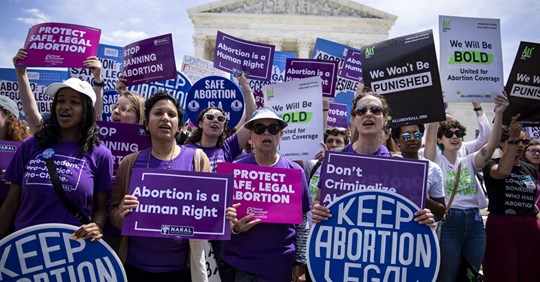
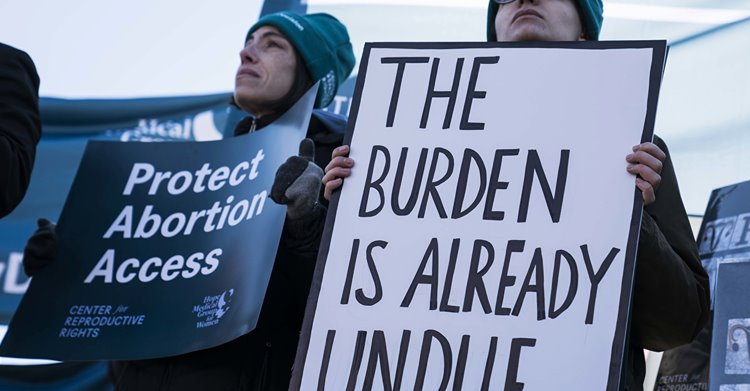
Pro-choice activists holds signs during a rally in front of the U.S. Supreme Court. (Anna Moneymaker/Bloomberg)

Nancy Northup is the president and CEO of the Center for Reproductive Rights.

When the Supreme Court on Monday struck down a Louisiana abortion law designed to shut down clinics, it sent a clear message affirming our constitutional right to abortion.

This should be a pivotal and promising moment for reproductive rights. And yet, I have never been as concerned about the future of abortion accesswhich is being hollowed out by a game of constitutional whack-a-mole. It’s past time for Congress to step in and end it.

Determining whether or when to have a child has a profound impact on a person’s health and life. For this reason, the Constitution protects our personal liberty and dignity to make such decisions for ourselves. But today that right is in peril.

Although we just won the case before the Supreme Court, June Medical Services v. Russo, this is a fight we shouldn’t have needed to wage at all. The Louisiana law at issue in the decision was identical to a Texas law we challenged, and which the Supreme Court struck down in 2016. Because states such as Louisiana continue to defy the Supreme Court’s abortion rulings, we have to go to court again and again and again, with no end in sight.

Relentless state-by-state attacks on abortion are only ratcheting up. Politicians have passed more than 450 state laws restricting abortion access over the past decade. Those laws are pushing abortion access out of reach. Nearly 90 percent of U.S. counties are without a single abortion provider. Six states — Kentucky, Mississippi, Missouri, North Dakota, South Dakota and West Virginia — are down to their last clinic. In 2019, nine states passed brazenly unconstitutional bans on abortion starting at six weeks of pregnancy — before many people know they’re pregnant. And at the height of the coronavirus pandemic, governors and officials of more than 10 states shamelessly took advantage of the crisis and tried to restrict abortion care.

This insidious campaign against abortion access hurts communities of color, young people, rural communities and people living in poverty the most. These restrictions mean that because there are fewer clinics and patients may have to travel considerable distances to reach them, a person’s ability to access abortion care often depends on where they happen to live, how much money they have and whether they can take time off work. This is just wrong. A right is not a right if you can’t exercise it.

It’s time to end this grinding, wasteful state of uncertainty. The Women’s Health Protection Act (WHPA) is the answer.

WHPA takes the Supreme Court’s precedents and solidifies them into a clear federal standard for preserving the constitutional right to abortion and treating abortion for what it is: health care.

The bill creates a federal statutory right for health-care providers to deliver, and for their patients to receive, abortion care free from medically unnecessary limitations and bans. It applies only to those restrictions that single out abortion care and no other comparable medical procedure. If states wouldn’t impose waiting periods or unnecessary protocols on patients seeking colonoscopies; if they wouldn’t limit early, less invasive medical treatment to help patients get care more quickly; and if they wouldn’t require doctors to provide medically dubious counseling for patients seeking those procedures, then they won’t be able to restrict abortion care in these ways under the WHPA.

Congress has taken this kind of corrective action before when abortion rights were under threat: Thirty years ago, during a particularly heightened period of terror, when doctors and clinic workers were murdered, and clinics were being bombed, vandalized, torched and blockaded. Federal action was needed, and in 1994, Congress passed the Freedom of Access to Clinic Entrances Act.

Today, access to abortion services is being blocked through an avalanche of pretextual laws designed to accomplish by the pen what could not be accomplished through brute force: the closure of facilities providing essential reproductive health care to patients in large swaths of the country.

Though the bill would face likely insurmountable hurdles in the current Senate, if the House passes the first proactive federal abortion rights legislation in decades, it would give Americans an opportunity to consider an alternate reality to continue fighting for — one in which basic health care is not constantly under attack.

For nearly half a century, the Supreme Court has continuously affirmed that a woman has the right to make personal decisions about her body, her family and her life. Now Congress must act and pass WHPA to stop these whack-a-mole state attacks, and ensure that the right to abortion first recognized in Roe v. Wade is a reality for people all across the country.

Source: https://www.washingtonpost.com/opinions/2020/06/29/its-time-congress-stop-states-playing-whack-a-mole-with-abortion/?fbclid=IwAR0dU3xmFEK7NJwwvsFZYG_3kmI2oEYsqtGAynpt_O3NuBnKyO4KauiEzK4

Washington — The Supreme Court on Thursday declined to consider a pair of disputes involving abortion restrictions in Chicago and Pennsylvania, leaving intact laws that create buffer zones outside of abortion clinics.

The first case rejected by the high court involves an ordinance in Chicago that makes it illegal for a person within a 50-feet radius from an abortion clinic to come within eight feet of another person “for the purpose of passing a leaflet or handbill, displaying a sign to, or engaging in oral protest, education or counseling.”

The challenge to the Chicago law was brought by four people and two anti-abortion rights groups that engage in sidewalk counseling outside of abortion clinics and argue the ordinance violates the First Amendment.

But a federal district court and the 7th U.S. Circuit Court of Appeals allowed the ordinance to stand, citing a 2000 Supreme Court decision upholding a similar law in Colorado.

Justice Clarence Thomas said he would have granted the request to hear the case.

The second dispute involves an ordinance enacted in the city of Harrisburg, Pennsylvania, that makes it unlawful for a person to “knowingly congregate, patrol, picket or demonstrate in a zone extending 20 feet from any portion of an entrance to, exit from, or driveway of a health care facility.”

As in the case out of Chicago, a group of citizens who engage in sidewalk counseling challenged the law and sought to block enforcement on the grounds the buffer zone violated their First Amendment rights.

The federal district court denied their request to block the law, and the 3rd U.S. Circuit Court of Appeals affirmed the decision.

The Supreme Court’s refusal to take up the two legal battles over the abortion restrictions follows its 5-4 ruling Monday striking down a Louisiana law that required abortion providers to have admitting privileges at nearby hospitals.

Chief Justice John Roberts joined the liberal wing of the bench in invalidating the Louisiana law, citing a 2016 Supreme Court decision striking down a nearly-identical Texas regulation.

The legal battle over the Louisiana abortion restriction was the first involving abortion rights to come before the Supreme Court’s new 5-4 conservative majority, which was cemented with the additions of Justices Neil Gorsuch and Brett Kavanaugh, both appointed by President Trump, to the high court.

In light of its ruling Monday, the Supreme Court tossed out lower court rulings blocking two Indiana laws from taking effect and sent the cases back to the lower courts for further consideration. One of the measures requires a woman to undergo an ultrasound at least 18 hours before an abortion and the second requires parents of minors to be given notice of a court-authorized abortion.

Source: https://www.cbsnews.com/news/supreme-court-abortion-clinic-buffer-zones/?fbclid=IwAR2mlkrYo390REyI9ttFQgfYz3D3O1Q_cZLMbFbxvcPVTb-vbJpNmCiJ4ac

“We’ve been fighting for this for years,” one pro-abortion rights activist said.

Virginia Gov. Ralph Northam (D) speaks during a news conference on June 4, 2020 in Richmond, Va.Zach Gibson / Getty Images file

Virginia’s Reproductive Health Protection Act goes into effect Wednesday, overturning many longstanding abortion restrictions in the state.

“No more will legislators in Richmond — most of whom are men — be telling women what they should and should not be doing with their bodies,” Gov. Ralph Northam, a Democrat, said in a statement.

For the first time in a generation, Virginia Democrats took control of the General Assembly last year and they have been active in pushing through changes.

The new law repeals regulations that require those seeking an abortion to undergo state-mandated counseling, a mandatory ultrasound and a 24-hour waiting period prior to the procedure.

It also removes the requirement that health centers performing five or more abortions a month be classified as hospitals. In addition, the act allows nurse practitioners to provide abortions within the first trimester of pregnancy, whereas previously, only physicians could provide care.

“We’ve been fighting for this for years,” said Tarina Keene, executive director of NARAL Pro-Choice Virginia. “The new law rolls back years of egregious, politically motivated, medically unnecessary anti-abortion laws that were simply put in place to shut off a woman’s access to abortion care.”

According to NARAL Pro-Choice Virginia, 170 restrictive abortion bills and regulations have been introduced in the state since 2011.

But Kathy Byron, a Republican member of the state’s House of Delegates, said that the legislation is a major setback.

“The law sacrifices the health, safety, and rights of pregnant women, prioritizing the interests of the abortion industry over those of Virginia women,” she said.

“What the pro-abortion majority in our General Assembly advocated for this year was not something that will benefit women looking for information regarding their pregnancy, but rather an action taken to protect the abortionists,” said Olivia Gans Turner, president of the Virginia Society for Human Life.

However, Dr. Shanthi Ramesh, an OB-GYN in Virginia, said that the law does not negatively impact a pregnant person’s health, instead it allows medical professionals to do what’s best for the patient.

“The decision about if and when to perform an ultrasound, the counseling before an abortion and what type of abortion someone has are all medical decisions,” she said. “It’s using the expertise of the provider and the patient’s unique needs to make those decisions.”

The new law marks a turning point for access to abortion care in the state, advocates said.

“It makes Virginia the first state in the south to proactively protect a woman’s access to abortion care and reproductive health,” said state Sen. Jennifer McClellan, a Democrat who sponsored the bill. “We want to be proactive in protecting the doctor-patient relationship and a woman’s access to care.”

Jamie Lockhart, executive director at Planned Parenthood Advocates of Virginia, agreed and said that rural and low-income communities have felt the brunt of abortion restrictions for too long.

“It’s tragic how Virginia conservative leaders for years put all these obstacles in place, likely knowing that they would impact Virginians who could least afford to go through those obstacles,” she said.

Since health centers, performing five or more abortions a month, are no longer under hospital regulations, Lockhart expects that more centers in rural areas and across the state will begin to provide abortion services.

According to the Guttmacher Institute, in 2017, 93 percent of Virginia counties had no clinics that provided abortions, and 80 percent of women in Virginia lived in those counties.

“I have driven from Richmond to Virginia Beach to make sure someone had a ride from an appointment, because they had to be discharged to someone in order to have that procedure,” said Ayé Johnson, community and volunteer engagement accomplice at the Richmond Reproductive Freedom Project.

She said that for most people, traveling more than an hour away to receive care would require additional planning and resources.

Johnson added that the abortion fund anticipates an influx of patients traveling to Virginia from neighboring states as a result of the legislation taking effect.

The law establishes Virginia as a safe haven for abortion care, not just for Virginians, but for those nearby, according to Keene.

“We’ve already taken our first step, and we obviously have a long way to go, but we are in it for the long haul,” she said.

Source: https://www.nbcnews.com/politics/politics-news/easing-abortion-restrictions-virginia-s-new-democratic-majority-takes-effect-n1232671

The headlines this week that almost 7,000 abortions had been carried out in Ireland last year were both a shock and a relief.

After all haven’t we been reading for decades of how thousands of Irish women had travelled to the UK to get abortions because they were not available in their home country. The difference now is these terminations of pregnancy are taking place on home turf. The vast majority of women do not have to book an airline ticket and go through the horrors of getting an abortion in a foreign country.

It is two years now since we made the historic decision to vote so decisively — more than 66% of us — to allow abortion in Ireland. The system has settled in, as it were, and the report by the Minister for Health on abortion notifications in 2019 shows that under new legislation, which allowed legal terminations of pregnancy, 6,666 abortions were carried out in 2019.

In the run-up to the referendum campaign to repeal the Eighth Amendment the then health minister Simon Harris — who leaves the Department of Health with a patchy record in some areas, but success on the issues of the Eighth Amendment, and his handling of the pandemic — stood in the Dáil and read into the record the numbers of Irish women who’d travelled to the UK for abortions in 2016. He named each county and gave the relevant figure for each place — bringing home the fact that it was an issue that affected women in every town and village, women that everyone knew.

“These are not faceless women. They are our friends and neighbours, sisters, cousins, mothers, aunts, wives,” he said.

The publication of this first annual report since those changes in law, means we can now look at a map of Ireland and see that, for instance, 606 women in Cork had abortions last year; 2,493 in Dublin; 48 in Kerry; 213 in Louth; 280 in Galway, and so on.

You can have an abortion now in Ireland if your pregnancy is less than 12 weeks. You do not have to pay for it. If it is less than nine weeks you can take the abortion pill which involves two consultations and a three-day waiting period in between. Later than that in the pregnancy involves getting a surgical abortion.

The vast majority of those abortions, 98%, took place in early pregnancy at less than 12 weeks gestation. We were not told whether they were performed in hospitals or in the community, but logic dictates that at this early stage of pregnancy, most, if not all, came about through use of the abortion pill. In the very few cases where it does not work a woman then needs to undergo a surgical abortion.

For huge swathes of those who voted yes there will have been little joy in seeing the number of abortions that took place. This is not a happy subject. More than most countries we had cultural and religious baggage that meant jumping that hurdle to remove the Eighth Amendment in the referendum was a massive step. People wanted solutions. We made emotional trade-offs, but decided ultimately to be caring and humane. So many of us knew women who’d had to travel for abortions and understood the pain that involved.

So if you look askance at those 6,666 abortions you may need to remind yourself you voted yes at that time for the women in your life that you loved and cared for, and did not want to see them having to undergo undue suffering by travelling to another country at a time when they were especially vulnerable. There are also a significant number of people who are simply pro-choice who voted yes, and for whom the right to an abortion is just an automatic entitlement for women who must be in charge of their own reproductive rights.

During the referendum campaign Irish people listened to these women and their stories, some of them heartbreaking. They told of their experiences of having “to travel”. But they also listened very closely to doctors who spoke in terms of women needing care in their own country.

They are two exceedingly different subjects, yet the common ground between Covid-19 and Ireland’s abortion referendum, are the exceedingly high levels of trust that Irish people had and continue to have, in the medical profession.

It has been interesting to see how the high level of trust in doctors has been so much to the fore during these last few months of the pandemic. It is hardly unusual for people to want medical and scientific advice at such a time, but opinion polling has repeatedly shown very high levels of approval for the advice that has been dispensed and observed. Similarly the manner in which the medical profession stepped up during the abortion referendum, carrying consistent messaging, ultimately ensured its success.

The pandemic also brought to the fore what a horror story it would have been for women if the law had not been changed and no one would have been able to travel for a termination over such a long period of time. According to An Garda Síochána there was a 25% increase in reports of domestic violence during lockdown. There is no doubt but there will be women included in those figures who will have become pregnant against their will, who would not have been able to travel for an abortion either, but could now get one at home.

Following the publication of the report executive director of Amnesty International Ireland, Colm O’Gorman, pointed out there remain some serious gaps in the legislation. Statistics published by the UK’s department of health and social care in early June revealed that 375 women and girls travelled from Ireland to access abortion services in England and Wales in 2019.

“We know that women’s health and wellbeing are harmed when they have to travel for abortion, and people voted to end that very harm.” Next year we are due to have a review of our abortion laws and how they operate. Hopefully ahead of that we will have legislation for exclusion zones outside hospitals and other healthcare centres where anti-abortion protesters gather to hassle and intimidate women.

Abortion will never be an easy subject to discuss. But we can hold up our heads that we finally faced it head on two years ago. This week’s figures may not rest easily with many people, but the availability of abortion to Irish citizens is a sign of a mature society.

Source: https://rewire.news/article/2020/07/01/one-of-these-cases-could-be-the-next-big-fight-for-abortion-rights/

In the months leading up to Monday’s Supreme Court decision in June Medical Services v. Russo, which overturned a Louisiana law requiring abortion providers to have admitting privileges with a nearby hospital, media outlets largely covered Louisiana as they did the near-identical Supreme Court case from Texas four years prior. They framed it as a “potentially catastrophic decision” that would have “massive consequences” for the future of abortion in the United States.
While this was certainly true, the case was important for more reasons than its potential impact on future access nationwide. If the law had been upheld, it would have had an immediate and disastrous impact on low-income Black women across Louisiana, forcing them to seek abortion care in neighboring states, some of which are are actively battling abortion bans.
Treating cases like June Medical Services as a harbinger for what’s to come also erases a glaring and uncomfortable fact: For people seeking abortion care in the American South, the future so many fear is already a reality, and has been for a long time. Just as the U.S.-Mexico borderlands operate as a “Constitution-free zone” where the Constitution technically applies but is subverted and debased, the American South operates in practice as a Roe-free zone. Kamyon Conner, the executive director of the Texas Equal Access (TEA) Fund, an abortion fund that provides assistance to low-income people in the northern region of Texas, told Prism she would never downplay the importance of Roe v. Wade, the 1973 Supreme Court case that affirmed abortion is a constitutional right.
“But what good is Roe v. Wade to the South if people can’t access the abortion care they need?” Conner asked.

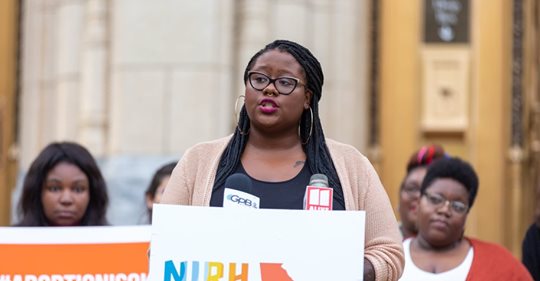
Kamyon Conner, executive director of the Texas Equal Access Fund.
In the red state/blue state binary that is American politics, the American South is regularly framed as backwards, often because of its strict anti-abortion laws. Conner says she finds that image particularly insulting. The TEA Fund’s executive director said she wants people outside of the region to understand that the South is not a monolith and it is not merely the product of the region’s right-wing lawmakers. The area is home to a vast network of BIPOC leaders rooted in reproductive justice who successfully help people access abortion in states notoriously hostile to access.
Abortion funds: a model for how to move forward
Abortion funds across the South offer a model for how to continue serving communities in need, even though the attacks on abortion access will surely continue after yesterday’s decision. The TEA Fund is one of several BIPOC-led abortion funds in the South, and one of an estimated 24 BIPOC-led abortion funds that are a part of the National Network of Abortion Funds. Broadly, abortion funds remove financial and logistical barriers to abortion access by working with clinics to help pay for abortions. Many also offer other forms of support, including transportation, lodging, child care, translation, and sometimes even doula services.
As an abortion fund in Texas, the TEA Fund has been through it—not just battling and maneuvering through anti-choice state laws, pivotal Supreme Court cases, and “sanctuary city for the unborn” ordinances that create hyper-local barriers to abortion care, but also working to address systemic inequities through advocacy, organizing, and community building.
“Our work is intersectional very purposefully—because it has to be. We don’t have the luxury to just provide direct services, to just do advocacy, to just provide practical support like rides, shelter, food, and lodging,” Conner said. “Some abortion funds do work around immigration and Indigenous rights. Some are doing environmental work, racial justice work, decriminalization work. They are doing abolitionist work. They are advocating for sex workers and uplifitng the LGBTQIA+ community. This is because all of the people impacted by these systems have abortions too.”
Mars Earle, the director of engagement at the Carolina Abortion Fund, said that a useful way for people to understand the power of abortion funds in this moment is to consider how crucial mutual aid has become during the COVID-19 pandemic. As the federal government floundered in its response to the coronavirus, community coalitions formed across the U.S., using inventive and resourceful ways to get aid to those most in need of masks, food, and other necessities. Abortion funds are mutual aid, Earle said: “they are systems of care and support.”
“In my experience, abortion funds in the South strive to not be transactional. Part of that is because of the layers of barriers and who is impacted, but it’s also just not how the work is approached. This isn’t about paying down debt. It is a practical thing, but it’s not one and done,” Mars said. “This is very much about relationship-building, consciousness-shifting, and emotional support. That is so much of the work that we do and as people become more and more alarmed about potential repercussions in the Louisiana case, I think the community care and mutual aid we strive to provide is something that is powerful to consider.”
In an ideal world, according to advocates who spoke to Prism, abortion funds wouldn’t need to exist. In the meantime, these funds serve as a crucial stopgap to unjust anti-abortion laws intended to strip people of their constitutional rights, agency, and power.
Building collective power in the face of opposition
Abortion bans aren’t just about abortion, wrote Alicia Garza, president of the Black Futures Lab and the co-founder of the Movement for Black Lives, last year after a series of abortion bans pummeled Southern states that have high concentrations of Black and low-income people. They are about power: who has it, who doesn’t, and who wants to keep whom from gaining it. In the face of these dynamics, Garza wrote that southerners struggle “to be powerful against an entrenched network of people in power who don’t necessarily represent or even reflect their own constituents.”
In the piece, Garza pointed to Monica Simpson, the executive director of the groundbreaking reproductive justice organization SisterSong, as an example of a pivotal leader in the South. The goal of the Atlanta, Georgia-based organization is to improve the institutional policies and systems that impact the reproductive lives of marginalized communities. Simpson’s work is a continuation of a long legacy of “intersectional Southern activism” too often erased and infrequently deferred to. In May of last year when the Alabama Senate passed its abortion ban, Simpson wrote that while Southern history is steeped in injustice, it has borne a “resilience and a resistance that we should look to as a model for how to move forward.”
While legislative and political attacks are not new and certainly not unfamiliar to reproductive justice advocates in the South—even during a pandemic, as the Tennessee legislature just illustrated by passing a covert, middle of the night anti-abortion bill—the fight can be exhausting, said Kwajelyn Jackson, the executive director of the Feminist Women’s Health Center in Atlanta, Georgia. Jackson’s clinic has been central to the fight against Georgia’s abortion ban signed last year by Gov. Brian Kemp. The ban was set to go into effect on the first day of this year, but a judge blocked the law while it plays out in court. Oral arguments in the case began June 15.

Kwajelyn Jackson, the executive director of the Feminist Women’s Health Center in Atlanta, Georgia.
Unlike other states in the region, Georgia has had a lot of success in holding back anti-abortion legislation, but Jackson said she is deeply concerned by the way the anti-abortion movement is shifting, concentrating its efforts on the courts and in a more recent development, co-opting the language of the Movement for Black Lives as part of its targeted harassment of the Feminist Women’s Health Center, where 50% of patients are Black. But Jackson says she doesn’t want to be anywhere else.
“People not in this region may not understand this, but there are real benefits to working in Georgia and other areas of the South,” Jackson said. “We are coordinated and we are organized because reproductive justice really blossomed here. Black women, queer folks, and young people are working in coalition here and it allows us to work across issues and build collective power.”
‘This is our legacy’
One needs to look no further than Alabama for an example of collective power-building. Exactly one year after Alabama passed its own abortion ban (which, like Georgia’s, is temporarily blocked), the Yellowhammer Fund took an unprecedented step: It purchased the West Alabama Women’s Center, which provides more than half the abortions in the state and serves people across the Southeast. As Becca Andrews reported for Mother Jones, abortion funds like the Yellowhammer Fund have traditionally operated separately from clinics. “Consolidating their mission,” Andrews wrote, could “shore up the precarious network of access in the region and make abortion care available to low-income folks.”

Amanda Reyes, executive director of the Yellowhammer Fund, dellivers school supplies to Alabama children.
Purchasing an abortion clinic in a state that instituted an abortion ban may seem counterintuitive to some, but the Yellowhammer Fund’s executive director, Amanda Reyes, told Prism there is never a good time to open an abortion clinic. According to Reyes, one of the primary reasons the clinic’s former owner sold it to the Yellowhammer Fund is because she knew that no matter what came up through the courts, what the Alabama legislature tried to pass, or what happens in the June Medical Services case, the Yellowhammer Fund “would fight to keep the clinic open and accessible in Alabama.
“We focus on what we can control. We can use our collective resources and networks to make sure people in our community get the care they need. When you prioritize getting care for your community, that’s a radical perspective,” Reyes said. “It’s easy to scapegoat the South for all of these anti-choice laws, but they don’t come from the people. [Abortion funds] are focused on the people in the country who are the most marginalized. No matter what changes, we need to keep focusing on making sure the people in our communities who need abortions can get them without being criminalized.”
This is something that speaks directly to the mission of El Paso, Texas’ West Fund, an abortion fund in West Texas that advocates for abortions without borders. Alexis Andrea, the helpline manager at the West Fund, told Prism that people seeking abortion care in this heavily militarized portion of the state are not only subjected to Texas’ anti-abortion and anti-immigrant laws, but they are also navigating a “medical desert.” There is only one full-time provider in the region, and they don’t work with abortion funds.
“Operating in a border town gives you a completely different perspective when it comes to overcoming barriers, and it really teaches you about resilience and resourcefulness,” Andrea said. “People maybe don’t realize that if we wanted to send patients to other clinics in Texas, it would take over eight hours to get there from where we are. It’s a burden and an unrealistic expectation in a low-income city, so we’ve had to develop other networks and we’ve developed relationships with people in New Mexico, which is only four hours away.”

Members of Indigenous Women Rising.
In the West Fund’s network is Indigenous Women Rising (IWR), an Indigenous-led and centered reproductive justice collective on Tiwa land that funds abortions exclusively for Indigenous people. IWR organizer Nicole Martin told Prism that one of the most important characteristics of abortion funds is how nimble they are and the ways they can adjust to meet the needs of various Indigenous communities. While their abortion fund is based in the Southwest, IWR funds abortions across the country, including the South, stepping in wherever Indigenous people are trying to access care.
“We saw that there really wasn’t any cultural sensitivity for Indigenous people when it comes to abortion and we really wanted to respond to that with our own abortion fund,” Martin said. “It’s the cultural sensitivity and awareness that we can really offer because when it comes to abortion, many people in our communities will not feel comfortable talking to someone who is not familiar with their spirituality or the teachings they were brought up with. Responding to the needs and respecting the beliefs of our callers’ communities are really important to us.”
Before the Supreme Court’s decision, the abortion fund Access Reproductive Care (ARC)-Southeast was gearing up to support the needs of communities across Alabama, Florida, Georgia, Mississippi, South Carolina, and Georgia. ARC-Southeast’s co-founder and co-director, Oriaku Njoku, assumed that if the Supreme Court upheld the law there would be a domino effect, forcing people to leave Louisiana to access abortion care in neighboring states. But Njoku told Prism that no matter what happened in the June Medical Services case, ARC-Southeast could “not operate in fear.”
While Supreme Court cases are important, Njoku said, they cannot be treated as the end-all, be-all for abortion access. ARC-Southeast was founded by three queer Black women who met working at the same clinic, seeing firsthand the barriers that BIPOC communities experienced trying to access care. The abortion fund’s founders committed to doing everything in their power to help people access abortion, which continues to be the fund’s primary mission.
“No matter the ebbs and flows of the courts, we are steadfast in our commitment,” Njoku said. “Abortion is still legal across the United States, but legality is not the same as accessibility. You can still get an abortion in Georgia and Alabama right now, but is it accessible? That’s why I say that while these cases are important, they can’t be it. Especially not here [in the South].”
Working in a region hostile to abortion access does not mean you “shrink yourself,” said Quita Tinsley, ARC-Southeast’s co-director; it means “you embrace big, bold ideas.” An example of this is the groundswell of opposition ARC-Southeast created with other reproductive justice advocates as part of #PissedOffPeaches, a movement that took a multipronged approach to fighting Georgia’s abortion ban. ARC-Southeast organized against the ban as various industries boycotted the state because of it.
To Tinsley, it made little sense to abandon Georgia residents at a time when the most marginalized among them would face insurmountable barriers to accessing necessary health care, but people across the state are working in unison with reproductive justice advocates to fight back. Tinsley says this is yet another example of the “radical work” being done in the South, work that rarely gets highlighted in reporting that purposefully or inadvertently paints the South as a regressive place, especially as the country awaited the decision in the June Medical Services case.
“I’ve seen more Black women and femme leadership in the south than I’ve seen in other regions of the country. This is a place steeped in resistance, and so of course the way the South is talked about doesn’t resonate with me,” Tinsley said. “You know what comes to mind for me when I think of the south? Harriet Tubman in the woods with a gun leading Black folks to freedom. How are you going to paint this as ‘Trump country’ when this is our legacy?”
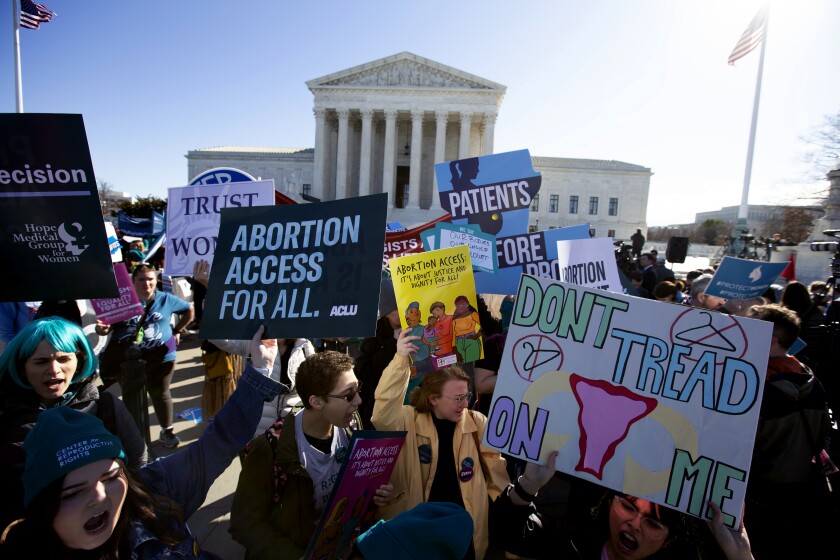
Abortion rights demonstrators and anti-abortion demonstrators rally outside the U.S. Supreme Court

Demonstrators rallied outside the Supreme Court on March 4 when the court heard a case against a Louisiana abortion case. (Jose Luis Magana / Associated Press)

The Supreme Court struck down an onerous and unnecessary Louisiana restriction on abortion, offering a striking rebuke to the state for passing the same version of a law the high court ruled was unconstitutional four years ago.

In a 5-4 decision in June Medical Services L.L.C. vs. Russo, the court found that the Louisiana law requiring doctors who perform abortions to have admitting privileges at nearby hospitals provided no health benefits to women and would drastically curtail access to the procedure, most likely leaving one clinic and one doctor in the state to provide abortions.

Justice Stephen G. Breyer, writing the principal opinion, made it clear in his opening sentence that the Louisiana law was “almost word-for-word identical” to the Texas law that the court struck down in the Whole Woman’s Health vs. Hellerstedt case four years ago.

As in the Texas case, the tribunal upheld a lower court’s finding that requiring hospital admitting privileges would make it impossible for many women and arduous for most others to obtain a safe, legal abortion in Louisiana — and would not make an already very safe procedure any safer. According to a comprehensive review of published studies, office-based abortion clinics reported a less than 0.5% risk of hospitalization after a first-trimester abortion, the most common type.

However, there was plenty of evidence that getting admitting privileges can be difficult. Hospitals denied doctors privileges for reasons having nothing to do with their skills providing outpatient abortions. The court also found that the vetting for privileges added nothing to the vetting already conducted by the State Board of Medical Examiners.

The Supreme Court has, yet again, made clear that it rejects the pretext that these laws are intended to protect women’s health. Nothing could be farther from the truth. All these laws do — and the court has said this — is make it profoundly difficult to get an extremely safe and legal procedure. And that burden of difficulty falls hardest on those with the least means — poor women and women of color and those who live in rural areas.

You would think one ruling of the Supreme Court in 2016 would be enough to discourage abortion opponents from passing a law identical to the one the court threw out. But of course they were hoping that the court in 2020 with two new conservative justices would see the admitting privileges law differently. In fact, they did. Justices Neil M. Gorsuch and Brett M. Kavanaugh dissented from the majority.

The surprise (somewhat) was conservative Chief Justice John G. Roberts Jr. siding with the liberal justices even though he did not join their opinion. He made it clear, in his separate opinion, that he never supported the decision in the original Texas case, but that “the Louisiana law imposes a burden on access to abortion just as severe as that imposed by the Texas law, for the same reasons.”

Roberts is no champion of abortion rights, but he is a stickler for precedent and he noted that Louisiana’s law could not stand given the Texas decision. And he did recognize the burdens that women face in states with restrictive abortion laws. (Louisiana’s are among the most restrictive.) And that was heartening at a time when abortion rights are still under attack.

Now that the Supreme Court has twice invalidated laws about admitting privileges, maybe abortion opponents will give up on this ruse.

But these rulings are unlikely to stop what Nancy Northup of the Center for Reproductive Rights, whose lawyers argued the Louisiana case, calls an “avalanche” of anti-abortion laws.

It’s appalling that nearly 50 years since the passage of Roe vs. Wade guaranteed a right to a safe, legal abortion — and after landmark Supreme Court cases in 1992 and 2016 reaffirmed that decision — women are still fighting to preserve their legal right to an abortion. The Women’s Health Protection Act would guarantee a right to abortion and bar the onerous restrictions various states have placed on providers and patients. But that faces an uphill climb in Congress. We expect the courts everywhere to stop these attempts in their tracks — and that is exactly what the Supreme Court did Tuesday.

Source: https://www.latimes.com/opinion/story/2020-06-29/abortion-decision-supreme-court-louisiana?fbclid=IwAR1-0FHVrBquB4GHQrif5Gt_8JGulV_DrGcMzqHgjjW1tQ6X-gO3UNt-6z0

The Supreme Court upheld the constitutional right to abortion Monday, rejecting a state’s attempts to limit access to the procedure for the second time in four years.

Demonstrators hold banners outside of the Supreme Court during oral arguments in the June Medical Services v. Russo case, March 4.

The Supreme Court upheld the constitutional right to abortion Monday, rejecting a state’s attempts to limit access to the procedure for the second time in four years.

The decision strikes down a 2014 Louisiana law that required physicians performing abortions at clinics to have admitting privileges at a nearby hospital. Justice Stephen Breyer, who wrote the deciding opinion, noted that the law at issue was identical to the one the court considered and struck down in Texas in 2016.

Attorneys for the state argued in front of the justices in March that the law made abortions safer because it ensured that if anything went wrong during an abortion procedure, the patient could be rushed to a nearby hospital.

The Center for Reproductive Rights sued and its attorneys countered that the law was unnecessary — hospitals will admit anyone with a medical emergency and medical complications in first trimester abortions are exceedingly rare. They also argued that obtaining admitting privileges is difficult, and that the law is really designed to make doctors unable to perform abortions and to close abortion clinics in the state.

In a rare move, there is no majority opinion in this case. Chief Justice John Roberts sided with the more liberal justices on the court to strike down the law, but noted that he thinks the precedent that Monday’s decision is based on was wrongly decided. Still, Roberts wrote, he must treat the Louisiana Law the same way the court treated the Texas law in 2016.

Monday’s case, called June Medical Services v. Russo, is nearly identical to the 2016 case Whole Woman’s Health v. Hellerstedt, over a similar law in Texas which caused half of the state’s clinics to close. In that case, the Supreme Court struck down the law which had already gone into effect. In the wake of Justice Antonin Scalia’s death, the 2016 vote was 5–3 with Roberts dissenting.

The 2016 decision reaffirmed the “undue burden standard” — the idea that it is unconstitutional to pass laws creating major barriers to abortion access — a benchmark used by the Supreme Court in every case examining abortion regulations since it was established in the 1992 case Planned Parenthood v. Casey.

Monday’s Supreme Court ruling re-emphasizes the power of this standard.

In a statement following the release of the decision, Nancy Northup, president of the Center for Reproductive Rights, which argued the case, wrote that her organization was “relieved” but concerned about future cases.

“We’re relieved that the Louisiana law has been blocked today but we’re concerned about tomorrow. With this win, the clinics in Louisiana can stay open to serve the one million women of reproductive age in the state,” the statement reads. “But the Court’s decision could embolden states to pass even more restrictive laws when clarity is needed if abortion rights are to be protected.”

In his opinion striking down the Louisiana law, Breyer wrote that in Whole Woman’s Health v. Hellerstedt, the court held that “[u]nnecessary health regulations that have the purpose or effect of presenting a substantial obstacle to a woman seeking an abortion impose an undue burden on the right’ and are therefore ‘constitutionally invalid.’”

Louisiana’s law, Breyer wrote, “almost word-for-word identical to Texas’ admitting-privileges law,” and that the District Court’s findings in the Louisiana case “mirror those made in Whole Woman’s Health in every relevant respect and require the same result.”

“We consequently hold that the Louisiana statute is unconstitutional,” Breyer wrote.

Breyer was joined by Justices Ruth Bader Ginsberg, Sonia Sotomayor, and Elena Kagan, while Justices Clarence Thomas, Samuel Alito, Neil Gorsuch, and Brett Kavanaugh joined the dissent.

In his separate, concurring opinion, Roberts wrote that he joined the dissent in Whole Woman’s Health and still believes today that the Texas case was wrongly decided.

“The question today however is not whether Whole Woman’s Health was right or wrong, but whether to adhere to it in deciding the present case,” he continued, concluding by the end of his opinion that the legal doctrine of stare decisis requires the Supreme Court, “absent special circumstances, to treat cases alike.”

“The Louisiana law imposes a burden on access to abortion just as severe as that imposed by the Texas law, for the same reasons,” Roberts wrote. “Therefore Louisiana’s law cannot stand under our precedents.”

On a phone call with the press Monday afternoon, lawyers for the Center for Reproductive Rights said that while the decision was “absolutely a victory,” Roberts’ opinion “muddied the waters” and opened the door for more abortion-restricting laws to be passed, and more litigation over abortion to come before the court.

“The opinion is concerning to us, but ultimately the court did uphold the rule of law,” Julie Rikelman, who argued the case before the Supreme Court, said.

One argument that Louisiana made before the court that Texas did not is that third party plaintiffs like abortion clinics should not be able to file lawsuits on behalf of their patients. This is the way most abortion cases are fought in court. While third parties are not typically allowed to sue on behalf of others, groups like the Center for Reproductive Rights, Planned Parenthood, and others have often brought cases against anti-abortion regulations on behalf of their clients under a standard called “third-party standing” — in which plaintiffs have a “close relationship” with the damaged parties. The precedent of doctors suing on behalf of their patients goes back to the 1800s.

In response to this claim, Breyer wrote that he believed the state made this point too late. Breyer wrote that the state had already argued this case through several courts for years without arguing that the case was invalid because the clinic should not be able to sue on behalf of its patients.

“And even if the State had merely forfeited its objection by failing to raise it at any point over the last five years, we would not now undo all that has come before on that basis,” Breyer added. “We have long permitted abortion providers to invoke the rights of their actual or potential patients in challenges to abortion-related regulations.”

The court rejected the state’s claims, allowing clinics and other medical institutions to continue to be able to sue on behalf of their patients.

If the court had sided with Louisiana, the decision could have applied to lawsuits unrelated to abortion and uprooted many cases currently being argued across the country.

Justice Thomas wrote the dissenting opinion, writing that the majority of the court “perpetuates its ill-founded abortion jurisprudence by enjoining a perfectly legitimate state law and doing so without jurisdiction.”

However, Thomas focused his dissent on the majority’s holding that clinics should be able to sue on behalf of their patients.

“This suit was brought by abortionists and abortion clinics. Their sole claim before this Court is that Louisiana’s law violates the purported substantive due process right of a woman to abort her unborn child,” Thomas wrote. “But they concede that this right does not belong to them, and they seek to vindicate no private rights of their own.”

Article III of the US Constitution, which deals with the rules of judicial power, is generally interpreted to hold that third parties are not legally allowed to file lawsuits on behalf of other people. However, if those parties are found to have “substantial interest” in the case, an exception can be made. In past Supreme Court decisions, the court has found that this exception applies to cases where the plaintiffs have a “close relationship” with the damaged parties, and that a doctor–patient relationship is a close one.

Thomas argued against this precedent applying to Louisiana’s case, even going so far as to say that the Supreme Court lacks “jurisdiction to decide these cases.”

“When a private plaintiff seeks to vindicate someone else’s legal injury, he has no private right of his own genuinely at stake in the litigation,” Thomas wrote. “Even if the plaintiff has suffered damages as a result of another’s legal injury, he has no standing to challenge a law that does not violate his own private rights.”

Justice Samuel Alito wrote a separate dissent joined by Gorsuch. His dissent concurred with Thomas in part, and a separate dissent written by Kavanaugh also partially agreed with Alito’s dissent.

“The majority bills today’s decision as a facsimile of Whole Woman’s Health v. Hellerstedt, … and it’s true they have something in common,” Alito wrote. “In both, the abortion right recognized in this Court’s decisions is used like a bulldozer to flatten legal rules that stand in the way.”

Alito argued that, outside of the law’s bulldozer attitude, June Medical is “very different” from Whole Woman’s Health.

“The decision in Whole Woman’s Health was not based on the face of the Texas statute, but on an empirical question, namely, the effect of the statute on access to abortion in that State,” Alito wrote. “There is no reason to think that a law requiring admitting privileges will necessarily have the same effect in every state.”

Alito’s opinion stated that the Louisiana law is important, and different from Texas’, as it protects patients from “lax practices” at some of Louisiana’s abortion clinics.

Monday’s decision will not be the last of this year’s rulings on reproductive rights. The court also heard two combined cases via video chat in May about the Trump administration’s rules granting employers and universities the ability to refuse to provide birth control coverage for their employees for religious or moral reasons.

The cases, Little Sisters of the Poor v. Pennsylvania and Trump v. Pennsylvania, examined challenges to an Obama administration-era rule requiring employers to provide insurance coverage for contraception to their employees, or to apply for an exemption to have that coverage taken over by another entity.

Source: https://www.buzzfeednews.com/article/emaoconnor/supreme-court-upholds-abortion-rights-strikes-louisiana-law?ref=bfnsplash&fbclid=IwAR0eiDEuUxWjCz5ToNgosAFSIfA5wIRjdJSEwQfT8PW3pRElYXC75zb-8ew

The Women’s Health Protection Act would protect abortion access from bans and burdensome restrictions.

Monday’s Supreme Court ruling is an important win, but we need federal action to restore and protect access to abortion across the country—like the Women’s Health Protection Act, which was introduced in May 2019 and co-sponsored by Sen. Kirsten Gillibrand (D-NY). Andrew Caballero-Reynolds/AFP via Getty Images

Many of us had been nervously anticipating this moment. On Monday, the U.S. Supreme Court handed down a 5-4 decision on abortion rights, striking down a highly restrictive Louisiana law intended to shut down abortion clinics in the state. This outcome is a big relief, and an important win for the people of Louisiana.

Justice Breyer’s opinion is a rewarding read for anyone who cares about facts and evidence. It refutes false claims by the anti-abortion politicians and activists that had imposed this law, calling them out on the fact that this restriction has no benefits for patient health and only served to shut down clinics in Louisiana.

So let’s celebrate, and offer our thanks and gratitude to the Louisiana abortion providers and their allies who took this case to the Supreme Court and earned this major victory.

At the same time, we should not be under any illusion that the future of abortion rights is secure. Decades of history and evidence, including the more than 1,200 restrictions states have enacted since the Roe v. Wade decision in 1973, leave no doubt about the lengths to which anti-abortion activists will go to push their coercive agenda. The result: Our experts at the Guttmacher Institute classify 29 states as “hostile” to abortion rights based on the large number of restrictions they have enacted, with almost six out of every ten U.S. women of reproductive age (or 40 million) living in one of these states.

Every day, these policies stand between pregnant people and the abortion care they seek. For instance, the average one-way driving distance to an abortion clinic for a woman of reproductive age in Louisiana is 41 miles. While attempts to shut down the remaining clinics in the state have failed, at least for now, it’s chilling to know that the average distance would increase to 172 miles (or more than four times as far) if patients were forced to travel out-of-state to get to the nearest abortion clinic.

Even in the absence of a pandemic, the thicket of abortion restrictions means many abortion patients struggle to get the care they need. This includes navigating intentionally burdensome requirements that serve no medical purpose, as well as coming up with the money to pay for the procedure. These difficulties—taking time off work, securing childcare, finding the money to pay for all of this—is compounded when restrictions lead to clinic closures and women are forced to travel longer distances, or even have to go to a neighboring state.

That’s why abortion restrictions are a fundamental violation of human rights. And these coercive policies disproportionately harm Black and brown communities that face overlapping oppressive policies and structural racism.

The onslaught of restrictions needs to stop. Abortion is essential, time-sensitive health care. When someone decides to get an abortion they should be able to get affordable, accessible, and compassionate care.

It’s on all of us to make this right a reality for all—and many have already take action. Last year, nine states took major steps to repeal restrictions or to protect and expand access, while governors in another five states vetoed abortion restrictions passed by the state legislature. More states should follow suit, and we have laid out a host of ways they can do so. This includes affirming the right to abortion, providing insurance coverage for abortion care, expanding online and telehealth access, and promoting policies and practices that support individuals who self-manage their abortions.

States stepping up is critical, but not all states will do so, and abortion access should not depend on your ZIP code. That’s why we need federal action to restore and protect access to abortion across the whole country—and Congress has the tools it needs at its fingertips. The Women’s Health Protection Act is a federal bill that would protect abortion access from bans and burdensome restrictions like the Louisiana admitting privileges law.

Congress must also take action to ensure people can afford the care they need by repealing the discriminatory Hyde Amendment and related restrictions. Restoring insurance coverage of abortion for everyone insured through Medicaid and other federal programs is a critical step toward dismantling structural barriers and systemic racism with respect to access to abortion care.

In many ways, 2020 is a clarifying moment, where all of us are called upon to stand against injustice, racism, and sexist oppression. So even as we celebrate that the Supreme Court struck down Louisiana’s terrible law, we must not let down our guard. It will take every one of us to carry forward the fight for reproductive freedom and bodily autonomy for all.

Source: https://rewire.news/article/2020/06/30/how-congress-can-immediately-seize-on-mondays-abortion-rights-win/