The Senate GOP’s unconstitutional 20-week ban was always destined to fail, but anti-choice advocates and their allies in Congress pushed ahead for the sake of politics.

Monday evening’s failed vote on an unconstitutional 20-week abortion ban was part of a coordinated effort between congressional Republicans and their far-right base to try to set up vulnerable Democrats in red states to lose in the 2018 midterm elections. Their strategy, however, could just as well backfire.

A combination of new polling, GOP vulnerabilities, and longstanding legislative and judicial backstops reveals a political reality at odds with the wisdom of these tactics.

The GOP’s scuttled legislation prohibited abortion at 20 weeks “post-fertilization,” or 22 weeks into the medically accepted definition of a pregnancy, in a ploy to legitimize junk science.

Legislation without unanimous consent requires an initial 60 votes in the U.S. Senate to bypass the threat of a filibuster, or unlimited debate on an issue. (Remember Democratic Sen. Chris Murphy and his 15-hour hold over the Senate floor over gun control back in 2016? That was a filibuster.)

Senate Majority Leader Mitch McConnell (R-KY) no doubt knew he didn’t have enough votes to pass a 20-week abortion ban, as was the case in 2015 when he brought a similar ban to the floor even though President Barack Obama had threatened to veto it. Once again, the vote was always meant to be primarily about politics, not policy—this time forcing several Senate Democrats from red states to go on the record about an issue that abortion foes have done their best to vilify.

Under a GOP-held U.S. House of Representatives where only a simple majority of votes is needed to pass “shock value” abortion bills, and a Trump administration where unelected bureaucrats dictate restrictions on abortion, birth control, and LGBTQ health care, anti-choice Republicans and their allies know how much more they could achieve with absolute control over the Senate. So they’re trying to force out enough Democrats to secure a GOP supermajority in the Senate come this November.

And McConnell was willing to do his part.

“We’ve talked to him many times about this,” Susan B. Anthony (SBA) List President Marjorie Dannenfelser told Rewire in an interview shortly before House Republicans passed a related 20-week ban last October. McConnell, she said, “has no problem bringing it up on the floor as an important thing to get people on record for, to have the conversation, to build the vote ’til next time.”

Abortion opponents are hoping that when the bill comes up next time, Republicans will have increased their Senate majority and ended the legislative firewall between a nationwide prohibition on legal abortion care at 20 weeks, further eroding access as they work to do away with it entirely.

This scenario would require the elusive Senate GOP supermajority, or close to it. Republicans hold 51 seats in the chamber, but two of those belong to Sens. Susan Collins (ME) and Lisa Murkowski (AK), who have mixed records on reproductive rights, though so far they’ve been reliable “no” votes on 20-week bans. Democrats, meanwhile, have 47 seats and can depend on favorable reproductive rights votes from the two Independents who caucus with them. When it comes to the 20-week ban, Democrats lose three members: Sens. Joe Manchin (WV), Joe Donnelly (IN), and Bob Casey (PA). All three backed the latest version of the legislation.

Within minutes of Monday’s vote, SBA List was at work to unseat Senate Democrats who had opposed it. The organization announced ad campaigns against four of them: Sens. Sherrod Brown (OH), Claire McCaskill (MO), Heidi Heitkamp (ND), and Jon Tester (MT)—all from states that President Trump won.

“Those senators who voted against this life-saving bill need to know that we saw what they did and will fight to hold them accountable—and defeat them,” Dannenfelser wrote in a Tuesday email soliciting donations from supporters.

Political Pitfalls Mar Anti-Choice Strategy

Though anti-choice advocates hope that highlighting the abortion rights positions of vulnerable Democrats may help them secure an allied Senate GOP supermajority, recent polling indicates that Democrats across the board could, in fact, benefit at the ballot box from embracing abortion rights. That’s because according to findings released earlier this month by the nonpartisan research firm PerryUndem, “Republicans have more voters ‘outside the tent,’” or with different positions on the issue, than Democrats.

Per the polling, 71 percent of Democrats and 31 percent of Republicans are more likely to vote for candidates who support the right to abortion. So are 46 percent of Independents. At the opposite end of the spectrum, a much smaller 8 percent of Democrats and a comparable 36 percent of Republicans are more inclined to vote for candidates who oppose the right to abortion. Only 15 percent of Independents would join them. 

“Between now and November’s midterm elections, we’ll surely hear more arguments about the wisdom of compromising on reproductive rights,” Vox’s Anna North wrote of the poll. “But the PerryUndem findings suggest that when it comes to the issue of abortion, tacking right may not be smart politics.”

Doing so could instead amount to flushing pro-choice political capital down the drain at a time when it could prove critical. Democrats may be well positioned to win back the House, thanks to GOP defections from vulnerable seats and the public’s dissatisfaction with Trump. On abortion specifically, Republicans have used the House to cultivate restrictions, such as its recent debut of a federal “heartbeat bill,” or total abortion ban. Democrats in charge of the House could put an end to the parade of GOP abortion restrictions, even if Republicans maintain control of the Senate.

Unless, that is, Democrats pander to the imaginary crowd of abortion opponents in their ranks.

Several high-profile Democrats in 2017 repeatedly cast off the notion of an abortion “litmus test” as an indicator of party loyalty, going so far as to invite anti-choice candidates into the fold. SBA List pounced on the self-inflicted vulnerabilities to shame Democrats and later abortion care.

“Odds are, we’re not going to win this vote [on the 20-week ban],” Dannenfelser told Rewire last year. “But Democrats, evidenced by the big arguments within the Democratic Party about whether this is a litmus test, are really having trouble advancing late-term abortion as a humanitarian cause. That’s what we want to highlight.”

Dannenfelser and her allies are fudging the facts on abortion, especially later abortion care. The overwhelming majority—89 percent—of all abortions occur within the first trimester. The 1.3 percent that occur after 20 weeks’ gestation, or a little more than midway through the second trimester, can be attributed to a variety of factors, from medical issues that threaten a pregnant person’s health or life, to the discovery of nonviable pregnancies, to GOP-driven state-level restrictions that delay the ability to access care.

Their casting of later abortion care in a particularly negative light doesn’t conform with public opinion either. Americans were evenly split, 46 percent to 46 percent, in their support or opposition to 20-week abortion bans in their state, according to a January 2017 Quinnipiac University poll. But public support was higher in a 2016 Harvard T.H. Chan School of Public Health survey that injected nuance into the questions. Sixty-one percent of Americans said they opposed legal abortion after 24 weeks. But 59 percent supported it when provided with an example—in this case, Zika—of a severe risk to a fetus’ health.

Altogether, the findings give credence to some basic inferences. By shifting right on abortion, Democrats running for office risk alienating core voters, especially Black women who face disproportionate consequences from anti-choice policies and deliver victories for reproductive rights and Democratsalike, even in traditionally red states like Alabama. And while abortion foes have bet big on demonizing later abortion care, their caricature of it may be a harder sell to the public than they counted on.

Abortion Opponents Challenge the Rules

Though some so-called establishment Republicans and anti-choice groups may have been playing politics in setting up the Senate’s 20-week vote, they still hope to pass the ban sooner rather than later.

At least one lawmaker—Sen. James Lankford (R-OK), a former Bible camp director behind perennial congressional GOP-led efforts to criminalize a common medical procedure used after miscarriages and during second-trimester abortions—downplayed the political machinations behind the Senate’s 20-week ban. “I want to pass it,” Lankford said, according to a CQ Roll Call report. “So our goal is not just to make messages; it’s to get it done.”

Twenty-week abortion bans with varying exceptions have already been enacted in 21 states: Alabama, Arkansas, Arizona, Georgia, Idaho, Indiana, Iowa, Kansas, Kentucky, Louisiana, Mississippi, Nebraska, North Carolina, North Dakota, Ohio, Oklahoma, South Carolina, South Dakota, Texas, West Virginia, and Wisconsin. Federal courts have blocked 20-week bans in two of those states: Arizona and Idaho.

Additional legislative and judicial backstops, however, complicate efforts against legal abortion care and the Democrats who support it.

Legal experts believe 20-week bans are unconstitutional because they undermine a key provision of Roe v. Wade, the 1973 U.S. Supreme Court case that established the right to an abortion until fetal viability. Fetal viability differs for each pregnancy, but generally occurs around 24 weeks’ gestation. For now, in theory, the courts could stop a nationwide 20-week ban that somehow managed to pass the full Congress and garner Trump’s promised signature into law.

Trump and Senate Republicans have, of course, partnered to remake the federal judiciary in their anti-choice image, clearing the way for a 20-week ban and other abortion restrictions to reach the Supreme Court and potentially clash with Roe. Senate Judiciary Committee Chair Chuck Grassley (R-IA) is pushing through Trump’s radical nominees, even if that means spitting in the face of Senate tradition that allows individual lawmakers—i.e., Democrats—to object in committee. Senate Republicans have then easily confirmed anti-choice nominees to lifetime slots on the federal bench, thanks to a rule change under the chamber’s former Democratic majority leader, Harry Reid (NV), who eliminated the filibuster and allowed a simple 51-vote majority to confirm most presidential picks.

McConnell last year went a step further in “nuking” the filibuster for Neil Gorsuch’s path to the Supreme Court. So far, McConnell has held firm against pressure from Trump to end it altogether, even though a simple majority would enable the 20-week abortion ban to become law. And thanks to the conservative pipeline to the judiciary, a federal ban could survive an all but certain Supreme Court challenge should Trump appoint, and Senate Republicans confirm, more justices in Gorsuch’s mold.

Rep. Trent Franks (R-AZ), the original lead behind the House bill, frequently criticized the filibuster, and McConnell, over abortion bans. Franks in December resigned from the House when news broke that he had asked female staffers to bear his child via surrogacy.

At least one anti-choice group has picked up where Franks left off.

“Pro-life Americans would finally have a groundbreaking victory for life in the U.S. Senate if the vote passed with majority rules as it should,” Students for Life of America President Kristan Hawkins said in a statement. “It’s time for a rule change.”

Sen. Lindsey Graham (R-SC), the Senate bill’s lead sponsor, opposes the change. “It’s frustrating, but you know, we won’t always be in charge, and I think most people in the pro-life community understand that,” he told Politico last year.

And still, intra-movement fighting poses another threat to the strategy around the 20-week ban.

Rep. Steve King (R-IA), a prominent white nationalist, recently told LifeSiteNews that there’s a “turf battle” brewing among anti-choice groups. King expressed resentment that House Majority Whip Kevin McCarthy (R-CA) and the anti-choice group National Right to Life have prioritized the 20-week ban and the “shock value” Born-Alive Abortion Survivors Protection Act over his total abortion ban.

Ultimately, the anti-choice end runs have shown conservatives’ electoral hand. Whether they win is not as certain as it is transparent.

Source: https://rewire.news/article/2018/02/02/vote-20-week-abortion-ban-part-republicans-questionable-midterms-strategy/

The U.S. Senate blocked a proposed national ban on abortions after 20 weeks gestation following a closely divided 51-46 vote on Jan. 29.

The Pain-Capable Unborn Children Protection Act, which passed the House last year after a 237-189 vote, did not earn the 60 votes it needed to clear the Senate, marking a defeat for anti-abortion proponents such as Senate Majority Leader Mitch McConnell (R-Ky.).

U.S. Capitol
franckreporter/Thinkstock

If passed, the bill would have made it a crime for physicians to perform or attempt to perform an abortion if the probable post-fertilization age of the fetus was 20 weeks or more. Exceptions would exist for victims of rape or incest or to save the life of a pregnant woman.In a Jan. 29 statement, Sen. McConnell said the Pain-Capable Unborn Child Protection Act reflects a growing consensus that unborn children should not be subjected to elective abortion after 20 weeks.

Sen. Mitch McConnell (R-Ky.)

Sen. Mitch McConnell (R-Ky.)

“There are only seven countries left in the world that still permit this,” he said in the statement. “That includes the United States along with China and North Korea. It is long past time that we heed both science and common-sense morality and remove ourselves from this undistinguished list.”After the vote, President Trump said in a statement that it was “disappointing that despite support from a bipartisan majority of U.S. Senators, this bill was blocked from further consideration.”

The American College of Obstetricians and Gynecologists (ACOG) denounced the legislation in a Jan. 26 statement, calling it an attack on women’s access to comprehensive health care, including abortion care.

Dr. Haywood L. Brown, president of ACOG

Dr. Haywood L. Brown

“This bill ignores scientific evidence regarding fetal inability to experience pain at that gestational age,” ACOG President Haywood L. Brown, MD, said in the statement. “In addition, the phrase ‘probable post-fertilization age’ is not medically or clinically meaningful, as it is impossible to know the precise date of fertilization, except where fertilization is achieved through assisted reproductive technology. This language creates ambiguity that would leave abortion providers vulnerable to unwarranted punishment.”The vote was primarily split along party lines. Only three Democrats voted for the bill – Sens. Robert P. Casey Jr. of Pennsylvania, Joe Donnelly of Indiana, and Joe Manchin III of West Virginia. The three are all up for reelection this year in states in which Trump won in 2016.

Source: https://www.mdedge.com/obgynnews/article/157379/obstetrics/senate-votes-20-week-abortion-ban?channel=322&utm_source=News_OBGN_eNL_020218_F&utm_medium=email&utm_content=Senate%20votes%20on%2020-week%20abortion%20ban

The drive to ban the medical procedure eight weeks into pregnancy is the latest iteration of state and federal level policies designed to erode abortion access.

New Hampshire Republicans in the state house have put forward a bill that would effectively ban abortion after eight weeks. HB 1511 modifies a so-called fetal homicide bill passed in 2017 by the state’s Republican-held legislature.

The eight-week abortion ban is at odds with the Granite State’s commitment to personal freedoms, Dr. Julie Johnston told Rewire.

“This bill would make it illegal for a woman to have full control of her body after eight weeks of pregnancy,” said Johnston, a family medicine physician in New Hampshire and a fellow with Physicians for Reproductive Health.

Eight weeks seems to be a new marker for anti-choice activists and politicians, said Jessica Mason Pieklo, Rewire’s vice president of law and the courts, who wrote this week about the GOP’s failed 20-week abortion ban in the U.S. Senate.

“By 8 weeks after fertilization, the unborn child reacts to touch. After 20 weeks, the unborn child reacts to stimuli that would be recognized as painful,” the Republican Senate bill stated—although evidence-based physicians refute such claims.

Ushma Upadhyay, an associate professor at the University of California at San Francisco’s Advancing New Standards in Reproductive Health (ANSIRH), told Rewire she has grave concerns about New Hampshire’s eight-week ban.

“There is absolutely no science that would support a cutoff at eight weeks. I have no idea what science they are basing it on. Usually, viability is at 24 weeks and even that is debatable,” she said. “The concern is that laws like these will drive many abortions outside of the clinical system and it will cause more harm to women.”

Nearly 90 percent of abortions take place in the first 12 weeks of pregnancy, with two-thirds occurring in the first eight weeks. About 1 percent of all abortions in the United States take place after 20 weeks, according to data from the Guttmacher Institute.

“[Denying access to abortion care at] twenty weeks is horrible, even 24 weeks is horrible for many women. I don’t think there is an acceptable cutoff for all people and all situations because there are so many specific situations women are in, and women will need access to abortion throughout the pregnancy,” Upadhyay said. “It really is a medical decision that should be made between the woman herself in consultation with her doctor.”

Devon Chaffee, executive director of American Civil Liberties Union New Hampshire, is concerned that last year’s fetal homicide bill will “lead to a slippery slope that threatens women’s health and women’s rights.”

“In the 2018 legislative session we have already seen legislation proposed that would expand the fetal personhood provisions to effectively ban abortion at eight weeks and erode specific exemptions intended to protect healthcare providers. We are going to have to be ever vigilant moving forward to protect the health and reproductive rights of all women in our state,” she said.

While it is not clear what impact the fetal homicide bill has had yet, Molly Cowan, communications manager of Planned Parenthood of Northern New England, pointed out that along with HB 1511, New Hampshire has several other bills filed that are “direct attempts to chip away at reproductive freedom and constitutional rights.” These include a later abortion ban, an “informed consent” billreligious imposition legislation that would allow health-care providers to “conscientiously object” to performing abortions, and a bill to protect women from so-called coercive abortions, a policy that has been deemed “wildly divorced from reality.”

“In each instance, the New Hampshire Legislature is seeking to disrupt and intervene in the relationship between a woman and her health care provider. Abortion bans, waiting periods, and ‘provider refusal’ bills are bad policy because they would prevent a woman from making her own personal, private decision about her health and medical care,” Cowan said.

Local community organizer Crystal Paradis, who lives in Somersworth, called HB 1511 an “anti-choice attack” against people in her state.

“It redefines a fetus’ embryo stage from the 20th to the eighth week—a huge leap with no medical or scientific basis,” she told Rewire in an email. “This extreme legislation is not in line with our values as Granite Staters. We believe that medical decisions should remain between a patient and their medical provider, including decisions around abortion care.”

Upadhyay said she has a hard time believing an eight-week ban would pass legal muster, given Roe v. Wade, but she agreed that bills curbing access to abortion care using unscientific time markers are a growing trend.

“Women who are denied an abortion due to gestational age are four times as likely to be below the federal poverty level compared to women who received a wanted abortion,” she said, citing a recently released study published in the American Journal of Public Health.

Nearly one in four women in the United States will receive abortion care in her lifetime, according to the Guttmacher Institute. The majority, Johnston said, are mothers who make that decision for the sake of their health and family.

“I often see women who are already mothers and become pregnant again despite using birth control and know that they cannot afford the care of another child at that time. These women are hardworking, may have three jobs, and care for several children as a single parent. Many of these patients do not have health coverage for effective birth control,” she said.

One of Johnston’s patients, for example, was diagnosed with breast cancer early on in her pregnancy. Chemotherapy was needed to save her life but could not be administered while she was pregnant. She made the difficult decision with her husband and physician to end the pregnancy so she could receive crucial medical care and live, Johnston said.

“Even when abortion is outlawed, it does not go away,” Johnston said. “We cannot move back on women’s health. We should move forward towards improved access and coverage of methods that prevent pregnancy instead of criminalizing a safe medical procedure.”

Source: https://rewire.news/article/2018/02/01/new-hampshire-republicans-ban-abortion-care-eight-weeks/

Mayor Muriel Bowser signed the law at the Planned Parenthood location in Northeast D.C.

The D.C. government has adopted a broad women’s health bill that requires insurers to provide many women’s health services for free. It also allows pharmacists to prescribe birth control. News4’s Mark Segraves reports. (Published Wednesday, Jan. 31, 2018)

WHAT TO KNOW

  • A new D.C. law will allow pharmacists to prescribe birth control.

  • Women who want contraception would take a self-assessment of their health, then a pharmacist could give a 12-month supply of birth control.

  • Eight other states have similar laws, but the rules and regulations vary widely.

A bill that will give women access to birth control prescriptions at pharmacies was signed into law by D.C. Mayor Muriel Bowser on Wednesday, meaning that within a year, many women could get contraception without a doctor’s visit.

“We trust women to make their own decisions,” Bowser said ahead of signing the bill.

D.C. would be the eighth state to support such a law, NBC Washington reported in December.

Insurers will also be required to pay for contraceptives.

Under the law, pharmacists could start prescribing up to a 12-month supply of contraceptives to eligible patients as early as October.

Women would be required to use a self-screening tool developed by the D.C. Board of Pharmacy to identify risk factors, including high blood pressure, liver tumors, heavy smoking or heart disease so pharmacists can determine if it’s safe to prescribe.

Patients who face serious risks from contraception will be referred to their primary care doctor or a nearby clinic.

Not every pharmacist would be automatically eligible to prescribe, but every local pharmacy will be required to publicize in stores and online when women could come see a pharmacist licensed to prescribe contraception.

Bowser signed the law, which covers a range of women’s health issues, at Planned Parenthood of Metropolitan Washington’s headquarters in Northeast D.C.

“Regardless of what happens at the federal level, health insurance really has to mean something,” the mayor said. “No woman should ever have to decide between paying rent and going to simple check ups.”

Regulations on pharmacist-prescribed or over-the-counter contraception vary widely in the eight states that have similar laws.

For example, many California pharmacies choose not to offer contraception without a prescription, despite state laws that allow pharmacists to prescribe them, the Los Angeles Times reported.

Increasing birth control access is only one rule in the broad Defending Access to Women’s Health Care Services Amendment Act, which the D.C. Council unanimously passed in January.

Insurance companies will be required by D.C. to pay for a number of preventative health services, including breast cancer, diabetes and HIV screenings; well-woman exams; counseling for domestic violence survivors and breastfeeding support. Insured residents can access those services without paying anything out of pocket.

The local chapter of the American College of Obstetricians and Gynecologists told News4 the legislation should go further and make birth control available over the counter, like ibuprofen is. However, they voiced support of the bill as a whole.

“This bill is much bigger than that single provision. We support the broader legislation because, in the face of the administration’s attempts to undermine coverage, the D.C. City Council can and must be a backstop. With its passage, we will send a message to the administration: women’s health is medical, not political,” the organization’s vice chair, Sara Imershein said in a statement.

As with every D.C. law, Congress has a chance to review the legislation within 30 days.

“No other state or local jurisdiction in the country has to worry that a random congressman is going to try and meddle with a locally passed law,” Council member Charles Allen, who authored the bill, said in a statement.

“But I am worried that with a Congress obsessed with overturning a law that protects women from being charged more for basic care, we need to be ready to fight back and say hands off D.C.”

https://www.nbcwashington.com/news/local/New-Law-Allows-DC-Women-to-Get-Birth-Control-Without-A-Doctors-Visit-471955083.html

“Abortion reversal is not based in science or medicine. It is not an actual thing.

Proponents of abortion pill “reversal” aim to gain a foothold in Idaho with Republican legislation to tell those seeking abortion care about the unproven treatment.

Patients would receive a “fetal development packet” with information on “interventions, if any, that may affect the effectiveness or reversal of a chemical abortion” and where to find providers, under a bill introduced Monday by state Sen. Lori Den Hartog (R-Meridian).

Abortion pill “reversal” purports to stop a medication abortion by delivering a large dose of the hormone progesterone before a patient takes the second pill in a series of two required medications to have a medication abortion. Backed by anti-choice lawmakers, legislation advocating for the experimental treatment has appeared in at least ten states since 2015, with limited success. Colorado legislators are also considering an abortion pill “reversal” bill this year.

The American Congress of Obstetricians and Gynecologists has condemned the so-called reversal treatment, saying it is “not supported by the body of scientific evidence.” Abortion rights foes point to a 2012 study of six pregnant patients they say demonstrates the treatment works.

“Some women change their minds or have regrets after taking the first of two pills necessary to complete the chemical abortion,” Den Hartog told Rewire in an email. “I believe it is important for women in Idaho who are considering these choices during a potentially stressful time in their life to know what options might be available to them.”

More than 400 providers of so-called abortion pill reversal have sprung up around the country in a network that includes doctors, physician assistants, nurses, and midwives, according to Sara Littlefield, executive director of the Abortion Pill Reversal program, which is based in Escondido, California. The California nursing board, after much dispute, now offers continuing education credit for a course on abortion pill “reversal.”

Littlefield told Rewire that Idaho has one registered provider of abortion pill “reversal,” and others can be found across the border in Montana, Utah, and Washington state.

Den Hartog sponsored the same bill last year, but told Rewire she held it over to this session to give the legislation more time.

“We worked with the Idaho Medical Association (who took a neutral position on our bill last year) to not have language that compelled a doctor to say something about the protocol treatment,” she told Rewire.

Reproductive rights advocates had criticized the bill last year for advancing “make-believe health care.”

“Abortion reversal is not based in science or medicine. It is not an actual thing,” said Mistie Tolman, Idaho public affairs manager with Planned Parenthood Votes Northwest and Hawaii.

Last year, a panel of medical experts convened by Louisiana lawmakers to study the effectiveness of abortion pill “reversal” found “neither sufficient evidence nor a scientific basis to conclude that the effects of an abortion induced with drugs or chemicals can be reversed.”

Source: https://rewire.news/article/2018/01/31/gop-lawmakers-pushing-make-believe-health-care-across-us/

The failed bill showed that anti-choice lawmakers’ have a new strategy for undermining Roe v. Wade.

Senate Republicans tried and failed on Monday to pass the “Pain-Capable Unborn Child Protection Act,” a law that would ban abortion at 20 weeks under the false premise that a fetus can feel pain by that point. The measure was unlikely to pass—Majority Leader Mitch McConnell (R-KY) never had the 60 votes to clear the filibuster threshold, even with the help of three Democratic senators who voted in favor of it.

But the fact that Republicans have set their sights on this particular type of abortion restriction is a key indicator of anti-choice lawmakers’ strategy: legislating to advance the government’s interest in “fetal life.”

Since Roe v. Wade, the courts have identified two avenues through which the government can pass legislation to stifle abortion rights. It can either do so to advance patient safety or to promote its interest in advancing fetal life. Before Whole Woman’s Health v. Hellerstedtwhich in 2016 struck as unconstitutional two Texas anti-abortion provisions, lawmakers largely focused their attention on the “patient safety” path, enacting a panoply of restrictions targeting the business of providing abortions. These included requiring doctors performing abortions to have admitting privileges at a nearby hospital; requiring clinics to have transfer agreements with a local hospital; requiring clinics to meet the same architectural standards as stand-alone surgical centers, even if they did not provide surgical abortions; or requiring providers to adhere to outdated FDA protocol in administering medication abortions.

All in all, the list of restrictions passed in the name of advancing patient safety is long. And it was effective: Through these kinds of measures, for instance, lawmakers came very close to leaving Mississippi without any abortion clinic at all. They also decimated abortion access in the Rio Grande Valley of Texas.

That was until Hellerstedt. For the first time in over 15 years, the U.S. Supreme Court took anti-choice lawmakers to task for their brazenness in attacking abortion rights.

In Hellerstedt, the Court struck down Texas’ admitting privileges requirement and its ambulatory surgical requirement because, the Court concluded, lawmakers didn’t have any evidence to support their claim that the regulations actually advanced patient safety. If lawmakers were going to restrict abortion rights in the name of protecting abortion patients, Hellerstedt made clear they would have to be able to provide clear evidence that their proposed restriction would meet that goal. Needless to say, that evidence did not exist in the Texas fight and it’s not likely to. Closing clinics and heaping administrative burdens onto providers and patients do not advance patient health and they never did.

Some of these restrictions are still in place, as advocates use the Hellerstedt precedent to get them struck as well. As the fight in Missouri illustrates, though, even that outcome isn’t a guarantee.

Still, we’ll see the immediate impact of the Hellerstedt decision unfold over the next couple of legislative sessions as lawmakers pivot to the other path: legislating to advance fetal life. Already, states like MississippiMissouri, and New Mexico are working up pre-viability bans of various sorts. These laws, like a 15-week abortion ban or a “heartbeat ban,” or dilation and evacuation bans, are direct attacks on Roe’s fundamental holding; that the state cannot ban abortion before viability. Like the 20-week bans scattered in 21 states across the country and the repeated attempts by Congress to pass a federal 20-week ban, they are all tests designed to see how far government power to legislate on behalf of a fetus can reach.

It’s reasonable to believe one of these new restrictions will land before the Supreme Court.

There are some early markers that suggest even conservative federal judges see viability as a firm stopping point to the extent of state power to legislate in the name of fetal rights. The Supreme Court, however, has historically given mixed signals here. It refused to take up a challenge to Arizona’s 20-week ban, leaving it blocked, but upheld a pre-viability ban in Gonzales v. Carhart,. But anti-choice lawmakers in both Congress and the states wouldn’t be pushing legislation like the 20-week ban and other direct attacks on pre-viability abortions if they didn’t believe they had the votes of five friendly Supreme Court justices either. So take those mixed signals with a proverbial grain of salt.

Which brings us back to Monday’s vote and the idea of “fetal pain.” McConnell almost certainly knew the bill would fail. But he held the vote anyway. He did so, as anti-choice leaders have stated, in order to put lawmakers on record, thus making them answerable to the anti-choice lobby as midterm elections approach. But he also clearly wanted to make a very public statement: that conservatives have finally dropped all pretense of being concerned for the health of pregnant people and instead will use the full power of the government to legislate on behalf of fetal rights.

Source: https://rewire.news/article/2018/01/30/20-week-abortion-ban-scare-us/

Media captionClaire had to carry her pregnancy to full term and describes her experiences

The Irish government has agreed to hold a referendum at the end of May on whether to reform the country’s near-total ban on abortion.

The vote will decide whether to repeal a constitutional amendment that effectively bans terminations.

Currently abortion is only allowed when a woman’s life is at risk, but not in cases of rape, incest or fatal foetal abnormality.

Prime Minister Leo Varadkar has said that he will campaign for reform.

The ballot will not be on specific terms of any new law, but on whether to retain or repeal article 40.3.3 of the constitution, known as the Eighth Amendment.

The amendment, which was approved by a 1983 referendum, “acknowledges the right to life of the unborn” – meaning the life of the woman and her unborn child are seen as equal.

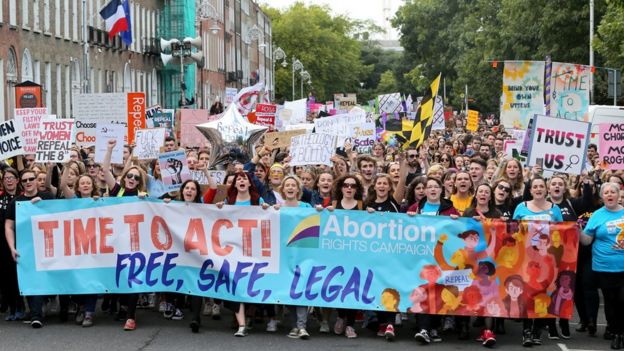
Hundreds of pro-choice protesters in Dublin on 30 SeptemberImage copyrightAFP/GETTY
Image captionTens of thousands rallied in Dublin in September for constitutional change

Before the vote, the country’s health minister will draft legislation proposing unrestricted abortion access be made available to women who are up to 12 weeks pregnant, and in exceptional circumstances after.

An exact date for the referendum will be decided after it is debated in the Irish parliament.

‘Not black and white’

Campaigners have long called for the laws to be changed, and last year a special cross-party parliamentary committee and citizens assembly both recommended repealing the amendment.

“I know this will be a difficult decision for the Irish people to make,” Mr Varadkar said.

“I know it is a very personal and private issue and for most of us it is not a black-and-white issue, it is one that is grey – the balance between the rights of a pregnant woman and the foetus or unborn.”

Mr Varadkar, the country’s former health minister who trained as a doctor, acknowledged that thousands of women in the country travelled every year for terminations or took illegal pills ordered online at home.

He said the current law meant that abortions in Ireland were “unsafe, unregulated and illegal”.

“These journeys do not have to happen, and that can change, and that’s now in our hands,” he said.

Presentational grey line

Analysis

By BBC Dublin correspondent Shane Harrison

The Irish government’s preference is to hold the referendum in late May, during university term time, as it is expected that the majority of students will support the government.

If there is a delay, polling is then most likely to happen at the start of June, when many Irish students leave the island for the summer.

Presentational grey line

Irish Health Minister Simon Harris has been working with officials in his department and the attorney general on the wording of the referendum, which is expected to be formally published at the beginning of March.

“It is very important to stress any legislation to amend constitution would remain subject to review,” said Mr Harris.

‘Issue not going away’

“The government does not intend to, or wish to, limit the power of our courts to interpret law. Anyone who wants any change to our regime, it is necessary to repeal the Eighth.

“This issue is not going away. It is time for the people of Ireland to have their say on that.”

In 2016, 3,265 women and girls gave Republic of Ireland addresses when accessing abortion services at clinics in England and Wales, according to UK Department of Health statistics.

The National Women’s Council of Ireland (NWCI) welcomed Monday’s announcement.

“Every pregnancy is different, every decision is deeply personal. Women and girls in Ireland deserve their dignity. They deserve the right to privacy, family and home,” said the group’s director Orla O’Connor.

BBC abortion map
Presentational grey line

Abortion in the Republic of Ireland

The Republic of Ireland currently has a near total ban on abortion.

Terminations are not permitted in cases of rape or incest, or when there is a foetal abnormality and thousands of women travel abroad for a termination every year.

The eighth amendment to the Republic’s constitution, introduced in 1983, “acknowledges the right to life of the unborn”.

However, there have been significant challenges and changes to the law in recent years.

A campaign to liberalise abortion gathered momentum in 2012, after Indian woman Savita Halappanavar died in a Galway hospital after she was refused an abortion during a miscarriage.

Savita HalappanavarImage copyrightTHE IRISH TIMES
Image captionSavita Halappanavar died after a miscarriage in University Hospital in Galway in October 2012

The following year, legislation was passed to legalise abortion when doctors deem that a woman’s life is at risk due to medical complications, or at risk of taking her life.

Twenty years before Mrs Halappanavar’s death, a 14-year-old rape victim was initially prevented from travelling to England to terminate her pregnancy.

It became known as the X Case, as the girl could not be named to protect her right to anonymity.

The 1992 ban on travel was later overturned by the Irish Supreme Court.

A referendum approved a further update to the constitution, stating that the eighth amendment did not restrict the freedom to travel to another state.

Source: http://www.bbc.com/news/world-europe-42868035?ocid=socialflow_facebook&ns_mchannel=social&ns_campaign=bbcnews&ns_source=facebook

Protesters on both sides of the abortion issue gathered outside the Supreme Court in Washington during the March for Life. CreditSusan Walsh/Associated Press

People who care about basic American freedoms should be grateful to the Senate majority leader, Mitch McConnell, for one thing: He has given liberals another good reason to flock to the polls in November.

Mr. McConnell is set to hold a procedural vote this week on a bill that would ban abortion at 20 weeks of pregnancy. The so-called Pain-Capable Unborn Child Protection Act, sponsored by Senator Lindsey Graham, a South Carolina Republican, is part of a long-term legislative effort by the anti-abortion movement to gut Roe v. Wade and severely curtail abortion access nationwide.

Twenty-week abortion bans, enacted in more than a dozen states and struck down in two, violate the Supreme Court’s standard that abortion can be restricted only when a fetus is viable outside the womb. Many, including the one being considered by the Senate, are based on claims not supported by most scientists about when a fetus feels pain.

Only about 1 percent of women seeking abortions do so after 21 weeks, and they often make that decision because a fetal abnormality has been found or because their own health is in danger. Twenty-week bans particularly curb access for poor women, who often struggle to find the money and time for the procedure.

The Senate bill contains exceptions for rape and incest if the women reported the abuse to law enforcement and sought counseling 48 hours before the abortion. But there is no exception to protect the health of the pregnant woman.

Abortion providers, who already face harassment and threats to their lives and work, would face criminal penalties, with a sentence of up to five years, for performing abortions after 20 weeks. The locations of all such procedures would need to be reported to the federal government.

Though President Trump urged Congress to “pass this important law and send it to my desk for signing” in his address to the anti-abortion March for Life this month, Republicans are almost certain to fall short of the 60 votes needed to formally take up the bill.

Still, abortion rights advocates and medical professionals are taking the legislation seriously, since abortion foes are working hard for it. The prospects for such a ban considerably diminish if the Democrats take back either house of Congress after the 2018 midterm elections. And if they control the Senate, Mr. Trump will have virtually no chance of picking another anti-abortion Supreme Court justice.

Since announcing his candidacy, Mr. Trump, at one time a supporter of abortion rights, has embraced anti-abortion politics with zeal. But that seems to be a matter of maintaining evangelical support. His concern for fetal life cannot be fairly measured, but his sensitivity to the needs of women, or lack of it, is well known.

Some sponsors of the version of this bill that the House passed in October seem to share Mr. Trump’s attitude. One, Trent Franks, Republican of Arizona, resigned his seat in December after it was reported that a female staff member had felt pressured to have sex with him as part of a surrogacy scheme. Another, Tim Murphy, a Pennsylvania Republican, voted for the bill just hours after news broke that he was accused of pressuring his mistress to — get this — have an abortion. He later quit.

Ultimately, the fate of the ban and other anti-abortion measures will be in the hands of voters. For supporters of abortion rights, the choice should be clear.

Source: https://www.nytimes.com/2018/01/28/opinion/editorials/threat-abortion-rights.html?mtrref=undefined&assetType=opinion

GETTY IMAGES

This week, Senate Republicans are scheduled to advance a nationwide ban on abortion care after 20 weeks, with no exceptions to protect a woman’s health or in cases of fetal abnormalities. This bill is just the latest measure in a coordinated effort to ban abortion and erode access to reproductive health care, piece by piece. Among other penalties, this bill also threatens doctors with five years’ prison time for violating the ban. 

In the early years of our marriage, my husband and I eagerly planned our family. I relished my pregnancy and, when the time came, wondered at my daughter and the deep power I had in her creation.

We tried again to grow our family, but experienced only miscarriage. Three in a row. By the time another baby finally took, the expansiveness and easy hope of my first pregnancy was stifled by bad luck.

The first trimester came and went, then the second. Still, I felt anxious. At 7 months, I tried to think positively. I picked up my knitting needles and began a tiny sweater for this next baby girl. I was working the final rows of that sweater at an ultrasound, which my midwife hoped would ease my relentless worry. When she saw me knitting, the doctor’s eyes welled with tears.

She showed me black marks on my daughter’s ultrasounds: large, fluid-filled holes in my baby’s brain. She named it: Dandy Walker Malformation, and referred me to a neurologist to learn more. She listed my options: adoption, abortion, or parenting this child with heavy medical intervention for her short life. If I chose to deliver my baby, it would be a high-risk birth for both of us, complicated by my baby’s condition.

Why was she offering me these choices? Didn’t she know how deeply I loved my baby? I tried to respond, but could only manage a question, “There are abortions for women like me?” I was 35 weeks pregnant. I wondered if there had been a mistake.

“We don’t know.” She said. “We used to send women to Kansas. But we can’t anymore.”

WHEN I CALLED MY HUSBAND FROM THE HUMMING DARKNESS OF THE ULTRASOUND ROOM, THE ONLY SOUND I COULD MUSTER WAS A DEEP, LONG WAIL.

I understood. The doctor who performed abortions for women 35 weeks pregnant had been shot by a man who followed him to his church. Somewhere in my brain, the memory of that news story revealed itself along with the stark understanding that I was entering a world in which people might want to shoot me, too, depending on my choice.

I shut it all out. When I called my husband from the humming darkness of the ultrasound room, the only sound I could muster was a deep, long wail.

The neurologist delivered more bad news: additional brain anomalies. My little daughter would likely never walk, talk, swallow, or support the weight of her head. She would require brain surgery to extend her life, but no surgery could ever cure her.

“What can she do?” I asked. “Does a child like mine just sleep all day?”

He winced at the question. “Children like yours are not generally comfortable enough to sleep.”

My wall of hope and denial crashed down around me. I could not subject my child to that kind of suffering. I wished for a miracle, but I would not risk my daughter’s wellbeing. My heart sang clearly: I would give my daughter peace. Abortion was the choice to meet our family’s values and our daughter’s needs—it was the option we could live with.

My pregnancy was so advanced, there was only one clinic in the entire country that would take us. It was a Friday afternoon when we found them, 2000 miles away. The clinic instructed us to fly Monday, get a hotel for the week, and come to the clinic first-thing Tuesday with $25,000 for a four-day outpatient procedure. We did not have that kind of money, but I agreed without hesitation, determined to figure something out. With the help of family, we did.

Our time in Colorado was deeply beautiful and crushingly sad. My care was kind, legal, compassionate, and, most importantly, safe. On the first day of the procedure, my doctor carefully, gently, lay my baby to rest in my womb. Her motion slowed and then stopped. Through my tears, I thought about that injection, one shot. It pales in comparison to the interventions she would have endured to live even one day on this Earth.

It has been five years since I lost my daughter Laurel, since I gave her the gift of peace. I carry these memories with me every day, the memories of her body, heavy on my lap. The memory of her living, moving, wriggling in my womb. The memory of my desperation, when I found myself cast out of care at home in Massachusetts. The understanding that I would have done anything, no matter how dangerous, to save my baby from a lifetime of suffering.

GOVERNMENT INTERFERENCE, LIKE ABORTION BANS, MAKES HARD SITUATIONS WORSE, FORCING FAMILIES TO GREATER EXTREMES.

Before I found myself in this dire position, I never understood the need for third trimester abortion. In my naivety, I did not realize that extreme actions are inspired by extreme circumstances. Good people in hard times must do hard things. Government interference, like abortion bans, makes hard situations worse, forcing families to greater extremes. Care becomes dangerous, and tragedy is compounded. Women and families in these devastatingly complex situations need trust and support, and that’s why organizations like NARAL fight for families like mine

Mine was a hard, painful choice. I carry it, but I have never once regretted it because I followed my heart and my values and did the best I could for my daughter. It is a terrible thing to have to choose between peace and life—but it is important that families, not committees, not politicians, not governments, make the best informed decisions for our children. We do so with deep and abiding love that cannot be duplicated in Congress.

Source: http://www.elle.com/culture/a15911671/late-abortion-senate-vote-2018/

The contemporary anti-abortion movement has never really cared about lives outside the womb. Now they’re praising Trump as a “pro-life” icon while his administration neglects undocumented immigrants, sick kids, and poor families.

Photo by Gage Skidmore via Flickr

Last week, President Trump became the first-ever sitting president to speak at the March for Life, an annual protest against abortion rights timed with the anniversary of Roe v. Wade. Addressing the tens of thousands of marchers who had gathered at the Capitol via satellite, Trump spoke about the sanctity of life and the power of love. “Every child is a precious gift from God,” he announced, to applause. “We know that life is the greatest miracle of all.”

Introducing Trump before his speech, Vice President Pence praised him as “the most pro-life president in American history.” This was mere days after Trump provoked an international outcry by reportedly wondering why the US government would allow the formerly unborn children of Haiti, El Salvador, and nations of Africa wanted to leave their “shithole” (or, possibly, “shithouse”) countries and move here. It was also in the midst of a congressional stalemate over DACA that left the fates of hundreds of thousands of immigrants who had arrived in the US as children hanging in the balance. On the afternoon of the March for Life, Senate Majority Leader Mitch McConnell tweeted a particularly grotesque infographic, one that needlessly pitted these vulnerable undocumented immigrants against sick children who rely on the Children’s Health Insurance Program (CHIP). “Democrats have a choice to make,” it read. “CHIP or DACA.”

In September of last year, the Pope himself criticized Trump for his stance on immigration. “If he is a good pro-life [man], then he will understand that the family is the cradle of life and that it must be defended as a unit,” he said. In December, uncowed, the White House tweeted a statement calling for the end of “chain migration,” ostensibly on the basis of stopping terrorism. Critics were quick to point out that “chain migration” is just a slightly sociopathic way of saying “family-based immigration.”

As Congress furiously debated the futures of thousands of people who call America home, the March for Life stayed largely silent on their failure to reauthorize DACA. (According to an op-ed published on Catholic News Agency, at one point during the march, “a whole group of pro-life marchers started chanting, in unison, ‘Build that wall! Build that wall!’”) Nor did anyone at the March demand aid for the thousands of families without power in Puerto Rico, or protest when Trump’s budget decimatedprograms for disabled people and poor families. Instead of pushing Paul Ryan to vote on the future of healthcare for 9 million children, they invited him to proudly tout the anti-abortion votes Congress took under his reign.

So, yes, Trump might be “the most pro-life president in American history,” but only if your definition of life ends at the moment of childbirth. In his first year in office, he’s provided the anti-abortion movement with win after win—reinstating and expanding the Global Gag Rule, which denies US aid to any organization that so much as discusses abortion; appointed extremely anti-choice justices to the Supreme Court and federal courts across the country; and filled the Department of Health and Human Services with anti-abortion and anti-contraception extremists.

Trump might be “the most pro-life president in American history,” but only if your definition of life ends at the moment of childbirth.

At the same time, of course, his administration has been hellbent on destroying the Affordable Care Act, with a plan that would eliminate maternity and newborn care as essential health benefits, and could increase the cost of pregnancy by 425 percent; nominated a woman who doesn’t think insurance companies should be required to provide maternity coverage to head the Centers for Medicare and Medicaid Services; and directly attacked the rights of transgender kids and sexual assault survivors in schools.

It’s fitting that Trump would be lauded in such grandiose terms at the March for Life. He perfectly epitomizes everything the contemporary anti-abortion movement stands for: While they obsessively protect life at conception, they’ve never actually stood to protect lives. Nowhere is the anti-abortion movement’s indifference to lives outside of the womb more apparent than in their appropriation of Black Lives Matter rhetoric. Signs bearing the slogan “Unborn lives matter”—and, more pointedly, “Unborn Black lives matter”—have become a fixture at anti-abortion marches. A popular talking point among this strain of anti-abortion activist is that abortion is akin to Black genocide, because Black women have abortions at higher rates than white women. In actuality, this is due to racialized health disparities—another thing the anti-abortion movement is conspicuously silent on. And, of course, the “pro-life” movement has never spoken out about the state-sanctioned murders of children like Tamir Rice and Aiyana Stanley-Jones.

The vast majority of anti-abortion activists are sitting idly through a maternal mortality crisis of epic proportions: The US now has the highest rate of maternal mortality in the industrialized world, with Black women dying at four times the rate of white women. It’s now been over four years since the Flint water crisis made headlines, yet no anti-abortion leaders have called to replace the pipes so babies have clean water to nourish their growing bodies. This is despite an ongoing miscarriage crisis among Black women in Flint, which is thought to be caused by the toxic water.

The “pro-life” movement cannot claim the moral high ground on protecting life until they prove they’re interested in protecting the lives of all people, not just the unborn—and, really, only the unborn threatened by abortion. There are currently millions of people living in America who desperately need advocates to fight for them: those deeply in need of healthcare, those who want to keep their families together inside our nation’s borders, and children who want to attend school and play in parks without fearing for their lives. Until the “pro-life” movement can show it’s willing to fight for these individuals, too, they’ll only be marching for hypocrisy.

Source: https://broadly.vice.com/en_us/article/mbpyv4/the-laughable-hypocrisy-of-the-pro-life-movement-under-trump