“Women have fought for generations for the right to control their own bodies.”
Nathan Denette / THE CANADIAN PRESS
Prime Minister Justin Trudeau during his town hall meeting in Hamilton.
Prime Minister Justin Trudeau says that anti–abortion rights groups are out of step with both his government and Canadian society.
He made the remarks at a town hall event in Hamilton, Ontario, part of a series of events across the country.
An audience member prompted the response by asking about free speech, and where the government draws the line.
“If you’re pro-life then you are ridiculed and insulted, but if you’re pro-choice then you are praised,” the audience member said, according to HuffPost Canada.
Trudeau said that “defending rights and freedoms” is at the core of both himself and Canada, but the issue of abortion presents particular considerations.
“An organization that has the explicit purpose of restricting women’s rights by removing rights to abortion, the right for women to control their own bodies, is not in line with where we are as a government and quite frankly where we are as a society,” Trudeau replied.
He then referenced recent changes to the Summer Jobs program that requires applicants adhere to Canadian rights — including access to abortions, and protections for LGBT Canadians. The program funds summer job placements for not-for-profit organizations, public sector employers and small businesses, the Canadian Press reported.
Darryl Dyck / THE CANADIAN PRESS
Conservative MP Brad Trost.
The change sparked concern from religious organizations that depend on the program and criticism from the opposition.
“That’s discrimination. Canadians are allowed to have different political views than the government of the day and they shouldn’t have their funding cut off because they disagree with the government,” said Brad Trost, a socially conservative Tory MP, in an online video.
Anti–abortion rights groups, such as Campaign Life Coalition, weren’t so happy with Trudeau’s remarks.
.@JustinTrudeau says pro-lifers are out of sync with society but it sounds more like he’s out of sync with the Charter. There is no ‘Charter Right’ to #Abortion. The SC ruled that there is “a legitimate right for Parliament to legislate” on abortion. http://ow.ly/rEjq30hHH42
Anti-abortion efforts out of sync with Canadian society: Trudeau
Prime Minister Justin Trudeau doubled down Wednesday in Hamilton on his defence of reproductive choice in Canada at the second stop on his town hall tour across the country, saying groups seeking to…
Trudeau said in Hamilton that the changes will only affect groups whose explicit purpose is targeting those rights.
“Women have fought for generations for the right to control their own bodies, to be able to choose for themselves what to do with their bodies,” Trudeau said, according to Global News.
“When those beliefs lead to actions aimed to restrict a women’s right on what to do with her body, that’s where we draw the line.”
The decision comes as the Supreme Court is set to examine the constitutionality of a similar California law.
The evidence is clear: Patients at fake anti-choice clinics receive inadequate care and are provided with medically false and misleading information. Shutterstock
Religious imposition laws are designed to shield private individuals and businesses from complying with nondiscrimination laws based on a religious objection to that service.
A federal appeals court on Friday ruled as unconstitutional a 2009 Baltimore city ordinance requiring anti-choice crisis pregnancy centers (CPCs) to post signs disclosing that they neither offer nor refer patients for abortions. The decision strikes a blow to similar efforts across the country and comes just as the U.S. Supreme Court is considering a similar case out of California.
In 2009, Baltimore city officials—concerned that patients might get the wrong impression about available services—passed a law that required businesses advertising as reproductive health-care centers to publicly disclose via waiting-room signs whether they do not, in fact, offer or refer visitors for abortion care and emergency contraception. The ordinance applies to “limited-service pregnancy centers,” meaning any entity “whose primary purpose is to provide pregnancy-related services” and which “provides information about pregnancy-related services,” but “does not provide or refer for” abortions or “nondirective and comprehensive” birth control. The signs must be “conspicuously posted” and “easily readable” in English and Spanish.
The Greater Baltimore Center for Pregnancy Concerns (GBCPC) is a CPC that advertises itself in places like the local paper and on the sides of buses as a reproductive health-care clinic providing a full range of services. The center does not, however, offer abortion and emergency contraception; nor does it refer patients elsewhere for that care. In March 2010, GBCPC sued the City of Baltimore over the disclosure law, arguing it violated the center’s free speech rights. The following year, a district court agreed and blocked the ordinance. Attorneys for the city appealed; in 2012 a panel of judges for the U.S Court of Appeals for the Fourth Circuit affirmed the district court’s decision. Attorneys for the city then asked the entire Fourth Circuit to hear the case. The full court reversed the panel’s decision, directing the case to go back to the district court for more evidence-gathering. The court determined that more information was needed about GBCPC’s advertising practices as well as “evidence substantiating the efficacy of the ordinance in promoting public health.”
According to the Fourth Circuit’s latest ruling, while the city has “considerable latitude in regulating public health and deceptive advertising,” the ordinance at issue is “too loose a fit with those ends.” The result, according to the court, is to “compel a politically and religiously motivated group to convey a message fundamentally at odds with its core beliefs and mission.”
“The ordinance forces the center to utter in its own waiting room words at odds with its foundational beliefs and with the principles of those who have given their working lives to it,” wrote Judge J. Harvie Wilkinson III for the panel. “Without proving the inefficacy of less restrictive alternatives, providing concrete evidence of deception, or more precisely targeting its regulation, the city cannot prevail.”
First Amendment speech cases are often full of muddled arguments. But in recent years, conservative legal advocates have taken the murky waters of free speech jurisprudence and made them almost unnavigable by arguing laws that regulate the commercial sphere—such as truth-in-advertising laws, or anti-discrimination ordinances like the one at issue in Masterpiece Cakeshop—unconstitutionally force them to endorse political speech they disagree with.
This case is a perfect example of a federal court buying those arguments hook, line, and sinker.
Attorneys for the City of Baltimore had defended the ordinance on the grounds that the regulation targets commercial or professional speech, areas government bodies typically have greater legal latitude to regulate. The law does, in fact, target commercial speech: It requires certain professions to issue certain truthful disclosures: in this case, that anti-choice pregnancy centers posing as reproductive health-care clinics do not offer comprehensive reproductive health-care services. It seems like a pretty clear-cut argument, and it should have been an easy win for the city. So what happened?
What happened is that the Fourth Circuit determined that the ordinance as applied to the center doesn’t regulate commercial speech because the anti-choice clinic is, basically, not engaged in any commercial transaction in the waiting rooms where the signs are required to appear.
“Even if pregnancy-related services are discussed there,” Wilkinson wrote, “the Center collects no remuneration of any kind, including referral fees from physicians. A morally and religiously motivated offering of free services cannot be described as a bare ‘commercial transaction.’”
So. Let’s break this down even more. A business—because that is what GBCPC is, regardless if whether it is a for-profit or a nonprofit one—is apparently not doing business in its waiting room? In this case, yes, says the Fourth Circuit.
According to the court, the center is a “nonprofit organization whose clearest motivation is not economic but moral, philosophical, and religious.”
The fact that its free services may have commercial value in other contexts—like, say, where touting them for fundraising to keep its doors open is concerned—is not enough to “transform the Center’s ideological and religious advocacy into commercial activity,” the court determined.
In effect, the court decided that GBCPC is a pop-up religious storefront that just so happens to offer services like ultrasounds that are commercial in nature. But because it operates as a nonprofit and subsidizes its services, it’s not really a business at all. It doesn’t matter that it is advertising commercial services, in a commercial context, apparently. According to the Fourth Circuit, what matters is what is in the hearts and minds of GBCPC employees. And that, the court determined, is religious advocacy, not money.
Of course, what is in the hearts and minds of the GBCPC employees and its business mission shouldn’t immunize it from the legal effects of deceptively advertising itself to the public—or, for that matter, from refusing service to LGBTQ people or other vulnerable groups. These businesses, with some exceptions, are subject to truth-in-advertising laws and anti-discrimination laws like their for-profit counterparts.
Furthermore, there’s a break in GBCPC’s logic here. If it is so fundamentally focused on a religious mission that includes anti-abortion ideology, then why not be willing to state that loud and proud by complying with the disclosure? GBCPC gets to have it both ways here. It gets to argue both that it has a religious motivation for offering pregnancy-related services and duck the law without having to disclose that it doesn’t provide all pregnancy-related services.
The Fourth Circuit acknowledged that different facts might have a different result, but it is hard to imagine another anti-choice pregnancy center falling outside of the court’s reasoning here. This could spell bad news for reproductive rights advocates nationwide as the U.S. Supreme Court prepares to hear arguments later this spring in National Institute of Family and Life Advocates v. Becerra, a case challenging a California law passed in 2015 that requires the state’s licensed pregnancy centers to display a brief statement with a number to call for access to free and low-cost birth control and abortion care. Unlicensed centers must disclose that they are not medical facilities.
Anti-choice pregnancy centers represented by the conservative litigation mill Alliance Defending Freedom (ADF)—which was at one point also involved in litigating the GBCPC case—argue the disclosure mandated under the law violates their First Amendment free speech and religious exercise rights because it requires religiously affiliated institutions to send a message that conflicts with their mission of promoting childbirth. Both a lower court and the U.S. Court of Appeals for the Ninth Circuit have ruled the California law is constitutional.
The Supreme Court has not yet scheduled an argument date for the California case. And while the Fourth Circuit’s decision last week has no impact on that one, it’s difficult to imagine the conservative wing of the Roberts Court coming to a different conclusion than the Fourth Circuit did here.
The result of such a decision would do real harm to pregnant people. The evidence is clear: Patients at fake anti-choice clinics receive inadequate care and are provided with medically false and misleading information. It’s a predatory business model with a religious objection to comprehensive reproductive health care at its core—and it could very well get the blessing of the Supreme Court later this year.
Anti-abortion groups are pressing for the vote to happen Jan. 22, the anniversary of Roe v. Wade, the 1973 Supreme Court decision that made abortion legal nationwide. (AP)
The Senate is likely to vote this month on a bill that would ban abortion after 20 weeks of gestation, sources familiar with the matter told the Washington Examiner.
Anti-abortion groups are pressing for the vote to happen the same day as the March for Life rally on Jan. 19, which happens every year close to the anniversary of Roe v. Wade,the 1973 Supreme Court decision that made abortion legal nationwide.
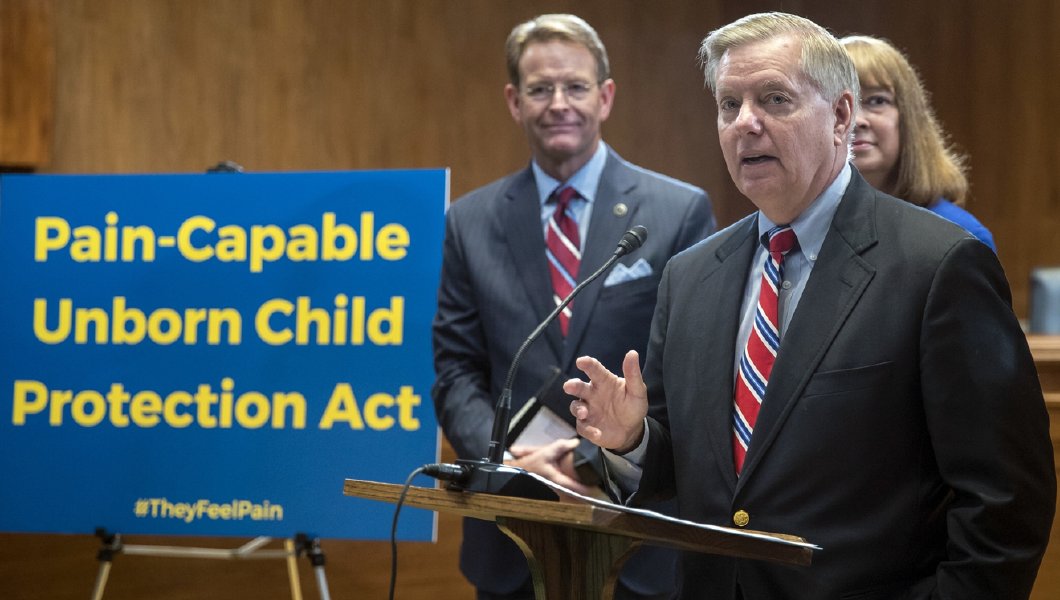
The House passed the 20-week abortion ban in October. The bill, the Pain-Capable Unborn Child Protection Act, would penalize medical providers who perform abortions after 20 weeks of gestation with fines or with up to five years in prison, or both. The bill contains limited exceptions, including when a woman’s pregnancy puts her life at risk and in cases of rape or incest.
President Trump said in a statement of administration policy ahead of the House vote that if the bill were to reach his desk his team would recommend he sign it into law.
But the legislation will need at least 60 votes in the Senate and is not expected to pass. Still, anti-abortion groups hope that a vote will force the conversation during an election year to clarify candidates’ stances on abortion later in a pregnancy.
A similar bill banning abortion after 20 weeks met the same fate in 2015.
States have different restrictions on abortions, with 17 of them banning abortion at about 20 weeks post-fertilization, according to the Guttmacher Institute, which tracks and studies reproductive laws.
Advocates of 20-week bans say a fetus can feel pain at this stage, while abortion rights groups have countered that women who have an abortion late in a pregnancy are often faced with genetic results that indicate if a child is born he or she will be disabled or will not survive.
California nursing regulators have flip-flopped again on whether they will allow a notorious abortion-rights foe to offer nursing classes teaching unproven abortion pill “reversal.”
The board’s latest decision paves the way for Heartbeat International to continue providing abortion pill “reversal” training for continuing ed credit. Shutterstock
Evidence provided to Congress by state attorneys general and health departments proves that abortion is both extremely safe and highly regulated. Searchable by state.
California nursing regulators have again given the green light to a class teaching nurses about unproven abortion pill “reversal,” marking the third time the oversight agency has reversed course on the continuing ed class.
Dr. Joseph Morris, the chief of the nursing board, issued the approval in a December 19 letter to an attorney for Heartbeat International, an Ohio-based anti-choice nonprofit that offers the class to nurses from around the United States.
So-called abortion pill reversal is an experimental treatment advanced by abortion rights foes absent rigorous peer-reviewed research. The treatment purports to stop the effects of a pill-induced abortion with a large dose of the hormone progesterone after the first abortion pill. A pill-induced, or medication abortion, requires two medications to be effective.
The board reinstated Heartbeat International’s ability to teach so-called abortion pill reversal for continuing ed credit, “having considered the information provided during the informal conference December 11, 2017, with representatives of Heartbeat International,” according to a letter signed by Morris.
The California Board of Registered Nursing has for months flip-flopped over the class. Emails obtained by Rewire suggest board officials fear denying the class will prompt a lawsuit from anti-choice groups. In one email, Morris, the chief of the nursing board, warned two board members, Donna Gerber and Trande Phillips, the “issue has the potential to go viral.”
A board spokesperson told Rewire the board’s recent decision was “based on the course satisfying the Board’s regulatory requirements for continuing education and not on a threat of a lawsuit.”
The controversy came to a head last summer when the nursing board said the abortion pill “reversal” class met scientific standards, but reversed course less than two months later, when Morris issued a cease-and-desist letter to stop the class. Heartbeat International appealed the decision.
Best known for its network of anti-abortion crisis pregnancy centers, or fake clinics, Heartbeat International has been a board-approved continuing education provider since 2012, and has taught abortion pill “reversal” for years. Rewire’s reporting first brought the class to the board’s attention in 2016.
A spokesperson for Heartbeat International said it will offer the newly re-approved class at a national conference in Anaheim in April.
The course has become a political hot potato in the state capitol, according to documents Rewire obtained through a public records request that included emails from top officials. In recent months, legislative aides, attorneys, and nursing board officials debated whether the board had grounds to prohibit the abortion pill “reversal” class amid dueling legal opinions.
In emails last fall, nursing officials circulated a Facebook post in which Heartbeat International threatened to sue the board. In one email exchange, a state senate aide shared a legal opinion suggesting the board and staff would be “safe” in the event of a lawsuit.
“Thanks! I was asked this question several times today,” replied Morris, the board chief.
In another, the aide told Morris, “Yes the board would be exposed to litigation, but it would win. Is the board completely risk adverse to the extent of not defending any standards?”
The American Congress of Obstetricians and Gynecologists has condemned abortion pill “reversal,” saying it is “not supported by the body of scientific evidence.” A Heartbeat International nursing instructor, Martha Shuping, has acknowledged abortion pill “reversal” is “not actually an accepted procedure.”
Emails Rewire obtained among staff for Assemblyman Jim Patterson (R-Fresno) and the head of the nursing board also suggest the lawmaker met with Morris and others on behalf of Heartbeat International after the board ordered the organization to stop teaching abortion pill “reversal.”
Patterson’s office did not respond to repeated requests for comment about the meetings. Patterson consistently opposes pro-choice positions, according to voting scorecard from the California Pro-Life Council.
State code requires nursing courses to be related to “scientific knowledge” or patient care. But documents Rewire obtained show that attorneys diverged on the legal standard for prohibiting the class and ousting Heartbeat International as a continuing ed provider.
Spencer Walker, attorney for the state Department of Consumer Affairs, the umbrella agency for the nursing board, wrote in an August 2017 memo that the abortion “reversal” course met state standards and was “clearly science-based.”
But in an earlier opinion in February 2017, state Legislative Counsel Diane Boyer-Vine wrote the nursing board could apply a different standard—where the yardstick was whether the course was “relevant to the practice of nursing.” Boyer-Vine held the board could withhold approval on that basis.
The nursing board is expected to consider revising regulations of continuing ed courses that teach “new and experimental healthcare treatments” at an upcoming meeting, a board spokesperson told Rewire.
Jay Hobbs, spokesman for Heartbeat International, commended the board for “resisting an overtly political attack that strips women of the right to choose against abortion,” in an email to Rewire.
The abortion pill “reversal” course is among several continuing-ed classes that first came to the board’s attention through Rewire’s reporting in 2016. Rewire revealed how Heartbeat International and other national anti-choice groups capitalized on a loophole in state law to teach unproven notions to nurses for state credit. Care Net and National Institute of Family and Life Advocates also taught anti-choice classes for state nursing credit.
Soon after, state Sen. Jerry Hill (D-San Mateo) introduced legislation to require continuing education courses to be based on science and the nursing board to routinely audit continuing ed providers. The law, approved by California’s governor in September 2016, went into effect in January 2017. That same month, a state nursing auditor warned Heartbeat International not to offer abortion pill “reversal” instruction as a California-approved provider. Susan Engle, a registered nurse and auditor, wrote:
… content related to medications used to reverse abortion, including but not limited to, Update on Abortion Reversal Abortion, Abortion Reversal and Your Clinic, and Reversing RU-486 does not meet the scientific knowledge required for the practice of nursing in accordance with CCR section 1456.
In October, the American Civil Liberties Union filed a lawsuit against the Food and Drug Administration in an effort to change the regulations surrounding the abortion pill. Right now, mifepristone — one of two components that comprise the abortion pill (while referred to as “the abortion pill,” the medication often comes in the form of two pills)— is heavily regulatedand one of the medications isn’t available from pharmacies, only through providers that meet a specific set of standards. But, the abortion pill has been found to be a safe and effective way to end a pregnancy within the first 70 days. On top of that, Melissa Grant, chief operations officer for carafem Health, previously told Teen Vogue that having access to the abortion pill could become a crucial part of keeping women seeking to end their pregnancies safe as more and more restrictions on abortion appear. In 2016 alone, at least 14 states passed measures to make abortions harder to get, and those efforts at restricting abortion are continuing in 2018. With all that going on, the American College of Obstetricians and Gynecologists (ACOG) has now released a statement officially opposing efforts to criminalize self-induced abortions.
According to the statement released on January 3, the ACOG opposes prosecuting women for allegedly causing harm to their fetus, including efforts to criminalize self-induced abortion, in part because they say self-induced abortions may start happening more frequently.
“The reasons why women attempt to self-induce an abortion are varied and include barriers to accessing clinic-based care, including cost, distance to the facility, and lack of knowledge of where and how to access care, as well as a preference for self-care,” the statement said. “Due to the growing restrictions on abortion access and the closure of facilities providing this service, self-induced abortion attempts may become more common.”
According to the Self Induced Abortion Legal Team at the Center on Reproductive Rights and Justice of University of California, Berkeley, there had been 17 known arrests or convictions related to self-induced abortions as of 2017. Ultimately, the ACOG pointed out that criminalizing self-induced abortion may make the process even less safe.
“The threat of prosecution may result in negative health outcomes by deterring women from seeking needed care, including care related to complications after abortion,” the statement said.
Daniel Grossman, one of the physicians who helped write the ACOG’s position statement, told Broadly that is wasn’t one thing that spurred the group’s opinion, it was the realization that self-induced abortions aren’t going away. In 2015 , the ACOG pointed out that there were more than 700,000 Google searches for information on self-induced abortion in the United States.
While criminalizing self-induced abortion may be an attempt at restricting abortion overall, Grant previously told Teen Vogue that it’s counterintuitive.
“Efforts to end abortion through restrictive laws only increases the shame and desperation for those seeking abortion,” she said. “It does nothing to decrease the number of unintended pregnancies or the number of abortions.”
Running a family planning clinic without electricity has proven a monumental challenge, with little hope for improving conditions in the coming months. “There is still a lot of work to be done to overcome the devastation in our neighborhoods.”
A nurse takes a patient’s vital signs at Clínica Celestina Zalduondo in San Juan. The Puerto Rican clinic still lacks reliable power nearly four months after Hurricane Maria. Profamilias
Texas has seen some of the nation’s most regressive abortion restrictions in recent years. This series chronicles the fall-out of those laws, and the litigation that has followed.
Running family planning clinics without electricity on the island of Puerto Rico has become routine for Blanca Cuevas, executive director of Profamilias.
Small generators power two Profamilias clinics in San Juan, the capital, more than three months after Hurricane Maria tore through the commonwealth. A larger generator is on order from the Dominican Republic.
The strongest hurricane to hit the island in nearly a century, Maria ripped roofs off some 250,000 homes, flooded neighborhoods, and toppled tens of thousands of power lines. The hurricane raked an island already mired in a debt crisis and reeling from the effects of Hurricane Irma just two weeks earlier.
The plight of Profamilias, its patients, and employees reflect widespread struggles on the island to regain a semblance of normalcy in a post-Maria world. Cuevas called the pace of government assistance “slow and inadequate.”
Dark streets, she said, have become dangerous. Shops have closed. Residents lack basic necessities. Workers are left jobless. Hundreds of thousands have fled.
For Cuevas, among “the hardest challenges have been to open the clinics without electricity,” she told Rewire.
Profamilias operates two clinics in San Juan, and eight family planning centers around the island. Its clients are largely folks with low incomes who rely on the facilities for affordable gynecological services, sexually transmitted infections tests, contraceptives, and sex ed, among other services.
In a physical sense, Profamilias was lucky.
Two Profamilias clinics are in what Cuevas described as an old working class residential area of San Juan. The mostly concrete and cement structures were spared major damage. The clinic had prepared for the worst, protecting vulnerable equipment.
Downed trees remain in the parking lot of the Profamilias clinic in Puerto Rico. (Profamilias)
Still, signs of devastation have scarred the surrounding neighborhood, Cuevas said. Downed trees clog the San Juan clinic parking lot. Fallen power lines, electric cables, and debris have been pushed off the streets and now block sidewalks. No one has cleared the wreckage.
“There is still a lot of work to be done to overcome the devastation in our neighborhoods,” Cuevas said.
Cuevas has watched two clinic workers and untold patients leave the island, seeking stability and steady work. Reports suggest more than 200,000 Puerto Ricans have fled to Florida.
Running a health-care clinic without electricity, phones, or internet access is not an exercise for the faint of heart. In the days after the hurricane, Profamilias warned patients on Facebook of the closures, with a promise to reopen. “We continue to work hard for the restoration of services,” said an October 6 Facebook post. The pharmacy reopened a few weeks later, in late October. Clinical services restarted in mid-November.
The clinics rely on generators that were never intended as a full-time power supply. Profamilies must turn away patients when the generators break down. Cuevas said spare parts and repair services for the generators are in short supply. Profamilias is not alone in this plight. Estimates suggest as much as 90 percent of the island runs on small gas- and diesel-powered generators.
Cuevas, who has been with Profamilias for two decades, said she’s never seen a catastrophe on this scale. The aftermath of the hurricane brought widespread shortages of food, water, gasoline, batteries, propane tanks, and hygiene products. Infectious diseases broke out from mosquito bites and contaminated drinking water.
Residents in the countryside fare worse. Despite dangerous road conditions, Profamilias and other volunteer organizations have mounted a mobile health brigade to bring remote residents a range of free services, including mammograms and contraceptives. Last month, “Caravana Violeta,” as it’s called, traveled to Arecibo, on the northern coast about 50 miles from San Juan. The brigade has visited the towns of Mayagüez, Ponce, and Río Piedras.
Along the way, Cuevas has met people who still lack food and safe drinking water. She’s seen families without a roof over their heads and children without schools.
“The pain of seeing people living in homes without roofs or walls, abandoned homes, small businesses closed, and thousands of children without access to their schools, this has definitely touched my heart,” she said. “It is very sad to witness the suffering of so many people.”
Before the hurricane, close to half of Puerto Rico’s residents lived below the poverty line. One study suggests the number will grow to nearly 60 percent if relief efforts drag on.
The caravan, for Cuevas, is an exercise in heartbreak and hope. She said she expects the need for the kind of services Profamilias provides to only increase as more residents are gripped by poverty. She’s already planning how to meet their needs.
The show that focuses on technology’s twisted effects couldn’t figure out something pretty simple: the difference between emergency contraception and medication abortion.
Unfortunately, Black Mirror’s storyline just perpetuated myths and misunderstandings about the drugs we have in the real world. Netflix / YouTube
Religious imposition laws are designed to shield private individuals and businesses from complying with nondiscrimination laws based on a religious objection to that service.
This Week in Sex is a summary of news and research related to sexual behavior, sexuality education, contraception, sexually transmitted infections, and more.
Show Gets Emergency Contraception All Wrong
We here at This Week in Sex are not regular Black Mirror viewers, but if you are and have not yet watched the episode titled “Arkangel,” you might not want to read this yet.
The science fiction show’s second episode of the season mixed up emergency contraception (EC) and medication abortion. And the internet let the show’s creator, Charlie Brooker, and the episode’s director, Oscar-winner Jodie Foster, know that they’d screwed up.
Black Mirror, a Netflix original in its fourth season, is like the Twilight Zone for a new generation. Each episode tells a different story that takes place in an alternate version of our world where advanced technology is key. The technology that is front and center in “Arkangel” is a chip that can be implanted into a person’s brain to allow constant and complete surveillance.
The episode follows Marie, a mom who is using the chip and its accompanying software to monitor her teenage daughter, Sara. Through the chip, Marie learns that Sara is pregnant and takes it upon herself to terminate the pregnancy by crushing pills into Sara’s food.
While there are many ethical issues that are brought up in the scenario—privacy, bodily autonomy, and informed consent, to name a few—there is also a big problem with the facts themselves.
Sara learns that she has been given the pills when she visits the nurse after throwing up in school. The two have the following exchange:
“It was the EC pill that made you sick,” the nurse says.
“EC?” Sara replies.
“Emergency contraception. For terminating a pregnancy,” the nurse tells her.
“It will work in spite of the vomiting. You don’t have to worry about that. You’re not pregnant anymore,” the nurse explains.
Sara looks visibly confused. She didn’t know she had taken pills and may not even have known she was pregnant.
The show is set in a slightly different world than our own, so maybe its writers thought they could get away with having pills that can cause an abortion instantly with one dose. In fact, many of us would be thrilled for a world in which that was not just possible but easily available.
But, unfortunately, Black Mirror’s storyline just perpetuated myths and misunderstandings about the drugs we have in the real world.
While medication abortion does exist and is highly effective, it is not as simple as walking into a pharmacy and then crushing pills into a smoothie. More importantly, it is not the same thing as emergency contraception, which does not end a pregnancy.
As for medication abortion, there is a combination of drugs—mifepristone and misoprostol—that can together terminate a pregnancy. Mifepristone is usually given by health-care provider in a clinic setting. It blocks the body’s production of progesterone, which is needed to continue a pregnancy. The pregnant person later takes misoprostol, which causes the uterus to cramp and bleed similar to a very heavy period or an early miscarriage.
Most emergency contraceptive pills (ECPs) contain levonorgestrel, a synthetic progestin that is also found in many birth control pills. These pills—sold under brand names like Plan B One-Step and My Way—are available over-the-counter in drug stores. They can be taken up to five days after unprotected sex, but are most effective if taken within the first three days. Another type of ECP, sold as ella, relies on a medicine called ulipristal; it’s just as effective on day five but only available by prescription.
Both types of ECPs work by delaying ovulation. Sperm can only live in a woman’s reproductive tract for about five days. If there is no egg available to be fertilized in that time, then the woman will not get pregnant.
ECPs also do not affect an already established pregnancy. If a woman is already pregnant when she takes the pills, she will still be pregnant.
Conflating ECP and medical abortions is dangerous and irresponsible—even in a show about an alternate world. Dr. Daniel Grossman, director of Advancing New Standards in Reproductive Health (ANSIRH), a research institute at the University of California, San Francisco, toldThe Lily: “It’s quite clear that there are efforts under way to undo the contraceptive coverage guarantee under the Affordable Care Act. There’s been increasing restrictions on abortion. It’s very much clear that reproductive health and rights is under attack and, unfortunately, by highlighting this confusion between EC and abortion-causing medications, in some ways plays into that further.”
Yet Another Reason to Get the HPV Vaccine
In the final installment of This Week in Sex last year, we wrote about a study that found males who had not yet had penetrative sex were nonetheless at risk of contracting HPV (most likely from other sexual behavior), and reminded everyone of the importance of getting young people vaccinated early to prevent HPV which is known to cause cancer.
Now it’s a new year, and we have a new reminder of how important this vaccine is: The rate of head and neck cancers caused by HPV (likely contracted through oral sex) is rising.
These results come from a retrospective study funded by the National Cancer Institute. Researchers reviewed almost 150,000 cases of head and neck cancers diagnosed between 2002 and 2012.
The good news is that the incidence of head and neck cancers overall decreased slightly in each of those years, a trend the authors believe may be attributed to decreased cigarette smoking
At the same time, the incidence of HPV-related head and neck cancers rose 2.5 percent each year and even more so in men (2.89 percent each year). In fact, men with HPV-related head and neck cancers out number women by four to one. The researchers say that compared to patients with other types of head and neck cancers, those who have cancers caused by HPV tend to be white, younger, and have higher levels of education. They also tend to have more sexual partners but use alcohol and drugs less.
The researchers think that the rise in HPV-related head and neck cancers can be attributed to changes in sexual behavior such as having sex at younger ages, a higher number of lifetime partners, and increased engagement in oral sex. As for why men are more at risk, they note vaccine discrepancies between sexes. The vaccine was originally just recommended for women, and many people associate it only with cervical cancer.
So, we’ll start 2018 with this reminder: The vaccine now protects against the nine types of HPV known to cause cancer. The Centers for Disease Control and Prevention recommend that all young people get the vaccine at age 11 so they can be fully protected before they become sexually active. But the vaccine is available to people up until age 26.
A Male Contraceptive Will Start Clinical Trials This Year
Male birth control has supposedly been just around the corner of the calendar for decades. But nothing—other than the ever-reliable condom and the permanent-solution vasectomy—has been made available to men yet.
Researchers at the National Institutes of Health have been working with the Population Council to develop a gel that can block sperm production. The gel contains two synthetic hormones. The first is a version of progestin that blocks the testes from making enough testosterone to produce sperm. The second is a form of testosterone itself to make up for the hormone imbalance that is caused when the body doesn’t make its own (testosterone is generally responsible for sex drive and characteristics such as facial hair, muscle mass, and a deeper voice). The gel is applied to the upper arm, not the genitals, and blocks sperm production for 72 hours. Men need to use it every day regardless of whether they are having sex in order to keep their sperm count down.
This combo gel will start a four-year clinical trial in April. Researchers are recruiting more than 400 opposite-sex couples in Chile, Italy, Kenya, Sweden, the United Kingdom, and the United States. The men will be required to use the gel every day while their female partners continue to use another method of birth control for at least the first few months. The men’s sperm count will be closely monitored. Once it drops below one million sperm per milliliter of ejaculate, the women will be asked to go off birth control. Then the couple will use the gel as their only form of contraception for one year, which will allow researchers to evaluate its efficacy.
Dr. Stephanie Page, a researcher at the University of Washington and the principal investigator on the trial, told the MIT Technology Review: “I am very confident that if men put the gel on every day and apply it correctly, it will be effective.”
Of course, before we see it on pharmacy shelves, we’ll have to find out if men will actually use the gel every day, if the side effects are manageable, and if there’s actually a market for male contraception after all.
“We know there’s a growing momentum to engage around a more affirmative agenda.”
Pro-choice activists gather in D.C. during the #TrumpGlobalGag protest on March 8,2017.
Lauryn Gutierrez / Rewire
Texas has seen some of the nation’s most regressive abortion restrictions in recent years. This series chronicles the fall-out of those laws, and the litigation that has followed.
State lawmakers’ efforts in 2017 to repeal or reform archaic and unconstitutional laws restricting access to abortion care were among several achievements by state-level policymakers to “advance reproductive health, rights, and justice policies,” according to a new report by the National Institute for Reproductive Health (NIRH).
Andrea Miller, president of NIRH, told Rewire that NIRH’s fourth annual report is intended to “lift up and recognize” the efforts of elected officials, advocates and health care providers that have pushed back against legislative efforts to restrict or outright eliminate access to abortion.
State lawmakers and advocates saw successes in the repeal or reform laws that criminalize abortion care. There were 645 bills introduced in 2017 that sought to protect access to reproductive health care, and 86 of these bills were passed into law, according to the report. That represents a marked uptick in pro-choice measures considered in state legislatures, as 191 pro-choice bills were introduced in 2016.
“Although generally unenforced, some of these clearly unconstitutional laws remain on the books, causing providers uncertainty about what is legally permissible and sometimes limiting the type of care they can offer to their patients,” the report states.
There are 18 states that have laws that could be theoretically enforced if Roe v. Wade were to be overturned, including ten states that have retained their unenforced, pre-Roe abortion bans, according to the Guttmacher Institute.
Miller said some of the pre-Roe abortion bans date back to the 1800s while others were modified in the 1960s and 1970s. Some of these laws have “criminal components to them that are problematic” for pregnant people and health-care providers.
Delaware Gov. John Carney (D) in 2017 signed into law a bill that repealed the state’s pre-Roeunconstitutional and unenforceable abortion ban.
Lawmakers in New York and New Mexico advanced legislation that would “bring the states in line with constitutional standards and decriminalize abortion,” according to the report.
New York’s AB 1748, which would repeal the state’s unenforceable abortion ban and codify the protections of Roe, was passed by the state assembly and is currently pending in the state senate. New Mexico’s HB 473, which would repeal the state’s unenforceable abortion ban, was favorably passed by committee, but lawmakers failed to bring it up for a floor vote in the house. This year, lawmakers in New Mexico have reintroduced an identical bill.
So-called trigger laws, which would automatically criminalize abortion if Roe were to be overturned, have been passed by states including Louisiana, Mississippi, North Dakota, and South Dakota.
Illinois Gov. Bruce Rauner (R) signed into law a bill that expanded insurance coverage of abortion care for people with low incomes and repealed the state’s trigger law that would outlaw the medical procedure if conservatives on the U.S. Supreme Court overturned the Roe precedent.
Miller said it’s important to build on the progress made during the past year in expanding and protecting reproductive rights even as GOP-held legislatures find new ways to erect barriers to the procedure.
“We know there’s a growing momentum to engage around a more affirmative agenda,” Miller said. “We want to make sure that we’ve laid out the kind of road map that people might need to be able to say, ‘Here’s what we could do, this is something another state did, let’s look at how we could tailor that to our circumstances and try to make progress in our state.’”
U.S. Attorney General Jeff Sessions holds a news conference at the Department of Justiceon Dec. 15, 2017, in Washington.Chip Somodevilla/Getty Images
As Americans were preparing to ring in the new year over the weekend, the Trump administration fired a new retaliatory salvo in its war against undocumented teenagers who seek lawful abortions in contravention of the government’s wishes. In November, the Department of Justice asked the Supreme Court to sanction the ACLU attorneys who secured one minor’s right to abortion access, an unscrupulous act of attempted retribution. Now the DOJ wants to punish a minor by revealing her private medical information to an uncle who threatened to “beat” her if she terminated her pregnancy.
Justice Department attorneys launched their latest offensive in response to yet another judicial rout of the administration policy that attempts to bar undocumented minors from getting abortions, even in the case of rape. On Dec. 18, 2017, U.S. District Judge Tanya Chutkan ordered the Trump administration to allow two more undocumented teenagers in federal custody, known as Jane Poe and Jane Roe, to obtain abortions. She also prohibited the government from divulging information about their pregnancies or abortions “to anyone.” Both women promptly underwent the procedure, according to an ACLU court filing. Then, on Thursday, the ACLU asked Chutkin to extend her restraining order by continuing to bar the government from disclosing Poe and Roe’s abortion statuses.
This request was quite reasonable, as Poe and Roe have a constitutional right to privacy in their medical information. But the Justice Department decided to oppose the ACLU’s motion for two reasons. First, the DOJ argued that Roe does not deserve privacy protections because she is 19 and therefore subject to a different set of rules from undocumented minors. (Roe says she is 17 and was initially treated like a minor, but the government located a birth certificate indicating that she is actually two years older.) Second, with regard to Poe—who is indisputably 17—the government demanded the ability to disclose her abortion information “to medical providers” in order “to vet potential sponsors.”
The government does not persuasively explain why it might need to disclose Poe’s abortion status to her doctors instead of simply letting her do it. But what’s more disturbing is the notion that Trump administration officials would want (or need) to tell Poe’s possible sponsors about her procedure. A sponsor, typically a family member, houses an undocumented minor until she reaches the age of majority, acquires lawful status, or gets deported. Poe’s most likely sponsor is her uncle—who told Poe that he would “beat” her if she terminated her pregnancy. The government requests the authority to inform Poe’s uncle—as well as her parents, who made the same threat—that she went through with the abortion.
Bizarrely, the Justice Department claims that the government may disclose Poe’s abortion status because other people already know about it. It points to the ACLU court filing that implies Poe obtained the procedure and notes that “it will be obvious in a matter of months” to her parents. The DOJ asserts that the First Amendment grants Poe’s parents the right to discuss their daughter’s abortion status once they find out about it. It then suggests that freedom of expression alsoprotects the government’s authority to disclose Poe’s medical history. “Here,” the DOJ claims, “just as Ms. Poe’s parents are permitted to act based on information lawfully obtained, so, too may ORR.” (That’s the Office of Refugee Resettlement, which oversees undocumented minors.)
In this startling passage, the government is essentially arguing that it holds a First Amendment right to reveal Poe’s abortion status to her abusive family. Why? Because ORR is “acting in the place of [Poe’s] parent” and thus holds similar “custodial responsibilities” and rights—including, apparently, the ability to disseminate her medical information. As Greg Lipper, First Amendment attorney and current litigation partner at Clinton Brook & Peed, told me on Tuesday, this theory is deeply flawed.
“The argument goes off the rails,” Lipper said, “because parents have rights to do all sorts of things—require their children to attend church, regulate their children’s speech, ground them without due process of law, etc.—that the government plainly may not do to people in its custody.” Actual parents hold rights that ORR does not, even when the agency acts as a parent. The First Amendment forbids the government from abridging free expression; it does not grant government actors free-speech rights to violate a minor’s right to medical privacy.
Within a day of the DOJ’s filing, the ACLU hit back, writing that the response “demonstrates precisely why” Chutkin must extend the restraining order. ORR officials “affirmatively seek to tell Jane Poe’s parents and potential sponsor about her abortion,” the ACLU wrote, “which is stunning given that Ms. Poe’s parents and potential sponsor have threatened to physically harm her if she obtained an abortion.” Moreover, government officials “do not possess a First Amendment right to tell others about Ms. Roe’s and Ms. Poe’s abortion decision[s]. To the contrary … they are bound by the Constitution—unlike a minor’s parents—to protect Ms. Roe’s and Ms. Poe’s privacy.”
On New Year’s Eve, Chutkin granted the ACLU’s request over the DOJ’s objections, extending the restraining order to proscribe the government from disclosing Poe or Roe’s abortion status. It is not yet clear whether the DOJ will appeal Chutkin’s order. What is distressingly evident is that the Trump administration’s anti-abortion crusade has become bitterly retributive. The government does not only wish to force undocumented minors to carry unwanted pregnancies; it also wants to penalize the lawyers who defend those teens as well as the women themselves. And so, while claiming to “promote life,” the administration is seeking to subject Poe to the threat of physical abuse—in the name of protecting her “best interest.” That’s not pro-life. It’s just cruelty.
An Illinois judge dealt a blow to anti-abortion groups Thursday, dismissing a lawsuit aimed at stopping a law that’s about to take effect that would expand Medicaid and state-employee group health insurance to cover abortions.
Associate Circuit Judge Jennifer Ascher ruled that the judiciary should not intervene in “political questions” in the General Assembly, such as a law’s effective date or whether there’s an appropriation to fund it.
Those are the pillars of the lawsuit seeking to stop the law from taking effect Monday. It was filed by the Catholic Thomas More Society on behalf of 11 conservative and Christian groups and a dozen legislators.
State Rep. Peter Breen, a Republican from Lombard and special counsel to the Thomas More Society, said he will appeal the ruling on Friday in Springfield’s 4th District Appellate Court and seek the same injunction he sought from Ascher.
Breen argued that lawmakers passed the measure too late in the year for it to take effect Jan. 1 and that they didn’t appropriate funding to cover the cost of the abortions through the publicly funded insurance plans. Despite the ruling, he remained upbeat after the hearing.
“After today’s argument, I’m more confident than ever in the truth and the correctness of our position,” Breen said. “I heard nothing today … that caused me to think that somehow, the General Assembly has done its job any more than it had a few days ago.”
John Wolfsmith, an assistant attorney general representing the Illinois Department of Healthcare and Family Services and other defendants, claimed Breen’s clients are simply trying to buy time by delaying the law’s implementation to June 1.
Breen contends that taxpayers will be billed for 30,000 elective abortions annually in Illinois. They will cost $1.8 million, according to the state health care agency.
Democrats in the General Assembly initially sold the measure as a way to keep abortion legal in Illinois if a U.S. Supreme Court, bolstered by anti-abortion justices President Donald Trump has promised to appoint, reverses the 1973 Roe v. Wade decision legalizing abortion.
After Roe, Illinois restricted public funding for abortions under the 1977 Hyde Amendment — named for Illinois Congressman Henry Hyde — to women who were victims of rape or incest or in cases where pregnancy endangers a mother’s life.
More than two dozen states follow the Hyde Amendment, according to the Guttmacher Institute, a research group supporting abortion rights. But a state can use the state portion of Medicaid state-federal program funding for women seeking abortions for other reasons. Seventeen states do that, 13 because of a court order.
The issue generated a subplot when Rauner signed the plan in September. The private equity investor ran for governor in 2014 supporting abortion rights and maintaining that he had no social agenda. But after signaling last spring that he would veto it, his signature so infuriated conservatives that he invited a primary challenge from state Rep. Jeanne Ives, a Republican from Wheaton who is a plaintiff in the abortion-funding case.










 Abortion - Abortion Clinics, Abortion Pill, Abortion Information