The Appalachia I live in is one where the region’s problems are set against a long history of organizers.

In 1982, the small, low-income rural health clinic operated by Eula Hall from her home in Mud Creek, Kentucky, burned to the ground. After taking the morning off to assess the damage, likely caused by a frustrated intruder attempting to loot the pharmacy, she re-opened the clinic, such that it was, from a picnic table pulled under the shade of a tree where she coordinated appointments from a telephone line hastily installed on its trunk.

This memory of Eula served me well during 2017 and I thought about her often—a determined woman who, like me, became stuck and then worked to free herself and others from the wreckage of a clumsy thief who would rather burn things down than admit his plans a failure.

The national perception of Appalachia in 2017 made little room for people like Eula Hall, who today is 90 years old and is still the patron of her low-income clinic. Rather, many came to know Appalachia through a glut of character studies obsessed with the inner lives of white, disaffected Trump voters in which progressive, justice-seeking voices became as rare as employed coal miners. Entire population groups that complicated the idea of Appalachia as the natural dominion of resentful, white, working-class men and their families ceased to exist.

This monolithic place is not the Appalachia I know. As I wrote in my forthcoming book, the Appalachia I live in is one where the region’s problems are set against a long history of organizers who “have struggled against them, often sacrificing their health, comfort, and even their lives.” With a similar intent, let me give you a snapshot of the Appalachia you didn’t often see in the press this year—the Appalachia filled with activists and organizers seeking many forms of justice, from reproductive rights to environmental protections, often using principles of community organizing passed down through generations to mitigate the harm promised to the region’s most vulnerable residents.

The potential for harm is great. According to many metrics, Appalachia is ground zero for rising health-care costs and access disparities, which have profound consequences on reproductive and sexual health in the region and, when combined with reactive politics, literally hold bodies hostage in a war over values. Political leaders in Kentucky and West Virginia, on both sides of the aisle, are particularly hostile to reproductive freedom, orchestrating the closure of all but one abortion-providing clinic in both states this year.

Caring for the reproductive and sexual health needs of rural and low-income people and all people of color in Appalachia often falls to clinics like the Women’s Health Center, in Charleston, West Virginia, and the EMW Women’s Surgical Center, in Louisville, Kentucky, both facing ongoing and pivotal legal battles this year as pressure to effectively ban abortion in these states intensifies. The new year in Kentucky started, for example, with a ceremonial signing of historic anti-abortion legislation by Republican Gov. Matt Bevin, who told the press, “We must continue to fight this scourge that is the taking of innocent life.”

In Appalachia, the movement for reproductive justice that has risen to the challenge of combating abortion restrictions is multi-racial, multi-generational, and multi-faith. Its leaders are people like the the Rev. Millie Peters, who formed the Kentucky chapter of Concerned Clergy for Choice in 2014 and Caitlin Hays Gaffin, the director of operations at WV Free, a reproductive rights organization based in Charleston, West Virginia. Other grassroots organizations that fill gaps in reproductive care and education have formed or expanded. The Kentucky Health Justice Network recently launched the All Access EKY program, directed by Whitesburg, Kentucky, native Stacie Sexton, to promote birth control access in underserved counties. In a recent interview with CNN, Sexton said, “Our goal is helping people control their futures.”

The opioid epidemic in Appalachia also occupies an urgent place in regional public health concerns. Although the Trump administration has recently announced plans to focus policy on combating the crisis, including expanding the enforcement powers of the Drug Enforcement Agency in Appalachia, much of the day-to-day care and management of those experiencing addiction falls to organizations in the hardest-hit communities. In southeastern Ohio, Bassett House is one of the only treatment centers for children and teens and now operates on a shoestring budget due to funding cuts enacted under the Ohio’s Behavioral Health Redesign program that caps Medicaid payments at a lower rate.

Because of the dearth in drug-treatment funding in Appalachia, grassroots organizations often focus on prevention, harm reduction, and compassionate programs that offer emotional support and outlets to those impacted. In April, the Pittsburgh-based Saltworks Theatre Company premiered “Off Script,” a play performed by teens based on the experiences of individuals who had battled addiction. The Higher Ground Theater, in Harlan County, Kentucky, offers similar programming through participatory action theater, starting with their 2005 namesake production that focused on prescription drug abuse.

In November of this year, officials in North Carolina launched the state’s first needle exchange program run by a county fire department, using kits donated by the North Carolina Harm Reduction Coalition. According to the organization, “harm reduction refers to a range of public health policies designed to reduce the harmful consequences associated with drug abuse, sex work, and other high-risk activities.” Support for harm reduction strategies has risen in Appalachia as the opioid crisis has worsened.

Environmental activism in Appalachia is a public health matter as well, but also a reminder that environmental justice is always racial justice. In West Virginia, Virginia, and North Carolina, affected residents and their allies have waged a determined fight this year against two proposed natural gas pipelines planned for immediate construction. The developers of the Atlantic Coast Pipeline plan to use experimental compressor stations in two communities in Virginia and North Carolina that are home to a significant population of low-income African-Americans and Native individuals respectively. In response to this threat, a coalition of groups across three states organized a people’s tribunal in Virginia in October, placing modern resource extraction and its consequences within the long history of settler colonialist plunder.

In December, grassroots environmental organization Appalachian Voices joined the North Carolina NAACP to sue Duke Energy to obtain an order requiring the energy company to remove coal ash from the groundwater in Stokes County, North Carolina. NAACP North Carolina President the Rev. T. Anthony Spearman told the Greensboro News & Record, “This is a quintessential example of environmental justice. In a county that’s predominately white, Duke Energy’s polluting coal ash sits in the middle of a Black community with limited means.”

In West Virginia, opposing a proposed Appalachian gas storage hub—a vast network of underground storage and pipelines for natural gas—is a focus of the Ohio Valley Environmental Coalition. Trump’s November $83.7 billion memorandum of understanding with China Energy Investment Corp. to create chemical and gas projects in West Virginia brought the hub one step closer to reality. Set against this enormous sum are people like the late Dianne Bady, the founder of the Ohio Valley Environmental Coalition, who passed away this year, who believe “The only way you can win on environmental issues is if the power of organized people is greater than the power of organized money.”

This brief slice of Appalachian activism has been about the year that was—but it is also about the year ahead and the battles to come. Instead of telling people in red states or Trump Country to “just move to a blue state,” a more productive strategy in 2018 might be to support, acknowledge, and learn from the work of Appalachian organizers engaged in local fights that the Trump administration promises will soon be national.

Source: https://rewire.news/article/2017/12/21/unseen-unsung-appalachia-fighting-future/


Janet Benshoof was an ACLU litigator before she founded the Global Justice Center and the Center for Reproductive Rights in New York. (Lynn Savarese/For the New Abolitionists Campaign)
 December 19
Janet Benshoof, a human rights lawyer who campaigned to expand access to contraceptives and abortion, leading organizations that advocated on behalf of women from the mainland United States to Burma, Iraq and Guam, where she was once arrested for protesting the most restrictive abortion law in America, died Dec. 18 at her home in Manhattan. She was 70.She was diagnosed in November with uterine serous carcinoma, an endometrial cancer, said her son David Benshoof Klein.

Ms. Benshoof (pronounced ben-shawf) began her legal career just before the 1973 Supreme Court case Roe v. Wade established a woman’s right to an abortion. She spent the next four decades fighting to uphold the case’s legacy in the United States and to expand women’s reproductive freedom around the world, founding the New York-based Center for Reproductive Rights and Global Justice Center to defend clients that included abortion providers facing bomb threats as well as rape victims in war zones.

Proclaiming the motto “Power, not pity,” she acquired a reputation as a fierce presence in the courtroom — as a litigator for the American Civil Liberties Union, she argued sex education and abortion cases before the Supreme Court — and as a frank, even funny guest on news programs such as “Good Morning America” and “The MacNeil/Lehrer NewsHour.”

“I feel like I’m married to the mob,” she told the New York Times in 1998, half-joking after Buffalo obstetrician Barnett Slepian was murdered by an antiabortion activist. “Saturday night, after the doctor was shot, another client called and talked for an hour. He was also in Upstate New York. He said, ‘Do you think I could just get police protection until the leaves fall off?’ He thought once the trees were bare and there was snow on the ground he’d be okay. It would be harder to find cover and not to leave tracks.”

Ms. Benshoof at a Washington protest march in 2000, wearing a flag across her mouth to symbolize a rule that she said hindered women’s health organizations from advocating for reform of abortion laws. (Michael Robinson-Chavez/The Washington Post)

Ms. Benshoof, who professed to being more worried about turbulent plane rides than militant abortion foes, played a supporting role in many of the legal and cultural flash points that followed Roe. At the ACLU, where she led the Reproductive Freedom Projectbefore founding her own organization in 1992, she made abortion one of the group’s top priorities, expanding the project’s annual funding from $70,000 to $2.2 million.

She made national headlines in 1990, when she flew to the U.S. territory of Guam to lobby against what was then considered the country’s most severe abortion legislation: a law that banned the advocacy of abortion and outlawed the procedure except when the life of the woman was threatened.

Ms. Benshoof arrived after the bill was signed into law, but at a news conference she stood up and announced that “women who are pregnant, seeking an abortion, should leave the island” and head to a Planned Parenthood clinic in Hawaii.

One day later, she was arrested for “soliciting” women to have abortions — a violation of the new law — and faced a $1,000 fine, a year in prison and the wrath of the island’s governor, Joseph F. Ada.

“It’s her right to question it, but she’s making a mockery of our abortion law,” he told People magazine. “That’s not nice.”

Legal niceties prevailed, however. The charges against Ms. Benshoof were dropped after the island faced an ACLU-backed lawsuit over its abortion law, which appeared to challenge the outcome of Roe. Five months after it was passed, the legislation was struck down by a federal district judge who ruled that Guam, like the rest of the United States, was bound by the Roe ruling.

Janet Lee Benshoof was born in Detroit Lakes, Minn., on May 10, 1947. Her father was a county prosecutor, and her mother was a teacher-turned-homemaker.

She received a bachelor’s degree in political science from the University of Minnesota, graduating summa cum laude in 1969, and graduated from Harvard Law School three years later, paying her tuition using money from a summer job at an A&W Root Beer stand.

Ms. Benshoof said she encountered a female lawyer for the first time while at Harvard, where she developed a friendship with future Supreme Court Justice Ruth Bader Ginsburg, co-founded the Harvard Women’s Law Association and met her husband, Richard Klein, who became a law professor. Their marriage ended in divorce.

Survivors include her husband of six years, Alfred Meyer of Manhattan (Ginsburg officiated their wedding); two sons from her first marriage, David Benshoof Klein and Eli Klein, also of Manhattan; and a sister.

Ms. Benshoof worked for South Brooklyn Legal Services, filing class-action lawsuits on behalf of low-income clients in New York, before joining the ACLU in 1977. She left the organization 15 years later, during the “year of the woman,” taking her entire staff with her in what ACLU Executive Director Ira Glasser described as a “dead of night” departure.

Weeks later, she received a $280,000 “genius” grant from the MacArthur Foundation, providing what she described as a bit of much-needed financial stability as she established what was then known as the Center for Reproductive Law and Policy. (She said she also donated some of the money to a women’s health clinic in Minnesota.)

In one of Ms. Benshoof’s most enduring achievements, the center effectively launched the use of the “morning after” pill as an emergency contraceptive, filing a petition to the Food and Drug Administration in 1994 that asked for companies to label birth control pills as postcoital contraceptives.

Two years later, the FDA published a notice affirming the safe and effective use of the pills after sex, following a contentious hearing in which Ms. Benshoof testified that the pills could prevent up to 1.2 million unwanted pregnancies and as many as 1 million abortions each year. Opponents likened the emergency birth control method to murder.

“You would think that finding ways to stop unwanted pregnancies would be common ground,” Ms. Benshoof said at the time. “The fact that it isn’t shows just how anti-woman the antiabortion movement really is.”

https://www.washingtonpost.com/local/obituaries/janet-benshoof-lawyer-who-pursued-abortion-rights-for-women-dies-at-70/2017/12/19/76194422-e4d2-11e7-ab50-621fe0588340_story.html?utm_term=.ee0bc0232240

For now, Republicans have dropped their crusade to expand a federal ban on abortion coverage in the nation’s health insurance plans, but they are likely to return to the issue when lawmakers return to Capitol Hill in January.

Congressional Republicans punted into early 2018 what could have been a dramatic year-end government shutdown over an abortion crisis of their own making: whether to add the Hyde Amendment to a bipartisan U.S. Senate plan temporarily stabilizing the Affordable Care Act (ACA), or Obamacare.

As the longstanding appropriations ban on federal funding for abortion except in rare circumstances, implemented annually since 1976, the Hyde Amendment already applies to Obamacare’s embattled cost-sharing reductions (CSRs) that reduce the price of insurance for people with low incomes. Even Senate Health, Education, Labor, and Pensions (HELP) Committee Chair Lamar Alexander (R-TN), who opposes abortion, doesn’t think his bill needs to spell out the Hyde Amendment because of who’s in the White House.

“This is only a two-year law so [President] Trump-[Vice President Mike] Pence will be there the entire time of the existence of this law, which I would think would cause pro-life groups—and I have a 100 percent pro-life rating—to be comfortable with it,” Alexander told Politico’s Pulse health-care policy newsletter.

Anti-choice groups disagreed. The Susan B. Anthony (SBA) List falsely claimed in a press release that a vote for Alexander’s bill, which he co-wrote with the HELP Committee’s top Democrat, reproductive rights champion Sen. Patty Murray (WA), “is a vote for taxpayer-funded abortion.” SBA List on Tuesday led a coalition of 67 anti-choice groups in warning members of Congress that they would oppose not only the underlying bill, but also “any larger legislative package that includes stabilization funds for abortion-covering plans.”

Should the Hyde-esque provisions not be added to the Senate’s Alexander-Murray bill, a number of influential Republicans in the U.S. House of Representatives threatened to withhold support from a must-pass continuing resolution to keep the government funded and running beyond December 22—this coming Friday. They raised objections during a Tuesday morning meeting of the House GOP conference, according to The Hill, and House Speaker Paul Ryan (R-WI) backed them up. By Wednesday, House and Senate Republican leaders, facing opposition from multiple constituencies within their conferences, decided to pursue a straight continuing resolution with no extraneous provisions.

The dissenting Republicans, in all likelihood, want more than a simple reiteration of existing Hyde policy, perhaps best known for barring Medicaid beneficiaries from obtaining abortion services through their government-run health care. House Republicans could insist on cutting off CSR payments to any and all health-care plans that cover abortion, even if those plans are in the private insurance market. The fact that CSRs can’t and don’t fund abortion itself, in accordance with federal law, doesn’t square with the GOP myth that taxpayer money is fungible. Republicans have long used that myth to attack Planned Parenthood, and now they could wield it to create a chilling effect that leads private insurers to drop abortion coverage.

House and Senate Republicans tried to finagle a comparable outcome earlier this year. They sought to end abortion coverage in any health insurance plan, public or private, through their ultimately doomed Obamacare repeal bills. The House-passed bill, for instance, delivered a one-two punch, ending CSRs and prohibiting federal tax credits from insurance plans that cover abortion, according to a Kaiser Family Foundation brief. But the restrictions, along with a provision to defund Planned Parenthoodviolated Senate rules and couldn’t have proceeded as was even if the repeal bills had been successful.

Such precedent doesn’t bode well, according to a reproductive rights advocate based in Washington, D.C. “If past is prologue, we know that’s going to be really bad,” the advocate said. “They’re going to go for the worst thing.”

A different reproductive rights advocate elaborated on the consequences of denying CSR payments to insurers that cover abortion: “Insurers will have to decide to include abortion coverage or forgo billions of dollars,” the second advocate said. “So, it would basically coerce insurance plans to drop private coverage of abortion.”

House Pro-Choice Caucus Co-Chairs Reps. Diana DeGette (CO) and Louise Slaughter (NY), both Democrats, expressed similar concerns.

“This Republican-produced instability has created a dire need for CSR funding among health insurers,” they said in a joint statement on Wednesday. “By attaching abortion-coverage restrictions to CSR funds, dramatic declines in abortion coverage are likely to occur across the country, denying many women access to safe and affordable care.”

The Background

Without CSRs, Vox‘s Dylan Scott explained, people with low incomes will still qualify for Obamacare’s financial assistance. “The most immediate questions will be: Can insurers hike their rates even more to account for the loss of CSR payments, or can they drop out of the Obamacare markets entirely?” he wrote.

Alexander and Murray in mid-October thus struck a bipartisan deal to continue the payments and provide certainty for insurance companies. Their plan followed Trump’s decision to stop CSR payments in keeping with the administration’s regulatory and executive actions to undermine Obamacare in the absence of a legislative repeal. (In a twist, the White House now reportedly supports the legislative fix for CSRs.)

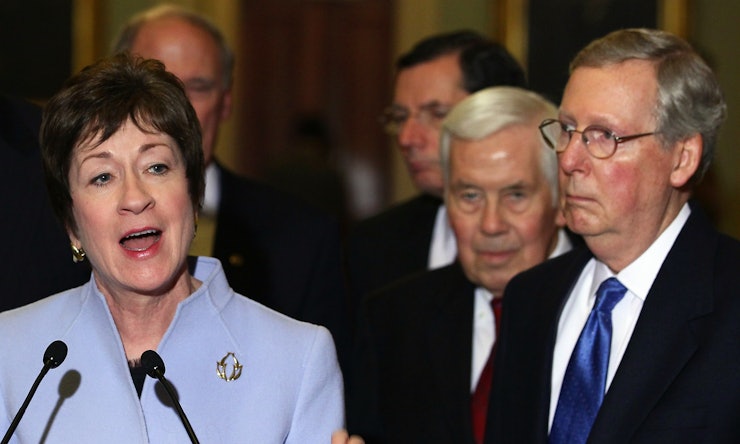
Then came the GOP’s regressive tax overhaul, currently en route to Trump for his signature into law. The tax bill repeals Obamacare’s individual mandate, the foundational requirement for people to purchase health insurance or face a penalty, despite the nonpartisan Congressional Budget Office’s estimate that the move will drive 13 million more people off insurance over the next decade. Sen. Susan Collins, a more moderate Maine Republican who helped sink her party’s Obamacare repeal efforts, agreed to vote for the tax bill if Senate Majority Leader Mitch McConnell (R-KY) promised to pass the restoration of CSRs, among other demands.

Collins’ vote doesn’t represent a fair trade, according to Democrats.

“The Alexander-Murray bill was never designed to fix the problem that [Republicans are] creating with this tax bill,” Murray told reporters on Tuesday following Senate Democrats’ weekly policy lunches.

The Stakes

Now, Republicans want to add a measure curtailing reproductive rights to an already ineffective health-care fix.

Democrats aren’t having it.

“A good faith effort would not be laying down a marker that it must have the Hyde Amendment in it,” Senate Minority Leader Chuck Schumer (D-NY) said during the same Tuesday press conference. “That’ll kill it altogether.”

As Republicans increasingly realized that extraneous provisions would doom the continuing resolution, Alexander and Collins issued a joint statement on Wednesday announcing that they had asked McConnell to refrain from including the CSR plan in the continuing resolution.

“It has become clear that Congress will only be able to pass another short-term extension [of government funding] to prevent a government shutdown and to continue a few essential programs,” Alexander and Collins wrote. Their assessment was correct; Republicans have dropped full fiscal year 2018 defense spending, a GOP favorite, from the continuing resolution.

But Alexander and Collins are just punting the CSR issue to the new year. Congress must pass a continuing resolution by Friday in order to avert a government shutdown. The version under consideration would keep the government running through January 19, at which time Congress will either have to fund the government through another short-term continuing resolution or an omnibus spending package to fund the government through the September 30 end of the current fiscal year.

Two spokespeople for Collins did not respond to Rewire’s emails requesting the senator’s position on the abortion restrictions. Collins has a mixed record on reproductive rights.

Collins’ GOP colleagues haven’t shied away from government funding fights over reproductive rights in recent years. But the underlying CSR bill could be moot, given opposition within the House GOP conference to the subsidies. Rep. Mark Walker (R-NC), chair of the conservative Republican Study Committee, views CSRs as insurer bailouts.

Democrats’ and reproductive rights advocates’ words of caution still stand, given the stakes and the potential for another shutdown in January.

“It is unconscionable that Republicans are holding both government funding and health insurance markets hostage in their quest to deny women access to abortion,” DeGette, the House Pro-Choice Caucus co-chair, said in Tuesday’s statement. “Every woman should be able to make personal decisions about reproductive health care with dignity and respect, and without interference from politicians.”

https://rewire.news/article/2017/12/21/republicans-punt-government-shutdown-manufactured-abortion-crisis/

Alex Wong/Getty Images News/Getty Images

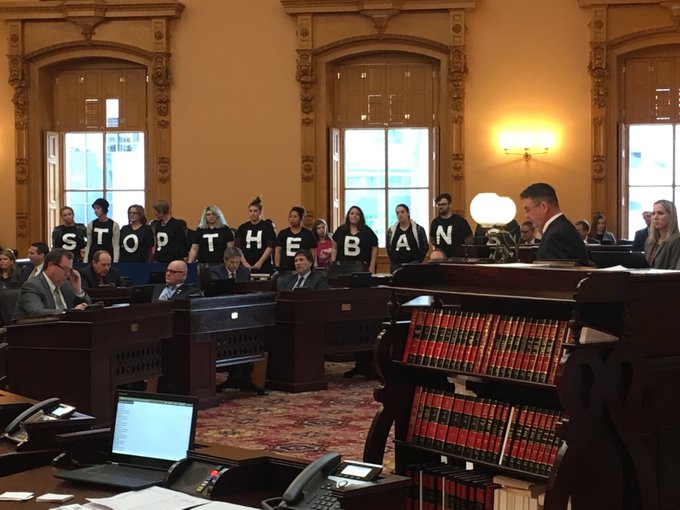
Soon, the third state in the country to instate a Down syndrome abortion ban might be Ohio, opening the door to an intense debate on women’s reproductive rights. A bill criminalizing abortions performed after testing reveals a fetus may have Down syndrome has passed through the Ohio state legislature and is now headed to Gov. John Kasich’s desk for final approval.

Ohio House Bill 214 easily passed through the state’s Republican-led Senate Wednesday in a 20-12 vote, moving the state one step closer to enacting the anti-abortion legislation. The bill would make it a felony for a doctor to abort a fetus if they know the procedure is being sought as a result of a fetal Down syndrome diagnosis or positive screening test. Moreover, it does not require a concrete diagnosis but rather would prohibit abortion in cases where the fetus “has or may have Down syndrome.” Legislators behind House Bill 214 claim the legislation is not an attempt to restrict women’s reproductive rights but rather a move to end discrimination.

“I believe that life begins at conception and that abortion should never be considered an option,” Rep. Sarah LaTourette, the legislator who introduced the bill, said earlier this week, as CNN reported. “However, regardless of if you agree with me or not, I hope that you can see that this is not an issue about abortion; it is an issue of discrimination — discriminating against a person, not allowing them their God-given right to life, simply because they might have Down syndrome.”

View image on Twitter

Opponents of the bill, however, have criticized the legislation as a move to impede women’s choices and pit the disability rights community against the reproductive rights community.

“Yet again, Ohio lawmakers are trying to disguise their attempt to push abortion further out of reach in our state,” Gary Daniels, Chief Lobbyist for the American Civil Liberties Union of Ohio, said in a statement released Wednesday. “This bill does nothing to improve the lives of people with disabilities, nor increase their access to health care or other services, nor does it educate a woman and her family about having a child with a disability. It only further restricts a woman’s ability to make a decision about ending a pregnancy.”

The Center for Reproductive Rights called the bill “a dangerous attempt by anti-choice politicians to pit the disability rights community against the reproductive rights community” in a tweet posted Friday.

Should the bill be signed into law anyone who performs an abortion in such a situation could face time in prison and have their medical licenses revoked. However, women who obtain an abortion in such circumstances would reportedly not be penalized or face criminal charges under the bill.

Down syndrome is a genetic disorder often caused by an error in cell division, which results in a sperm or egg cell containing an extra or partial copy of chromosome 21 either at or before the time of conception. According to the American Pregnancy Association, Down syndrome occurs in one out of every 800 infants.

The bill had cleared the Ohio House of Representatives in early November. Gov. Kasich now has 10 days to sign or veto the bill. Although the governor has not explicitly said whether or not he will sign the bill, he’d previously said he felt the legislation was “appropriate.” Kasich’s press secretary told CNN the governor would take “a good hard look at the bill.”

Similar laws have been passed in Indiana and North Dakota in recent years, although the Indiana bill was blocked by a federal judge earlier this year after being challenged by the ACLU. The North Dakota law, which was enacted in 2013, has not been challenged.

Source: https://www.bustle.com/p/ohios-down-syndrome-abortion-ban-is-close-to-becoming-law-it-severely-limits-womens-choices-7614149

The confusing response she got was part of a bigger pattern in the Trump administration.

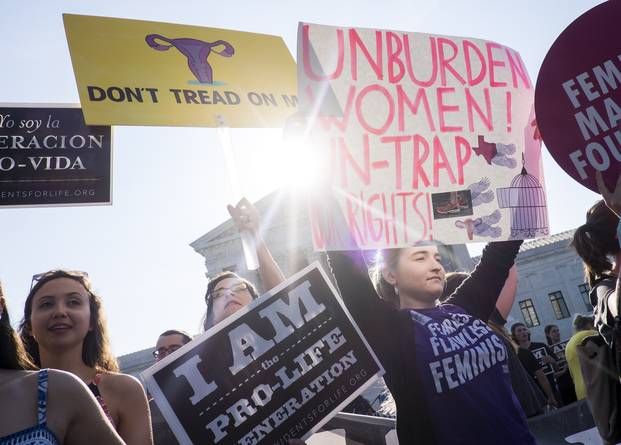
Supporters of birth control access rally outside the Supreme Court in Washington, DC, March 23, 2016.
 Saul Loeb/AFP/Getty Images

Members of the Trump administration have long conflated abortion and birth control. Now it seems the administration is doing the same thing in emails to constituents.

A woman who sent the White House an email as part of a campaign to counter measures by the administration to curb access to birth control was surprised to receive a reply within hours — but even more surprised that the response had nothing to do with birth control, and instead touted President Trump’s anti-abortion stances.

Charissa, who asked that her last name not be used, had used an online form to send an email to the White House protesting the administration’s recent weakening of an Obama-era requirement that most employers offer copay-free insurance coverage for birth control. The emailed response, she said, didn’t specifically mention birth control at all. And she wasn’t alone.

The Keep Birth Control Copay Free campaign, launched in May and funded by the Women’s Equality Center, offers a form email that users can send to the White House. “I demand you keep birth control copay free,” the message begins. “Why? Because it’s absolutely critical to women’s health, equality and empowerment.”

When Charissa used the website to send the message, she got the following response from the White House:

Thank you for taking the time to express your views regarding abortion.

The right to life is fundamental and universal. As your President, I am dedicated to protecting the lives of every American, including the unborn.

As I have made clear, organizations like Planned Parenthood should not receive Federal funding if they perform abortions. For that reason, I was proud to sign into law a bill that allows States to prioritize how they spend their Federal family planning grant money, including the choice to withhold taxpayer funding from organizations that insist on performing abortions.

I am also dedicated to ensuring that America does not fund abortions abroad. That is why one of the first actions I took as President was to reinstate and modernize the Mexico City policy, which ensures that American taxpayer dollars are not used to fund organizations that perform abortions in foreign countries.

At the same time, I am deeply committed to investing in women’s health and support Federal funding for programs that provide world-class services for women, such as cardiovascular care, breast and cervical cancer screenings, family planning and gynecological care, and obstetrics and prenatal care. I will continue to advocate for policies that promote better healthcare for women.

Thank you again for your suggestions. As President, I am committed to protecting the right to life and supporting women’s health services. Please visit www.WhiteHouse.gov to read more on how I am delivering on these issues for the American people.

The message was electronically signed by Trump (see the image below). Vox used a method recently outlined by ProPublica to authenticate the email’s ARC signature, a way of determining that it was not tampered with by the recipient.

Courtesy of Charissa

As it turns out, Charissa wasn’t the only one to receive this message — other users of the Keep Birth Control Copay Free website have as well, according to a spokesperson for the campaign.

The White House has not yet responded to questions from Vox about the message Charissa received. But in the past, the Trump administration has spread faulty information on contraception — and one influential member of the administration has argued that many types of birth control are actually forms of abortion.

“I was really confused and frustrated with the response,” Charissa said. “If American people take the time to voice their opinions about something,” she added, it’s important “that they’re at least getting an accurate statement back.”

The Trump administration has a history of promoting misinformation on contraception

The message Charissa got wasn’t the only response received by users of the email form at Keep Birth Control Copay Free. According to the campaign, some users received the following instead, also electronically signed by the president:

Thank you for taking the time to express your views regarding religious liberty.

I have signed an Executive Order entitled “Promoting Free Speech and Religious Liberty,” which is based on the fundamental principle, enshrined in the First Amendment of our Constitution, that the government should not discriminate against or punish Americans or their organizations simply because of their religious beliefs. It is improper for the government to make religious organizations, such as schools, churches, hospitals, and charities, choose between violating their religious beliefs and closing their doors.

I firmly believe that America is stronger when people of faith and their organizations can exercise their religion freely. These people and organizations are often government’s most effective partners in caring for the sick and elderly, assisting the poor, educating the young, and showing love and compassion to all. America’s tradition of welcoming faith into the public square is a source of our strength.

Unfortunately, we have occasionally lost sight of the importance of religious freedom. Changes to the Federal tax code made by the Johnson Amendment, for example, prohibit churches and religious organizations from participating or intervening in certain types of political campaigns. This law inhibits our faith leaders from speaking freely about moral and other issues without fear of retribution.

Only Congress can repeal the Johnson Amendment, but I have done everything in my power to limit its infringement on critical First Amendment rights. My Executive Order helps ensure that churches and religious organizations are able to take public positions on moral and political issues without undue Government interference.

My Executive Order also addresses harmful Obamacare regulations that require employer-provided healthcare plans to cover certain items and services that may violate their religious or moral beliefs. These regulations force such organizations to choose between following their consciences and facing severe penalties. The government should not force law-abiding organizations to make this choice.

Thank you again for writing. Our First Amendment right to practice our faith freely, without government penalties, must be defended. As President, I am committed to protecting religious liberty for all Americans.

“The Trump administration’s response just shows they have a single, sweeping reproductive health agenda: putting basic, essential care, including birth control and abortion, out of reach for millions of Americans,” said Amy Runyon-Harms, the coordinator of the Keep Birth Control Copay Free campaign, in a statement to Vox.

It’s not clear why the White House sent these particular emails in response to messages about birth control, but the fact that multiple users received each one suggests that the responses were intentional, not a mistake. And the Trump administration has been spreading anti-contraceptive messages — and conflating birth control with abortion — for some time. In particular, the administration has used misinformation about the effectiveness and safety of birth control to justify moves that would reduce access to the medication.

In October, the Trump administration released new rules allowing any employer to seek an exemption from the birth control coverage requirement for moral or religious reasons. Included in the rules were misrepresentations of the science around birth control, as Vox’s Julia Belluz has noted.

The administration questioned whether birth control really works to reduce unintended pregnancy, despite clear evidence that it does. In one 2014 study, for instance, researchers provided a group of teenagers with free birth control and followed them for three years; their rates of pregnancy — and abortion — were less than half those of other American teens.

The rules also suggested that a birth control coverage mandate could “affect risky sexual behavior in a negative way.” This claim is not supported by research, as Belluz notes. It also harks back to arguments used by anti-contraception advocates as long ago as the 1870s.

Several people working on health care policy in the Trump administration have expressed both anti-abortion and anti-contraception views. Notably, Matthew Bowman, a lawyer at the Department of Health and Human Services who was reportedly a key author of the new birth control regulations, wrote in 2011 that the Obama administration’s contraceptive coverage mandate included “several drugs or devices that cause the demise of an already conceived but not yet implanted human embryo, such as certain intrauterine devices (IUDs). Likewise in that category are many birth control methods that potentially prevent embryos from implantation, such as ‘the Pill’ and ‘emergency contraception.’” Bowman also referred to the contraceptive coverage mandate as “the HHS abortifacient mandate.”

Opponents of birth control have long argued that many forms should be considered abortifacients because they can prevent implantation of a fertilized egg. In fact, daily birth control pills, IUDs, emergency contraception, and other hormonal methods work primarily by inhibiting ovulation, fertilization, or both — not by stopping already fertilized eggs from implanting. Scientists say that the morning-after pill, a subject of controversy in recent years, does not prevent implantation of fertilized eggs. In some cases, a copper IUD inserted after sex can act as emergency contraception, and may inhibit implantation — but studies suggest this is relatively uncommon. The American Congress of Obstetricians and Gynecologists is clear: “FDA-approved contraceptive methods are not abortifacients.”

Though the Trump administration’s new rules on birth control went into effect immediately, they are not technically final, and the Health and Human Services Department accepted public comments on them until December 5. More than half a million Americans wrote to the administration to protest the broad exemptions offered by the new regulations and to ask HHS to protect birth control access. The rules have also been challenged in court, and a judge has blocked them from being enforced nationwide until the case is heard.

Charissa decided to join those writing to oppose the new rules because of how much the contraceptive mandate meant to her. “I remember the first time picking up my birth control prescription and not having to pay for a copay,” she said, “and it was just this incredibly validating feeling knowing that the Obama administration cared about women.”

Copays can be a real economic obstacle for many women, she added. “I wouldn’t want us to go back to that.”

https://www.vox.com/identities/2017/12/21/16790870/trump-birth-control-abortion-contraceptive-mandate

Sadly, there’s overwhelming evidence to suggest that the short-term future will be, at best, challenging for the pro-choice movement. For one, President-elect Donald Trump has taken many hostile stances on abortion access for women, including a promise that “there has to be some form of punishment” for women who undergo the procedure. After heavy backlash, he walked back the statement, redefining himself as “pro-life with exceptions.”

Regardless of Trump’s personal views, there’s mounting evidence that so-called pro-life activists are emboldened by Trump’s Electoral College victory. In the last two weeks alone, Texas passed a law requiring the burial of aborted fetuses, and an Ohio law that would ban abortion at six weeks, with no exceptions for rape and incest, was approved by its state legislature. In Trump’s America, it seems, women’s reproductive rights will constantly be under attack. This grim procession of new abortion restrictions appear to decidedly ignore a woman’s constitutional right to control her own body, which was affirmed in 1973’s Roe v. Wade, and they often rely on emotional pseudoscience. With that in mind, I’d like to propose that we stop using the term “pro-life” once and for all and start calling that position what it really is: anti-choice.

The term “pro-life” is a dishonest phrase designed to manipulate emotions instead of clarify a difference of opinion. People who are pro-choice are not anti-life. Many pro-choicers believe that life begins at birth, not conception. Others are personally opposed to abortion, but believe that women should have the right to make that decision for themselves.

SOURCE: SAUL LOEB/AFP/Getty Images

Tim Kaine, for example, personally opposes abortion, as do many Catholic Democrats. But Kaine is pro-choice because he understands that the issue of choice is separate from his personal beliefs about the procedure. Moreover, Kaine wants to reduce the number of abortions in the United States, but seeks to do so though “education and access to health care and contraception rather than criminalizing women’s reproductive decisions.”

View image on Twitter

He’s right. Abstinence-only sexual education actually increases teen pregnancy rates, according to a 2011 study. Researchers Kathrin W. Stanger-Hall and David W. Hall of the University of Georgia concluded that the available data showed the “increasing emphasis on abstinence education is positively correlated with teenage pregnancy and birth rates.” Comprehensive sex ed, on the other hand, has been shown to decrease teen pregnancy rates by 50 percent, according to a study published in The Journal of Adolescent Health, cited in a 2008 ABC News article.

You know what else reduces abortion? Planned Parenthood. According to Slate’s William Saletan, Planned Parenthood promotes the most effective methods of birth control and accurately empowers women to use them. “Planned Parenthood is the world’s leading provider of birth control,” he wrote in 2015, when some Republicans in Congress were threatening to defund the organization. “By undercutting this work, Republicans are threatening to cause an increase in the number of unintended pregnancies. And that, in turn, would lead to more abortions.”

Perhaps neither anti-choicers nor Sen. Kaine would choose abortion for their own families, but only anti-choicers seek to eliminate the option for abortion instead of examining the systemic causes of unplanned pregnancy. Kaine knows that women should make that decision themselves.

SOURCE: Andrew Burton/Getty Images News/Getty Images

The term “pro-life” also highlights a major question about that movement: Which lives are they in favor of, exactly? Women who lose access to abortion sometimes try to self-induce, according to The Huffington Post, by using misoprostol, which can be “life-threatening”without medical supervision.

Even wanted pregnancies sometimes turn tragic. According to the American College of Obstetricians and Gynecologists, abortions are “necessary in a number of circumstances to save the life of a woman or to preserve her health.” This is a medical fact. Yet many so-called “pro-life” groups deny this fact, and even push for legislation that outlaws abortion but does not allow for exceptions to save the life of the mother.

Furthermore, when anti-choicers move to defund Planned Parenthood, they risk the lives of thousands of women who rely on its other health services. By detecting early-stage breast and cervical cancer through the exams it offers, Planned Parenthood saved the lives of 88,000 women between 2012 and 2013. An additional 900,000 American women received low-cost cancer screening at Planned Parenthood locations in 2015, according to the organization’s reports.

I cannot call a group “pro-life” if its efforts contribute to jeopardizing the life of an adult woman, whether it’s a woman attempting to terminate a pregnancy without medical help, a suffering would-be mother whose wanted pregnancy has gone horribly wrong, or a woman who relies on Planned Parenthood’s easy access to cancer screenings.

Simply put, risking the lives of American women is not pro-life. It’s anti-choice.

Source: https://www.bustle.com/articles/199345-why-we-shouldnt-call-it-pro-life-but-anti-choice

Pool/Getty Images News/Getty Images

On Monday a federal judge found that the Trump Administration cannot block two more undocumented teens from accessing abortions. But the fight is not over; the ruling was issued with a 24-hour stay so that the administration could appeal the ruling. Just after the decision came down, the government appealed the ruling to the US Circuit Court of Appeals for the District of Columbia and the Supreme Court.

US District Judge Tanya S. Chutkan addressed the situation of the women who are currently in the care of the Office of Refugee Resettlement, the government agency that’s in charge of resettling refugees and undocumented minors. She wrote that her ruling was necessary to protect the women’s “constitutional right to decide whether to carry their pregnancies to term.”

Their situation is very similar to another woman, given the name Jane Doe, who was initially denied an abortion while under the supervision of the ame agency. She was able to have one, but only after a month’s wait and many rounds of appeals. Chutkan was the same judge to initially hear that case.

In a statement to Bustle, Brigitte Amiri, senior staff attorney with the ACLU Reproductive Freedom Project and a lawyer working on the case, painted the ruling as a win, noting that “justice prevailed”:

The ACLU further detailed what they claim is troublesome new policy by the Office of Refugee Resettlement . Not only have the women been denied access to abortions, but they have forced them to attend religious anti-abortion centers to receive counseling that pressures them to continue their pregnancies as well as have unwanted sonograms. They’ve also kept them from medical appointments, the ACLU contends.

Bustle reached out to the Office of Refugee Resettlement and its director Scott Lloyd for comment through the Administration for Children and Families (ACF), the area of the Department of Health & Human Services (HHS) that the agency falls under. The ACF responded with the following statement:

Lloyd has, according to the ACLU, even contacted some of these women personally, urging them to carry their pregnancies to term. Shelters who are contracted by the Office of Refugee Resettlement are not to allow women to see attorneys or otherwise seek to get an abortion unless Lloyd personally approves.

Last week the Administration for Children and Families did comment to the Associated Press about the women. “The minors in this case — who entered the country illegally — have the option to voluntarily depart to their home country or find a suitable sponsor. If they choose not to exercise these options, HHS does not believe we are required to facilitate the abortion,” the statement provided to the AP read.

Those fighting the Trump Administration have found allies in 12 state attorneys general who have pushed the federal government to allow the women abortion access. The group, led by New York Attorney General Eric Schneidermanreleased a statement in support of the women:

If a further stay is not granted, the woman should be able to access abortion as soon as Tuesday. It is unclear what states they’re being held in, but one is almost 22 weeks pregnant. In many states abortion is no longer a legal optionafter 22 or 24 weeks. The woman does not have time for endless appeals.

Source: https://www.bustle.com/p/judge-rules-trump-cant-block-2-undocumented-teens-abortions-but-that-might-not-be-the-end-of-it-7634950?utm_source=facebook&utm_medium=post&utm_campaign=healthfb&utm_content=jane-december17

Mark Wilson/Getty Images News/Getty Images

With a Friday deadline looming, a fight over health care funding and abortion could shut down the government. House Republicans are demanding that Obamacare measures in the spending bill — which would avert the shutdown — must include Hyde Amendment language to prevent federal money from funding abortion procedures.

The drama begins with the GOP tax bill that passed the Senate yesterday on a purely partisan vote of 51 to 48. One of the key Senate votes was Susan Collins, the Republican from Maine. She made a deal with Senate Majority Leader Mitch McConnell to vote for the tax plan only if a few other bills passed, including extra funds to stabilize the health care markets.

But now those other bills are at risk because anti-abortion activists want to carve out an exception explicitly in the spending bill that would prevent the federal funds from paying for abortion. The Hyde Amendment already does that, but this would strengthen the language and could result in private insurance plans, partially paid for with government subsidies, not covering the procedure.

Collins’ main hesitation to vote for the tax bill seemed to be its inclusion of the individual mandate repeal — that’s essentially the failed skinny repeal of Obamacare from earlier this year that kills the requirement for people buy insurance. Repealing the individual mandate would result in premiums rising, and Collins expressed concern that the premium increases would eat away at any potential tax cut that middle-class Americans saw. So she had McConnell promise her that they would pass other bills to stabilize the insurance markets.

Now it’s time to pass the bills he promised — one measure would give insurance companies stabilization funds to provide discounted deductibles and copays to poor consumers, and another would award states billions of dollars to help cover patients in high-risk pools. But many GOP members in the House won’t vote for these measures unless there’s this abortion carveout.

“It needs to have Hyde,” GOP co-chairman of the Pro-Life Caucus Rep. Chris Smith told The Hill.

Matters become even trickier when these measures are added to the stopgap government funding bill that would keep the government open past Friday, the shutdown deadline. Now both Democrats and Republicans are digging in on both sides of the abortion fight.

Senate Minority Leader Chuck Schumer told The Hill that adding Hyde Amendment language to the bill would “kill it altogether.” At least eight Democratic or Independent votes are needed to pass the bill in the Senate. Senate Republicans might support the bill even without the abortion language, but the House is another story.

Sen. John Thune of South Dakota told The Hill that it’s likely to come down to a fight in the House.

Several GOP representatives suggested that the House Speaker Paul Ryan would not yield on the matter. Republican Rep. Tom Cole of Oklahoma told The Hill it would be unlikely to pass without the wording being added.

Ryan himself has not spoken out on the matter, but he and McConnell will need to come to some sort of arrangement — one that garners eight votes from across the Senate aisle — if they want to avoid a shutdown.

Source: https://www.bustle.com/p/will-republicans-shut-down-the-government-theyre-pushing-for-more-abortion-restrictions-7647717

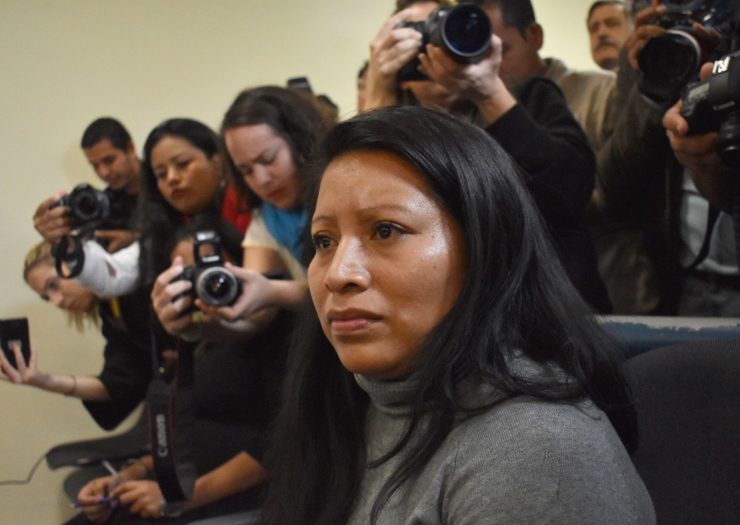
Vasquez’s supporters in El Salvador and internationally see these events as a referendum on the ability of Salvadoran courts to serve the interests of justice, especially for women living in poverty.

On the morning of December 13, Teodora Vasquez entered a courtroom in El Salvador, where abortion is banned in all cases, hoping she’d be going home with her parents and son that evening for the first time in a decade. Vasquez had already served ten years of a 30-year prison sentence for aggravated homicide following a stillbirth.

During the new trial in the country’s Second Court of Appeal last week, two expert witnesses testified that no crime had been committed and that the death was from natural causes. Still, the three-judge panel—Judges Alejandro Guevara, José Luis Giammattei, and María del Pilar Abrego—reaffirmed their original decision. Vasquez was sent back to prison to serve out the remaining 20 years of her sentence.

Vasquez’s supporters in El Salvador and internationally see these events as a referendum on the ability of Salvadoran courts to serve the interests of justice, especially for women living in poverty.

In 2007, the 24-year-old Vasquez was working in the cafeteria of a school in San Salvador. Vasquez, who was the mother of a 3-year-old boy, was pregnant and awaiting the birth of her second child. According to repeated testimony she has given over the years, while at work she began to feel intense pains, and knew it was time to go to the hospital. She made several phone calls to the police, who frequently provide emergency transportation in El Salvador, but, she says, they never responded. During the long wait, she felt the need to use the bathroom. There, she says, she felt something fall from her body. She fainted, came to for a few moments, and fainted again.

Eventually, she emerged from the bathroom. When other workers saw the blood from her severe hemorrhaging, they called police. This time, the police arrived and arrested Vasquez, who had lost consciousness again. When she awoke, she says, police were questioning her about why she killed her baby. She was taken to the hospital, and then to prison. In 2008, she was sentenced to 30 years for aggravated homicide.

While in prison, Vasquez became part of the group known as “Las 17,” women convicted of aggravated homicide after experiencing obstetric complications and precipitous births without medical attention. With support from the Agrupación Ciudadana por la Despenalización del Aborto (Citizen Group for the Decriminalization of Abortion) in El Salvador, the 17 women each requested a pardon from the Salvadoran government. All but two requests were denied, including Vasquez’s.

Morena Herrera, Agrupación president, said at a press conference the day after Vasquez’s hearing that the group knows of at least 28 women currently serving sentences similar to Vasquez’s. Two more, she said, are still awaiting trials.

In seeking to gain Vasquez’s freedom, the Agrupación and Vasquez’s attorney, Victor Hugo Mata Tobar, requested a revision of the original conviction. The criminal law branch of the Salvadoran Supreme Court granted the request, but named the same three-judge panel that had convicted Vasquez ten years ago to hear the case. Mata Tobar appealed and asked to have those judges recused, but the higher court insisted the judges could be impartial.

Still, Omar Flores, an attorney with the Salvadoran legal foundation FESPAD, noted his concern at the press conference that, as far as he saw it, “The proceedings gave preference to the prosecutor’s case while ignoring the scientific evidence and studies that demonstrated Teodora’s innocence.”

That evidence included testimony from two witnesses—a Salvadoran OB-GYN and a Guatemalan forensic medical specialist and attorney—who explained that asphyxiation connected to childbirth is not caused by some type of mechanical strangulation carried out by a person, which is what the prosecution accused Vasquez of doing. Rather, this medical phenomenon can happen due to natural causes before, during, or after birth and involves no criminal activity.

After the judges ruled against Vasquez a second time, civil society organizations denounced the double standard under which the judicial system operates in El Salvador. They argued that accused aggressors are “treated with indulgence,” and often allowed to wait for trials out of prison, while women like Vasquez are treated as guilty from the beginning.

Erika Guevara-Rosas, Americas director at Amnesty International, qualified the decision not to release Vasquez as an outrageous step backward for justice.

Although Vasquez was convicted of aggravated homicide and not abortion, a chorus of national and international bodies argued that the country’s anti-abortion law helps create a social and legal climate that leads to the imprisonment of women who have pregnancies that end in the death of the fetus, even when there is no evidence of criminal activity. Many of these organizations renewed their calls for the Salvadoran government to take action to end the practice of prohibiting all abortions and of using the anti-abortion law as part of a mechanism to criminalize women living in poverty who have obstetric complications.

A December 15 press briefing from Liz Throssell, spokesperson for the UN Commission on Human Rights in Geneva, noted that “El Salvador’s Penal Code disproportionately affects women living in poverty, such as Teodora. We have not seen women from wealthier backgrounds jailed under similar circumstances in El Salvador.”

It urged the Salvadoran government to “review all cases where women have been detained for abortion-related offenses. If it is found that these cases were not compliant with international standards, the women should be immediately released.” As the Agrupación announced, the European Parliament had issued a similar resolution on December 14 specifically noting Vasquez’s case, along with that of Evelyn Beatriz Hernandez Cruz.

Throssell concluded, “Basically they are being convicted for being women, for losing a child, and for being poor.”

According to Herrera, the Agrupación is already working with partners such as the Center for Reproductive Rights and Amnesty International to investigate other possible legal avenues to secure Vasquez’s release from prison, both through the Salvadoran courts and through the Inter-American  Court of Human Rights (IACHR). The IAHRC has already admitted—meaning accepted and will have hearings for—other cases of Salvadoran women with similar convictions.

Vasquez stated before the hearing that she had confidence that the court would “rectify the error” because “I know I am not guilty.”

The Agrupación will also continue exploring legal options for the other women behind bars. As Herrera told Rewire, “The citizenry of this country—but above all those who live in situations of poverty—do not have their rights protected when facing the judicial system.”

Source: https://rewire.news/article/2017/12/20/sentenced-30-years-stillbirth-teodora-vasquez-will-return-prison/

Anti-choice Trump administration officials are again standing in the way of immigrant teens seeking abortion care.

UPDATE, December 19, 9:13 a.m.: A federal judge on Monday issued a temporary restraining order barring Trump administration officials from preventing the two teenage immigrants from seeking abortion care. The administration said it would allow one of the teens to receive abortion care, but requested a stay for the other teen, the Los Angeles Timesreported.

After losing its fight to keep Jane Doe—a teenager whose abortion care was delayedbecause of court proceedings—from making her own reproductive health-care decisions, the federal Office of Refugee Resettlement (ORR) is once again attempting to block unaccompanied immigrant minors from accessing care.

Little is known about the two teenage girls, known as Jane Roe and Jane Poe,requesting access to abortion. Minors in ORR custody are often asylum-seeking young people from Central America. Many young women are escaping gender-based violence. Brigitte Amiri, senior staff attorney with the American Civil Liberties Union’s (ACLU) Reproductive Freedom Project, told Rewire in Octoberthat many of the girls and women in ORR’s care are pregnant as a result of being raped on their journey to the United States. Amiri said the stats for unaccompanied immigrant minors are similar to those of other migrant women. An estimated 80 percent of Central American women crossing Mexico en route to the United States are raped along the way, according to a 2014 report from Splinter.

Amiri was in court Monday, requesting an emergency order to prevent the Trump administration from denying the teenagers access to care based on a new ORR policy devised by anti-choice advocates.

The Trump administration in March implemented a revised policy “that allows [shelters] to wield an unconstitutional veto power over unaccompanied immigrant minors’ access to abortion,” according to court documents. This directive prevents unaccompanied immigrant minors in ORR’s care from obtaining abortion care by prohibiting federally funded shelters from taking “’any action that facilitates’ abortion access to unaccompanied minors in their care without ‘direction and approval’” from ORR Director Scott Lloyd. Advocates charge that Lloyd is a religious fanatic unqualified for his position as ORR director. He is considered by advocates to be an ideological pick by the Trump administration.

Lloyd has gone to great lengths to coerce immigrant teens to carry unwanted pregnancies, including using taxpayer funds to fly to shelters to “counsel” teens about their choices, despite admitting to having no counseling or medical experience. Lloyd has a well-documented history with so-called crisis pregnancy centers (CPCs), or fake clinics, which provide people with false information to dissuade them from seeking abortion care. These clinics compose almost all of the approved counseling centers listed by ORR for minors requesting abortion care. An investigation by Reveal found that this list came from the anti-abortion advocacy group Heartbeat International, whose mission is “to make abortion unwanted today and unthinkable for future generations.”

The Department of Health and Human Services’ (HHS) Administration for Children and Families, the agency that oversees ORR, is arguing that because Jane Roe and Jane Poe entered the United States without authorization, they can “voluntarily depart to their home country or find a suitable sponsor,” according to the Washington Post. If the girls choose not to return to their countries of origin or cannot find a suitable sponsor, “HHS does not believe [it’s] required to facilitate the abortion.”

The government made the same arguments in Jane Doe’s case. During an October hearing, Amiri said that if Jane Doe was an adult in an immigrant detention center overseen by Immigration and Customs Enforcement or was an undocumented adult in prison for committing a crime, her abortion care would not have been delayed. But because she was a minor in legal custody of ORR—and ORR maintains an interest in “fetal life and child birth”—the teen was forced to carry an unwanted pregnancy.

When asked by the court to clarify why Jane Doe could access abortion care as an undocumented adult in detention or prison but not as an undocumented minor detained in a shelter, the government’s counsel said the difference was that Jane Doe has the option of “voluntary departure.” Voluntary departure means that Jane Doe, who fled an abusive home in Central America where her teenage sister was beaten by her parents for being pregnant, could have self-deported to her country of origin, where abortion is illegal. The government argued that presenting voluntary departure to Jane Doe as her primary option did not constitute an undue burden.

Sponsorship is not easy to come by for immigrant girls seeking abortion care in ORR custody. Jane Doe has been in ORR custody for months and has had multiple sponsors denied by the agency. In November, Amiri told Rewire she doesn’t know the reason the teen is still in custody. A federal appeals court on October 20 gave the teen until October 31 to secure a sponsor so that she could access abortion care, and the federal government said it could find Jane Doe a sponsor by that date. But as of November 30, Jane Doe was still without a sponsor. This means that had Jane Doe’s attorneys not continued to fight for her to access care sooner than the October 31 deadline, she would have passed the 20-week mark and been forced to carry an unwanted pregnancy; ultimately, she was able to secure abortion care. Part of the reason Jane Doe may not have secured a sponsor is because the government is fighting for the ability to inform any potential sponsor that Jane Doe has accessed abortion care, a violation of her rights.

An ACLU spokesperson told Rewire they are anticipating a decision regarding the emergency order for Jane Roe and Jane Poe “within hours” of today’s 10:30 a.m. ET court hearing. The ACLU is expecting the federal government to “immediately appeal” the decision, with the possibility of the case quickly heading to the U.S. Supreme Court.

Source: https://rewire.news/article/2017/12/18/trump-administration-continues-blocking-immigrant-teens-accessing-abortion-care/