The Supreme Court struck down a Louisiana law that restricted abortions in that state, with Chief Justice John Roberts siding with the liberal justices in the ruling.

The case of June Medical Services v. Russo was over Louisiana’s requirement for doctors performing abortions to have admitting privileges at a local hospital. A federal court found that the law would leave one abortion provider for the state.

The Supreme Court struck down a similar Texas law in 2016, CNBC reports, leaving some to worry that the court was taking up the issue again with a more conservative majority.

Writing for the liberals on the court, Justice Stephen Breyer ruled the court agreed with a lower court decision “that Louisiana’s law poses a ‘substantial obstacle’ to women seeking an abortion; its determination that the law offers no significant health-related benefits; and its determination that the law consequently imposes an ‘undue burden’ on a woman’s constitutional right to choose to have an abortion.”

Breyer and the three other liberal justices said Louisiana’s law on abortions violated the constitution.

Chief Justice John Roberts, in a concurring opinion, said, “The Louisiana law burdens women seeking previability abortions to the same extent as the Texas law, according to factual findings that are not clearly erroneous. For that reason, I concur in the judgment of the Court that the Louisiana law is unconstitutional.”

This is the first time the current court, which has a majority of justices with judicial records of ruling against abortion rights, has heard an abortion-related case, NPR reports.

During his 2016 campaign, President Donald Trump said he would nominate judges that would overturn the landmark ruling in Roe v. Wade that guaranteed women’s access to abortion.

Louisiana passed its Unsafe Abortion Protection Act in 2014, but it’s been blocked from being enforced since it was enacted, CNN reports.

A federal district judge struck down the Louisiana law, but the 5th Circuit Court of Appeals overturned the ruling and said the law could go into effect, according to NPR.

A 5-4 decision from the Supreme Court in February 2019 blocked the law temporarily as the justices considered the case.

The ruling is the third major decision to come out of the Supreme Court in the past two weeks on hot-button social issues. The court ruled last week that employers could not fire someone because of sexual orientation or gender identity.

The court also stopped the Trump Administration from ending the DACA program, which gives legal status to immigrants brought to the United States as children. That ruling has been seen as a blow to the president who promised to end DACA in his 2016 campaign.

Another issue in today’s ruling was whether abortion providers can even sue the state over the law. Louisiana questioned if June Medical Service has what’s called “third party standing,” according to ABC News. That concept would allow doctors to sue on behalf of those who’s rights are impacted, in this case, their patients.

Attorneys for June Medical Services argued that the law regulates doctors, not their patients, so the doctors do have the right to sue over the law, ABC News reports.

Source: https://www.thenewstribune.com/news/nation-world/national/article243757837.html?fbclid=IwAR0E8vQUqJYqxqGsWumgnarzxxhLqnUuoPk_l2VuQBMska4j9xXNxcBYG2Q

The pandemic has been even worse for women’s reproductive health care than the 2008 recession. And this is just the beginning.

AP PHOTO/RICH PEDRONCELLI, FILE

One in three women struggled to get their birth control, had to delay a doctor’s visit for sexual or reproductive health care, or had to cancel a visit entirely due to the coronavirus pandemic, according to findings released Wednesday by the Guttmacher Institute.

Researchers at the Guttmacher Institute, which tracks restrictions on reproductive health, surveyed more than 2,000 cisgender women across the United States in late April and early May. Even in those early weeks of the global shutdown, they discovered that the pandemic had already made getting birth control and related health care a struggle for more women than the 2008 recession had.

That finding surprised even Laura Lindberg, the Guttmacher Institute’s principal research scientist.

“We’re just a few short months in the pandemic. I think the fuller effects are still unfolding,” Lindberg said. “Some of the big concerns here are as individuals lose their jobs, with that, in our country, they also often lose their health insurance. Women are more likely to be losing jobs. Women from more marginalized communities are in occupations where it’s not clear those jobs are gonna come back as quickly.”

Experts have warned for months that the pandemic would likely imperil people’s ability to get birth control and reproductive health care. Though government officials urged people to stock up on essential medications, contraception isn’t available over the counter in most states. And as businesses and colleges shutter, people have had to transfer their prescription to a new location or fight to get an appointment with a doctor — even as many doctor’s offices close their doors.

Those are challenges even for people who’ve managed to hold onto their jobs, and their health insurance, in the middle of record-high unemployment. But as people are pushed out of work by the pandemic, the obstacles to care can continue to mount. Without insurance, contraception can also cost hundreds of dollars a year.

Women aren’t only facing the prospect of going without birth control — they may also be delaying or skipping procedures like STI screenings, pap smears, and mammograms. In several states, access to abortion was also briefly choked off, as officials tried to cite the pandemic as a reason to ban abortion, and a previous Guttmacher study found that HPV vaccinations among adolescents have plummeted by 68% between February and early April.

“It’s just layer upon layer,” Lindberg said. “And we focus so much on where people are getting their Lysol wipes or where are people getting their groceries, or how are they doing that, but this matters in a woman’s life also. And it’s something that they need, immediately.”

The Guttmacher Institute didn’t specifically ask how or why women had trouble getting the health care they needed. But they did find stark racial disparities in who is struggling. While 29% of white women reported that the pandemic made it harder to access contraception and reproductive health care, 38% of Black women and 45% of Hispanic women said the same.

Because Americans tend to get their health insurance through their jobs, that racial disparity in access to care is inextricably tied to another disparity, in unemployment. Although the U.S. unemployment rate dipped in May to a still-astronomical 13.3% — from a high of 14.7% in April — unemployment among black workers rose to 16.8%. That’s higher than the rate has been in more than a decade.

More than half of the surveyed women told the Guttmacher Institute that they or someone in their household had either lost their job or seen their work hours cut due to the pandemic. About one in three said that, in April 2020, they were financially worse off than they had been the year before. And these women were more likely to say that they had struggled to access birth control or sexual and reproductive health care.

Even as women struggle to get their birth control, more women are reporting that the pandemic has led them to reconsider if and how they want to have kids. More than a third of the surveyed women said that, because of the pandemic, they had decided to get pregnant later or have fewer children. So a coronavirus baby boom is pretty unlikely, Lindberg said, pointing to the fact that the U.S. birth rate fell after the 2008 recession and never recovered.

“The uncertainty about what the future holds and the disruptions to the way people live their lives make a baby bust much more likely,” she said.

Source: https://www.vice.com/en_us/article/y3zgx7/planned-parenthood-is-furious-republicans-want-to-claw-back-their-bailout-money

SPRINGFIELD — An Illinois anti-abortion nonprofit filed a federal lawsuit challenging Gov. J.B. Pritzker’s social gathering restrictions, arguing it should be excluded from caps on attendees to charity, planning and educational events.

Illinois Right to Life’s lawsuit was filed in the Northern District just over one week after the state Republican Party filed a near-identical argument in the same court. The two groups are represented by the Chicago-based firm Liberty Justice Center.

The cases center around the U.S. Constitution’s equal protection clause — because Pritzker’s executive order contains a carve-out for churches and has not been enforced against systemic racism protestors, it should not apply to the nonprofit, either, they claim.

According to the court document — written by Daniel Suhr, the attorney also representing the Republican Party — religious institutions are permitted to hold socially-distanced services of more than 10 people. Faith-based associations are “encouraged to consult and follow the recommended practices” published by the Illinois Department of Public Health, but “are not required to obey them.”

Illinois Right to Life already canceled several previously-planned events, rescheduled others and received “minimal” attendance at ones they were able to hold, Suhr wrote. The group argued that due to the nature of its advocacy work, remote alternatives are not helpful.

“IRL believes that internet-based alternatives are not sufficient to spread its speech effectively. Abortion is a deeply personal topic; the issues IRL works on are some of the most personal and emotional decisions that women and others face in their lifetimes, and conversations around them often turn emotional,” Suhr wrote in the organization’s court document. “A video conference cannot replace the interpersonal interaction called for around this topic.”

The group is asking a federal judge to rule Pritzker’s social gathering restrictions unconstitutional and bar the government from enforcing the executive order as it applies to Illinois Right to Life. It is also requesting to be reimbursed for attorneys’ fees.

Source: https://www.dailyherald.com/news/20200624/anti-abortion-group-sues-to-hold-large-gatherings

Last year, over 1,000 women travelled to England from NI to access abortion services. Why are people still forced to take a flight in order

As of a week ago, abortion is legal in Northern Ireland. Sort of. Abortion regulations came in to law on March 31 – making them technically legal, though still impossible to obtain as the government wrangled over how to actually roll them out. But last Wednesday, this was ratified in the House of Commons and the House of Lords; two votes confirming that the service must be made available to women in Northern Ireland from here on out.

Over 60,000 women have travelled to England since 1970 in order to terminate a pregnancy – including in the months since the regulations passed the first hurdle in March; overwhelming evidence that abortion is needed in Northern Ireland. Julian Smith understood this when he was Secretary of State for Northern Ireland, drafting the consultation on the regulations, but our devolved government has meant this issue is regularly stymied by politicians who cannot reach a consensus. Arlene Foster, the first minister, has previously blocked attempts at legalisation. “I don’t think it’s any secret that I don’t believe that abortion on demand should be available in Northern Ireland,” she said in April. “I think it’s a very retrograde step for our society.”

The House of Lords has stood firm in support of the Convention on the Elimination of all forms of Discrimination Against Women (CEDAW) and their inquiry findings on abortion in Northern Ireland in 2018, which found that the UK was guilty of grave and systemic human rights abuses by forcing people to have to travel from NI to England for abortions. It also stated unequivocally that devolution agreements do not preclude regions from obligations to human rights treaties, which subsequently means Westminster will always be ultimately responsible for human rights in NI. Similar findings were reflected again in the Women and Equalities Committee Inquiry on Abortion in 2019 which acknowledged the rise of the illegal use of telemedicine abortion pills from online sources; Westminster has since then been tasked with acting where the Assembly had failed.

Just two weeks ago, the Stormont Assembly held a vote to try and demonstrate to Westminster that NI opposed the new legislation. The vote did show a majority opposition, but this was hinged on one point; abortion legislation being extended to all non-fatal disabilities, such as Down’s syndrome.

Westminster has rightly stepped in after years of Stormont prevarication. Now all the Department of Health in NI has to do is properly commission services and provide information for doctors and abortion seekers. Yet, when pressed, they have said that they will not do so until there is full agreement from the Stormont Executive – a move that is legally unnecessary and what appears to be a ploy to allow the DUP and others to block and delay these long-awaited provisions coming into effect.

The DUP voted in April against a proposal to allow doctors to prescribe the abortion pill via telephone consultations – a measure that has been introduced across the rest of the United Kingdom in the wake of coronavirus lockdown. The Ulster Unionist Party abstained, a source close to the Northern Ireland executive said.

Westminster has made clear that any changes they make to the regulations must remain CEDAW compliant. CEDAW recommends a diagnosis of severe foetal abnormality should be treated without having to travel to England. That means that people like Sarah Ewart, who was denied an abortion in Northern Ireland in 2013 despite doctors saying her baby would not survive outside the womb, would be spared having to seek medical help in another country. It would treat those like Ashleigh Topley, who had to carry her pregnancy to term knowing that it had a fatal abnormality and would not survive. Seven years on, she still receives mental health support for this tragedy.

In October 2019, a judge at Belfast’s High Court ruled that Northern Ireland’s abortion law breaches the UK’s human rights commitments.

Previously, NI’s 1939 Bourne judgement allowed for abortion in cases where the mother’s mental health is at risk. In a more liberal society this would have meant abortion was legal, but in NI that was not enough. These regulations are now much clearer for outlining unequivocally that travel is not a human rights compliant solution, despite the proclamations of the Northern Ireland Office, who continued to advertise travel to England for NI women at the height of Covid-19.

The regulations also make clear it is the Department of Health who have to implement this. This means commissioning services, training staff, allowing trusts to get on with their work and publishing clear pathways. The NI Direct website has no information about what is currently available, should a woman be looking to seek an abortion; a Google search only brings news articles about campaigns.

We have seen rogue pregnancy centres in Belfast pretend to be abortion clinics, but use this ruse to misinform women that abortions will give them breast cancer, and purposefully delay women so that they are beyond the 10 week limit that would mean they can easily access and Early Medical Abortion. We need clear signposting from government bodies that mean women in crisis do not end up in places where seeking help may result in the opposite, without their knowing.

Alliance for Choice have been campaigning for abortion rights in NI for decades, and have been involved in a number of court cases, including one at the Supreme Court. We have helped people access pills from reputable sites, guaranteed access to abortions for those who cannot travel, gathered and shared people’s stories of abortions to try and undermine the mytth of the ‘typical abortion seeker’, and have heard the horrific experiences so many have been put through because of archaic laws that prevented access to legal abortions in our own country. We helped our siblings in Ireland campaign for the abortion referendum, and have continually fought for free, safe, legal and local abortion access because we understand the toll on people that secrecy and travel takes. Last year over 1000 women and girls travelled to England in order to access abortion services, we will continue to lobby Stormont, Westminster and the Dáil to make sure this becomes zero. Healthcare should not involve an airport.

These regulations being ratified should have meant we have achieved our goals and can take a well-earned break, yet health trusts are now finding themselves put in the very difficult position of trying to provide with no resources, training, staff allocation, or public health campaign as the Department of Health drags its feet.

Until abortion is free, safe, legal and local and until we have access to abortion, we will continue to call those in power to account.

Source: https://www.telegraph.co.uk/women/life/abortion-now-legal-northern-ireland-arent-procedures-actually/?fbclid=IwAR2myM8dJzeXZc0J-Is57i6VIVR5wVbwVLD1BybJ_tHSz9cvfwLwqRBKE7o

It took President Donald Trump less than four years to take over the federal courts. It will take us a lifetime to undo the damage.

President Donald Trump may end up losing the presidential election in November, but the 200 judges he already got confirmed to lifetime appointments will outlast the next several elections.
U.S. Senator Chris Coons/YouTube

This afternoon, President Donald Trump got his 200th federal judge confirmed to a lifetime appointment.

It’s been an unbelievable run.

During a typical presidency—one where there isn’t someone like U.S. Senate Majority Leader Mitch McConnell (R-KY) ramming unqualified judge after unqualified judge through the nomination process—you could expect around 30 fewer confirmations. But one in four circuit court judges is now a Trump judge. The circuit courts are the federal appellate courts—the second-highest courts in the land. Those judgeships have always been pretty blindingly white, but Trump has nominated not a single Black person for those seats.

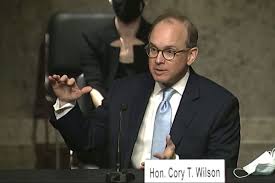
That whiteness isn’t limited to the appellate courts. All of Trump’s federal judge picks are substantially whiter than Obama’s appointees, and overwhelmingly male. And what’s perhaps most distressing is Trump’s picks are much younger: Cory Wilson, who was confirmed Wednesday afternoon to the U.S. Court of Appeals for the Fifth Circuit by a 52-48 vote, is 49. In fact, the Trump administration has bragged about the young judges that have been confirmed—the average age for Trump appointees is ten years younger than that of Obama’s.

A judge like Wilson now has decades to affect the federal appellate courts, so the impact of all these Trump nominations cannot be overstated. There’s legal immunity for killer cops. There’s the state of legal abortion. There’s full LGBTQ equality. There’s immigration.

These are just a handful of critical issues the federal courts will weigh in on in the coming months and years. Thanks to Trump’s success in stacking the courts, the circuit courts will consist of a bunch of Brett Kavanaughs and his fraternity brothers (and very few sorority sisters) deciding if social service agencies can discriminate against queer families or if states can ban abortion before patients even know they’re pregnant.

How does Trump find such dewy-eyed, youthful judicial candidates? In part, it’s because he’s letting the Federalist Society basically pick judges for him, regardless of their experience. Of the 53 judges Trump has put on the appellate courts, all but eight are tied to the Federalist Society, which is basically a breeding ground for lawyers who hate reproductive health freedoms.

It’s also because the administration is willing to give woefully unqualified people lifetime appointments to these seats, so the nominees don’t have to have spent years doing things like “practicing law.”

In fact, the American Bar Association (ABA) has rated nine of Trump’s judicial picks as “not qualified.” By contrast, during Obama’s two terms, the ABA gave exactly zero of his judicial picks that rating.

Consider Jonathan Kobes, now on the bench for the Eighth Circuit. Kobes, who is 45, was only 43 when Trump tapped him for the seat. Kobes was such a weak candidate that the ABA functionally couldn’t evaluate him. They had “difficulty analyzing Mr. Kobes’ professional competence” because he couldn’t even provide the sort of writing samples the ABA would typically review. Kobes gave the ABA some examples, but they said those were “either from Mr. Kobes’ early days as a lawyer, relating to relatively simple criminal law matters, or from his recent legislative work for Senator [Mike] Rounds. None of the writing that we reviewed is reflective of complex legal analysis.”

Ouch.

Of course, Kobes got confirmed anyway, and he’s recently showed us he’s just fine with cops shooting unarmed people in the back.

For a more recent example, there’s Justin Walker, Trump’s 199th confirmed judge; the U.S. Senate confirmed him last week. Walker is the newest member of the D.C. Circuit and he’s only 38 years old, getting the seat after less than nine months on the Western District of Kentucky bench. When he was up for the Kentucky seat, the ABA rated Walker as “not qualified” for several reasons, chief among which was that he basically had no experience as a lawyer. What Walker did have, though, was a ton of experience boosting U.S. Supreme Court Justice Brett Kavanaugh during his confirmation hearings—and that’s what counts these days.

In a typical presidential administration, a crusade so strong it appeared to make someone unable to “exercise dispassionate and unbiased judgment”—which is kind of the whole point of being a judge—would be disqualifying. In Trump’s world, this is a feature, not a bug.

Together, these Trump judges are shifting federal courts rightward at a fast clip. They have no real incentive to behave impartially, as they were chosen precisely for their ability to be partial to a conservative agenda.

Right now, here’s the figure and number you should be most worried about: The former head of the Federalist Society is revving up a dark money group that’s poised to throw at least $10 million at a campaign focusing on judges in the 2020 election.

Liberals need to put the issue of judges front and center for Election Day as well. The effects of the Trump agenda are going to be felt for decades, long after this administration is consigned to the ash heap of history. Clawing back the federal courts, nomination by nomination, is going to be key to pulling us back from the brink of a world where only white straight Christian men have rights.

Trump may end up losing the presidential election in November, but the 200 (and counting) judges he got confirmed to lifetime appointments will outlast the next several elections. Remaking the federal courts must be a top policy priority for progressives and Democrats moving forward. Otherwise, Trump may as well just be in office forever.

Source: https://rewire.news/article/2020/06/24/trumps-200th-judge/

Ban beginning at six weeks, which is before most women know they are pregnant, is blatantly unconstitutional

The state capitol in Nashville. Photograph: Mark Humphrey/AP

Republicans in Tennessee have voted to ban abortion as early as six weeks after conception, in a surprise midnight vote held in the middle of a pandemic, without members of the public present.

The ban beginning at six weeks, which is before most women know they are pregnant, is blatantly unconstitutional and will almost certainly be blocked in the courts before it goes into force. Reproductive rights advocates were swift to promise a challenge.

The bill was not listed on the state legislature’s calendar and the vote took place in Nashville in a state capitol closed to the public because of the coronavirus pandemic.

The rate of new coronavirus cases in some Tennessee counties has risen, although the state’s weekly trend has plateaued.

Alexis McGill Johnson, acting president and chief executive of the Planned Parenthood Federation of America, said: “It is a disgrace that in the face of a true public health crisis, Tennessee politicians wasted their time with this last-minute move to attack abortion access before closing up shop this session.”

According to a local reporter, the only protesters present during debate were three women in masks who “snuck” into the public gallery. Placed in handcuffs by all-male capitol police, they yelled “Banning abortion in Tennessee does not save lives!” and “Pro-life is a lie, we don’t care if women die!”

The bill is almost certain to pass into law, as it was proposed by the state’s governor. It comes just days before the US supreme court is expected to issue an opinion in the most highly anticipated abortion rights case in decades.

Abortion is legal in all 50 US states, despite a recent spate of bans. The procedure was legalized to the point a fetus can survive outside the womb by the US supreme court in 1973, in the landmark case Roe v Wade.

The upcoming ruling is expected to indicate the nine-member court’s appetite for restricting abortion. The panel has a 5-4 conservative majority, thanks to the confirmation of two justices nominated by Donald Trump. Notably, all the conservatives are men.

During debate in Tennessee, Gloria Johnson, a Democrat from Knoxville, said: “I feel like there was a bargain made on my reproductive health rights in order to get the budget passed.”

The headline restriction of the new bill is a “heartbeat” provision, which bans abortion after fetal cardiac activity can be detected, which is typically between six and eight weeks after conception. At that stage, a pregnancy is still classed as an embryo. The chambers of the heart and the circulatory system are not yet formed.

The bill also requires abortion clinics to post a sign and provide information telling patients medication abortions may be reversible – although there is no medical evidence to support the claim – under penalty of a $10,000 fine.

It bans abortion outright for juvenile women in state foster care and bans abortion if sought because of a Down’s syndrome diagnosis, or because of gender or race. There are no exceptions for cases of rape or incest.

The bill also requires doctors to perform an ultrasound and forces women to view images of the fetus and to listen to cardiac activity and a description of its limbs and organs. Those requirements are likely to drive up the cost of abortions, which are primarily obtained by young and poor women.

The ban is also sequential, according to the Tennessean. If a court strikes down a provision banning abortion at six weeks, a ban will automatically be instituted at 10 weeks, then 12, 15, 18, 20, 21, 22, 23 and 24 weeks. A full-term pregnancy is 39 weeks after a woman’s last period. A fetus can live outside the woman at 24 weeks, although it is more likely to suffer severe disabilities. Abortions late in pregnancy are extremely rare.

“Hopefully we can protect more lives, we can save more babies,” said the Republican state representative Susan Lynn, according to local news station WJHL.

Despite the pandemic, Tennessee Republicans have refused to pass a bill to expand health insurance to 280,000 low-income residents who have no access to the healthcare system. According to the Kaiser Family Foundation, more than 666,000 Tennesseans lack insurance, including more than 77,000 children.

Source: https://www.theguardian.com/us-news/2020/jun/19/tennessee-republicans-approve-six-week-abortion-ban-surprise-vote?fbclid=IwAR034IPjDD1HZ55Tj4OER9SzUCaFMIUIMPeZtQt2jstW20DcjH4KkTNY3W8

Pro-choice Christians exist! With Roe v. Wade in mortal danger, they’re mobilizing around “reproductive justice”

Donald Trump holding the Bible (Getty Images/Salon)

onald Trump’s upside-down Bible photo-op at St. John’s Church has led to unprecedented blowback from retired military generals, culminating in a mea culpa from Gen. Mark Milley, chairman of the Joint Chiefs of Staff. But the religious pushback was similarly sharp, starting with the Rev. Gini Gerbasi, an Episcopal priest who was among those “literally DRIVEN OFF of the St. John’s, Lafayette Square patio with tear gas and concussion grenades,” as she described on Facebook — an extraordinary use of state power to crush religious liberty. A bevy of leaders from the Episcopal Church spoke out forcefully, soon joined by CatholicsLutherans and others, including some evangelicals.

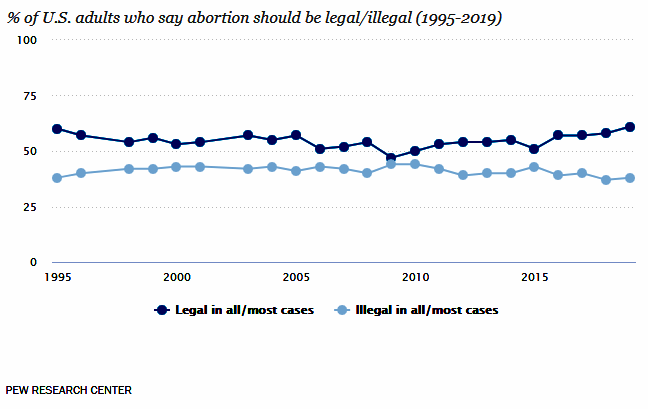
But as McKay Coppins writes at The Atlantic, “most white conservative Christians don’t want piety from this president; they want power.” In particular, they want the power of his judicial appointments, with the goal of overturning Roe v. Wade, writing their minority views into law for generations to come, even as their share of the population (though not the electorate) plummets. As noted in a forthcoming report from Political Research Associates, support for legal abortion is at a 25-year high:
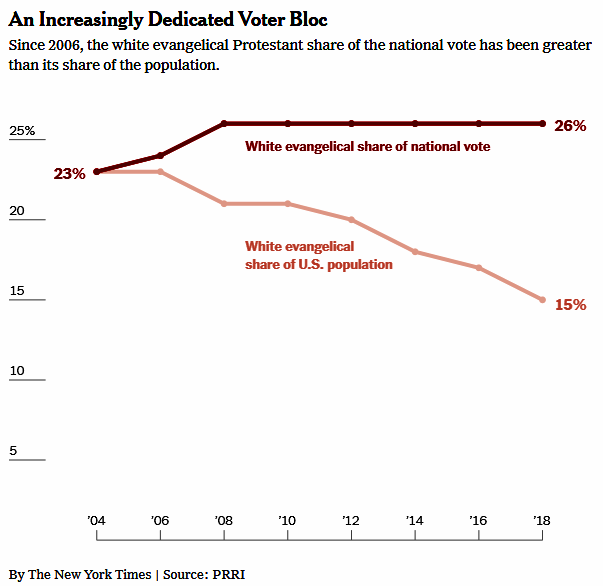
At the same time, the main voting bloc opposed to legal abortion — white evangelical Protestants — is shrinking as a share of the population, even as it holds steady as a share of the electorate:
There could not be a more clear-cut example of anti-democratic minority rule than the multi-decade process of eroding abortion access, with ultimate goal of overturning Roe v. Wade.

But it’s not just a majority of Americans whose views are being overridden. It’s a majority of America’s religious believers, too. Hence the title of the report: “The Prochoice Religious Community May Be the Future of Reproductive Rights, Access, and Justice,” by PRA senior research analyst Frederick Clarkson, who wrote an essay and led a online colloquium based on his findings in mid-May. As the title of one section argues, “The Power is Not in the Polls; It’s in the Organizing.”

In the essay, Clarkson writes, “There is a vast prochoice religious community in the United States that could provide the moral, cultural, and political clout to reverse current antiabortion policy trends in the United States…. Taken together, they have vast resources, institutional capacity, historic and central roles in many towns and cities, and cadres of well-educated leaders at every level.”

This is not brand new, in historical terms. In his report, Clarkson cites the story of the Clergy Consultation Service on Abortion, the largest abortion referral service in pre-Roe America, with nearly 2,000 religious leaders involved.

His findings were not what he had initially expected, Clarkson told Salon.

“For many years, my colleagues and I have argued that there is much to be learned from the successes of the Christian Right (and much that we shouldn’t emulate),” Clarkson said via email. “But when I was tasked with a project to look over the horizon to a time when Roe v. Wade will have been overturned, I didn’t expect I find myself trying to live up to my own advice.”

He discovered that “part of the secret of the success of the Christian Right was what are called ‘parachurch’ organizations, and that the time had also come for the pro-choice religious community to have some of their own, if there was going to be any hope of turning things around someday.”

The power of “parachurch” organizations

Parachurches are nonprofit organizations outside denominational control, and Clarkson describes three different sorts of roles they could play. The first is issue-oriented groups, rooted in basic shared values. “A menu of possibilities would include the creation of state, local or regional groups — at least as pilot projects — to figure out what works and what doesn’t,” he said.  They could also vary in focus from within a single denomination, such as Catholicism, to being ecumenical or multi-faith. “They might also be multi-issue in the manner of what Religious Left organizations might be like if reproductive choice, access and justice were part of the agenda.”

The second sort of organization is electorally-oriented: both creating a voter base and building a cadre of political workers — up to and including candidates and office-holders. But they would not go away after Election Day. Their whole purpose is to be ongoing, to build capacity over time and not to require reinvention every two or four years.

The third kind of organization is needed to support the first two: clearinghouses, or strategy and training centers.

The overall result is more than the sum of the parts. “The genius of the Christian right was, first, to adjust theologies and connect specific religious values to the activities of politics and government and to the ongoing project of building for power via electoral politics,” Clarkson said:

Pat Robertson’s Christian Coalition was the first large-scale such organization, its leaders having moved past the apolitical theologies of evangelicalism to ones that not just accommodated, but required political action and governmental control. What historian Gary Wills recognized was, it was all about dominion. The coalition not only sought voters to expand its base, but turned voters into activists, activists into politicians and political professionals, and politicians into candidates and government officials.

All of that is what goes into keeping the Christian right’s political power constant, even as its share of population continues to plummet.

“Groups on the liberal left of the religious community might say they already do some of this,” Clarkson observed. “But exactly none, to my knowledge, do such things with the comprehensiveness and on the scale that the organizations of the Christian right have done — especially in organizing across the electoral cycle with a vision for the future.”

There are lobbying groups connected with major religious institutions that “focus on regulations, legislation and making public statements,” Clarkson said. “All good, but not the same thing as developing a broad and deep vision, and building capacity for electoral engagement.”

Another way of understanding parachurch organizations came from researcher Rachel Tabachnick in a response paper. She introduced a simplified organizational structure tree describing how they function: “First, the branches of the tree represent the deliverable products and services…. policy guidelines, education, media, get-out-the-vote efforts, etc.” Second, “The trunk of the tree represents the tangible resources,” which she describes in shorthand as “Fixers, Funders and Fellows.” The fixers are the architects who create the organizations. Third are the roots, the intangible resources: “These are often the least visible assets, but they are the foundations on which the rest of the organization depends. These include knowledge, vision, values and ideas.”

The religious right has had a relatively easy time building its infrastructure, in part because it was a social minority with relatively homogeneous views and strong deference to authority. In his essay, Clarkson writes:

The Christian Right has had the benefit of being more religiously and racially homogeneous while the prochoice religious community will necessarily be religiously and racially more diverse. Navigating our differences while building greater unity may be challenging, but the call to do so is at the core of the values of most religious communities — and this usually includes the commitment to the values of religious freedom, religious equality, and separation of church and state.

These core values alone could form the foundation for a broadly shared framework for advancing a pro-choice religious agenda. Separation of church and state is historically important for many people of faith — particularly Roman Catholics, as John F. Kennedy made clear in a famous speech to Protestant ministers two months before the 1960 election. A long line of Catholic politicians, in the spirit of Kennedy’s speech, drawn a sharp line between their own personal following of Catholic dogma (which is contested) and their actions as public officials.

The reproductive justice framework

But Clarkson also discussed another framework: that of reproductive justice, defined by the group SisterSong as “the human right to maintain personal bodily autonomy, have children, not have children, and parent the children we have in safe and sustainable communities.”

This definition resonates with the comments of a CCS client who had chosen to have an abortion, interviewed by Gillian Frank and quoted in Frederickson’s report:

Later I had two healthy beautiful children and a marriage that’s been excellent, and I always felt that this fetus was a potential life, but I had, every month, the potential for life. And if I had gone forward with that pregnancy, the children I have now would not have come to be. And so this was a choice that I needed and deserved.

One of the colloquium respondents, Presbyterian theologian Rebecca Todd Peters, author of “Trust Women: A Progressive Christian Argument for Reproductive Justice,” elaborated on the reproductive justice perspective in comments she provided to Salon:

I would propose that the primary goal of this organizing should be to change the national conversation about abortion from a conversation focused on justification to a conversation focused on justice. Everything about how we think and talk about the issue of abortion is shaped by the justification framework and the belief that women need to justify their abortion decisions.

That framework needs to be rejected, she said:

The idea of focusing on reproductive justice [RJ] began with a group of 12 black women in 1994 and the RJ movement has been developed and led by women of color from the beginning. I have learned an enormous amount from the leaders and activists in the reproductive justice movement and I believe that RJ offers a clear and focused agenda for movement building that also has a solid prophetic connection to the social justice traditions of Christianity and Judaism that will make RJ organizing both challenging and meaningful in religious spaces and with religious communities.

Progressive religious traditions have repeatedly drawn on a justice perspective. Today, Clarkson noted, “a variety of issue coalitions that arguably fall under the definition of parachurch exist on the social justice spectrum, but they avoid any focus on reproductive health, rights and justice.” The reasons for this are varied. “Most originated in another time, when such matters were treated as marginal, if they were considered at all. Or they have no position and do not discuss such things because of the role of Catholics in the group. No such group has evolved in this regard, to my knowledge.”

Which is why the need should be obvious right now, as Peters, the Presbyterian theologian, notes:

Organizing outside of traditional church spaces is not the natural orientation of the progressive Christian community. There is a certain irony that the people who hold the most narrow and rigid dogmatic religious beliefs are also those who are simultaneously most interested, involved with and influenced by parachurch organizations like Focus on the Family and the Moral Majority. On the Christian right there is a unity of thought and dogma that is possible that I do not think is possible on the left.

At times, that unity can verge on sheer fantasy. As can be seen in one example that Tabachnick cited, the product of a 40-year relationship “between the ‘free market’ think tanks and the Family Policy Councils in many states” that “merges laissez-faire capitalism with social conservative policy”:

Evangelical activist David Barton, a Christian nationalist who has been described as one of the most influential leaders in the Christian Right today, exemplifies this blending of far-right social values and economic policy. He says he uses abortion as a litmus test to determine if a politician will “protect your money.” Barton says, “If you don’t respect the right to life, you won’t respect property, you won’t respect protecting income, you’ll think you ought to tax people more rather than protect their income, you’ll take it from them, you won’t protect their property, you won’t protect their religious liberties, you won’t protect their right of self-defense, you’ll try to take their self-defense away from them.”

Barton’s fantastical blending of right-wing grievances and bogeyman-paranoia is obviously not something progressives should seek to emulate. But if the content is inherently odious, the idea of developing new practices to build political power surely shouldn’t be.

Along these lines, Peters notes, “There are some very obvious spaces and places where the religious pro-choice community has ceded ground to the anti-choice folk. These are places where we can start our organizing,” based on a reproductive justice orientation.

First, she says, is “ministering to and with women who have had abortions,” explaining that “in refusing to recognize that abortion can be a reproductive loss (even if wanted and chosen), we have lost the opportunity to think about what women, particularly religious women, need and want in terms of spiritual and material resources as they navigate abortion care — including the weeks and months after their abortions.”

Second is working with local churches on reproductive justice, following the model of LGBTQ-welcoming churches that were critical to changing attitudes and understanding around LGBTQIA issues. “In my work across the country,” Peters said, “I continue to meet amazing and inspiring lay people and religious leaders who are eager for new and different language and ideas about how to think, talk and act differently on this issue in their congregations and in their communities.”

Third is “public religious voices in communities,” a ground-level approach to the misconceptions cited above. “The vast majority of the American public believes that the Christian position on abortion is anti-choice,” Peters observed. “While there are many of us who are speaking out with progressive Christian pro-choice arguments and perspectives, these voices are not being heard. A widespread public pro-choice campaign is needed and necessary in changing the public conversation about abortion in this country.”

In fact, parachurch groups could potentially develop programs that can synergize all three of the above.

In his conclusion, Clarkson writes: “This enormous sector of American society — the prochoice religious community — is currently under-recognized, under-reported on, under-resourced, and under-organized. But because this is so, it is also a virtually untapped source of hope for the future of reproductive freedom, access and justice — and that a better future is possible.”

When he wrote those words in mid-May, they might have sounded pollyanna-ish, even with all the evidence he had found. But consider how all our assumptions around police reform have been turned upside down in the last few weeks. Why can’t the same thing happen with reproductive rights?

Source: https://www.salon.com/2020/06/18/can-the-religious-left-save-abortion-rights-from-republican-hypocrisy/?fbclid=IwAR3sr6C13Vd3qfOvDUJoX_Eg8Wl5HOBVMY34u-0oReIFtsv54a2fWRtOT3k

In its first major test on abortion since President Trump appointed conservative Justices Neil Gorsuch and Brett Kavanaugh, the Supreme Court is expected to render a decision soon that will signal to state lawmakers how far they can go in restricting abortion access. How the Court comes down on the case could also serve as an indicator of its willingness to dial back reproductive rights going forward.

The case, June Medical Services v. Russo, comes out of Louisiana, but is strikingly similar to a Texas law the Court struck down four years ago in Whole Woman’s Health v. Hellerstedt. Both are considered to be the targeted regulation of abortion providers: Known as TRAP laws, they are medically unnecessary abortion restrictions that lawmakers pass under the guise of protecting women’s health.

This means the biggest change at play isn’t the Louisiana law itself or how it impacts women. It is who is sitting on the bench.

But first, what is the case?

In 2014, then Louisiana governor Bobby Jindal signed a law requiring that doctors performing abortions have admitting privileges at a nearby hospital. The law was challenged by Hope Clinic (whose corporate name is June Medical Services) and two abortion providers, and has been circulating through the court system ever since.

There are two key issues at the center of June Medical. The first is the restriction itself. The Louisiana law requires that abortion providers have admitting privileges to a nearby hospital, citing women’s safety. But complications from abortion are incredibly rare, and admitting privileges are hard to obtain by design. Roughly 70,000 abortions have been performed at Hope Clinic and only four patients have been sent to the hospital as a result of the procedure — equating to less than a .01 percent hospitalization rate. In conservative states where many hospitals are religiously affiliated or simply don’t want to be associated with abortion, the admitting-privileges requirement can greatly limit the number of providers able to perform the procedure, reducing options for women and therefore placing an undue burden on access. For this very reason, the Court struck down Whole Woman’s Health v. Hellerstedt in a 5-3 decision.

The other issue raised in June Medical is who can bring forward abortion cases. The state is arguing that Hope Clinic and its providers are not appropriate plaintiffs because they are not personally close with their patients, women can protect their own interests, and there is a conflict of interest when providers challenge regulations intended to make patients safer. But the admitting-privileges requirement has not been proven to protect women from harm; if anything, it limits access to safe, legal abortion, increasing risk.

Julie Rikelman, senior litigation director for the Center for Reproductive Rights, which is representing Hope Clinic, also points to the fact that the admitting-privileges law applies directly to doctors. Since they are subject to the law, and could lose their medical licenses or face criminal penalties if they violate it, she asserts that they are the right plaintiffs in this case.

Here’s another way upholding the law could have a huge impact going forward: Future cases would need to be brought by female patients or women seeking an abortion — not clinics or providers. Rikelman said this could be devastating for abortion access and many laws would go unchallenged. Women often do not have the resources to sue, and have concerns about their privacy.

How has SCOTUS changed since its last major abortion case?

In short: a little, then a lot. Gorsuch is reliably conservative, despite his surprising lead earlier this week on the Court’s ruling to protect LGBTQ people from workplace discrimination. But his presence on the bench didn’t change the liberal-conservative balance; he replaced fellow conservative Justice Antonin Scalia, who died a few months before the Whole Woman’s Health ruling (which left eight justices to decide the case).

It is Kavanaugh’s replacement of Justice Anthony Kennedy that marks the most significant change. Kennedy was a moderate conservative who became a key swing vote in Whole Woman’s Health when he sided with the Court’s more liberal justices, agreeing that the Texas law imposed an undue burden on women’s constitutional right to an abortion (a decision that saved most of the state’s abortion clinics from closing). But Kavanaugh is a hard-line conservative whose appointment has had abortion-rights advocates sounding alarms. Now, it is Chief Justice John Roberts — who was part of the dissenting opinion in Whole Woman’s Health, but has recently sided with liberal justices in multiple cases — who is expected to be the critical vote.

What are the political implications?

The decision comes in the middle of an election year, and will no doubt be viewed as either a victory or failure for President Trump, who pledged to put anti-abortion justices on the Court during his 2016 campaign — which he said would “automatically” overturn Roe. It didn’t, of course, but Gorsuch and Kavanaugh haven’t been up to bat yet. Now, in the middle of a national reckoning over racial injustice, these two white men chosen by a white, male president and confirmed by a mostly white, male Senate wield significant power over American women’s bodies.

The optics are glaring: Not only will the Court’s decision disproportionately impact low-income women, who may lack the means to travel out of state for care, but Black women. Due to an intersection of factors, including discrimination within the health-care system and lack of access to affordable, quality care, Black women terminate pregnancies at higher rates than white and Hispanic women. They also represent a higher percentage of state populations in parts of the country with severe restrictions.

How did we get here?

State battles over abortion laws largely stem back to the early ’90s, when in Planned Parenthood v. Casey, the Supreme Court upheld Roe but changed the legal standard by which restrictions are evaluated. The Court threw power back to the states, allowing restrictions that don’t place an “undue burden” on women seeking an abortion. The decision weakened Roe but did not, of course, overturn it. “What we’ve been faced with is really a tug of war over this … undue burden standard,” said Andrea Miller, president of the National Institute for Reproductive Health. “Ever since, it’s been, What is the purpose? What is the effect? What is the substantial obstacle?

What’s likely to happen?

How the Court will ultimately come down on June Medical is unclear, but the Court is expected to render its decision shortly. In March, abortion-rights advocates said they were encouraged by the questioning of Justice Roberts, who initially seemed likely to uphold the Louisiana law. During the hearing, he appeared frustrated when Louisiana solicitor general Elizabeth Murrill and U.S. principal deputy solicitor general Jeffrey Wall — who defended the law on behalf of the state and the Trump administration, respectively — struggled to adequately argue why the Louisiana law and the burden it placed on women was different from the Texas law previously struck down by the Court.

Alexis McGill Johnson, the acting president and CEO of the Planned Parenthood Federation of America and the Planned Parenthood Action Fund, said that she was heartened by the questioning “particularly of the female justices.”

Justices Ruth Bader Ginsburg, Sonia Sotomayor, and Elena Kagan predictably poked holes in Murrill’s arguments. Ginsburg called attention to the fact that women who have medication abortions take the pills at home and therefore a patient would likely go to the hospital closest to her, not her provider, making the doctor’s admitting privileges irrelevant. Kagan raised the issue that hospitals can refuse such privileges for a multitude of reasons that have nothing to do with the quality of the doctors and the care they provide. “They were talking about the practical implications of why this law makes no sense,” said McGill Johnson.

Source: https://www.thecut.com/2020/06/supreme-court-case-june-medical-v-russo-may-change-abortion.html

An amendment to a bill would require women to wait 24 hours after initial screening to receive an abortion. Pro-life groups see this as a step in the right direction, but Democrats say it was pushed through at the last minute without the public’s input.

Planned+Parenthood+in+seen+on+Friday%2C+May+8%2C+2020.+

Planned Parenthood in seen on Friday, May 8, 2020.

Early in the morning on Sunday, Republicans in the Iowa Legislature passed an amendment to House File 594 requiring a 24-hour waiting period between a woman’s initial screening with her doctor and an abortion procedure.

The amendment was tacked on to a bill that limits withdrawal of life-sustaining procedure from a minor. The bill was passed by the Iowa Senate along party lines, 31-16, around 5:30 a.m on Sunday. The bill is yet to be signed by Iowa Gov. Kim Reynolds.

The last-minute timing of the amendment frustrated Democrats like Sen. Zach Wahls, D-Coralville. The bill had been passed 53-42 and amended in the House earlier on June 13.

“The deep irony is that Republicans introduced a 24-hour waiting period for women to access abortion, but they didn’t even give the public 24-hours notice that they were going to do this,” Wahls said.

Pro-life organizations in Iowa see the bill as a step in the right direction.

“Any time a piece of pro-life legislation can pass through both chambers is a win for unborn babies, a win for women, and a win for science,” Caitlyn Dixson, executive director of Iowa Right to Life, said in an email to The Daily Iowan. “Iowa Right to Life is thrilled that even with the obstacles of the 2020 Session, a powerful piece of legislation was passed through.”

Drew Zahn, director of communications for The Family Leader — an Iowa-based religious group that advocates for conservative policy — said he hopes that 24-hour window and information about options besides abortion will result in women keeping the pregnancy.

“In Iowa, we already have consideration periods in place for major life decisions, such as marriage or divorce … It’s important women be given the time and information to know there are other options and ways to receive help,” Zahn said in an email to the DI.

Wahls said that for services like divorce, marriage, and adoption, requiring a wait period in the is different because it’s not a medical procedure, like abortion.

Francine Thompson, executive director at the Emma Goldman Clinic, which among other services provides abortions, said the logic surrounding the wait period is flawed.

“The reality is that women have given their decision thought. Women have given thought and consideration to whether or not they want to be parents,” Thompson said. “Many women have talked to those that are important in their lives and who they consult whenever they make decisions, and so it’s based on a faulty premise that somehow women don’t take time to consider what they might want to do when they find themselves faced with an unplanned pregnancy.”

Thompson said the majority of the clinic’s clients come from outside of the Iowa City area. The 24-hour waiting period will create a greater challenge for women who live far from abortion providers.

“Most clients travel, need to secure childcare, and possibly take time off from work and so that increases their expenses and of course it is most detrimental to those that have access issues anyway, so folks who maybe don’t have paid leave, who don’t have routine childcare, maybe who don’t even have transportation,” Thompson said.

Wahl had similar concerns about the ways the bill will affect women differently based on their financial situation and location.

“It’s just putting more obstacles, more roadblocks in the way and it’s not right,” he said.

Source: https://dailyiowan.com/2020/06/17/iowa-legislature-passes-amendment-requiring-24-hour-wait-period-for-women-seeking-abortion/

“Those who were most marginalized before this are being hit the hardest now.”

In the face of COVID-19, barriers to accessing birth control have increased significantly, further denying people the reproductive health care they need.
Cindy Ord/Getty Images

Courtney Jones, a recent graduate of the University of Nevada, Las Vegas, has a story that rings all too familiar for people across the country who have been unable to access vital contraception before and during the COVID-19 pandemic.

Balancing demanding college coursework with a part-time job, Jones, 21, found herself struggling to visit her doctor and cover the costs that came with using a NuvaRing, a monthly birth control device. Eventually, she had to make the difficult decision to stop using it altogether.

“The last thing I want is another story like mine,” she said.

In the face of COVID-19, barriers to accessing birth control have increased significantly, further denying people like Jones the reproductive health care they need.

recent poll from the National Family Planning and Reproductive Health Association (NFPRHA) revealed that nearly half of women between 18 and 34 years old are concerned about accessing reproductive health care during the pandemic, in comparison to 13 percent of older women. About half of Black women share those concerns, compared to just 28 percent of white women.

According to Rebecca Thimmesch, campaign manager for Advocates For Youth’s #FreeThePill project, the cost of care during a period of financial unease, along with the safety concerns with physically visiting doctors, have “amplified” the struggles typically faced by people trying to access contraceptives. “COVID has been framed as a great equalizer, but what we’re actually seeing is that those who were most marginalized before this are being hit the hardest now because they often have fewer resources to fall back on,” she said.

For those who are able to use online birth control delivery services, apps have been an important way of getting access to care without visiting clinics or pharmacies. One such service, Nurx, said it experienced a 50 percent increase in requests for mail-order birth control since the public health crisis worsened in March.

Although telemedicine services and sexual health apps have become more popular, gaps in coverage remain, Thimmesch explained. “They’re not an across-the-board solution.” Some apps only serve a limited number of states, while others impose fees or may have age restrictions for confidential care. And patients who lack smartphones, access to reliable internet, or permanent addresses are locked out of these services with few safe alternatives.

“I think the last few months have been very challenging, but very crystallizing for us in the field,” Thimmesch said. “We’re seeing unprecedented attacks on sexual and reproductive healthcare; we’re facing a daunting slate of potential Supreme Court decisions; and we’re hearing from the young people we serve that they can’t access the care they need.”

Youth advocates working with the #FreeThePill campaign are still mobilizing during the pandemic—by distributing information on birth control access and organizing online resources for young people who want to participate in activism from home.

Jones is one of these youth advocates. Reproductive control and autonomy are at the heart of her work with the program. “We should have the freedom to make decisions for our own bodies and our own families. It makes you feel like you’re not in control when you don’t have the income, when you don’t have the transportation, or even the time to go to a doctor, get a prescription, go to a pharmacy, and pick it up,” Jones said. “We’re working to allow people to have reasonable, accessible, and affordable alternatives to medical visits and prescriptions.”

As a youth activist, it’s important to Jones that young people have a voice and are able to advocate for their reproductive health needs. “During this time, a lot of people don’t have the access and especially the money,” Jones said. “We want to make sure that people know we’re still fighting for their rights and what they deserve during this time.”

“It’s always been wrong to ask young people to jump through so many hoops to get the birth control they need. But now, it’s not just unnecessary, it’s risking health and safety,” Thimmesch said. “People are worried about their health and the health of their families, their livelihoods, and their ability to stay housed and fed. They shouldn’t have to worry about an unplanned pregnancy, too.”

Source: https://rewire.news/article/2020/06/17/in-a-pandemic-birth-control-is-out-of-reach-for-many-young-people/