If Gov. Jay Inslee (D) signs HB 1851 into law, Washington joins California, New Jersey, and others in shoring up reproductive rights. Bruce Bennett/Getty Images
Washington’s latest abortion protections will not only help pregnant people in the state but also the thousands who travel to the Evergreen State for care.
While many states are scrambling to protect abortion legislation for a post-Roe America, Washington is taking their commitment even further.
HB 1851 updates the state’s Reproductive Privacy Act to include gender-neutral language and include physician’s assistants, advanced registered nurse practitioners, and other authorized abortion providers. Washington state voters approved the RPA in 1991,
The state legislature passed HB 1851 last week. The bill will also expand the right to have and provide abortions with protections against Texas SB 8-style penalties for assisting someone seeking an abortion as well as any pregnancy outcomes.
This isn’t just good news for Washingtonians—it’s also going to protect the hundreds of thousands of people from Idaho, Montana, Oregon, and more who regularly travel to the state for abortion care.
If Gov. Jay Inslee (D) signs the bill into law, Washington joins California, New Jersey, and more in shoring up protections for reproductive rights as other states prepare to revoke those same rights once Roe v. Wade falls.
“When HB 1851 is signed into law by Governor Inslee, it means Washington will keep doing our part in the national fight to protect access. As access to abortion is potentially removed for millions of patients, we will be here to take them in,” Courtney Normand, Washington state director of Planned Parenthood Alliance Advocate, said, according to the Stranger.
Communities shouldn’t *have* to fill these gaps in care, but it’s beautiful that we do.
he day after my abortion, I stepped into my winter boots and left my house to deliver a meal. A mother in my community had just given birth to a daughter, prematurely. The baby was in the NICU, growing stronger, while her parents took shifts, alternating between sleepless nights spent beside her hospital incubator and caring for her 3-year-old sibling at home. I was bringing them a feast of Iraqi takeout, from what they’d told me was their favorite local spot: spiced biryani, warm grape leaves stuffed with rice, juicy lamb kebabs and za’atar-dusted flatbreads and salty deep-fried falafel, and a rainbow of pickled vegetables, shining up from their brine-packed tub like so many pink and green and orange vinegared jewels. The act of bringing this dinner was at once special — infused with joy and warmth and comfort for an exhausted, overwhelmed family — but also entirely ordinary.
I was simply doing what so many friends and neighbors and co-workers had done for me the year before, when I’d given birth to my son and my fridge had filled immediately with unfamiliar Tupperware containers and casserole dishes and homemade postpartum tea blends and specially delivered cookies believed to promote lactation lined my kitchen counters. This must be the village, I’d said to my partner, weeping with gratitude and exhaustion and postpartum hormones, the village that it takes to raise a child.
Now, as I loaded the warm and fragrant takeout bags into my car, heading off to play my own small and unremarkable role as a villager in someone else’s life, I barely noticed the pickup truck approaching until it was rolling to a stop in front of my house. A woman I’d never seen before, wearing a colorful wool beanie and a brilliant smile, hopped down from the driver’s seat and walked up the driveway in my direction, waving. I saw that she was holding a huge glass mason jar of swirling amber liquid — broth and vegetables — and that a box of dried pasta was tucked under her arm. Chicken noodle soup. She greeted me, warmly and by name, as she met me by the car and held out the meal. A gift, for me. An offering.
This must be the village, I’d said to my partner, weeping with gratitude and exhaustion and postpartum hormones, the village that it takes to raise a child.
This friendly, soup-bearing stranger was, I now realized, a work colleague of my partner’s. Though we’d never met before, she knew the pain that bloomed in my lower abdomen, the very specific hairline fracture in my heart, the process unfolding inside my body and mind. She’d been speaking with him about the leave he was taking from work in order to care for me through my abortion, and he’d explained to her in candid terms why he needed the time off — that I’d had a medication abortion, which had been painful and also unsuccessful, and there was pregnancy tissue still clinging to the walls of my uterus. That I needed to undergo an in-clinic aspiration to finish emptying my womb. My partner would stay with me through the procedure and then help me recover by watching our 1-year-old, making comforting meals, bringing me pain medication and heating pads and the postpartum underwear I’d hoped to never see again. When this woman had heard about the physical and emotional pain I was in, she decided to treat me as she would someone who is postpartum — because she recognized that that’s exactly what I was. She — with an exhausting full-time job and a pregnant sister and a heavy responsibility load of her own — decided to bring me some dinner, just as I was doing for that new mother and her family.
“We think of all of these experiences — birth and abortion and miscarriage and everything — as these very separate experiences,” says Gabriella, a midwife who provides abortion care at a clinic in New England. “But really, in so many ways, they’re all on the same spectrum, the same wheel.” When Gabriella was undergoing the fertility treatments that would ultimately lead to the birth of her (now-4-year-old) child, she was called upon to accompany and support a close friend. “(She) found out, when she was 34 weeks pregnant with twins, that one of them had a completely devastating neurological condition. And nobody had spoken with her about selective termination; nobody had talked with her about it at all.”
“She was like, we can’t do this. This kid is going to have 30 seizures a day, and will suffer horribly for his entire life.” So, Gabriella dropped everything. She helped her friend figure out her options, and process all the emotions that attend the termination of a deeply wanted pregnancy. She flew across the country with her friend to a state where her third-trimester abortion was legal, supported her through the procedure, and accompanied her home.
“Having a baby is so ordinary and so extraordinary at the same time, and abortion is so much the same way.”
“On the shame tip … she felt horrible. She felt terribly guilty, and really traumatized. And I think one of the things that I was able to remind her of is: ‘If you had a friend who was going through this, would you find her horrible?’ And she was like ‘No, of course not.’ And I said, ‘Not only would you NOT find her horrible, but wouldn’t you actually find her even more deserving of your love? Would you not just want to wrap her up and tell her how good and brave she is?’
Implicit in the act of supporting someone’s abortion is affirming for them their inherent worth, goodness, and right to make that choice. “I think our culture has so much garbage that attends abortion, obviously,” Gabriella told me, “that in addition to that logistical piece — being able to fly back to her city with her, and tuck her into bed, before I got on a plane back to my city — was that I need to be able to reflect back to someone who they are.”
I know that the flowers delivered to me, the phone calls and texts and cards of support, the rainbow friendship bracelets beaded with care for me and my son, all did much to help drown out the voices of shame and stigma.
Camila Ochoa Mendoza, creator of the Abortion, With Love podcast, remembers with gratitude and tenderness the friend who — “a true Virgo,” she laughs — wrote out a schedule for her to follow as she had her medication abortion at home. And I was inspired to do the same for a friend of mine, whom I’d met through a local mother’s group while pregnant with our children, as we prepared for her self-managed abortion using pills obtained online. Many folks are able to be prescribed and shipped the medications when they’re not even pregnant, through a process called “Advance Provision,” to keep on hand just in case.
Stretching across the country and reaching into every state are vast networks of practical, financial, emotional, and sometimes medical support organizations and collectives. Indigenous people, Black people, and queer and trans people of color — folks used to loving and protecting one another from the systemic violence of the state, used to imagining and building structures of their own — have always recognized the need for interdependence and community in any and all pregnancy outcomes.
“It can be this calm, loving, supported situation. And that’s how we can take care of each other: by treating it like it is, as just a fact of life.”
Reproductive justice, as defined by SisterSong, the collective of Black women who formalized the term, is the human right to maintain personal bodily autonomy, have children, not have children, and parent the children we have in safe and sustainable communities. And living in service of that idea can take many forms, as abortion access increasingly becomes the province of our friend groups and social networks: being a sustaining donor to your local abortion fund, becoming a doula or talkline counselor, signing up to volunteer as a clinic escort to protect people accessing health care from the harassment and violence of anti-abortion protestors. Or simply showing up for individual people, in whatever ways you can, and helping to meet their needs as they navigate their abortions.
We shouldn’t have to show up in these ways for our community members when they have their abortions, considering how safe and straightforward — and how common — abortion is. But just as postpartum support has largely fallen to us to provide one another, so has abortion support. “Basically, in the same way that we are there for our friends who are postpartum,” says Gabriella, “and it is both this extraordinary thing and totally routine. Having a baby is so ordinary and so extraordinary at the same time, and abortion is so much the same way. It can be this calm, loving, supported situation. And that’s how we can take care of each other: by treating it like it is, as just a fact of life.”
Despite our modern American culture’s tendency toward isolation, our communities are made up of many more people than just our family or friends. My next-door neighbors left a plate of home-baked brownies, a pint of vanilla ice cream, and a beautiful card on my doorstep. Co-workers shifted schedules around, taking on extra work to support me and cover for my absence. Strangers funded my abortion care through the Laura Fund ($555 in total, as I was denied even partial coverage by my health insurance company and — ironically — it was unaffordable on my health care worker’s salary at the clinic where I received it), and most abortion doulas work to support people they’ve never met before and may never see again.
We shouldn’t have to pour our own limited resources — our time, money, hearts, and health — so fully into building a scaffolding of funds and practical support organizations and advocacy groups, considering that abortion is safer than a root canal, and that taking Mifepristone and Misoprostol is safer than taking Tylenol, penicillin, or Viagra. We shouldn’t have to put our own bodies on the line to fill these gaps in care, to shield our community members and their families from the misogyny, transphobia, and medical racism found in both anti-abortion and “pro-choice” spaces. But it’s beautiful that we do. And we will keep showing up for one another, no matter what, to cook dinner, to babysit your kids, to drive you to the clinic. To braid your hair and hand you the heating pad. To be your village, whether you’re raising a child or not.
Anti-abortion activists march during the 49th annual March for Life in Washington DC on Friday. Photograph: Paul Morigi/REX/Shutterstock
Court’s conservative supermajority appears open to reversing Roe, overturning nearly 50 years of precedent since 1973 decision
In 1974, on the first anniversary of the Roe v Wade supreme court decision, abortion opponents gathered on the National Mall in Washington to “march for life”. They vowed to return each year until the ruling, which established the right to abortion, was no longer the law of the land.
On Friday, anti-abortion activists from across the country braved sub-zero temperatures and the coronavirus pandemic to assemble in Washington, more hopeful than ever that this would be their last march to a court where the fate of Roe will soon be decided.
“We are hoping and praying that this year, 2022, will bring a historic change for life,” Jeanne Mancini, president of the March for Life Education and Defense Fund, told a crowd tens of thousands strong and waving signs that read “I am the post-Roe generation” and “The future is anti-abortion”.
Praising followers for standing against what she called the “single-most critical rights abuse of our time”, Mancini said they sent a clear message to the supreme court: “Roe is not settled law.”
Chris Smith, a Republican congressman from New Jersey, described the mood as one of “fresh hope and heightened expectations”. The court’s conservative supermajority appears open to reversing Roe, thereby overturning nearly 50 years of precedent since the 1973 decision.
“There’s optimism in the air, there is a sense that a significant hurdle to protect the unborn is about to move,” he said.
The rally took place a day before the 49th anniversary of the Roe decision. The theme of the march, also in its 49th year, was “equality begins in the womb.” Speakers told rally-goers that their cause was bound up with the struggles for racial justice and gender equality and described abortion as “the ultimate form of discrimination”.
The march typically draws about 100,000 abortion opponents by the busload to Washington. But this year’s march took place amid a wave of Omicron infections in the nation’s capital that limited turnout.
Some activists said on social media they would not attend because of a new mandate in Washington requiring anyone over the age of 12 to show vaccination proof before entering restaurants, conference centers and other public places.
Still, the event attracted a large and enthusiastic crowd, priests, pastors and busloads of high school students, among them. Together after the rally they marched to the supreme court singing hymns and chanting “Hey hey, ho ho, Roe v Wade has got to go!”
The jubilant demonstration comes as the supreme court reviews a case involving a Mississippi law which bans abortion after 15 weeks of pregnancy, a direct challenge to Roe. At oral arguments, several members of the court’s conservative bloc appeared open to not only upholding the ban, but to overruling Roe entirely. A decision is expected by the end of June, months before the midterm elections.
“We’ve been building to this moment,” said Victoria Cobb, president of the Family Foundation of Virginia who spoke on a virtual panel organized by the March. Her group was active in helping confirm Amy Coney Barrett to the supreme court, part of a decades-long legal strategy by abortion opponents to remake the nation’s federal court system.
“We heard justices say that precedent shouldn’t be upheld if it was incorrectly decided in the first place,” Cobb said. “That’s a big deal.”
Several Republican lawmakers appeared on stage and virtually to voice their unwavering support for the anti-abortion cause, declaring that the movement was “winning this battle”.
Last year, states enacted more than 100 new abortion restrictions, a record, according to the Guttmacher Institute, a research organization that supports reproductive rights and tracks state-level legislation. The group has called 2021 “the worst year for abortion rights in almost half a century”, and estimates that 26 US states are “certain or likely” to immediately ban abortion if Roe is overturned.
And conservative states are already laying the groundwork for new restrictions as fights over issues like telemedicine and abortion pills gain momentum.
Though the anti-abortion movement has made significant legal and policy gains in recent decades, public opinion polls have consistently found that a majority of Americans believe abortion should be legal in all or some circumstances.
“If Roe falls, the battle lines will change,” Mancini said. “But make no mistake, the fight for life will need to continue in the states.”
Kelly and Greg King, a married couple from Los Angeles, who were attending the event for a third time, said the supreme court decision would likely push their state to expand abortion access. They worry about plans to make California a “sanctuary” for out-of-state patients seeking reproductive care in a post-Roe legal landscape.
Clear-eyed about the state’s progressive politics, Kelly King said she would focus her efforts on “changing hearts” rather than changing policy.
“Abortion has become … ” Kelly King said, searching for the word. “Normalized,” her husband chimed in. “Yes, normalized,” she said. “That’s the problem.”
Hours before marchers arrived on the National Mall, the supreme court declined to accelerate a legal challenge to a Texas law that has effectively banned abortions in the second-largest state.
Yet among the speakers, there were few references to that victory or to the Texas law, which is deeply unpopular, including among Republicans.
Pro-choice supporters also marked the anniversary, using the occasion to “sound the alarm” on the threat posed to reproductive rights.
Mini Timmaraju, the president of NARAL Pro-Choice America, warned that a “small but vocal minority” was “determined to undermine the will of the majority of people in this country who support reproductive freedom”.
“They falsely claim to be supporters of ‘equality’ all while working ardently to block abortion access and end the legal right to abortion,” she said in a statement. “Make no mistake – this movement’s end goals would only criminalize and endanger people based on pregnancy outcomes, furthering inequality.”
At the White House, press secretary Jen Psaki noted the anniversary of Roe v Wade during her press briefing, saying that “reproductive healthcare has been under extreme and relentless assault ever since, especially in recent months”.
She said the Biden administration was committed to working with Congress to pass federal legislation essentially enshrining into law a woman’s right to an abortion. The Democratic-controlled House passed the bill last year, but it remains stalled in the Senate, where it faces a Republican filibuster.
“We’re deeply committed to making sure everyone has access to care and we will defend it with every tool we have,” Psaki said.
At the rally, the presence of Make America Great Again hats was a reminder of the mutually beneficial relationship forged between Christian conservatives and Donald Trump, who became the first sitting president to attend the event in 2020.
As they gathered, Trump voiced his allegiance: “As you gather together today for the March for Life, I am with you in spirit!”
While many of the speakers anticipated the end of Roe, several demonstrators said they would continue to attend future marches until its mission “to make abortion unthinkable” was achieved.
“I just pray every year that this is the last year we’re here,” said Janice LePage, who works for the youth ministry in the Archdiocese of St Louis. “I’m praying that the following year will be a march of celebration.”
Several states are trying to copy Texas, which allows civilians to sue anyone who “aids or abets” a woman who gets an abortion once fetal cardiac activity can be detected. Credit…Ilana Panich-Linsman for The New York Times
The ruling says state officials have no authority to enforce the law, which empowers private citizens: “We cannot rewrite the statute.”
The Texas Supreme Court on Friday effectively shut down a federal challenge to the state’s novel and controversial ban on abortion after about six weeks of pregnancy, closing off what abortion rights advocates said was their last, narrow path to blocking the new law.
The decision was the latest in a line of blows to the constitutional right to abortion that has prevailed for five decades.
The Texas law, which several states are attempting to copy, puts enforcement in the hands of civilians. It offers the prospect of $10,000 rewards for successful lawsuits against anyone — from an Uber driver to a doctor — who “aids or abets” a woman who gets an abortion once fetal cardiac activity can be detected.
It is the most restrictive abortion law in the nation, and flies in the face of the Supreme Court’s landmark 1973 decision in Roe v. Wade, which prohibits states from banning the procedure before a fetus is viable outside the womb, which is currently about 23 weeks of pregnancy.
By empowering everyday people and expressly banning enforcement by state officials, the law, known as S.B. 8, was designed to escape judicial review in federal court. Advocates of abortion rights had asked the Supreme Court to block it even before it took effect last September. The justices repeatedly declined, and said that because state officials were not responsible for enforcing the law it could not be challenged in federal court based on the constitutional protections established by Roe.
But the Supreme Court left open the smallest of windows, saying in December that opponents of the law could file suit against Texas medical licensing officials, who might discipline abortion providers who violate the law.
On Friday, the justices of the Texas Supreme Court, all Republicans, said that those officials did not, in fact, have any power to enforce the law, “either directly or indirectly,” and so could not be sued.
The justices said the law had effectively tied their hands. They agreed that the state’s licensing officials had the authority to discipline providers for violating other abortion restrictions. “But we conclude that the Heartbeat Act expressly provides otherwise,” the court said, using the title of S.B. 8.
“The act’s emphatic, unambiguous and repeated provisions” declare that a private civil action is the “exclusive” method for enforcing the law, the justices wrote. They added, “These provisions deprive the state-agency executives of any authority they might otherwise have to enforce the requirements through a disciplinary action.”
“We cannot rewrite the statute,” the justices wrote.
“With this ruling, the sliver of this case that we were left with is gone,” said Nancy Northup, the president of the Center for Reproductive Rights.
Texas’ attorney general, Ken Paxton, declared it a “major victory.”
“This measure, which has saved thousands of unborn babies, remains fully in effect, and the pro-abortion plaintiffs’ lawsuit against the state is essentially finished,” he wrote on Twitter.
Abortion rights supporters and legal scholars said the Texas law would encourage other states not only to pass similar bans on abortion, but to attempt to nullify other precedents they oppose.
The law allows no exceptions for abortion even in the case of women who have been raped or are victims of incest. It has thrown Texas abortion providers into crisis, and similar legislation is pending around the country.
The Supreme Court is considering a Mississippi law that bans abortion after 15 weeks of pregnancy, and in oral arguments in December, the six conservative justices on the court appeared inclined to uphold that law.
Several justices indicated that they would vote to overturn Roe v. Wade outright, as Mississippi has asked. And lawyers for abortion rights groups argued that even if the court only upholds the Mississippi law, it would effectively overturn Roe because of its central holding on viability.
Already, state legislatures are advancing bans on abortion as if Roe were overturned. Some have passed outright bans on abortion that are to take effect immediately if the court rules to overturn Roe even “in part,” and others have prepared to ban the procedure at six, 10, 12 and 15 weeks.
Legal experts said the court’s decision on Friday would further embolden states to enact aggressive measures to restrict abortions.
“The combination of the U.S. Supreme Court and Texas Supreme Court rulings on this unique law means that other states are going to see this as a way to insulate their own laws from judicial review,” said David S. Cohen, a law professor at Drexel University.
The innovations of the Texas law — its civilian enforcement and bounty system — could be adapted to shield other kinds of laws, including ones making it a crime to travel to another state for an abortion or to obtain abortion drugs in the mail, said Mary Ziegler, a law professor and historian at Florida State University. Tennessee lawmakers have proposed a bill allowing civilian enforcement of a ban on the delivery of abortion pills.
“If conservative states want to do things that may not look constitutional even to this Supreme Court, they can use a bounty system to achieve that,” Professor Ziegler said. “The message sent by the Texas litigation was that if you have concerns that you might lose a constitutional challenge, that shouldn’t hold you back. Because you can use this road map to keep the case out of federal court entirely.”
Kimberlyn Schwartz, a spokeswoman for Texas Right to Life, said abortion opponents believed they were seeing real gains after decades of chipping away at the constitutional right to an abortion.
“We’ve known that this lawsuit all along was just invalid and should have been dismissed, and now the fact that we’re on that trajectory now is encouraging,” Ms. Schwartz said, adding that the movement “is not going to let our foot off the gas yet.”
Amy Hagstrom Miller, the chief executive of Whole Woman’s Health, the clinic that sued to stop S.B. 8, said “the courts have failed us.”
“This ban does not change the need for abortion in Texas, it just blocks people from accessing the care they need,” she said. “The situation is becoming increasingly dire,” she said, as the surrounding states pass their own restrictions.
Data released in February shows that the Texas law cut the number of abortions in the state by 60 percent. Planned Parenthood clinics in neighboring states have reported an 800 percent increase in women seeking abortions. But that avenue, too, is likely to close soon.
Many women have traveled to Oklahoma for the procedure, but this week the State Senate passed its own six-week ban modeled on the Texas law. The Idaho Senate passed a similar law last week. Lawmakers in other states have proposed similar bans, but have held off in hopes that the Supreme Court decision, expected in June, will allow them to ban abortion entirely.
Florida Gov. Ron DeSantis is expected to sign the 15-week abortion ban that state lawmakers passed last week. Mark Wallheiser/Getty Images
Republican Gov. Ron DeSantis is expected to sign the bill banning abortion at 15 weeks. It would then take effect July 1.
If it feels like we talk about Florida a lot, well, we do. And you can blame their lawmakers for that after they passed an unconstitutional 15-week-abortion ban with no exceptions for rape, incest, or human trafficking.
In addition to banning abortions starting 15 weeks after the first day of the pregnant person’s menstrual period, the bill also adds additional restrictions that would force them to carry a fetus with a “fatal abnormality” for even longer and revises language about tobacco-prevention programs to include “women who may become pregnant” as targets for state surveillance—a hint of what’s to come after Roe v. Wade falls.
Republican Gov. Ron DeSantis is expected to sign the bill, which would take effect July 1.
Rep. Anna Eskamani (D-Orlando) released a statement against the ban, tweeting that “there is no such thing as a reasonable abortion ban … this is a sad day for reproductive rights in Florida, but our fight is not over.”
Arizona and West Virginia are considering similar abortion bans—all of which are modeled after the case at the heart of Dobbs v. Jackson Women’s Health Organization, Mississippi’s 15-week ban that’s awaiting a ruling at the Supreme Court.
Until now, the southeasternmost U.S. state has been a destination for out-of-state abortions in the region. Even with a 24-week abortion ban and parental consent law, among other restrictions, Florida is still more lenient than its neighbors when it comes to access.
So where do they—and Floridians who need abortions—go now? And what happens to the people who can’t travel out-of-state for an abortion, including immigrants and especially those with undocumented family members or without documents themselves?
There are a lot of unanswered questions, but there are two things we know for sure: This will be devastating to pregnant people in the South, and the anti-abortion movement will not stop here.
Copyright 2022 The Associated Press. All rights reserved Jody Steinauer, director at the Bixby Center for Global Reproductive Health, poses for photos at Zuckerberg San Francisco General Hospital and Trauma Center in San Francisco, Thursday, March 3, 2022. As members of the U.S. Supreme Court mull whether to uphold Mississippi’s 15-week abortion ban, the American College of Obstetricians and Gynecologists has filed a friend-of-the-court brief calling the ban “fundamentally at odds with the provision of safe and essential healthcare.” (AP Photo/Jeff Chiu)
NASHVILLE, Tenn. – As the Supreme Court mulls whether to uphold Mississippi’s 15-week abortion ban, the American College of Obstetricians and Gynecologists filed a brief against the state law, calling it “fundamentally at odds with the provision of safe and essential healthcare.”
But the organization’s support for abortion hasn’t always been unequivocal. After the 1973 Roe v. Wade decision guaranteed the right to abortion, American OB-GYNs remained divided on the issue. Many declined to perform elective abortions either out of moral opposition or because they wanted to avoid the “butcher” stigma that still clung to abortion doctors from the pre-Roe days.
That helped keep abortion on the margins of mainstream medicine and separate from other OB-GYN care — both physically and in the minds of many Americans. It also made abortion and the clinics where it was performed easy targets for those who opposed it.
“I think we’d be in a very different place today if right from the get-go abortion training was established and more OB-GYNs had taken it up. If family medicine had taken it up,” said Carole Joffe, a sociologist with the Bixby Center for Global Reproductive Health who has researched and written extensively on abortion.
Shortly before Roe, a group of 100 OB-GYN professors from around the country published a paper calling on their fellow specialists to begin teaching and providing abortions. But their vision of integrating abortion care into routine OB-GYN practice never materialized, despite abortion quickly becoming the most sought-after elective surgery in the U.S.
“They had the right motivations and wanted to provide abortions, but they really didn’t know how,” said Philip Darney, professor emeritus of obstetrics and gynecology at the University of California, San Francisco.
Instead, abortion clinics like those run by Planned Parenthood proliferated, many with a woman-centered approach that seemed to allay the need for a more widespread provision of abortion.
There were good reasons for the clinic model — a precursor of today’s outpatient surgical centers. Hospitals were performing abortions in operating rooms under general anesthesia, which was expensive and unnecessary, Darney said.
Also, many insurance companies didn’t cover abortions, so they needed to be affordable. By specializing, clinics brought in a high volume of abortion patients that kept the costs down and allowed a few doctors to become adept at the procedure.
“There’s no question of the huge adverse effect of the movement of abortion into clinics,” Bixby Director Jody Steinauer said. “You go see your OB-GYN if you want to continue the pregnancy and go to a clinic if you want an abortion.”
By 1992, only 12% of OB-GYN programs were routinely training residents in abortion care, according to a 1995 study in the journal of Family Planning Perspectives.
“In 1992 there was a huge crisis. All the doctors who had seen women die before Roe were reaching the end of their careers … and they were panicked that there was going to be no younger generation to care for these patients,” said Steinauer, who founded Medical Students for Choice when she was in medical school.
Pressure from that organization and others prompted the accrediting body for OB-GYN residency programs to begin requiring abortion training, with a way to opt-out, in 1996.
By 2018, 64% of residency directors said their programs were providing routine abortion training, according to survey results published in the September 2021 Obstetrics and Gynecology journal. In addition, family planning has become a subspecialty within obstetrics and gynecology.
“Now it is so normalized,” Steinauer said. “The twist is that states are getting super restrictive.”
Medically speaking, abortion has never been safer or easier. The abortion pill, which accounts for more than half of U.S. abortions, is extremely effective with a very low complication rate.
There’s also a push to expand the types of providers who can prescribe them. The Food and Drug Administration recently dropped a requirement that patients pick up the pills in person — allowing doctors in some states to prescribe the pills via telehealth and mail them to patients to take at home.
But even in states with liberal abortion laws, the political and bureaucratic obstacles for doctors wishing to perform abortions remain numerous.
When Susan Yanow, a longtime reproductive rights advocate and consultant, began working to bring abortion care to the Cambridge, Massachusetts, community health clinics, just obtaining abortion pills was a complicated, bureaucratic procedure. And adding a new service to the health centers required a credentialing process, she said.
“Other than Berkeley, there’s not a more liberal city in the United States,” Yanow said. “Yet it took us seven years to get abortion into our community health system. And I knew the mayor and all the doctors!”
Public pressure from anti-abortion activists often makes it easier for hospitals and group practices not to provide abortions. Some OB-GYNs say they’ve been required to sign contracts that prohibit them from performing abortions even outside of the hospitals or practices where they work.
Meanwhile, Catholic hospitals won’t allow abortions for religious reasons and affiliate non-Catholic hospitals often have to follow the same church-based rules. There’s also the Hyde Amendment, which prohibits federal money from being used for abortions, even indirectly.
In recent years, OB-GYNs as a group have become much more supportive of abortion. The American College of Obstetricians and Gynecologists (ACOG) has vocally opposed restrictions. And more OB-GYN residents say they plan to perform abortions in their practices.
A demographic change has accompanied the change in attitude. According to ACOG, the current class of residents is 86% female. But with the Supreme Court now considering serious challenges to Roe, many of those new doctors could find themselves working in a state where the procedure is illegal.
“ACOG of the last five years is very different than it used to be, but I wish this defense of abortion care had happened sooner, when it might have had more of an impact,” Joffee said.
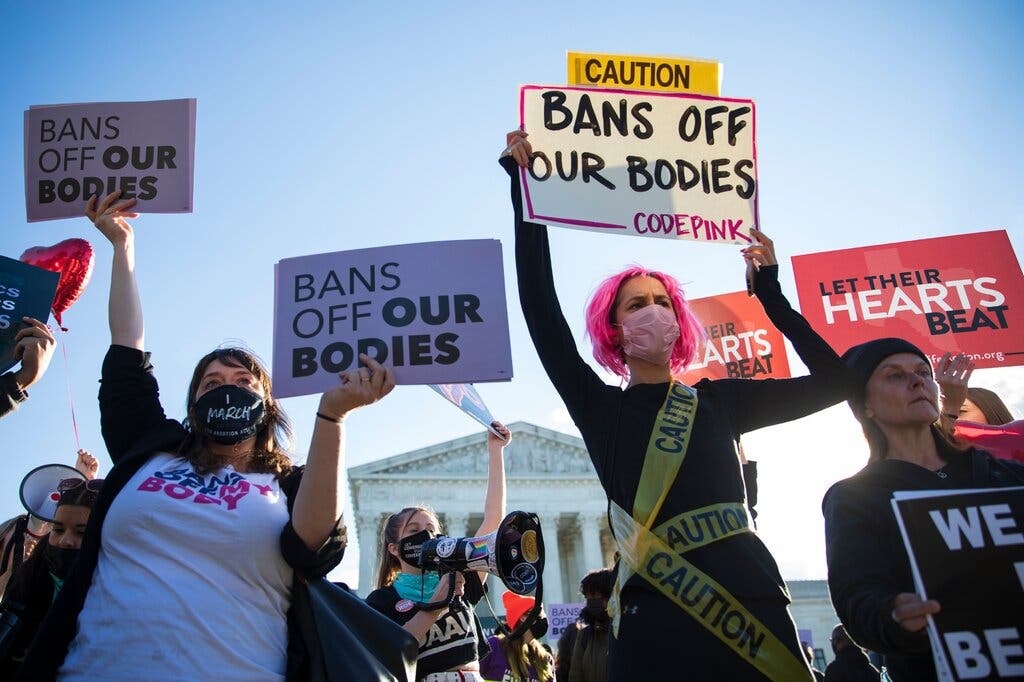
PRO-CHOICE DEMONSTRATORS PROTEST OUTSIDE OF THE US SUPREME COURT IN WASHINGTON, DC ON NOVEMBER 1, 2021. (PHOTO BY YASIN OZTURK / ANADOLU AGENCY VIA GETTY IMAGES)
The Idaho state Senate passed a bill that would hand people the ability to sue over abortions that take place as early as 6 weeks into pregnancy.
The Idaho state Senate on Thursday passed a bill that would ban abortion as early as six weeks into pregnancy and hand people the ability to sue over illegal abortions. This makes the legislative chamber the first in the country to pass a copycat version of the infamous Texas abortion ban.
“I am worried about the person who doesn’t go to college or drops out of school because they’re forced to continue a pregnancy [that] they don’t want to have. I’m worried about the impact that will have on the rest of their lives,” Erin Berry, who provides abortions in Idaho and serves as Planned Parenthood’s Washington state medical director, told VICE News. “We’ve made a lot of progress on gender equality and to me the right to abortion is essential to that.”
Legislators in at least 11 states have introduced legislation that mimics the Texas ban, which has devastated abortion access in the Lone Star State since it went into effect six months ago. The month after the ban took effect, abortions in clinics fell off by nearly 60 percent, while demand for at-home abortion pills surged.
But Idaho’s bill is now the closest in the nation to becoming law.
The Idaho bill isn’t exactly identical to its Texas predecessor, however. Unlike the Texas ban, where complete strangers can sue anyone who “aids or abets” an illegal abortion, the Idaho ban limits the group of people who can sue to abortion patients and a grandparent, father sibling, or aunt and uncle of “the preborn child.” Someone who impregnates a person through rape or incest is blocked from suing—but the bill doesn’t seem to block a family member who simply disagrees with the patient’s decision to end their pregnancy.
Under the Idaho bill, “medical professionals” could be sued for no less than $20,000 in statutory damages.
Berry pointed out that, in reality, someone who is six weeks pregnant means that they’ve only been able to confirm the pregnancy, at most, two weeks ago.
“Two weeks—it’s just not enough time for most people to make a decision, even though they’re pregnant, get time off work or get child care, and find an appointment,” said Berry, who has treated abortion patients fleeing the Texas ban. “With Covid, the whole health care system has been gravely impacted. We’re all facing staffing shortages and therefore wait times for appointments, across the health care spectrum, are longer.”
She continued, “Even if you called the day you had a positive pregnancy test, you very well may not be able to get in anywhere in your state, even now, to get that appointment.”
“For somebody to reach across the table into my body, not their own body, doesn’t really seem on par with Idaho’s values,” Alexa Roitman, an Idaho resident who testified at an Idaho senate committee hearing on the bill, told VICE News. Had this Idaho bill been in effect at the time she got her abortion, Roitman said, she would not have been able to get the procedure. She was shocked by the legislation.
“It just feels really hypocritical. It doesn’t really make sense in the state of Idaho, considering that they are all for property rights, they’re all for gun rights,” Roitman said. “They’re all about autonomy, what’s mine is mine.”
The Supreme Court is currently deliberating over a case that threatens to overturn Roe v. Wade, the 1973 decision that legalized abortion nationwide. If the justices decide to obliterate Roe, this Idaho copycat bill may become moot. Idaho, like 12 other states, has a law on the books that would ban most abortions in the event that Roe is overturned.
Abortion rights advocates demonstrating in front of the Supreme Court in November.Credit…Tom Brenner for The New York Times
With a Supreme Court ruling looming, both parties expect the issue to resonate in this year’s midterm elections.
WASHINGTON — Republicans on Monday blocked the Senate from taking up sweeping abortion rights legislation as Democrats sought to put lawmakers on the record on the issue in advance of the midterm elections and a coming Supreme Court ruling on access to abortion.
Democrats fell 14 votes short of the 60 needed to bring the Women’s Health Protection Act to the floor for consideration after the House last September passed it on a narrow party-line vote. One Democrat, Senator Joe Manchin III of West Virginia, joined all Republicans in opposition to beginning debate on the measure.
Lawmakers said it was the first time that the Senate had voted on a separate bill to enact the constitutional protections of Roe v. Wade into law. The outcome was anticipated, but Democrats were determined to hold the vote as members of both parties draw battle lines over what is expected to be a major election-year issue. The conservative-dominated Supreme Court is set to rule later this year on a case that could undermine or overturn the landmark abortion decision.
“We want Americans to know where their legislators stand on this important issue,” said Senator Patty Murray of Washington, the No. 3 Democrat and a leading backer of the abortion rights bill.
The measure would codify in federal law abortion rights that have long been protected by the 1973 court ruling. It was pursued by Democrats and abortion rights groups as a way to counter the increasingly severe abortion restrictions being enacted at the state level as well as the prospect of a high court ruling upholding tough new abortion limits in Mississippi and leaving in place a Texas law that has severely limited abortion in that state.
“People are counting on the Senate to do what the Supreme Court will not,” said Nancy Northup, president of the Center for Reproductive Rights.
About two dozen states have readied legislation that would immediately restrict abortion rights if the court upholds the Mississippi law, which bans most abortions after 15 weeks of pregnancy, about two months earlier than Roe and subsequent decisions allow.
During Supreme Court arguments in December, conservative justices indicated a willingness to scale back, if not undo, the federal abortion protections and leave most of the regulation up to individual states. Democrats say the measure is needed to guarantee that women around the nation have equal access to abortion and to prevent states from imposing restrictions that are not medically necessary as a way to unconstitutionally curtail abortion.
Senator Chuck Schumer, the majority leader. Democrats fell short of assembling the 60 votes needed to bring the Women’s Health Protection Act to the floor for consideration after the House passed it on a party-line vote last September.Credit…Michael A. McCoy for The New York Times
Senator Chuck Schumer, Democrat of New York and the majority leader, decided to move forward with a vote on the Democratic bill despite the Republican opposition in the Senate, calling it a “dark, dark time” for abortion rights in the United States.
“Abortion has never been more at risk in America,” he said.
Abortion rights opponents say the proposed legislation, which President Biden has said he would sign if it reached his desk, goes far beyond the scope of the Roe decision, and would allow late-term abortions and eliminate state restrictions on abortion that have strong public support.
“The misnamed Women’s Health Protection Act is the most radical abortion bill in United States history,” said Jeanne Mancini, president of March for Life. “It would enshrine into federal law abortion on demand until the moment of birth, and it would nullify state laws — new and existing — that protect unborn children and their mothers.”
Senator Mitch McConnell, Republican of Kentucky and the minority leader, criticized Democrats for holding a “show vote” on the Senate floor when there were more pressing issues such as the conflict in Ukraine to consider. He predicted the maneuver would backfire on Democrats, noting that public opinion polls show most Americans favor some restrictions on abortion, particularly late-term procedures.
“Yet again our colleagues wish to demonstrate that the radical left fringe runs today’s Democratic Party,” Mr. McConnell said on the Senate floor before the vote. “I want to thank the Senate majority leader for making it clear where his party’s priorities lie.”
Both sides are bracing for abortion rights to be a major issue in the November elections, particularly if a high court decision in May or June is seen as gutting Roe. While abortion has traditionally been seen as an issue that is a stronger motivator for conservatives, Democrats say that a court decision striking down Roe and the spread of new abortion restrictions around the nation could rally women voters and turn the issue in their favor.
Democrats did not try to disguise the fact that Monday’s vote was aimed at getting Republicans on the record.
“Make no mistake,” said Senator Richard Blumenthal, Democrat of Connecticut and a chief author of the legislation, “reproductive freedom will be on the ballot in November.”
Cities could be where we create the world we dream of, one with unrestricted abortion access and full equity. We can build from there. Megan Varner/Getty Images
City governments have the power to make it easier or harder to ensure abortion access—it’s time to adapt and learn how to be effective at the local level.
Roe v. Wade will fall, and abortion will almost certainly become illegal in most of the South and Midwest when the Supreme Court rules in Dobbs v. Jackson Women’s Health Organization.
In places like my home state of Texas, abortion is already only a hair’s breadth away from inaccessible. As clinics fight to stay open, we must continue supporting abortion funds so those organizations are able to help their clients travel the ever-greater distances to cities in other states that still have abortion services. And all of us must step up our efforts to protect and expand abortion access in those cities. While it’s late to sound this alarm, I’m hopeful that much can still be done.
Given the horror show that is the current news about abortion rights and access, maybe it is not surprising that when voters in Lubbock, Texas, approved a city-level abortion ban last May, there was not much coverage in the mainstream media. After all, Lubbock is in Texas, where the state government has been in all-out assault mode against abortion rights, so news like this wasn’t much of a surprise.
Every couple weeks for the past few years, a small city in the United States passes a municipal-levelabortion ban, all instigated by the work of one Texas pastor. But until Lubbock, not one of the towns that passed such a ban actually had a clinic operating there. Unfortunately, Lubbock won’t be the last.
As the founder and director of Equity Agenda, an organization that partners with city governments and mission-aligned nonprofits throughout the country to increase gender equity at the local level, I have spent nearly two decades working in gender equity, abortion rights, and city government. When I started my career in reproductive rights, we in the younger generation were fighting to direct our attention and resources to state governments because we knew then that Roe was insufficient. Twenty years later, we finally have at least a critical mass of reproductive health, rights, and justice organizations and funders focused on the state level. Unfortunately, this came after the anti-abortion movement had already developed broad state-level infrastructure and expertise that is effectively interconnected with the broader conservative movement—coordination on a scale that abortion rights organizations can’t yet match.
Today, I see us repeating the mistake of ignoring a particular field of battle, of ceding ground at the city level that needn’t be lost because of the belief that such efforts aren’t as effective or powerful as working at the state or federal levels.
But abortion clinics exist nearly entirely in cities, and city governments have the power to make it easier or harder to ensure access. For instance, cities can regulate protests and sidewalks and street access and noise (Spokane, Washington); subject clinics and health facilities to zoning regulations—aka TRAP laws—designed to burden providers and make it difficult to obtain abortion care (San Antonio, Texas); and direct resources toward keeping, or at least attempting to keep, providers and patients physically safe (Knoxville, Tennessee), to name just a few areas of concern.
The likely outcome of Dobbs v. Jackson Women’s Health puts an even finer point on the risk to access posed by not prioritizing cities. There are signs of the opportunity that pushing back against these bans can be successful, but there’s also a tremendous risk in failing to marshal resources and expertise at the city level. A proposed ordinance in Lindale, Texas, would criminalize providing help to people to access abortion outside the city limits.
Even though resources for abortion rights are always less than we would hope, even comparatively small investments in creating robust local government efforts will be meaningful.
Lubbock’s ordinance should have been a wake-up call to all of us—especially those in the abortion rights movement, including funders—if all the small-town bans leading up to it weren’t enough already. At the end of January, the appeal to overturn the Lubbock ban was abandoned, illustrating clearly the limits of relying solely on a defensive legal strategy at the local level.
I’m thrilled to partner with the National Institute for Reproductive Health, one of the only organizations funding proactive local work, in generating progressive abortionwins in big liberal cities. But it’s also crucial to invest in defending abortion rights, especially in the Midwest and the South, and that reproductive rights, health, and justice organizations work to increase their expertise in municipal government operations and local politics. Local city coalitions that are built around a framework of issues that impact people who are not white, straight, cis men—issues such as abortion access, police violence, public safety, and care infrastructure, among others—could be incredibly powerful foundations for progressive action.
I also work with women mayors around the country. During a recent conversation, I discussed with one West Coast mayor the likely tsunami of abortion-seeking people the clinic in her city will likely see after the Supreme Court issues its decision in Dobbs v. Jackson Women’s Health later this year. Such a deluge of patients is easily foreseen: Clinics in states around Texas continue to face similar waves of abortion-seekers months after the Texas Legislature passed a six-week ban. And many of the states currently seeing abortion patients from Texas may end up with no clinics of their own after the Court’s ruling in Dobbs, increasing the pressure on cities with clinics even more.
The mayor’s politically moderate city is only one of the foreseeable targets for a ban by anti-choice activists. Unfortunately, very few resources are available to help the city prepare to support the clinic as demand dramatically increases, or to brace for a local abortion-ban effort, because of the paucity of resources for municipal work.
Last July, the Guttmacher Institute reported that 30 cities in six states had passed abortion bans over the previous three years. In just six months’ time, the 40th city in Texas alone considered a ban; the city council rejected the proposal in January. Nearly all these municipal-level bans are the result of just one activist’s organizing efforts, which have been well-resourced and paid for by anti-abortion funders. Their strategy has always been to chip away at our rights, and now we can see clearly the landslide that has been created at the state and federal levels as well as in the courts. We can’t allow this same dynamic at the city level.
It’s also worth mentioning that the roots of the bounty-style Texas abortion ban are the same as those of the local bans. We can and must fight back. Federal, state, and legal work is as critical as ever, and even though resources for abortion rights are always less than we would hope, even comparatively small investments in creating robust local government efforts will be meaningful. Working at the community and city levels will create returns on investment for our work at every level of government and at the ballot box, but we can’t just reuse the same strategies and tactics.
We know that a majority of Americans support abortion rights. This is true even in small towns. We can defend and increase access to abortion at the local level in many parts of the country if we increase resources dedicated to local government work, and especially local government expertise, within the movement.
Cities could be where we create the world we dream of, one with unrestricted abortion access and full equity. And we can build from there. To address the risks and take full advantage of the opportunities, we must adapt and learn how to be effective at the local level.
Rick Perry and George W. Bush managed to identify early on the right (and right-wing) anti-abortion coattails they needed to ride to carry them to political success. Robert Daemmrich Photography Inc/Sygma via Getty Images
Decades of stagnation on abortion rights from Texas’ ostensibly pro-choice political left led to the rise of restrictions—and the GOP amassing power.
To understand the story of Texas SB 8, which went into effect six months ago today, and how we got here, we have to talk about George W. Bush and Rick Perry.
Despite being largely unqualified for the positions of power to which they aspired and later held, Bush and Perry, two profoundly careerist and deeply unprincipled men, managed to identify early on the right (and right-wing) anti-abortion coattails they needed to ride to carry them to political success.
In 1989, before he became famous for his hair, Perry switched parties from Democrat to Republican because he saw the winds of change coming in the Lone Star State. Bush never did much of anything (he was a bigwig in the Texas Rangers baseball franchise) before he traded on his father’s name—and his father’s anti-abortion politics—to move into politics.
Over the course of my research for this series, it became increasingly apparent that, despite literal decades of warning signs, gargantuan red flags, and Republicans’ outright statements of their intent to pass abortion restrictions at the first possible moment, many of the people who were best situated to protect abortion rights and access in the Texas Legislature—both before and during the rise of Bush and Perry—either neglected to do so, willfully chose not to, or openly assisted in anti-abortion efforts not over a few years or sessions, but over decades.
After all, if Rick Perry and George W. Bush could figure out that adopting the classism, racism, and misogyny of the growing, mostly politically unopposed anti-abortion movement in Texas could help propel them to success despite their demonstrated lack of personal and professional investment in anti-abortion principles, it is hard to believe no one saw these two clowns coming. Indeed, many abortion rights advocates and abortion providers on the ground repeatedly issued warnings that anti-abortion politicians and lobbyists were doing exactly what they said they were doing: trying to outlaw abortion by any means necessary.
But as the anti-abortion right became bolder and more assured, the ostensibly pro-choice political left in Texas, reluctant to take these warnings seriously, seemed to stagnate or even move backward, helping Republicans pass legislation that would open the floodgates for restrictions to come.
Texas targets young people
On January 22, 2000, the New York Times headline read in part: “With Help From Democrats, Bush Managed a Coup on Abortion Bill.” The Times published this story on the 27th anniversary of Roe v. Wade amid Dubya’s first bid for the presidency. It is an alarming piece of journalism that describes Democrats’ fecklessness in addressing the threat of the anti-choice movement in Texas.
The bill referenced is Texas’ 1999 parental notification law, which required abortion providers to notify a parent of an unemancipated minor seeking abortion care at least 48 hours before performing an abortion, or else the minor must navigate the courts in hopes of obtaining a “judicial bypass.” (Judicial bypass is a legal process that compels a pregnant minor to ask a judge for permission to get an abortion without informing a parent.)
In the piece, Democrats admit to helping Bush, who as governor pushed for Texas’ parental notification law to curry favor with the anti-abortion right and Christian evangelicals as he prepared for his White House. Texas House Democrats helped Bush nudge the bill over the finish line because, according to one unnamed lawmaker, they “like[d] him,” and because Democrats, who had already lost control of the Texas Senate, felt they would ultimately lose the battle anyway, so why cause a big to-do about it?
A former Planned Parenthood worker and Texas Democrat pooh-poohed concerns about Bush’s anti-abortion agenda, telling the Times that the bill was purely to “placate the religious right” because Bush wasn’t “strongly anti-abortion.” Another Democrat described the parental notification bill as both a “big loss” and a “nothing-burger” that “clearly had to be given to the religious coalitions.”
I doubt the young people who have been forced to expose their most intimate and personal experiences to strangers and judges in court or else carry an unwanted pregnancy to term would describe forced parental involvement and the judicial bypass process as a “nothing-burger” that “clearly” needed to exist for anyone, least of all “religious coalitions” or Bush’s political aspirations. But in light of the previous 25 or so years of Texas abortion politics, and with Texas Democrats largely viewing abortion rights as a subject to be avoided—or something to restrict—rather than actively expanded or protected, the dismissal of young people’s rights as inconsequential and immaterial to abortion rights more broadly makes a certain kind of sense.
And, of course, some Democrats reported getting some things in return for their support of the 1999 parental notification law: The Times notes that Bush was “willing to reward” those who helped him out, notably by not campaigning against “friendly lawmakers in the other party.”
While political representation has very slowly improved over the years, the vast majority of early political decision-makers in Texas were (and continue to be) people who would never face an unwanted or untenable pregnancy.
In short, some Texas Democrats threw young people under the bus not to secure landmark progressive legislation or support for key left-wing initiatives, but in hopes of saving their own political asses. And for what? To live to fight abortion restrictions another day? Their records on that are pretty scarce, too.
The last time a Texas Democrat was elected to state office was in 1994; Democrats lost majority control of the legislature in the 1996 elections. The one piece of pro-abortion-rights legislation I could find from the mid-to-late ’90s was proposed by Democrat Ron Wilson, who in several sessions introduced a constitutional amendment “prohibiting the state from requiring a woman to complete a pregnancy.” His bill never made it out of committee.
It’s one thing to grow tired of a losing battle. It’s another thing entirely not to have entered the fight before it’s too late. And I think that, when the parental notification bill passed in 1999, it may have been in many ways too late for Texas. Not because we Texans as a people didn’t value reproductive freedom (we do and long have, just like the rest of the country), or because a few passionate, pro-choice Texas lawmakers and politicians never made it their business to support abortion rights and access. They did.
But because so much rhetorical, narrative, and political ground on abortion had already been ceded and seeded from day one of Roe, the case’s predication on a right to privacy was almost certainly flawed from the jump. The ink was barely fresh on Roe before the Supreme Court started to become openly hostile to abortion rights and access, and while political representation has very slowly improved over the years, the vast majority of early political decision-makers in Texas were (and continue to be) people who would never face an unwanted or untenable pregnancy.
More than anything else, Texas’ legislative record on abortion up until and including 1999 shows the fear of and even hostility toward affirmative, expansive reproductive rights. Seventeen abortion bills were proposed in the Texas Legislature in 1999, at that point the most ever in a single session. Just one—Ron Wilson’s proposal—supported abortion rights.
If those years in Texas politics had seen new, fresh-faced political leaders who were ambivalent about—or at least minimally motivated to pass—abortion restrictions, things might be different. But along came Dubya and Rick Perry, both of whom needed to wield little more than a good-ol’-boy charm offensive to meet the demands of an anti-abortion movement that never intended to stop encroaching on young people’s abortion access.
Of course, hindsight is 20/20, and perhaps abortion rights supporters in the Texas Legislature in the late ’90s and early 2000s could not have predicted how thoroughly the body would turn against abortion access, despite repeated warnings of the coming storm from abortion rights groups and the plainly stated intentions of anti-abortion politicians and lobbyists. Even so, it is hard to imagine looking forward at the time and predicting that, over the next 30 years or so, no Texas Democrat nor pro-choice anybody would be elected to statewide office, no matter how “friendly” they played with Bush.
Clearly, more than a few Democrats had bet on their bipartisan cooperation paying off politically. But if they hoped that supporting forced parental involvement laws would be the key to retaining Democratic seats in an increasingly Republican state, they were mistaken.
Instead, cooperation backfired into concession, and it wasn’t long before Republicans needed no help in passing Texas’ first omnibus anti-abortion law.
A new playbook in abortion politics—for both sides
If the abortion restrictions passed in Texas up to and including 1999’s parental notification law were incrementalisms, mere placations, and “nothing-burgers” meant only to shore up political careers, 2003 marked a dramatic shift in the anti-abortion playbook.
That year, Texas passed the “Woman’s Right to Know Act,” an expansive package of restrictions on abortion rights ranging from mandatory pre-abortion waiting periods to ambulatory surgical center requirements to forcing providers to share medical misinformation with patients seeking abortion care. States across the country would begin replicating those restrictions, as well, while anti-abortion sentiment grew stronger at the federal level, too.
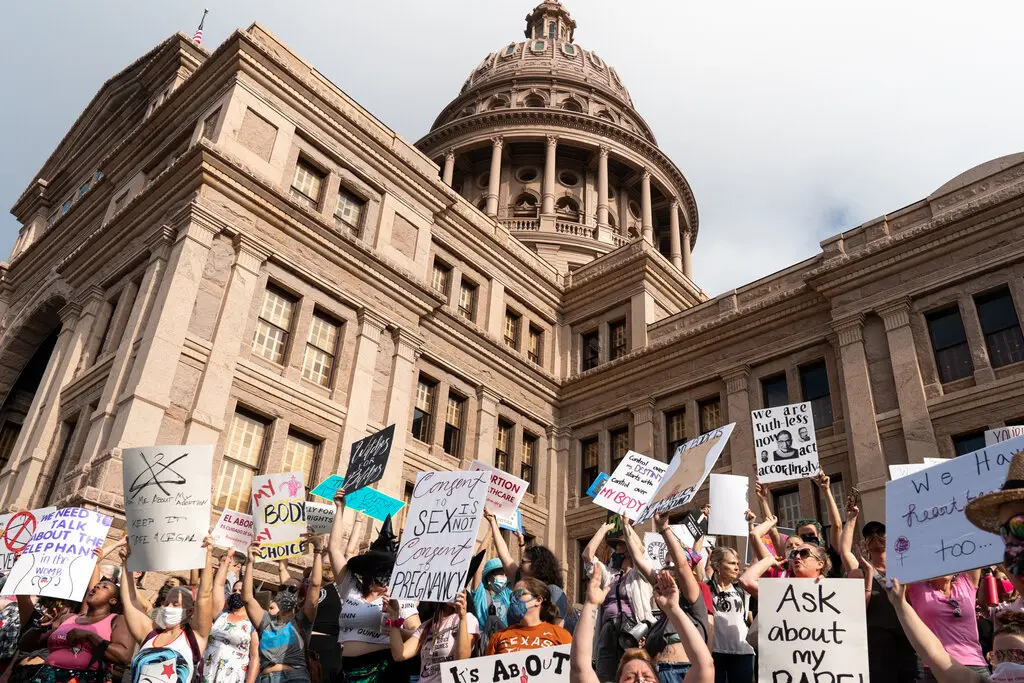
Outside the Texas capitol in 2021. (Jordan Vonderhaar/Getty Images)
Outside the Texas capitol in 2021. (Jordan Vonderhaar/Getty Images)
Just after the 2003 Texas legislative session, Congress passed the “Partial-Birth Abortion Ban Act,” which capitalized on decades of anti-abortion lies and fearmongering about the provision of later abortion care but was nevertheless championed by President George W. Bush, building upon his early success convincing Texas lawmakers to restrict abortion care for young people.
Meanwhile, Rick Perry had won the governor’s seat in Texas, and in the 2005 legislature, state lawmakers proposed 21 new abortion laws, eight of which would have repealed existing restrictions, expanded abortion access, or protected abortion rights—15 years after Gib Lewis suggested that “both sides” might try to propose 25 or 30 bills every session to influence abortion provisions in Texas.
Despite the eight bills filed in support of abortion rights and access and a slew of efforts by Texas Democrats to derail anti-abortion proposals, the 2005 Texas Legislature, by then under total Republican control, passed more abortion restrictions—a 24-week ban, plus a requirement that minors obtain parental consent, not merely notification, for abortion care—by tacking them onto other legislation as amendments. During that same year, Texas also created its “Alternatives to Abortion program,” a scheme directing public funds to religiously backed “crisis pregnancy centers” that exist to dissuade people from seeking or accessing abortion care.
Texas got a reprieve from further abortion restrictions in 2007 and 2009. The 2009 session in particular saw a surge of Democrats ride the enthusiasm for Barack Obama’s presidential candidacy into office, tipping the balance of power not quite back in favor of Texas House Democrats, but closer to it than Dems had seen in either chamber in a decade. Nearly 30 abortion bills were proposed between the two sessions, almost half of which were in support of either abortion rights and access or of basing the state’s sex education standards on medical science, not religious abstinence. Texas’ strongest champions of abortion rights and access gained steam, growing adept at heading off anti-abortion proposals and becoming more confident and vocal in their support for reproductive freedom.
It’s no coincidence that this new cohort of lawmakers were women and men of color who did things differently—and took threats to abortion access much more seriously—than the aging white men who’d dominated Texas abortion politics for the previous 30 years.
So what came next was no accident: the racist Tea Party backlash to Obama’s first term as the country’s first Black president.
The Tea Party takes Texas
Abortion supporters in Texas had already warned in decades prior that abortion restrictions were predicated on racism, classism, and misogyny; the enthusiasm with which a new wave of anti-abortion Texas lawmakers, many of them Tea Partiers, approached the 2011 legislative session exposed those warnings as truth all too clearly. Even though Texas’ white, mostly (but not always) male conservatives didn’t really have any lost power to reclaim in terms of abortion—remember, no affirmative expansions or protections for abortion rights or access had ever passed in the state—they nevertheless aggressively pursued further attacks on reproductive freedom.
Anti-abortion lawmakers, the vast majority of them Republicans, proposed 36 new restrictions on abortion in 2011, surpassing previous records as the most ever introduced in one session One new restriction passed: Texas’ mandatory sonogram law, thanks to an assist from anti-abortion Texas Democrats whose support was needed to bring the bill to a vote.
Texas also ratcheted up efforts to “defund” Planned Parenthood, drastically cutting state family planning funds to health-care entities affiliated with abortion providers, which in the long term would reduce access to preventive screenings and reproductive health care of all kinds for tens of thousands of Texans. (A number of these abortion restrictions seemed to be supported by dark-money groups like the American Legislative Exchange Council, which provides right-wing “model legislation” to conservative lawmakers.) One House bill in the 2011 session sought to mitigate the worst effects of the defunding measure; it didn’t make it to the floor.
But as successful efforts to restrict abortion were ramping up, so too was a statewide political will in support of abortion rights and access. When the Texas Legislature convened again in 2013, it would see the state’s first real, all-out fight over abortion access, complete with a takeover of the state Capitol. The time for cooperation and concessions was over.





















 Abortion - Abortion Clinics, Abortion Pill, Abortion Information