Trump’s ignorance when it comes to women’s health, as demonstrated at the final debate, would be literally deadly

Dana Weinstein was pregnant with her third child, 29 weeks in, less than three months to go. She and her husband wanted this child. Then, terrible news: a routine sonogram revealed a brain anomaly that meant their baby almost certainly wouldn’t survive, and whatever life it had would be full of suffering.

Imagine making the decision that faced Dana and her husband.

Will the GOP nominee commit to a peaceful transfer of power?

Now imagine Donald Trump making that decision for them.

Trump had a terrible debate Wednesday night. He was irritable and irresponsible. He repeatedly took Hillary Clinton’s bait and lashed out childishly. (“You’re the puppet.”) His dark intimation that he would refuse to concede when he loses on election night doesn’t just undermine our democracy, it could lead to real violence.

But most of all he was – as he always is, not just in the three presidential debates he lost decisively but also in interviews, at his rallies, and probably in every conversation he has ever had in his entire life – shockingly ignorant. And nowhere in Las Vegas was his ignorance on brighter, flashier display than on the subject of late-term abortion.

It was shocking when moderator Chris Wallace asked a direct question about abortion, a subject debate moderators usually avoid like the plague. (The topic came up in the vice presidential debate, but not directly from a moderator question.) Clinton offered a full-throated defense of a woman’s right to access abortion, saying she “will defendRoe v. Wade” because “we have come too far to have that turn back now.”

Trump said he’d appoint anti-abortion judges who will overturnRoe and then “the states will then make a determination.” Many states have already made that determination, putting strict anti-abortion laws on the books that would effectively end abortion rights the moment the Supreme Court reverses Roe.

Then Wallace asked Clinton about her support of late-term abortion rights, and she explained exactly why they’re so important.

“The kinds of cases that fall at the end of pregnancy are often the most heartbreaking, painful decisions for families to make. I have met with women who, toward the end of their pregnancy, get the worst news one could get that their health is in jeopardy if they continue to carry to term or that something terrible has happened or just been discovered about the pregnancy. I do not think the United States government should be stepping in and making those most personal of decisions.”

When Trump opened his mouth to respond, he released a flurry of ignorance so ugly it would have been shocking if it weren’t coming from the planet’s most ignorant excuse for a human being. “I think it’s terrible if you go with what Hillary is saying,” Trump said, lying about what Clinton had said: “in the ninth month you can take the baby and rip the baby out of the womb of the mother just prior to the birth of the baby.”

“You can take the baby and rip the baby out of the womb on the ninth month on the final day,” he continued, getting the facts so deeply, offensively wrong you could smell his stupidity through the television screen. Of course, abortions do not take place at nine months.

For the past few years, in Congress and state legislatures across the country, Republicans have been on a tear, pushing laws banning abortion after 20 weeks of pregnancy based on pseudoscience claiming that’s when fetuses start feeling pain.

But these Republicans don’t care about pain. They don’t care about the pain of mothers like Dana Weinstein, faced with a tragedy and forced to make a difficult decision. They don’t care about other mothers who will literally die if they can’t end their pregnancies late in their terms. They don’t care about the suffering these women go through.

If Donald Trump becomes president and fulfills his promise to appoint right-wing, anti-abortion judges to the Supreme Court, he’ll be in charge of these women’s decisions. He’ll have forced these women to carry their pregnancies to term, to carry a child who won’t survive, to put their own lives in danger. And in some cases, those policies will kill them.

It is already nearly impossible to access late-term abortion care in this country. Weinstein was lucky enough to be able to afford to fly to Colorado to a doctor who could do the procedure at that late stage of her pregnancy. She could find someone to care for her two children. For many women, that wouldn’t have been an option. And with anti-abortion legislators pushing stringent new regulations all the time, for many women the right to choose is already a meaningless abstraction. Under a Trump presidency, that right would virtually disappear.

Later in the debate, Trump laughably claimed, as he has before, “nobody has more respect for women that I do – nobody.” But the man who bragged about grabbing women “by the pussy,” who called them “fat pigs,” is not the world’s most respectful man. But it isn’t just his demeaning comments or the sexual assaults multiple women have come forward to accuse him of. It isn’t just the creepy way he has sexualized his own daughter.

Donald Trump doesn’t respect women enough to learn about women like Dana Weinstein. He doesn’t listen to their stories. He doesn’t realize that the decisions he will thankfully never get a chance to make as president of the United States would inevitably lead to some of them dying. He simply doesn’t care.

http://www.rollingstone.com/politics/features/donald-trumps-abortion-policies-would-kill-women-w445735

Source: The Rollng Stone

Donald J. Trump and Hillary Clinton offered drastically different opinions on the issue of abortion during the presidential debate in Las Vegas on Wednesday.

http://www.nytimes.com/video/us/politics/100000004721329/trump-and-clinton-on-abortion.html?action=click&contentCollection=us&module=lede&region=caption&pgtype=article

By THE ASSOCIATED PRESS on Publish DateOctober 20, 2016. . Watch in Times Video »

In the presidential debate Wednesday nightDonald J. Trump expounded on pregnancy and abortion, asserting that under current abortion law, “You can take the baby and rip the baby out of the womb in the ninth month, on the final day.”

Doctors say the scenario Mr. Trump described does not occur.

“That is not happening in the United States,” said Dr. Aaron B. Caughey, chairman of obstetrics and gynecology at Oregon Health and Science University.

“It is, of course, such an absurd thing to say,” he said. “I’m unaware of anyone that’s terminating a pregnancy a few days prior to delivery of a normal pregnancy.”

There can be situations where complications or problems occur late in pregnancy — if the woman was in a car crash, for example, or if she was suffering from severe pre-eclampsia, a potentially life-threatening condition involving high blood pressure.

But in cases like that, doctors said, the baby would be delivered before the due date, either by inducing labor or performing an emergency cesarean section.

If, very late in pregnancy, a fetus was found to be nonviable — to have a condition that would not allow it to survive after birth — the woman might continue the pregnancy and deliver a stillborn baby, or she might decide not to continue the pregnancy, Dr. Caughey said.

“Would you call that an abortion?” he said. “I think most of us wouldn’t use that language. We would say induction of labor for a nonviable pregnancy.”

Mr. Trump made his statements to condemn Hillary Clinton, who, as a senator, voted against a federal ban on late-term, or what critics call partial-birth, abortions.

Abortions that occur more than halfway through pregnancy are very rare in the United States, and many states have laws that add restrictions to the timing of abortions.

According to the Guttmacher Institute, a reproductive health research organization that supports abortion rights, 1.3 percent of abortions in the United States occur at 21 weeks of pregnancy or later.

Roe v. Wade, the 1973 Supreme Court case legalizing abortion, essentially established abortion as legal up until a fetus would be viable outside the womb (about 24 weeks into pregnancy) but also said later abortion is permissible under certain conditions, including to protect the life or health of the mother.

The Guttmacher Institute reports that 43 states prohibit abortion after a specific time in pregnancy, including 19 states that set the limit at fetal viability, three that prohibit abortion in the third trimester, beginning at 27 weeks, and 15 states that ban abortion at 22 weeks of pregnancy.

Some of these laws are considered unconstitutional by abortion rights advocates, but their existence indicates that late-term abortion is extremely rare.

On social media, many people reacted sarcastically or angrily to Mr. Trump’s assertions.

A few wrote emotionally about their own late-term abortions, and said that Mr. Trump minimized the pain they felt in having to make one of the most difficult decisions in their lives.

http://www.nytimes.com/2016/10/21/health/donald-trump-debate-late-abortion-remarks.html?_r=0

Source: New York Times

Several women from neighbouring hospitals have reportedly already contacted Norwegian hospitals about the procedure

21-october-post

Under the rules a woman can abort one foetus and keep the other BraunS/iStock


Norway’s health ministry has ruled foreign women pregnant with twins can have selective reduction abortions in the country’s hospitals even if the foetus is healthy.

The ruling means women from neighbouring Sweden and Denmark where “selective reduction” abortions – meaning aborting one or more foetuses and leaving at least one behind – are illegal can come to Norway for the procedure.

As hospitals are not required to ask for a fixed address there are fears the move could lead to a rise in “abortion tourism” – though foreign women will have to pay for the procedure, Dagsavisen reported.

Several women from other Scandinavian countries are already said to have contacted Norwegian hospitals about the procedure, national broadcaster NRK reported.

It comes after lawyers at the Norwegian Department of Justice ruled in February that selective reduction procedures should be treated no differently to other types of abortion under Norwegian law.

Now the Department of Health has ruled this applies to foreign women as well.

Currently women are allowed to terminate a pregnancy until the end of the 12th week in Norway.

Dr Torunn Janbu, an official at the ministry, told The Local: “We don’t as the Directorate have anything to say about the ethics.

“We just inform the local health services about how to apply the law.”

But doctors are warning against the procedure which they say carries risks for both the health of the mother and the remaining foetus.

Dr Birgitte Heiberg Kahrs, a specialist in fetal medicine at St Olav’s Hospital in Oslo said: “We have not found any medical benefit from this.

“On the contrary, it exposes the second child in the womb to danger as the abortion risk increases.

“Our recommendation was that this should only be allowed for twins if one fetus showed developmental abnormalities, and that it should be done between weeks 12 and 14 to reduce the abortion risk.”

Two Norwegian political parties, the Christian Democrats and the Centre Party, have called for selective reduction abortion to be banned outright.

They have called for the Norwegian parliament to debate the proposal – arguing that selective abortion was not medically possible when the current abortion law was passed in 1978.

http://www.independent.co.uk/news/world/europe/norway-pregnant-selective-abortion-foreign-women-womens-rights-pro-choice-a7368421.html

Source: The Independent

20-october

Republican presidential nominee Donald Trump at Wednesday’s debateSource: Win McNamee/Getty Images


At Wednesday night’s presidential debate, Hillary Clinton and Donald Trump went head-to-head on Roe v. Wade right out of the gate.

When discussing the composition of the Supreme Court, Republican candidate Trump said in no uncertain terms that he would appoint “pro-life” justices to the bench who would overturn the 1973 landmark decision and allow states to decide whether, and under what conditions, a woman can terminate a pregnancy.

After Clinton emphasized her firm support of the landmark ruling, Trump used his speaking time to elaborate on a gruesome — and grossly misleading — description of abortion.

“I think it’s terrible if you go with what Hillary is saying,” Trump said. “In the ninth month, you can take the baby and rip the baby out of the womb of the mother just prior to the birth of the baby.”

“Based on what she’s saying and based on where she’s going and where she’s been, you can take the baby and rip the baby out of the womb in the ninth month, on the final day,” he continued. “And that’s not acceptable.”

In fact, according to U.S. Centers for Disease Control and Prevention data, only1.2% of abortions performed in the country are happen after 21 weeks. And theGuttmacher Institute notes that 43 U.S. states restrict access to abortions “after a certain point in pregnancy.” Clinton repudiated Trump for using what she called “scare rhetoric” that misrepresents women’s experiences.

“[This is a choice] that women make with their families in accordance with their faith, with medical advice, and I will stand up for that right,” Clinton said.

And, of course, it’s a right Trump himself once stood up for, too.

https://mic.com/articles/157217/donald-trump-says-roe-v-wade-would-be-overturned-under-trump-presidency?utm_source=policymicFB&utm_medium=main&utm_campaign=social#.JhBebuj7S

Source: News Mic

19-october

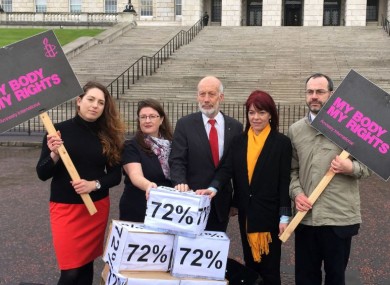
L to R: Adrianne Peltz of Amnesty International, Kellie Armstrong of the Alliance Party, David Ford of the Alliance Party, Claire Bailey of the Green Party and Patrick Corrigan of Amnesty International at Parliament Buildings in Belfast.


IX IN TEN people in Northern Ireland want abortion to be decriminalised, new research has found.

Northern Ireland is the only part of the UK where abortion is illegal, except where continuing a pregnancy would cause a serious risk to the mother’s health.

The Amnesty International poll was conducted by Millward Brown Ulster using face-to-face interviews with a representative sample of 1,000 people aged 16 and older, in multiple urban and rural locations across Northern Ireland.

Here are the main findings:

  • 72% of people think abortion should be available if the pregnancy is a result of rape or incest; while 15% are opposed
  • 67% of people think abortion should be available in cases of fatal foetal abnormality; 17% are opposed
  • 58% of people think abortion should be decriminalised so there would be no criminal penalty for women who have abortions in Northern Ireland; 22% are opposed to this change
  • 59% of people think abortion should be decriminalised so there would be no criminal penalty for doctors and medical staff who assist women to have abortions in Northern Ireland; 21% are opposed
  • 68% of people think the fact that in most cases abortion is classified as a crime in Northern Ireland adds to the distress of women seeking an abortion; 14% disagreed
  • 75% of people think the fact that women from Northern Ireland who are seeking a lawful abortion must travel to England adds to their distress; 11% disagreed
  • 71% of people agreed that having to travel to England for a lawful abortion has a disproportionately negative impact on women with low income; 11% disagreed.

More than 45,000 people have signed a petition calling for abortion to be decriminalised in the north, where it is currently punishable by a life sentence in prison.

The largest party in the Northern Ireland assembly, the Democratic Unionist Party, is opposed to extending access to abortion there.

Adrianne Peltz, Amnesty International’s Northern Ireland Campaigner, said:

“These poll findings demonstrate an overwhelming demand for change to Northern Ireland’s draconian abortion laws. This is not a small margin of support for women’s access to abortion, it’s a definitive landslide. Northern Ireland has changed.

People who think women should be denied abortions are in a small and ever-decreasing minority. Only one in six people agree with the status quo for abortion laws.

“Not only do a huge majority of people in Northern Ireland want to see abortion made available to women and girls in the tragic circumstances of rape, incest or fatal foetal diagnosis, but they also want to see abortion decriminalised for all women.

“Politicians from all parties in the Northern Ireland Assembly should study these poll findings in great detail.”

Criticism 

Precious Life, a pro-life group, says the poll “has no regard for the democratic process that respects and upholds the views of the pro-life people of Northern Ireland.”

The results of the last Northern Ireland Assembly Election in May 2016 showed that the majority of people of Northern Ireland vote for pro-life politicians who they entrust to defend our pro-life laws and defend the right to life of all unborn children, regardless of their abilities, disabilities, or circumstance of conception.

In November 2015, Northern Ireland’s High Court found that the region’s restrictive abortion laws breach the European Convention on Human Rights in cases of fatal foetal abnormality and where the pregnancy resulted from sexual assault. The Northern Ireland Executive has appealed the judgment and a decision from the Court of Appeal is now pending.

In April of this year, a 21-year-old Northern Ireland woman was given a three-month suspended prison sentence after being found guilty of taking abortion pills to end her pregnancy. The court was told that the woman, aged 19 at the time of the offence, could not afford to travel to England to have a lawful abortion.

The Eighth Amendment

In the Republic, a contentious debate continues in relation to the Eighth Amendment – the section of the Irish Constitution that gives equal status to the unborn as to the mother.

TDs will soon debate an Anti-Austerity Alliance/People Before Profit bill calling for the amendment to be repealed.

The issue is also being examined by the Citizens’ Assembly, which began its work at the weekend.

Speaking on Saturday, Taoiseach Enda Kenny said the topic of abortion has “divided our country in the past”.

Kenny said he believes “diverse views” are no longer given the freedom they deserve in modern society.

Regrettably, we live in a time when an opposing view is no longer seen simply as a diverse opinion on a topic worthy of attention and debate.

“Rather we live in a time when a diverse opinion has become something, or someone to be pitied, ridiculed, virtually hounded, or indeed destroyed.

“I would remind all commentators that posts that seem might seem devastatingly witty to them might be simply devastating to the people they refer to, the people who receive them and indeed to their families,” Kenny stated.

http://www.thejournal.ie/abortion-access-northern-ireland-3032996-Oct2016/

Source: The Journal

18-october-post

Dr Sameh Azzazy, an obstetrician and gynaecologist at Welcare Hospital in Dubai, says a change in the law is needed to avoid women undergoing illegal terminations overseas or in unsanitised places


ABU DHABI // Doctors and mothers have called for a change in the law to make terminating a pregnancy permissible even when a foetus is above 120 days.

They say babies are being born with abnormalities that cannot be detected until much later in pregnancy, risking the life of both mother and child.

One mother was told a few weeks before she gave birth that her baby had a chromosomal abnormality that would cause all his organs to gradually shut down, and he would live for less than a year. Grief-stricken and helpless, she must now watch her little boy die.

“There is no worse pain,” she said. “I would not have kept the baby if I had known earlier.”

There had been hopes that a new health law introduced last month would have changed the rules. It did not, and they have remained unaltered since 2008.

A termination is permissible only if the mother’s life is in danger, when it may be carried out at any time; or if the child could not survive after birth, in which case the 120-day limit applies. The period is based on Sharia, as the time at which the soul is believed to enter the body.

“Many anomalies can only be detected at around 150 to 160 days,” said Dr Nazura Siddiqi, a specialist in obstetrics and gynaecology at Bareen International Hospital in Abu Dhabi.

A scan for anomalies is routinely carried out at 20 weeks. “Even then, you can miss a lot of congenital anomalies,” Dr Siddiqi said. “I’ve had patients who’ve gone to the 5th and 6th month and only then did they discover that the baby had an abnormality and that the laws did not allow an abortion at the stage.”

Scans before 120 days identify only major abnormalities, she said. “There are many others that we cannot make out until after 150 to 160 days.”

When an abnormality is diagnosed after 120 days, many mothers travel to countries where the law permits later abortions. Some have an illegal termination in the UAE or a neighbouring country, risking serious harm to their health, and possibly their lives.

“Illegal abortions are done in unsanitised, shoddy practices, and are very dangerous,” said Dr Sameh Azzazy, an obstetrician and gynaecologist at Welcare Hospital in Dubai.

“The woman is susceptible to disease, or an incomplete abortion that might need another operation. She might suffer severe infections and bleeding that damage the uterus, or even cause death.

“We are talking about serious infections like Aids, hepatitis, or even losing your ability to ever conceive again.

“Women are resorting to these places, or to taking pills to abort the baby, because of the law.”

There should be no hard and fast cut-off date for terminating a pregnancy in cases of severe foetal abnormality, Dr Azzazy argues.

“These have to be looked at on a case-by-case basis and referred to a committee that can include a religious scholar. Our aim in the end, as physicians, is to have a healthy child or a child that can be treated so that ultimately we are not torturing a soul and making the entire family miserable.”

17-october-post-home-abortion-kits-women-ireland-study

Women in the Republic of Ireland and Northern Ireland who have obtained abortion pills online in defiance of the law overwhelmingly express gratitude and relief that they were able to end an unwanted pregnancy, a new study shows.

Their only regret, according to a paper published in the British Journal of Obstetrics and Gynaecology, is that they are having to do something that is illegal in their country. They express anger and disappointment that they could not access a safe, legal abortion and felt they were treated as second-class citizens.

“Abortion is a huge decision for some women to make. It’s shameful that we are met with brick walls and judgment in our own country,” said one.

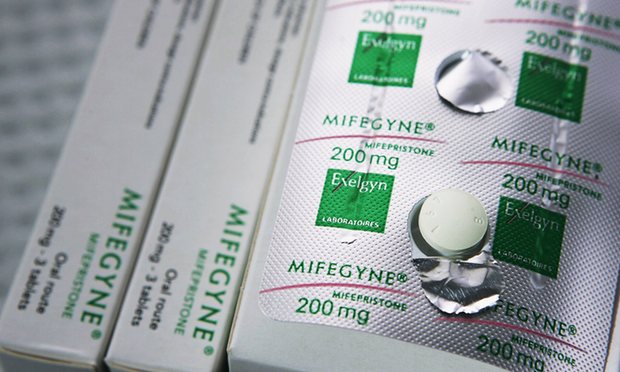
Abortion is illegal in both countries but since 2006, the Netherlands-based organisation Women on Web has been offering medical consultations online and dispatching in the post the two pills – mifepristone and misoprostol – that will terminate a pregnancy within the first 10 weeks.

The organisation offers the service around the world and has seen a sharp increase in women seeking help from countries in Latin America, where abortion is also illegal, after the link was made between Zika virus infection in pregnancy and brain damage in babies.

Packages shipped to Ireland are stopped, so women travel to Northern Ireland to collect them instead. It is not illegal to buy or sell the drugs, but it is to use them to bring about an abortion.

In April, a woman in Northern Ireland who took the pills and was reported to the police by her two flatmates was given a three-month suspended sentence by Belfast crown court. The case sparked protests and demonstrations of solidarity from other women who announced they too had resorted to the abortion pills and challenged police to arrest them.

Women with an unwanted pregnancy in Ireland previously had to travel to the UK if they wanted to have an abortion. Between 1970 and 2015, 180,797 women from Ireland and 61,311 women from Northern Ireland made the journey. Many still do rather than break the law by bringing about an abortion at home.

But the study, carried out by Abigail Aiken and her colleagues at the University of Texas at Austin, found that many of the women who went online for help could not afford to travel or to take time off work or the costs of childcare.

“These barriers create a stark health inequity: women with financial and social resources can access offshore termination of pregnancy, while women who lack such resources cannot,” says the paper.

The study found that 5,650 women sought help from the site between 2010 and 2015. Most (85%) were between 20 and 30 years old and were mothers (63%).

The most common reason for choosing to terminate pregnancy (reported by 62% of women) was not being able to cope with a child at that point in their lives. Nearly half – 44% – cited having no money to provide for a child, and 23% felt their family was already complete. Nearly a third – 30% – felt they were too young to have a child or wanted to finish their education.

Almost all – 97% – said they felt accessing and using the medication at home was the right thing for them and 98% said they would recommend it to other women in a similar situation. The most common feeling they reported after completing the procedure was relief (70%), followed by satisfaction (36%). Over a quarter – 26.8% – said they were happy and 22% said they were pleased. The vast majority – 94% – expressed gratitude that they could go online and obtain the pills.

Advertisement

“There is a very negative perception of a home abortion,” said Aiken, an Irish-born assistant professor at the US university. “People regard it as desperate and a last resort. But women say it is very helpful for their health, wellbeing and autonomy. The only negative thing is that they have to do it outside of the law.”

The website asks women to make a donation to its costs, suggesting €70 to €90. Over a third – 35% – said they found it difficult to find the money. Nearly a quarter (24%) said they did not get enough emotional support from family and friends.

One of the women surveyed told the researchers: “There is no way I could have afforded to travel to England, pay for the procedure, stay in a hotel, and have someone there to support me. Thanks to this service, I was able to have a safe abortion in an environment where I felt comfortable and with my partner there to support me. Thank you for enabling women to have control over their own bodies.”

Others said that without access to home abortion, they would have considered suicide. “I can’t thank you enough – you have saved my life,” said one. “I would have had to resort to desperate measures. You will never understand how grateful I am.”

https://www.theguardian.com/world/2016/oct/17/home-abortion-kits-women-ireland-study

Source: The Guardian

post-16-october-2016

The Royal College of Midwives (RCM) is facing criticism after calling for abortion to be decriminalised, without consulting its members on the issue.

The union, which represents almost 30,000 midwives and health workers, has said it gives its “full support” to the British Pregnancy Advisory Service (BPAS), the UK’s biggest abortion provider, in its campaign for abortion to be removed from criminal law.

Prof Cathy Warwick, chief executive of the RCM, is also chairman of the board of trustees of BPAS.

It is currently against the law for women to terminate a foetus after 24 weeks unless there is a medical reason to do so, while abortions earlier in a pregnancy are only legal if two doctors agree to it.

But the RCM is backing calls for the legal limits to be scrapped and abortion to instead be regulated in the same way as other medical procedures, at the discretion of doctors.

,,For the organisation that represents us to support the radical position that all protections for unborn children should be removed… we find utterly unacceptable,, -RCM members’ letter

Critics fear this could lead to more late-stage terminations and open the door to children being aborted based on their sex.

Last week, the RCM issued a formal position paper confirming it “supports the campaign to remove abortion from criminal law”,  explaining that “the continued criminalisation of abortion in the UK may drive women to access abortion services which are neither safe nor legal, and which may prove harmful or even fatal”.

A letter of protest to the board of the RCM disowning its stance and demanding it consult its members has now been signed by 200 midwives, according to campaign group Christian Concern.

The letter says that decriminalisation “would mean the introduction of abortion up to birth for any reason” and says the signatories object to the “extreme position”.

“It is out of keeping with what we take to be the ethic of our profession, as well as the consistently expressed wishes of British women with regards to the legality and regulation of abortion, and it has been taken with no consultation whatsoever of RCM membership,” it says.

A spokesman for the RCM confirmed it “did not consult on this issue”.

“The RCM’s constitution allows for our members to elect the RCM Board and for this body to set our strategic objectives. The positions we take are based on these agreed objectives,” he said.

The BPAS campaign follows the jailing of a 24-year-old woman who used poison deliberately induced a miscarriage when at least 32 weeks pregnant.

http://www.telegraph.co.uk/news/2016/05/15/royal-college-of-midwives-backs-abolition-of-abortion-law-that-c/

Source: The Telegraph

(Reuters Health) – Women seeking an abortion tend to be more certain of their choice, even after the procedure, than people making other healthcare decisions, according to a new U.S. study.

Some state laws require waiting periods, ultrasounds or counseling before abortions are provided, ostensibly to give women more time to make up their minds.

But the results suggest that women who choose an abortion have very little uncertainty by the time they arrive at the clinic seeking information, researchers say.

“Levels of certainty about the decision to have an abortion were comparable to, and often higher than, levels of certainty found in other studies of men and women making other health care decisions like whether to have a mastectomy after a breast cancer diagnosis, undergo prenatal testing after infertility, or have reconstructive knee surgery,” said lead author Lauren J. Ralph of Advancing New Standards in Reproductive Health (ANSIRH) at the University of California, San Francisco.

“Our finding directly challenges the idea that decision-making on abortion is somehow exceptional and requires additional protection, such as state laws that mandate waiting periods or targeted counseling and whose stated purpose is to prevent women from making an unconsidered decision,” Ralph told Reuters Health by email.

In the recent debate between vice presidential candidates Democratic Virginia senator Tim Kaine and Republican Indiana governor Mike Pence, the appropriateness of abortion restrictions came up and Kaine said his ticket “trusts” women to make the decision for themselves.

The new study assessed decisional certainty among 500 women seeking abortion care at four family planning facilities in Utah. All completed baseline surveys and two-thirds answered follow-up questions by phone three weeks later.

Utah requires that women seeking an abortion visit the clinic and hear a face-to-face “information script” from their provider at least three days before actually receiving an abortion. During this first visit, the women participating in the study completed a survey rating 20 items designed to assess how informed, certain or conflicted they were about their decision.

On average the women were 25 years old, most were white and half had never had any children. Most were employed or in school and most were in a relationship with or married to the man involved in the pregnancy.

More than half of women strongly agreed with every item on the certainty scale, including, “I know which options are available to me” and “I expect to stick to my decision.” The one exception was the item: “this decision is easy for me to make.”

The results of the decisional conflict scales, scored from 1 to 100 with higher scores representing higher conflict or uncertainty, showed the women overall to be very sure of their choice. Mean scores were 15.5/100 and 12.4/100.

According to the follow-up phone interviews, 267 women, or 89 percent of the group, did return to the clinic for an abortion. The 11 percent who were still pregnant at that point had scored higher on the uncertainty scale when surveyed at the clinic, with a mean uncertainty score of 28.5, compared to a mean of 13.5 among women who went through with an abortion.

That indicates the tests were accurate in gauging decisional certainty, the study team writes in the journal Contraception.

To those who work in the abortion area, and who are familiar with how women handle an unplanned pregnancy and the decisions surrounding it, the new study’s results are not surprising, said Louise Keogh of the Melbourne School of Population and Global Health at The University of Melbourne in Australia, who was not part of the new study.

“But it is fantastic to have confirmation of the fact that women are able to make the decision to end a pregnancy with a high level of certainty,” Keogh told Reuters Health by email.

The results confirm that forcing women to wait or view an ultrasound before going through with an abortion is inappropriate practice, she said.

“I think they support the model we have in Victoria, Australia, where women are assumed to be capable of making the decision, and of accessing the support they need to do so,” she said.

“Laws aimed at preventing women from making an unconsidered decision about abortion – including mandatory waiting periods and information scripts, ultrasound review requirements, and parental involvement requirements – are common in the U.S.,” Ralph said.

“These laws presuppose that most women are conflicted in their decision about abortion, and need additional time and information to make a decision,” she said.

SOURCE: bit.ly/2e6tahz Contraception, online October 10, 2016

http://www.reuters.com/article/us-health-abortion-decision-certainty-idUSKCN12D1IM

Source: Reuters

Abortion remains a crime in Queensland and NSW in Australia. Queensland Parliament has just decided against decriminalising abortion. However, laws are obsolete and unclear, dating back over 100 years. Around 100,000 abortions are performed around Australia every year. In practice, early abortion is available on demand.

Abortion should be decriminalised. Early abortion should be freely and easily available on request. Late abortion should be freely and easily available at least for those who have a valid justification: significant fetal abnormality, threat to woman’s health or serious social reason, for example child pregnancy or rape. Family planning, including safe, free and open abortion services, is an essential part of a civilized society.

Failure to regulate abortion properly results in women being denied safe, effective abortion services, affecting their mental health and social welfare, as well as those of their family and society. It is stigmatising to women and health professionals to allow abortion to occur, while retaining it as a criminal offence. It is also moral hypocrisy.

With Lach de Crespigny, Dominic Wilkinson, Tom Douglas and Mark Textor, we conducted a survey which showed the majority of Australians believed early abortion (61%) should be fully decriminalised. Only 12% believed it should be unlawful. [deCrespigny, L., Wilkinson, D., Douglas, T., Textor, M., and Savulescu, J. (2010) ‘Australian attitudes to early and late abortion’.  The Medical Journal of Australia  Vol: 193(1) pp 9 – 12]

Summary

Simple yes/no polls may give a misleading picture of public opinion. Previous surveys permit only a limited view of community sentiment.

87% say abortion should be lawful in the first trimester: 61% unconditionally and 26% depending on the circumstances.

There is community support for abortion and late-abortion being a woman’s choice. A majority of Australians support women’s access to lawful termination after 24 weeks when there is good reason.

Support for lawful access to termination is higher when there are maternal or fetal complications than when there are personal reasons.

There is little support for professional sanctions against doctors for providing terminations

Australians who nominate a religious affiliation are only slightly less likely to oppose sanctions than those who say they have no religion.

There are overwhelmingly strong ethical arguments for making early abortion, freely and easily available, paid for by Medicare. It is safest, it allows women the possibility of family planning and it is consistent with the practices occurring in Australia and attitudes of a majority of Australians.

Queensland and NSW in Australia should repeal their antiquated abortion laws and make abortion available on demand.

Our survey also suggested politicians would not lose votes by taking a liberal stand on abortion.

2% abortions are late, occurring after 24 weeks, usually because of a delay in medical diagnosis. Most Australians are against professional sanctions being imposed on doctors who perform such abortions. Nearly half of Australians believe they should be lawful when performed for a valid reason. And most were against professional sanctions in a wide variety of circumstances.

Ethically, there is little difference between early and late abortion. After 24 weeks the fetus becomes capable of living outside the mother with intensive care and becomes minimally conscious. But neither of these developments has real ethical significance for abortion. More restrictive public attitudes to late abortion are not grounded on good ethical arguments but rather gut responses, current social norms and traditional dominant Christian religious values imposed during upbringing.

If ethics and law are not to depart too far from current public attitude, we should embrace decriminalisation of late abortion for valid justification. Virtually every woman who chooses to have a late abortion does so for good reason. What is essential is that we remove the legal, professional, social and economic barriers to abortion for those women who have valid reason to obtain one. It is time to take a more ethical approach to abortion.

http://blog.practicalethics.ox.ac.uk/2016/08/abortion-should-be-decriminalised/

Source: University of Oxford