29-october-post

RUTH COPPINGER HAS said that it’s because of “sell-out Independents” that the AAA-PBP bill requesting a referendum to repeal the Eighth Amendment will be rejected.

Earlier today, the Government took a unified position on the bill, agreeing collectively to not accept the bill until the Citizens’ Assembly has finished its work.

The Government has also agreed to put forward a reasoned amendment to the bill.

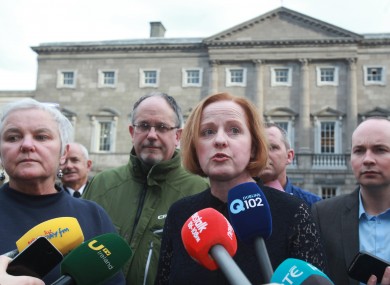
Speaking on the Dáil plinth today, Coppinger gave this strong statement about Independent TDs in Government, flanked by her AAA-PBP colleagues:

This is a sell-out and betrayal by the Independent Ministers like Katherine Zappone, John Halligan and Shane Ross.

“Ministers, who said they are in favour of repeal, will line up and vote as part of the government against repealing the Eighth Amendment. They are putting their ministerial seats before the health and lives of women.

This vote will guarantee that no referendum will take place during the lifetime of this government.

“By the time the Citizens’ Assembly reports back, the Oireachtas Committee sits and then a bill is passed through both houses, the earliest opportunity for a referendum will be late 2018 or early 2019, by that stage this government may not be in power. They have sent a clear message to women telling them they can continue to wait.”

The Pro Life Campaign protest outside the Dáil today.

Bríd Smith also weighed in, saying:

“I am absolutely furious with the ‘so-called’ Independents who are co-operating with Fine Gael to practically ensure that the Eighth Amendment is not dealt with in the lifetime of this Government.

To fob us off with the reliance on the adjudication of a Citizens’ Assembly of 99 people is not good enough. It is undemocratic.

“It prevents thousands of young people who never had a chance to vote on abortion or women’s bodily autonomy from having their say on the Eighth.”

The bill is due to be debated in the Dáil tonight.

Citizens’ Assembly

The Programme for Government, agreed by the coalition in the wake of lengthy talks, said the Eighth Amendment issue would be dealt with by convening a Citizens’ Assembly.

In a statement today, a spokesperson said that there were different views in Government around the issue of the Eighth Amendment, but Cabinet had agreed that the Citizens’ Assembly should be allowed to finish its work.

The Assembly is expected to give its report on the issue in the first half of next year. The report will then be referred to a special Oireachtas Committee which will be asked to respond to its findings within in six months.

Government TDs will be given a free vote on the matter once the Citizens’ Assembly has reported back.

Minister for Children and Youth Affairs Katherine Zappone.

Speaking this afternoon on RTÉ’s News at One, Children’s Minister Katherine Zappone – who is in favour of repealing the Eighth Amendment – said that she and her Cabinet colleagues had come to “mature” decision.

“I think we’ve come to very mature decision in terms of how to agree,” she said.

The minister said that the Government was not “technically opposing the bill” but inserting an amendment so that the Citizens’ Assembly could finish its work.

“I am anxious that we ensure that the process goes as quickly as possible,” she said.

The Eighth Amendment

The Eighth Amendment to the Constitution grants the equal right to life of to the mother and the unborn child, effectively making abortion illegal except in very rare circumstances.

The AAA-PBP bill had been contentious, with members of the Independent Alliance in Government initially wanting a free vote on the matter.

The Government was keen to avoid a similar situation as had occurred with Independents 4 Change TD Mick Wallace’s bill earlier in the Dáil term.

Wallace had put forward a bill which would have allowed for abortions in situations where a child would not live outside the womb.

The bill failed to pass, but it was backed by Minister for Transport Shane Ross and junior ministers John Halligan and Finian McGrath, who voted against government advice.

http://www.thejournal.ie/abortion-bill-3045028-Oct2016/

Source: The journal

MONTGOMERY, Ala. (AP) — A federal judge on Thursday blocked new Alabama abortion restrictions that sought to ban clinics near schools and outlaw a common second trimester abortion procedure.

U.S. District Judge Myron Thompson issued a preliminary injunction Thursday against the provisions, which would have banned abortion clinics within 2,000 feet of K-8 public schools and barred the second-trimester procedure known as dilation and evacuation.

Thompson said the location restriction would force closure of two of the state’s busiest abortion clinics — facilities in Huntsville and Tuscaloosa— that together perform 70 percent of all abortions in the state. Those clinics are also the only providers of abortions beginning at 15 weeks of pregnancy.

“The availability of abortions in Alabama would be significantly reduced, and abortions beginning at 15 weeks would become almost wholly unavailable,” Thompson wrote in the 102-page opinion.

The location bill targeted the Alabama Women’s Center for Reproductive Alternatives in Huntsville. The clinic moved to a new location in 2013 in order to comply with a new state law requiring clinics to meet the same building code requirements as outpatient surgical centers. The new location is down the street from a K-8 magnet school.

Thompson also issued an injunction against the ban on abortion through dilation and evacuation, in which the contents of the uterus are removed with forceps. Alabama lawmakers who supported the ban called the procedure “barbaric.” The state had argued abortion could still be conducted through procedures, such as an injection of potassium chloride, that first induce fetal demise. Thompson said those procedures are riskier and difficult to obtain.

“As explained, in the absence of an injunction, Alabama women would immediately lose the right to obtain a pre-viability abortion anywhere in the State when they reached 15 weeks of pregnancy, whereas all the State will face is that a likely unconstitutional law passed by legislators will not go into effect,” Thompson wrote.

Similar laws have been blocked in Kansas and Oklahoma.

The laws were to take effect Aug. 1, but enforcement was delayed until after an Oct. 4 hearing before Thompson after clinic owners and an abortion doctor challenged the laws.

“It’s long past time for our elected officials to stop wasting time and taxpayer money passing laws that violate women’s constitutional rights and start focusing on the needs of women and families in this state,” said Susan Watson, executive director of the American Civil Liberties Union of Alabama, which filed the challenge.

The attorney general’s office and governor’s press office could not be immediately reached for comment Thursday night.

http://www.dailymail.co.uk/wires/ap/article-3880916/Federal-judge-blocks-Alabama-abortion-restrictions.html

Source: Daily Mail

Epidural anesthesia may do more than relieve pain during labor; in some women it may decrease the likelihood of postpartum depression, suggests a preliminary study presented at the Anesthesiology® 2016 annual meeting.

“Labor pain matters more than just for the birth experience. It may be psychologically harmful for some women and play a significant role in the development of postpartum depression,” said Grace Lim, M.D., director of obstetric anesthesiology at Magee Women’s Hospital of the University of Pittsburgh Medical Center and lead investigator on the study. “We found that certain women who experience good pain relief from epidural analgesia are less likely to exhibit depressive symptoms in the postpartum period.”

The researchers controlled for factors already known to increase the risk for postpartum depression, including pre-existing depression and anxiety, as well as post-delivery pain caused by tissue trauma during childbirth. After accounting for these factors, the study found that in some women, labor pain was still a significant risk factor for postpartum depression symptoms. And therefore, alleviating this pain might help reduce the risk for postpartum depression.

In the study, researchers reviewed the medical records of 201 women who used epidural analgesia and had their pain assessed using a 0-10 scale during labor. They calculated the percent improvement in pain (PIP) throughout labor after the implementation of epidural analgesia. Depression risk was assessed using the Edinburgh Postnatal Depression Scale (EPDS) six weeks after childbirth. Researchers found the higher the PIP scores, the lower the EPDS scores.

“Although we found an association between women who experience less pain during labor and lower risk for postpartum depression, we do not know if effective pain control with epidural analgesia will assure avoidance of the condition,” said Dr. Lim. “Postpartum depression can develop from a number of things including hormonal changes, psychological adjustment to motherhood, social support, and a history of psychiatric disorders.”

Labor pain may be more problematic for some women than others, the authors note. Additional research is needed to identify which women are more likely to experience severe labor pain and who would benefit the most from effective labor pain-control strategies to help reduce the risk and impact of pain on postpartum recovery.

Story Source:

Materials provided by American Society of Anesthesiologists (ASA)Note: Content may be edited for style and length.

https://www.sciencedaily.com/releases/2016/10/161026113938.htm

Source: Science Daily


post-27-october-2

A poll conducted for Politico (10/26, Haberkorn) by the Harvard T.H. Chan School of Public Health found that “most voters oppose Hillary Clinton’s proposal to allow federal tax dollars to cover abortion – but her most ardent supporters love it.” According to the poll, “only 36 percent of likely voters want to overturn the long-standing ban on Medicaid paying for abortion with federal funds.” However, 57 percent of “self-described Clinton voters…support scrapping the current rules.” The poll also found that “77 percent” of Donald Trump voters “want to maintain current policy while 19 percent oppose it.”

Campaigners believe Catholic priests are exerting political leverage to further restrict women’s reproductive rights

27-october-post

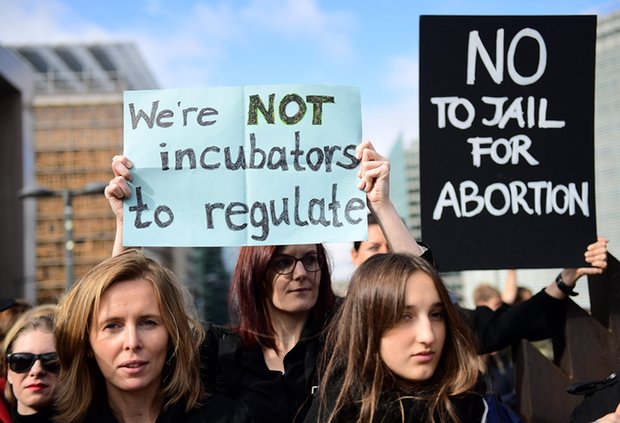
Women protest in Brussels against a proposed near-total ban on abortion in Poland. Photograph: Emmanuel Dunand/AFP/Getty Images

“It’s a strange thing to say about a country in the middle of Europe, in the 21st century, but this is how it works – nearly all politicians here are afraid of the Catholic church,” said Anna Leszczyńska, a women’s rights activist.

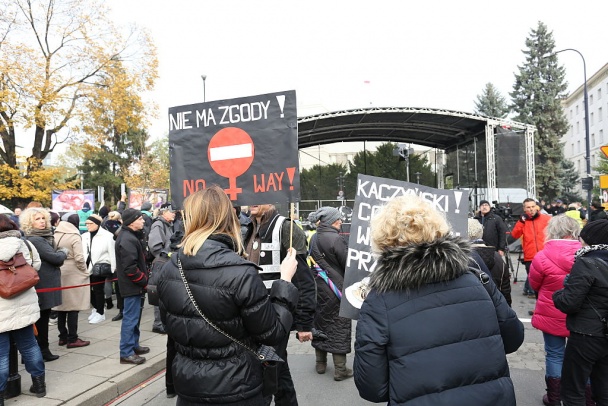
Thousands of campaigners marched through Poland’s largest cities on Sunday and Monday to protest against the government’s proposals to further restrict abortion laws in the country.

Campaigners believe the government is at the bidding of the Catholic church which is using its political leverage to push for laws that serve its strict religious dogma.

“Kazimierz Nycz, one of the country’s influential and moderate Polish cardinals, has just said that the church will not accept any compromise regarding abortion. Even though the amount of practising Catholics is decreasing, the church is still a major political power in our country” said Leszczyńska.

This month, protestors were successful in forcing the government to backtrack on proposals that would have meant a blanket ban on abortion. Consequently, leaders of Poland’s ruling Law and Justice party, or PiS, are now hoping to tighten Poland’s abortion laws by removing the right for a termination in cases where the foetus has a congenital disorder.

Leszczyńska said: “It’s sick to consider forcing women to give a birth to a fatally damaged child. What monster would even think of such a thing? Pregnancy and giving birth is hard work, pain, risk – and they expect us to suffer all these things? Will they congratulate themselves when we are crying and watching our newly born babies die?”

“I protested, and I’m going to protest in the future. I feel it’s my responsibility. As long as I have the courage to speak, protest and express my anger, I retain my human dignity.”

Jarosław Kaczyński, head of the PiS party, said the government wanted to ensure that even pregnancies involving a child “certain to die, very deformed, still end up in a birth so that the child can be baptised, buried, have a name”. The government would not step back from this aim, he said.

Poland already has some of the most restrictive abortion laws in Europe, with terminations legally permitted only when the life of the foetus is under threat, when there is a grave threat to the health of the mother, and in the instance that the pregnancy arose from rape or incest.

Women who have spoken to the Guardian say they are concerned that those with hardline conservative religious views will persist in lobbying the government until the restrictions are pushed through.

Agata Piotrowska, 34, a scientist, who took part in the protests this month, said she feared the very real chance that the abortion rules would be implemented. “The Catholic church helped the government win the elections. And it is using this legislation, among others, to pay its debt. We have a group of religious radicals hijacking the Polish juridical system to make it reflect extremist beliefs. The new law will not decrease the number of abortions, and it will not save any lives. It will only make abortion more costly and more dangerous, and lead a score of women, and possibly doctors, to jail.”

The election pitch of PiS was based on Polish nationalism, Catholicism and promises to help poorer Poles. Last year 40% of women backed PiS compared to 38% of the wider population.

Elżbieta, 42, who lives in Wroclaw, the largest city in western Poland, said that despite campaign promises, anti-abortion proposals risked causing the most harm to those they were pledging to help most.

“It is tolerable enough if you have a good income, as you can take a short trip to Germany or Slovakia and terminate an unwanted pregnancy. But if you are poor, very young, abused and uneducated, you are nothing. The government will force you to give birth to a child conceived in rape, force you to give birth to the severely damaged foetus, they even force you to die,” she said.

A total ban of the morning-after pill has been proposed by the Polish Federation of Pro-Life Movements, with the support of an MP from a rightwing faction. Under the proposals anyone caught selling or distributing emergency contraception could be imprisoned for up to two years.

“People, but most of all politicians, are afraid to stand against priests,” said Elżbieta. “The church introduced the concept of ‘child conceived’ to the common consciousness, which demands control over women, their lives and their sexuality. They want to decide when and how many children we should have by banning access to both contraception and abortion. Don’t be fooled by how European our country seems on the outside.”

Iwona, 26, who works in finance in Gdynia, a city in northern Poland, took part in the demonstrations this month. She said the country had been increasingly divided since the last election. “I do not deny the church to have their opinion and ask Catholics to follow their guidelines, but this should be reserved only for people who decide to do so and not to the whole society.”

Legislation drafted in October this year by the hardline conservative advocacy group Ordo Iuris and submitted by the Stop Abortion coalition as a citizens’ initiative, has been the latest bill to restrict women’s reproductive rights.

A separate, PiS-sponsored bill restricting IVF (in vitro fertilisation), which would make it illegal to freeze embryos and allow women to fertilise only one embryo at a time, was passed to the parliamentary committee stage in September.

https://www.theguardian.com/world/2016/oct/27/polands-abortion-laws-activists-blame-grip-of-hardline-church

Source: The Guardian

26-october-post

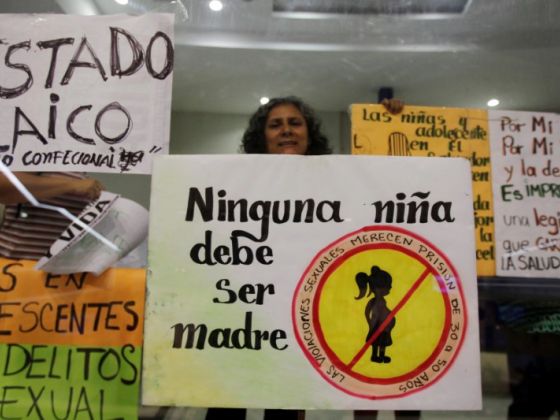
Women participate in a demonstration during a Salvadoran congress session in support of a proposal to allow abortion in cases of rape or risky pregnancy in San Salvador. Photo: Reuters


SAN SALVADOR – El Salvador’s ruling leftist party on Tuesday presented a proposal to Congress to allow abortion in cases of rape or risky pregnancy, offering a ray of hope to abortion proponents in the impoverished nation.

The Central American country is famous for its tough anti-abortion rules, with women who have abortions facing up to 30 years in prison. The rules offer no exceptions.

The proposal, presented by the Farabundo Martin National Liberation Front (FMLN), would allow abortion in cases of rape or trafficking, when the woman’s life is in danger, or when the fetus is so deformed that it makes life unviable.

The church and conservative groups have not yet made a statement on the bill.

To pass the law, the FMLN, a former Marxist guerrilla group, needs 43 out of 84 votes in Congress, but only has 31 seats.

There are at least 14 women in El Salvador who have been sentenced to prison terms of 12 years or more for abortion and about 130 currently facing legal proceedings, according to the Citizens Association for the Decriminalization of Abortion. REUTERS

http://www.todayonline.com/world/el-salvador-proposes-decriminalizing-abortion-cases-rape

Source: Today

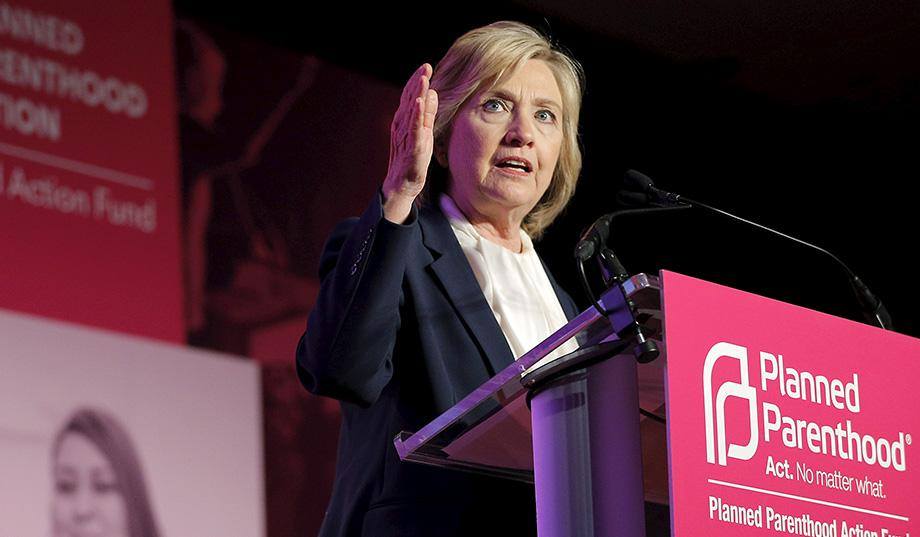
I’ve been trolling some of the pro-life blogs during this election season and recently there has been a spate (is that a word?) of posts about the “close relationship” between Hillary Clinton and Cecile Richards, the President of the Planned Parenthood Federation of America.  You know – the group that has murdered or killed or extinguished gazillions of babies over the years.

At first I wondered if these pro-life bloggers were suggesting that Hillary and Cecile were like really, really close, like in that way – if you know what I mean.  Not that there would be anything wrong with that of course.  I mean, these blogs really had me wondering!  But as I dug deeper I discovered it was nothing that juicy.  No, it was just that they were “close” in a political, non gay sense.

I was stunned.  How dare the Democratic nominee for President be close to the head of a large pro-choice organization?  Did this mean that they might actually be talking to each other and, worse yet, strategizing over how to beat their pro-life opponent?   Is this the state to which our political institutions have sunk to?

As a former lobbyist (the Washingtonian Magazine actually named me one of the “Top 50 Lobbyists” in 1994), I have to laugh when all of these political candidates talk about how they are gonna fight the “special interests,” and how they will bar all of those scuzzy, slime ball lobbyists from their White House.  What a joke.

My long time experience in the world of political and legislative affairs tells me that EVERY elected official not only talks to lobbyists on a regular basis but relies on them for information and advice.  So, for example, during the heated debate over the “Partial Birth Abortion Ban,” the pro-choice legislators were looking for a way to cover their butts when it came to third trimester abortions.  So one of them came up with the idea of offering an amendment to the original bill saying all of those abortions would be banned except in cases of life endangerment and severe health reasons.  But before that proposal was officially floated to their pro-choice colleagues, that legislator first went to the pro-choice groups to get their opinion.  And the pro-choice White House was also in touch with them to make sure they were all on the same page.  In other words, they did not offer the amendment – which failed – in a vacuum.  At the same time their pro-life colleagues were consulting with the National Right to Life Committee and others to see how they felt about the amendment.

Interestingly, as a footnote, some pro-choice members of Congress voted against the pro-choice amendment – and the converse was true as well.

A President does not sit in his OR HER Oval Office with all the phones off.  No American would want it any other way.  These people are generalists – they are usually not experts on any issue.  So, if Hillary wins she is not just going to propose climate change legislation.  She is going to sit down with environmentalists and others to make sure she is proposing effective climate change legislation.  If Trump wins, he is not just going to reverse all business regulations.  He will first sit down with the Chamber of Commerce and other pro-business groups and get their suggestions about which regulations should be repealed.

So, stop all this crap about “fighting special interests.”  To be accurate, say you’re gonna fight all of those “special interests” who oppose you.  And let’s just let Hillary and Cecile be friends.

post-25-october

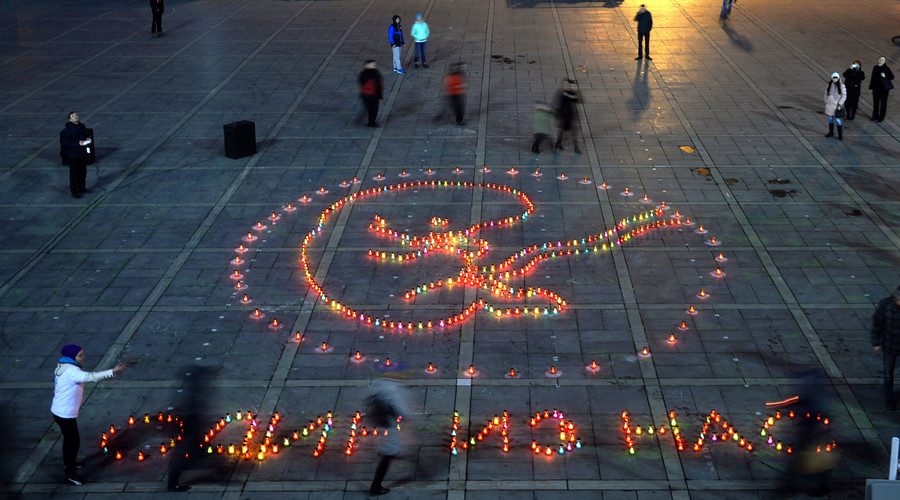
An overwhelming majority of Russians are against an initiative by Christian pro-life activists promoting a total ban on abortions, a nationwide public opinion poll conducted soon after the plan’s launch reveals.

According to the results of the research conducted by state-owned VTSIOM, 72 percent of Russian citizens are currently against a total legislative ban on abortions. Only 4 percent of respondents said they considered the procedure unacceptable under any circumstances.

In addition, 70 percent of the Russian public opposes the proposal to exclude abortions from the list of operations covered by state healthcare insurance, while 21 percent said that they would support such move.

When researchers asked Russians what negative consequences could emerge from an abortion ban, respondents named a sharp rise in illegal abortions, an increase in the number of orphans, higher infant mortality rate and poverty. Among those polled, 57 percent said that they knew people who had had abortions. One in 10 women who answered the questions said that she had personally undergone the procedure.

The poll was conducted in mid-October, about two weeks after the ‘For Life’ public movement backed by the Russian Orthodox Church claimed that its petition for a complete ban on abortions in the country had been signed by over 300,000 people. The head of the movement, Sergey Chesnokov, also claimed that once this number reaches 1 million people, the document would be forwarded to the presidential administration.

Apart from a legal ban on abortions, the authors of the petition are seeking broader and more-effective measures guaranteeing state support for pregnant women and families with small children.

Patriarch Kirill of the Russian Orthodox Church has signed the petition, but his press service issued a special statement saying that he had done so as an ordinary citizen, and also explained that any Orthodox priest would do the same in the Patriarch’s place.

Newly-appointed Russian Ombudsman for Children Rights Anna Kuznetsova also supported the campaign. Presidential Press Secretary Dmitry Peskov, meanwhile, told reporters that the Kremlin will not participate in the ongoing abortion discussion.

The existing Russian law on abortions is fairly liberal, but conservative lawmakers are attempting to tighten it. In May 2015, MPs representing the parliamentary majority United Russia party and the center-left opposition Fair Russia party drafted a bill that would limit state insurance payments for abortions, ban private clinics from performing them, and allow women to buy morning-after pills only on prescription after an obligatory health check. The motion has not yet passed through parliament.

https://www.rt.com/politics/364011-two-thirds-of-russians-oppose/

Source: RT

24-october-3

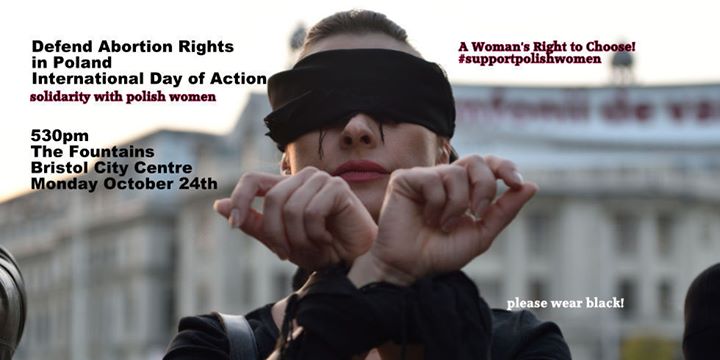
Defend Abortion Rights in Poland

Abortion is currently only legally permissible under certain strict conditions in Poland. If the pregnancy constitutes a threat to the life or health of a woman, if prenatal examination indicates heavy, irreversible damage of the embryo, or if an incurable illness threatens the embryo’s viability, then it is legal. It is also legal if there is justified suspicion that the pregnancy is the result of an illegal act – but that must be confirmed by a prosecutor. The Federation for Women and Family Planning has estimated that around 150,000 illegal abortions are carried out in Poland each year, while legal abortions number only around 1,000 per annum.

But in September this year the Polish government agreed to consider a Bill in parliament that would effectively ban abortion altogether. Women who have abortions could be jailed for up to five years under a law backed by Polish MPs which would almost completely ban terminations even in cases of rape or incest. Opponents of the bill have argued along with depriving women over the choice of what to do with their own bodies, a complete ban on abortion would fuel an underground, and at times dangerous, market for the procedure, and drive pregnant Poles to seek abortions abroad.

So October 3rd Polish women organised a nation-wide strike in protest at the Government’s plans. It was called Black Monday and supported by trade unions and tens of thousands. In dreadful weather, Polish women across almost 200 town and cities inPoland, and across the world, took to the streets to protest. They took their inspiration from a strike by women in Iceland in 1975, when 90% of women refused to work, clean or look after children in protest at discrimination in the workplace.
Many employers sanctioned a day off and shops, museums and restaurants were closed. The protests in the heart of Warsaw paralysed the Polish capital. Protesters wore black clothes and waved black flags to signify the loss of reproductive rights and the future deaths of Polish women under a complete ban on abortion.

As a result the government withdrew support for the anti-abortion legislation, but then began working on its own abortion bill, which is likely to propose that so-called “eugenicabortions” – abortions on the grounds of foetal congenital deformity – to be outlawed. Given that out of 1,044 legal abortions in Poland in 2015, 1,000 were permitted on these grounds, this would still result in a virtual ban on abortion.

As a result of the government’s trickery Polish women are calling for an International Day of Action to defend abortion rights on October 24th.

https://www.evensi.uk/defend-abortion-rights-in-poland-water-fountains-bristol/189489653

Source: Evensi

24-october-post

A protester shouts slogans as Polish women have again donned black and taken to the streets, launching another round of protests against efforts to tighten Poland’s abortion law, in Warsaw, Poland, Oct. 23, 2016 (AP Photo)


Despite total abortion ban was rejected by MPs, new proposals emerged to tighten the law

Women in Poland are taking to the streets again. Polish activists have launched fresh demonstrations against new efforts to tighten abortion laws.

A rally was held outside the parliament building in Warsaw on Sunday, with more action, including boycotting jobs and classes is expected on Monday.

After mass country-wide protests,Poland’s parliament rejected a total ban on abortions on 6 October. However, fresh proposals emerged to outlaw abortions in cases where foetuses are unviable or have severe abnormalities.

post-24-october-2

Women are holding protest against Polish abortion laws at the parliament (Sejm) as a part of the ´black protest´movement (Getty Images)

This time Polish women are protesting under the slogans: “No to humiliation and violence against women,” “No to church in politics” and “Not to politics in education.”

Abortion was legal and easily available under communism in Poland, but after its fall, the country re-embraced many of its Catholic traditions. The current law, passed in 1993, bans most abortions, with exceptions only made in cases of rape, if the mother’s life or health is at risk, or in cases of severe foetal abnormality.

Official statistics show there were 1,040 legal abortions in Poland last year, although many more abortions are known to take place, with women travelling to neighbouring countries for the procedure or ordering abortion-inducing pills online.

http://uatoday.tv/society/polish-women-stage-fresh-protests-over-planned-abortion-restrictions-791924.html

Source: Ukraine Today