Francesca is among dozens of women in Italy who say they were shocked to learn their aborted fetuses had been buried and their own names put on small crosses in part of a Roman cemetery dubbed the Garden of Angels. (Differenza Donna Association)
Rome prosecutor’s office investigating after women say they did not consent to burial of fetuses
When Francesca joined a group of friends on a fact-finding visit to a cemetery in Rome last week, she was not prepared to find a small, white cross with her name on it.
The friends had learned through Facebook that a woman from Rome who had an abortion had later discovered her name on a similar cross in the sprawling Prima Porta Cemetery in the Flaminio district on the northern outskirts of the capital city.
Francesca, a 36-year-old body movement instructor who asked that her last name not be published, had an abortion in September 2019 after learning her fetus had a fatal heart malformation and would not survive. But she never expected that someone would bury her fetus and mark the site with a cross bearing her name.
“Nobody told me the fetus would be buried, nobody asked me if I wanted a burial and nobody got my permission to put my name on a cross,” she said. “I can’t tell you what a horrendous feeling it is to find a cross with your name on it.”
Public prosecutor investigating
This week, Italian feminist organization Differenza Donna filed a formal complaint with the public prosecutor of Rome on behalf of dozens of women who were named on small crosses in an area of the graveyard referred to as the Garden of Angels.
The public prosecutor has opened a file against “unknown persons,” according to Italian media reports.
In a Facebook post last month, a woman named Marta Loi wrote about her surprise at learning her name was posted on a cross in the cemetery.
Marta Loi posted this photo of a small cross with her name on it that she said had been put up at Prima Porta Cemetery in Rome without her knowledge. CBC has blurred the name on the cross behind Loi’s. (Marta Loi/Facebook)
Loi wrote on Facebook that when she had her abortion, she was told by hospital staff that if she wanted a funeral and burial for her fetus, she would have to fill out a form. She didn’t.
About seven months later, she wrote, she began wondering what happened to the remains of her fetus and called the hospital, which told her the remains were still being held by the mortuary in case she changed her mind about a funeral and that they would take care of them. Later, she found the cross with her name on it.
She posted a photo of her cross, which is among 200 or so, some dating as far back as 2004. Many are made of wood, have rotted and fallen over.
Women say they didn’t consent to burial
“I get chills every time I talk about it,” said Elisa Ercoli, head of Differenza Donna, which filed the complaint and is calling for an investigation into the matter.
Elisa Ercoli is head of the Italian feminist association Differenza Donna, which has filed a formal complaint with the public prosecutor of Rome on behalf of dozens of women who learned their names had been put on small crosses at the cemetery. (Megan Williams/CBC)
“We have fought for years in Italy for women to have the right to give their own children their last name [without the father’s permission], a right they are still largely denied,” she said.
“Now this – the public shaming of women who have gone through a legal, therapeutic abortion, an intimate and private choice of self-determination that no one has the right to comment on. This is a very serious act of institutional violence.”
Italian law stipulates the burial of fetuses from therapeutic abortions from 20 to 28 weeks can take place upon written request from the mother or parents within 24 hours. Yet, the women on whose behalf Differenza Donna is advocating say they did not receive clear information about the consent process or give written consent.
As a result of the discovery in Rome, authorities are now looking into “babies never born” sections of public cemeteries in other parts of the country. Graves of fetuses buried without women’s permission were discovered in Turin in 2013 and removed.
Volunteers ‘show up with a bag’
Cathy La Torre, a lawyer representing some of the women, said if women don’t request a burial, often what happens is that hospitals or local health authorities strike agreements with ultra-conservative Catholic associations to bury the remains as a way to save on costs. Under Italian law, fetal material from 20 to 28 weeks must be buried; up to 20 weeks, the material is incinerated.
“Volunteers from these groups show up with a bag and cover the costs to have the abortion material buried. Then women find their names on a little cross,” said La Torre.
One such group is Difendere la Vita con Maria, or Protect Life with Mary, which describes on its website that it undertakes “burying fetuses regardless of whether a family has requested it” and to place crosses on them.
Francesca says the crosses are emblematic of a system that is set on punishing women who have abortions. (Differenza Donna )
Maurizio Gagliardini, a parish priest who runs the association, says the group is not responsible for putting the names of the women on the crosses, which he agrees is a violation of privacy. His group, he said, only puts the date of the abortion and a number code on the cross.
“I think the pro-life movement should be allowed to express itself in a democracy,” said Gagliardini. “We are Catholics, but we don’t go to the hospital to preach. Crosses on buried fetuses, yes, but names of women, no.”
He said his association has no formal agreement with Rome hospitals but is a group of volunteers that provides a service that some women formally request, namely, burying fetuses.
He admits the group puts crosses atop buried fetal material without women’s written permission but said he believes the Italian law permits it if a woman does not claim the material within 24 hours.
But Francesca said finding her full name on a small cross in the Rome cemetery is merely the last straw in what she calls a “system of physical and psychological torture” of women who seek abortions in Italy.
“Everyone is now up in arms about the privacy issue,” she said, “but the real issue is that Italy does not permit women to have abortions in a dignified way.”
Health care workers object to abortion
While women in Italy won the right to abortion in 1978, the law gives doctors and nurses the right to conscientiously object to performing them. Because so many hospitals in Italy are Catholic, the vast majority of health care workers choose to object, not necessarily for religious reasons, but because some fear that if having performed or assisted in abortions is on their work record, they won’t be hired in Catholic hospitals.
Francesca said in Italy, there is no readily available information for women seeking abortions. It took her weeks to locate a doctor – and a nurse who worked the same shift – willing to perform the procedure. She said she was forced to have multiple ultrasounds where technicians urged her to look at her daughter’s “beautiful face” and was insulted by health care workers at the public hospital.
She says the abortion itself was like “a horror film” and that she was denied an epidural and anesthesia.
“Putting our names on crosses is merely the final step in a system that is set on punishing women who have abortions.”
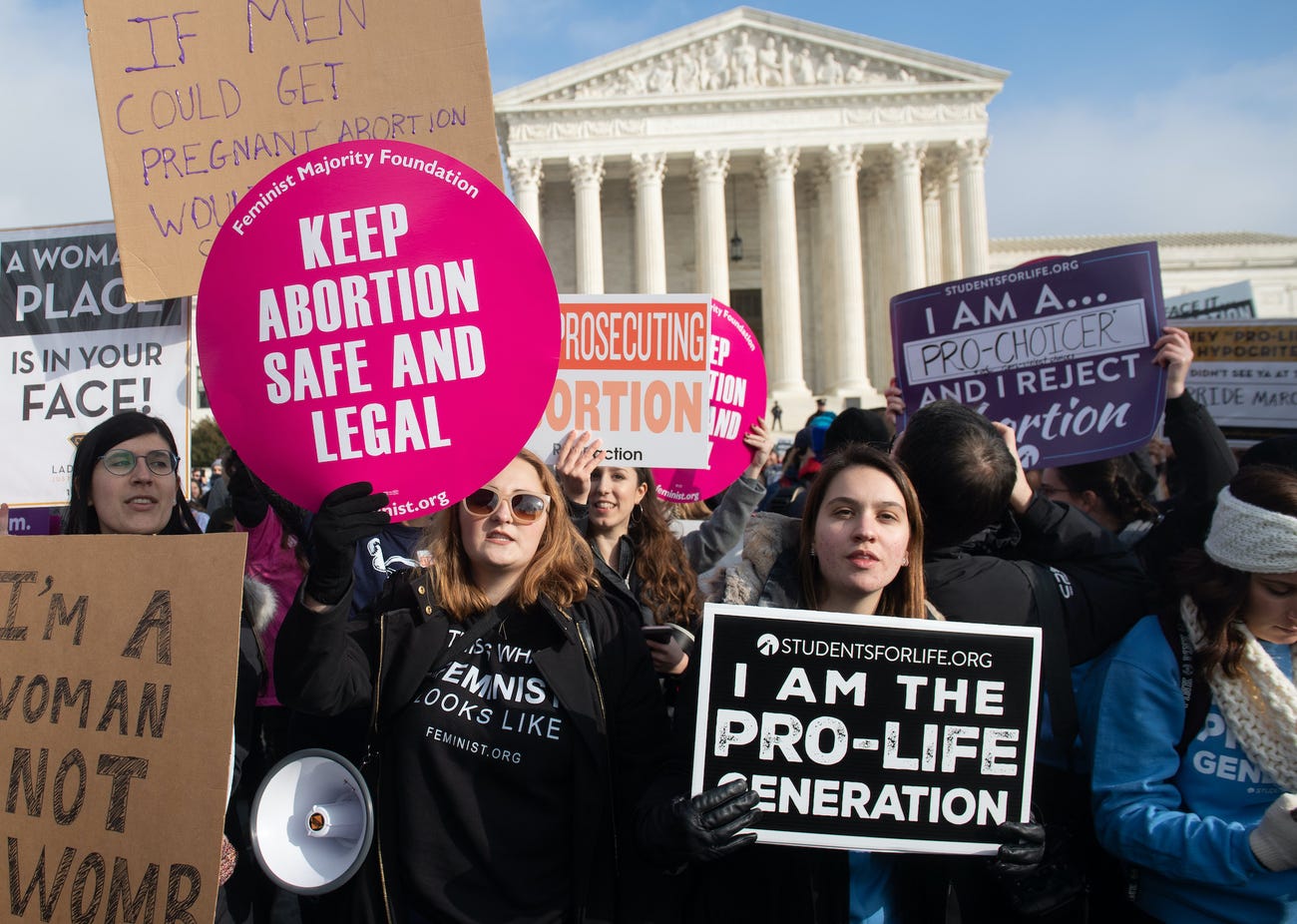
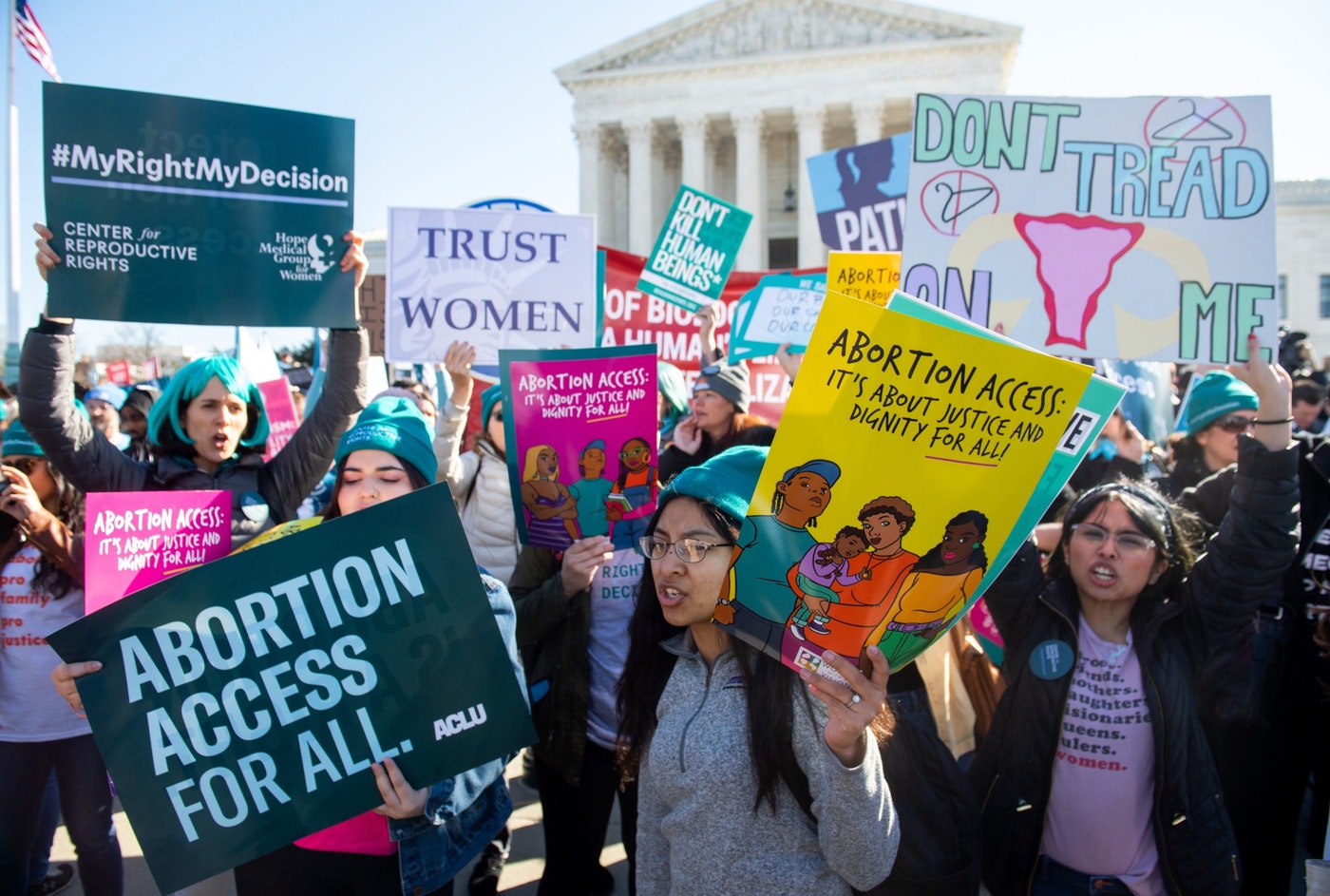
Pro-choice activists hold signs alongside anti-abortion activists participating in the “March for Life,” an annual event to mark the anniversary of the 1973 Supreme Court case Roe v. Wade, which legalized abortion in the US, outside the US Supreme Court in Washington, DC, January 18, 2019. SAUL LOEB/AFP via Getty Images
The right to abortion is protected under federal law, but state policies dictate varying levels of abortion access.
Some states, like New York and California, have passed policies to expand abortion access and protect the right under state law.
Other states, namely those in the south and the Rust Belt, have historically been hostile to abortion.
TRAP laws, mandatory waiting periods, and gestational limits can all restrict access to abortion.
A landmark Supreme Court case called Roe v. Wade protects the right to abortion without excessive government interference at the US federal level. But when it comes to state legislature, each jurisdiction has its own set of laws that affect access to abortion services.
Since the appointment of conservative and historically anti-abortion justice Amy Coney Barrett to the Supreme Court, states such as Mississippi have sent abortion rights cases to the highest court in hopes of setting a new precedent for bans and restrictions.
Louisiana and Colorado both posed ballot initiatives concerning abortion rights in the 2020 presidential election, with Louisiana officially amending its state constitution to explicitly not protect abortion and Coloradans declining to pass a ballot measure that would ban abortion after 22 weeks of pregnancy.
Elisabeth Smith, chief counsel of state policy and advocacy at the Center for Reproductive Rights, said although these state laws cannot outright ban abortion while it is protected at the federal level, they can seriously impact access to it.
“Federal law creates a floor that says abortion is a right, and then state law has the potential to either increase access or really prohibit access,” she said.
Here’s a breakdown of how state laws either expand, protect, or restrict access to abortion in the US.
New York, Vermont, Connecticut, California, Oregon, Washington, and Hawaii all have expanded access to abortion
States that not only protect the right to abortion in their constitutions but also have removed barriers to getting a safe and legal abortion are considered expanded access states, according a “What If Roe Fell?” tool published by CRR.
In 2019, New York passed a reproductive health act that protected the right to abortion under state law, ensuring that it would remain so even if Roe v. Wade was overturned. The law also removed abortion from the state penal code and allowed clinicians to perform abortions after 24 or more weeks of pregnancy if the mother’s life is at risk or the fetus is not viable.
“If you look at a state like New York State, that, in state law, protects the right to abortion, allows advanced practice clinicians to provide abortion care, and covers abortion in a Medicaid program, you can see that they’re pretty full access,” Smith said.
Allowing advanced practice clinicians such as physician assistants or nurse midwives to provide abortion care makes the service more widely available compared to states where only physicians have that power. Most expanded access states also require both private insurance and Medicaid to cover the cost of abortion care.
However, some expanded access states — Connecticut, Vermont, Washington, and Oregon — still have TRAP laws, or laws imposed on abortion providers that are not required for other medical providers.
14 other states and the District of Columbia protect the right to abortion
As recently as 2019, states have recognized the right to abortion in laws and court precedents.
Illinois passed comprehensive abortion legislation in 2019, which not only protected the right to abortion but also repealed restrictive laws that required husbands to give consent for their wives and put doctors at risk of criminal penalties.
Even in Kansas, where abortion remains heavily restricted, the state Supreme Court ruled that women have autonomy over decisions that affect their bodies and health. The state maintains a 22-week gestational ban and only allows certain methods of abortion.
Alaska, Delaware, the District of Columbia, Florida, Iowa, Maine, Maryland, Massachusetts, Minnesota, Montana, Nevada, New Jersey, and Rhode Island also protect the right to abortion. Most of the states have imposed some degree of restriction, such as gestational limits or requiring young people to obtain parental consent.
The right to abortion could be at risk in more than half of all US states if Roe v. Wade were overturned
If Roe vs. Wade were challenged or overturned, abortion rights would be protected in less than half of the US states. Not all of these states restrict abortion access, but they all leave reproductive rights vulnerable under a majority-conservative Supreme Court.
New Hampshire, Virginia, Wyoming, Colorado, and New Mexico do not protect abortion rights but are not considered hostile to abortion, according to CRR. Most of these states have some restrictions, such as Virginia’s prohibition of third trimester abortions.
Colorado, however, is one of seven states that do not prohibit abortion at any point during pregnancy. Only one percent of abortions take place after 21 weeks, usually in cases of poor maternal health or an inviable fetus, according to the Guttmacher Institute. But because abortions after that point are so restricted, women from across the country travel to Colorado for later-term abortions.
States in the south and the Rust Belt have historically been hostile toward abortion rights
By regulating who can provide an abortion, when they can do it, and who has to pay for it, many states have established themselves as anti-abortion zones.
Alabama has the most restrictive abortion law in the US, which bans abortion at any stage of pregnancy under any circumstance. District courts ruled the law unconstitutional in 2019, so it is currently on hold.
In the meantime, Alabama maintains medically unnecessary restrictions, including mandatory ultrasounds at abortion appointments and a required 48-hour waiting period before the procedure can take place.
Arkansas, Kentucky, Louisiana, Mississippi, Missouri, North Dakota, South Dakota, and Tennessee all have so-called “trigger bans” that could prohibit abortion if Roe falls. However, Smith said the bans likely would not be put in place automatically as the name suggests, and would require some legal proceedings to pass.
Gen Z activists have been unapologetic and confrontational, a shift in tactics for a movement at a crossroads.
Anti-abortion protesters and clinic defenders faced off across the street from A Preferred Women’s Health Center in Charlotte, N.C., in November.Credit…Clark Hodgin for The New York Times
In a TikTok filmed in August outside of a women’s health center in Charlotte, N.C., the uncensored version of the mid-1990s novelty rap song “Short, Short Man,” by Gillette blares: “Eenie weenie teenie weenie shriveled little short, short man.”
The camera is focused on a middle-aged white man in sunglasses, who is holding a poster depicting what appears to be a fetus with the word “abortion” printed on it. The caption on the video reads, “don’t worry, the volume was turned all the way up so he could hear :-)”
This is just one of a series of viral videos by Alex Cueto, 19, an abortion clinic defender with the organization Charlotte for Choice. She posts videos of her confrontations with abortion protesters on TikTok as @alexthefeminist, to a large audience. The “Short, Short Man” video, which was filmed outside of A Preferred Women’s Health Center, has over four million views.
More well known is the TikTok in which Ms. Cueto recites the lyrics of Cardi B and Megan Thee Stallion’s bawdy hit “WAP,” while an opponent of abortion reads the Bible outside the clinic.
“We treat these protesters like they’re a joke already,” Ms. Cueto said in an interview. “We don’t give them that sense of moral superiority.”
Ms. Cueto, who grew up in South Carolina and now lives in Charlotte, is one of many Gen Z campaigners for abortion rights who use social media to galvanize their peers. “Every day I post about being pro-choice,” said Michaela Brooke, 19, a student at the University of Alabama in Birmingham and an activist with Advocates for Youth, a nonprofit that organizes young people around reproductive health. Ms. Brooke said she posts educational resources, as well as information about opportunities to organize.
Clinic defenders have become more common as anti-abortion protesters have increased in number outside of women’s health centers.Credit…Clark Hodgin for The New York Times
Many of these activists came of age in Southern and Midwestern states with significant restrictions on abortion. Katie Greenstein, 17, who takes nongendered pronouns and lives in Wildwood, Mo., said that they got involved with NARAL Pro-Choice Missouri, the local branch of an abortion rights advocacy group, after Missouri outlawed abortion after eight weeks in 2019 (the law was later blocked by a federal judge).
Still, “abortion is out of reach because of various barriers enacted” in Missouri, Ms. Greenstein said. They include a 72-hour waiting period and a prohibition on the use of telehealth services to counsel those who seek abortions by medication. “It pushed me into wanting to fight,” Ms. Greenstein said.
According to an American Psychological Association Survey conducted in August, 64 percent of Gen Z adult women say that a possible change in abortion laws is a source of stress for them in 2020. The confirmation of Amy Coney Barrett, a conservative, on the Supreme Court soon after, also invigorated abortion rights proponents who fear that Roe v. Wade may be at risk.
The day after Justice Barrett was confirmed, “I woke up angry, just ready to go,” said Ms. Greenstein, whose state has a so-called “trigger law” that would immediately ban abortion if Roe v. Wade were overturned. “There is so much on the line.”
Shunning Shame
The modern abortion rights movement grew out of the women’s rights movement of the 1960s, said Alesha Doan, 48, a professor at the University of Kansas and the author of “Opposition and Intimidation: The Abortion Wars and Strategies of Political Harassment.” In the early days, activists worked on passing laws at the state level, and talked about their experiences in consciousness-raising groups, Ms. Doan said.
After Roe v. Wade became federal law in 1973, the anti-abortion movement began to coalesce, adopting the tactics the abortion-rights proponents had once used. You can’t talk about one group without the other, Ms. Doan said: “They coexist, they learn from each other, and they respond and react to each other.”IN HER WORDS: Where women rule the headlines.Sign Up
Clinic escorts — volunteers who stand outside clinics and help patients enter safely — were not widespread until the late 1980s and early 1990s, said Shoshanna Ehrlich, 64, a professor of women’s, gender and sexuality studies at UMass Boston. “That really grew up in a very powerful way in response to the increased clinic violence” from abortion foes, she said, which included the murders of a handful of doctors who performed abortions, as well as other clinic workers.
The guiding philosophy for clinic escorts has always been to not be confrontational, Ms. Ehrlich said; they have seen their role more as human shields, protecting clients with their bodies, even if not with their words.
But while escorts still by and large take a nonconfrontational approach to dealing with anti-abortion protesters, so-called defenders, like Ms. Cueto, act more as counterprotesters.
The rise of defenders mirrors the rise of anti-abortion protests outside of clinics. According to a report from the National Abortion Federation, there were more than 6,000 incidents of anti-abortion picketing at clinics in 2010, and more than 100,000 incidents in 2019. Trespassing incidents also increased significantly over the course of a decade.
And since the pandemic began, “we’ve seen an increase in harassment and attempted clinic invasions and people showing up to scream and protest and shout unmasked,” said Katherine Ragsdale, 62, the president and chief executive of the National Abortion Federation.
This is where clinic defenders and other more adversarial counterprotesters have stepped in. In general, young activists “are pushing forward with a more unapologetic voice,” said Alexis McGill Johnson, 48, the president of Planned Parenthood’s action fund.
Though Gen Z isn’t the first group to employ loud and unapologetic tactics — some older activists and writers, including Katha Pollitt, have been pushing these ideas for years — they may be doing it in larger numbers.
There is some evidence that a slightly greater percentage of Gen Z Americans support abortion rights than previous generations, and that those who support abortion rights feel more strongly about it, said Natalie Jackson, the director of research at the Public Religion Research Institute, a nonprofit and nonpartisan polling organization.
According to the nonprofit’s most recent survey, from 2019, 59 percent of Americans ages 18 to 29 say abortion should be legal in all or most cases, compared with 57 percent of the same age group in 2014. “Other age groups have not changed much since 2014,” the report noted.
What’s more, some activists in their teens and early 20s now reject the “safe, legal and rare” framing of abortion rights that was embraced by many in the 1990s, said Diana Thu-Thao Rhodes, 36, the vice president of policy, partnerships and organizing at Advocates for Youth. Gen Z activists “have really pushed for the issue as an intersectional issue. Your race, gender, sexuality, age — all of those contributing identities impact your access to care.”
Anti-abortion protesters and clinic defenders, at odds, in November.Credit…Clark Hodgin for The New York Times
A Shift in Strategy
Calla Hales, 30, the executive director of A Preferred Women’s Health Center (A.P.W.H.C.) in Charlotte, has seen the number of anti-abortion campaigners outside the clinic explode since 2015. She knows the history of the A.P.W.H.C. well, as her parents started the network of clinics in 1999 in Raleigh, N.C.
Before 2015, “on a weekday, we’d see five to 10 protesters, and on the weekends 20 to 30,” Ms. Hales said. In the past five years, there have been prayer walks outside the Charlotte clinic on Saturdays organized by a group called Love Life, involving as many as 5,000 people according to her clinic’s estimates, Ms. Hales said.
“In years past we have had several thousand gather for prayer and worship and celebration of life,” said Josh Kappes, the director of city development for Love Life. “This year was much less due to Covid.”
“This year, we continued our outdoor prayer walks offering masks and hand sanitizer in each participating city,” he said. “Love Life strongly encouraged social distancing and face coverings where they were mandated. We also encouraged virtual participation for at-risk family members, elderly and communities with community spread.”
In March, four men who are part of the Love Life organization were charged with violating a stay-at-home order in Greensboro, N.C. Ms. Hales, of the clinic, said it was not uncommon to see 90 anti-abortion advocates gathered outside the clinic on a typical day earlier this year when the state was much more locked down with coronavirus restrictions.
Local newspapers like The Charlotte Observer and The Queen City Nerve have been covering the clashes between abortion rights advocates and anti-abortion campaigners outside A.P.W.H.C. for years. Many involve disputes over noise ordinances. Anti-abortion campaigners have camped out on the land next door to the health center so they can “point their speakers toward the clinic while avoiding the need for a city-approved sound permit,” The Observer reported. In November, the anti-abortion group Cities4Life received a consent order from a federal judge which allows protesters to approach cars as they enter and exit the clinic’s driveway. Cities4Life did not respond to a request for comment.
Ms. Hales said that her parents “were very much of the ‘put your head down’ kind of crowd, a strategy favored by a lot of abortion providers,” which involved not confronting those campaigning against abortion. “That doesn’t work any longer when they’ve got the property next door and they’re coming in droves at a time.”
She said 2020 was also the first time a large number of people in their teens and 20s have been organizing outside her clinic. A media strategist for Charlotte for Choice who withheld her real name because she fears harassment from anti-abortion campaigners, said that since Ms. Cueto and others have been publicizing the organization’s work in providing clinic defenders and escorts, volunteers have tripled from 50 to 150.
Not everyone is happy with the new strategies, though. A handful of board members resigned from Charlotte for Choice in response to the more confrontational tactics adopted by clinic defenders this year, said Angela Blanken, 42, a founding board member who was among those who resigned.
While the anti-abortion protesters have always been noisy, Ms. Blanken said having counter-protests just added to the chaos, and made the experience worse for patients. “It’s just more noise outside your medical appointment,” she said. Referring to patients, she added, “they don’t know who is on their side and who’s against them.”
Ms. Hales disagrees that the patient experience has suffered. “As the executive director of the clinic who is more intimately involved with the ins and outs of the clinic, that has not been the case,” she said.
Ms. Cueto believes that adversarial methods are effective because they draw attention away from patients. “We’re making sure they’re focusing on us and arguing with us and how mean we are, and not focusing on trying to shout through the bush line and telling patients they’re murdering their baby and going to burn in hell,” she said.
NEW YORK/WASHINGTON — President-elect Joe Biden is expected to repeal the Mexico City Policy as one of his early acts in office. But a memorandum rescinding the policy — which has been expanded during President Donald Trump’s administration — is only the start of what’s needed to reverse its impacts, according to experts.
“We have every reason to believe this policy will be lifted almost immediately with the Biden-Harris administration, but I think that what you are going to see is the impacts don’t immediately go away,” said Nina Besser Doorley, associate director of advocacy and policy at the International Women’s Health Coalition.
The “global gag rule,” or Mexico City Policy, states that foreign NGOs that receive any U.S. global health funding are prohibited from engaging in abortion-related activities, including providing counseling or education. The policy has been shown to hamper sexual and reproductive health services around the world, and has also stopped or reduced the work of implementing partners of U.S.-backed HIV-programming, recent findings show.
The impacts of the restrictive policy have reached far beyond sexual and reproductive health in the southeast African country, according to advocates.
The Trump administration enacted the policy in January 2017, and later expanded it to cover all global health assistance — not just family planning funding. If the Biden administration rescinds the policy within its first few days of days, it would follow the precedent of previous Democrat presidents.
But the likely policy reversal won’t result in automatic change, according to Jen Kates, senior vice president and director of global health and HIV policy at the Henry J. Kaiser Family Foundation. She described the process as the “worst game of telephone tag.” Word that the U.S. will again offer global health funding to INGOs that engage in abortion work will take time to reach a “small, foreign NGO working in one corner of a country,” Kates explained.
Other experts also told Devex that even once the policy is rescinded there will still be a lot of work the administration needs to do.
While there is a sense of urgency to “get the policy out of global health funding and work to make sure there are no unnecessary delays,” reversing all elements of the policy will take time, said Serra Sippel, the president of the Center for Health and Gender Equity, CHANGE.
“We still have partners who are fearful, who have been chilled by enforcement of the policy, who are leery of what they can and cannot do,” said Jonathan Rucks, senior director of policy and advocacy at PAI.
Providing in-country training, offering clear communication from missions, and rebuilding partnerships will all be important in changing the environment, Sippel and Rucks said.
The process of getting funding to organizations that wouldn’t accept the global gag rule will be slow, several experts told Devex. Any big organizations will have to wait until the next cycle of projects they can bid on. And while smaller organizations may get funding once again as subgrantees, scaling up hiring, opening new clinics, or expanding programs will take time, they said.
“Organizations that have chosen to stop U.S. funding, or stop abortion services, or chosen not to apply for U.S. funding, will need to make the decision: Do I want to get back in the game or not?”— Jen Kates, senior vice president and global health director, Henry J. Kaiser Family Foundation
That is, if they choose to seek U.S. funding again.
“Organizations that have chosen to stop U.S. funding, or stop abortion services, or chosen not to apply for U.S. funding, will need to make the decision: Do I want to get back in the game or not?” Kates said.Get development’s most important headlines in your inbox every day.Subscribe
MSI is still considering whether or not it will again seek U.S. funding if the policy is reversed and the funding becomes available, Sarah Shaw, MSI’s head of advocacy told Devex. MSI is also prepared for the possibility that the rule can again be reinstated in four or eight years, if a Republican again is elected president in the U.S.
There has been an effort by Democrats in Congress to permanently eliminate the Mexico City policy, including through the Global HER Act introduced in 2019, but its prospects remain uncertain — especially with the potential for a divided Congress.
While the policy has been in place, there has been a constant concern for MSI partners that they could jeopardize the work of other organizations funded by USAID. A Kenyan MSI partner, for instance, now doesn’t sign into country-level family planning working group meetings so that USAID-funded partners in attendance can’t be accused of supporting a “noncompliant NGO,” Shaw said.
MSI’s decision to go without U.S. funding reduced its donor income by 17%, or $30 million. That money would have allowed it to reach an additional 8 million women and girls with sexual and reproductive health services, and would have prevented an estimated 6 million unintended pregnancies, in addition to 1.8 million unsafe abortions, according to Shaw.
“Definitely the generosity of other donors kicked in, but it is different, and you find that it comes with different service priorities, or geographical priorities,” Shaw explained. “The disruption of cutting services, or having to temporarily reduce services and then reconfigure them to fit the priorities of a different donor is incredibly disruptive to services. It is not a smooth transition.”
The Trump administration may still take action to further expand the Mexico City Policy, which it calls the Protecting Life in Global Health Assistance Policy, in the next couple months — a move experts said would further complicate a Biden administration’s efforts to reverse course.
In September the Trump administration issued a proposed rule about the PLGHA policy that would make it applicable to foreign contractors in addition to foreign NGOs. The public comment period for the rule closed on Nov. 13, and the comments will now be reviewed and “considered in the formation of the final rule,” according to the federal register.
If the Trump administration pushes through the new rule — it is unclear if it will do so — language related to the PLGHA policy will be included in contracts, and the rule would have to be rewritten and go through the relevant rulemaking process to be reversed, which could take time.
“It would add time and confusion to partners operating with contracts that have the rule,” Rucks said. “Let’s be clear about why the Trump administration is doing it. They are seeing the writing on the wall and want to muck things up and cause confusion and chaos.”
The Hyde Amendment—which bans using federal insurance for abortions—has again taken center stage in the battle for reproductive freedom. (Photo by SAUL LOEB/AFP via Getty Images)
As the US House discussed the future of the Hyde Amendment—which restricts federal abortion funding—leaders in reproductive justice testified to its racist past and enduring impact.
Access to abortion is a right—a fact decided by landmark US Supreme court case Roe v. Wade in 1973. However, the Hyde Amendment, which was passed three years later, intentionally restricted the rights of low-income women and women of color to abortion care, and continues to do so.
On Tuesday, the House of Representatives held a historic meeting to discuss ending it and its racist impact.
“Health care is a human right and every person has the right to have access to the same services,” said Dr. Jamila Perritt, president and CEO of Physicians for Reproductive Health, at the hearing. “They should not have to make decisions based on economics and income.”
The Hyde Amendment, first passed in 1976 and renewed every year since, prohibits the use of federal insurance funds for abortions. Currently, nearly 40 million women in the US rely on Medicaid—a federal insurance program—for healthcare coverage. Black, Latina, and low-income women make up the majority of those enrolled, and they are disproportionately harmed by the restrictions of the Hyde Amendment.
Such restrictions send a “stigmatizing message” to low-income women, said Amanda Beatriz Williams, executive director of the Lilith Fund, who also testified at the House hearing. “That they are not worth safe and affordable health care and we do not care about their rights,” she continued.
Given the amendment’s disproportionate affects on Black, Latina, and low-income women, withholding the right to safe abortion care due to inability to pay is racist and classist. As such, the Hyde Amendment is in line with the history of reproductive care in the US, which has historically denied women of color agency over their own bodies.
“There is a direct line from the forced sterilization of Black women to policies like the Hyde Amendment,” Dr. Herminia Palacio, president and CEO of Guttmacher Institute, said before representatives from the House. “Black bodies have been experimented on and forced sterilization was the rule of the day.”
Dr. Palacio was referring to J. Marion Sims, the father of gynecology who experimented on enslaved Black women without anesthesia and without consent. In the wake of Roe, Henry Hyde made it clear that the intent of the Hyde Amendment was to target “poor women.” With that in mind, an end to the Hyde Amendment would mean the start of an end to disregarding and restricting the reproductive rights of the most vulnerable women in the United States.
“Yes, we have a racist history, and, yes, Hyde is a racist policy,” said Palacio. “We cannot remedy a racist history if we continue racist policies into the future.”
Loeffler, the richest member of Congress, is fighting for her seat against Democrat Raphael Warnock in a January runoff election.
Sen. Kelly Loeffler speaks to supporters during a “Defend the Majority” rally on Nov. 19 in Perry, Georgia. Jessica McGowan / Getty Images
Republican Sen. Kelly Loeffler, who will fight to retain her seat during a Georgia runoffelection in January, donated large portions of her Senate salary to anti-abortion and anti-LGBTQ rights organizations.
Among these organizations are several “crisis pregnancy centers” that often pose as abortion clinics in order to dissuade people from getting the procedure, and an adoption agency that has a strong anti-LGBTQ ethos and bans same-sex couples from using it.
Loeffler is the wealthiest member of Congress. She and her husband hold a roughly $500 million stake in the New York Stock Exchange’s parent company, Intercontinental Exchange, Forbes reported, estimating that the couple’s net worth is at least $800 million.
Because of this, Loeffler pledged to donate her $174,000 congressional salary to Georgia charities each quarter. Over the last two financial quarters, she donated $26,600 to seven anti-abortion pregnancy centers, and $3,800 to Covenant Care Adoptions, an anti-LGBTQ agency.
Covenant Care Adoptions, a nonprofit adoption and counseling agency based in Georgia, requires that all adoptive parents be “husband and wife” who agree to the Statement of Faith listed on its website. The statement says that “the term ‘marriage’ has only one meaning: the uniting of one man and one woman in a single, exclusive union,” and that “any form of sexual immorality (including … homosexual behavior, bisexual conduct, bestiality, incest, and use of pornography) is sinful and offensive to God.”
The statement also says, “Rejection of one’s biological sex is a rejection of the image of God within that person,” and it is “imperative” that anyone who works for or volunteers with Covenant Care Adoptions or who wants to adopt a child through the organization “share these beliefs.”
Loeffler’s office did not immediately respond to a request for comment on her choice to donate to Covenant Care Adoptions, or whether she agrees with the organization’s anti-LGBTQ statement.
She has served in the Senate for less than a year, after being appointed to the seat in January, and has been an ally of President Donald Trump’s. She faced a challenge from fellow Republican Rep. Doug Collins as well as Democrat Raphael Warnock in Georgia’s all-party primary in November. Loeffler was forced into a runoff against Warnock, as neither candidate passed the necessary 50% vote threshold they needed to win the seat in November. The runoff will take place Jan. 5.
Of the seven crisis pregnancy centers Loeffler donated to this year, one is the Georgia branch of Obria Medical Clinics, a California-based company that has been embroiled in controversy over the past few years.
In 2019, Obria obtained a $5.1 million federal grant of Title X funding that would be doled out over three years, specifically intended to subsidize clinics providing birth control. Obria does not provide patients with any kind of contraception, instead recommending abstinence or the highly ineffective “rhythm method,” which recommends people only have sex while they are not ovulating in order to not conceive.
Obria’s grant was a part of the Trump administration’s attempt to redistribute Title X money to conservative, anti-abortion organizations instead of Planned Parenthood, which previously received a large portion of the grant. (The money was legally barred from being used for abortions.)
Campaign for Accountability — a progressive watchdog group that sued Trump’s Department of Health and Human Services for information about its use of federal family planning funds — argued in 2019 that Obria is in violation of the requirements for receiving the grant. Before the Trump administration altered the grant requirements (triggering ongoing lawsuits), it included providing contraception and abortion counseling, services Obria does not provide.
In response, an HHS spokesperson said in a statement to Politico that it would not force Obria to comply with the contraception requirements.
Obria also says on its website that it provides “abortion pill reversal,” an unproven idea that suggests that taking a hormone called progesterone can halt the termination of a pregnancy after a pregnant person has taken the first of two pills required for a medication abortion. There is no evidence this is possible, and no clear understanding of possible side effects. Two major studies of abortion reversal were shut down for ethical and safety issues.
Obria CEO Kathleen Eaton Bravo also faced pushback from abortion rights advocates after the Guardian unearthed her 2015 interview with the Catholic World Report, in which she said that Christianity began to “die out” in Europe “when its nations accepted contraception and abortion.”
“With Europeans having no children, immigrant Muslims came in to replace them, and now the culture of Europe is changing,” she said.
Loeffler donated $3,800 of her Senate salary to Obria over the last two financial quarters. Obria did not immediately respond to a request for comment.
Trump will campaign for Loeffler and Republican Sen. David Perdue, who is also in a runoff, in Georgia on Saturday.
For seven months, two public health crises enveloped in South Dakota: the COVID-19 pandemic and no abortion care.
According to the Guttmacher Institute, the average one-way driving distance for abortion patients in South Dakota is 92 miles—the third longest in the country. Shutterstock
After the staunchly anti-abortion judge Amy Coney Barrett was nominated to the Supreme Court in late September, advocates warned her confirmation would mean the end of Roe v. Wade, the landmark 1973 Supreme Court decision that affirmed the right to abortion. Not getting similar headlines was the fact that, even with Roe still on the books, one U.S. state had gone for more than six months without abortion access already.
South Dakota has just one abortion clinic, Planned Parenthood in Sioux Falls, near the state’s eastern border with Minnesota and Iowa. But there’s no permanent doctor to provide care in the state. The organization typically flies in abortion providers from Minnesota, but due to the COVID-19 pandemic, they halted that travel in March. At that point, South Dakota became the first state since Roe to have zero abortion access for an extended period of time. In a preview of a post-Roe future, everyone seeking an abortion had to travel out of state—that is, if they had the resources to do so. Only in October was the clinic able to partially reinstate abortion procedures, offering care just one day per month, thanks to a doctor driving at least four hours each way.
Access was “hanging by a thread before and it’s hanging by a shredded thread now because of the pandemic,” said Sarah Stoesz, president and CEO of Planned Parenthood North Central States, which represents Iowa, Minnesota, Nebraska, North Dakota, and South Dakota.
Thanks to South Dakota’s intense abortion restrictions, many people were traveling out of state for care even before the pandemic. The state requires patients to undergo counseling 72 hours before their procedure, not including weekends and holidays—it’s the most restrictive waiting period in the country. That counseling must be done in person, which effectively bans prescribing abortion medication via telemedicine, and the physician providing the abortion, not a nurse or another staffer, must do the state-mandated counseling.
This web of regulations meant that the Sioux Falls clinic did counseling on Mondays and procedures on Thursdays, providing abortions just one day per week pre-pandemic. The practice isn’t big enough to hire a full-time doctor, and pro-choice doctors in the state are prohibited by their health system employers from providing abortion on the side, Stoesz said. So Planned Parenthood has flown in providers from other states ever since they took over the clinic in 1995. In recent years, Minnesota-based providers flew in on Monday morning and flew home that night, and again on Thursdays.
Then COVID-19 hit. In March, the clinic’s medical director made the decision to stop travel out of concern for provider and patient safety. Plus, the doctors who fly to South Dakota needed to stay well in order to serve patients in Minnesota.
“There’s no good answer here,” Stoesz said. “There’s a terrible provider shortage, and so we have to be very, very careful with our physician resources. Having a physician get sick and not be able to work would impact many, many people.”
The clinic can’t treat patients virtually because of a state ban on the practice; South Dakota is one of 19 states that bans telemedicine for abortion.
“It would be a perfect solution if we could use telemedicine abortion but we can’t,” Stoesz said. As a workaround, in June they were able to reopen an Iowa clinic 85 miles away to offer medication abortion. The Sioux Falls providers are driving to that clinic, which had shut down in 2017 after Iowa lawmakers defunded Planned Parenthood. But it’s still very far for people in the northern and western parts of the state, so they’re also referring people to their nearest clinic across state lines.
Then, in October, a Minnesota provider started driving in one Monday and Thursday each month in order to have one day of on-site procedures. After seven months without access, Sioux Falls is back to providing about 10 to 15 abortions on that single day per month.
One of the board members of a new South Dakota abortion fund, the Justice through Empowerment Network, or JEN, acknowledged that COVID-19 is out of control in the state. But while provider safety is important, she said, the decision to halt procedures had a huge impact on patients who now have to cross state lines to get care.
“It’s a bad situation for everybody right now,” said Emily, whose name has been changed to protect her privacy. “People went from having to drive two or three hours to, like, seven. To get from Pierre, South Dakota, to St. Paul, Minnesota, is a pretty good trek.”
Elizabeth Nash, interim associate director of state issues at the Guttmacher Institute, said South Dakota lawmakers have passed 38 abortion restrictions since Roe. That’s a lot less than, say, Louisiana with 89, but Nash said that doesn’t show the whole picture.
“Then you layer in, what does access look like, and the geography of the state, because it is so big,” Nash said. “Then you start to see just how inaccessible abortion is for people in South Dakota. It’s incredibly difficult.”
Insurance plans sold through the state’s Affordable Care Act marketplace can only cover abortion in cases of life endangerment or severe risks to the pregnant person’s health; the state’s Medicaid program only covers abortion if a person’s live is in danger, in violation of the federal Hyde Amendment standards. Even though it’s technically still a legal right in South Dakota, just 332 residents had an abortion in the state in 2019.
According to a Guttmacher analysis published in April, the average one-way driving distance for abortion patients in South Dakota is 92 miles—the third longest in the country, behind North Dakota and Wyoming. When the state’s sole clinic wasn’t offering procedures, that distance more than doubled to 188 miles.
“Telehealth should be available in this situation,” Nash said. “Making health care easier to access has been a huge part of what we’ve seen in the coronavirus response, but not so much when it comes to abortion.”
A post-Roe reality
The COVID-induced barriers in South Dakota are a view into a post-Roe world, a world in which many people already live, Nash said.
“In many ways, South Dakota, and other states in the South, Midwest, the Plains, were already in a world where abortion access is so limited, it is much like what it was before Roe: Abortion is not legally banned, but accessing services is so difficult that for some people they cannot do it,” Nash said.
Emily agrees, and that’s why she and a group of other activists formed JEN. They used to be involved with the state’s now-defunct affiliate of NARAL Pro-Choice America and started talking last December about forming a new group since, as Emily says, NARAL was mostly focused on politics. While they understood the need to work on political goals like repealing the state’s “trigger law,” which would ban abortion if Roe is overturned, that work would take years and people were being oppressed now.
“We just kind of felt useless,” she said. “We saw people needing help accessing care and we decided that we just wanted to have the freedom to do what we felt would be most helpful.”
Through donations, JEN can help people pay for the many expenses associated with getting an abortion. (The fund is named after Emily’s former co-worker, who died suddenly and was passionate about abortion access.)
“We knew that there was a need for not just procedure funding, but also transportation, childcare, lodging—especially with the 72-hour waiting period,” Emily said.
Depending on funding availability, JEN helps pay for the procedure and sometimes travel. They’ve partnered on a few clients with the Midwest Access Coalition, a practical support group that helps organize and pay for travel and lodging. JEN can also help people pay for birth control and emergency contraception, since a major insurance plan in the state is offered through a Catholic health system and doesn’t cover contraception.
Since starting in March, JEN has helped a handful of people. “We haven’t had a lot of people call us because a lot of people don’t know about us yet,” Emily said.
The state’s long-standing abortion fund, South Dakota Access for Every Woman, has seen an uptick in calls this year amid the pandemic, said Evelyn Griesse, who runs the fund along with her sister Ann. They started in 1985 and offer funding between $100 and $300 for people having procedures in the same five states served by the regional Planned Parenthood network: Iowa, Minnesota, Nebraska, North Dakota, and South Dakota.
Griesse said South Dakota’s abortion restrictions are disrespectful to women.
“I really wish that legislators would have to live six months hoping that they can get their rent paid, and that the car doesn’t break down, and that the abusive partner goes away, and all those sorts of things,” Griesse said.
She added that, through October, the fund has helped 152 people, more than the total they served the past four years. People calling the fund for help say they’ve lost their jobs or are making less money, Griesse said.
It’s OK to have an abortion
Indigenous people face even greater economic challenges, said Charon Asetoyer, executive director and CEO of Native American Women’s Health Education Resource Center (NAWHERC), a South Dakota-based nonprofit that successfully sued the Indian Health Service to get IHS to provide emergency contraception in all its clinics. Native people made up 9 percent of the South Dakota population in 2018.
This means most Native women have to travel to a non-IHS clinic for an abortion, and “generally speaking, you’re really stuck with having to pay full cost,” Asetoyer said. On top of the insurance coverage barrier, there’s the fact that Native women typically earn only 60 cents for every dollar paid to white, non-Hispanic men, according to the National Partnership for Women and Families. For comparison, white women make 79 cents for every dollar that white men do.
Asetoyer, who is a citizen of the Comanche Nation, said women are contacting her group on a regular basis for help in figuring out how to get abortion care during the pandemic.
“It’s almost impossible to get an appointment up in Sioux Falls,” she said. “If they can go to Omaha—if they’ve got the resources—they’ll do it, but if they don’t, they don’t have much alternative. It’s been really, really heartbreaking.”
Asetoyer compared the pandemic situation in South Dakota to life before Roe, when women with money flew to Canada or Europe for abortions while people with fewer resources were left to use non-legal channels or give birth.
“Women have wanted them, but can’t afford to leave the area,” Asetoyer said. “And by being down a provider, it’s made it even more difficult to access. So it has been a huge burden on women.”
There are also women in the community who have several children and want their tubes tied, but IHS refuses to do it: Some IHS facilities contract providers through Avera Health, a Catholic system, and those providers comply with the Catholic health directives that ban sterilization, Asetoyer said. It’s also possible that IHS doesn’t want to be accused of anything untoward, given the country’s dark history of forcibly sterilizing Native women. Their choices are also gone.
Griesse was grateful to see a spurt of donations, from both private foundations and individual donors, after Justice Ruth Bader Ginsburg’s death, and that will help meet the increased need this year.
Griesse is hopeful that a COVID-19 vaccine will help return some semblance of normalcy, but normal was already hard. Improving access in the state long-term will be an uphill battle, thanks to the huge amount of anti-abortion stigma. Stoesz calls the region “the Northern Bible Belt” and pointed to the tradition of father-daughter Purity Balls, with public pledges of abstinence until marriage.
“People don’t want to share about how hard it is or do anything [to improve access] because you don’t want to draw attention to yourself as being somebody who needed abortion services,” Emily, the JEN board member, said.
To spread the word about JEN and address the stigma problem, the group purchased eight billboard ads in Sioux Falls over the summer that read, “It’s OK to have an abortion.” They plan to buy more ad space across the state.
Emily has seen online comments saying that people should just move out of South Dakota if they don’t like its abortion laws.
“Pardon my language, but that’s bullshit,” she said. “I grew up here, my parents live here, my grandparents lived here, my great grandparents lived here. Why should I have to move away from my family and raise my daughter away from her grandparents because you don’t want to give me my basic human rights?” She’s staying to fight.
When Polish authorities sought to impose a near-total ban on abortion in October, actress and singer Karolina Micula spontaneously stripped to her waist along with a friend and climbed on the roof of a car at a busy Warsaw intersection during a protest
People face a riot police line during a protest against a top court ruling restricting abortions in W.
WARSAW, Poland — Karolina Micula had used her bare chest in political protest once before.
When Poland’s right-wing government first tried to restrict abortion rights, the actress and singer delivered an intense performance onstage in Wroclaw in 2017 that included her spreading paint in the national colors — white and red — onto her breasts and face, ending with a fist raised high.
When the authorities tried again to impose a near-total ban on abortion in October this year, Micula, along with a friend, again stripped to her waist and stood on top of a car at a busy Warsaw intersection during a protest, holding a flare high and giving the middle finger.
“A woman’s body is a place of political battle,” the 32-year-old said from her Warsaw apartment in an interview. “My gesture meant that I will do with my body whatever I want to do with it. If I want to stand naked in front of people, I will do it, because it’s my choice.”
Micula’s friend had just come from physiotherapy following a double mastectomy and wanted to encourage other protesters by showing her tattooed chest. Theirs is among many taboo-breaking acts by furious women in Poland in the past weeks.
The upheaval began when Poland’s constitutional court, packed with loyalists of the conservative ruling party, ruled Oct. 22 to ban abortions in cases of congenital fetal defects, even if the fetus has no chance of survival.
Poland already had one of Europe’s most restrictive abortion laws, and the ruling would mean that the only legal reasons for abortion would be rape, incest or if the woman’s life is in danger.
Jaroslaw Kaczynski, the ruling party leader and Poland’s most powerful politician, had said he wanted even nonviable fetuses to be carried to birth, so they can be given a baptism, a name and a burial.
The rage of Polish women, and many men as well, erupted onto the streets across the country, growing into the largest protest movement in the three decades since communism fell.
Protesters at first disrupted Masses, shouted obscenities at priests and spray-painted the number of an abortion hotline on church facades. Those early provocative tactics were largely dropped after they triggered a backlash in a society where many cherish Catholic traditions.
They continued their protests on the streets, however, refusing to be cowed by the authorities or by the pandemic.
“My water has broken. I am delivering a revolution,” said one sign at a protest in Warsaw on Nov. 18, expressing a view held by an increasing number of protesters.
The interior minister recently warned that the government would not tolerate “a revolution made by force against the constitutional organs of the Polish state.” Police have been increasingly detaining and charging protesters, and in some cases using tear gas and other force.
Still, amid the massive social upheaval, the government has not formally implemented the court ruling and has spoken of coming up with a new law. But reproductive rights activists say that hospitals are already refusing to carry out abortions of congenitally damaged fetuses.
The governing party’s attempt to ban abortion, with the use of a court packed with loyalists and during a pandemic, seemed excessively cruel to 21-year-old Nina Michnik, a student of Arabic studies and philosophy.
“They did it in this critical moment when everyone was scared of the pandemic,” said Michnik. She described feeling extremely lonely and fragile when the court ruling came down.
“They caught us in this very sensitive moment,” Michnik said. “That’s why we were so angry.”
While she was stuck at home by the country’s coronavirus lockdown, Michnik had stopped the boxing workouts she loves. After the protests erupted, she began working out again and joined a group that scans protests for far-right troublemakers.
The recent protests have certainly become a political awakening for Polish youth, but older Poles also have taken part. They are led by the Women’s Strike, a group of female activists, but many men have also joined in. What began as a revolt against an abortion ruling has become a larger struggle for democracy and human rights.
Before the court ruling, the people on the front lines of Poland’s culture war had been LGBT rights activists who were frequently denounced by government and church leaders as a threat to Poland’s culture and families.
Those grievances have now been woven together into one larger struggle against a government that the protesters hope to eventually bring down. Rainbow flags are held high at all the abortion protests.
Gabe Wilczynska, 19, has so far this year joined rallies for LGBT rights, racial justice in the U.S., and against sexual violence. With political convictions shaped by having been raped by a boy in high school, Wilczynska, who identifies as a lesbian and as non-binary, has gotten five court citations for involvement in the recent protests.
Wilczynska’s forms of protests have included dressing in a red handmaid costume to protest the government’s “attempts to control our bodies,” and joining a group that has pasted slogans at night on city walls with messages including: “My uterus is not a coffin,” and “Abortion is a right not a favor.”
In interviews, protesters often say they feel a connection with the women of neighboring Belarus, who have emerged as a driving force in an uprising against the regime of longtime authoritarian President Alexander Lukashenko.
The decision to have weekly, rather than daily, protests, for example, was inspired by what is happening in Belarus, the goal being to keep people from getting worn down by daily protests, Micula said.
Conscious of the global battles between authoritarian and democratic forces, some Poles are also putting faith in U.S. President-elect Joe Biden, who is expected to encourage democracy and human rights.
Micula said she is hopeful that a new, better society is being born now, her hope bolstered by the sight of young people dancing on the streets during the protests and their solidarity with each other.
No matter what happens politically in the short term, in the longer term, “we are winning,” she said.
“The social revolution is already happening,” she continued. “Society is changing.”
Three to 12 years of (sorta) hassle-free birth control, explained.
Over the last half-decade, there’s been a number of catalysts for people with uteruses to rush to their OB-GYN’s office to get an IUD: President Trump’s election, Justice Kennedy’s 2018 retirement, and now conservative justice Amy Coney Barrett’s confirmation to the Supreme Court. Each of these events sparked fears that reproductive rights could be under renewed attack. As a result, some people are contemplating reliable, long-term birth control, such as intrauterine devices (IUDs).
Coney Barrett, who replaces the liberal justice Ruth Bader Ginsburg, has signaled anti-choices views, signing a letter calling Roe v. Wade, the 1973 ruling legalizing abortion, “barbaric“, and supporting anti-abortion groups and speakers throughout her career. A lot of people are afraid that her appointment will impact their accessibility to birth control or abortion, especially if Roe gets overturned. There was also a spike in IUDs after President Trump was elected in 2016, since they’re a long-term birth control option that’s often free… at the moment, anyway. However, before you run out and get one, there are key things you should know before getting an IUD, because they may not be not the right choice for everyone.
If you don’t already have one, you may wonder about the pros and cons of IUDs — and there are things your OB-GYN wants you to know, too.
It’s Effective, Safe, And Long-Term
Since the IUD is inserted into your body, naturally, you may wonder how safe it is. “The IUD is an effective, safe, and long-term contraception,” Dr. Ross says. “IUDs are small, flexible plastic which fits nicely inside the uterus. Almost all women, including teenagers, now make great candidates for the IUD. Plus, we now know that IUDs are completely safe for all women, regardless of whether they have been pregnant or not.” Furthermore, in a recent Committee Opinion on adolescents and Long Acting Reversible Contraception (LARCs), the American College of Obstetricians and Gynecologists (ACOG) recommends the IUD as a ‘first-line’ option for all people of reproductive age, Dr. Ross says.
A big bonus of the IUD is its low failure rate, both in terms of failing to prevent pregnancy or other complications. Dr. Ross says that European countries have as many as 20% of women using IUDs, while only around 6% of Americans use them. That’s despite the fact it has just a 1% rate as contraception compared to the 9% failure rate of the birth control pill.
Dr. Kendra adds that once your IUD is in, that’s pretty much the last time you’ll have to think about it. “Overall, complications with IUDs are uncommon, and include expulsion, method failure, and perforation.”
3. You Can Choose Between A Hormonal And Non-Hormonal One
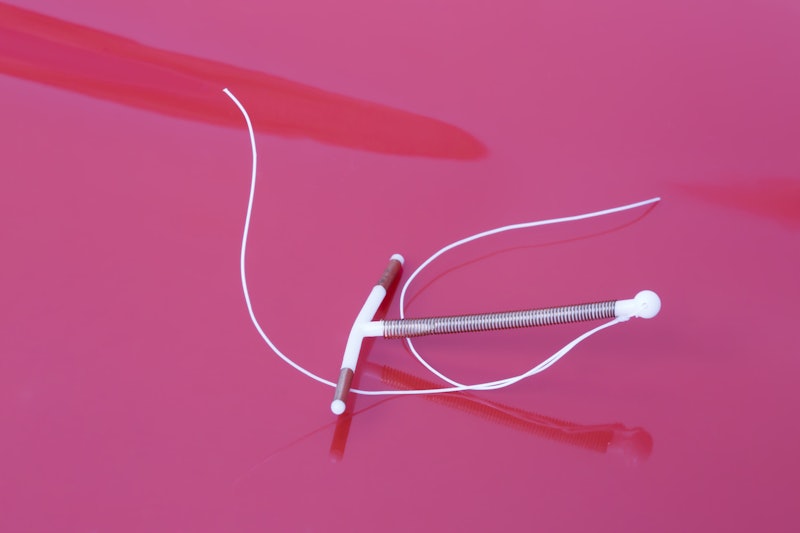
There are two main types of IUDs, one with hormones and one without. “Different brands and types last for different lengths of time,” Dr. Kecia Gaither, M.D., a double board-certified physician in OB-GYN and Maternal Fetal Medicine, tells Bustle. “There’s the hormonal Mirena IUD (effective for approximately five years) and the copper ParaGard IUD (effective for approximately 10-12 years). These devices prevent pregnancy and are deemed to be more efficacious than oral contraceptives, patches, or vaginal rings.” Another common hormonal one is the Skyla, which is effective for three years.
But how do they work? “The copper IUD prevents pregnancy by stopping the sperm from going through the cervix and into the uterus and creating a sterile inflammatory reaction inside the uterine cavity,” she says. “The IUDs with progesterone make the cervical mucus thicker so sperm cannot get inside the uterus to fertilize the egg.”
4.There May Be Side Effects
As with most forms of birth control, there may be side effects. “There are downsides to the IUD,” Dr. Ross says. “Women using the copper IUD may experience heavier, longer, and more painful periods.”
Symptoms may be different when it comes to the hormonal IUD. “Those using the progesterone IUD may experience irregular bleeding during the first 3-6 months,” Dr. Ross says. “Also, some women will not have a period at all, which is often a welcomed side effect.”
Although you may think the small T-shaped IUD will fit everyone the same way, that’s not true. “The Skyla IUD, which is smaller in size than the Mirena and Copper IUD, is used for three years, and may work best for those with a smaller uterine cavity, like teens and women who have never been pregnant,” Dr. Ross says. She also suggests the Kyleena or Liletta IUDs for this same demographic.
6. It’s Best To Get An IUD Inserted Immediately After Your Period
Although it may be tempting to go get an IUD inserted *right now*, it may not be the most ideal time to do so. “The best time to insert an IUD is immediately following your last menstrual period,” Dr. Ross says. She also suggests taking 600-800mg of ibuprofen 30 minutes prior to the insertion.
“Then, once the IUD has been inserted, it is best to periodically check the string at the entrance of the cervix,” Dr. Ross says. “Just don’t pull on it!”
7. Everyone Reacts To An IUD Differently
While an IUD may sound like a simple birth control solution once it’s in place, different people will have different side effects. “When an IUD is inserted, everyone seems to have a different response, depending on your pain tolerance and IUD preparation,” Dr. Ross says.
There may be other disadvantages, too, Dr. Segura says, such as unexplained vaginal bleeding or having an allergic reaction to one of the components in Skyla or Mirena (such as levonorgestrel, silicone, polyethylene, silver) or ParaGard (copper).
Another issue Dr. Kendra stresses is that IUDs don’t protect against STIs like condoms or other barrier methods do. So, while the IUD will help prevent pregnancy, it won’t help prevent potentially getting an STI. In other words, if you or your partner are sleeping with other people, an IUD should not be the only safe sex method you use.
8. Always Discuss The Pros And Cons With Your Doctor First
Of course, before you make an appointment to get an IUD, speak to your OB-GYN or doctor first to make sure its the right option for you. “It is always best to discuss the risks and benefits,” Dr. Ross says. “Studies show that the IUD has the ‘highest patient satisfaction’ amongst contraception users. I would say the IUD is making a serious and purposeful comeback, especially with the threat of losing birth control accessibility for women.”
Of course, only you can decide if an IUD is the best contraceptive choice for you. But with Amy Coney Barrett on the Supreme Court, it may be the time to make birth control decisions in general, IUD-related or not.
Providers discuss how their clinics have responded to the challenges of providing abortion care amid the COVID-19 pandemic.
In the face of ever-changing policies and guidance, independent abortion clinics have continued to keep the safety of patients and staff top of mind. Shutterstock
It wasn’t long after the World Health Organization declared COVID-19 a pandemic that anti-choice lawmakers in the United States seized their opportunity to suspend abortion services under the guise of protecting public health.
And despite important wins for abortion rights in 2020—June Medical Services v. Russo among them—the Supreme Court’s new conservative supermajority and ongoing efforts to outlaw abortion in states like Texas and Louisiana mean the right to an abortion remains under constant threat.
A report released today by the Abortion Care Network details how the country’s independent abortion clinics are faring in the face of unrelenting legislative assaults on reproductive rights. Such clinics play an outsize role in abortion care, providing 58 percent of abortion procedures in the United States even though they represent just 25 percent of all facilities that offer abortion care.
A worrisome rate of clinic closures in recent years and increased patient barriers due to the COVID-19 pandemic continue to jeopardize meaningful access to abortion care through all stages of pregnancy. Consider the following:
Sixty-two percent of U.S. clinics that perform abortions after the first trimester are independent. After 22 weeks, that number grows to 81 percent.
As of November, the Abortion Care Network has identified 14 closures of independent clinics this year alone, for a total of 127 closures since 2015.
Travel restrictions and reduced patient capacity as a result of social distancing requirements in some areas have put abortion providers like Washington state’s Cedar River Clinics on shaky financial ground.
Yet even in the face of ever-changing policies and guidance, independent abortion clinics have continued to keep the safety of patients and staff top of mind. Rewire News Group asked providers around the country how their clinics have responded to the challenges of providing care amid the COVID-19 pandemic.
On adapting quickly and adopting new public health guidelines
“As a nurse, the biggest impact of COVID-19 on abortion care is safety protocols. Abortion clinics provided exceptionally safe care before the pandemic, but now we have adjusted every aspect of patient care to ensure safe COVID practices. It has really changed the experience staff and patients have with each other. We are used to holding hands, wiping tears, giving hugs, and sharing laughter. We do miss being able to provide that type of intimate care and support.” —Ashia George, RN, Scotsdale Women’s Center in Michigan
“Washington was one of the first states hit by the pandemic, and we had to adapt quickly to meet the needs of our patients. We were able to respond with timely implementation of telemedicine services to increase access to safe abortion, and it’s allowed us to continue to offer quality care to all people seeking our services.” —Mona Walia, owner and director, All Women’s Health in Washington
“During the COVID-19 pandemic, our patients and staff need us to continue to provide care as safely as possible. In my state of Arizona, however, telehealth for abortion is banned, and ultrasound and laboratory testing are required for abortion care. These targeted regulations aimed at abortion providers make it nearly impossible for us to innovate during these difficult times.” —Dr. DeShawn Taylor, owner and medical director, Desert Star Family Planning in Arizona
On patients’ ability to access care in a hostile state during the pandemic
“Access to abortion services is already scarce, and many patients have to travel long distances and incur increased costs. The current pandemic has created more job loss, travel restrictions, and increased health concerns that have made accessing abortion services even more difficult. This is abundantly true for low-income patients and patients in rural areas, and the people who have been most negatively impacted are the same people who have historically been disproportionately affected by systemic health-care disparities: people of color.” —Dr. Yashica Robinson, medical director, Alabama Women’s Center for Reproductive Alternatives
On the impact of state public health orders that deemed abortion “nonessential”
“COVID-19 came with such urgency and confusion that it left the entire country in dismay. In Texas, we saw additional, consistent attacks on abortion through executive orders. During the first, there was fear and panic within our clinics and communities. Patient appointments were canceled and rescheduled numerous times. Some patients were forced to travel to another state to seek care. Our staff battled the constant changes and updates to policies and procedures. Through it all, what has remained true is the dedication of our clinic staff and providers to protect and provide for the women and families that need our essential services. That is the light that guides us through this unforeseen time and continues to shine bright.” —Marva N. Sadler, director of clinical services, Whole Woman’s Health in Texas
“We saw an incredible change in [the] volume of patients at the beginning of the pandemic. In New Mexico, we are surrounded by states that had executive orders; Texas, Louisiana, and Oklahoma are not that far away. We all of a sudden got a huge influx of patients, and it was a shock to our system. We never capped the number of people that we saw; we worked longer [and] harder and scrambled for PPE.” —Dr. Shelley Sella, Southwestern Women’s Options in New Mexico
On supporting staff during the pandemic
“Clinic staff are working on the front lines of providing critical patient care during the COVID-19 pandemic, and it is a clear imperative for us to care for our employees’ well-being so that they can truly care for themselves and their families. We have implemented policies around hazard pay for clinic staff who work directly with patients and one another, as well as supplemental pay to ensure that staff retain their typical pay if they are away from work due to COVID-related absences.” —Cicely Paine, director of people and organizational culture, Feminist Women’s Health Center in Georgia
On the financial impact of the pandemic
“The pandemic has hit us hard financially. Our huge concern was risk mitigation, so we made efforts to limit the number of people in the clinic and cut our appointments so we could stagger and distance patients. Like many clinics, the majority of our revenue comes from patient services, so cutting our schedule affected our financial health greatly. It feels like we are figuring out what the future holds on a month-to-month basis, and this is going to impact us financially for a long time. Our future isn’t certain.” —Mercedes Sanchez, director of development, communications, and community education and outreach at Cedar River Clinics in Washington














 Abortion - Abortion Clinics, Abortion Pill, Abortion Information