GIRLS AT THE ROSA MARIA HOUSE FOR CHILD AND TEEN MOTHERS IN ASUNCIÓN, PARAGUAY LEARN HOW TO COOK AND CHANGE DIAPERS. (PHOTO BY NATHANIEL JANOWITZ/VICE WORLD NEWS)

The Rosa Maria House in Asunción, Paraguay—where abortion is illegal—welcomes girls as young as 10 with unplanned pregnancies and teaches them how to be mothers.

The Rosa Maria House in Asunción, Paraguay—where abortion is illegal—welcomes girls as young as 10 with unplanned pregnancies and teaches them how to be mothers.

ASUNCIÓN, Paraguay—Gabriela was 17, pregnant, and out of options.

In her hometown in rural Paraguay, Gabriela found a local doctor who offered to give her a clandestine procedure for 3 million guaraníes, or roughly $400. For a senior in high school whose family didn’t know she was pregnant in one of South America’s poorest nations, that was basically impossible. So Gabriela saved up her money and bought cheap blackmarket abortion pills that didn’t work. 

The father of the baby, a much older non-blood relative, insisted she keep the pregnancy a secret, Gabriela said. At the suggestion of a local pastor she was sent to a church-run facility 100 miles away in a suburb of the capital Asunción: the Rosa Maria House. Gabriela told her family she was going on a “spiritual retreat” but instead went to live at the house where she’d receive free room and board and have the baby.

The Rosa Maria House is part of a network of several dozen church-run homes throughout Paraguay for children. But its specialty is taking in pregnant girls as young as 10, often referred by the authorities after being abused by family members or people close to the family, then facilitating the birth of the child, and training them to become mothers. As Gabriela waited for her baby to arrive, she would be given classes on changing diapers, cooking, and other skills needed to care for babies and toddlers. 
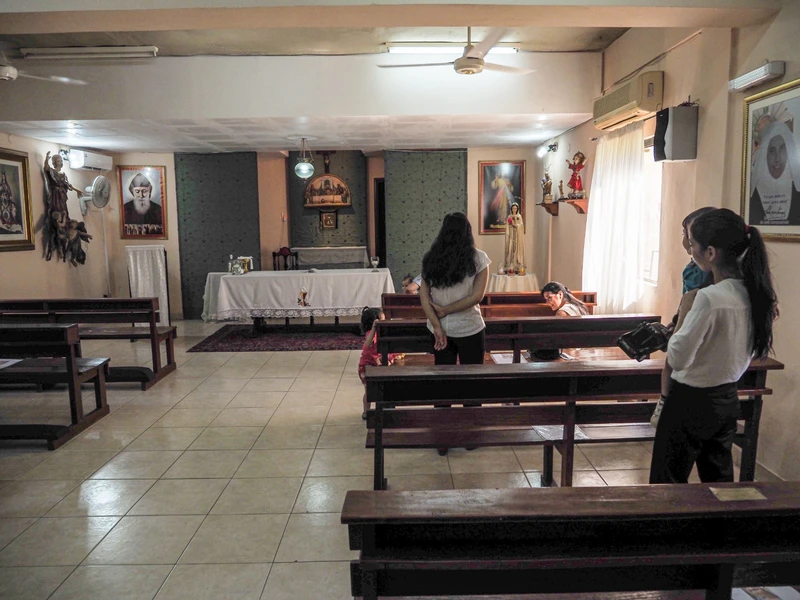
THREE PRE-TEEN MOTHERS TEND TO THEIR CHILDREN WITH ONE OF THE MEMBERS OF THE ROSA MARIA STAFF IN THE SHELTER’S ON-SITE CHAPEL. PHOTO BY NATHANIEL JANOWITZ FOR VICE WORLD NEWS.

In Paraguay, where abortion is completely outlawed except to save the life of the mother, people often face an impossible dilemma: carry the unwanted fetus to term or face possible jail time if they manage to successfully abort. Gabriela’s case was even trickier. When she got pregnant, she hid her pregnancy from her mother, embarrassed by the fact that the father was a much older man who already had a wife and children of his own. “I didn’t know what [a condom] was,” she said.

“I even tried to commit suicide, I wanted to have an abortion. My life was a disaster back then,” Gabriela, whose name has been changed to protect her identity, told VICE World News. “I wanted to study medicine, I already had everything figured out, where I had to take the course, how much the books would cost.”

Gabriela, now in her mid-twenties, described her childhood as “very difficult,” and said that she was sexually abused as a child by a different older man in her life—her former stepfather. She never met her own father, and when she became pregnant she feared her mother would be ashamed “because she also got pregnant with us [her and her siblings] very young and she didn’t want us to go through that situation again,” she said. 

But when she arrived at the Rosa Maria House, she realized she was far from the most difficult case there.

“There I came across the reality of many more girls who were in much worse situations than mine,” she said. “There were girls of 12 or 13 years old who were already pregnant because of being raped that were brought in by the police.” 

She said that many of the girl’s didn’t “know how to read, many came from far away, they didn’t have the chance to go to school.” 

She was grateful for the meals and relative safety of the Rosa Maria House, but she didn’t like losing her freedom. They confiscate the girls’ cell phones and do not allow them to communicate with people outside besides arranged visits with family, she said. She didn’t like being bossed around, “that they tell me to do this or do that,” such as chores, praying in the on-site chapel, or certain lessons.

But still, she considered it a mostly positive experience, and loves her child —who she continues to raise today—very much. She was especially appreciative that through the shelter she met a professor who helped her obtain a partial scholarship to attend university after she eventually graduated high school. 

CHILDREN’S CLOTHES DRY ON A PLAYSET AT THE ROSA MARIA HOUSE IN PARAGUAY. PHOTO BY NATHANIEL JANOWITZ FOR VICE WORLD NEWS.

“They gave me the medicines that I had to take, and do the [medical exams]. They helped me a lot in that sense…They give you everything there: they gave you food, they gave you clothes,” said Gabriela. “There were cooking classes. People taught some subjects so they can read, write. Those were the good things that I saw, that nobody needs anything. They got all the support.”

The Rosa Maria House is in a nondescript white brick house on a quiet street in a nice-ish residential suburb of Asunción. After repeated attempts to call the house with no answer, VICE World News showed up at their door and was greeted by Oscar Ávila, an elderly bald man in charge of the shelter. He gave a short interview, and tour of the common areas of the house, like the chapel, the kitchen, and the courtyard with one condition—speaking with girls was off limits.

Over the past 22 years, young girls living in the shelter have given birth to over 230 babies, Ávila said. He believed that by facilitating young girls to give birth, he was doing God’s work, even if the mothers were children themselves, some of whom became pregnant after being raped by adult neighbors and family members.

“Why are you going to kill the child if you’re not going to kill the father? He who made the mess, that’s who should die,” said Ávila. As he spoke, a young girl walked past his small office in the center. He called out to her, asking her age.

“13,” she responded quietly. He nodded, and told her she could continue on, seemingly proud of showing off the work he was doing.

The Rosa Maria House is supported by a local parish and donations, said Ávila, while refusing to go into further detail besides saying that “we belong to a pro-life organization that is not very well seen in the New World Order.”

Young girls aged around 12 or 13 wandered around the shelter carrying small children when VICE World News visited in March 2022. The building was made up of a few offices and a chapel where the girls were sent to pray. A courtyard was littered with children’s toys and strollers. The smell of lunch permeated the building as a couple of girls cooked in the kitchen.

While a number of the girls are pregnant from relationships with kids in their own age range, others were brought in by state care after their families either abandoned them or took them to the police or hospital looking for help. Many girls arrived after direct intervention by authorities because their family members were the ones hurting them, and their homes were no longer considered safe.

The girls kept their eyes low, seemingly nervous of the presence of an outsider listening to Ávila explain how young girls have an intrinsic “maternal capacity.” Many of the girls just refer to Ávila as abuelo, or “grandfather” in English. 

“Even if they’re 10 or 12 years old, the young girls that we receive actually have the most love for their children,” said Ávila. The fact that the mothers were still children themselves, he argued, made the connection between the mother and child even closer. 

The house supports the girl’s medical treatments at a local hospital before, during the birth at the hospital, and afterward as they learn to become mothers at the house, only letting them leave the shelter for doctor’s appointments, and Sunday mass at a nearby church. Ávila didn’t worry about the health effects of young girls giving birth, claiming that every child has survived over the past 22 years, both mother and baby.

FATHER OSCAR ÁVILA STANDS IN THE HALLWAY NEXT TO A BUNCH OF CHILDREN’S TOYS AT THE ROSA MARIA SHELTER FOR PRETEEN MOTHERS IN ASUNCIÓN, PARAGUAY. PHOTO BY NATHANIEL JANOWITZ FOR VICE WORLD NEWS.

Paraguay is arguably South America’s most conservative and religious country. Children and teens who become pregnant see little option beyond giving birth, whether they want to be mothers or not. Draconian abortion laws, a mobilized Christian resistance to sex education in schools, and widespread abuse has created a child pregnancy epidemic. With abortion illegal even in the most extreme cases of abuse, shelters like the Rosa Maria House are one of the few options for pregnant children and teens. 

In a nation of only 7 million inhabitants, roughly 12,000 girls between 15 and 19 gave birth in 2019, and 1,000 girls aged 14 or younger gave birth between 2019 and 2020, according to Amnesty International. An average of two girls between 10 and 14 give birth everyday with 80 percent of the cases coming from within the family unit — the second highest rate in South America after Venezuela. 

A second woman who lived at the Rosa Maria House as a teen and gave birth to her child at age 18 while there also told VICE World News that the people who ran the house treated her well. Both of the women who spent time at the house said that they experienced no abuse there, nor saw any against the other girls during their time there.

The woman, who was 18 when she gave birth and also asked to remain anonymous, recalled that the house also provided “psychological support.”

“Many psychologists came and there were two or three, the ones who always came constantly to have conversations with those girls who were the ones with the most complicated and emotional situations, which could lead to depression.” 

She also said the girls were young. “I was the oldest of all of them,” she said. “They were all minors, 11, 12, 13, 14, up to 15.” 

“I thought that I was the person who has suffered the most in life and that what I have gone through, it would happen to very few, but no,” she said. “Really, when I went there and heard the story of those girls, I said: my God, thank you Lord, because I seriously cried with every story that I heard.” 

The Rosa Maria House offered classes in what it appears to consider to be practical careers for young mothers. “We practically started studying because people came to give us private classes,” she said. “We were learning things and manicures, pedicures, makeup, whether it was massage, we did hairdressing.”

That girls would see their stay at the Rosa Maria House as a somewhat positive experience doesn’t surprise Alejandra Rodríguez from ENFOQUE Niñez, a non profit organization that has worked with different shelters since 2005. Many of the girls who end up at the shelter and homes like it are simply grateful to have food and to be protected from abuse.

“A girl who lived subjected to all kinds of violence before, either at home or wherever she was, and suddenly she is in a place where she receives certain pressures but at least she is already protected from sexual abuse, it is a significant change in her life,” said Rodríguez. “Because she also has a plate of food and the possibility of studying, without having to give anything in return.”

But she expressed concern that those in charge of shelters like the Rosa Maria House do not truly consider “the complexity of the situation of a pregnant girl or adolescent.” She said that the directors of these institutions speak with “great pride that they [the girls] are taught to be mothers, without questioning whether or not they want to be.” 

“That loss of status as a girl or teenager, due to the fact of the responsibility of being a mother, was very apparent,” she said. 

There are 35 shelters in Paraguay that host children, but only one that exclusively focuses on pregnant girls, according to a 2020 ENFOQUE Niñez report titled How Do We Protect? When Do We Protect?. Rodriguez said that the quality of these shelters can vary, and that in the majority “there are very little personnel, with very little preparation.”

“In some shelters, for example, the use of medicalization. That is, the use of psychiatric or neurological medication to control behavior,” she said.

In May, a children’s shelter near the border with Brazil and Argentina was shut down after authorities discovered that its residents were allegedly being mistreated by women mostly posing as nuns.

“The biggest problem is that the highest authorities are not listening to the specialists that address the situation of children, who are abused daily in Paraguay,” Rosalia Vega, Amnesty International Paraguay’s executive director, told VICE World News in the NGO’s office in Asunción.

The government repeatedly failed to implement a 2018 law that aimed to consolidate comprehensive care for child and teen sexual abuse victims. The changes would have given survivors of child and adolescent sexual abuse a single pathway to non-religious based care without having to be repeatedly retraumatized by having to constantly retell their stories to authorities. Instead, Vega said that authorities are involved in “perverse games.” Evangelical groups have become intertwined with politicians, she said, and political promises related to anti-abortion and sexual education legislations are made to popular evangelical leaders in return for the support of their congregations. “Whether you like it or not, these sectors of the Church are sectors of power in our society,” she said.

In walking distance of both the Amnesty International office and the Rosa Maria House in Asunción stands a statue of an unborn fetus in the middle of a prominent traffic roundabout. The monument has come to embody the way that anti-abortion sentiment permeates Paraguayan society.
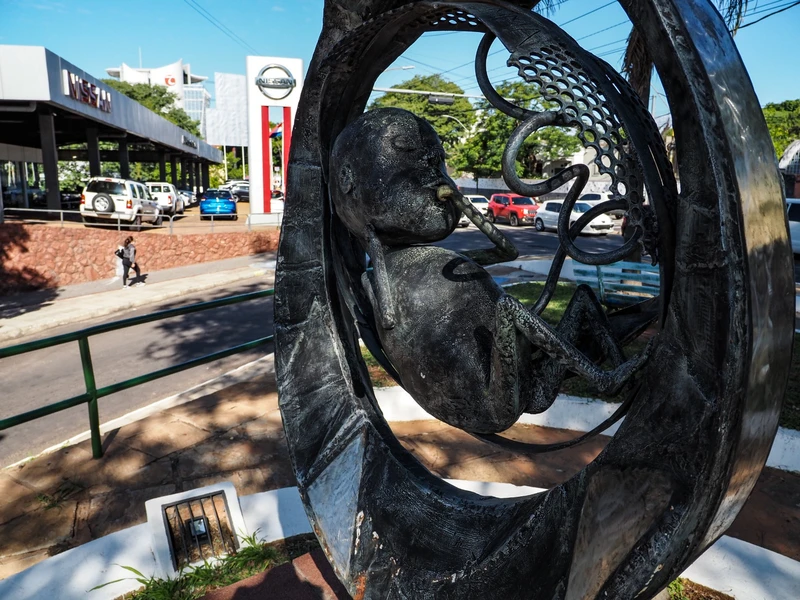
A WOMAN WALKS PAST A PRO LIFE FETUS STATUE LOCATED AT A PROMINENT ROUNDABOUT IN FRONT OF A NISSAN DEALERSHIP IN ASUNCION, PARAGUAY. PHOTO BY NATHANIEL JANOWITZ FOR VICE WORLD NEWS.

The artist behind the statue, Diego Cesperedes, was contracted by an anti-abortion group to construct it in July 2015, just two months after the internationally condemned ruling by a Paraguayan court that denied a pregnant 10-year-old rape victim an abortion. The victim became known by the pseudonym “Mainumby”, which means hummingbird in the Indigenous Guarani language that is still widely spoken throughout much of Paraguay. The young girl was allegedly raped by her step-father and became pregnant.

The case became particularly controversial after Mainumby’s mother was arrested and held in prison for two months for allegedly being complicit in the abuse, even though she’d reported suspicions about the step-father to the authorities more than six months before the pregnancy, and authorities took no action. Mainumby and her family appealed to the highest courts in Paraguay under a rare exception where abortion is permitted if the mother’s health was at risk, but they were eventually denied by legislators. She was forced to give birth in August of that year.

Vega recalled how it was “taboo” to publicly campaign for Mainumby’s right to choose, and those who did, “the defenders of sexual rights, sexual and reproductive rights, at that time, we received death threats.”

The 2015 verdict emboldened the country’s anti-abortion activists. The organization behind the fetus statue, Pro Vida Generation, and other groups began a program  around the country, to promote the concept of “Pro Life, Pro Family” communities. Between 2017 and 2019, 10 towns and cities in Paraguay formally declared themselves “Pro Life, Pro Family,” with a few hosting identical fetus statues to the one in the capital.

With anti-abortion laws firmly entrenched, the evangelist movement continues to rail against comprehensive sexual and gender education for children. The religious groups often hold demonstrations around the country aimed at derailing any sort of progressive agenda, and recently took specific aim at civil society-produced guidelines and teacher training information for rights-based sexual education supported by E.U. and UN agencies. The Ministry of Education has a long relationship with the evangelical church movement and publicly denounced the attempts to bring sex education into schools. 

Some of the evangelical organizations have direct connections to an anti-abortion U.S. Christian Ministry with links to former Vice President Mike Pence and former Secretary of State Mike Pompeo.

Sex education, which was already poor, is now practically non-existent, and evangelical groups have “positioned wrong information that permeates society,” said Vega.

Gabriela believes that with proper sex education, her life could have been different, but “I think that the Church is super against that.” 

As the government continues to bend to the whims of the country’s religious and conservative base, more grassroots movements are popping up around the country to provide other options for Paraguay’s youth.

Somos Pytyvohara is one, and focuses on providing sexual education to children and teens. Its members spent years giving free classes on sex education, but after the pandemic hit, they started a new phone line where callers can receive sexual education and advice from their staff of young volunteers. 

“It’s young people [talking] to other young people,” said Alejandra Sosa, a member of Somos Pytyvohara. “We believe that education should be given horizontally, from people who are about the same ages. It’s a slightly safer space to talk about these usually taboo topics.”

She noted that they’ve received phone calls from people in neighboring countries as well and provide a non-religious option for information so that girls can “make more assertive decisions regarding teenage pregnancy,” said Sosa.

MARCH 8 WOMEN’S DAY PROTESTERS TAGGED A WALL IN DOWNTOWN ASUNCIÓN WITH “CHE RETE, CHE M’BAE”, WHICH MEANS “MY BODY, MY PROPERTY” IN GUARANÍ. MARCH 8 WOMEN’S DAY PROTESTERS TAGGED A WALL IN DOWNTOWN ASUNCION WITH “CHE RETE, CHE M’BAE”, WHICH MEANS “MY BODY, MY PROPERTY” IN GUARANÍ. PHOTO BY NATHANIEL JANOWITZ FOR VICE WORLD NEWS.

Nearly a decade after Gabriela left the Rosa Maria House, she expressed repeatedly that she was glad that she had her child, but believes that girls in Paraguay should be able to choose for themselves if they want to be mothers, and learn how to prevent it if possible from an early age. She’s about to graduate from university with a degree on a career track, years later than she had hoped when she was 17.

“It’s hard going through a teen pregnancy. As much as you say that you are prepared to do many things, you miss things, many things, good things,” she said. “You stop living so you can become a mom. It is very difficult. It is better if one can prevent it.”

She hoped that the next generation in Paraguay would have different opportunities than she and hundreds of other girls who’ve passed through religious shelters like the Rosa Maria House. And that begins by making options available.

“I am not going to judge people who want to [have an abortion] or not,” Gabriela said. “It’s everyone’s individual decision.”

“That’s why now, I decided to leave the church a bit too, because there are many things I don’t like.”

Source: https://www.vice.com/en/article/bvmkea/paraguay-christian-shelters-rosa-maria-house

Kaiti Sullivan/For The Washington Post/Getty Images – Dr. Caitlin Bernard in Indianapolis on September 28, 2022.

Indiana’s attorney general is asking the state medical licensing board to discipline an Indianapolis doctor who provided abortion services to a 10-year-old girl – a move the physician’s attorney has called an effort to “intimidate” abortion providers.

Attorney General Todd Rokita in a complaint filed Wednesday alleges that Dr. Caitlin Bernard violated federal and Indiana law related to patient privacy and the reporting of child abuse, according to the complaint.

“Dr. Bernard violated the law, her patient’s trust, and the standards for the medical profession when she disclosed her patient’s abuse, medical issues, and medical treatment to a reporter at an abortion rights rally to further her political agenda,” Rokita said in a statement.

The complaint also claimed that Bernard became “unfit” to practice by not staying “abreast of current professional theory or practice.”

The complaint asked the licensing board to impose “appropriate disciplinary action,” but did not request a specific penalty.

Bernard’s attorney, Kathleen DeLaney, in a statement Wednesday called Rokita’s filing a “last-ditch effort to intimidate” her and other abortion providers.

“Though I am disappointed he has put my client in this position, we are not surprised given Mr. Rokita’s consistent efforts to use his office to seek to punish those with whom he disagrees at the expense of Indiana taxpayers,” DeLaney added.

Bernard, an obstetrician-gynecologist, provided abortion services in Indiana to a 10-year-old Ohio rape victim in late June, Bernard previously told CNN.

Ohio banned abortion as early as six weeks of gestation following the Supreme Court ruling, and the girl was six weeks and three days into the pregnancy, Bernard said.

In July, the attorney general announced an investigation into Bernard’s potential failure to report the abortion and child abuse.

Bernard sued the official several months later, alleging his office used illegitimate consumer complaints to seek patient records and pursue the probe, CNN previously reported.

“These improper investigations unfairly burden plaintiffs in numerous ways, threatening not only their livelihoods but also the availability of the essential services they provide to their patients,” the lawsuit reads.

Indiana Department of Health documents obtained by CNN show that Bernard reported the procedure two days after it was completed.

Bernard’s employer, Indiana University Health, concluded she was “in compliance with privacy laws.”

Source: https://edition.cnn.com/2022/12/01/us/indiana-abortion-doctor-attorney-general/index.html

A line of early voters stretches outside the building at the start of early voting in the runoff U.S. Senate election between Democratic Senator Raphael Warnock and his Republican challenger Herschel Walker, at the City Services Center in Columbus, Muscogee County, Georgia, U.S. November 26, 2022.

A week-long early voting period begins Saturday in some Georgia counties as Democratic Sen. Raphael Warnock and Republican challenger Herschel Walker enter a week-and-a-half, post-Thanksgiving sprint to their December 6 runoff election.

Unlike the 2021 runoffs, control of the Senate is not on the line, with Democrats having won 50 seats already and Vice President Kamala Harris giving the party a tie-breaking vote.

However, the stakes remain high: A Warnock victory would give Democrats the majority outright, rather than requiring the power-sharing agreement that is now in place. Democrats would have the majority on committees, allowing them to advance President Joe Biden’s nominees more easily.

Georgia’s Supreme Court delivered Warnock a victory Wednesday, allowing counties to offer early voting on Saturday. Democrats said they expected as many as 22 counties to do so – some in heavily populated areas around Atlanta, including DeKalb and Fulton, as well as Chatham County, home of Savannah.

That ruling followed a legal battle triggered by Georgia Secretary of State Brad Raffensperger’s interpretation of the state’s 2021 voting law. He said the new law restricted weekend voting immediately after holidays.

That 2021 law cut in half the timeline for runoff elections, to four weeks, and limited the early voting window to a minimum of five days rather than the minimum of 16 days that had been in place when Democrats won two Senate runoffs in the state in January 2021.

As many as 22 of the state’s 159 counties let voters cast their ballots Saturday.

At a polling site in Atlanta, Boston College student Emma Demilio said she probably wouldn’t have been able to vote in person if the early voting sites hadn’t opened.

“This is kind of the only time that I’m in Georgia and able to vote. I leave tomorrow, so I was really happy I was able to get it in,” she said, adding that she may have tried to scramble for an absentee ballot.

Warnock continues to outraise Walker as they enter the final stretch.

Warnock raised nearly $52.2 million from October 20 through November 16, a period covering the end of the general election and roughly the first week of the runoff. Walker collected $20.9 million in that time, according to his campaign’s filings with the Federal Election Commission. Warnock ended the period with more than $29.7 million remaining in the bank, more than three times the $9.8 million left in the coffers of his rival.

Obama leads surrogate list

Warnock is set to bring in a top Democratic surrogate: Former President Barack Obama is slated to travel to Atlanta on Thursday for a rally ahead of the final day of early voting.

So far, Obama is the only president past or present slated to visit Georgia ahead of the runoff.

Neither President Joe Biden, to whom Walker’s campaign has tried to latch Warnock, nor former President Donald Trump, who was in office when Republicans lost two Senate runoffs two years ago, have scheduled trips to the state. On Saturday, Warnock appeared with Sen. Cory Booker (D-NJ) at a rally in Sandy Springs, just outside of Atlanta.

Trump allies, including Sens. Ted Cruz of Texas and Lindsey Graham of South Carolina, have been out in force for Walker, the former president himself has not campaigned with the candidate he recruited.

Other Republicans, meanwhile, are rallying around Walker, with the Senate Leadership Fund, the super PAC aligned with Senate Minority Leader Mitch McConnell, pumping more than $10 million into the race since the general election.

In addition to the new influx of outside spending, Georgia Gov. Brian Kemp, who cruised to re-election earlier this month, made his first appearance with Walker on the trail after stiff-arming the former football great throughout the fall.

Kemp defeated a primary challenger backed by Trump in May and then outpaced Walker by more than 200,000 votes in the general election – a sign both of his crossover appeal to moderate Democrats and Walker’s difficulties consolidating Republicans.

Still, Democrats said they doubted Kemp could rescue Walker in a runoff election in which Walker is the only Republican on the ballot.

“There’s tons of folks that voted for Raphael Warnock and Brian Kemp,” said Jason Carter, the 2014 Democratic nominee for governor and grandson of former President Jimmy Carter.

He called Warnock a “unique figure,” noting that he “got more votes than Herschel Walker and he got more votes than any other Democrat.”

“People appreciate him. And they think of him as Raphael Warnock first, and as his political party and all that other stuff second,” Carter said.

Renewed focus on abortion

A new potential flashpoint in the runoff election emerged Wednesday. The Georgia Supreme Court, in a separate legal battle, also reinstated the state’s six-week abortion ban.

It was a policy victory for the Republicans who had enacted that ban and defended it in court, but one that could come at a political cost, reviving the backlash over the Supreme Court’s reversal of Roe v. Wade that energized Democrats and swung moderate voters in their favor on the party’s way to a surprisingly strong showing in this year’s midterm elections.

In the midterms, according to CNN exit polls, 28% of Georgia voters said abortion was the most important issue to their vote – second only to inflation at 37%.

Of those who identified abortion as the most important issue, 77% backed Warnock, compared to 21% who voted for Walker – a reversal of inflation, an issue that favored Walker by a 45 percentage point margin.

Fifty-three percent of Georgia voters said abortion should be legal in all or most cases, and among those voters, 75% backed Warnock. Of the 43% who said it should be illegal in all or most cases, 87% backed Walker.

Ad battle tops $40 million

Already, both parties have pumped more than $40 million into television advertising in the runoff. Democratic groups have spent nearly $25 million, while GOP groups have spent nearly $16 million, according to the ad tracking firm AdImpact.

In an effort to unite Republican factions, a Walker super PAC is sending out mailers touting Kemp’s support and trying to tie Warnock to Democratic gubernatorial candidate Stacey Abrams. “You stopped Stacey. Now reject Warnock,” they read.

“Who do you want to fight for you in the United States Senate? Do you want a guy that represents our values like Herschel Walker, or do you want a guy who’s stood with Joe Biden 96% of the time?,” said Kemp, borrowing a familiar attack from Walker, at a rally last weekend in Cobb County.

Kemp also echoes that line of attack in a new television ad launched by SLF. The governor and McConnell’s group have are also linking up for get out the vote efforts. SLF is boosting Kemp’s state operation, which has been pivoted to help Walker, with a $2 million cash injection.

Warnock’s campaign, too, is trying to win over Republicans who effectively chose Kemp over Trump.

A new ad from the Warnock campaign features a woman who says she voted for Kemp this year and describes herself as a lifelong Republican, but goes on to say she won’t support Walker in the runoff because of his “lack of character.”

Warnock has also campaigned on what should be some of Walker’s safest territory: his hometown. At an event in Wrightsville, where Walker played his high school football, Warnock asked voters to separate the sports hero from the political candidate.

“I saw what your favorite son did on the football field. I don’t mind giving credit where credit is due. That brother could razzle dazzle you on that football field. He created a lot of excitement and did a lot for the great University of Georgia. And he deserves credit for that,” Warnock said. “But tonight, we’re on a different field.”

At the same time, the Republican has faced some backlash over an ad of his own – alongside University of Kentucky swimmer Riley Gaines, who has appeared with Walker before and competed with transgender swimmer Lia Thomas, who became a focus of debate surrounding trans women’s participation in sports and has frequently been attacked in conservative media.

“For more than a decade, I worked so hard. Four a.m. practices to be the best. But my senior year, I was forced to compete against a biological male,” Gaines says in the ad.

The spot was released in the days after a gunman allegedly targeted the LGBTQ community at a gay club in Colorado. One of the five people killed was a trans man.

Source: https://edition.cnn.com/2022/11/26/politics/georgia-runoff-early-voting-starts/index.html

Former President Donald Trump announces he is running for president for the third time on November 15, 2022. (Andrew Harnik/AP)


The highly touted red wave in last month’s midterm election failed to develop largely because it hit a wall of resistance among independent voters, especially across the key battleground states. And that presents difficult questions for Republicans looking forward to 2024.

The GOP’s disappointing showing among independents this year marked the third consecutive election in which the party has underperformed with those critical swing voters. Although Donald Trump ran competitively among independents in his first presidential race in 2016, since he took office, the GOP has consistently faced broad opposition among them, especially those who are women or hold four-year college degrees.

The GOP’s 2022 struggles with independents were especially striking because they came even as most of those voters expressed negative views of both President Joe Biden’s job performance and the state of the economy – sentiments that typically cause most swing voters to break for the party out of the White House. To many analysts in both parties, the reluctance of so many independents to support Republican candidates despite such discontent underscores how powerfully the Trump-era GOP has alienated these voters.

“There’s a huge lesson here, which is if you talk like Trump or remind voters of Trump, particularly at a personality level, it’s pure poison to independent voters,” John Thomas, a GOP consultant, said flatly. “It might have been effective in 2016 because voters were looking for something new and a change, but it hasn’t been useful since then.”

For Republicans, the results underscore the electoral risks of the party’s continuing refusal to repudiate Trump, even as he has openly associated with two antisemites who praised Adolf Hitler, praised the January 6, 2021, US Capitol rioters and publicly called for the “termination” of the US Constitution to restore himself to power.

In the election, fully 66% of independent voters said they had an unfavorable view of the former president while just 30% viewed him favorably, according to the results of the exit poll conducted by Edison Research for a consortium of media organizations including CNN. Among female independents, Trump’s ratings were even worse: just 23% favorable and 72% unfavorable, according to previously unpublished exit poll results provided by the CNN polling unit. Trump’s unfavorable rating hit a comparable 69% among independents with at least a four-year college degree. “I have a hard time seeing the Republican Party escaping the grasp of Trump with or without him on the ballot anytime soon,” says Tom Bonier, chief executive officer of TargetSmart, a Democratic data and voter targeting firm.

The results among independents also contained plenty of warnings for Democrats. The exit poll found that Biden’s image among them was only slightly more favorable than Trump’s (with 37% viewing the president favorably and 60% unfavorably) and that nearly three-fourths of independent voters (including virtually identical numbers of men and women) said they did not want him to run again in 2024. In a post-election survey conducted by Way to Win, a liberal group that works primarily with candidates and organizations focused on voters of color, roughly four-fifths of independents across the battleground states said they couldn’t identify anything the Biden administration has done that has directly improved their lives.

Most importantly, the exit poll showed Democrats winning independents in the national vote for the House of Representatives only by a narrow 49% to 47% margin. That was a significantly smaller advantage than the double-digit lead among independents Democrats enjoyed in both the 2020 presidential race and the 2018 contest for the House.

“These results weren’t necessarily an endorsement of Democrats,” says Democratic pollster Matt Hogan. “But they disliked Republicans and viewed them as even more extreme.”

Still, the magnitude of the Democratic advantage among independents was probably less revealing than the fact that the party carried them at all, especially in a period of such economic unease. The party controlling the White House has not won independents in the national vote for the House in any midterm election since at least 1982, according to exit polls.

While Republicans held the presidency, Democrats won independent voters by double-digits in House elections in the midterms of 2018, 2006 and 1986, according to exit polls. While Democrats held the presidency, Republicans won independents by double-digits in House elections in the midterms of 2014, 2010 and 1994. In each of the past two midterms, the party out of the White House (Democrats in 2018 and Republicans in 2014) won independents by a resounding 12 percentage points, the exit polls found. The GOP’s severe underperformance of that standard allowed Democrats to finish unexpectedly well last month even though Republican voters, extending the usual midterm pattern for the party out of the White House, participated in larger numbers than Democrats.

In the key statewide races this year, the Democratic advantage among independents was often much more pronounced than their slim lead in the national House vote.

Democratic candidates, the exit polls found, won independents by double-digit margins in the Senate races in Arizona, Georgia, Pennsylvania and New Hampshire, narrowly ran ahead with them in North Carolina and essentially split them evenly in Nevada, Ohio and Wisconsin. (The latest CNN poll conducted by SSRS for Tuesday’s Georgia Senate run-off again shows Democratic Sen. Raphael Warnock holding a commanding lead among independents over Republican Herschel Walker.)

Winning Democratic candidates also posted gaping double-digit advantages among independents in the Michigan and Pennsylvania governor races and solid leads of 6-7 percentage points in Arizona and Wisconsin. Republican Govs. Ron DeSantis in Florida and Mike DeWine in Ohio, two increasingly solid red states, were the only statewide GOP candidates to win independents by a comfortable margin, according to the exit polls.

Jenifer Fernandez Ancona, vice president and chief strategy officer for Way to Win, says concerns about the Trump era GOP’s commitment to basic rights, including abortion rights, and to democracy itself offset the usual tendency among independents to check the party holding the White House. “I think that the combination of the threats to democracy, the threats to freedom was a powerful antidote to that usual pattern,” she said.

Hogan was part of a bipartisan team (along with Tony Fabrizio, Trump’s lead pollster in 2020) that polled during the election for the AARP, the giant senior’s lobby. In a post-election survey of the 63 most competitive House districts, that pollster team also found that Democrats narrowly carried independent voters.

Like Ancona, Hogan says the key to that result was that as many independents in these districts said abortion rights and threats to democracy were the most important issues in their vote as cited inflation and the economy – a result that surprised him. Though many independents were negative on Biden’s job performance and pessimistic about the economy, he notes, they remained unwilling to entrust power to a Republican Party reshaped in Trump’s image.

Another measure of that hesitation came in the national exit poll. Overall the survey found that a virtually identical share of voters nationwide, just over half, said they viewed the GOP and the Democratic Party each as “too extreme.” But independents were much more likely to stamp that label on the GOP. While the share of independents who considered Democrats extreme exceeded the share who did not by a narrow four percentage points, the gap for Republicans was 18 points. Nearly two-thirds of independents with college degrees, and exactly three-fifths of female independents, said they viewed the GOP as too extreme, considerably more than in either group that identified Democrats in that way, according to detailed results from the CNN polling unit.

Paul Bentz, an Arizona-based Republican pollster and the 2010 campaign manager for former GOP Gov. Jan Brewer, believes that label severely hurt the GOP in that critical swing state. Bentz says the GOP’s 2022 slate of Trump-aligned candidates – led by gubernatorial nominee Kari Lake and Senate choice Blake Masters – systematically alienated not only independents but also a critical slice of moderate Republicans through their rigid opposition to legal abortion and embrace of Trump’s discredited claims of fraud in the 2020 election. “They did not appear to have any interest in targeting, identifying and communicating with independent voters,” Bentz says.

In Arizona and elsewhere, the GOP especially struggled among college-educated and female independents. The exit poll found that Democratic Sen. Mark Kelly, while beating Masters, drew 55% of female independents and 61% of independents (of both genders) with college degrees; Democratic governor-elect Katie Hobbs, in her win over Kari Lake, won almost exactly as many of each group.

They were hardly alone in dominating among both college-educated and female independents. In the national exit poll, Democrats carried exactly 54% of each group. In Michigan, Democratic Gov. Gretchen Whitmer won 59% of the independents with degrees and 56% of women independents. Wisconsin’s Democratic Gov. Tony Evers virtually matched those numbers. In the Pennsylvania Senate race, Democrat John Fetterman carried over three-fifths of both groups in his comfortable victory; Democratic Sen. Maggie Hassan roughly equaled his performance while winning reelection by an even wider margin in New Hampshire. Democratic Senators Catherine Cortez Masto in Nevada and Warnock in Georgia both carried 53-55% of each group. Josh Shapiro, the Democratic-governor elect in Pennsylvania, set the pace by carrying over two-thirds of both female and college-educated independents in his landslide against far-right GOP nominee Doug Mastriano.

Results provided by Edison Research showed that Democrats also dominated among women and college-educated independents in the 2018 House races and 2020 presidential contest, races also heavily shaped by attitudes toward Trump.

In both parties, many analysts see little chance for the GOP to reverse these trends if they nominate Trump for the presidency again in 2024. The bigger question may be whether another nominee would allow the GOP to climb out of the hole that Trump has opened beneath the party with independents.

Bentz, the Arizona-based GOP pollster, thinks the answer is yes. Bentz says the key to the state’s recent tilt away from decades of Republican dominance is the recoiling from the Trump definition of the party among well-educated, higher-income swing voters in the Phoenix suburbs. But he notes that outgoing GOP Gov. Doug Ducey, with more of a business-oriented and problem-solving image, twice ran well with those voters; that precedent, Bentz says, suggests that if Florida Gov. Ron DeSantis can fit that mold, he could recapture many of them in 2024.

“Trump would very much struggle in this state again,” Bentz says. “DeSantis, especially depending on who he chooses as his running mate, I think he could be competitive here.”

Less clear is whether DeSantis can present himself in that way. While he’s less personally bombastic and does not carry the association with election denial and violence that has stained the former president, the Florida governor has embraced a wide array of right-wing culture war causes, from limiting how teachers talk about race, gender and sexual orientation to targeting undocumented immigrants and restricting access to abortion.

With that resume, Fernandez Ancona says DeSantis is vulnerable to the same stamp of extremism and intolerance that has hurt Trump with independents-if Democrats do the work to define him. “I don’t think you can separate Trump from Trumpism,” she says. “And DeSantis is absolutely an acolyte of Trumpism … that’s a story we would have to tell.”

Thomas, the GOP consultant, is the founder and chief strategist of Ron to the Rescue PAC, a Super PAC promoting a 2024 presidential bid for DeSantis (who has not yet announced whether he’ll run). Like Bentz, Thomas believes DeSantis could improve on the GOP’s Trump-era performance among independents. For all DeSantis’ fervor as a culture warrior, Thomas argues, the Florida governor has also shown he can execute the nuts-and-bolts aspects of governing “that matter to independents.”

But Thomas doesn’t discount the risk Democrats could define DeSantis exactly in the manner Fernandez Ancona suggests – especially if the Florida Governor leans too far into what Thomas calls culture war “stunts” like his recent move to fly undocumented immigrants from Texas to Martha’s Vineyard. Thomas says he’s confident that if DeSantis runs, he can manage “the tightrope” of appealing to both independent general election voters repelled by Trump and base primary voters attracted to his belligerence toward liberals. But Thomas agrees if DeSantis’ “argument for voters is the stunts, I think that becomes too Trump-like at the end of the day.”

Republicans performed better among independents last month in states that already lean in their direction. Gov. Greg Abbott in Texas ran virtually even among those voters, and DeSantis carried them – as did Ohio GOP Gov. Mike DeWine and, even more decisively. J.D. Vance, the GOP’s Ohio senator-elect, also ran about even with them, the exit polls found.

But despite all the unhappiness with Biden and the economy, Republicans continued to struggle with independents in almost all gubernatorial and Senate races across the five states that decided the last presidential race by switching from Trump in 2016 to Biden in 2020 – Michigan, Pennsylvania, Wisconsin, Arizona and Georgia. (The only exceptions were the governor’s race in Georgia and Senate contest in Wisconsin where Republican incumbents Brian Kemp and Ron Johnson each ran about even among independents.)

That pattern suggests Republicans are unlikely to regain an Electoral College majority and recapture the White House in 2024 unless they can pry away more independents from the coalition that has now staunchly rejected Trump’s vision for America over three consecutive elections. And Democrats, watching the GOP again almost completely avoid direct criticism of Trump amid his latest provocations, see few signs Republicans are willing to do what that would likely require.

“I don’t think these fundamentals are going to drastically change,” says Fernandez Ancona. “The pieces are in place right now for us to be able to continue to grow this anti-MAGA majority.”

Source: https://edition.cnn.com/2022/12/06/politics/trump-legacy-independents-red-wave-2022/index.html

(GETTY)

“It was the ugliest feeling explaining to the doctor that delivered your child that she was raped, and then him telling you he can’t do anything to help you.”

Legally, if you get pregnant after being raped in Mississippi, you should be able to get an abortion. Although the state has banned almost all abortions, it does permit them in cases of rape. But when a teenager there recently became pregnant through rape, her parents still had to take her to Illinois for an abortion. The last clinic in Mississippi had already closed.

“It was the ugliest feeling explaining to the doctor that delivered your child that she was raped, and then him telling you he can’t do anything to help you. He gave me the number to the Louisiana clinic,” the mother of the unnamed teenager told a local Mississippi news outlet in late November. That clinic, too, had closed, thanks to that state’s abortion ban. There were simply no abortion clinics close by.

Long held up as common-sense compromises by Republican politicians and grudgingly tolerated by anti-abortion activists, abortion bans with exceptions for rape and incest have now become something of an endangered species. Abortion bans in states like Alabama, Arkansas, Kentucky, Louisiana, Missouri, Tennesse, and Texas—practically all of the South—have zero exceptions for incest or rape.

But even when laws do allow abortions in cases of rape and incest, experts told VICE News that, in reality, they rarely work. Now that Roe v. Wade has fallen and abortion bans have snapped into place, it’s simply not financially feasible for clinics to stay open in states with bans, because there just aren’t enough patients. And when a rape victim is allowed to get an abortion, they may be asked to navigate a series of logistically arduous, emotionally wrenching obstacles. 

When states started loosening their bans on abortion in the 1960s, many agreed to let people seek abortions in cases of rape, incest, and medical emergencies. After the Supreme Court decided Roe v. Wade in 1973, rendering that that trifecta of exceptions unnecessary, anti-abortion activists spent decades chipping away at Roe—but still tended to leave rape and incest exceptions alone. Many believed that a fetus conceived through rape was still a baby, worthy of protecting against abortion, but the movement usually recognized that such a position wasn’t exactly politically tenable. Towards the twilight of the Roe era, as the movement grew ever more powerful and conservatives’ grip on the Supreme Court tightened, anti-abortion activists pushed for what they really wanted: the end of rape and incest exceptions. 

Still, the majority of Americans believed as recently as 2018 that abortion should be permitted even in the third trimester of pregnancy if the pregnancy resulted from rape or incest. After the Supreme Court demolished Roe, people were aghast at the account of a 10-year-old Ohioan who had to leave her state for an abortion after she got pregnant through rape. She wasn’t the only one: Another two raped children had to flee Ohio for abortions, according to legal records in a lawsuit over Ohio’s abortion ban. One had to wait more than three weeks for an abortion, an abortion clinic worker said in an affidavit.

“What is the state’s interest in a law like this, in really forcing minors who are raped to carry pregnancy to term?” said Jessie Hill, an attorney representing Ohio abortion providers in that lawsuit. That ban is now on hold, thanks to a judge’s court order. Legally speaking, the rape and incest exceptions had little to nothing to do with that order. But, Hill said, “I do think just the fact of how this law really plays out in reality was very moving to the judge. I mean, it was to a lot of people.”

Hill said that, before Roe’s overturning, she regularly got calls from abortion clinics asking how to handle minor patients who have gotten pregnant through rape. “I find the whole discourse so frustrating, because you knew this could happen,” Hill said. “Everybody knew this was going to happen.”

Georgia is one of the few states that has banned nearly all abortions past six weeks of pregnancy, but allows it in cases of rape or incest. The state requires that an abortion patient file a police report in order to obtain the procedure. However, out of every 1,000 sexual assaults, just 310 are reported to police, according to statistics from RAINN, the nation’s premier anti-sexual assault organization. Of those reports, ultimately just 25 will result in the perpetrator’s incarceration.“

“We know that lots of victims of sexual violence don’t want to report to law enforcement. That’s one of the most underreported and under-prosecuted offenses,” said Mary Ziegler,  a professor at the University of California, Davis School of Law who studies the legal history of reproduction. “Some of these laws not only require that you report to law enforcement, but that you do it in a particular way, within a particular time frame, which may not really work for people who’ve been traumatized.”

“Occasionally you’ll see these statistics reported where essentially people say, ‘There are very few abortions occurring in cases of sexual violence,’ and I think that’s probably not true,” Ziegler continued. “Before Roe was overturned, lots of people who were victims of sexual violence didn’t invoke rape or incest exceptions or report the reasons they were having abortions. They just had abortions.”

Roxane Sutocky handles communications for the Women’s Centers, a network of abortion clinics with locations in New Jersey, Connecticut, Pennsylvania, and Georgia. While she said she’s not aware of any Georgia rape victims who’ve asked for abortions since Roe’s overturning, the Pennsylvania clinics are used to dealing with rape and incest exceptions. Although abortion remains legal there, Medicaid can only be used to cover it in cases of rape, incest, or medical emergencies. 

“The reporting there is very burdensome, depending on the insurance carrier. Sometimes [it] even requires an extra visit for pre-authorization ultrasounds, so that in and of itself can cause undue delays,” Sutocky said. “For a lot of folks, they find they don’t want to have to go through the trouble of documenting their experience, feeling potentially retraumatized through that process just to gain coverage in those cases.”

Despite the lack of incentive to report, the very existence of that requirement suggests that legislators and law enforcement believe people will lie about having been raped in order to obtain abortions. 

“There was a theory that if people waited too long to report, there was no bonafide sexual assault essentially, that people who were waiting were having time to make up a story or something,” Ziegler said. “You hear loophole arguments all the time.” (Florida Republican Sen. Marco Rubio recently made a similar point about laws that would allow people to get abortions in cases where they say they may kill themselves if they can’t end their pregnancies.)

Even in cases where people do report sexual assaults to law enforcement, it’s not yet clear how abortion bans will shape police’s ability to respond to them. Dr. Eve Espey, a New Mexico OB-GYN who performs abortions, said that, since Roe’s overturning, she’s seeing more patients who have been raped or survived incest. “We’ve had several chain of custody cases from Texas, which is really challenging, particularly minors that have been raped,” Espey said. “Our law enforcement works with Texas law enforcement to try to help bring perpetrators to some kind of justice.” 

One of the raped children who fled Ohio for an abortion ultimately had the procedure performed in Indiana, according to legal records. Law enforcement had to drive out to Indiana to pick up tissue in order to test it for the child’s sexual assault case.

“I am concerned that Ohio’s ban and the need to travel increasingly far distances to obtain abortion care not only causes unimaginable harm to these young victims,” an Ohio abortion clinic worker said in an affidavit, “but could also hamper law enforcement’s ability to investigate and prosecute these cases in the future.”

In the wake of the midterms, when anti-abortion forces lost every statewide measure over abortion and the Republican “red wave” failed to materialize, anti-abortion activists have doubled down on the narrative that the GOP needed to go harder on abortion. With state legislatures set to open up in January, lawmakers will get a new opportunity to add exceptions to their abortion bans—or tighten them even further. 

Kristan Hawkins, the president of Students for Life, tweeted that the midterm results proved that the anti-abortion movement needed to focus more on federal abortion restrictions. “Like other injustices our nation faced in our past, some states will just refuse to acknowledge human rights and progress,” she wrote.

Kristi Hamrick, spokesperson for Students for Life, told VICE News that the organization rejects “prejudice against children based on circumstances outside of their control.”

“Rape should be prosecuted to the full extent of the law. But I would I think one of the questions we have to ask ourselves is, does the violence of abortion in any way cure or mitigate the violence of rape?” Hamrick said. “I think everybody is looking at the legal framework that existed for the last 50 years and asking, what’s next? What do we need to keep? What needs to be changed? I think it’s a conversation that’s being had, whether you’re pro-life or abortion, across the political spectrum.”

The parents of the raped Mississippi teenager told their local news outlet that they had never been “advocates of abortion,” as the outlet put it, but they felt like they made the best possible choice in horrifying circumstances. 

“There was no trying to wait and waste time,” her father said. “Our first instinct, you know, was her future.”

Source: https://www.vice.com/en/article/g5vnay/rape-and-incest-abortion-exception-doesnt-work

Since the Supreme Court overturned Roe v. Wade in June, debate over access to contraceptives has become a proxy fight for abortion.

A federal mandate would guarantee the right to contraception, but FDA efforts to consider expanding access have stalled.

Lina gave birth at a Catholic hospital, where contraception was neither prescribed nor dispensed. Since insurance and health-care providers are permitted to deny reproductive health care based on “conscientious objections,” the hospital could withhold contraceptive care. Lina, whose name has been changed for privacy reasons, had to wait until their six-week postpartum visit to even inquire about it.

When they finally were able to ask, their OB-GYN could not provide the intrauterine device they wanted and referred them to the local health department. After an appointment at the department, they had to schedule another visit to have the device inserted.

What should have been a simple health-care decision turned into months of medical appointments and mountains of paperwork, all while juggling and balancing transportation, child care, time off work, and expenses. I learned about Lina’s experience in a research study I conducted.

Since the overturn of Roe v. Wade, debate over access to contraceptives has become a proxy fight for abortion. It was a hot-button issue in state elections, including Georgia’s gubernatorial race. Some states successfully liberalized access in the midterms (California and Michigan), while others continue to try and restrict it (Indiana, Iowa, Kentucky, Missouri, and Wisconsin, to name a few). In states with abortion bans, college campuses have become a battleground in the fight over contraceptive access.

This fight is coming to a head, but it’s not new. For 20 years, the Free the Pill coalition of over 100 advocacy groups, researchers, and health-care providers has worked to ensure and expand access and options. It also calls on the federal government to mandate protections for oral contraceptives, including affordable pricing, allowing health-care plans to cover the cost, and making the pill available to people of any age. It has also long championed making oral contraceptives available over the counter without a prescription.

There was finally some significant movement on these fronts in Washington—the Food and Drug Administration was scheduled to review an application for the first over-the-counter birth control pill today. But it was indefinitely postponed in October. In July, the House passed the Right to Contraception Act, which would codify contraceptive access as a fundamental right, including to the pill; however, it was blocked in the Senate.

But defending access alone is not enough. Nearly everyone who is capable of getting pregnant uses at least one form of contraception at some point in their lives. This holds true for people of various ages, sexual and gender identities, socioeconomic backgrounds, religions, and racial and ethnic identities. Therefore, contraceptives must be available on demand, without restriction, and affordable to all regardless of insurance status. That was the point of expanding contraception coverage under the Affordable Care Act. Yet many who need contraceptive information, services, and methods still can’t get them.

It’s important to note that contraceptives aren’t solely used to prevent pregnancy. They also address other reproductive and general health issues, from managing acne, regulating periods, and reducing pain to managing symptoms from endometriosis and polycystic ovarian syndrome. Contraception is health care that millions need.

So instead of putting a burden of complex regulations on contraception, the federal government should make it easier to access. It should make contraceptives services and methods accessible and available at no cost to anyone who wants them. It will take a federal mandate to guarantee this.

This is a far cry from the system we have today. Lina’s experience represents what people go through today.

Currently in the United States, people who are young, poor, disabled, or identify as a racial or ethnic minority or LGBTQ have more challenges acquiring their preferred contraception method than others. To meet the needs of diverse users, the full range of contraceptive options, including hormonal and non-hormonal methods, must be freely accessible to everyone. The health-care system must support whatever contraceptive options people do or don’t choose, and it should also support switching and transitioning between methods if that’s what patients want.

Cost is a major barrier to contraceptive access for many in this country. Few can afford to pay out of pocket for their method of choice. Those with insurance, including Medicaid and employer-based plans, have some coverage, but their options are limited. They have to cope with multiple consultations with providers, long wait times, and hard-to-schedule appointments at specific clinics.

To be effective, contraception must be available and accessible. The FDA approving an over-the-counter birth control pill would be a step in that direction. But beyond that, we need a federal mandate for full coverage of all contraceptive methods, including hormonal and non-hormonal options, at no cost, for everyone. Only such a mandate can guarantee reproductive and bodily autonomy as a right and give people the practical ability to exercise it.

Source: https://rewirenewsgroup.com/2022/11/18/hey-fda-the-time-is-now-to-approve-over-the-counter-birth-control/

(GETTY)

“There was no decision, really, because the baby wasn’t going to survive… I’m not going to leave my son without a mom.”

Early one Friday morning, about six weeks into her pregnancy, a woman started throwing up and didn’t stop for more than 36 hours. She tried drink after drink—ginger ale, tea, Pedialyte—to rehydrate, but the woman kept vomiting. Once chills started to wrack her body, she decided enough was enough. The woman, who VICE News is calling A. for privacy reasons, needed to go to the emergency room. 

A., who already has a toddler son, had already been nervous about being pregnant in her home state of Texas. Although A. and her husband had planned for this pregnancy, A. worried that if anything went wrong, Texas’ ban on abortion would prevent her from getting help. 

At the emergency room, A. learned that there was a reason why she was throwing up so much: She was having twins. 

One of the fetuses initially looked slightly less developed than the other, A. told VICE News, but that didn’t necessarily mean anything was wrong. But ahead of a scheduled ultrasound in her twelfth week of pregnancy, the 35-year-old told her husband, “I just feel something’s wrong.”

A series of tests gradually revealed that the smaller fetus, who A. nicknamed Baby B, had several severe abnormalities. There was a problem with the brain, some organs were outside of the abdomen, and the fetus seemed to have Trisomy 18, a rare chromosomal disorder that is also nearly a guaranteed death sentence. “This baby isn’t going to make it to birth,” A. said her doctor told her. If a fetus with Trisomy 18, which is also known as Edward syndrome, does make it to birth, they tend to live about eight days. If they live past a month, just 10 percent live past a year.

“Every other doctor, every genetic counselor, they were all unanimous that every day that Baby B continued to grow, that he was putting his twin and myself at further risk,” A. said. Three days after the Trisomy 18 news, A. couldn’t stop vomiting. She went back to the ER. 

In Texas, nearly all abortions are now banned thanks to a trio of overlapping abortion bans. A. calculated that she had three options: She could wait for the pregnancy to end naturally, she could wait until she was so close to death that her doctors would be legally able to end it, or she could leave Texas and undergo a procedure known as a “single twin reduction” in a state where abortion isn’t banned. Through that procedure, she would abort the fetus that likely had Trisomy 18, while continuing her pregnancy with the healthy fetus.

She decided to get the abortion.

Before the overturning of Roe v. Wade in June, the vast majority of abortions took place at or before the thirteenth week of pregnancy. But there are a number of devastating fetal abnormalities that can only be detected through testing after that first trimester of pregnancy. People who desperately want to continue their pregnancies, like A., may end up facing a wrenching decision—and, now that Roe is gone, struggling to navigate a bewildering array of obstacles to get an abortion that they would rather not have to undergo in the first place.

“Abortion is merciful in some instances. Frankly, in a lot,” A told VICE News in an interview. “There was no decision, really, because the baby wasn’t going to survive. There was no chance. And we had another baby to think about, we had me to think about, and, of course, my family. I’m not going to leave my son without a mom.”

Technically, abortion is now banned in Texas under three separate laws. Under a 19th-century law that went dormant under Roe, abortion is punishable by two to five years in prison. Under a law enacted in 2021, people who help others get an abortion past roughly six weeks of pregnancy can be sued for tens of thousands of dollars. Finally, under a law that was triggered by the downfall of Roe, performing an abortion can be grounds for a lifetime prison sentence.

There are limited exceptions for medical emergencies. The trigger law only allows for abortions in circumstances where a pregnant person is facing “a risk of death” or “a serious risk of substantial impairment of a major bodily function.” That language, versions of which can be found in abortion bans across the country, blocks doctors from being able to act preemptively to help patients with dangerous pregnancies, doctors have told VICE News. Instead, they say they are forced to wait and watch as their patients inch closer to death.

Only one medical provider brought up the term “single twin reduction.” But when A. tried to ask for more information, the provider said she couldn’t say more.

A. understood that her medical team was trying to obey the law and keep themselves safe. But it was still maddening to feel like the state government was crouched in the exam room, making medical decisions for her.

“We have to scramble. We don’t even know what we’re doing and we have to make plans,” A. wrote in her journal. “I feel blind and confused and scared and I hate all of this. I want my baby to be OK and he will never, never, never be OK.”

It took about 10 days for A. and her husband book an abortion in Colorado, now one of the most abortion-friendly states in the country, and travel there. A. hails from family money, lives in a metropolitan area, and is well-connected enough that she was able to ask an out-of-state doctor friend help arrange her abortion. Her toddler has a nanny and her mom flew in to help babysit, leaving A.’s husband free to travel with her. 

“Money was not an issue. Time was not an issue. Travel was not an issue. We’re by a major airport. Again, we’ve got child care covered,” A. said of herself and her husband. “All of those things, and it was still stressful. It was still hard to get answers. We’ve both got graduate degrees. He’s a Ph.D. And we were still struggling to figure stuff out.”

Paranoia gnawed at A. Even though it is legal for patients to cross state lines for an abortion, her husband has no such protections; because he was helping her get the procedure, he could be in legal danger. Abortion foes have already started to murmur about blocking what they call “abortion tourism,” and law enforcement surveillance of every pregnancy is poised to deepen as new restrictions mount. When A. and her husband arrived at the airport, with A. visibly pregnant, she couldn’t stop wondering if people suspected what they were up to. 

A. is deeply attuned to state politics and policy. In addition to her journal, A. provided VICE News with copious records to back up her account and itemized every expense, down to a 25-cent pill. Texas’ abortion laws haunts her journal; even before she found out about Baby B, A. is alternately fearful and furious over it. Shortly after discovering she was pregnant, A. wrote in her journal, “I hope (especially with the fall of Roe v. Wade) that this pregnancy is as uncomplicated and normal as” her last pregnancy.

A.’s abortion was scheduled for the day after she arrived in Colorado. “I try to take comfort in the fact that all he will ever know or have known is the coziness, warmth, and security of being in his mommy’s belly,” she wrote of the fetus she was about to abort. “I love you so much, little one. And I’m so, so sorry that we will never know you and that something as small as a genetic mutation means that you have no future. You will always be with me.”

A. signed the consent form for the procedure at 2:30 in the afternoon. It was all over by 3. In total, between the flights, the hotel, and the child care, and the abortion itself, A. traveled more than 1,000 miles and spent almost $3,000 on a half-hour procedure. 

She sobbed afterward. 

Still, A. was certain that she had done the right thing. After she and her husband left the facility where A. got the abortion, they walked through a garden and breathed in the crisp fall air. A. felt the finality settle over her. 

“It felt like a huge weight had been lifted, because it was done,” A. told VICE News. “We had done the best that we possibly could at that point, for both babies and for myself.”

The abortion ended the fetus’ development, but she didn’t deliver it. Instead, that fetus remained inside A.’s body, no longer threatening her or the other fetus, until her delivery. Within 48 hours of the procedure,  A. started to feel much better physically. The nonstop vomiting finally eased.

“It’s hard to be as sad as I would like to be and to actually go through and properly grieve this whole process, because I’m so furious at how much additional stress that we were forced into, how unnecessary this whole process was,” A. said. “We had a baby that had no chance of survival, and the only thing that could occur by not having that abortion was to put its twin and myself at more risk. They can call themselves ‘pro-life’ all they want. But if they’re going to kill three people because they refuse to allow the termination of one, I don’t see I don’t see anything about life in that.”

A few weeks after the abortion, A. decided to go public with her story on a private social media profile. She deliberately didn’t say that she had already had the abortion, but she outlined the choice—or lack of—that Texas had left her with. Despite her fears over being targeted by the government, A. wanted to explain why she was no longer having twins; it had become painful to break the news to everyone who wanted to celebrate. 

And, she thought, her story could change the minds of her Republican relatives ahead of the midterm elections.

“Some of these folks are just completely out of the loop of reality. But they know me. There are people who have grown up with me. So putting a face to this, I felt, was really important,” A. said. “If I get in trouble, it’s probably better me than somebody else, frankly, because I can afford the legal costs.”

The response from her family and friends stunned her: A few people, who A. called “dyed-in-the-wool Republicans,” reached out to say that they planned to support Democrats after hearing her story. A relative who A. had barely met told her that they had donated to ActBlue in A.’s name. 

A. is still struggling to get truly excited about her soon-to-be baby. She’s deleted anything twin-related from her baby registry and thrown out the blue paint samples she had picked out for the twins’ room. Although she wants three kids,  she can’t fathom getting pregnant again while still living in Texas. But she also doesn’t want to leave.

“I have a lot of resources,” A. said. “I feel like I would leave people who don’t have that behind. I think it’s important that I stay and try and help people in this state, just because I have that ability to do so.”

Source: https://www.vice.com/en/article/epz7ap/texas-abortion-ban-woman-travels-to-save-twin

Instead of dismissing the region as a lost cause, invest in its progress.

JOHN PARRA

In the Southeastern United States, Roe was dead in spirit for a solid 15-plus years before the Supreme Court issued its edict earlier this year that overturned the landmark ruling and declared that abortion is no longer a constitutional right.

This long and exhaustive winnowing of reproductive rights in the region, in addition to Dobbs, have brought on malaise and despair among locals. It’s affected me, too. I live in the South, and come from generations of Southerners, and my own lucent rage has struggled to maintain its fervor. As a longtime abortion rights reporter, I grow wearier by the day as constant fear hovers overhead, threatening to snuff out what remains of my furious energy.

In the face of such defeat, many folks, exhausted, are concluding that the fight is over, abortion rights lost, and it’s time to pack it up and head to Illinois or whatever haven state is accessible. This is a mistake.

Writing off the South means disregarding the slow, deliberate work done by grassroots organizations that have fought to provide reproductive health care there for decades (in some cases, since the Roe ruling). It also means shrugging off Southerners, many of whom are people of color, who struggle to get basic health care, let alone abortion care, including well-person exams, contraception, STI/STD testing, cervical cancer screenings, prenatal and postnatal care, the list goes on.

Time and time again, it has been proven that abortion access matters in elections all over the country. Despite being told repeatedly by pundits that abortion was not a significant factor in the midterm elections, voters proved that talking point wrong, and nowhere was that more clear than in the Southeast. In Kentucky, a referendum to clarify that “to protect human life,” abortion was not protected in the state’s constitution was defeated. Polling from the Associated Press and the Kaiser Family Foundation confirms that some two-third of voters supporting Sen. Raphael Warnock, who has been unapologetically pro-abortion access in his campaign, did so at least in part because of the outcome of the Dobbs decision. There is power in the South.

The misguided dismissal of the Southeastern U.S. that has arisen from the death of Roe has come from several places. Often it’s from people who live outside the region and write us all off as a bunch of backwoods rednecks who deserve what they get, a sentiment that comes across clearly when we’re asked, “Why don’t you just move?” The same people use the phrase “bless your heart” laden with irony, the only way they know how. (There are, for the record, many ways to use the phrase, and some of them are sincere.) Other times, it comes from the very privileged who live among us here in the South; those who can take comfort in their personal resources, that if they need care, they can afford to get it, even if that means traveling outside of the state where they live and vote and work, without much concern for what their neighbors may have to endure to get medical care.

Writing off the South means disregarding the slow, deliberate work done by grassroots organizations that have fought to provide reproductive health care there for decades.

History offers a lesson here: Whenever complacence has settled over us, it has gone badly for the most vulnerable. As I write in my book, No Choice: The Destruction of Roe v. Wade and the Fight to Protect a Fundamental American Right, white feminists in particular were lulled into a false sense of security after the Roe ruling. When the Hyde Amendment was proposed in 1977 to ban the use of federal funds for abortion care, the effort was largely waved off by the mainstream abortion rights advocates, most of whom were white, upper-middle-class women. They were certain that it would fizzle, given their recent victory at the highest court in the land. (That the law would not affect them may have also been a motivator for their lack of alarm; Henry Hyde was unabashed in the fact that his legislation took aim at poor people.) But the Hyde Amendment did pass, became law, and ever since, has resulted in a loss of abortion access for low-income folks who relied on Medicaid to help pay for care.

I don’t mean to be alarmist, but what I’m getting at is this: It can always get worse, and it is unquestionably better for people to invest in the groups that are working to fill in the gaps wherever they can then to simply write off the South as lost.

Remember, the South raised some of the greatest justice-minded leaders in our nation’s history. Women’s suffrage under the 19th Amendment was cemented in Tennessee. The civil rights movement was born here, fortified by Martin Luther King, Jr., John Lewis, Fannie Lou Hamer, Rosa Parks, Ida B. Wells, and so many more. It lives on perhaps most acutely in voting rights organizing below the Mason-Dixon line. There is a rich labor rights history here, where coal miners have fought for safe working conditions and fair wages for generations, and where Amazon and Starbucks employees are now doing the same. The reproductive justice movement in the South has threads from all of these efforts running through it. Recently, LGBTQ+ leaders here have shown immense bravery in the face of a new wave of transphobic panic, and their determination to continue on has deeply moved me.

The work being done in this region is, and has traditionally been, truly extraordinary. Given the circumstances, nothing less could make much of an impact. In Texas, for example, two local abortion funds: La Frontera Fund in the Rio Grande Valley, and Fund Texas Choice in Austin, among others, have been helping patients who are past six weeks’ gestation travel to clinics outside of the state long before there was a legal precedent for such a restrictive ban. They experienced the fallout of a post-Dobbs reality nearly nine months before it was the law of the land, after Texas banned abortion at six weeks’ gestation. Both groups are Latinx-led, and they helped set a roadmap for other abortion funds in hostile states across the country before the Supreme Court ruling. (While these two funds are not currently directly funding abortion care while they wait for legal clarity from the courts, money donated to them keeps their phone lines open so that they can give advice on safe reproductive care.)

In Tennessee, my home state, abortion funds like Abortion Care Tennessee and Mountain Access Brigade leapt into action after the ruling, knowing there was a finite amount of time before the state’s trigger law took effect and abortion was banned outright. Choices, a full-scale reproductive health care center in Memphis, was also prepared for the moment—they opened a clinic a few hours’ drive north in Carbondale, Illinois, where they can provide abortion care, while continuing to maintain all other reproductive health care in Memphis, where their clientele is largely low-income people of color. (By the way, even in states where abortion is banned, people still need access to reproductive care, and it’s often not easy to come by—abortion stigma infects all aspects of this sort of care.)

In Mississippi, Laurie Bertram Roberts has guided the Mississippi Reproductive Freedom Fund for almost a decade, helping abortion seekers, pregnant people who wish to give birth, and mothers. Recently, they were on the front lines of the water crisis in Jackson, Mississippi, distributing clean water to those in need. In Alabama, the West Alabama Women’s Clinic has also pivoted to emphasize full reproductive care outside of abortion services, including gender affirming care in the college town of Tuscaloosa. Since abortion was banned, they’ve struggled to keep their doors open.

Further south, in Montgomery, Alabama, a city known for its civil rights activism, abortion clinic escorts have long operated out of a house next door to the local clinic. Though the clinic is now closed, the house is not—the crew continues to provide emergency contraception, pregnancy tests, and condoms, in addition to serving as a space where organizers can come and discuss how to meet the needs of their communities.

This is not an exhaustive list of the incredible work that’s being done in the Southern United States. Not by a long shot. The work that is being done in our region to make it a place where all are welcome and cared for keeps me going. I hope the rest of the country can see that good work—and invest in it. Otherwise, things can only get worse for those who are already suffering disproportionately.

Source: https://www.elle.com/culture/a41913811/abortion-reproductive-care-south/?emci=a92713bf-6567-ed11-ade6-14cb65342cd2&emdi=4ffe4014-6d67-ed11-ade6-14cb65342cd2&ceid=3411192

Another woman has come forward with the harrowing details of how the Supreme Court’s decision four months ago to overturn Roe v. Wade put her life in danger.

CNN has told the stories of several women – including one from Houston, one from central Texas and one from Cleveland – and what they had to do to obtain medically necessary abortions.

Now, a woman from Austin, Texas, has come forward because she nearly died when she couldn’t get a timely abortion.

This is her story.

The loss of a ‘miracle’ baby

Amanda Eid and Josh Zurawski, both now 35, met in 1991 at Aldersgate Academy preschool in Fort Wayne, Indiana, and dated in high school.

“Josh always tells me he’s been in love with me since we were 4 years old,” Amanda said.

Three years ago, they married in Austin, Texas, where they both work in high-tech jobs.

They tried to have a family but failed. Amanda had fertility treatments for a year and a half and finally became pregnant.

Amanda Eid became pregnant after a year and a half of fertility treatments.

Amanda Eid became pregnant after a year and a half of fertility treatments.Courtesy Amanda Zurawski

“Very excited to share that Baby Zurawski is expected in late January,” Amanda shared on Instagram in July. The post included a picture of her and her husband in “Mama” and “Dad” hats, Amanda holding a strip of ultrasound photos of their baby girl.

“The fact that we were pregnant at all was a miracle, and we were beside ourselves with happiness,” she said.

But then, 18 weeks – just four months – into her pregnancy, Amanda’s water broke.

The amniotic fluid that her baby depended upon was leaking out. She says her doctor told her the baby would not survive.

“We found out that we were going to lose our baby,” Amanda said. “My cervix was dilating fully 22 weeks prematurely, and I was inevitably going to miscarry.”

She and Josh begged the doctor to see if there was any way to save the baby.

“I just kept asking, ‘isn’t there anything we can do?’ And the answer was ‘no,’ ” Amanda said.

Texas anti-abortion laws

When a woman’s water breaks, she’s at high risk for a life-threatening infection. While Amanda and Josh’s baby – they named her Willow – was sure to die, she still had a heartbeat, and so doctors said that under Texas law, they were unable to terminate the pregnancy.

“My doctor said, ‘Well, right now we just have to wait, because we can’t induce labor, even though you’re 100% for sure going to lose your baby,’ ” Amanda said. “[The doctors] were unable to do their own jobs because of the way that the laws are written in Texas.”

Texas law allows for abortion if the mother “has a life-threatening physical condition aggravated, caused by, or arising from a pregnancy that places the female at risk of death or poses a serious risk of substantial impairment of a major bodily function.”

But Texas lawmakers haven’t spelled out exactly what that means, and a doctor found to be in violation of the law can face loss of their medical license and a possible life sentence in prison.

“They’re extremely vague,” said Katie Keith, director of the Health Policy and Law Initiative at Georgetown University Law Center. “They don’t spell out exactly the situations when an abortion can be provided.”

In September, CNN reached out to 28 Texas legislators who sponsored anti-abortion legislation, asking them for their response to CNN stories about the woman in Houston and the woman in central Texas.

Only one legislator responded.

“Like any other law, there are unintended consequences. We do not want to see any unintended consequences; if we do, it is our responsibility as legislators to fix those flaws,” wrote state Sen. Eddie Lucio, who will be leaving the Senate at the end of the year.

The Zurawskis participated in an ad for Beto O’Rourke’s unsuccessful Texas gubernatorial campaign.

Going downhill very fast

After her water broke, Amanda’s doctors sent her home and told her to watch for signs of infection, and that only when she was “considered sick enough that my life was at risk” would they terminate the pregnancy, Amanda said.

“My doctor said it could take hours, it could take days, it could take weeks,” she remembers.

Once they heard “hours,” they decided there was no time to travel to another state for an abortion.

“The nearest ‘sanctuary’ state is at least an eight-hour drive,” Amanda wrote in an online essay on The Meteor. “Developing sepsis – which can kill quickly – in a car in the middle of the West Texas desert, or 30,000 feet above the ground, is a death sentence.”

So they waited it out in Texas.

On August 26, three days after her water broke, Amanda found herself shivering in the Texas heat.

“We were having a heat wave, I think it was 105 degrees that day, and I was freezing cold, and I was shaking, my teeth were chattering. I was trying to tell Josh that I didn’t feel good, and my teeth were chattering so hard that I could not even get the sentence out,” she said.

Josh was shocked by his wife’s condition.

“To see in a matter of maybe five minutes, for her to go from a normal temperature to the condition she was in was really, really scary,” he said. “Very quickly, she went downhill very, very fast. She was in a state I’ve never seen her in.”

Josh rushed his wife to the hospital. Her temperature was 102 degrees. She was too weak to walk on her own.

Her temperature went up to 103 degrees. Finally, Amanda was sick enough that the doctors felt legally safe to terminate the pregnancy, she said.

‘I was really scared I was going to lose her’

But Amanda was so sick that antibiotics wouldn’t stop the bacterial infection raging through her body. A blood transfusion didn’t cure her, either.

About 12 hours after her pregnancy was terminated, doctors and nurses flooded her room.

“There’s a lot of commotion, and I said, ‘what’s going on?’ and they said, ‘we’re moving you to the ICU,’ and I said, ‘why?’ and they said, ‘you’re developing symptoms of sepsis,’ ” she said.

Sepsis, the body’s extreme response to an infection, is a life-threatening medical emergency.

Amanda’s blood pressure plummeted. Her platelets dropped. She doesn’t remember much from that time.

But Josh does.

“It was really scary to see Amanda crash,” he said. “I was really scared I was going to lose her.”

Family members flew in from across the country because they feared it would be the last time they would see Amanda.

Doctors inserted an intravenous line near her heart to deliver antibiotics and medication to stabilize her blood pressure. Finally, Amanda turned the corner and survived.

‘These barbaric laws’

But her medical ordeal isn’t over.

Amanda’s uterus suffered scarring from the infection, and she may not be able to have more children. She had a surgery recently to fix the scarring, but it’s unclear whether it will be successful.

That leaves the Zurawskis scared – and furious that they might never have a family because of a Texas law.

“[This] didn’t have to happen,” Amanda said. “That’s what’s so infuriating about all of this, is that we didn’t have to – we shouldn’t have had to – go through all of this trauma.”

The Zurawskis say the politicians who voted for the anti-abortion law call themselves “pro-life” – but they don’t see it that way.

“Amanda almost died. That’s not pro-life. Amanda will have challenges in the future having more kids. That’s not pro-life,” Josh said.

“Nothing about [this] feels pro-life,” his wife added.

In many ways, Amanda feels fortunate. She wonders whether she’d be alive today if it weren’t for her husband, who rushed her to the hospital and made sure she got the best care possible. And they have good jobs with good health insurance and they live in a big city with high quality health care.

“All of these things I had going for me, and still, this was the outcome,” she said.

She and Josh worry about women in rural areas, or poor women, or young, single mothers in states like Texas. What would happen to them, considering what happened to Amanda?

“These barbaric laws prevented her from getting any amount of health care when she needed it, until it was at a life-threatening moment,” Josh said.

Source: https://edition.cnn.com/2022/11/16/health/abortion-texas-sepsis/index.html

While Kentucky voted against barring abortion protections in the state constitution, the battle over access will still play out in the Kentucky Supreme Court. Cage Rivera/Rewire News Group

Kentucky’s attorney general filed a motion asking the Kentucky Supreme Court to ignore Amendment 2’s outcome.

Pro-abortion referendums won big in the midterm elections last week, but we want to bring your attention to an anti-abortion ballot measure that didn’t win in Kentucky: Amendment 2.

That’s right, Kentucky voters rejected an amendment that would have prevented the state constitution from protecting the right to abortion, giving local providers and pregnant people cover should they need it.

GIF of a map of the United States zooming into Kentucky, with the text "State Spotlight: Kentucky" written to the right.
GIF by Cage Rivera

And they might—under the newly drawn legislative maps, which Democrats are challenging in court, Republicans maintained their hold over the Kentucky legislature and governor’s office (which isn’t up for election until next year). It’s a reminder that voters’ rights are reproductive rights.

But the abortion referendum underscored one simple fact: Kentuckians support the right to abortion—even if much of other media doesn’t report that more than half of all Kentuckians support the right to access care.

Perhaps that has something to do with why Joe Fischer, an anti-abortion state representative, lost a bid for the Kentucky Supreme Court to incumbent Justice Michelle Keller after positioning himself as a partisan candidate for a “nonpartisan” position.

Tomorrow, the Kentucky Supreme Court is scheduled to hear a challenge to the state’s trigger ban, a total abortion ban, and six-week ban brought by EMW Women’s Surgical Center. (Remember this fight?)

Former Fallout Villain of the Week and Kentucky Attorney General Daniel Cameron is back to say screw what the voters want, we’re banning abortion anyway—or something like that. In a statement, he announced that his office filed a motion to explain to the state’s highest court why the will of the people should have no bearing in the case’s outcome.

“While this result is disappointing, it does not change our belief that there is no right to abortion hidden in the Kentucky Constitution and that the regulation of abortion policy is a matter that belongs to our elected representatives in the General Assembly,” Cameron said in the statement.

How long can lawmakers in Kentucky and other red states get away with overriding the will of the people to restrict their reproductive rights? Only time will tell.

Source: https://rewirenewsgroup.com/2022/11/14/abortion-wins-in-kentucky-but-the-state-doesnt-care-about-the-will-of-the-people/