Supreme Court Justice Ruth Bader Ginsburg has been selected as this year’s recipient of the National Constitution Center’s Liberty Medal.
August 28, 2020
Ruth Bader Ginsburg to be awarded this year’s Liberty Medal
Posted by laurasmith20200 under Abortion Information | Tags: Abortion, Abortion Rights, reproductive rights |Leave a Comment
August 27, 2020
I’m an Abortion Provider, and Here’s What I Want to Tell Abby Johnson
Posted by laurasmith20200 under Abortion Information | Tags: Abortion, Abortion Rights, reproductive rights |Leave a Comment
Abby Johnson’s five minutes at the RNC were full of lies about abortion, but what she said about our profession is true.
As I sat at my new desk at West Alabama Women’s Center this morning and watched a clip from last night’s Republican National Convention, I had a sinking feeling in my stomach.
I had been sent a link to Planned-Parenthood-director-turned-anti-abortion-spokesperson Abby Johnson describing her so-called conversion moment, and I was struck by a horrible realization.
Abby Johnson is right.
Oh, she isn’t right about most of the “facts” that she crafted around her fictional conversion during day two of the RNC. We all know that while Margaret Sanger was a eugenicist, her attitudes were similar to most of the upper-class white intellectual and activist leaders of her time, including many of the suffragettes that the anti-abortion movement continues to name themselves after.
We know that “80 percent of clinics” actually aren’t located in “minority neighborhoods.” And while a fetus can have a reflexive reaction to stimuli (just like a person with no brain activity does), that doesn’t mean it “can feel pain” or “can swim away from anything.” She isn’t right about clinic employees “piecing babies back together” in the lab like some sort of Frankenstein’s monsters; in fact, clinicians are checking to ensure every bit of tissue has been removed in order to prevent hemorrhage, infection, and a patient’s potential death.
And while technically abortion has a “smell,” that smell is the same as menstruation (the smell of menstrual blood and uterine lining), the smell of labor (blood and amniotic fluid and fecal matter), or the same as a tubal ligation (a cauterizing smell that is strangely reminiscent of popcorn popping).
Body fluids have smells. Why is she ashamed of them?
But Abby Johnson is right about the problematic issues inherent to the reproductive medical profession. She disclosed the longstanding tradition of male (and primarily white) OB-GYNs who do not see the patients they treat as members of their community, but rather as people they perform medical procedures on in order to earn their salaries.
I have little reason to doubt Johnson’s story of the doctor who said, “Beam me up, Scotty” at the moment of suction, because in my career, I have frequently encountered these men—in my classes, my clinics, and my hospitals. They are the male doctors who speak about their patients to their colleagues as though the patient wasn’t sitting right there. They push unnecessary medical interventions in an effort to hurry along a labor that isn’t progressing quickly. They are the ones who ignore the concerns of their pregnant patients who happen to know something is medically wrong with their bodies. These doctors dismiss patients’ pain and symptoms until it’s too late.
They are the reason mothers—especially Black and Native mothers—are dying. They are the reason our infant mortality rate remains so high despite the extensive advances we’ve made in medical care.
There is very, very little that Abby Johnson said in her five minutes of fantasy that bore any resemblance to reality. Donald Trump can’t be “the most pro-life president in history” when our poor can’t access medical care, and our asylum seekers are in cages. He ignores our prisons and long-term care facilities as they are swept with death from the spread of COVID-19 while he pretends it is still “fake news.” Police are murdering Black people on a weekly basis, and he does nothing.
But Abby Johnson is right about one thing. Our medical profession is drowning in systemic misogyny and racism, and if we don’t address it soon, the most vulnerable Americans will continue to suffer.
And no, that does not include embryos or fetuses.
August 26, 2020
Anti-Abortion Activist Abby Johnson Is Speaking at Tonight’s RNC. So Who Is She?
Posted by laurasmith20200 under Abortion InformationLeave a Comment
From lies about abortion to pretending to help women’s rights, here are five of Abby Johnson’s outrageous claims.
Abby Johnson is a former Planned Parenthood employee turned anti-choice activist. You’re going to hear her spew a bunch of nonsense about abortion tonight on day two of the Republican National Convention. (We’re told Democrats also care about abortion, but who can be sure?)
Johnson has a long and colorful history of making up stories when it comes to abortion, while she frames her work as “helping” women. Here is a snapshot of some of her most outrageous claims.
1. Johnson said doctors perform abortions on patients who aren’t even pregnant
Really. She did.
A common trope among anti-choice activists is that abortion providers are unethical predators willing to do anything for a buck—including performing make-believe abortions on patients who aren’t even pregnant. What anti-choice activists like Johnson are actually talking about when they peddle this misinformation is miscarriage management. But most people are not familiar enough with reproductive health care, let alone reproductive health care in a clinic setting, to understand the difference between that and ABORTION in neon letters like Johnson suggests.
Johnson revived this trope in 2012 in defense of anti-choice Missouri Rep. Todd Akin, who got dragged for repeating the claim, and her response—which dehumanizes providers and pushes scientific disinformation to advance a political agenda—perfectly sums up anti-choice advocacy.
2. She thinks racial profiling is a positive thing
The connections between anti-choice activism and white supremacy run deep, but they’re not necessarily well-known or widely discussed.
This summer, Johnson gave us an opportunity to revisit that conversation. In a video she posted and has since taken down, Johnson stands in front of a cross while speaking about mass incarceration, racial profiling by police, and Black fathers. She released the video, titled “My Biracial Boy,” during a national uprising against police violence targeting Black lives. Johnson’s video was so bad it prompted other anti-choice activists to write a letter to the Catholic Church urging it to stop promoting Johnson and her work.
Yikes.
3. She fights for women’s rights
Call it a Mrs. America throwback, but Johnson is among the high-profile women in the anti-choice movement who see their work rolling back reproductive rights and gender equality as a mission to help women. Johnson frames her work as a form of pro-life feminism that “respects everyone’s choices.”
In reality, though, it’s just repurposed paternalism.
Take her stance on “family voting,” which existed before women got the right to vote and which Johnson said she’d support bringing back. Yeah, no.
4. She knows a good grift when she sees it
Johnson exploded onto the anti-choice activist scene following the publication of her memoir, Unplanned, in 2011. In it, Johnson describes her “conversion” moment from “extremely pro-choice” Planned Parenthood employee to anti-choice crusader after witnessing an ultrasound-assisted abortion.
Johnson’s story had a few holes in it, but that didn’t stop it from being made into a movie. The Hallmark Channel released Unplanned the film in 2019, and it is quite a production.
5. Making money by lying to patients—it’s the Abby Johnson playbook
Back in 2011 and 2012, anti-choice lawmakers were laser-focused on enacting forced ultrasound laws, which are abortion restrictions designed to add delays and expense while steeping the patient in uncertainty and shame.
It should come as no surprise then that Johnson would parlay her individual success in grifting into a playbook for the movement writ large, including teaching so-called crisis pregnancy centers how to parlay procedures like ultrasounds and additional testing into revenue streams for these fake clinics and propaganda vehicles to try and shame patients out of abortion care.
August 25, 2020
Coronavirus Could Result in 1.5 Million Unsafe Abortions Worldwide, Report Finds
Posted by laurasmith20200 under Abortion Information | Tags: Abortion, Abortion Rights, reproductive rights |Leave a Comment
Consequences of the novel coronavirus pandemic could force at least 1.5 million more women to seek unsafe abortions worldwide, according to new estimates.
The figure appeared in a Tuesday report published by Marie Stopes International (MSI), a global reproductive care organization that provides contraception and safe abortions to women in 37 countries. As lockdown measures implemented in response to COVID-19 made accessing the organization’s usual services more difficult, almost 2 million women and girls were left without options for legitimate reproductive care.
Data included in MSI’s report suggested that lost services between January and June could lead to as many as 900,000 unintended pregnancies and 3,100 pregnancy-related deaths across the world, in addition to unsafe abortions. Those numbers compound the incidences of each circumstance that existed prior to the global health crisis, and only account for barriers to accessing MSI’s programs.
Women in India felt the most significant impacts of lost services previously offered by MSI. Tuesday’s report noted 1.3 million fewer women had access to reproductive care, and roughly 920,000 fewer women had access to safe abortion and post-abortion services, due to the nation’s lockdown. The organization expects an additional 1 million women will undergo unsafe abortions in India as a result, and an estimated 2,600 more will die from complications related to pregnancy.
“Women’s needs do not suddenly stop or diminish during an emergency—they become greater. And as doctor I have seen only too often the drastic action that women and girls take when they are unable to access contraception and safe abortion,” said Dr. Rashmi Ardey, the director of clinical services for MSI’s initiatives in India, in a statement alongside the organization’s most recent report.
“This pandemic has strained healthcare services all over the world, but sexual and reproductive healthcare was already so under prioritised that once again women are bearing the brunt of this global calamity,” Ardey continued.
MSI partnered with governments and non-profit organizations in several nations in efforts to expand access to reproductive care during the pandemic, advocating for safe abortion and post-abortion services to be classified as essential work. Still, with laws heavily restricting abortion access, or banning altogether, still effective in dozens of countries, the organization said global leaders need to do more to protect women’s health.
“Governments need to take immediate action to overturn the restrictive, and colonial, penal codes which restrict women’s legal access to abortion,” Bethan Cobley, director of policy and partnerships at MSI, said in a statement to Newsweek on Wednesday. “Until these legal barriers are overturned health systems will be unable to adapt to respond to pandemic such as Covid-19 and women will have to endure the indignity of unintended pregnancy or risks their lives seeking unsafe procedures.”

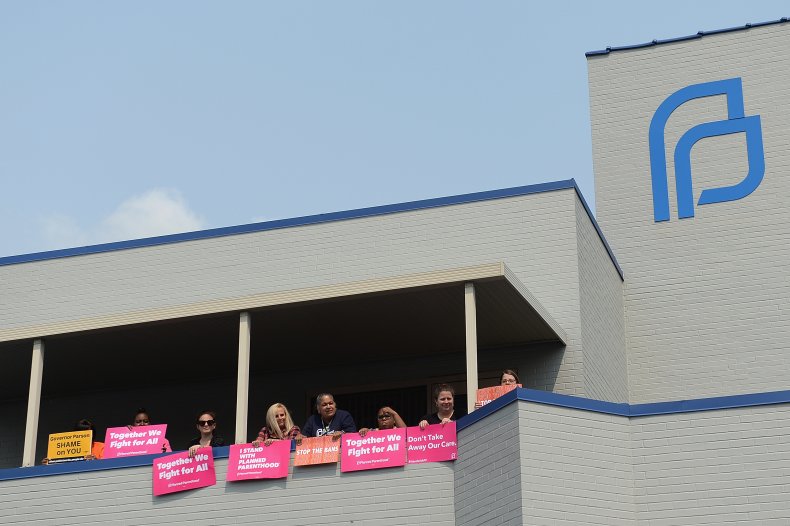
Demonstrators participate in a rally held outside a Planned Parenthood in St. Louis, Missouri, in May 2019. A new report from global reproductive care organization Marie Stopes International estimated at least 1.5 million additional women will undergo unsafe abortions as a result of services lost due to the novel coronavirus pandemic.MICHAEL THOMAS/GETTY
The pandemic has affected a number of leading reproductive care organizations. Planned Parenthood, the largest reproductive health care provider in the United States, shifted many of its services to prioritize remote consultations as clinics closed earlier this year.
“This global health crisis has highlighted the reality that sexual and reproductive health care is essential and time-sensitive,” Dr. Krishna Upadhya, a senior medical advisor at Planned Parenthood, said in a statement sent to Newsweek.
“Even as some state politicians use the COVID-19 pandemic as an excuse to attack safe, legal abortion, Planned Parenthood has adapted quickly to ensure patients can still access critical care and information, while keeping both patients and health center staff safe,” Upadhya added, referencing the wave of state regulations blocking abortion access during the COVID-19 outbreak.
Some Planned Parenthood sites cut hours or suspended walk-in appointments as the national outbreak persisted, while others closed entirely and began referring patients to different locations or providers instead. The organization outlines procedures still offered and shares resources about how and where to receive contraception and safe abortion services in guidance shared to its website.
August 24, 2020
Types of Abortion: A Judgment-Free Breakdown
Posted by laurasmith20200 under Abortion Information | Tags: Abortion, Abortion Rights, reproductive rights |Leave a Comment
Abortion. Almost everyone has strong feelings about it. No matter what your beliefs are, it’s important to know the facts. Here’s everything you need to know about the different types of abortion, along with important resources.
- About 862,320 abortions were performed in the United States in 2017.
- The ratio of abortions to live births was 186 to 1,000 in 2016.
- 1 in 4 women will have an abortion before they’re 45, according to 2014 statistics.
- In 2014, 51 percent of women who had abortions had used a form of birth control. The most common birth method was condoms, at 24 percent. Accidents happen.
In the United States, abortions are legal during the first and second trimesters. They’re not offered during the third trimester unless the woman’s or fetus’s life is in danger.
Most abortions occur during the first trimester. The rules get more complicated during the second trimester. Some states allow abortions up to the 24th week of pregnancy. Other states ban it after 20 weeks.
A pregnancy is broken up into three trimesters:
- First trimester: Weeks 1 to 12
- Second trimester: Weeks 13 to 27
- Third trimester: Weeks 28 to delivery (usually about 40 weeks)
There are multiple safe forms of abortion available. The kind you get depends on your stage of pregnancy, local laws and resources, and other important factors.
- Medical abortion
- Surgical abortion
- Induction
You can have a medical abortion until the 10th week of pregnancy.
A lot of people call this the “abortion pill.” You take the medications mifepristone (Mifeprex) and misoprostol (Cytotec). The two work together to end the pregnancy.
Mifepristone blocks the hormone progesterone, preventing the embryo from implanting or growing. Misoprostol makes the uterus contract, pushing out pregnancy tissues.
Your doctor may not recommend this method if you:
- are on blood thinners
- have a bleeding disorder
- have an intrauterine device (IUD)
- have kidney, liver, or lung disease
- are taking a corticosteroid medication
- are experiencing an ectopic pregnancy (when the embryo implants outside the uterus)
Procedure
A medical provider gives you mifepristone, which you usually take in their office. Then they prescribe misoprostol, which, in most cases, you can take at home. You can either swallow the pills or insert them into your vagina.
Recovery
In many cases, this method works within about 4 hours, but it can take up to 2 days. You may want to take some time off from work due to the possible side effects. You should expect heavy cramping and bleeding 1 to 4 hours after taking misoprostol.
Additional symptoms include:
- headache
- sweating
- dizziness
- tiredness
- nausea and vomiting
- diarrhea
- passing of small blood clots
Afterward:
- Don’t have sex for a week or two.
- Your period should go back to normal within 4 to 6 weeks.
- You’ll start ovulating in about 3 weeks.
- It shouldn’t hurt your chances of getting pregnant in the future.
Cost
The cost of a medical abortion varies from place to place. On average, it ranges from $300 to $800, and some insurance plans will cover the cost.
MTX can be used in the first 7 weeks of pregnancy.
Methotrexate is a cancer drug that stops cancer cells from growing, and it can also stop embryo cells from multiplying. Misoprostol works by contracting the uterus, helping it release its contents.
MTX takes longer to work than mifepristone and misoprostol, and it’s almost never used for planned abortions. It’s mainly used to end a pregnancy that’s outside the uterus — an ectopic pregnancy can be life threatening.
Don’t use methotrexate and misoprostol if you:
- have an IUD
- take blood thinners
- are severely anemic
- have issues with blood clots
- have seizures more than once a week
- have kidney, liver, or inflammatory bowel disease
Procedure
An MTX abortion is broken up into two phases. First, you take methotrexate at the doctor’s office or clinic as a pill or shot. Then, you take misoprostol pills 4 to 6 days later. You can take them at home, either orally or by inserting them into your vagina.
The abortion starts within 1 to 12 hours after you take the meds. Research from the 1990s suggests that this method of abortion is more than 90 percent effective, but if it doesn’t work, you might need a surgical abortion.
Recovery
You may need to take a few days to reset after this procedure. Bleeding usually lasts 4 to 8 hours and can be heavy.
Possible MTX side effects are:
- chills
- diarrhea
- dizziness
- headache
- bad cramps
- low grade fever
- nausea and vomiting
Afterward:
- Wait a week or two to have sex.
- Your period should return in a month or two.
- It shouldn’t hurt your chances of getting pregnant in the future.
Cost
Methotrexate and misoprostol can cost anywhere from $300 to $1,000, and some insurance companies cover it.
Vacuum aspiration (aka suction aspiration) can be performed during the first 16 weeks of pregnancy.
Some folks choose this method as option A, but others may fall back on it if a medical abortion has failed.
Procedure
A doctor uses suction to gently remove the fetus and placenta from your uterus. You might feel some cramping, because your uterus will contract during the procedure.
You can get a vacuum aspiration at a doctor’s office, clinic, or hospital. The procedure usually takes only 5 to 10 minutes, but you might be asked to stay at the clinic for a few hours to make sure your body is bouncing back the way it should.
Your doctor may need to perform this procedure in a hospital if you have:
- a pelvic infection
- a history of blood clots
- serious health problems
- an unusually shaped uterus
Recovery
The procedure itself shouldn’t be painful. But discomfort is normal during the healing process.
Side effects can include:
- cramps
- nausea
- sweating
- dizziness
- bleeding or spotting
Afterward:
- Avoid sex for at least a week.
- Your period should return in 4 to 6 weeks.
- It shouldn’t hurt your chances of getting pregnant in the future.
Cost
The price of suction aspiration ranges widely, depending on location and stage of pregnancy. Some insurance plans will cover some or all of the cost.
Your privacy is important to us. Any information you provide to us via this website may be placed by us on servers located in countries outside of the EU. If you do not agree to such placement, do not provide the information.
D&E is used after the 14th week of pregnancy.
This method is recommended for those who were delayed in getting another type of abortion. It’s often used in situations where the fetus has a medical problem or severe abnormality.
Procedure
D&E is a combo of forceps, vacuum aspiration, and dilation and curettage (D&C).
Here’s what happens: Your doctor widens (dilates) your cervix to make it easier to remove the tissue. The next day, they use forceps to remove more tissue and placenta. They may also use suction. Then they use a scoop-like tool (a curette) to gently scrape the uterine lining.
This procedure has to be done in a hospital or medical clinic. It can be painful, but your doctor can give you a numbing medication to prevent extreme discomfort.
The procedure itself takes less than 30 minutes, and you can go home the same day. But usually you’ll rest in the office for a few hours after the procedure.
Recovery
D&E recovery will typically take longer compared to other abortion types. If you can, you may want to take a few days off from work. Side effects can last for 2 weeks after the procedure.
Symptoms can include:
- nausea
- bleeding
- cramping
Afterward:
- Don’t have sex for at least 2 weeks.
- Avoid intense exercise for at least 1 week.
- Your period should return in 4 to 8 weeks.
- Ask your doc how long you should wait to try to conceive again.
- It shouldn’t hurt your chances of getting pregnant in the future.
Cost
A D&E abortion can cost $1,500 or more, depending on where you’re having it done and how far along you are. Some health insurance plans will cover some or all of the cost.
An induction abortion is done during the second trimester.
Induction abortion might be an option if you’re past 24 weeks and you can’t get a D&E, but it’s rarely used in the United States.
Procedure
Your doctor gives you a medication that puts you into labor. This makes your uterus contract and release the fetus. Your doc may also use a curette to gently remove tissues from your uterus.
Induction abortions are done only in hospitals or specialized clinics, and they can last several hours or even a day from start to finish.
You’ll most likely be given sedatives or an epidural for this type of procedure, as intense cramps and discomfort are common.
Recovery
You might have cramps and feel uncomfortable for a day or two. You’ll likely want take some time off from work, if you can.
Side effects from an induction abortion can include:
- nausea
- vomiting
- diarrhea
- pain
- bleeding
- cramping
- chills
- headache
Afterward:
- Avoid sex for 2 to 6 weeks. The exact timing depends on how far along you were and other medical factors.
- Don’t do heavy exercise for 2 weeks.
- Your period should come back in 4 to 8 weeks.
- Ask your doc before trying to conceive again.
- It shouldn’t hurt your chances of getting pregnant in the future.
Cost
This procedure is done when you’re further along, so it will be more expensive than other abortion types. It can cost $3,000 or more, but some health plans will cover some or all of the cost.
“Later-term abortion” can mean different things to different people. Some consider an abortion later-term when it’s performed after the 20th week of pregnancy. Others believe it’s only considered later-term when it’s done during the third trimester.
Most states ban or restrict later-term abortions. They’re rare in the United States but may be necessary for many reasons.
You can get two types of abortion in the third trimester — induction abortion and D&E.
Some good news: Complications from later-term abortion are rare. The procedure shouldn’t hurt your chances of conceiving in the future.
The morning-after pill (e.g., Plan B) is a type of emergency contraception, not a type of abortion. You can take the morning-after pill up to 5 days after unprotected sex. It prevents pregnancy and won’t end an existing pregnancy.
You can get the morning-after pill at most pharmacies and family planning clinics without a prescription, and there’s no age requirement to buy it.
An abortion ends a pregnancy, but you’ll likely be able to get pregnant again. Talk to your doctor about contraception choices, since there are many options out there. You’ll find a method that works for you.
Abortion is legal is every state, but that doesn’t mean it’s always easy to find a provider. Not all doctors offer abortion services.
There’s a chance you’ll have to travel to another state. To date, 45 states allow individual healthcare providers to refuse an abortion. Forty-two states allow institutions to refuse the service.
The Guttmacher Institute can help. They keep an updated list of abortion laws in each state.
If you’re in the U.S., you can give Planned Parenthood a call. Their website offers lots of resources, and they can help you find your closest location.
You can also search for an abortion provider using these resources:
Mental health resources
It’s normal to feel a lot of different emotions before or after an abortion. Don’t let anyone tell you how you should feel. You can’t prevent other people from judging, but you don’t have to judge yourself.
Talk to a therapist, psychologist, or social worker if you’re having a tough time after your abortion. If you’d feel more comfortable, you can reach out to an organization that will have your back.
Some supportive groups include:
Choosing to have an abortion can bring on many different emotions, and sometimes an emergency situation may leave you feeling like you don’t have much choice.
Remember:
- You know yourself best.
- You know your situation best.
- You know your life goals best.
Don’t feel obligated to share your abortion with friends or family if you don’t want to. There are tons of resources available that will help you get through it. Please be kind to yourself. And remember, you’re not alone. ❤️
August 23, 2020
Rise in Teenage Pregnancies in Kenya Linked to COVID-19 Lockdown
Posted by laurasmith20200 under Abortion Information | Tags: Abortion, Abortion Rights, reproductive rights |Leave a Comment
Movement restrictions and school lockdowns make it harder for girls to access sexual health care.
![]()
Over a period of three months in lockdown due to COVID-19, 152,000 Kenyan teenage girls became pregnant — a 40% increase in the country’s monthly average. These numbers, from early July, are some of the earliest pieces of evidence linking the COVID-19 pandemic to unintended pregnancies.
Public health officials and women’s rights advocates worry that the ongoing pandemic is delaying an adequate response to a growing sexual reproductive health crisis.
One survey conducted by the Kenya Health Information System found that 3,964 girls under the age of 19 were pregnant in Machakos County alone.
And new data from the International Rescue Committee found that girls living in refugee camps have been particularly affected.
While only eight cases of teenage pregnancy were reported in June 2019 at Kakuma refugee camp in the northwest of the country, 62 pregnancies were recorded in June 2020. At Dadaab refugee camp, there was a 28% increase in reported teenage pregnancies during the April-June period, compared to the same period last year.
When Kenya introduced strict preventive measures to try to contain the spread of the coronavirus in April — including restricting movement and closing schools — accessing sexual and reproductive health services became much harder.
Dr. Manisha Kumar, head of the Médecins Sans Frontières (MSF) task force on safe abortion care, recently spoke about how the pandemic is affecting sexual reproductive health during an online press conference.
“During the pandemic, a lot of resources got pulled away from a lot of routine services and care, and those services were redirected to coronavirus response,” Kumar said.
Because hospitals and health care facilities are focusing primarily on the threat posed by COVID-19, there are often not enough resources or personnel to continue to offer reproductive health care.
“The collateral damage of taking that kind of approach is when we shut down these routine services, we saw an increase in maternal and child death, from preventative causes,” Kumar said.
In April, the United Nations Population Fund warned that lockdown-related disruptions could leave 47 million women in low- and middle-income countries without modern contraceptives, resulting in 7 million additional unintended pregnancies.
The World Health Organization reports that complications during pregnancy and childbirth are the leading cause of death for 15- to 19-year-old girls and women globally — 99% of those deaths occur in low- and middle-income countries. Further, teenagers who give birth often face higher rates of poverty and domestic violence later in life due to misogynistic cultural norms and threadbare social safety nets.
The COVID-19 pandemic is an especially dangerous time for teenage pregnancies because of the growing economic, hunger, and health crises worldwide.
“It is alarming that so many teenage girls have fallen pregnant during lockdown, which can have lifelong consequences for them,” Kate Maina-Vorley, Plan International Kenya’s country director, said in a statement.
Plan International is now calling on governments around the world to incorporate sexual health planning as a part of COVID-19 response plans.
The organization is also exploring new ways to distribute sexual and reproductive health education online through social media and via telehealth platforms amid the pandemic.
Source: https://www.globalcitizen.org/en/content/rise-in-teenage-pregnancies-during-kenya-lockdown/
August 22, 2020
Proposed abortion restrictions hit snag in Nebraska
Posted by laurasmith20200 under Abortion Information | Tags: Abortion, Abortion Rights, reproductive rights |Leave a Comment
On July 29, a filibuster stopped an abortion bill that would outlaw a common second-trimester abortion procedure. Supporters will need a 33-vote super-majority of support to overcome the filibuster at a later date or the bill will effectively die. (Getty Images){/p}
LINCOLN, Neb. — A proposal to outlaw a common second-trimester abortion procedure has hit a snag in the Nebraska Legislature, leaving its prospects unclear.
Opponents used a filibuster to keep the measure from coming to a vote Wednesday after the allotted three hours of debate.
Supporters now have to show that they have a 33-vote super-majority of support necessary to overcome the filibuster at a later date.
If they don’t, the bill will effectively die this session.
The measure appears to have support from a majority of the Legislature’s 49 senators.
The abortion bill would ban dilation and evacuation abortions.
August 21, 2020
Democrats Love Abortion and Care About the Courts—or So I’m Told
Posted by laurasmith20200 under Abortion Information | Tags: Abortion, Abortion Rights, reproductive rights |Leave a Comment
Democrats couldn’t bring themselves to say “abortion” or talk about the federal courts during their convention this week.

It’s not just disappointing that Democrats failed to highlight abortion rights, the federal courts, and how the two go together. It’s political malpractice.
Olivier Douliery/AFP via Getty Images
Political conventions are strange beasts. They are spaces where intraparty wrangling for influence among elected officials gets broadcast alongside entertainers and activists tasked with appealing to both progressives and centrists.
That sounds miserable, honestly.
But the people who love conventions really love conventions, and while I don’t share that enthusiasm, I will give the Democrats credit for pulling off a solid convention this week.
The COVID-19 pandemic upended the Democratic National Convention, as it has upended just about everything in this country, and the Democrats responded by taking their convention virtual. It worked, and they should never go back.
I had braced for a webinar, but the organizers pulled off an often engaging, sometimes weird, and frequently earnest show. Former first lady Michelle Obama’s speech was intimate and conveyed the urgency of this election. That sentiment would have been lost in a convention hall broadcast, no matter how tightly the camera cropped on her face.
Democrats’ insistent and exhausting appeal to bipartisanship produced a weird moment where the rabidly anti-choice former Ohio Gov. John Kasich (R) was perhaps staged to look like he was standing at the crossroads … of a crotch? Who’s to say? It was weird, and, also, Democrats don’t need to give a platform to politicians committed to attacking Democrats. However. Democrats should always and forever do the roll call of states like this. What a beautiful homage to the diversity and dorkiness in this country! It was the DNC’s version of Walt Disney’s “It’s a Small World,” and they crushed it
And that’s what makes their failure to feature abortion rights and the federal courts—hell, to even mention them in more than a passing fashion—such a disappointment. They were making some magic out of this pandemic convention and whiffed it here.
Did the Democrats talk about health care? A whole bunch!
But did the Democrats talk about the pending Supreme Court case where down-ballot Republican senators and President Donald Trump have asked the Court to take away health insurance for tens of millions of people in the middle of a pandemic? Did the Democrats mention abortion in the list of political attacks on health care? Not so much.

On the one hand, the Democrats are just bad at this stuff. Even though abortion is a winning issue for voters, they just won’t say the word when mic’d.
That will not be the case Monday when the Republican convention starts. New York archbishop and abortion foe Cardinal Timothy Dolan will open the Republican convention with a prayer, while anti-choice activist Abby Johnson and Nicholas Sandmann are slated to speak. When he was in high school, Sandmann got into an altercation with Native American elder Nathan Phillips at the Lincoln Memorial while on a trip with his classmates for the 2019 March for Life. That dude. The Republicans are bringing in THAT DUDE to speak because abortion.
For a brief moment, it looked like Democrats had gotten the message, too. At the 2016 convention, NARAL Pro-Choice America President Ilyse Hogue shared her abortion story in a convention room filled with energized supporters who understood that a Trump presidency would mean a direct attack on legal abortion. They were right! So why did Democrats stay basically silent on the issue of abortion this week?
It’s not just disappointing that Democrats failed to highlight abortion rights, the federal courts, and how the two go together. It’s political malpractice.
As nominee for vice president, Democrats have Kamala Harris, who has both a strong record on abortion rights and the ability to connect the dots for voters on abortion and the courts. Remember this exchange with Supreme Court Justice Brett Kavanaugh in 2018? Abortion saw its only real mention at the convention during her acceptance speech Wednesday night. Where were the rest of the Democrats on this issue?
Exit polling from the 2016 election showed many conservatives voted for Trump because of the federal courts, identifying the Supreme Court as the “most important factor” in determining who would get their vote. And Trump has responded accordingly, moving at lightning speed to nominate over 200 federal judges and all but completely capturing the courts for conservatives for a generation.
These are not your father’s conservative judges, either. Trump judges are younger, less experienced, and more radical and regressive than their predecessors. They are ideologues and activists, and if Democrats win the presidency in November, and especially if Democrats take back the Senate as well, we can expect those Trump appointees to do their damndest not just to gum up a Biden-Harris political agenda, but to also stan for conservatives on every culture war issue that lands before them. Abortion. LGBTQ rights. Voting rights. Immigration. The list continues.
We can and should expect these Trump judges to do everything they can to stymie progress and actually push this country back. These judges won’t say that Brown v. Board of Education, the case that ruled racial segregation in public schools unconstitutional, was rightly decided. Do we really think they’ll hold law enforcement officers accountable for killing Black folks or rule in favor of voting rights?

And as soon as Republicans started worrying about the outcome of the 2020 election, what happened? They started talking about abortion and the federal courts.
Professor Melissa Murray points out that the Democrats’ failure to prioritize reforming the federal courts could doom any electoral successes they may eventually come by in November. She’s right.
“Speeches about courts may not make for good television (though you don’t know until you try). But the courts may determine the fate of the issues at the heart and soul of the Democratic Party,” Murray wrote for the Washington Post.
Democrats ended up pulling off a convention full of digital content—some of it really good!—even if that wasn’t their original plan. By necessity they ended up with oodles of material that can be sliced and diced for ads in what will undoubtedly be the electoral push of a lifetime for many of us. Imagine if had Democrats had also managed to weave abortion into a list of the critical health-care services under assault by Republicans and the Trump administration. Imagine if they had taken that first step from 2016 of saying abortion on the convention stage and run with it, making the case for reproductive autonomy and freedom that is so central to their entire platform.
Imagine how far that could go in further reducing the stigma around abortion that results in laws like “abortion reversal” legislation. “Abortion reversal” is all the rage with anti-choice activists because it enshrines junk science that claims to be able to interrupt or “reverse” a medication abortion and perpetuates the dangerous and largely made-up “abortion regret syndrome.” Abortion regret syndrome is not a real thing. Former Supreme Court Justice Anthony Kennedy made it up in 2007 to justify upholding an otherwise unconstitutional abortion ban in Gonzales v. Carhart. Imagine if Democrats had used some of their time this week to tie abortion to the federal courts in any meaningful way.
The issue of abortion, the reality of abortion, extends well beyond the courts. Imagine if Democrats had told the story of Louisiana, where a big abortion rights win at the Supreme Court didn’t really change much. Imagine if Democrats had zoomed in on Black maternal mortality rates in the state, an issue Harris has spoken about in her career. Imagine if they talked about the Republican politicization of the COVID-19 pandemic to restrict abortion access, as the country reaches 200,000 deaths from the virus. Or the fact that Louisiana’s minimum wage remains at the federal floor of $7.25 an hour—for those fortunate enough to still have a job right now.
Maybe speeches about courts would make terrible television. Even so, Democrats have a compelling and winning story to tell on abortion, and one that reflects the reality of where abortion lands in people’s lives—at the intersection of all their identities. Massachusetts Sen. Elizabeth Warren’s rallying cry that child care is “infrastructure for families” belongs in the same breath as a rallying cry for abortion access, just as speeches about the critical importance of the Affordable Care Act need to explain to voters the decades-long campaign by Republicans to repeal it in the courts because they didn’t have the spine—or the vote—to repeal it in public.
Conventions are the spaces where policy meets the public, and for all the wins this week, Democrats missed a critical opportunity to make their case to voters that abortion is health care and the federal courts matter. I doubt Republicans will make the same mistake next week.
August 20, 2020
Where Kamala Harris Stands on Abortion
Posted by laurasmith20200 under Abortion Information | Tags: Abortion, Abortion Rights, reproductive rights |Leave a Comment
She and Biden have clashed on the subject.
Joe Biden’s choice of Kamala Harris as his VP pick means that Harris could be the first female and first Black vice president—and that alone should inspire you to vote this November. The California senator, who was running in the Democratic presidential race before dropping out in December and being tapped by Biden as his VP, has long been vocal about many key issues, including abortion and women’s reproductive health care.
Abortion has been a hot-button issue in this country for what feels like forever, and everyone has opinions on it—but you might be wondering where Harris stands on the subject. Let’s dive in, shall we?
Harris wants to repeal the Hyde Amendment.
Along with numerous other Democrats, Harris has pushed to repeal the Hyde Amendment, which blocks federal Medicaid funding for abortion services unless the person’s continued pregnancy will put their life in danger or the baby is the product of rape or incest.
During a July 2019 debate, Harris challenged Biden on his record on the Hyde Amendment. The presidential nominee, known for backing the amendment, suddenly changed his mind in June.
“You made a decision for years to withhold resources to poor women to reproductive health care, including women who were the victims of rape and incest,” said Harris to Biden. “Do you now say that you have evolved, and you regret that?”
The decades-old ban affects people with low incomes, people of color, young people, immigrants, and anyone else who relies on Medicaid for healthcare coverage. To put it into perspective, Medicaid provides coverage to 1 in 5 women between the ages of 15-44.
(You can go to allaboveall.org to learn how you can take action, btw.)
Major pro-choice organizations are backing Harris.
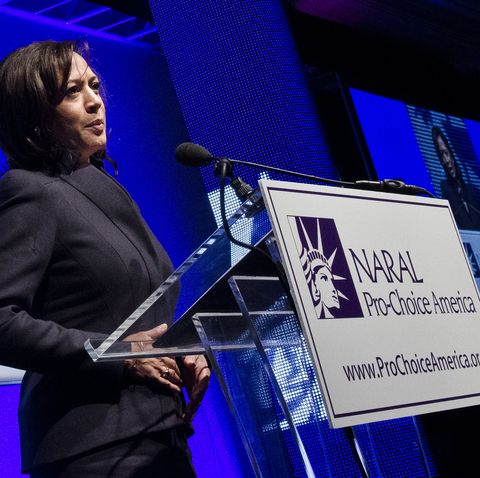
While in the U.S. Senate, Harris maintained a 100 percent rating from the reproductive rights group NARAL. According to NARAL’s website, they highly rate “candidates who make women’s health care, including abortion access, a priority.”
Harris has also received support from Emily’s List, an organization dedicated to getting pro-choice women elected to office. Its president, Stephanie Schriock, even made a statement when Harris’ ended her campaign for president, saying:
“Kamala Harris is a fighter for the people, and she carried that grit throughout her presidential campaign. Her historic presence in the race—as one of the few women of color to run for president in history—brought a critical perspective and voice to conversations about America’s future.”
Harris co-sponsored the Women’s Health Protection Act.
Harris has continued to be vocal about the Women’s Health Protection Act, which is similar to the Voting Rights Act but geared towards abortion access. If the Act passed, states would have to get pre-clearance from the federal government before implementing more abortion-based restrictions in their states and counties.
In May 2019, Harris spoke about the act at town hall event, saying, “Are we going to go back to the days of back-alley abortions? Women died before we had Roe v. Wade in place. On this issue, I’m kind of done.”
If passed, the act could stop legislation like the “fetal heartbeat” bill, which bans abortion once a fetal heartbeat is detected. (Tennessee lawmakers passed their version of this in June.) Sometimes, a heartbeat can be detected as early as six weeks into a pregnancy—before many people know they’re pregnant.
Forty-three other senators currently co-sponsor the Women’s Health Protection Act.
August 19, 2020
Brazil: outcry as religious extremists harass child seeking abortion
Posted by laurasmith20200 under Abortion Information | Tags: Abortion, Abortion Rights, reproductive rights |1 Comment
Ten-year-old girl was forced to fly more than 900 miles to north-eastern city of Recife for the procedure after being raped

A man walks in front of a graffiti of pregnancy on an overpass in Recife, Brazil, 4 February 2016. The graffiti reads, ‘We all have a right to live’. Photograph: Ueslei Marcelino/Reuters
Scores of Brazilian women have taken to the streets to protect a 10-year-old child who was being persecuted by religious extremists for trying to legally undergo an abortion after being raped, allegedly by her uncle.
The girl, from São Mateus, a small town in the south-eastern state of Espírito Santo, was admitted to hospital on 7 August complaining of abdominal pain and doctors confirmed she was pregnant.
The child told police she had been abused by her uncle since age six and had stayed silent out of fear. The 33-year-old man is reportedly on the run.
Brazil’s highly restrictive abortion laws – largely written in 1940 – permit terminations in cases of rape, when the mother’s life is at risk and when the birth defect anencephaly is detected.
Yet despite this, the child was forced to fly more than 900 miles to the north-eastern city of Recife for the procedure, following a highly politicized legal battle which saw one hospital in the girl’s home state refuse to treat her.
When the girl reached the hospital where the termination was to be performed on Sunday afternoon, its entrance had been occupied by far-right anti-abortion activists and politicians who were filmed hurling abuse at hospital staff and the child, and trying to stop them entering.
“When you see a 10-year-old girl being criminalized for terminating a pregnancy resulting from rape and because her life is in danger, it really gives you a sense of how religious fundamentalism is advancing in our country,” said Elisa Aníbal, a Recife-based feminist campaigner.
The activists appear to have discovered the hospital’s location, which was kept secret for security reasons, from a hardcore supporter of Brazil’s far-right president, Jair Bolsonaro.
In an online video, which was later deleted but the Guardian has seen, the pro-Bolsonaro extremist Sara Giromini names the girl and falsely claims authorities had kidnapped her and chartered a private jet to transport her to the termination.
“This is an extremely serious human rights violation!” claims Giromini, brandishing a plastic doll she alleged was the size of the fetus.
It’s just unbelievable this is happening in Brazil, that part of the population really believes abortion is worse than rape
Until last year Giromini worked for Bolsonaro’s minister for women, family and human rights, a conservative evangelical pastor called Damares Alves. The two women appear together in a widely circulated campaign video in which Alves boasts: “Sara is more than my comrade in this struggle to defend life and the family – Sara is like my daughter.”
Paula Viana, a pro-choice activist who escorted the girl from Recife’s airport to the hospital, said she had been warned anti-abortion activists lay in wait as they drove there in a taxi. They stopped the car, hid the girl in its boot and smuggled her into the building through a side-door.
“It’s just unbelievable this is happening in Brazil, that part of the population really believes abortion is worse than rape,” said Viana from the women’s rights group Curumim. “But we weren’t surprised because we know we have a president who is supportive of these shows of hatred.”
As word of the anti-abortion ambush spread among Recife’s feminist community, activists flocked to the hospital to defend the girl’s right to a termination she had requested.
“We realized we needed reinforcements,” said Aníbal, from the Fórum de Mulheres de Pernambuco group, who summoned supporters on social media.
“By the end of the day there were more than 150 people there supporting that girl … women, trans people, black people, young people … and when we looked at the other group they were mostly old white men in suits, with just few women among them.”
Footage that went viral on social media showed the women challenging the fanatics with a call-and-response battle cry that recalled the Chilean anti-rape anthem A Rapist in Your Path.
“This child fell pregnant after being raped and these fundamentalists are here to say that her life doesn’t matter,” the women chanted. “We’re here to say that our lives do matter.”
Debora Diniz, a reproductive rights campaigner who has championed the girl’s cause, said she had been moved by the “beautiful” rally.
Diniz, who lives in exile because of death threats, called Sunday’s standoff the perfect portrait of Bolsonaro’s Brazil: a “hurricane of hatred” colliding with determined, non-violent feminist resistance.
Gabriela Rondon, a lawyer from the pro-choice group Anis, said the extremists’ widely condemned behaviour had inadvertently boosted the debate about decriminalizing and legalizing abortion.
“Brazil’s laws are clearly inadequate and put millions of women at risk. According to our figures half a million women must subject themselves to illegal abortions each year,” Rondon said. “That’s almost one woman per minute.”
Despite the horrific circumstances, Rondon said Sunday’s demonstration “brought us real encouragement”. “A crowd of women protecting a young girl – it gives us such great hope of change.”
Viana said the girl had said she was desperate to get back to playing football. “She is very strong – but she is just a child … She will need long-term psychological support. She understands everything that she is going through.”