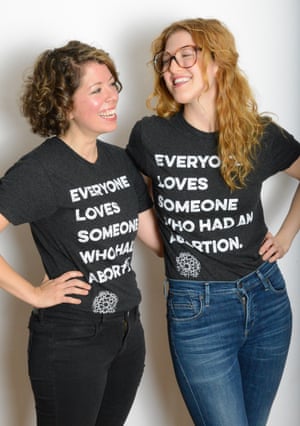
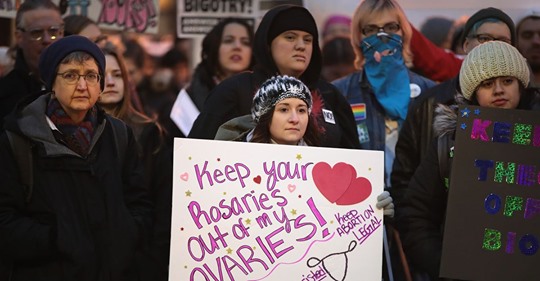
Maine Democratic Gov. Janet Mills signed a bill on Monday authorizing two non-doctor categories of medical professionals to perform abortions.
June 12, 2019
Maine governor signs law expanding medical professionals allowed to perform abortions
Posted by laurasmith20200 under Abortion Information | Tags: Abortion, Abortion Rights, reproductive rights |1 Comment
June 11, 2019
A Michigan hotel is offering free accommodations for anyone traveling for an abortion
Posted by laurasmith20200 under Abortion Information | Tags: Abortion, Abortion Rights, reproductive rights |1 Comment
In recent months, states across the country have been passing laws designed to make it harder — and in some cases, nearly impossible — to get an abortion.
June 9, 2019
Why the Guardian is changing the language it uses to describe abortion bans
Posted by laurasmith20200 under Abortion Information | Tags: Abortion, Abortion Rights, reproductive rights |Leave a Comment
New style guidance encourages editors to avoid medically misleading terms like ‘heartbeat bill’ in reference to restrictive abortion laws sweeping the US
The Guardian will no longer use the term “heartbeat bill” in reference to the restrictive abortion bans that are moving through state legislatures in the US.
Editors and reporters are encouraged to use the term “six-week abortion ban” over “fetal heartbeat bill”, unless they are quoting someone.
“We want to avoid medically inaccurate, misleading language when covering women’s reproductive rights,” the Guardian’s US editor-in-chief, John Mulholland, said. “These are arbitrary bans that don’t reflect fetal development – and the language around them is often motivated by politics, not science.”
The Guardian style guide already encourages editors to use “anti-abortion” over “pro-life” for clarity, and “pro-choice” over “pro-abortion”, since not everyone who supports a woman’s right to reproductive choice supports abortion at a personal level.
The Guardian’s updated style guide on abortion bans is in line with the view of the American College of Obstetricians and Gynecologists, the largest professional organization for doctors specializing in women’s health.
ACOG, which represents 58,000 physicians, says the term “heartbeat bill” is not medically accurate.
“Pregnancy and fetal development are a continuum,” said the ACOG president, Dr Ted Anderson. “What’s interpreted as a heartbeat in these bills is actually electrically induced flickering of a portion of fetal tissue that will become the heart as the embryo develops.”
Some doctors who opposed the bans say the term was developed as political tactic to win support for the bills.
“These bills present the idea that there’s something that looks like what you or a person on the street would call a baby – a thing that’s almost ready to go for a walk,” said Dr Jen Gunter, a gynecologist in Canada and the US who runs an influential blog. “In reality, you’re talking about something that’s millimeters in size and doesn’t look anything like that.”
The Guardian’s updated style guide comes as a wave of restrictive abortion bans are sweeping the US: between 1 January and 20 May, 378 abortion restrictions were introduced across the United States. An unprecedented 40% of them have been abortion bans that prohibit terminations after a certain gestational age or for another specific reason, according to the Guttmacher Institute.
Many of those measures ban abortion after about six weeks, before most women know they are pregnant.
Despite the laws, abortion is legal in all 50 US states because the bans contravene Roe v Wade, the landmark decision which legalized abortion in 1973. The laws are all expected to be challenged in court and are unlikely ever to go into effect. Supporters hope the bills will make it to the US supreme court and force a challenge to Roe.
June 7, 2019
Margaret Atwood says it’s “a form of slavery to force women to have children they can’t afford”
Posted by laurasmith20200 under Abortion Information | Tags: Abortion, Abortion Rights, reproductive rights |1 Comment
Margaret Atwood has an eerie prediction about the outcome of abortionrestrictions, one that bears an uncanny resemblance to the dystopian future depicted in her hyper-relevant novel, The Handmaid’s Tale.
Speaking at New York City’s Book Con on Saturday, Atwood argued that when states obligate women into childbearing, they institute “a form of slavery,” Insider reported. State-mandated reproduction has two outcomes, she said: That women die, and that orphanages fill up.
Atwood referred specifically to Texas, where Gov. Greg Abbott is poised to sign Senate Bill 8. The legislation not only requires abortion providers to bury or cremate fetal remains, but also bans the most common second trimester abortion procedure — dilation and evacuation — as well as dilation and extraction, the typical procedure for late-term abortions. Dilation and extraction abortions are, generally speaking, only performed when the mother’s life or health is in danger.
“I’m waiting for the first lawsuit,” Atwood said, explaining that she expected families of women who died to sue the state. “I’m also waiting for a lawsuit that says if you force me to have children I cannot afford, you should pay for the process,” she added.

Author Margaret Atwood speaks after being introduced for the Ivan Sandrof Lifetime Achievement Award at the National Book Critics Circle awards ceremony on Thursday, March 16, 2017.
Texas’ long-fought war on abortion access correlates with two trends that bear out Atwood’s theory: Since the Lone Star State began purposefully funneling federal money away from abortion providers in 2011, both maternal mortality rates and birth rates have spiked, mostly among women who rely on government funds to get medical care.
The reality of Texas’ abortion restrictions, Atwood said, is state-mandated reproduction without a safety net — and that’s a problem:
They [Texas] should pay for my [a woman’s] prenatal care. They should pay for my, otherwise, very expensive delivery, you should pay for my health insurance, you should pay for the upkeep of this child after it is born. That’s where the concern seems to cut off with these people. Once you take your first breath, [it’s] out the window with you. And, it is really a form of slavery to force women to have children that they cannot afford and then to say that they have to raise them.
Her assessment looks a lot like the picture painted in Atwood’s 1985 novel,The Handmaid’s Tale. It’s currently experiencing a surge in popularity thanks to a Hulu show and a political climate in which abortion is demonized. Critics have drawn parallels between real life attacks on reproductive rights and female existence in the book’s fictional society, Gilead, where fertile women are conscripted as sex servants in the houses of powerful men. Their sole purpose is bearing children.
The difference between women in Gilead and women in Texas, though, is that the former are provided for. Atwood thinks Texas should, at the very least, do that.
“If you’re drafted into the army, the other situation in which the state seizes control of your body, at least you get three meals a day, clothing, and a place to sleep,” she said. “So, if you’re going to do that to women, pay up.”
June 6, 2019
Ctrl Alt Delete: the pro-choice comedy that’s the bravest TV show in America
Posted by laurasmith20200 under Abortion Information | Tags: Abortion, Abortion Rights, reproductive rights |Leave a Comment
They have been called ‘worse than Nazis’ for their abortion-clinic comedy. But for Roni Geva and Margaret Katch, the hate pales beside the outpouring of gratitude
The makers of Ctrl Alt Delete like to say it’s a typical workplace comedy. “But not your typical workplace,” says co-creator Roni Geva. “Do you come here often?” jokes a woman in the abortion clinic waiting room in the first episode, and from that moment they’re off – in short snappy episodes, the laughs come fast in this pro-choice comedy.
At a time when the debate around abortion in the US is reaching vitriolic and absurd levels – see last month when President Trump said women were giving birth and then deciding, with their doctor, whether to “execute” the baby, and the number of states seeking to restrict abortions, including Alabama’s ban last week – it seems right for a different, more humorous and human, approach.
The second season of Ctrl Alt Delete has just started, with two episodes released each week on Vimeo. The show is based on real stories, many of which happened to Geva the day she had an abortion. So there’s the doctor, played by Ed Begley Jr, who tells bad jokes; the counsellor who also supports the zero population growth movement; and the patient who is so regular at the clinic she says they keep a chair open for her, played by Naomi Grossman who was nominated for an Emmy for the role.
Its creators, Geva and Margaret Katch, met while working for a health company in Chicago in between acting jobs. They moved to Los Angeles within months of each other and decided to create their own work. Katch suggested they write something about abortion. “And I said ‘only if it’s funny’,” says Geva.

They had both terminated pregnancies years earlier. “I felt really alone when I found out I was pregnant,” says Katch. “The only stories I could find [online] were young women who were in this difficult decision, and ended up having the baby.” Katch says it wasn’t a difficult decision to choose an abortion. “That doesn’t mean the process was easy, but the decision was very clear to me right away. After the procedure I was so relieved – and there were no stories of people like me anywhere.”
Through social media, they found women all over the US to interview about their abortion experiences, and fictionalised versions make up the first season of Ctrl Alt Delete. There is the middle-aged mother of teenagers and the woman who has a one-night stand, the twentysomething whose contraception failed and the teenage girl who has a great relationship with her dad. It was important to show the range of experiences and reasons why some women decide to terminate a pregnancy, and to normalise it. “When it comes to destigmatisation of anything, comedy and storytelling have been at the forefront,” says Katch.
One of the usual narratives is that a woman who chooses an abortion must feel immense trauma, guilt and shame, but it was important to Katch and Geva to bust this trope. “Most women we talked to had zero guilt or shame and if they did, it was because other people made them feel that way,” says Katch. “Most women feel relief. That is really something we wanted to bring to light.”
They self-funded the first two episodes, then crowdfunded the rest. It was shot with an all-female crew. “There is a different energy on set when it is all women,” says Geva. “I had a couple of crew members come up to me and say ‘it is so cool that no one is yelling’.” One day on set, a bit of kit malfunctioned – so the director of photography and the gaffer and their respective teams sat together and worked out how to fix it. “What was amazing was every person would say ‘I have an idea, why don’t we try this?’” says Geva. “And their leaders would say yes. There was no ego. When I’ve told some male friends about this, they say if there were guys around they would be throwing their weight – or their titles – around. It was super collaborative, everyone listening and taking care of each other.”
The second season takes place over a whole day at the clinic. A suspected bomb in a pizza box provides the comedy – along with the unsettling reminder that abortion clinics in the US are regularly under threat from protestors. The bomb plot, too, came from a real-life story. But they also sensitively handle a late abortion, based on something a friend went through. “Those second trimester stories? I’ve never seen one of those on TV or in a movie,” says Geva. “If I have, it was never in a compassionate light. It was so important to us to include a story like that because that has been highly politicised, especially in the US right now. A lot of it is misinformation and we wanted to say ‘here’s a normal girl having a situation that is sad and hard’.”
Such is the toxicity of the debate in the US, both say their mothers were concerned they would be attacked because of the show’s subject matter. Were they worried? “Yes, in the beginning. We definitely girded our loins,” says Katch. And there have been many abusive messages. They haven’t had explicit death threats but, says Katch, “we have been told we’re worse than Nazis and we should die.”

One night recently, Geva was driving to an event when Katch called and said Glenn Beck, the rightwing radio talkshow host, was discussing them on his show. “I had to pull over because my hands were shaking,” says Geva. “Lots of people on the other side of the aisle listen to Glenn Beck and they’re not interested in watching our show, they’re just interested in yelling about the fact our show even exists. They came out in droves and sent lots of hate mail on social media.”
Katch says they were “prepared for an onslaught of hate and we were so surprised that in general the response has been incredibly positive. The hate has paled in comparison to the appreciation and gratitude, and the relief that stories like this are being told.”
They would love to take the show to a wider audience, but that relies on getting picked up by a big studio. Do they get the sense TV executives are nervous? “Definitely,” says Katch. Geva says “They don’t want to lose advertising. However, in the world of digital platforms, abortion is becoming part of the storytelling zeitgeist.” She points to the show Shrill, based on the memoirs of writer Lindy West, in which the main character has an abortion in the first episode, and there have been other recent examples of stories of abortions being told in different – often matter-of-fact, normalising ways – including in Scandal and Jane the Virgin.
“I feel like we’re at a tipping point where some executive somewhere is going to be brave and realise the power of storytelling and the platform they have, where millions of eyeballs can watch a show that can change hearts and minds, and change the course of women’s lives,” says Geva. “I know that sounds grandiose, but we’ve seen what television can do.”
Watch Ctrl Alt Delete here now. New episodes are added every Wednesday
June 5, 2019
Protecting and Expanding Social Security Doesn’t Mean Policing Reproduction
Posted by laurasmith20200 under Abortion Information | Tags: Abortion, Abortion Rights, reproductive rights |Leave a Comment
It is no one’s patriotic duty to have children for the sake of economic security.

The truth is that Social Security will continue to be strong, regardless of the birthrate. Indeed, Democrats have introduced several bills expanding Social Security, with no cuts, while bringing in enough new revenue to ensure that the system can pay all benefits in full and on time for the foreseeable future.
Jer123 / Shutterstock.com
Recently, there’s been a lot of hand-wringing in the media about a drop in the U.S. birthrate. Exhibit A is a front-page article in the Wall Street Journal on why many millennials aren’t having children. Smuggled into the piece were several paragraphs of fear-mongering, claiming that the lower birth rate endangers Social Security. Importantly, nowhere did the word “immigration” appear—a fatal omission.
The truth is that Social Security will continue to be strong, regardless of the birthrate. Indeed, Democrats have introduced several bills expanding Social Security, with no cuts, while bringing in enough new revenue to ensure that the system can pay all benefits in full and on time for the foreseeable future. One of these bills, the Social Security 2100 Act, has more than 200 co-sponsors in the U.S. House. It is fully paid for, in part by, requiring millionaires and billionaires to contribute into Social Security at the same rate as the rest of us do.
To be sure, the Wall Street Journal article does not directly cite the availability of birth control or abortion as a cause for fear around Social Security. Yet the unnecessary panic over the birthrate is particularly ill-timed given the passage of recent laws in Alabama, Georgia, Kentucky, Mississippi, Missouri, and Ohio that would ban abortion in all or nearly all circumstances. None of the laws have taken effect yet due to legal challenges, but given how many new judges President Donald Trump has appointed to the U.S. Supreme Court and other federal courts, that could change soon.
With Republicans waging an ongoing war on our reproductive rights, it’s more important than ever to make it clear that politicians—predominantly men—should not force anyone to have children. Politicians should not override the will of those they are supposed to serve. It is no one’s patriotic duty to have children; nor should it be the policy of the United States to conscript our bodies and force us to bear children against our will for the sake of economic security (or for any other reason, for that matter.)
Instead of waging war on women, those who claim to care about the dignity of their fellow humans should address some of the economic reasons that prevent some people, including those quoted in the Wall Street Journal article, from having children. That is the only real problem with a lower birthrate. It is a preventable tragedy in our wealthy country that those who very much want to have children are being forced to forgo that dream due to financial burdens. These include stagnant wages, student debt, soaring health care costs, lack of affordable housing, and the outrageous cost of child care.
Those who wring their hands at today’s low birthrates should join the fight for a living wage, guaranteed high-quality health care, free public college and cancellation of student debt, and paid family leave. They should support Social Security caregiving credits, which would allow people who take time out of the paid workforce to care for children or other family members to continue to earn their Social Security.
They should be fighting to reject the anti-immigration policies championed by Trump and his allies, and instead welcome immigrants. Immigration is a moral issue, not merely one about Social Security and the economy. Nevertheless, as Social Security’s chief actuary has explained in testimony before Congress, immigrants bring in billions of dollars net to Social Security every year. In fact, an analysis by the Office of the Actuary published in 2013 found that undocumented workers alone contributed approximately $12 billion to Social Security in 2010.
Rather than indulging in misogyny and xenophobia, they should fight for policies that would expand Social Security’s earned benefits and other programs that increase the health and well-being of families in the United States. They should also require the wealthy to pay their fair share. Given that many millennials are rightfully wary of bringing children into a world facing the catastrophic impacts of climate change, they should endorse the Green New Deal and other bold policies to save life on our planet.
If the media wants to stimulate fear for clicks and ratings, there is plenty to focus on without exploiting unwarranted fears about Social Security and private decisions regarding childbearing. If you are worried about the real threats of climate change, gun violence, and endless war, fight for change. If you are worried about your retirement security, fight to expand—not cut—Social Security.
June 5, 2019
Trudeau bans anti-abortion groups from summer jobs funding
Posted by laurasmith20200 under Abortion Information | Tags: Abortion, Abortion Rights, reproductive rights |[2] Comments

Canadian Prime Minister Justin Trudeau has pledged millions towards sex-ed and reproductive rights worldwide
Canadian PM Justin Trudeau has established a policy mandating that groups that apply for youth employment grants support abortion rights.
The policy has angered religious groups from many faiths as well as drawn ire from American conservatives.
Canada Summer Jobs grant applicants must check a box on their forms stating they support human rights, including “reproductive rights”.
Mr Trudeau has dismissed the backlash as a “kerfuffle”.
What is the controversial policy?
A new clause in the grant application for the Canada Summer Jobs programme and the Youth Service Corps demands that applicants check a box that says:
“My organisation’s core mandate respect individual human rights in Canada… these include reproductive rights and the rights to be free from discrimination on the basis of sex, religion, race, national or ethnic origin, colour, mental or physical disability or sexual orientation, or gender identity or expression.”
The jobs programme funds some 70,000 summer jobs for youths between the ages of 15-30.
The clause was added after the government was forced to pay a court settlement to three anti-abortion groups after it denied them funding in 2017.
Is it a surprise?
Mr Trudeau has made it no secret that he adamantly supports reproductive rights.
When he first became leader of the Liberal Party in 2014, he banned anti-abortion candidates from running for office and insisted that all party members vote in favour of pro-choice.

“Of course, you’re more than allowed to have whatever beliefs you like,” Mr Trudeau said during a town hall in Hamilton, Ontario last week.
“But when those beliefs lead to actions determined to restrict a woman’s right to control her own body, that’s where I, and I think we, draw the line as a country. And that’s where we stand on that.”
How has it been received in Canada?
Pro-choice groups have applauded the decision, but many religious organisations and anti-abortion groups are outraged.
The Toronto Right to Life Association has already filed suit alleging discrimination, just months after the government settled with the group for also denying them funding last year.
Other religious groups who do not actively campaign against abortion have expressed concern that the policy penalises people for their beliefs.
“It requires an evaluation of employers based not on what they’re going to do, but who they are and what they believe,” says Ray Pennings, the executive vice president for the non-partisan Christian think-tank Cardus.
Why is it making waves in the US?
The policy was debated on Fox News’ morning programme Fox and Friends, while former White House staffer Sebastian Gorka called Mr Trudeau “reprehensible” on Twitter.
On Fox and Friends, Jeanne Mancini, who organises the March for Life, said Mr Trudeau was “out of touch with mainstream America”.
“We’ve lost over 60 million Americans to abortion. To the prime minister, I would just really want to talk to him,” she said.
But it is not the first time Mr Trudeau has run afoul of US conservatives.
In 2017, US President Donald Trump cut funding for groups that provide abortion services, prompting Mr Trudeau to pledge $523m (C$650m; £376million) towards sex education and reproductive health initiatives around the world on International Women’s Day.
June 4, 2019
Men Can’t Sit Back While Women Fight Alone for Reproductive Rights
Posted by laurasmith20200 under Abortion Information | Tags: Abortion, Abortion Rights, reproductive rights |Leave a Comment
I say that as a husband, a Catholic, and the father of two daughters.
So far in 2019, 27 abortion bans have been enacted in 12 states. After Louisiana’s ban at six weeks’ gestation, Missouri’s at eight weeks, and Alabama’s near total ban, I’ve seen the outpouring of action by women, sharing their most personal stories and missing school and work to protest. But men have been largely silent.
We can’t just sit on the sidelines while women work to protect reproductive rights. If men support a woman’s right to choose, they need to get up and support it. I say that as a husband, a man of faith, and especially as a parent blessed with two daughters and a son.
My family is Catholic. I know well the Catholic teachings. It’s been easy for me to separate my faith from the laws in our country because we don’t live in a theocracy. We live in a democratic, secular state, where the burden is not to find a way to impose your faith on others. It’s the exact opposite—democracy is about making sure nobody can enforce their beliefs on you or anyone else. In a democracy we rely on science and data to guide our decisions. If we were to rely on religion, how could we ever decide when life starts? Catholics are taught it begins at conception; Jews say it begins around 40 days. Other faiths say something else, so what are you going to pick? You might think you win today if you’re Christian and your beliefs inform our jurisprudence on a woman’s control of her own body, but what happens when this country is majority atheist, or majority Muslim, or majority something else, and they turn and put their beliefs on you? That’s why you don’t play that game.
It’s tricky to explain all of this to my kids. I know we’re raising them in a faith that, frankly, looks down on women, says women can’t have equal roles, can’t have equal power. And parents know: You can’t fool kids. My answer? What’s fundamental is the source of your faith. Believe in a wisdom bigger than your own; believe the simple message of God: love, mercy. That’s what I’ve tried to teach.
Coming to an understanding about faith doesn’t make navigating today’s politics any easier. In May my oldest daughter asked to march in New York City to support abortion rights. At first I had reservations; I worried about her safety, but I also wanted to understand why she was going. She was processing it as well. She told me, “If I were to get pregnant today”—not something any father wants to contemplate about his 16-year-old—“I could have an abortion and I wouldn’t have to tell you.” Yes, that’s true under New York state law, I told her, and we talked about whether kids should be able to make those kinds of decisions without their parents. We talked about how I think it’s always important to come to us about big things like this, because you get to make a choice only once, and you have to make sure it’s the right one for you.
Her reply: “But why should any man be able to tell me how I can treat my own body? Am I equal to you or not? Because nobody’s telling you what to do with your body.” I explained how some people believe that the life inside a woman should be recognized as a person with legal rights, and she pointed to the science, the viability standard of when a fetus could survive outside the womb, which was part of the decision in Roe v. Wade. This was like many of our discussions about faith and democracy: Your faith might tell you to reject the science, but that does not mean you get to change the law.
Courtesy of Chris Cuomo
One of the first cases that came up after Roe affirmed that women could make their own decision. Planned Parenthood v. Caseyasked whether or not a woman had to tell her husband before she got an abortion. Why? Because the idea that she needed permission was an extension of our patriarchal society, the notion that a woman is chattel and does what a man says. I’ve raised my daughter to never, ever seek a man’s approval for anything.
I used to joke that I was a shotgun-and-shovel kind of guy: If you’re coming to my house to date my daughter, you better be hands-up and have packed a lunch because it’s going to be a long day for you. But I evolved because, as she got older, I realized that I didn’t want to insulate her—I wanted to equip her to make the best choices. Now I tell her: You do whatever you want as long as it’s on your own terms. And if you’re not sure, you can talk to me or talk to your mom (she’s the smarter one anyway).
The cascade of abortion bans completely contradict what I’ve told her that her reality should be. I’ve always tried to make her feel assured that there are no limitations on who she wants to be. That nobody gets to define her except herself. This is not about being pro-choice or pro-life—that’s not an accurate reflection of what this fight is about. This is about pro-women’s-choice and anti-women’s-choice. There are people who believe women should not have this choice. That’s what motivated her to go down and march—her fear for herself, her future.
I let her go to the march. She stopped by my office afterward, safe, tired, and hopeful. My fears, however, haven’t dissipated. I worry, of course, that she’ll lose the right to control her body and reproductive health. But increasingly that’s the least of my concerns. If we allow our society to decide that people don’t have determination over their life, their future, their body, where does it end? Where will that lead us? If you can tell somebody, “I’m sorry, sweetheart, you can’t have this procedure,” what’s next? We don’t know. Maybe: We’ve decided we don’t like physical augmentation either; we don’t like you changing how you look because it’s not how God made you. We’ve decided you must always submit to men, to your husbands, because that’s what scripture says. And on and on.
I’m also afraid for her generation and how this might jaundice their views of our democracy. What is a more powerful and corrosive way to make people not want to participate than to rob them of their most personal, intimate, and profound choices? How can we move forward when a generation could feel so disempowered from making decisions?
The parenting struggle I have now is that I have to help my daughter understand that she lives in a society that doesn’t necessarily agree about what’s best for her. That’s not easy. I tell her she has a right to feel the way she does, and that sometimes you have to fight for things that you shouldn’t have to fight for at all.
But I’ve also told her I will fight with her. I will ask men to stand alongside her and her fellow protesters. Nobody’s saying we want abortions because we’re in the people-killing business. Nobody’s happy to have an abortion. We’ve had difficult pregnancies; we’ve had things not go our way. We’ve had to agonize about what to do. We know the pain of it. My wife had to suffer, and I suffered by her side. There’s a pain in the powerlessness of how little we men can help.
As men, we must listen to women’s fears, concerns, and considerations. We cannot be deafened only by the sound of faith. If you are a man of faith, consider whether or not it’s right to thrust your religion on others. Start there. If you’re not doing everything your faith tells you to do every single day, be very slow to talk about how anyone else should live.
Men say they cherish women. But more often than not they don’t want to cherish; they want to control. That’s what you have to ask yourself as a man: Do you want to create a situation that is fair and just, or do you want control? That’s a big distinction. Are you man enough to respect women as your equal, as a partner? If you truly cherish women, cherish their wisdom to make their own choices.
June 3, 2019
Illinois affirms the “fundamental right” to abortion by passing a new bill
Posted by laurasmith20200 under Abortion Information | Tags: Abortion, Abortion Rights, reproductive rights |[2] Comments
The bill repeals Illinois laws that placed restrictions on abortion, and is expected to be signed into law by Gov. J.B. Pritzker.
As states across the US pass laws restricting access to abortion, Illinois passed legislation declaring a pregnant person has a “fundamental right” to terminate their pregnancy and stating that a “fertilized egg, embryo, or fetus does not have independent rights.”
The new legislation, passed Friday, repeals a 1975 state law that required spousal consent, waiting periods, placed restrictions on abortion facilities, and outlined procedures for pursuing criminal charges against abortion providers. The bill also rolls back some state restrictions on late-term abortions by repealing Illinois’ Partial Birth Abortion Ban Act, the Chicago Tribune reported. Many provisions in the two newly negated laws had not been enforced due to court injunctions, according to the paper.
“We’re not going back,” said Sen. Melinda Bush, who sponsored the bill in the Illinois Senate, as she argued for the bill. “We’re not going back to coat hangers, we’re not going back to dying. We’re not going back. And I am proud to say Illinois is a beacon for women’s rights, for human rights.”
Democratic Governor J.B. Pritzker said he would sign the bill, called the Reproductive Health Act; it passed the Illinois House of Representatives early last week and Friday night the Senate voted 34-20 to approve it.
Illinois lawmakers pointed to the possibility of a conservative Supreme Court majority overturning Roe v. Wade as a reason for choosing to shore up abortion rights on a state level now.
“We can no longer rely on bad law protected by federal injunctions,” said Illinois state Rep. Kelly Cassidy, who sponsored the bill in the House.
Cassidy told her colleagues that a medically necessary abortion in her first pregnancy saved her life and allowed her to go on to become a mother to her three sons. She also criticized Illinois’ neighboring states that have recently passed restrictive abortion laws.
“To our neighbors in Illinois who hear the news around the country and worry that this war on women is coming to Illinois, I say, not on my watch,” Cassidy said. “To the people in Missouri and Alabama and Georgia and Kentucky and Mississippi and Ohio, I say, not on my watch.”
New, restrictive abortion laws are cropping up across the country
The move to expand abortion rights in Illinois comes as states including Alabama, Georgia, Ohio, Missouri, Indiana, Kentucky, and Mississippi have all passed laws restricting access to abortion. Lawmakers in some of those states have said they championed the restrictive laws in the hope of triggering court challenges that will force the US Supreme Court to revisit its Roe v. Wade decision, which guarantees a Constitutional right to abortion. These lawmakers believe the court’s new conservative majority will overturn Roe.
In May, Alabama passed the “Human Life Protection Act,” which criminalizes all abortion. Doctors who perform abortions under the ban could be sentenced to up to 99 years in prison unless the pregnant person faces serious health complications that place their life at risk. The law makes no exceptions for cases in which a pregnant person seeks an abortion after rape or incest.
Alabama now has the nation’s strictest abortion law, but other states have also severely narrowed abortion access through the passage of so-called “heartbeat bills” that ban abortions after doctors are able to detect a fetal heartbeat. Heartbeats can sometimes be detected as early as six weeks into a pregnancy — before many know they are pregnant.
Ohio passed its heartbeat abortion ban in April and was quickly followed by Georgia, Mississippi, and Louisiana. Heartbeat bills in some states — like in North Dakota, Arkansas, Iowa, Kentucky, and Mississippi — have been blocked by courts. Ohio’s ban is currently facing a legal challenge. Planned Parenthood and the American Civil Liberties Union are among the parties suing to prevent the heartbeat laws from going into effect.
The Planned Parenthood Action Fund reports that so far in 2019, there have been 300 anti-abortion bills introduced in 36 states.
“This is an extremely dangerous time for women’s health all around the country,” Leana Wen, president of the Action Fund, told the Washington Post.
Anti-abortion activists hope to overturn Roe v. Wade, but last week, the Supreme Court signaled it is not quite ready to address the landmark ruling. In its decision regarding an abortion law passed by Illinois’ neighbor, Indiana, justices struck down one provision while affirming another part of the law, largely avoiding the question of whether abortion should be legal.
In a case involving an Indiana abortion law, the justices gave a kind of compromise ruling, according to the Washington Post. They allowed one portion of the law, which requires that fetal remains be buried or cremated, to stand. But they declined to take up another portion of the law, which bans abortions based on the fetus’s sex, race, or diagnosis of a disability. As a result, a lower court’s decision to strike that portion of the law will stand, and the ban will not go into effect.
The decision was hotly anticipated because if the Court had decided to hear the case, it could have been an opportunity for the justices to revisit Roe v. Wade, the landmark 1973 case that established Americans’ right to an abortion. Abortion opponents around the country are eager to see the Court overturn the decision, but previous moves have suggested that the justices aren’t ready to weigh in yet. Tuesday’s decision was more of the same.
But in a concurring statement, Justice Clarence Thomas wrote that the Court would need to make a decision soon on laws like Indiana’s. His words were a reminder that while a Supreme Court battle over abortion isn’t happening today, it might not be far in the future.
The laws are also having the effect of limiting access to abortion. In Missouri, which last week passed a law banning abortion after eight weeks with no exceptions for rape or incest, there is only one abortion provider left. And that provider — a Planned Parenthood clinic in St. Louis — was almost forced to close after state lawmakers refused to renew its license, citing its “deficient practices.” The state said that if all of its physicians submitted to interviews, it might be able to keep its license; however, doctors refused to comply for fear the interviews could lead to criminal prosecutions, North reported.
A judge’s temporary restraining order issued Friday will keep the clinic open — for now. The next hearing in the case comes on June 4; should Planned Parenthood lose its case, the people of Missouri will have to travel to another state, like Illinois, for abortion care.
Other states in addition to Illinois are working to protect access to abortion rights. Some 13 states including New Mexico, Rhode Island, and Nevada have proposed bills to include a right to abortion in their Constitutions. While many of those efforts are still in their early stages, Vermont passed a bill to include the protection in its Constitution last week.
June 2, 2019
Catholic Hospitals Can Deny Patients Contraception. This Is My Story.
Posted by laurasmith20200 under Abortion Information | Tags: Abortion, Abortion Rights, reproductive rights |[2] Comments
If the Trump administration gets its way, be prepared for an outpouring of stories that bear a resemblance to this one, but don’t wrap up so neatly.

A coworker recently asked me where she should go to get an IUD, and I told her to steer clear of Georgetown University Hospital. But where can I tell her to go now? Where is safe?
Shutterstock
I’ve always had a contentious relationship with contraception. When I started taking the pill at 18 years old, I could feel something in my body shifting, perhaps irrevocably. My breasts grew two sizes, making exercise uncomfortable and inviting commentary from the opposite sex that made me feel unsafe. My posture worsened as I tried to hide the alien entities, and my moods felt out of control and unpredictable. After eight years on the pill, I was in a stable, monogamous relationship—about to get married, in fact—and ready to see what life might be like without a hormonal contraceptive.
I was nervous and excited about the consult for my first intrauterine device (IUD) at MedStar Georgetown University Hospital. After a brief conversation, Dr. Case (a pseudonym) asked me to get off the exam table and follow her to her office for a “chat.” But in her office, when the door was safely shut, my excitement slowly started to fade. “Well, first things first, this is a Catholic hospital,” she said in a mock whisper.
“Oh,” I said, not hiding my surprise. She explained that Georgetown University Hospital does not prescribe birth control for the sole purpose of preventing pregnancy. “Do you have heavy cramping?” she asked. “Because we could prescribe hormonal birth control for heavy cramping.”
“No, I don’t have heavy cramping,” I said, wondering how on earth I had ended up in this situation. A month earlier, I had set up an appointment at MedStar Health for a physical. After two years of living abroad, I had a lot of questions about some symptoms I found troubling; hair loss and fatigue I thought could be linked to a thyroid problem. “Most young, menstruating women are a little anemic,” the doctor responded when I told him about my symptoms. Perhaps I should have left right then. But my main aim was a referral to a gynecologist so that I could get Paragard, a copper IUD. He seemed delighted in my decision, even saying he wanted to learn how to put in IUDs himself, and wrote me a referral to the woman I was now chatting with at Georgetown University Hospital.
Dr. Case went on to explain that when she took this gig, she knew it would mean she wouldn’t be able to help young women in all the ways she wanted to. But there was a workaround. She ripped a piece of paper in half and wrote a phone number on it in blue pen. “Call this number,” she said, passing me the paper in a way I can only describe as illicit.
I was confused by the process, and the implications of what it meant to be a woman asking for reproductive health services at a Catholic hospital, and Dr. Case could tell. She gave me detailed instructions about how to connect with a provider who could give me the contraception I sought.
Afterward, looking at the ring on my finger, she said, “Tell me about your fiancé.” I gave her the spiel: We’d been together for seven years, on and off, and we were getting married in the winter.
“And why do you want an IUD?” she asked.
“We’re hoping to start trying for kids in five to six years, so the timing would be perfect for me,” I said.
She gasped. “Well, that makes me sad!”
“Excuse me?” I said, wondering if I’d heard correctly.
“You’ve been with this man for seven years; you’re the perfect age to have children. It makes me so sad.”
In my shock, I told her the first thing I could think of: the truth.
“We recently decided not to get a cat, because if the cat got sick, we don’t think we could cover possible medical bills.”
I wasn’t trying to be funny. The silence in the room took on a palpable form.
She looked at my chart, trying to ease the tension. “Well, you could still safely start conceiving until you’re 32,” she said with a shrug. Though my head was spinning, it wasn’t lost on me that she was passing judgment rather than stating fact. While fertility rates do begin to decline after age 35 for most people, many women over 40 have successfully conceived.
On my way out of the labyrinthian building, I scrunched up the unofficial paper in my hand. The ripped edges felt sharp against my skin. In the Uber ride home, after paying transportation to and from my apartment to a world-class hospital and forking over a $50 copay for unsolicited advice about my vagina, I cried.
When I told the story to my fiancé, he was indignant. Friends couldn’t believe it. Some wouldn’t believe it. “Doctors don’t say that,” some said. “Is that even legal?” asked others.
At first, I blamed myself. Clearly, I hadn’t done my homework. ‘There must be clear verbiage on the website,” I thought. After a frustrating hour-long search, here’s a summary of what I found:
- Georgetown University Hospital was ranked #1 Hospital in the Washington Region by U.S. News & World Report for three years in a row, including 2018-2019.
- Georgetown University Hospital was founded in the Jesuit principle of cura personalis—caring for the whole person—and it’s stated mission is “to provide physical and spiritual comfort to our patients and families.”
- Georgetown University Hospital puts the patient first: “We strive to deliver the best to every patient every day. The patient is the first priority in everything we do.”
- Georgetown University Hospital values respect: “We treat each individual, those we serve and those with whom we work, with the highest professionalism and dignity.”
- Georgetown University Hospital values professionalism: “We project a professional image at all times and demonstrate expertise in our professional practice.”
- Georgetown University Hospital believes that patients have rights and responsibilities: “You have the right to respectful and considerate care and to be free from neglect, exploitation, abuse, or harassment. You have the right to receive treatment without discrimination as to age, race, ethnicity, color, religion, culture, language, physical or mental disability, sex, sexual preference or orientation, national origin, disability, gender identity or expression or socio-economic status.”
Here’s what I did not find: Any language that stipulates Georgetown University Hospital adheres to religious directives issued by the United States Conference of Catholic Bishops governing Catholic health services and will prohibit a range of reproductive health services, including contraception, sterilization, many infertility treatments, and abortion care.
But it does adhere to religious directives. And it does prohibit a range of reproductive health services, including the insertion of the IUD that I sought. Changes to the site since I first checked now reflect that fact. (I also confirmed in a phone call to the hospital this week that it only prescribes contraception for medical purposes—such as constant bleeding, long periods—and not if someone seeks birth control solely because they don’t want to get pregnant.)
Even so, why, when I asked my doctor for a referral to a gynecologist so that I could get Paragard, a form of contraception that exclusively prevents unwanted pregnancy, did he send me to a Catholic hospital? And why aren’t patients given more information about what it means for a hospital to follow religious directives?
The answer to that question may no longer be as important as I once thought. On May 2, the Trump administration issued a final “conscience rule” granting protection to health-care professionals who refuse to provide care that violates their religious beliefs. The future seems clear: Already vulnerable groups—women and members of the LGBTQ community, especially in underserved and rural areas where access to family planning and reproductive services is already a systemic issue—will be most affected. But this will affect all of us.
A co-worker recently asked me where she should go to get an IUD, and I told her to steer clear of Georgetown University Hospital. But where can I tell her to go now? Where is safe?
Months later, during a pregnancy scare, I decided to get the copper IUD for emergency contraception. But also because I still wanted it. Despite the shaming experience at the No. 1 hospital in the nation’s capital, I still knew my own mind. We found an abortion clinic, carafem, that took my insurance, didn’t require referrals, and offered same-day insertion.
In the midwife’s comfortable office, my story came out slowly, then all at once. She made no effort to hide her disgust. “Friends told me I should share this, but I was really, really ashamed,” I told her. She called my fiancé into the room and told both of us that no matter how long it took me to muster the courage to tell this story, I should. Because no woman needs a reason to not want to have a child right now. Or ever.
Unfortunately, this safe, supportive environment for women who know their own minds may soon be only a comforting memory. In February, the Trump administration released the text of its rule barring any clinic that provides or refers patients for abortions, clinics like carafem, from federal family planning funds under Title X. A federal judge did issue a nationwide injunction in April, preventing the rule from taking effect, but President Trump is only ramping up his anti-contraception and anti-abortion rhetoric.
Reproductive health-care clinics like carafem and Planned Parenthood are often the only option for low-income people across the country. If the Trump administration gets its way, be prepared for an outpouring of stories that bear a resemblance to this one, but don’t wrap up so neatly.