State GOP lawmakers have moved the anti-choice bill without input from medical professionals, according to advocates, who say the proposal has such narrow exceptions that it could land doctors in prison for providing standard abortion care.

Kelsey Williams said she knew something was wrong when the technician called a doctor during what should have been a routine 20-week ultrasound.

Her world crashed on that February day when the doctor informed her that the fetus had clubbed hands, feet, and severe deformities. He was not moving and would not be able to develop normally.

“We were completely shocked,” she told Rewire.

The doctors gave her three options—carry the fetus to term, opt for genetic testing, or end the pregnancy. Williams, 31, of Pittsburgh, went home devastated.

When the initial shock wore off, Williams decided to have an abortion. She also opted for genetic testing.

“I am forever grateful to the health care and support professionals at Magee-Womens Hospital of UPMC,” said Williams, who has a 5-year-old.

“On the day of my ultrasound, I had all of my follow-up consultation and care on the spot; they provided me with objective, straightforward information, answered all of my questions, and had all of my testing completed within a few hours,” she said. “And when I decided to end the pregnancy, they also provided me with my abortion care with all of my physicians and midwives working together for my benefit. This continuum of care provided by objective and compassionate professionals is absolutely what got me through those dark days of shock and grief.”

Williams underwent dilation and evacuation (D&E), a common abortion procedure, at 21 weeks and six days into her pregnancy. “It was the hardest week of my life,” she said.

So when she heard about the Republican-backed Senate Bill 3, which would make abortion illegal in Pennsylvania after 20 weeks of gestation, narrowing the threshold from the current 24 weeks, she said her reaction was “visceral.”

“My heart started racing, my palms started sweating .… I really had a physical reaction. I couldn’t wrap my head around it,” she said. “It’s unthinkable to me that legislators find it to be a priority to curtail a woman’s right to choose and to privacy, as if they know what’s best for each and every woman out there. No one can ever know what someone else is going through, what their personal circumstances are, what the baby’s prognosis is, what the woman’s social support or mental health status is. There’s only one person who can know all of that: the woman herself.”

Williams has since been a vocal opponent of the anti-choice bill, which could create one of the strictest abortion restrictions in the United States. It passed 32-18 in Pennsylvania’s Republican-held state senate in February, and was quietly passed Monday by the State House Health Committee. It is now up for a full house vote.

State GOP lawmakers have fast tracked the anti-choice bill without input from medical professionals, according to advocates at the Women’s Law Project (WLP). Officials at WLP charge that the abortion restriction has such narrow exceptions that it could land doctors in prison for providing standard abortion care.

“I share my story, my personal heartache, in hopes that it will give that woman the space to grieve and decide what is best for herself and her baby in private, without interference from legislators. And perhaps my story will also help to protect this constitutional right for us all,” Williams said.

Several women’s rights, physician, and hospital groups have fiercely opposed the fast-moving bill sponsored by state Sen. Michele Brooks (R-Crawford), calling it restrictive, dangerous, and unconstitutional. Democratic Gov. Tom Wolf, who plans to veto it, said it “would be a step backwards for women and for Pennsylvania.”

The state is already among the 19 that have the most restrictive abortion laws.

“We are alarmed by the Pennsylvania legislature’s attempt to interfere in medical practice by outlawing a very safe and common method of abortion care, and banning abortion after 20 weeks,” said Jodi Magee, president and CEO of the Physicians for Reproductive Health. “Individualized care is the cornerstone of the patient-provider relationship, and SB 3 takes safe options away from patients and their health care providers.”

The Women’s Law Project in Philadelphia, a legal advocacy group for women and girls, sent a letterWednesday to the Pennsylvania House of Representatives urging them to vote against SB 3.

Advocates are concerned that the bill criminalizes abortions past 19 weeks and the time-tested D&E procedure, uses non-medical terminology like “dismemberment,” contains a “method ban” provision, threatens to imprison doctors and stands in their way of providing standard care. Plus, it makes no exceptions for fetal anomaly, rape, incest, or unviability and is “blatantly unconstitutional.”

All it has is a narrow exception if the physician “reasonably believes that it is necessary to prevent either the death of the pregnant woman or the substantial and irreversible impairment of a major bodily function of the woman.”

There is more work to be done in advancing legislative proposals to support women’s health rather than waste taxpayer time and money to curtail it, advocates told Rewire.

“The women of Pennsylvania need our state legislators to pass workplace accommodations for pregnant women and nursing mothers, protection from the epidemic of sexual harassment, and access to reproductive health care, to name a few,” said Susan Frietsche, senior staff attorney at the Women’s Law Project. “These bills are sitting on a shelf while our lawmakers keep passing abortion restrictions. SB 3 will harm women’s health and take away our rights. It is unconstitutional. We have reason to be outraged.”

Medical experts who have denounced the bill have not been allowed to offer testimony as the bill’s sponsors declined to hold public hearings. Law Project advocates told Rewire that medical personnel in their white coats have become a common sight this year at the State Capitol in Harrisburg as they try to make their voices heard.

“Let’s be clear, this is not about patient safety. This is an incredibly safe procedure,” said Dr. Lisa Perriera, who has been providing abortions since 2003. “The public don’t realize that it is safer to have an abortion at this time than it is to have a full-term pregnancy and birth.”

A doctor at the Philadelphia Women’s Center and a member of the Women’s Law Project board, Perriera told Rewire if this bill was law, she wouldn’t have been able to offer the surgical solution she provided to a woman this week who was at 22 weeks in her pregnancy. The ultrasound showed that the fetus had a serious heart malfunction that surgeons could not fix. Her patient chose “the humane option to have an abortion and not make the baby or herself suffer.”

“These laws are forcing women to be incubators by not allowing them to make choices for their health and for the health of their babies,” Perriera said. “A women must be able to make decisions about her health without interference from politicians.”

A lot of fetal abnormalities are unfortunately not spotted before 20 weeks, which makes the proposed ban even more problematic for doctors and patients, Perriera added.

Williams said she can’t imagine what she would have gone through if she had not had the procedure. She thinks politicians should stop legislating women’s bodies.

“Since my abortion, I’ve had to listen to proponents of these bills like SB3 say that they know what’s best for babies and mothers, that they are the true voice for life. And that’s just flat out wrong,” she said. “I’m the only one in this world who ever held my son, carrying him in my womb for nearly six months. And I loved him enough to let him go so that he didn’t live only to know pain and suffering because life is about so much more than just a heartbeat.”

https://rewire.news/article/2017/12/08/unthinkable-pennsylvania-lawmakers-fast-track-dangerous-anti-choice-bill/

epa05623004 Nico, a rescue dog who belongs to Sharon French, of Cambridge, waits as his owner casts her ballot at the Lexington Avenue Fire House in Cambridge, Massachusetts, USA, 08 November 2016. Americans vote on Election Day to choose the 45th President of the United States of America to serve from 2017 through 2020. EPA/LISA HORNAK
LISA HORNAK/EPA
A dog waited as his owner cast her ballot.

Backers of a proposed constitutional amendment that would have allowed Massachusetts to exclude abortion services from state-funded health care did not collect enough support by a deadline this week to advance to the next step of the process, according to the treasurer of the ballot group.

“We just didn’t get enough signatures,” said Robert Aufiero of the Massachusetts Alliance to Stop Taxpayer Funded Abortions. “People are disappointed, but they are not discouraged.”

As a result of a 1981 Supreme Judicial Court decision, Massachusetts is one of 17 states in the country where state-funded abortions are allowed.

A coalition that supports abortion rights, including Planned Parenthood League of Massachusetts and the state ACLU cheered the reported demise of the effort.

“We are gratified that our founding document will not be undermined by a small group of people trying to force their dangerous agenda on the women of the Commonwealth,” they said in a statement.

https://www.bostonglobe.com/metro/2017/12/07/effort-ban-state-funded-abortion-services-didn-get-enough-signatures/BRbIcF6EGWOZaqX8os27EK/story.html?utm_content=buffer5b123&utm_medium=social&utm_source=twitter.com&utm_campaign=buffer

Activists delivered 512,811 comments to the Health Department. Tuesday is the last day people can comment on Trump’s birth control mandate rules.

The Iowa family clinic Chelsea Vargas went to recently closed, forcing her to reconsider her current form of birth control. The clinic provided her a free birth control ring. Without the clinic’s financial assistance, she won’t be able to afford her preferred contraception. (Although most plans cover the ring, she hasn’t been able to pay off her deductible to use her insurance.)

Before the clinic closed, she switched from the ring to an implant, a tiny rod inserted under the skin of the arm that lasts for four years. She doesn’t like that she no longer gets her period because of the implant; she’s noticed she gets more pimples too. The implant is not her preferred option but it’s long-acting unlike the ring, so she won’t have to worry about costs.

 “So I know what it’s like to have your birth control taken away — all the anxiety.” Vargas said. “And I came to support everyone else because I’ve been there.”

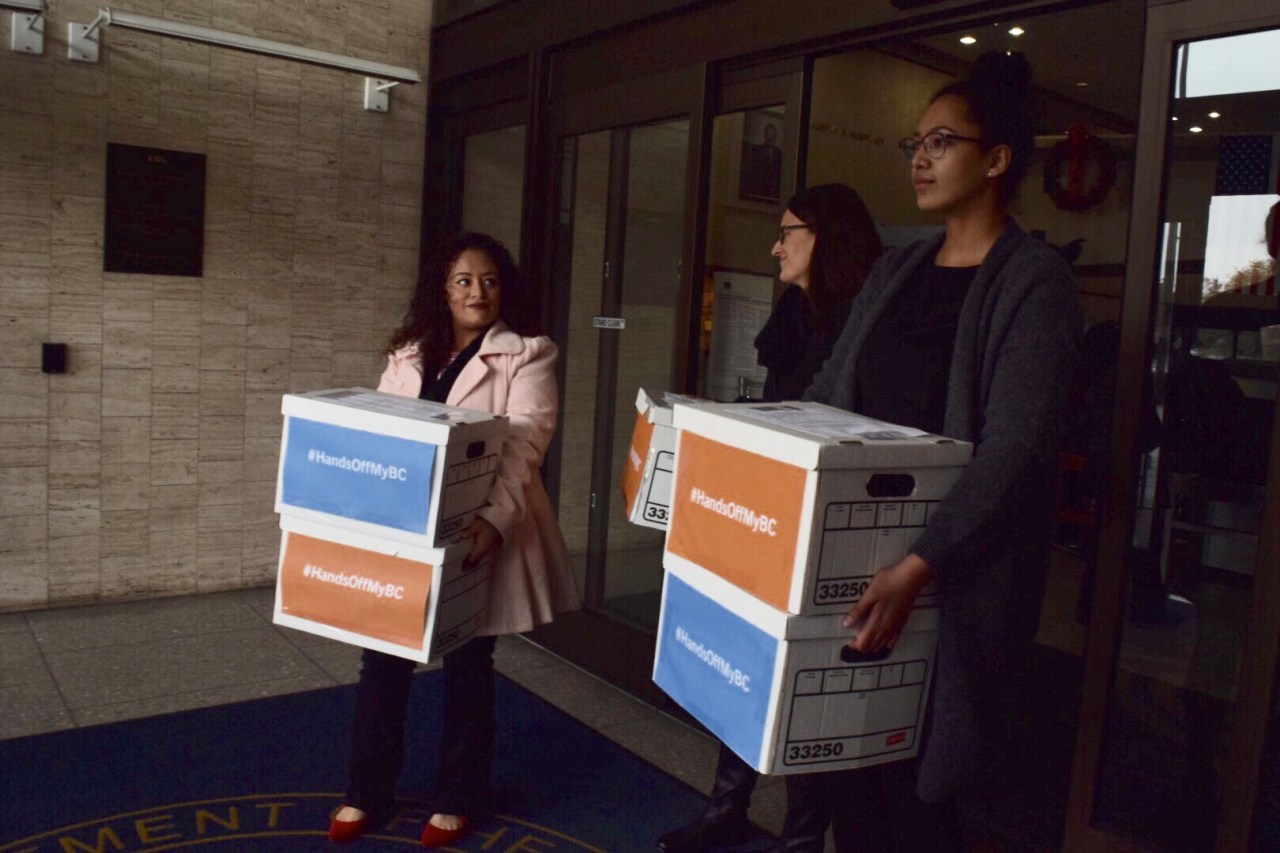
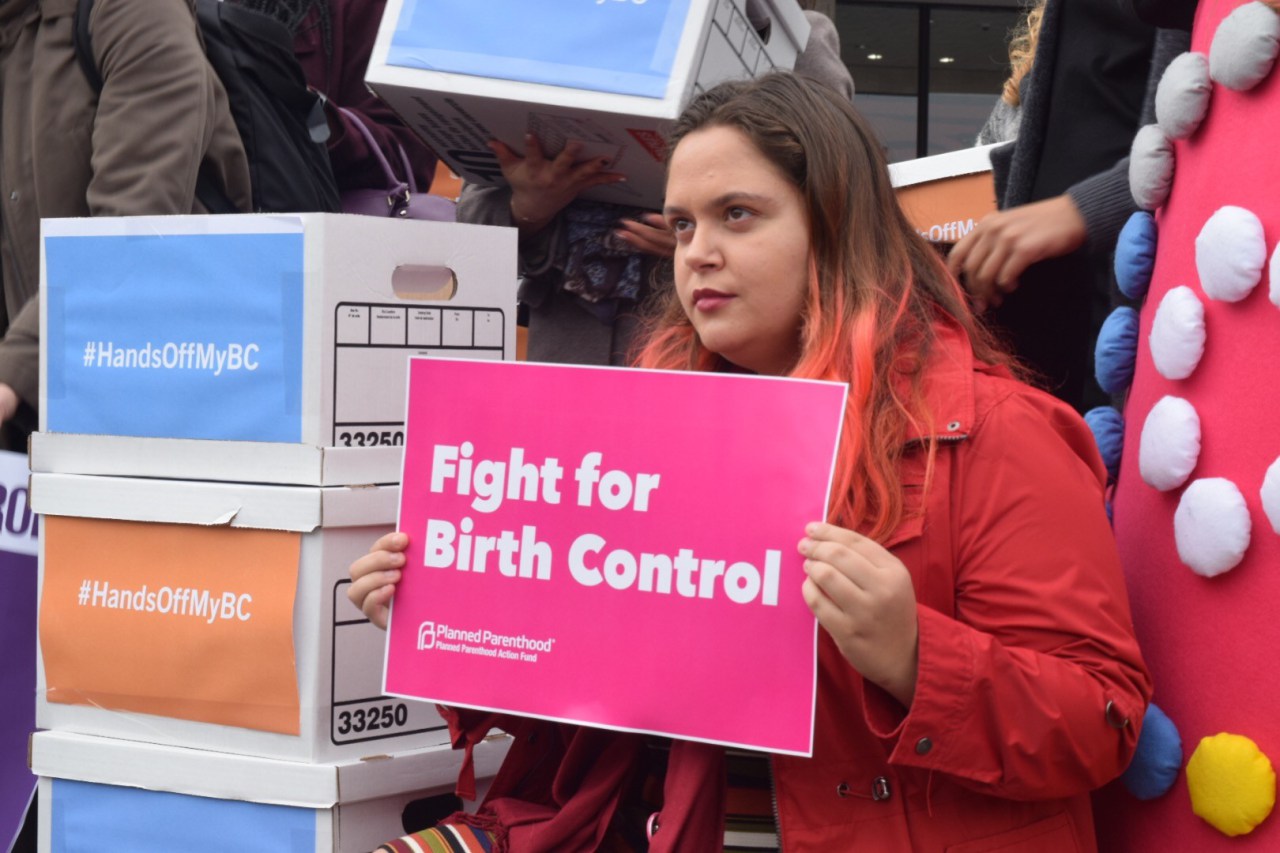
Vargas went to the Department of Health and Human Services (HHS) Tuesday to support Planned Parenthood as a patient advocate, and a dozen other reproductive and civil rights organizations. Advocacy groups crowded outside HHS to deliver tens of thousands of written testimonies, describing the impact contraceptive coverage has on millions of women and gender minorities.

The Trump administration rolled back the Affordable Care Act (ACA) protection that guarantees no out-of-pocket costs for 18 different methods of contraception. The Trump administration issued two regulations that hobbled the contraceptive mandate: The rules permit some employers — including universities and colleges — to object to providing free birth control, citing religious and moral convictions. Although the rules went into effect immediately, people can formally submit a comment to the federal government.

On Tuesday, various health organizations submitted 512,811.

Reproductive rights activists dropped off tens of thousands of written comments to the Department of Health and Human Services Tuesday morning. Credit: Amanda Michelle Gomez/ThinkProgress
REPRODUCTIVE RIGHTS ACTIVISTS DROPPED OFF TENS OF THOUSANDS OF WRITTEN COMMENTS TO THE DEPARTMENT OF HEALTH AND HUMAN SERVICES TUESDAY MORNING. CREDIT: AMANDA MICHELLE GOMEZ/THINKPROGRESS

“They still have to respond to every comment they actually get,” said Maya Rupert, senior director for policy at the Center for Reproductive Rights. “This rule does not have support.”

The objective for organizers Tuesday was to flood the comment section and communicate to HHS that this is an incredibly important issue; it’s about health care; it’s about economics. And they’ll have to answer to constituents online and in court. (The Center is among several national organizations that filed a lawsuit against the administration’s rules.)

“When they finalize the rule, they are actually going to have to come back through and explain why they have decided to ignore this overwhelming number of people who do not only disagree with the rule but question the legality of it.”

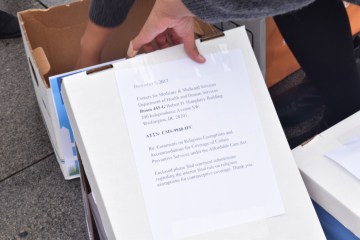
A box full of comments explaining why the Trump administration shouldn't roll back the birth control mandate.
A BOX FULL OF COMMENTS EXPLAINING WHY THE TRUMP ADMINISTRATION SHOULDN’T ROLL BACK THE BIRTH CONTROL MANDATE.

The effect of the regulations is not yet known, as employers are not obligated to report whether they’re seeking religious or moral exceptions. HHS officials have said they anticipate few employers will seek exemption and if some do, employees can turn to existing programs like family planning clinics. (The Trump administration has already taken steps to strip federal money from some family planning clinics.)

“We don’t know the impact but the agency has sent a clear message that essentially employers and universities can do whatever they want,” said Susan InmanSenior Federal Policy Counsel at the Center. The Center hasn’t been able to catalog the net effect — at least not yet.

Yulisa Vega flew in from Miami, Florida Monday evening. She's been on birth control since she was 16 years old. Credit: Amanda Michelle Gomez Health Reporter ThinkProgress
YULISA VEGA FLEW IN FROM MIAMI, FLORIDA MONDAY EVENING. SHE’S BEEN ON BIRTH CONTROL SINCE SHE WAS 16 YEARS OLD. CREDIT: AMANDA MICHELLE GOMEZ HEALTH REPORTER THINKPROGRESS

Yulis Vega flew in from Miami, Florida Monday evening to support the cause. She started taking birth control since she was 16 years old. She took the pill to regulate her period. Now, she takes birth control not just for pregnancy prevention, but for a medical condition: Twenty-year-old Vega recently learned she has ovarian cysts, and now takes oral contraceptives to treat the cysts. Her ability to get free birth control is not at risk under the interim final rule; she’s on Medicaid. But that’s not the point, she says. It’s larger than her. “Your choice to take birth control shouldn’t be in the hands of your employer, it should be in your hands.” Vega said. “It’s a taboo subject that shouldn’t be taboo. It’s like taking Vitamin C. It’s just something you do for your health!”

So far 37,631 people commented on the moral exemptions rule and 38,613 commented on the religious exemption rule. People have until the end of day to post a comment on regulations.gov.

Source: https://thinkprogress.org/birth-control-mandate-317d52d45d38/

Rewire has identified at least half a dozen state lawmakers and officials who are board members or are otherwise connected to anti-choice fake clinics that receive funding today or could qualify to receive state funding.

Texas’ GOP-held legislature has gradually increased funding for a state program directing money to crisis pregnancy centers, also known as anti-choice fake clinics, which try to dissuade people from seeking abortion care.

Rewire has identified at least half a dozen state lawmakers and officials who are board members or are otherwise connected to fake clinics that receive funding today or could qualify to receive state funding, including one Republican lawmaker who authored amendments to bolster state funding to fake clinics.

The Texas Alternatives to Abortion Program (A2A) is administered by the Health and Human Services Commission (HHSC) through the Texas Pregnancy Care Network (TPCN), a nonprofit that distributes funds to subcontractors the network selects and oversees.

The TPCN distributes funding to 50 approved subcontractors that operate 115 locations throughout the state, according to a list of subcontractor providers submitted to HHSC monthly. There are 29 subcontractors operating 52 fake clinics, including three so-called mobile clinics.

Rewire reviewed personal financial disclosure forms, tax returns, and other related documents to identify relationships between lawmakers and organizations. At least one state lawmaker and their spouse serve on the board of directors of a TPCN subcontractor, and at least three other lawmakers and a state official have direct connections with organizations that could qualify to receive state funding as a subcontractor.

Rep. Bill Zedler (R-Arlington) serves on the board of advisers of Metroplex Women’s Clinics, an Arlington nonprofit that offers pregnancy testing, ultrasounds, and counseling services. Zedler’s wife, Ellen, serves on the nonprofit’s board of directors.

Metroplex Women’s Clinics, formerly known as Arlington/Mansfield Pregnancy Center, has been a TPCN subcontractor since January 2016. It operates four facilities and a mobile clinic.

At least three other state lawmakers and one statewide office holder have similar relationships with anti-choice fake clinics that could qualify as TPCN subcontractors.

Rep. Matt Shaheen (R-Plano) serves on the board of directors for Prestonwood Pregnancy Center, which offers pregnancy tests and ultrasounds at the organization’s Richardson clinic. Prestonwood Pregnancy Center is a ministry of Prestonwood Baptist Church, an influential megachurch in Plano that claims a congregation of more than 40,000 members.

Shaheen was among several GOP lawmakers who filed budget amendments to increase funding for A2A. He submitted two amendments that would have each doubled the program’s funding.

State Attorney General Ken Paxton also served on the board of directors of Prestonwood Pregnancy Center. The center refused to answer questions sent by Rewire.

Rep. Phil King (R-Weatherford) serves on the advisory board of Grace House Ministries, which operates the Options Clinic, a Weatherford facility offering pregnancy testing, ultrasounds, and counseling services. Rep. Travis Clardy (R-Nacogdoches) is a sponsor of the Heartbeat Pregnancy Center, a Nacogdoches nonprofit organization that offers pregnancy testing, ultrasounds, and adoption agency referrals.

Critics have charged that fake clinics in the state use deceptive tactics and disseminate misinformation, and a Rewire investigation found that state-funded fake clinics provide limited services to clients and measure success only by the number of clients served. Public health programs are typically evaluated on measures of health care outcomes of clients or cost savings incurred by the state.

Alexa Garcia-Ditta, communications and policy initiatives director for NARAL Pro-Choice Texas, told Rewire that Texas is funding “deception, coercion, and lies” by funneling taxpayer money to fake clinics across the state.

“The tactics that crisis pregnancy centers use to lure pregnant people into their facilities, they use scare tactics, peddle fake medicine, and bad science,” Garcia-Ditta said. “In funding crisis pregnancy centers, Texas is supporting that.”

State lawmakers this year passed a budget that more than doubled the A2A program’s funding, and TPCN will distribute more than $38 million during the 2018-19 fiscal year.

In response to the budget increase, HHSC has “identified additional need and several key opportunities to expand services, increase the effectiveness of the A2A program, and improve the lives of A2A clients and their children,” according to an agency report. The HHSC plans to use the increased funding to extend services for new parents until the child’s third birthday, connect pregnant people to programs such as Medicaid, and expand job training and placement programs.

Joe Pojman, executive director of the Texas Alliance for Life, told the Texas Tribune that the program will save the state money because the new mothers will not need to rely on government assistance.

“If they’re self sufficient through the process of childbirth and afterward, that saves the state money and makes for much happier women and children and families,” Pojman said.

When TPCN was awarded the contract to administer the A2A program, the organization was required to file a 1295 disclosure form that identified interested parties—individuals who have financial interests. However, organizations are only required to file 1295 disclosure forms for contracts valued at at least $1 million, and subcontractors are not required to publicly disclose interested parties.

John McNamara, executive director of TPCN, told Rewire that the amount of funding each organization receives “vary by subcontractor and the time period in question,” and the TPCN submits monthly and quarterly reports to HHSC that include the funding that each subcontractor receives.

State lawmakers do make inquiries to TPCN, according to McNamara, about how potential nonprofit subcontractors in their districts can become subcontractors and how current subcontractors can expand the services they offer.

“In such situations, TPCN informs lawmakers about the requirements of the program to become a subcontractor and/or the requirements for an existing subcontractor to expand the program services they offer,” McNamara said.

Texas state ethics laws only prohibit apparent conflict of interests in very narrow circumstances,

McNamara noted according to the IRS sample conflict of interest policy, if a lawmaker or their spouse serves on a board of directors of a 501(c)(3) and has a financial interest, it “is not necessarily a conflict of interest,” unless the governing board or committee could determine it qualifies as a conflict of interest.

“TPCN is not aware of any Texas lawmaker or his/her spouse that serves on the board of directors of a subcontractor and has a conflict of interest,” McNamara said.

Rep. Donna Howard (D-Austin) told Rewire that several state lawmakers have served on the boards of a variety of nonprofit organizations that have received state funding, but that it is important for the Texas Ethics Commission to clarify what may constitute a conflict of interest.

“I don’t have any problem with any individual legislator advocating for causes and groups and issues that they care about and that they think will make a difference,” Howard said. “But I do believe that we have to be cautious about crossing the line of actually being on the board of an organization that is soliciting funds and will be considered in some kind of a procurement process to make sure we are not unduly influencing the awarding of those funds.”

Source: https://rewire.news/article/2017/12/07/conflict-interest-texas-gop-lawmakers-serve-boards-taxpayer-funded-fake-clinics/

An anti-choice fake clinic made edits to its website after a Rewire article prompted a consumer watchdog to file a complaint with Massachusetts Attorney General Maura Healey.

A crisis pregnancy center in Massachusetts has scrubbed misleading claims from its website after a Rewire report prompted a legal complaint accusing the anti-choice center of masquerading as an abortion clinic.

The website for Attleboro Women’s Health Center still offers appointments to “discuss the abortion methods that may be available to you,” along with detailed information about the costs and steps involved in abortion procedures. All of this still appears designed to obscure the fact that Attleboro Women’s Health Center is a fake clinic, whose purpose is to deter patients from seeking abortion care.

After Rewire exposed the fake clinic’s deceptive website, prompting a consumer watchdog to file a complaint with Massachusetts Attorney General Maura Healey, the center made some edits.

It cut from its homepage a passage that appeared to be a near-verbatim copy of the stated mission of Four Women Health Services, an abortion clinic about half a mile away. It also deleted the phrase: “If you’re pregnant and wondering how can I get an abortion [sic], visit Attleboro Women’s Health Center,” replacing it with an invitation to visit the center, “If you think you’re pregnant.” It deleted a claim that the center “provides quality, safe, accessible reproductive healthcare.”

The fake clinic added sources for some information, although the credibility of these sources varied. The website cites NARAL Pro-Choice Massachusetts for abortion pricing, for example, but attributes unproven claims about the purported psychological risks of abortion to the American Pregnancy Association, which presents itself as an unbiased medical resource but acts as a funnel to anti-choice fake clinics, as Rewire has revealed.

Katie O’Connor, legal counsel with the Campaign for Accountability, noticed the edits last week after she filed the complaint against the center last month.

“I do think they changed sort of the most egregious things that they had put on their website, but I still think it’s totally inadequate,” O’Connor told Rewire in an interview.

O’Connor called for more clarity surrounding the relationship between Attleboro Women’s Health Center and Abundant Hope Pregnancy Resource Center, a self-described “Christian pro-life ministry” and affiliate of Heartbeat International, which describes itself as the world’s largest network of crisis pregnancy centers. Attleboro Women’s Health Center shares an address with Abundant Hope, and the health center’s website is registered to Darlene Howard, Abundant Hope’s executive director. In an interview with Rewire Monday, Howard said the entities are “two separate divisions” that “are under the same organization.”

Howard told Rewire that the fake clinic added the citation information to its site “because it was missing” and to avoid complaints.

Pressed by Rewire on why the fake clinic had deleted the phrase inviting patients to visit if they are “pregnant and wondering how can I get an abortion,” Howard asked if she would be able to review the Rewire article prior to publication and, when this reporter declined, said she did not want her statements included in the story. Howard said she believes all the information on the website is accurate. She declined further comment and hung up on Rewire.

The legal complaint accuses Attleboro Women’s Health Center of deceptive business practices and misleading advertising, among other violations of state law.  Attorney General Healey’s office is reviewing the complaint and has not yet taken any action.

Source: https://rewire.news/article/2017/12/05/massachusetts-fake-clinic-deletes-deceptive-claims-website-legal-complaint/

Janet Porter, who runs an anti-LGBTQ hate group, also repeatedly invoked host Poppy Harlow’s pregnancy to promote the Alabama candidate accused of sexual misconduct with a minor.

Extreme anti-choice activist Janet Porter appeared on CNN’s New Day today to defend Republican Roy Moore amid allegations of sexual misconduct and to promote falsehoods about his opponent’s abortion position in the looming Alabama special election. During a 17-minute interview, CNN did not disclose Porter’s anti-choice stance, and she leveled a series of baseless and inflammatory claims, among them attacking the integrity of Moore’s accusers.

The segment kicked off with Porter appearing as a spokesperson for Moore, congratulating host Poppy Harlow on her pregnancy and using it to make false claims about Democrat Doug Jones and his position on abortion rights.

“Congratulations on your unborn child,” Porter told Harlow. “That’s the reason why I came down, as a volunteer, to speak for Judge Roy Moore, because he will stand for the rights of babies like yours in the womb where his opponent will support killing them up until the moment of birth.”

Porter again invoked Harlow’s pregnancy later in the appearance to push anti-choice falsehoods and defend Moore against allegations from multiple women that he had engaged in inappropriate sexual behavior.

“Here is the question that should be asked,” Porter said. “If you care about child abuse, you should be talking about the fact that Judge Roy Moore stands for protection, not only of our Second Amendment rights so we can protect ourselves against predators, for the rights of babies like your 8-month baby that you are carrying now. Doug Jones says you can take the life of that baby.”

After Harlow told Porter to stop talking about her pregnancy, Porter went on to claim allegations against Moore were false and that, “If we’re talking about what’s at stake here, we’re talking about fake allegations, concocted stories, about an innocent man versus real threat of child abuse, not only in the womb, but also in the locker room,” seemingly referencing anti-discrimination measures for transgender individuals.

But Jones, Moore’s opponent in the Alabama Senate race, has voiced support for current restrictions on later abortions except in cases of life endangerment. Though Jones told MSNBC’s Chuck Todd in September that he does not support a 20-week abortion ban, he later clarified in an interview with AL.com that though he supports “a woman’s freedom to choose to what happens to her own body,” when it comes to later abortions “the law for decades has been that late-term procedures are generally restricted except in the case of medical necessity. That’s what I support.”

Nevertheless, anti-choice activists like Porter and conservative media figures have latched onto Jones’ comments to falsely claim that Jones supports abortions up until “the moment of birth.” It’s a falsehood based on a procedure that doesn’t even exist. Media watchdog Media Matters for America pointed out in a recent fact check that the claim often comes up in discussions of “partial-birth” abortions, a term invented by anti-choice groups to mislead and inflame rhetoric in the abortion debate.

As Rewire Editor-in-Chief Jodi Jacobson explained when then-presidential nominee Donald Trump similarly misconstrued later abortions during a 2016 presidential debate, the suggestion “that third-trimester abortions are performed ‘on demand’ is an anti-choice myth meant to target women as being irresponsible and garner support for efforts to ban all abortions in the United States.”

“In real life and because of myriad restrictions and barriers to access, it is exceedingly difficult if not sometimes impossible to terminate a pregnancy in the last trimester, even when a wanted pregnancy goes horribly wrong or a woman’s life is in imminent danger,” wrote Jacobson.

Robin Marty further explained for Cosmopolitan that “there is no specific medical definition for a ‘late-term abortion,’ and because of that, abortion opponents are using it to mean anything they want.” Rutgers University professor and historian Johanna Schoen said that, as Marty puts it, the term is generally used to “group together any procedure after the first trimester and erase any distinction in developmental along the gestational period of the pregnancy.”

Though it was not disclosed in the segment, Porter has a long history of anti-choice activism. She heads the anti-choice group Faith2Action, the Southern Poverty Law Center-designated anti-LGBTQ hate groupbehind “heartbeat” legislation at the state and federal level that promises to outlaw legal abortion, and led a mid-November press conference bringing together a who’s who of anti-choice extremists to support Moore. As Rewire reported:

Porter orchestrated an Ohio GOP attempt to end legal abortion as early as six weeks into a pregnancy—before many people know they’re pregnant. The “moderate” Ohio Gov. John Kasich (R) vetoed the total abortion ban in favor of an equally unconstitutional 20-week ban, but Republican legislators have resurrected it as a pending bill in the current legislative session.

Porter subsequently convinced Rep. Steve King (R-IA), an unabashed white nationalist, to debut the federal version in Congress while both attended the funeral of Phyllis Schlafly, as People for the American Way’s Right Wing Watch first reported.

Porter’s leadership of the Moore press conference aligns with her increasingly prominent role on the national stage. Porter ran two Capitol Hill press conferences for King, the most recent after King’s contentious hearing on the total abortion ban. And she partnered with Tom DeLay, the former U.S. House of Representatives majority leader convicted on campaign finance violations that were later overturned on appeal, to lobby Vice President Mike Pence and his staff.

Porter’s and other anti-choice extremists’ support for Moore never wavered in the wake of the sexual misconduct allegations. Some, like Operation Rescue President Troy Newman, have refused to denounce Moore despite the allegations against him. Others, such as Janet Orient, the executive director of fringe anti-choice medical organization Association of American Physicians and Surgeons, have tried to play down the alleged sexual misconduct by Moore. Orient dismissed the claims against Moore in a Tuesday press release.

“Back in my day, jealous women might have called him a ‘cradle-robber’ because they felt they deserved him more,” said Orient. She went on to dismiss news that Moore had allegedly sexually abused a 14-year-old girl in 1979 as “heavy petting” with “an underage ‘child,’” though she did note that such behavior would be “icky” if it was true.

Activists with fringe views on abortion rights and LGBTQ rights consistently stuck by Moore as some establishment Republicans distanced themselves from him. The long-term strategy appears to have worked as the party has ultimately courted many of its supporters back to Moore’s camp.

Senate Majority Leader Mitch McConnell (R-KY), a frequent target of Moore’s ire, in mid-November told reporters that he believed the women who had accused Moore and said the candidate should exit the race. Fresh off his Senate GOP tax bill victory over the weekend, however, McConnell changed his tune.

“We’re going to let the people of Alabama decide,” McConnell said on the Sunday morning talk show circuit.

President Trump on Monday formally endorsed Moore, encouraging the candidate to “Go get ’em, Roy!” in a phone call from Air Force One. He indicated that he would endorse Moore in an early morning tweet that said: “Democrats [sic] refusal to give even one vote for massive Tax Cuts is why we need Republican Roy Moore to win in Alabama. We need his vote on stopping crime, illegal immigration, Border Wall, Military, Pro Life, V.A., Judges 2nd Amendment and more. No to Jones, a Pelosi/Schumer Puppet!”

The Republican National Committee, the party’s campaign arm, as of Monday restored get-out-the-vote funds to Moore, according to a New York Times report. The National Republican Senatorial Committee, the Senate GOP’s campaign arm, doesn’t plan to do so, the newspaper reported.

Source: https://rewire.news/article/2017/12/05/anti-choice-extremist-false-claims-cnn-moore/

Would the Democrats’ Alabama Senate candidate do better if he were anti-abortion? Maybe not.

Aside from the sexual misconduct allegations against Republican candidate Roy Moore, one of the top issues in the Alabama Senate race has been abortion.

Republicans have tried to portray Democratic candidate Doug Jones as extreme on the issue, with a super PAC running an ad claiming that he “supports abortion in even the most extreme circumstances.” At a rally last month, Moore’s wife told the crowd that Jones supported “full-term abortion.”

And there’s been significant speculation that if Jones were anti-abortion, maybe ― just maybe ― some Republicans who find Moore distasteful would vote Democratic.

But a new poll questions that assumption.

On Nov. 4-5, Clarity Campaign Labs, a Democratic polling firm, surveyed 707 Alabama voters in a survey commissioned by Planned Parenthood Votes. (Planned Parenthood has no involvement in the Alabama special election and has not endorsed a candidate.) The results were shared with HuffPost.

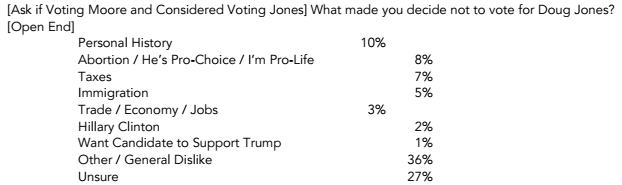
Clarity Campaign Labs was specifically interested in Republican voters who might be persuaded to back Jones. The survey found that less than 1.5 percent of Moore’s supporters said they had considered switching and backing Jones.

The pollster then tried to figure out why those voters decided to stick with Moore. Was it because of Jones’ support for abortion rights?

But Clarity didn’t want to limit people with a list of possible answers. So they were asked to explain, in their own words, why they continued to reject Jones.

“Abortion wasn’t really in the top couple issues people gave us,” said John Hagner, the Clarity pollster who conducted the survey.

More than one-third of those Republican voters who said they decided not to switch to Jones gave a reason that fell into the category of just generally not liking him. Ten percent said they didn’t like his personal history. (Jones is a former U.S. attorney best known for finally putting Ku Klux Klan members behind bars for blowing up an African-American church back in 1963.) Eight percent cited abortion as the reason.

CLARITY CAMPAIGN LABS

“Of the people who were undecided, they weren’t citing choice as the major driver,” Hagner said. “Of the people who had considered voting for Jones and decided not to, there was a whole range of issues.”

Clarity conducted the poll before women came forward and alleged that Moore had pursued them when they were in their teens and he was in his 30s. Presumably, there are more Republicans giving Jones a second look. But Hagner said he didn’t think abortion would now become a more significant factor in the race.

“If there was a pro-life Democrat running in this race, would he or she be doing better? We don’t see any evidence here that that’s the case,” he added. “There are people who won’t vote for any Democrat because of choice, but those are people who wouldn’t vote for any Democrat. They aren’t inclined, they’re not winnable voters.”

The specific controversy over Jones’ abortion position arose from an MSNBC interview the candidate did on Sept. 27. Host Chuck Todd asked Jones what “limitations” he believes there should be when it comes to abortion.

“I am a firm believer that a woman should have the freedom to choose what happens to her own body,” Jones said. “And I’m going to stand up for that and I’m going to make sure that that continues to happen.”

More from the interview:

TODD: But you wouldn’t legislate ― so you wouldn’t be in favor of legislation that said ban abortion after 20 weeks or something like that?

JONES: No, I’m not in favor of anything that is going to infringe on a woman’s right and her freedom to choose. That’s just the position that I’ve had for many years. It is a position that I continue to have.

But when those people ― I want to make sure people understand that once a baby is born, I’m going to be there for that child. And that’s where I become a right-to-lifer.

Jones later clarified his position in a statement to HuffPost, saying, “Roy Moore and his allies will do anything to distort this race and lie about my position. This is a deeply personal decision. I support the current law on a woman’s freedom to choose, which has been in place for decades, where late term abortions are permitted to protect the life or health of the mother.”

Elizabeth BeShears, a communications consultant in Alabama who has argued that abortion is a big factor in the Dec. 12 special election, said she believes that even if people didn’t point to it, the issue is playing a role in their support for Moore.

“The abortion issue is a check-the-box issue for Republicans,” BeShears said. “It’s something that’s important to them, and it’s like, ‘OK, he’s Republican. Check. He’s pro-life. Check.’ Then they don’t give any more thought to it than that necessarily. So it’s a qualifying attribute and not the deciding attribute.”

Hagner said he thinks the Republicans playing up Moore’s anti-abortion stance are essentially trying to portray him as just an average Republican. Alabama is a Republican state where likely voters oppose legal abortion 62 percent to 28 percent, according to Hagner.

“I think it’s an act of desperation,” he said. “Even before the revelations [about his alleged pursuit of teenagers] came out, choice wasn’t what was determining the race. I have a hard time imagining it’s what’s determining it now. I think what they’re really trying to do is just reframe it as get back to a more generic Republican versus Democratic [race].”

The contest between Moore and Jones is incredibly tight. When Moore beat the establishment candidate in the GOP primary, Democrats suddenly realized they might have a chance at winning. Moore, the former chief justice of the Alabama Supreme Court, has a national reputation for his religiously conservative positions, including his outspoken opposition to same-sex marriage.

Jones’ chances are considered even stronger, not surprisingly, since the accusations about Moore’s past behavior began pouring forth. Democrats in Alabama are working to expand their electorate ― primarily by getting more African-Americans to vote ― and to persuade some disgruntled Republicans to switch sides and vote for Jones (or, at the very least, stay home on Election Day).

https://www.huffingtonpost.com/entry/doug-jones-abortion-poll_us_5a25473fe4b03c44072eca22?utm_campaign=hp_fb_pages&utm_source=women_fb&utm_medium=facebook&ncid=fcbklnkushpmg00000046

“[Republicans] know they cannot achieve this goal of the anti-choice movement in the light of day, since it has failed every time it has been in front of the voters.”

Congressional Republicans can’t use their tax cuts for the rich to define and codify the view that life begins at fertilization, according to the rules of the U.S. Senate.

The GOP’s initial tax proposals in the U.S. House of Representatives and the Senate each conferred 529 college savings plan benefits to an “unborn child…at any stage of development” in an unprecedented attempt to wield the tax code against reproductive rights. Republicans on Capitol Hill have long sought deeply unpopular fetal “personhood” bills that try to classify fertilized eggs, zygotes, embryos, and fetuses as “persons,” and to grant them full legal protection under the U.S. Constitution, including the right to life from the moment of conception. Personhood laws, repeatedly rejected by voters across the United States, would criminalize abortion with no exception and ban many forms of contraception, in vitro fertilization, and health care for pregnant people.

The latest fetal personhood effort ultimately violated rules associated with the fast-track process Republicans are using to pass their tax bill. Under “reconciliation,” Republicans need a simple 51-vote majority in the Senate instead of the 60-vote threshold typically required to bypass a filibuster and pass controversial legislation. But reconciliation is subject to the Byrd rule, which puts the kibosh on provisions that are “merely incidental” to the budget.

In other words, Congress can’t wield the reconciliation process for the sake of a political agenda.

Enter the Senate parliamentarian, a nonpartisan, staff-level position tasked with enforcing the chamber’s rules and procedures. The Senate parliamentarian in July ruled against key anti-choice provisionsdefunding Planned Parenthood and restricting abortion access—in the GOP’s repeated failed attempts to repeal the Affordable Care Act.

Early Friday evening, in the home stretch to the 1:36 a.m. Saturday vote on the tax plan, the Wall Street Journal’s Richard Rubin flagged that the fetal personhood provision violated the Byrd rule.

Sen. Ron Wyden (OR), the top Democrat on the tax-writing Senate Finance Committee, and his staff challenged the personhood provision with the parliamentarian, said a Democratic aide in the chamber. The parliamentarian then “Byrded,” or ruled, the provision out of order, and Senate Republicans removed it to avoid a floor challenge, the aide told Rewire.

Wyden in an email said he “successfully struck several provisions that should never have been wedged into a tax bill, including the misguided Republican attempt to radically change the definition of personhood under the guise of helping parents save for their kids’ college education.”

“Burying personhood language in this tax bill that is primarily a handout for the wealthy is another attempt to carry out the Republicans’ perennial, extremist agenda to limit women’s reproductive autonomy,” he said.

A motion to waive the Byrd rule for the provision would return the threshold for passage to 60 votes, according to the nonpartisan Congressional Research Service. Most Senate Democrats would block the move, although anti-choice groups are using Democrats’ self-inflicted vulnerability on an abortion “litmus test” to end their legislative firewall on such proposals becoming law.

NARAL Pro-Choice America President Ilyse Hogue welcomed the news but remained wary.

“[Republicans] know they cannot achieve this goal of the anti-choice movement in the light of day, since it has failed every time it has been in front of the voters,” Hogue said in a statement. “So, we have every reason to expect they’ll try to do it again, and when they do NARAL members will be ready to fight this again.”

The House is scheduled to vote Monday evening on a motion to go to conference with the Senate and reconcile differences between the chambers’ tax bills. Among the consequences for people with low incomes and other marginalized people, the House and the Senate tax proposals make 529 college savings plans, the vehicle for the fetal personhood language, even more “deeply regressive” by similarly expanding them to K-12 private schools.

https://rewire.news/article/2017/12/04/senate-rules-strike-extremist-fetal-personhood-language-regressive-tax-overhaul/

Tasos Katopodis/Getty Images News/Getty Images

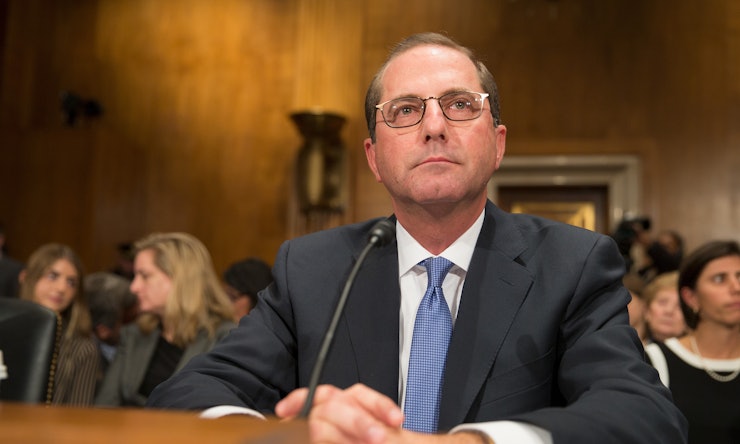
President Trump’s new nominee for health and human services secretary had his Senate confirmation hearing on Wednesday, where lawmakers grilled him about his position on birth control coverage. Trump’s pick, Alex Azar, said the agency should be weighing employers’ consciences against women’s birth control access. This suggests that he is aligned with the Trump administration’s position that companies may stop covering birth control for their employees.

Sen. Patty Murray (D-Wash.) questioned Azar about this crucial women’s health issue. The Trump administration took steps in October to make it easier for employers to limit coverage of birth control in their employees’ health insurance plans. Murray asked if Azar would commit to putting “science and health care access first,” rather than “ideology and extremism.”

“We have to balance a woman’s choice of insurance with the conscience of their employers,” Azar responded. That answer was of great concern to the senator. Murray tells Bustle in a statement that corporations should not be put above women’s health care:

Americans support a woman’s access to birth control regardless of who her employer is. Why doesn’t Alex Azar? https://twitter.com/BridgeProject21/status/935892269294608384 

It was also troubling to abortion rights advocates: NARAL Pro-Choice America President Ilyse Hogue said in a statement that the “Senate should use this opportunity to stand up to Donald Trump’s dangerous, backwards agenda and refuse to confirm Azar.”

Reproductive rights advocates also have noted Azar’s speech to the Islamic Medical Association of North America in 2006, when he thanked them for their “emphasis on protecting the health and well-being of the unborn.” They have taken his contributions to anti-choice politicians as a sign that he would limit birth control access. Before working as the president of major drug company Eli Lilly’s U.S. division, Azar was deputy secretary of health and human services from 2005 to 2007 under George W. Bush.

Alex Azar has donated to anti-choice politicians including Donald Trump, Mike Pence, and Mitch McConnell. Now he’s Trump’s nominee for HHS. http://ampr.gs/2infRvJ  

Why the HHS Secretary Nomination Matters for Women and Families – Center for American Progress

The next U.S. Secretary of Health and Human Services will play a pivotal role in creating a health care system that supports women’s and families’ health care needs.

americanprogress.org

NARAL’s Hogue wrote in the statement:

Azar’s full response to Murray acknowledged that he and the senator have different opinions on how to best carry out HHS programs.

“I’m the secretary for all Americans,” Azar said. “I would faithfully implement [HHS] programs. We may differ in different elements of how those get implemented, but I firmly believe in following evidence and science.”

Murray didn’t let him avoid the issue of birth control access, though, and doubled down on her question. “Do you believe all women should have access to the health care their doctor recommends for them? Yes or no?” she pressed him. That’s when he made his point about balancing employers’ and women’s concerns:

“Not in terms of access, but in terms of insurance,” Azar responded. “To force those very few… I believe it’s less than 200 have come forward, very few employers would be impacted by that conscience exception. To respect, frankly, their rights as well as women’s access through the insurance.”

Murray disagreed, saying, “I think women’s access to health care their doctor requires for them should take precedence.”

https://www.bustle.com/p/trumps-health-secretary-nominee-alex-azar-has-controversial-thoughts-on-birth-control-coverage-6745902

State avoided spending nearly $70 million to care for babies of low-income teens, study says.

The steep drop in teen pregnancies and abortions in Colorado since 2009 is mainly due to one thing: free, low-cost access to IUDs.

Intrauterine devices — tiny, T-shaped pieces of plastic placed in the uterus — are the main reason Colorado’s teen birth rate fell 54 percent and the teen abortion rate declined 64 percent in the last eight years, state health officials said Thursday.

The astounding numbers, capturing the eight-year period since IUDs became an affordable option for low-income health clinics, were released along with a study estimating the state avoided paying nearly $70 millionfor labor and delivery, well-baby check-ups, food stamps and child-care assistance because of fewer births to teen moms.

“This is one of the biggest public-health home runs that I’ve seen in my 35-year public-health career,” said Dr. John Douglas, executive director of the Tri-County Health Department, which has six clinics in Douglas, Arapahoe and Adams counties. “The work that’s happened is really striking.”

Thanks to a grant from billionaire Warren Buffett’s family, Colorado spent $28 million during eight years supplying IUDs to 75 public health clinics throughout the state, several based inside high schools. From 2009 to 2016, the program provided 43,713 contraceptive implants to women, plus trained medical staff on how to insert the devices.

“Because of that, everything changed,” said Jody Camp, who oversees the state health department’s family planning program. “People started hearing about it, saying ‘Wait, I can get one of those (IUDs) that my girlfriends with insurance have?’ It caught on like wildfire in a really important way.”

Before 2009, clinics typically couldn’t afford to spend up to $350 per patient who wanted an IUD, instead offering lower-cost options including the patch, monthly contraception shots or birth-control pills, which cost a clinic as little as $1 per pack. Some clinics, including in Tri-County, had an IUD wait list.

Pills, patches and rings often aren’t reliable birth control for teens and young women, Camp said. IUDs, though, can prevent pregnancy for three, five or even 10 years, depending on the type.

“That can change the trajectory of your life,” she said.

Colorado’s “teen fertility rate,” measured in births per 1,000 by teens aged 15-19, has dropped considerably faster than the national rate, also in decline. From 2009 to 2014, the U.S. rate decreased from 37.9 to 24.2 births. In Colorado, the rate dipped from 37.5 to 19.4.

The program was a “game-changer” for Tri-County’s clinics, said Lauren Mitchell, the department’s family planning nurse coordinator. The health department partnered with a campaign called “Before Play” to advertise, and teens walked in asking for long-term, reversible contraceptives.

“If you’re looking at teens and the way teens lives are, it is a lot more difficult to take a pill every day or to remember to go in during your window to get your shot,” Mitchell said.

Colorado law allows those under 18 to give their own consent regarding birth control and sexual health services.

An analysis by University of Colorado researchers found the state program was responsible for as much as two-thirds of the decline in births to teen mothers from 2009 to 2015. The drop in pregnancies “averted” $66 million to $69.6 million that might have been spent on four state and federal welfare and health care programs for low-income mothers, the researchers found.

The eight-year grant is gone, but Colorado lawmakers increased funding for the family planning program by $2.5 million per year, up to $4.1 million. Also, Colorado health clinics have received more Medicaid funding because of the Affordable Care Act, which expanded eligibility for government insurance for low-income residents. Medicaid reimbursements to the 75 clinics have risen from $500,000 to about $5 million annually.

IUD program leads to big decline in teen pregnancies, abortions in Colorado