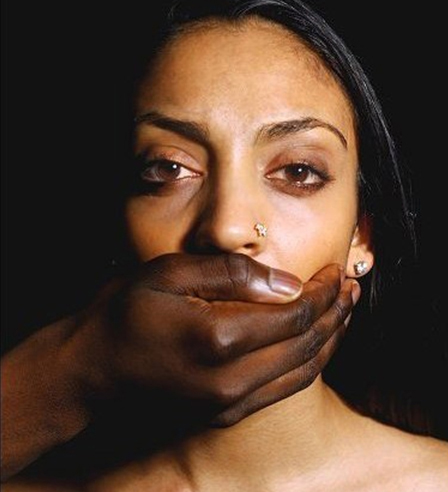
screen-shot-2016-10-05-at-3-56-50-pm Holy hell. This is nearly an unbelievable story, but here it is: Abortion Florida has launched a petition calling for an amendment to the state constitution that deems medical termination of a pregnancy to be a premeditated murder under Florida state law — making women who have abortions and their doctors eligible for the death […]

via Florida Christians Push For The Death Penalty For Those Having An Abortion — Godless Cranium


screen-shot-2016-10-05-at-3-57-20-pm

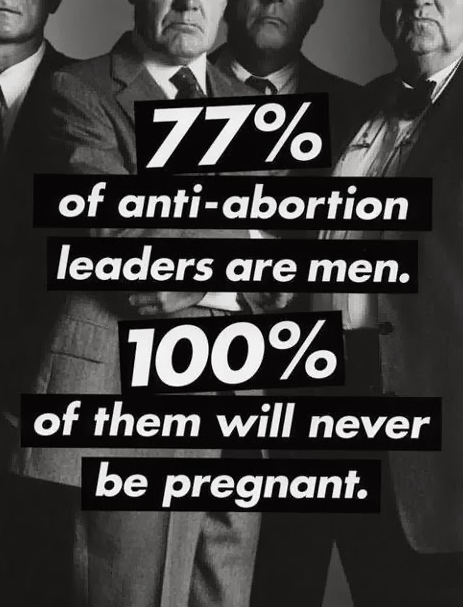
If Christians legislated abortion laws.

In a report from The Hill, the Republican nominee sent a letter to anti-abortion leaders dated “September 2016,” calling on them to join his campaign’s “Pro-Life Coalition.” This group would be lead by Marjorie Dannenfelser, president of the Susan B. Anthony List, an anti-abortion non-profit organization. The letter lays out a tougher stance than we’ve seen from Trump up to this point.

Most notably, he commits to making the Hyde Amendment permanent law, “to protect taxpayers from having to pay for abortions.” But as Rebecca Traister at The Cut points out, this will limit many women’s ability to have control over their health choices. Traister writes:

“The Hyde Amendment means that American women—many of them women of color—who cannot afford health insurance are effectively prevented from availing themselves of a legal medical procedure that is their right and that is fundamental to their ability to exert autonomy over their reproductive lives and thus their economic and familial futures.”


Trump also compares his stance on abortion to that of his opponent Hillary Clinton, who supports the repeal of the Hyde Amendment, a move that the Democratic Party laid out in its platform earlier this summer. Trump’s letter also correctly notes that Clinton is committed to appointing pro-choice justices, but falsely claims that Clinton supports abortion until an hour before birth. In addition to making Hyde permanent law, Trump’s letter says he would sign the Pain-Capable Unborn Child Protection Act that bans abortions after 20 weeks, and that Planned Parenthood would be defunded if it continued to perform abortions.


Source:  http://www.glamour.com/story/donald-trump-anti-abortion-stance

Fetal parts are for sale. Yep, the terrible Planned Parenthood abortionists found and tapped into a profitable market for fetal parts, especially intact forms.

This is the basic narrative inserted into the talking points of anti-abortion politicians these days after edited videos between Planned Parenthood representatives and imposter biomedical tissue brokers surfaced. Ignored was the benefit fetal tissue provides to medical research. Disregarded was the selectivity used to decide what was fit for public consumption. Much has been made of interactions that might be suspicious to outsiders of medical and scientific research environments or appeal to the emotions of the uninformed.AR headline

Planned Parenthood can sufficiently respond to the “undercover sting videos” of its medical staff discussing fetal tissue donation. The rest of us need to respond to this attempt by anti-abortion dogmatists to impose their view of the world into public policy.  The states that have initiated investigations based on the videos found Planned Parenthood in compliance with regulations. Even if one state, or several states, unsuccessfully takes action for political value or reject continued contracts with Planned Parenthood for health services, it would be a measurement of success for this false narrative. Planned Parenthood will remain open to provide important health services, but there are other issues of which we should all have concern.

Deception and Ethics

The videos were created by the Center for Medical Progress (CMP), which claims to be “…citizen journalists dedicated to monitoring and reporting on medical ethics and advances.”  Their website appears to be focused only on promoting anti-abortion viewpoints, no other medical ethics issues. End-of-life treatment, organ donation processes, and equality in accessing medical care are among the top ethical issues one would expect to see mentioned.ethics

Why the deception when it would have been perfectly acceptable for CMP to identify itself as abortion opponents with specific, legitimate ethical questions pertaining to abortion and fetal tissue?

Honesty and integrity are critical to discussions about ethical issues.  Would abortion clinic representatives talk openly with abortion opponents? I and many others certainly have on many occasions in our roles as reproductive healthcare professionals. Did the CMP even attempt to arrange a discussion? If the intent of the “undercover” effort was to learn about the involvement of some Planned Parenthood affiliates with fetal tissue procurement, it was not necessary for CMP to engage people by misrepresenting themselves as biomedical professionals. Why just Planned Parenthood and no other providers of elective, therapeutic, and emergency abortions? Hospitals and other medical facilities play a significant role in tissue procurement, which can seem quite unsavory to outsiders.

abortion safeApparently deception and fabrication are a preferred method of operation within anti-abortion activism. Deception and fabrication are the hallmarks of Crisis Pregnancy Centers, also known as fake abortion clinics because of the their strategy to appear as if they are abortion clinics and use misinformation to dissuade women from abortion once they arrive for their “abortion appointment.”  Anti-abortion literature distributed to Congress, the media, and the public also contains incorrect, distorted, and often manufactured information. This is how the public at times believes that most abortions are late term. Or have murky ideas about parental consent for abortion in which it is compared to unrelated issues that are often guided by business policies, not laws.

It is no surprise that deceptive tactics were used to generate the storyline about fetal tissue procurement. It is nonetheless striking that there is not outrage about the deception, especially when ethics is the alleged target. Clearly, acquiring and providing information about fetal tissue procurement would not generate outrage if done without the theatrics of imposter biomedical professionals and video editing skills. Do we really want topics of importance to be introduced to public discourse in this manner? Of course not. The media would serve the public well to fully investigate the “investigators” and bring political balance to that part of the story. The notion that an organization like CMP, with a Postal Annex rented address no record of prior work as a nonprofit in the medical ethics arena, and leadership comprised of people connected to anti-abortion groups like Operation Rescue, can have traction in promoting political ideology as if it was credible news or journalism is frightening. The media failed by not scrutinizing the source before doing the reporting, especially since another group, Life Dynamics, attempted to do the same in the late nineties.

For the record, pro-choice people resorted to deception to “out” the Crisis Pregnancy Center’s fake abortion clinic charades. Why? Because CPCs claimed that they informed women that they did not perform abortions, provided factual information, and other practices did not square with what women had shared with actual medical professionals.  A hidden camera sent in by the media with a young woman proved that the experiences of other women were accurately presented.

Using the Mistruths as Truths to Further the Mistruths

Talk radio stars Laura Ingraham, Sean Hannity, and Rush Limbaugh all regularly speak of the CMP as if it is a credible nonprofit out there doing good work.  Politicians, including U.S. Speaker of the House John Boehner and those running for president, refer to the videos time and again as if they were part of a documentary. Absolutely nothing revealed in the videos is evidence of anything sinister. At worst, the videos illustrate the seeming insensitivities that can develop when people work in medical settings. wd

Right wing websites are having a great time exaggerating the video content and piling on more false or misleading information. Red State claims that Planned Parenthood was “…caught…appearing to haggle over the sale of aborted baby parts.” Haggling? Not hardly. The videos revealed explanations, in clinical and business tones, about how tissues and parts are procured. Bear in mind that CMP presented themselves as biomedical professionals interested in obtaining fetal tissue. Would it have somehow been acceptable for responses to exclude information about quality of parts and associated costs?

Comments made by elected officials can be perceived as the truth. Thus, when Senate newcomer Joni Ernst (R-Iowa) states, “Planned Parenthood is harvesting the body parts of unborn babies,” to explain her sponsorship of a bill to defund Planned Parenthood, perceptions are broadly formed and shared throughout every possible medium. The tone of Ernst’s statement can conjure so many images that only perpetuate incorrect information. When Breitbart News quotes a Ted Cruz comment that the videos show Planned Parenthood representatives “confessing to multiple felonies,” it misleads, misinforms, and further polarizes people on the basis of ideology as opposed to facts. Shame on all who have made, and are continuing to make, comments implying that the videos exposed evidence of crime. Shame on all who are giving the CMP credibility, so much credibility that there are threats to shut down the government if Planned Parenthood is not defunded.

Fetal Tissue Research is Ethical and Beneficial

There has always been a market for anatomical and biological goods, including human fetal tissue and parts.  Specific companies respond to the demand for human and animal parts. College psychology departments buy brains to teach students. Medical and scientific researchers need specimens in order to learn more about genetics or real and prospective treatment options for a range of diseases, for example. Fetal tissue/parts obtained from miscarriages and abortions have been used for decades and have led to a number of medical breakthroughs, including rubella and polio vaccines. Kimberly Leonard wrote an excellent article in the August 4, 2015 online issue of US News about the contributions of fetal tissue research. Many of us are grateful for those contributions. In the August 12, 2015 New England Journal of Medicine, lawyer R. Alta Charo stated, “A closer look at the ethics of fetal tissue research…reveals a duty to use this precious resource in the hope of finding new preventive and therapeutic interventions for devastating diseases. Virtually every person in the [United States} has benefited from research using fetal tissue.”  Quite simply, it would be unethical for medical researchers to suddenly discontinue use of fetal tissue due to politically extreme ideology.

research petri dishFetal parts are not allowed to be sold – they can only be donated with consent from pregnant women after they are removed.  If profit for fetal parts is the actual concern of CMP, their time would be better spent honestly working with regulatory agencies to determine with certainty if any inappropriate financial transactions between abortion providers and biomedical tissue businesses exist. It is certain that people of all political views on the issue would abhor such a practice.

As the dribble of videos continues, no evidence of illegal activities will be presented. Instead, ideology will be promoted with the intent to cause some to rethink their views about abortion and try to stop an organization that serves the healthcare needs of so many low-income women. The effort will fail, but in the meantime, we will all have to witness the nonsense and speak up about reality when we can.

Congressional-sealCongress began the 2015 session proposing more anti-abortion legislation, keeping in step with legislators at the state level doing the same. Abortion rights have been chipped away so continuously, many of us have come to expect more, no matter how ludicrous.

The proposed laws calling for intrusive, expensive, and uncomfortable (even painful)  transvaginal ultrasounds and mandated scripted information containing unscientific , inaccurate or incorrect information to abortion patients serve no purpose but to promote anti-abortion propaganda and delay access to abortion services.  Some proposals are truly bizarre. An addendum to legislation in North Carolina that passed in 2013 is currently being pushed by some politicians to “…[establish] governing and quality assurance boards and [designate] a chief executive to handle day-to-day operations…”  Exactly what will an additional layer of bureaucracy in a medical practice accomplish for women’s health?

restrictions-2011-2013_smWhen asked to describe the benefits of these laws, the answers are generally the same and women generally have reactions of disbelief to their claims:

Women need to be “properly” informed. Once they are provided the right information, they will be less likely to have an abortion. Uh, yeah, even we women know that we really just do not know what we are doing when it comes to pregnancy, abortion, or other decisions involving our reproductive lives. Yep. We women need the wisdom and personal, often religious, convictions of politicians before we can feel confidence in our decision. We should not trust ourselves or our medical care providers.

It protects women’s health. Abortion is such a dangerous procedure with two victims – the pregnant mom is scarred for life and her child is killed. Can you please just give specifics about how it actually protects women? Are you saying that childbirth is safer or, really, be honest, are you just trying to put another barrier in place to stop women from choosing to have an abortion? Or, are you thinking illegal abortion would be better somehow?

We care about women and children. Oh, I know, I know…you will eventually convince me to give birth whether I am a healthy young woman, a 46-year-old woman with four children and no desire for more, a woman with chronic health conditions, a 13-year-old unprepared for pregnancy and parenting, an 11-year-old pregnant as a result of repeated sexual molestation from a male relative, or any other woman in any other circumstance. You care so much that you will promise to support me spiritually, emotionally, and financially until my offspring become adults. Oh, wait…I forgot, most of you actually stop supporting women once we give birth, once the fetus becomes a child.

preg patientsIf we assume for a moment that those who support abortion restrictions are sincere in their claims that they believe women should be properly informed, that the laws protect women’s health, and that they care about women and children, then they should also support other reproductive healthcare-related proposals that have the same goal in mind. If the premise of restrictive abortion laws is really about informing and protecting women, then laws must be developed to ensure that all women who get pregnant and plan to give birth are aware of the risks involved. All medical practices that have pregnant women as patients must arrange for structural modifications to their facilities to ensure women and the government that they can properly respond to medical emergencies that might arise. The medical providers of pregnant women must also be required to make specific, politically dictated statements about the range of risks involved in pregnancy and childbirth although, unlike the “abortion information,” statements can be based on empirical data and medical facts.

acogResearch by Elizabeth G. Raymond, MD, MPH and David A. Grimes, MD and published in the American College of Obstetrician and Gynecology’s Obstetrics & Gynecology (February 2012), concluded, “Legal induced abortion is markedly safer than childbirth. The risk of death associated with childbirth is approximately 14 times higher than that with abortion. Similarly, the overall morbidity associated with childbirth exceeds that with abortion.”  (Full PDF article available at no charge through embedded link.) While I am not interested in shattering the joy of women learning of a wanted positive pregnancy test, fair is fair. There are risks associated with pregnancy and childbearing for which women should receive appropriate medical information. Given the political and religious propaganda out there, the chances are that a lot of women think that pregnancy and childbirth are safe. If women cannot be respected as able to independently make decisions about abortion, how can we possibly believe them able to make decisions concerning pregnancy and childbirth?

In addition to pregnancy and childbearing putting women at a higher risk of death than abortion, there are numerous risk factors that require medical attention and monitoring, including prior to conception. Rh incompatibility, kidney disease, diabetes, polycystic ovary syndrome, and autoimmune diseases are among the many conditions that can dramatically complicate the health of pregnant women and their babies. Age and lifestyle are other factors that obstetricians must consider during preconception consultations and prenatal treatment practices. The latest blow to pregnant women and fetal wellbeing is research concerning the influence of the time interval between the delivery of the first baby and conception of the second.  “[A]n interval of less than 12 months causes an increased risk for severe preterm birth in women who already suffered preterm birth in their first pregnancy” was the primary finding of the research, which will be presented this week at the Society of Maternal-Fetal Medicine’s annual meeting.

Obesity is one of the most common risk factors for women in developed countries. According to research published in Science Daily (July 2010), “The heavier the woman, the higher the risk of induced preterm birth before 37 weeks, with very obese women at 70% greater risk than normal weight women.  Overweight or obese women also had a higher risk of early preterm birth (before 32 or 33 weeks). Again, the heavier the woman, the higher the risk of early preterm birth, with very obese women at 82% greater risk than normal weight women.”

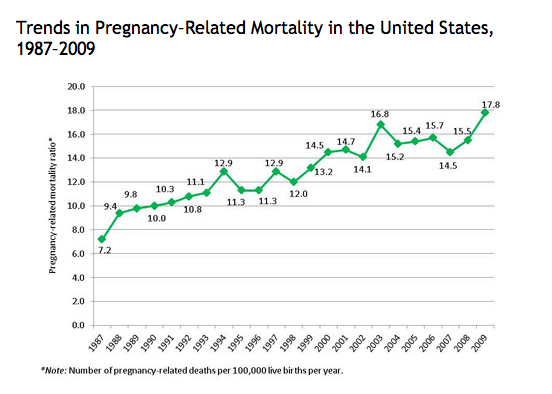
CDC pregnancy-related-death-2010_600pxAll proposed Pregnancy and Childbearing Risk Awareness legislation should reach far to include all possible complications – just as restrictive abortion legislation underscores improbable complications such as a perforated uterus or death. For example, maternal mortality is on the rise in the United States, with roughly 18 out of 100,000 women dying from pregnancy-related complications in 2013; between 1998 and 2005, the figure was much lower, with roughly eight deaths per 100,000 pregnant women. In 2011, the Center for Disease Control reported 17.8 deaths per
100,000 pregnant women, noting also significant racial disparities with a rate of 12.5 per 100,000 white women and 42.8 per 100.000 black women. The death rate from abortion is one for every one million abortions performed at eight weeks or less, one for every 29,000 abortions performed at 16 to 20 weeks gestation, and one for every 11,000 abortions performed at 21 weeks or later. Obviously, far more women die due to pregnancy-related complications than abortion complications, even at the later stages of gestation. It is only appropriate to ensure that women have the correct information so that they can decide if they really want to be pregnant and if motherhood is actually worth such possible health concerns.

Those of us who believe that reproductive justice is critical to achieving social and economic equality for women know that women can and do think for themselves in every sphere of life and most especially their reproductive lives. We also make many household and relationship decisions, not to mention educational and career decisions. We do not need politicians, pastors, or “sidewalk counselors” to help us make informed, personal decisions nor do we need them to create laws to try to impose their views on us. If they feel they must be a part of our reproductive lives, they should go about it fairly and provide complete and accurate information on abortion and pregnancy.

I’ve been writing for this blog for about a year now, and in that time I’ve never written a personal post, instead trying to elucidate some of the medical and legal aspects of abortion. I’ve spent my first two years in medical school learning all I can about abortion in politics and medicine, but it’s only in the last year I’ve begun to personally experience my first brushes with the actual impact of pro-life law, regulation, and thought.

Image

In that time I have been continually reminded of how large a role healthcare providers play in determining female autonomy, and that goes way beyond abortion. It means pharmacists unwilling to dispense emergency contraception. It means physicians at Catholic institutions forbidden from even discussing birth control, abortion, or physician-assisted suicide for terminally ill patients. It means, from the experience of two OB/GYN residents at the school associated with my hospital, forcing a poor patient who has already spent upwards of $1000 traveling from a nearby state to take off another day of work and purchase three more nights’ stay at a hotel because none of the weekend nurse anesthetists on call are willing to sit in on a surgical abortion.

And the patient interviews I’ve conducted this year have been particularly poignant for me. It is commonplace to ask about gynecological and obstetrical issues as part of a complete history. I’d already built a rapport with the first patient to tell me she’d had an abortion; she was funny and articulate, and the interview was going well. But when I asked about previous pregnancies and she mentioned her abortion, even though I made no sign that I treated it any differently than any other part of her medical history, I could see fear in her eyes. I realized she was afraid I would judge her, maybe even afraid I would say something about the decision. She quickly changed the subject.

The second interview was even more heart-wrenching. She was pro-life, and described an extensive history of physical and sexual abuse. Falling pregnant after one of a long string of rapes by an abuser, her doctor informed her she would not survive the pregnancy if she continued it, because of a severe, possibly life-threatening medical condition he’d diagnosed. She subsequently ended the pregnancy at his recommendation. Crying, she told me her illness had felt like a “blessing in disguise” for occurring when it did, because it allowed her to end a pregnancy that would have tied her forever to her abuser. How terrible have we become, as a society, when a potentially terminal illness is a “blessing” for justifying a choice that should require no moral absolution?

Two of the pro-life physicians I’ve encountered this year have displayed prominently just how important it is to be a vocal advocate. The first I met briefing with ACOG (the American Congress of Obstetricians and Gynecologists) members prior to meeting with state legislators to urge support on several bills, including the Reproductive Parity Act. During the meeting she posed her opinion that she disapproved of “abortions as a form of birth control.”

It’s one thing to hear this carefully coded language from politicians. It’s quite another to hear it from an obstetrician who should know that the majority of women who seek abortion had been using a primary form of birth control the month they became pregnant, much less in a room full of obstetricians that include multiple abortion providers, on a day intended to support a bill that would ensure equal access to reproductive healthcare.

The second was my own (former) OB/GYN in my hometown, who I discovered was the medical director of the local pro-life CPC (crisis pregnancy center), a position he failed to advertise anywhere to the patients in his practice. Giving him the benefit of the doubt, I visited the CPC that week and picked up the brochure materials they normally dispense to patients.

There I found so many medically inaccurate statements presented as fact I cannot see how any legitimate medical professional could possibly support it even tacitly, much less as its medical director. (A sampling: Plan B is an abortifacient; having more than one sexual partner over the course of one’s life reduces or eliminates one’s physiological ability to emotionally bond; abortion increases one’s risk of breast cancer, infertility, and depression; abortion of a pregnancy resulting from rape reduces one’s ability to recover from the psychological trauma of the rape.)

Image

What about the doctors of tomorrow, my own classmates? Thankfully it seems to me that the vast majority of my entering class was pro-choice, if not actively interested in reproductive health advocacy. Still, there have been a few alarming moments throughout the year. In an ethics case we were asked how to proceed with a woman who refused a Caesarian section, though the baby would die without it. It was a difficult case with no satisfying answer. Still, 5% of the class voted to force the C-section regardless of the woman’s refusal, which would be assault.

On the day of our abortion lecture, our professors played a short video of an interview with Jim Buchy, an Ohio state representative who proposed a “Heartbeat Bill” which would have banned abortion after 4-6 weeks, in which he admits he’s never considered why a woman would seek an abortion. A member of my class spoke up in support of Buchy’s stance: “If you believe a fetus is a person, I mean, it doesn’t even matter.”

I can’t help but feel that’s the overwhelming paternalistic problem with abortion opponents within the medical field: the woman’s concerns, her situation, her health, all of it “doesn’t even matter.” In the pursuit of a single moral absolute, the person most affected by their decisions simply disappears. To people who refuse to consider why a woman would seek an abortion because “it doesn’t even matter,” how can one possibly convey the desperation that would induce women to seek unsafe abortion where legal abortion is unavailable?

So what have my (admittedly few, this far into my career) experiences led me to believe about the future of medicine? It’s crucial now more than ever for pro-choice physicians to be active advocates, even if they don’t provide abortions. I worry about hospital mergers with Catholic institutions that refuse to offer even informed consent to patients, much less actual reproductive care. (In fact, the hospital associated with my medical school is undergoing just such a merger, to the worry of many students, faculty, and healthcare providers.) And while I strongly believe in the right of healthcare providers to consciously object to taking part in procedures they feel are morally wrong, I think hospitals that offer abortions should be required to have at least one member of every position required to perform the procedure on staff at any given time who do not object to helping.

And more than anything else, this last year has made me even more terrified of a future in which the pro-life movement is successful in its quest. What would this future be like for the woman who refused a C-section in our ethics case? Would forced surgery no longer be considered assault? Would it even be legal for her to refuse it? Maybe in that future, possibly terminal illnesses truly will be a “blessing” for women who do not want their pregnancies, providing not moral absolution but legal permission.


Sources:

1) 51% of women seeking abortions used a primary form of birth control the month they became pregnant; most either used it inconsistently due to a disruptive life event, or used a less effective method such as condoms: Jones R, Frohwirth L, Moore Ann, “More than poverty: disruptive events among women having abortions in the USA” (http://jfprhc.bmj.com/content/39/1/36.abstract). Summary available here: https://guttmacher.org/media/nr/2012/08/21/index.html


Anti Choice

Anti Choice

John Dunkle is an eighty-ish year old anti-abortion activist who makes his base in the Allentown/Reading, Pennsylvania area. For way too many years, he has regularly protested outside of a few abortion clinics in the area and occasionally at the home of clinic staff people.

I became acquainted with Dunkle through this blog. When I posted my stuff, he immediately jumped into the fray. For several years he almost single-handedly carried the banner for the anti-abortion crowd. Of course, we disagreed on everything but I always gave him credit for one thing: he had energy. He always seemed to have an answer, a reply, a zinger to my posts or to the comments from others. While I never agreed with him, I was always candid about my support of his ability to protest at a clinic and even at a house within certain boundaries. Indeed, years ago when the pro-choice groups were lobbying hard for passage of the Freedom of Access to Clinic Entrances Act, I took a lot of heat because I felt the First Amendment protected most forms of protest and we ultimately got language in the law saying so.

So, Dunkle regularly ranted and raved. I always found it interesting, however, when another anti-abortion person chimed in because I always thought Dunkle resented someone else barging in on “his” terrain. Then, about 18 months ago, Dunkle signed off. I don’t remember if he gave a reason, but he basically said adios and disappeared. I actually wondered if he was ill.

I will admit that I missed him in some way. I’ve always enjoyed being in the middle of the great abortion debate and I’ve always relished the opportunity to articulate my very strong convictions on this very delicate issue. And I never hid behind the “choice” word. I went right to the meat of the issue and talked about ABORTION. And I took a bunch of hits for doing so.

Anti Choice

Anti Choice

Then, lo and behold, Dunkle reappears! Like Lazarus rising from the dead, one day he just popped up and commented on a post! WTF?

I welcomed him back, as did some of the other pro-choice commentators. We had a few back and forth repostes, no damage done, then I asked him if he was still out there protesting. He said he was, that he continued to go to two clinics and a house. It was funny because, when I read that, I almost felt sorry for him. I envisioned this worn out activist, lamely standing outside of an abortion clinic, a pathetic sight to behold, shouting to the women as they entered the facility.

And then I asked him if he felt that, after all of these years, he had accomplished anything. His answer was something like that was not for him to judge. He didn’t say he had saved any babies, that he had furthered his cause, that he had made a difference. It sounded like a tired response.

I admire anyone who stands up for a cause, as long as it is done within legal limits. At least that person stands for something and is taking part in our democratic process. But I also think of Dunkle’s family, his kids, his grandkids, his wife and other loved ones who have watched him trek on down to the local abortion clinic every Saturday. I wonder if they think he has accomplished anything?

How sad.

Discussing the nuances of the case of Marlise Munoz, the legally dead pregnant Texas woman kept alive for weeks over her and her family’s wishes, my recent conversation with a pro-life friend continually circled back to one question of his: “But why wouldn’t she want the baby?”

Of course, the answer seemed obvious to me, but later I reflected more on his question, and realized why the concept seemed so absurd to him. To most pro-lifers, I think, it is incomprehensible that a woman who initially wanted a pregnancy might want to later terminate for almost any reason.

Abortion, after all, is for those women, way over there, the ones you’ve heard about but never met, despite the fact that 3 in 10 American women will have an abortion by age 45, and that 65% of women who had abortions in 2008 were Protestant or Catholic. To pro-lifers, it’s the domain of “amoral” women making an “irrational” decision they’ll regret when they get to know what having a child is truly like, despite the fact that most women who have abortions already have at least one child. And they claim it’s physically and psychologically harmful, despite the much lower risk of physical complications compared to pregnancy, and the thorough debunking of the largest study purported to show a causal link between abortion and mental illness.

None of these claims are new or uncommon, and none are really reflective of reality. But for those who desperately cling to them, the eminently insulting pro-life motto of recent years, Women Deserve Better, is perhaps more understandable (if not more palatable). But what explains the huge dichotomy between reality—at least, what little of it we can interpret from statistics—and the pro-life mythos of the woman who chooses abortion?

Image

Well, for one thing, these stereotypes are pervasive because that’s what we tend to see. What else except the self-evident “truth” of such claims would explain the dearth of stories about elective abortion in the media—stories that humanize it and display its depth as an issue? A recent analysis of television and movies that portrayed abortion showed that 9% of women who had or even contemplated an abortion died, a gross over-exaggeration of the procedure’s risk. (The actual risk of death from legal abortion is less than 1 per 100,000.)

And in public venues (like, say, slots for public testimony before legislatures considering abortion restriction bills), it is clearly only deemed “acceptable” when a woman who had an elective abortion appears regretful, wringing her hands and gnashing her teeth. Relatively very few women are willing to testify about purely elective abortions they have obtained, even if they do not regret them, and not without cause. When they do publicly discuss it, they risk serious consequences, like Lucy Flores, the Nevada legislator who told the story of her abortion as a teenager in support of a sex education bill and was summarily subjected to a torrent of death threats.

Even more subtle and pervasive than death threats is social ousting. Only days ago I had a conversation with another friend who, while she supports legal abortion, followed that up with the postscript that abortion is still “murder” and in “scenarios where I would not support her decision [I] would most likely be forced morally to cut ties with her.” Every time a friend, neighbor, or relative expresses such a sentiment (despite the high likelihood of unwittingly saying it to someone who has had an abortion), the idea that it is unacceptable to speak about the importance of abortion to the lives of real women is reinforced.

There are sadly far, far too many examples to name, but every time a politician describes abortion as an evil only terrible sinners might contemplate, he effectively silences women as well. Being told, for instance, that you are morally inferior to a rapist since “at least the rapist’s pursuit of sexual freedom doesn’t result in anyone’s death” (I’m looking at you, Rep. Lawrence Lockman) tends to have that effect.

In turn, shame-induced silence propagates the impression of absence. The void is filled by the “socially acceptable” hand-wringers and teeth gnashers who, while they certainly represent a portion of women who obtain abortions, are not reflective of the whole, or even the majority. Pro-lifers continue seeing exactly what they expect to see, and continue advancing (and believing!) the notion that abortion is tangibly harmful, not only to fetuses, but to women.

And, very, very slowly, the pro-choice movement loses ground in the culture war.

The number of people who labeled themselves “pro-choice” in the Gallup poll on abortion, which has been tallying the estimated percentages of pro-choice vs pro-life citizens since 1995, reached an all-time low of 41% in 2012. Other polling has shown an increasing number of pro-lifers among Republicans, and more disturbingly, an increase in the number of Democratic men who oppose abortion as well. While these numbers are more complicated than they appear (for instance, a personally pro-life person may still support some or all legal abortion despite his or her views), the trends over time still have a story to tell.

The Overton window is a political theory that describes a narrow range of political beliefs that are considered acceptable. The silence of women caused by systematic social shaming and a climate of public threat, combined with an increasing number of openly hostile public remarks about abortion, seems to have shifted this window significantly further to the right in the last decade. As claims of dubious medical credibility and offensive remarks about the character of women who choose abortion become more mainstream, support of abortion up to viability is slowly coming to be perceived as an extremist view.

So how can we reverse the trend?

End the silence.


Sources:

1) Gallup polling on abortion, trends over time: http://www.gallup.com/poll/154838/pro-choice-americans-record-low.aspx

2) The Pew Research Religion and Public Life Project on support for legal abortion: http://www.pewforum.org/2009/10/01/support-for-abortion-slips2/

3) Guttmacher Institute factsheet, Induced Abortion in the United States: http://www.guttmacher.org/pubs/fb_induced_abortion.html

4) Guttmacher, Characteristics of US Abortion Patients, 2008: http://www.guttmacher.org/pubs/US-Abortion-Patients.pdf

5) CDC Abortion surveillance for 2009: http://www.cdc.gov/mmwr/preview/mmwrhtml/ss6108a1.htm

6) Slate, “Characters Who Have, or Just Think About Having Abortions, Often Die”: http://www.slate.com/blogs/xx_factor/2014/01/17/abortion_in_movies_and_on_tv_often_results_in_death.html

7) Article on Lucy Flores, Nevada assemblywoman who received death threats following her testimony about her abortion at 16: http://www.policymic.com/articles/33199/lucy-flores-abortion-nevada-lawmaker-faces-death-threats-after-talking-about-her-abortion

8) An excellent article I recommend, “Abortion as a Blessing, Grace, or Gift: Changing the Conversation on Reproductive Rights and Moral Values” http://rhrealitycheck.org/article/2014/04/03/abortion-blessing-grace-gift-changing-conversation-reproductive-rights-moral-values/

9) A great TedX talk on abortion stigma: https://www.youtube.com/watch?v=FxI6HGpaP3Q

Pregnancy as an “inconvenience”

One of the greatest falsehoods of the pro-life movement is that pregnancy is merely an inconvenience, a period of temporary discomfort. This is more than a mere talking point; it’s a dangerous lie. Pregnancy is actually a life-threatening condition for many women.

The maternal mortality rate (MMR) is significantly higher in the US than in other developed countries, and the number gets even more pronounced when divvied up into demographics. The 2010 MMR in the US was 21 maternal deaths out of 100,000 live births, a number higher than 47 other countries listed by the CIA’s WorldFact report on maternal mortality. Compare this to the US Dept. of Health and Human Services’ goal for 2010 of 3.3 deaths per 100,000, and about seven times as many women are currently dying from pregnancy-related causes in the US than should be.

Shockingly, not only has the maternal mortality rate not fallen since the mid-1980s, it has actually steadily risen (the MMR in 1987 was 6.6!). But racial disparities in the MMR reveal even more appalling numbers: in 2007, black women were 2.7 times more likely to die of pregnancy-related causes than white women. A 2005 paper on the preventability of pregnancy-caused deaths in North Carolina showed that while 33% of deaths among white women were preventable, a full 46% of deaths among black women were preventable.  This is probably reflective of wider disparities: minority women are more likely to experience an unintended pregnancy, to be poor, and to receive care at lower quality medical centers than white women.

Image

Even worse, most of these figures are likely underestimated. A 2005 study compared actual rates of pregnancy-caused death to purported rates on death certificates in four regions and found a prevalent underestimation of pregnancy as a cause of death. In Massachusetts, death was inaccurately accorded to a cause other than pregnancy in 93% of the cases studied.

While the maternal mortality rate is increasing, the rate of severe pregnancy complications is also increasing. A 2009 study analyzing trends in the rates of severe obstetric complications showed a “20% increase in rates of renal failure, respiratory distress syndrome, shock, ventilation, and an approximately 50% and 90% increase in pulmonary embolism and blood transfusions, respectively” from 1998-2005. Although there was a correlation between increasing rates of (often unnecessary) caesarian section and severe complications, this only partially explained the dramatic rise in severe obstetric problems experienced by American women since 1998.

In addition, the infant mortality rate is also relatively high in the US compared to other developed countries. Despite substantial decline over the course of the 20th century, the rate of infant death has stagnated in recent years and the US international ranking for infant mortality fell from 12th place in 1960 to 30th in 2005. Abysmally, a Save the Children report recently showed that the US has the highest first day infant death rate of all industrialized nations studied in the report, 50% more than all other industrialized nations combined. And, as with the maternal mortality rate, racial disparities in the infant mortality rate are stark: according to the National Vital Statistics Reports for 2009, the mortality rate for black infants was 12.71per 1,000 live births, compared to 5.32 for white infants (and the report noted that the former is likely an underestimation).

And yet, as part of so-called “informed consent,” pro-life groups routinely tout the fallacious risks of abortion with pseudoscientific claims (e.g. increased risk of breast cancer, infertility, depression, and death) while understating the risks of childbirth. Among first trimester abortions, which comprise the vast majority of abortions, the risk of serious complications is less than .5%.  However, more than 50,000 women per year suffer from severe maternal morbidity (SMM), potentially life-threatening conditions associated with pregnancy. The rate of SMM is also increasing over time, more than doubling from 1998 to 2011. This does not include more minor complications, which are far more common in pregnancy (94.1% of the pregnancies in 2008) than first trimester abortion (2.5%).

Image

What should we be doing?

 First, and perhaps most importantly, we need to gather information. Why, besides increased caesarian sections, are the rates of severe obstetric complications increasing? Why is the maternal mortality rate increasing so steadily despite the $86 billion spent on pregnancy and childbirth in the US per year? How can we standardize data collection to ensure accurate information on maternal health outcomes across the board? What programs can hospitals institute to reduce the rate of mortality for women and infants?

Although we have some notion of risks associated with maternal and infant death, our data is far from complete. In 2011 the Maternal Health Accountability Act was introduced to provide grants to create state-level maternal mortality review committees to standardize data collection and eliminate disparities in health outcomes. The bill unfortunately died in a Republican-controlled committee.

Otherwise, we are aware of many of the risks and should be able to address at least some with public policy. Higher risk of infant mortality is associated with preterm birth, which is associated with teen pregnancy, unplanned pregnancy, and poor/minority mothers.

These risk factors overlap significantly; for instance, teen mothers are more likely to be poorer, less educated, and to receive less prenatal care than mothers in other groups, and 70% surveyed in a 2004-2006 North Carolina study indicated that their pregnancies were unintended. Similarly, poor and minority women are less likely to receive prenatal care, and minority women are more likely to be poor and have higher rates of unintended pregnancy than other women as well. As for maternal mortality, disparities in access to prenatal and labor care and family planning; poverty; and minority status are all major risk factors, and these also often overlap.

While the problem is systemic, it can be tackled in very specific ways. One of the most important steps in tackling poor health outcomes for mothers and infants is to reduce unplanned pregnancy, which is indirectly associated with both infant and maternal mortality, since the groups at highest risk of dying of pregnancy complications and/or losing an infant are also at very high risk of unintended pregnancies. The major means of accomplishing this goal are to offer comprehensive sex education to adolescents, to increase public funding to family planning clinics, and to make access to reliable contraceptives as universal as possible.

Every one of these things has been directly evidenced to reduce the rate of unintended pregnancy. Comprehensive sex education is associated with reduced rates of teen pregnancy. Conversely, abstinence-only education has not been correlated with lower rates of vaginal intercourse, and states with abstinence-only or non-requisite sex education programs consistently have some of the highest rates of teen pregnancy in the nation. But that doesn’t stop pro-life politicians from routinely insisting on abstinence-only programs, despite their marked failure year after year.

Image

For six in ten patients using publicly funded family planning services, it is their primary source of health care. An estimated 1.94 million unintended pregnancies and 810,000 abortions are prevented each year by use of public family planning clinics, but as I noted in my last article, they only meet a paltry 40% of the need. Increasing funding to family planning clinics, and therefore access to preventive services and contraceptives, would further decrease the rate of unplanned pregnancy. However, Republican politicians in numerous states consistently cut funding to family planning and women’s health services.

To give an example of the cognitive dissonance so prevalently present between stated pro-life ideology and the consequences of implementing pro-life laws, let us take Texas for an example. In 2011, as part of a sweeping pro-life agenda to shut down Planned Parenthood (the ultimate abortion scapegoat, despite 97% of its services being non-abortion related), Texas slashed family planning funds by 2/3 and barred Planned Parenthood from receiving funds from the Texas Women’s Health Program, resulting in a 77% reduction in the number of patients using family planning clinics, in a state that ranks first in the nation for the number of uninsured, 8th for poverty, and 3rd for teen pregnancy.

The maternal mortality rate has quadrupled in Texas in the last 15 years to 24.6, and even after improvement from 2009, the 2010 demographics are abysmal and much higher than the national average (27, down from 30.8, for white women, and 53.9, down from 66, for black women). For reference, that means black women are statistically better off giving birth in Mexico or Kazakhstan than Texas, and that white women would be better off in Saudi Arabia.

In addition, despite the incredibly high teen pregnancy rate, Texas schools stress abstinence education, do not require contraceptive education, and do not require that sex education be medically accurate. The budget cuts for women’s health care have also decreased the number of clinics that offer preventive healthcare for sexually active teens without parental consent or notification.

Every policy outlined above is one that increases the rate of unintended pregnancy, especially in populations more highly prone to infant mortality (teens) and maternal mortality (poor and minority women). Far from being “pro-life,” Texas has implemented a set of policies that will result in the unnecessary deaths of women and infants. It has instituted legislation that directly decreases access to contraceptives, preventive screenings, checkups, and prenatal care. These in turn lead to increased rates of poor health outcomes for pregnant women, as well as unintended pregnancy among the groups least likely to want or afford pregnancy or children. Simultaneously Texas has instituted sweeping anti-abortion policies that vastly remove access to abortion for women who can’t afford prenatal care or postpartum checkups.

The state ironically takes no responsibility for its own role in making women’s lives worse, exhibiting Orwellian double-speak about personal responsibility even as politicians systematically remove the resources women would otherwise use to BE personally responsible for their reproductive destinies.

All of Texas’ legislative actions aimed at shuttering the Planned Parenthoods in the state are particularly cruel considering they have also declined to expand Medicaid, leaving many poor and minority women nowhere to turn for contraceptives, preventive healthcare, and prenatal care. The Texas Policy Evaluation Project’s survey of low-income women following Texas’ 2011 budget cuts found that “now more than ever disadvantaged women must choose between contraception and meeting other immediate economic needs.”

Texas, sadly, is not alone. Many other states are likewise instituting anti-abortion restrictions while failing to address the unmet need for family planning, expand Medicaid, increase access to prenatal and postpartum care, or offer comprehensive or medically accurate sex education. Far from being an “inconvenience,” pregnancy is a condition fraught with major risks of health complications for both mother and infant. And when legislators intentionally limit abortion access while failing to address the increased risks of maternal and infant death that accompany high unintended pregnancy in poor, uneducated, teen, and minority women, they really don’t deserve to be called “pro-life.”


Sources:

1) “Deadly Delivery: The Maternal Health Care Crisis in the USA.” Amnesty International.  http://www.amnestyusa.org/sites/default/files/pdfs/deadlydelivery.pdf

2) Berg CJ, Harper MA, et al. Preventability of pregnancy-related deaths: results of a state-wide review. http://www.ncbi.nlm.nih.gov/pubmed/16319245

3) Hasnain-Wynia R, Baker DW et al. Disparities in health care are driven by where minority patients seek care: examination of the hospital quality alliance measures. http://www.ncbi.nlm.nih.gov/pubmed/17592095

4) MacDorman MF, Mathews, TJ. The Challenge of Infant Mortality: Have We Reached a Plateau? http://www.ncbi.nlm.nih.gov/pmc/articles/PMC2728659/

5) “Surviving the First Day: State of the World’s Mothers 2013”. Save the Children: http://www.savethechildrenweb.org/SOWM-2013/files/assets/common/downloads/State%20of%20the%20WorldOWM-2013.pdf

6) CIA World Factbook rankings of countries by maternal mortality rate: https://www.cia.gov/library/publications/the-world-factbook/rankorder/2223rank.html

7) Kochanek, K., Xu, J., et al. Deaths: Preliminary Data for 2009; National Vital Statistics Reports. http://www.cdc.gov/nchs/data/nvsr/nvsr59/nvsr59_04.pdf

8) Xu, J., Kenneth, D., et al. Deaths: Final Data for 2007; National Vital Statistics Reports. http://www.cdc.gov/nchs/data/nvsr/nvsr58/nvsr58_19.pdf

9) Gaskin, Ina. Maternal Death in the United States: A Problem Solved or a Problem Ignored? Journal of Perinatal Education, 2008.  http://www.ncbi.nlm.nih.gov/pmc/articles/PMC2409165/#citeref9 

10) Deneux-Tharaux, C, Berg, C, et al. Underreporting of Pregnancy-Related Mortality in the United States and Europe. 2005: http://opac.invs.sante.fr/doc_num.php?explnum_id=4060

11) CDC fact sheet on Severe Maternal Morbidity in the US: http://www.cdc.gov/reproductivehealth/MaternalInfantHealth/SevereMaternalMorbidity.html

12) National Abortion Federation fact sheet on the risks of abortion: https://www.prochoice.org/about_abortion/facts/safety_of_abortion.html#n5

13) Elixhauser A, Wier M. Complicating Conditions of Pregnancy and Childbirth, 2008. http://www.hcup-us.ahrq.gov/reports/statbriefs/sb113.pdf

14) “Unintended Pregnancies: 2004-2006 N.C. Pregnancy Risk Assessment Monitoring System (PRAMS)”  http://digital.ncdcr.gov/cdm/ref/collection/p249901coll22/id/22589

15) An epidemiological review of the effects of comprehensive, abstinence-only, and lack of sexual education on the likelihood of teen pregnancy and rate of intercourse: http://www.jahonline.org/article/S1054-139X(07)00426-0/abstract

16) Teen pregnancy rates by state: http://www.livescience.com/27417-teen-pregnancy-rates-by-state.html AND, for comparison, a brief on state policies on sex education: https://www.guttmacher.org/statecenter/spibs/spib_SE.pdf

17) Guttmacher news release on unintended pregnancies and abortions prevented by the use of publicly funded family planning services: https://guttmacher.org/media/nr/2009/02/23/index.html

18) 77% fewer Texas clients for family planning clinics: http://rhrealitycheck.org/article/2013/11/21/after-budget-cuts-texas-family-planning-program-serving-77-percent-fewer-clients/

19) Texas has highest uninsured rate and ranks 8th for poverty: http://dfw.cbslocal.com/2013/09/17/texas-has-highest-uninsured-rate-high-poverty/

20) “Republicans Offer an Obamacare Alternative,” Time Healthcare online: http://swampland.time.com/2014/02/03/obamacare-republican-alternative/

21) The Texas Policy Evaluation Project, “Low-Income Women’s Attitudes About Affordable Family Planning Services” http://www.utexas.edu/cola/orgs/txpep/_files/pdf/TxPEP-ResearchBrief-WomensAttitudesAboutFPServices.pdf

Part 2 of 3

By K.J. Farrell

In Part 1 of this three-part series, the focus was concern that the anti-abortion movement has with numbers in the claims that the media discriminates against them. News coverage and extremist branding are the focus of Part 2.

News Coverage Generally

Anti-abortion complaints about the lack of media attention to their annual 1/22 protest against Roe v. Wade were not justified. As noted in Part 1, there was coverage by all major media sources. The annual Roe v. Wade protests are predictable. Given the intense, real-time competition for consumers of print, online, and broadcast news, priority is given to issues of concern to the market – frigid weather and sports this year. There was no ideological media bias involved.

In addition to the Roe protest, anti-abortion groups do not think that their so-called “pro-life” bills are receiving proper attention. Media coverage of restrictive abortion legislation is newsworthy given the impact on social policy and law.  Even pro-choice bloggers have observed that basketball has received more media attention. After the media reports the initial announcement of the legislation, though, how many repetitions of predictable responses are necessary or beneficial?  Image

Why is it that anti-abortion organizations make such a fuss about media discrimination or bias but, aside from some random pro-choice blogs, there is little complaint from the pro-choice organizations? Why do they think the media favors the pro-choice position, especially given the lack of attention to the restrictive abortion legislation and its intent to erode reproductive rights for women?

One reader raised an interesting point: Any ideological bias on the part of the media could actually be steeped in religious views that favor the anti-abortion position.  Consider a 12/13  Harris Poll that revealed that 74% of U.S. adults believe in God; 54% believe in God with absolute certainty. In another survey, “only 21% of Americans believe humans beings evolved without involvement from God.”  When press coverage is poor or unfavorable, pro-choice supporters could make the claim that ideological bias towards the religious leanings of the anti-abortion movement is responsible.  What I do hear from the anti-abortion community regularly is reference to the religiosity of “most Americans” and message-manipulated polls that “most Americans” support the anti-abortion position. Thus, it would seem a bit of a contradiction: “Most Americans” would include the media. Therefore, if most Americans are religious and against abortion, media discrimination would be against the pro-choice position. Right? This premise takes me back to the questions, “Why all the fuss? Is there discrimination?”

Abortion-Related News and the Marketplace

Let’s look beyond the annual Roe v. Wade events. The criminal trial of former Dr. Kermit Gosnell is continually cited as evidence of media bias favoring abortion rights. I addressed media coverage of the case and will only say here that as egregious as the case was, the media did cover it fully, beginning with the indictment. It is insulting for anyone to suggest that the pro-choice community wanted it kept quiet – if anything, they wanted it exposed to illustrate what can happen when abortion is inaccessible, especially to poor women.

At this writing, there are 261,000 search engine results for the “Gosnell case” – 551,000 for his name alone. There are 86.5 million for “George Zimmerman case”, 12.5 million for “Jodi Arias case”, and 38 million for “Casey Anthony case” – exponentially more for each when “case” is excluded. Yes, the media responds to the marketplace.

Although anti-abortion groups claim that Americans are on their side, they clearly had/have more interest in cases unrelated to abortion or Gosnell. It would be the same situation if a fertility doctor or OB/GYN was found to be violating standards and law, or an adoption lawyer lost his license due to fraud. Media has ethical and practical responsibilities that are more important than the wishes of activists dedicated to a polarized issue. (Does anyone recall the name of the fertility doctor and the professional consequences he had as a result of his involvement in the Nadya Suleman multiple pregnancy? Probably few of you…but you know the names of all others referenced here.)

ImageThe recent “No Taxpayer Funding for Abortion Act” (NTFAA) that the House of Representatives recently passed will not likely be introduced in the Senate and, even if it was, President Obama would veto it. The Hyde Amendment already ensures that federal dollars cannot be spent on abortion. Prior versions of the NTFAA included language that introduced the political nuances to the legal term of “forcible” rape. This version is really about stopping insurance companies (private) from providing abortion coverage even though more than 80% include it with other reproductive services, including fertility services. The media knows that it will never be passed. Will coverage benefit their advertisers? No. Editors clearly decided that the coverage provided was sufficient to inform the public.

Contrast the coverage of the NTFAA to the political-conservative-initiated boycott of Girl Scout Cookies that began when the Girl Scouts supported Texas Senator Wendy Davis as someone who could be considered a Woman of the Year. Davis is pro-choice so, naturally, that means the Girl Scouts include abortion rights as part of their agenda. They actually have no position on abortion. Their agenda is developing girls into strong, independent women. Period. Role models are from all political and professional backgrounds.Image

The Girl Scout cookie boycott is newsworthy because the cookies are such an icon of Americana. Few have not had the pleasure of Thin Mints or Trefoils.  Most organizers of boycotts want news coverage.  Media did not create the news – press releases did! But, anti-abortion strategists realize that this is not the kind of news that will help their cause. That leads to the matter of branding with extremism.

 The Branding of the Anti-Abortion Movement by Extremists

Think about the purpose of news – to inform so that readers can form their own opinions. At times, the “goal to be truthful and objective can be at odds with journalistic ethics“ (Carole Rich, PracticalBioethics.org 1994). Those reporting the news must be responsible.

In the summer of 1991, when the notorious Operation Rescue was protesting outside of the clinic of the late Dr. George Tiller in Wichita, Kansas, a human fetus was pulled out of a jar to illustrate what a late term abortion produces. Responsibly, the media refused to show the dead fetus because there was no evidence that it was connected to Dr. Tiller. Neither the age nor the source of the prop could be verified. Reporting about the fetus took place but without visuals and with context provided to avoid implying that the fetus was from the clinic (Rich).

Operation Rescue was upset that photos of the fetus were not shown. Some anti-abortion groups were upset that it was reported at all because they believed that the media was conspiring to paint all anti-abortion activists as radicals.

To be fair, during the very contentious post-Roe era of Supreme Court decisions, in the late 80’s and early 90’s, the media did seem to provide more coverage of anti-abortion activities that involved violence or highly charged characteristics. Various surveys of abortion news concluded that while most likely not intentional, the pro-choice perspective had more column inches about their activities as well as more positive coverage. This prompted news organizations to initiate policies about abortion coverage that remain in place. That said, violence is newsworthy. The media doesn’t control absurd anti-abortion strategies staged for press. Through violence and shock tactics, the anti-abortion movement has branded itself. They have themselves to blame for the media coverage that they find unfavorable. By no means is it discrimination for the media to cover unusual tactics.

When conservative politicians try to justify anti-abortion legislation, they often mention that their constituencies are “everyday” people, not wild eyed religious zealots. It is hard to be convincing when, for example, a person interviewed about traveling to a protest refers to busloads of traveling companions as “die-hard Catholics” and “soldiers of Christ” or when an organizer for an event to celebrate the closing of a clinic in Missouri states that credit for the closure goes to God and those who pray daily.  Worse for politicians is when their colleagues, in promoting the anti-abortion position, discount rape or imply that the sex lives of women are the problem.  It is also challenging to justify public policy dependent on falsehoods.

No organization appreciates it when an inappropriate source is interviewed or a representative performs poorly. It happens. Among the anti-abortion representatives, there seems to be a preference for people who have no capacity to listen, an inability to be or sound reasonable, and talk over people with unproven, false talking points. In July, 2013, should the media have ignored it when former Pennsylvania Senator Rick Santorum “criticiz[ed] the media for portraying the [extremely restrictive abortion] legislation as radical instead of…part of a movement of love”? Had the media not reported, it then would have been accused of withholding media criticism from the public.

ImageThe media is not discriminating when religious zealots, ignorant politicians, and inarticulate organizers who alter or deny facts serve as contacts. Years ago, anti-abortion supporters complained that the very articulate, attractive, African American President of Planned Parenthood, Faye Wattledon, was quoted or interviewed so often. Their position was represented by James Dobson of the Family Research Council or Gary Bauer of Focus on the Family. NARAL’s Kate Michelman and NOW’s Molly Yard also spoke to the national media on the pro-choice side. Eagle Forum’s Phyllis Schlafly, National Right to Life’s John Wilkes or Wanda Franz, and religious leaders Jerry Falwell and Pat Robertson did for the anti-abortion side. Criticism about higher quality spokespeople on the opposing side was an internal issue in the anti-abortion movement – it was not discrimination.

Many of us supporting the pro-choice position are ardent supporters of free speech. We do not want a part of any discrimination towards an opposing view. It is safe to say that there is no discrimination in the news coverage of anti-abortion views or activities.

Stay tuned for Part 3, which will focus on the semantics of the abortion issue and the real discrimination that exists in the media coverage of abortion.