ImageYou are forever talking about what you know is right for women, what women want, and what they really need.   You’ve even told clinic staff, doctors and nurses that you know they could do better in another line or work. With your particularized notion of moral righteousness, you’ve lodged complaints with police about what you know are your rights to free speech at abortion clinics. You’ve written letters to private citizens, neighbors of doctors and clinic directors, asking them to tell these professionals to find a new job, because you know better, you know what’s right. But your self-obsession as well as your presumptuous omniscience conveniently ignores the rights of others and summarily dismisses the knowledge women have of their own lives. Behaving, as you are wont to do, foolishly believing you are right when you are really wrong on so many levels, you reveal more truths about your nature than you might imagine or want. Let me spell it out for you.

  • To begin, it’s not right when you call escorts, staff, and doctors murderers because they don’t murder anyone. The carnivalesque act of calling someone a murderer is convenient because it frees you from thinking about the sacredness of women and men who offer and choose abortion services.
  • It’s not right when you use grotesque images that defy the reality of abortion. Aborted fetuses look remarkably different from all the manipulated grotesque images you use in your visual propaganda. Using such images only serves to shame, hurt and demonize women and, consequently, alienate them to your message.
  • It’s not right to say that All Women Regret Their Abortion. Documented scholarly evidence illustrates that overwhelmingly women have no regrets about their abortion. Not one bit. People make choices and live with them. It’s called life. Some women have sadness about their choice to end their pregnancy, but choose abortion anyway because they know it’s right for their situation. Your bombastic overgeneralization only makes you look ignorant and desperate.
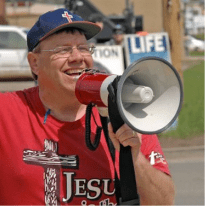
  • Forced Birther Screaming in Women's ears with Megaphone

    Forced Birther Screaming in Women’s ears with Megaphone

    It’s not right to scream at women we’re here to help you. Take a good look at yourself. You’re a stranger who is screaming. What reasonable person would want to trust you or anything you say? It makes you look doubly foolish and deceitful when you follow with the disingenuous high-pitched scream God loves and so do we and, immediately afterward, shout, you’ll regret this day the rest of your life. Again, take a good look at yourself for you are nothing but a vacuous and mean-spirited provocateur.

  • It’s not right to publicize your own sexual fears and perversions. Telling women that the doctor will perforate their rectum and uterus illustrates your own salacious fascination with debauchery. Telling well-endowed women with cleavage, “You look like you’re all set up for breastfeeding” reduces you to a common pervert. Telling women to abstain from sex reveals your prudish anxiety about human sexuality.  In your ill-conceived attempts to lie about body parts and sexual matters, you embarrass yourself in a most undignified way, earning a big fat 10 on the Ick Factor Scale.
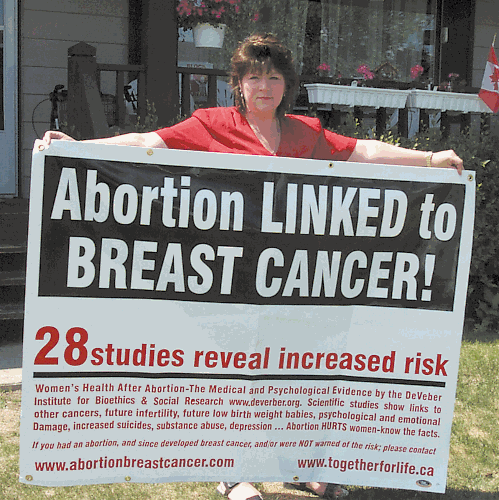
  • It’s not right to lie. Remember thou shalt not lie? Until you have an M.D. after your name, you should rely on reputable medical and scientific sources and not junk science in LifeSiteNews. The evidence is there for you to read. Let’s face it. You rely on the scientific and medical credibility of pediatricians, cardiologists, dermatologists and internists. Yet you throw out medical and scientific evidence when a gravid uterus is involved. Here’s the evidence: There is no post abortion stress disorder. There is no abortion-breast cancer link. There is evidence that the morbidity and mortality in pregnancy and childbirth can be more dangerous than abortion. It’s also a fact that the United States is 50th in the world for maternal health. Such transgressions illustrate the disturbed fascination with fear mongering that is your lingua franca.
  • It’s not right to inflict your religion on others. Humiliating and dehumanizing women is morally unacceptable.  Manipulating your faith to justify your heinous actions displaces your responsibility onto your God.  Like the Nazi war criminals that claimed they were only following orders, you antiabortion protesters claim you are doing God’s will. Barking like a madman “in the name of Jesus” as preface to a hurl of toxicity hardly seems godly. Face it; your morally bankrupt behavior only serves to show how unchristian and blindly intolerant you are towards others.
The Anti Abortion Brain

The Anti Abortion Brain

When I think about the pornography of your madness, your frothing, detailed rendering of humiliation of women and men who choose and provide abortion services, I have to say that the unintended consequences of your own behaviors illustrate how karma works. In plain English, you get what you give. And what you give is intolerance, disdain for truth, misogyny, desperation, alienation, and misanthropy.

God Hates

God Hates

Dear M and S,

I do not ask for understanding, but comprehension.  You both have questions.  Some I’ve answered, insinuated, or obscured for the normal parental reasons.  I owe you, though, the story as I remember it so you may understand through comprehension how dangerous it is, even in the 21st Century, to contradict and undermine conventional thinking.  I hope our family’s historical facts illustrate our ongoing obligation to confront fundamental Pentecostal thinking so we move forward, not backwards.  I am now a mere four years younger than your grandfather when one blinded by fundamentalism and the hate it naturally engenders created a symbol of the man who you never knew.

I last saw my father on Sunday, 7 March 1993.  We did not see each other often, but we talked with relative frequency and were repairing a fairly entrenched rift in our relationship that began 10 years prior when he left our family for another woman after moving us—your grandmother, aunt, and I—to a shit small hovel of an antiquated old southern town in Alabama split between the poles of old blue blood southern aristocratic antebellum money and dirt floor poverty.  Dad came and stayed the weekend with me in Birmingham as he did infrequently.   Three days before his visit, I’d had my wisdom teeth removed.  He called, as he was want to do, late in the afternoon on Thursday or Friday and announced he was coming into town and would be staying with me.  It was a conversation like any other and I don’t recall any real detail other than he was coming.

I know he stayed over at least Saturday and Sunday 6 and 7 March 1993.  I have no memories whatsoever of Saturday night; yet, I do vividly remember Sunday dinner, can still see the round wooden table and mismatched chairs I took from home when I moved away in 1989, and know we grilled cow protein of some form or another—it was probably a New York Strip as I’d not developed an appreciation for the rib eye yet.  Due to the recent dental surgery, the steak, though cooked appropriately, was difficult to chew which made it more difficult to swallow.  We enjoyed our meal, some more than others, while Billie Holliday gently but huskily sang in the background.  Our conversation drifted from school, to my sister—she was 17 and in the final days of her senior year, to politics—President Clinton had just been inaugurated, to my progress in school, and to his work.

Dad explained the protesters were becoming ever more aggressive and confrontational. The few protesters I personally encountered a few years prior when I traveled the circuit with dad were the typical abortion porn sign holders and silent layers of hands. In my teen years, I found his weekly schedule nothing but normal though it took him from our small town hell to Columbus, Georgia then to Montgomery, Alabama, then to Mobile, Alabama, and finally to Pensacola, Florida only to resume anew the next week.  Other kids’ parents traveled so what was so different about his schedule?  I did not figure out until much later that he made this circuit because no one else would.  I certainly never took it a logical step further and deeper to ask why no other local doctor in Columbus, Montgomery, Mobile, and/or Pensacola serviced these clinics.  It was my normal and I was 14 when I first started driving him on some of his trips; yet, as we discussed the present situation, I noticed he seemed preoccupied.  We finished our meal, drained a few more beers, and awoke March 8 and said our goodbyes.

I was aware clinics were bombed in the past and even asked him once if he ever worried about one of the clinics he serviced getting attacked.  He reassuringly told me it did not concern him, and he went on with his day.  Over the weekend of his last visit, though, I thought about the heightened protests, and the ever increasing threats of violence; additionally I remembered my mom calling me one afternoon about a year before this final visit to tell me strangers were in town passing out wanted posters of dad which included his weekly schedule.  When that incident occurred, he again brushed off our concern and said he was not preoccupied with the actions of some crazies.

That Monday morning, prior to seeing him off for the last time, I confronted him about the posters, the renewed threats, and told him I was scared for his safety.  Dad finally told me he had been carrying a gun for a few years, that he suspected he was being followed frequently, and that a strange protester approached him that previous Friday (would have been 5 March) while he was in the car leaving the clinic in Pensacola heading my way.  He said this man had an eerie look about him and spoke to dad through his car window while staring deeply at him with glazed long staring maniacal eyes.  I remember asking when the stalking started, and he indicated it had been going on at least as long as the wanted poster’s origination about a year or so earlier.  I asked if he considered quitting the circuit and going back to less controversial OB/GYN care.  He told me if he stopped, it would be difficult to find a replacement and he was committed to his patients.  He left headed south, and for the first time I admitted to myself that he had a dangerous job and as anyone whose parent has a dangerous job, I wrapped myself in the warmth and security of “not mine”, “not this time”, and drank the Lethean water temporarily cooling my angst and trepidation.

I spoke with your grandfather again on 9 March 1993.  We did not discuss anything specific.  I was preparing for exams; he was in another of the endless line of hotel rooms and sounded lonely.  Sadly, our terminal conversation was brief and unremarkable.  He indicated he was well and heading to Pensacola, and I told him to be safe.  In retrospect he seemed to hang on the line as though he did not want the conversation to end; yet, neither of us could find a way to carry it forward.

I drove to class the next morning on what was, otherwise, an exceedingly peaceful and beautiful spring day in Birmingham.  I’ve always preferred living in Birmingham than other cities as it is big enough to provide some degree of needed anonymity; yet, small enough to retain remnants of its prior smallness which is both sides of the pole simultaneously.  As I was studying for a Semantics class, dad was driving to work.  As I got into my car to head home, he was very likely getting out of his for the last time.

You guys have never seen a real answering machine as far as I know since everyone has digital voicemail these days.  In ’93 you were lucky to have the kind with a microcassette (I’ll explain that later) that was the size of a stereo component.  I don’t recall who checked the messages on the afternoon of 10 March—my at the time girlfriend or me—but I remember thinking it odd to get a message from my grandmother in the middle of the week in the middle of the day.  It was an altogether cryptic but clear message.  She simply said “call me when you get home.”  Both of you are still too young to know there are certain messages you don’t want to return.  I don’t mean the messages from people you’ve left behind or don’t want to talk with at that particular moment, but the messages from family purposely ambiguous so you are intrigued enough, but not too scared, to return the call as soon as you hear the message.  Of course I sensed something was wrong, and, logically, I feared it involved dad.

Dad called me one night in January surprisingly upbeat and happy sounding.  It was the night of the 20th anniversary of the Roe v. Wade decision (Supreme Court decision that guarantees a woman’s right to an abortion as you may or may not know when you read this; I’ll get to abortion proper later), and he actually to and was genuinely excited to share his day with me.  First, he said someone from Rolling Stone magazine contacted him recently looking to do a profile on his experience as one of the few Southern abortion providers; secondly, he told me how he had finally had enough of the protesters and their bullshit.  He then described how he sang “Happy Birthday to You” at the protesters outside one of the clinics in Montgomery and in the penultimate verse added, “happy birthday dear Roe v. Waaaade.” He subsequently aimed a small boom box at those gathered outside the clinic and played Tom Petty’s “I Won’t Back Down” singing loudly along.

For some reason, I thought of this event as well as the suspicious protestor dad described over the weekend as I returned my grandmother’s call.  When she answered, I immediately knew what I suspected was true; yet, we had to play out the charade.  I asked her why she called.  She asked if I had seen the news.  I told her I had been at school studying.  She said good.  I asked why.  She then told me what I intuitively knew.  “Your dad was shot,” she said and I could hear her sadness as she said it.  I asked if he was ok thinking people survive gun shots routinely.  She told me he wasn’t and that he died e route to the local hospital.  She said she was sorry, that she loved me, and asked that I call my mom.

One day both of you will confront my mortality.  Let’s hope it is much longer than four years from now when I’ll be 47 which is how old your grandfather was when he died.  I know that seems old, but it is really very young, and when you hit forty, you’ll both realize how young it is.  My desire is you are prepared for it and it doesn’t pounce on you from behind a corner while you’re busy reading some goddamned semantics notes.

I drove to my mother’s house where some friends and my sister had gathered.  We hugged, cried, and watched cable news run the story of dad’s death and label him “the first abortion doctor to be murdered” ad infinitum.  You have to contextualize the nature of the event and times to truly understand.  On one really used the internet, e-mail was barely in anyone’s vocabulary, and few people had cell phones.  CNN was the only 24 hour news source (it’s hard to conceive of life without Fox, but it was pleasantly non-existent at the time).  Abortion clinic violence was still considered fresh news and had not yet matured and then expired.  In laymen’s terms, your grandfather’s assassination was a big fucking deal, and was the news for days, months, and years as more doctors and nurses in the abortion field died violently.  Cable news still had some decency about the images they showed, or they were simply too late to get images of your grandfather’s body.  The image I recall from that spring day is a shot of his bloodstained glasses disfigured and broken in the grass where his body most assuredly fell.

Within hours of the killing, my mother’s phone started an interminable ringing which would not abate for months.  On the other end of the line was a New York Times reporter looking for comment.  I considered whether or not we wanted to talk, I had mixed feelings of surprise and anger at being asked for comment on the day I found out my dad was dead, and I had no idea what to do given our family’s life capsized, up righted, capsized, and sank in the span of a few hours that afternoon.  We had large issues confronting us:  burial, finances, familial relations, loss, and grief, and it was overwhelming to add media and politics into the mix.  Initially, I wanted to simply hang up on the woman from the Times; yet, I remembered how joyful dad was when he thought someone was finally going to tell his story and write about the insane conditions under which he worked all at the hands of fundamentalists.  I also remembered his calm happiness when he relayed the events of 22 January 2010 and how he joyously sang in defense of his profession and services.  I made a decision, asked for the reporter’s name and number, and said I’d call her back later as we had other pressing needs to address.

I always wondered if the protester dad described to me the weekend before he died was Michael Griffin, the man who assassinated your grandfather.  If so, he looked into the eyes of his assassin five days before he struck, and it was the last time he looked into his eyes as Griffin attacked from behind too cowardly to face the person he hated, stalked, and still feels deserved to die.  I am still convinced others were involved in dad’s assassination.  There was an organized protest in front of the clinic the day

Griffin struck, and the organizer of the protest had witnessed to Griffin in the weeks leading up to the assassination.  This self styled minster had an effigy of your grandfather in his garage, and I do not doubt he influenced or seduced Griffin to take his violent action.  I will tell you more about these events as I continue the story.

To this day I cannot forget the image of his glasses. I also continue to celebrate his fine voice which was inspiring to me personally and has proven inspirational to others.  I am now the dad where I once was the son, and it is my obligation and duty to pass this history on to you so, perhaps, in some minor way, it helps  you understand the essence and roots of hatred as well as how one fine voice can make all the difference if you simply sing out.

With love

PS. The title was taken from Treblinka by Jean Francois Steiner

Abortion

Abortion

We are very fortunate to have Ms. Heather Cale join our team of bloggers.  She is clearly an intelligent young woman who cares a lot about reproductive health issues.  And her research is not only impeccable but exhaustive.

Last week she wrote about “late term abortions” from a generally scientific point of view.  She talked about brain waves and all of that other stuff that some people really get into.  The idea, of course, is to try to determine when the fetus becomes “human” or exhibit human traits, like responding to pain.

I will be the first to admit that I glazed over a lot of the stuff that Heather wrote about because, to be honest, much of it was just way over my head.  And, I’m just not sure how relevant it all is.   This is not to criticize this well written piece but for many, many people – especially those women who have late term abortions – issues like when the cerebral cortex is developed are just irrelevant.

I’m reminded of a woman I met years ago at an abortion facility in Michigan.  At the time, I was with the National Coalition of Abortion Providers and I was touring some clinics for a few days.  Always interested in getting the real-life perspective of a women sitting in that waiting room, I asked the clinic staff if I could accompany one of the women and the woman agreed.   She was 22 weeks pregnant.

After filling out paperwork, we went into a room to get an ultrasound.  The technician rubbed her stomach with jelly, turned the machine on and suddenly you could see the fetus on the screen.  The woman’s first response was “is that my baby?”   I was flabbergasted.  Note she did not use the word “fetus.”  To her, it was a baby.  The technician said that was her baby and then started pointing out the head and other parts of the body.  The patient could not take her eyes away from the screen.  I was frozen and practically in tears, but the women never showed any emotion and just asked several questions about her baby.

Then the technician asked her if she wanted to continue to process and the woman without hesitation said she did.  As if she thought she needed to explain, she told us that she had three children already and could not possibly imagine having another one.  “I gotta think about the children I have already,” she added.  I asked her why she had waited so long and she explained that she could not get the money right away, the irony being that the cost of an abortion increases as the fetus develops.  Of course, if there was no such thing as the “Hyde Amendment,” then this woman would have been able to use her Medicaid card to get an earlier abortion.   Don’t get me started on that issue…

What was interesting to me was that this never asked if the fetus would feel pain, never asked about its cognitive functions, brain waves and all of that other scientific stuff.  In her eyes and mind, she was carrying a baby, pure and simple and she had to think of the real-world consequences of giving birth to that baby.

The science of this issue is very interesting, but that debate will never end.  Meanwhile, we just have to continue to insure that late term abortions continue to be available to women like the one I met in a Michigan abortion clinic.

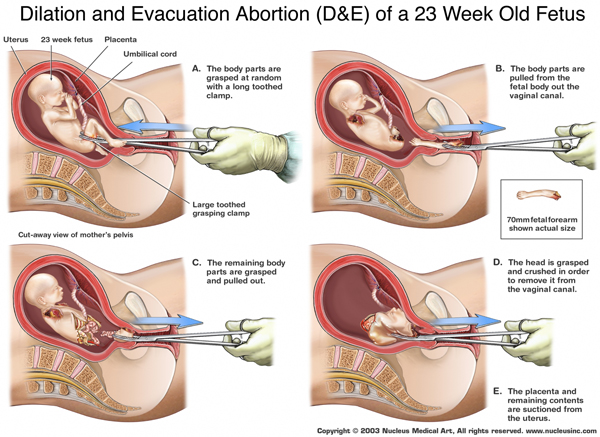
Let’s face it: most people view late term abortions as a pretty hideous thing, and that opinion is one of the few to cross the pro-choice/pro-life divide. The pro-life side is aware of this, which is why a substantial amount of propaganda focuses on the method of late term Dilation and Evacuation procedures and attempts to conflate it with earlier term abortions, to pair a false equivalence with emotional appeal. (I’ve seen the following picture—or one very much like it–shared from multiple conservative sites online, as well as handed out by abortion protesters at clinics or demonstrations.)

Image

What has been striking to me, however, is how prevalent the ignorance of issues relevant to late term abortion tends to be on both sides of the divide. On both sides, I often encounter ignorance as to why women might choose to seek late term abortions in the first place (although this is more prevalent among pro-lifers), and about the relevant physiological details in terms of fetal development near viability.

Is there a secular argument for late term abortion bans?

Actually—surprisingly—yes.  Essentially, the ethical considerations around abortion all center on the question of what defines a “person.” While it remains a hotly debated philosophical and religious question, it’s also one that we can attempt to answer scientifically. One answer is viability, and the landmark decision in Roe v. Wade adheres to this measurement. This in itself is a somewhat blurred line because each pregnancy is unique and the point at which different fetuses becomes viable is variable. Still, the court decision defined viability as between 24 and 28 weeks’ gestation. With new medical advances over time, the limit of viability (the gestational age that ensures a significant chance of survival outside the womb) has fallen to earlier in pregnancy, but a survey of just over 700 members of the American College of Obstetricians and Gynecologists (ACOG) showed that most would still not attempt to rescue fetuses younger than 24 weeks with a caesarian section if there were signs of fetal distress. Respondents who judged viability to be earlier than 24 weeks tended to have practiced for a shorter period of time and to be from southern or central states (I wonder what that could mean?).

There are other medically sound arguments that can be made, however, for abortion bans prior to viability. If we measure the beginning of meaningful life by the same benchmark we use to measure the end of meaningful life for comatose patients, a secular argument can be made that the beginning of brain function, which actually precedes viability, is more important in determining the beginning of meaningful personhood than likelihood of survival outside the mother’s body. Even here, however, the answer gets a little dicey: which benchmark is the most important to use?

From the review article “Pain and its Effects in the Human Neonate and Fetus,” we have the following description of the beginning of fetal brain function: “intermittent electroencephalograpic bursts in both cerebral hemispheres are first seen at 20 weeks gestation; they become sustained at 22 weeks and bilaterally synchronous at 26 to 27 weeks.”

Cortical functioning is crucial to higher order cognitive processes necessary to all attributes we associate with personhood (thought, memory, emotion, perception, reasoning, etc.), so using it as a measure for the beginning of meaningful personhood is sound logic, in theory. Philosopher Mary Anne Warren’s often-touted 5 criteria of personhood (consciousness, reasoning, self-motivated activity, capacity to communicate, and self-awareness), and other personhood definitions that require higher levels of cognitive or physical functioning, have troubled critics who point out that such a high bar may eliminate not only fetuses from “personhood,” but also many mentally or physically handicapped people and children up to several years of age. Lowering the bar instead to brain development necessary to support the most basic form of sentience is more inclusive: sentience is something of which all “people” are capable no matter how cognitively impaired, and in normal cases precedes other, higher forms of brain functioning. Below it, there is nothing indicative of personhood, and without it, all higher forms of awareness (such as self-awareness or the ability to reason) are impossible. This definition notably excludes those with brain death and early term fetuses.

What makes late term abortion bans a bad idea?

Despite their deep unpopularity that spans the abortion divide, and even despite a secular argument that could be used to support them, late term abortion bans are currently unfeasible, and likely a very bad idea. Why? There are several reasons:

1) Many severe fetal abnormalities can’t be caught until after the 20th week. Only about 1% of abortions are performed after the 20th week, according to the Guttmacher Institute, but many of those are due to severe developmental or genetic fetal abnormalities that are found by ultrasonography after 20 weeks.  Of these, many are unsalvageable pregnancies, in which the fetus will almost inevitably die close to birth or shortly after. Forcing women to carry wanted but doomed pregnancies to term is cruel and unnecessary.

Still, in the debate for late abortion bans, there remains huge controversy about the legality of abortion for less severe defects, such as Down Syndrome. This has led, on the pro-life side, to a sometimes prevalent impression that abortions for fetal defects are never necessary, but rather an excuse for “lazy” women to get rid of children that don’t meet their ideals. North Dakota recently became the first state in the country to pass a law banning abortions because of fetal defects, and dubbed the practice a form of “discrimination.” Meanwhile, in Texas, lawmakers who recently passed a 20 week abortion ban with no exception for severe but not definitively lethal fetal defects remained deaf to testimony from women who had received late term abortions for that reason.

There are multiple problems with this particular pro-life perspective.  First and foremost is the severity of the misperception of why women have abortions for non-lethal fetal defects. The blanket judgment that they are lazy or refuse to have imperfect children fails to acknowledge the very real psychological burden that mothers of impaired children bear. A study of mothers of disabled children of various types found they suffered from significantly higher psychological distress compared to other mothers, even after education, income, and race were controlled for. Many more studies of individual disorders among children (ADHD, asthma, cystic fibrosis, Duchenne muscular dystrophy—the list goes on, and yes, it includes Down Syndrome) consistently reveal poor mental health in their mothers compared to controls (depression and anxiety are most commonly studied). And while it is true that there appears to be gradation in the psychological effects on mothers concomitant with the severity of their children’s defects (for instance, one study showed Down Syndrome children’s mothers have better mental health than mothers of children with Fragile X syndrome or autism), this is no reason to discount the idea that not all women are psychologically or financially prepared to deal with raising a disabled child.  (It’s also worth noting that many women can receive earlier term abortions after discovering their child has Down Syndrome, since early tests are available that can screen for it in the first trimester, so it is much less relevant to the late term abortion debate than most pro-lifers imply.)

The second problem with the pro-life view that abortions are never necessary for fetal defects is that it heavily downplays the importance of abortions of wanted pregnancies performed for almost invariably fatal defects like anencephaly, a condition (seen below) in which much or all of the brain fails to form.

Image

Lastly, even when pro-lifers do recognize the importance of abortions for fatal disorders (instead of merely supporting perinatal hospice/palliative care instead), we run into another problem: the slippery slope. Where do fatal disorders fall that don’t cause death immediately, but invariably cause death over time? Cystic Fibrosis and Huntington Disease fall into this category, and prenatal testing options are available for both. If abortion bans are to be instated, and allow only some fetal defects to be used as an exception, who should draw the line in the sand, and where should that line be?

 2) Many abortion bans make exceptions for maternal life, but not maternal health. It’s difficult to overstate the severity of this oversight. The major problem with this kind of legislation is embodied by Savita Halappanavar, who recently began a firestorm in Ireland over women’s reproductive rights. Savita sought hospital care while undergoing a miscarriage, and though her physicians were well aware her pregnancy was doomed, their hands were tied by Irish law until the fetus’s heartbeat stopped, because Savita, despite being in extreme physical pain and distress, was not deemed to be in mortal danger. Unfortunately, when the heartbeat ended and Savita’s physicians were able to intervene, it was too late: Savita died of an entirely preventable case of septicemia. If you think the case will make a difference in Ireland’s laws, I’d urge you not to hold your breath: their new law doesn’t allow exceptions for rape, incest, or even lethal fetal abnormalities, but only for the life of the mother. Unfortunately, it doesn’t actually fix the problem that led to Savita’s death: as is, the legislation still requires doctors to wait for a preventable problem to become potentially lethal before they are legally allowed to intercede.

Image

Sadly, recent state level abortion bans in the US that make exceptions for the life but not the health of the mother suffer from the exact same problem. Addressing the Arkansas House about a recent proposed “fetal heartbeat bill,” the chairman of the Department of Gynecology and Obstetrics at the University of Arkansas for Medical Sciences (UAMS) pointed out that, under the law, doctors who perform abortions for women with congenital heart problems who have a 50% chance of surviving childbirth, or for women who suffer a rupture of the amniotic membrane surrounding the fetus (which inevitably causes miscarriage but may lead to severe infection while the fetus still lives) could be charged as felons.

3) Abortion bans are put in place without addressing the reasons women have abortions later in pregnancies besides fetal defects. A report by the Guttmacher Institute showed that black women, adolescents, women with lower levels of education, and women with insurance policies that covered abortion procedures were more likely to have second trimester abortions than other women. For the first three categories, the report may indicate significant issues in lack of access: “The overwhelming majority of second-trimester patients would have preferred to have had their abortion earlier, and our findings suggest that black women and those with less education would most benefit from increased access to early abortion services.”

Unfortunately, and ironically, anti-abortion legislation in multiple states aimed at reducing access by closing abortion clinics with unnecessary restrictions or requiring extra hurdles for women to obtain abortions (like mandatory delay, ultrasounds, and/or counseling), has a counterproductive effect. Most women affected by these laws still have abortions, but many seek them later due to their difficulty accessing services. This is further supported by a Guttmacher Institute report that studied the effects of a mandatory delay law in Mississippi on the timing of women’s abortions. It found that after the law was implemented, the rate of second-trimester abortions rose by 53% for all women who didn’t live close to an out-of-state provider! When coupled with laws aimed at eliminating early access to abortion, current late term abortion bans seem more about further preventing women from accessing abortion than a good-faith attempt at balancing women’s reproductive rights with bioethical concerns.

What does this mean for late term abortion bans?

While very strongly pro-choice, even I have serious moral qualms about the ethicality of very late term abortions in unexceptional cases, because of concerns that they may be performed after there is enough brain function to support a primitive form of sentience. Since I’m of the notion that “I think, therefore I am,” I feel there’s a serious case to be made that fetuses with intermittent or sustained cortical function (at 20 or 22 weeks’ gestation, 2-4 weeks prior to the current general bar for viability) are in fact “people.”  Still, I have to say that late term abortion bans are not currently feasible, because implementing them successfully would require the type of compromise between the pro-choice and pro-life community that neither side appears at all comfortable making.

For a late term abortion ban to be at all fairly implemented, it would require the pro-choice side to give up the notion that all elective abortions should be legal up to viability. In return, the pro-life side would have to concede several things: first, that exceptions should be made for rape, incest, maternal life and health, and all fetal defects discovered by ultrasonography or prenatal testing. Second, that early term abortion access should be encouraged and expanded, making it readily available for poor and minority women. This would, of course, require overturning the many, many laws passed in recent years by the GOP at the state-level aimed at doing the precise opposite, and may even require overturning the Hyde Amendment, which bars federal funding for abortion, thus preventing poor women from receiving elective abortions except in cases of rape, incest, and their lives.

As you can see, putting in place a late term abortion ban that could actually be considered a moderate proposal and which is supported by one secular argument for personhood is a near-impossibility, as it would require actual compromise between pro-choice and pro-life legislators and the willingness to lose ground on either side. In a political climate where ‘compromise’ is a dirty word, and one side refuses to even listen to opposing viewpoints, let alone negotiate, getting to a point where both sides meet in the center will be a long, uphill battle.

References:

1) Morgan, M.A., Goldenberg, R., Schulkin, J. 2008. Obstetrician-gynecologists’ practices regarding preterm birth at the limit of viability. Journal of Maternal-Fetal and Neonatal Medicine 21(2): 115-21. http://www.ncbi.nlm.nih.gov/pubmed/18240080

2) Anand, K.J.S., Hickey, P.R. 1987. Pain and its Effects in the Human Neonate and Fetus. The New England Journal of Medicine 317(21): 1321-29.

http://www.cirp.org/library/pain/anand/

3) Mary Anne Warren’s essay “On the Moral and Legal Status of Abortion”: http://instruct.westvalley.edu/lafave/warren_article.html

4) Guttmacher Institute’s “Facts on Induced Abortion in the United States,” including rates of early vs. late term abortion: http://www.guttmacher.org/pubs/fb_induced_abortion.html

5) For more on the extreme anti-abortion laws passed by North Dakota, including one barring abortion for gender preference or genetic defects (the first of its kind in the United States): http://www.nytimes.com/2013/03/27/us/north-dakota-governor-signs-strict-abortion-limits.html?pagewanted=all&_r=1&

6) Here are several papers on the psychological effects of raising disabled children:

–Breslau, N., Staruch, K.S., Mortimer, EA Jr. 1982. Psychological distress in mothers of disabled children. American Journal of Diseases of Children 136(8): 682-6. http://www.ncbi.nlm.nih.gov/pubmed/6213143

–Yilmaz, O., Sogut, A., Gulle, S., et al. 2008. Sleep quality and depression-anxiety in mothers of chidren with two chronic respiratory diseases: asthma and cystic fibrosis. http://www.ncbi.nlm.nih.gov/pubmed/18585104

–Bourke, J., Ricciardo, B., Leonard, Helen. 2008. Maternal physical and mental health in children with Down syndrome. http://www.ncbi.nlm.nih.gov/pmc/articles/PMC2586647/

–Abi Daoud, M.S., Dooley, J.M., Gordon, K.E. 2004. Depression in parents of children with Duchenne muscular dystrophy. Pediatric Neurology 31(1): 16-19.

–Abbeduto, L., Seltzer, M.M., Shattuck, P., et al. 2004. Psychological well-being and coping in mothers of children with autism, Down syndrome, or fragile X syndrome. American Journal of Mental Retardation 109(3): 237-54. http://www.ncbi.nlm.nih.gov/pubmed/15072518

–Hobdell, E. 2004. Chronic sorrow and depression in parents of children with neural tube defects. Journal of Neuroscience Nursing 36(2). http://journals.lww.com/jnnonline/Abstract/2004/04000/Chronic_Sorrow_and_Depression_in_Parents_of.5.aspx

7) For information on prenatal testing for Huntington Disease (http://predictivetestingforhd.com/testing-for-hd/prenatal-testing/) and Down Syndrome (http://www.mayoclinic.com/health/down-syndrome/DS00182/DSECTION=tests-and-diagnosis)

8) For more information on Savita Halappanavar’s death: http://www.irishtimes.com/news/health/report-identifies-multiple-failures-in-treatment-of-savita-halappanavar-1.1427332

9) For more on the new Irish abortion bill: http://www.bbc.co.uk/news/world-europe-23507923

10) For more on Dr. Curtis Lowery’s testimony in opposition to Arkansas’ proposed fetal heartbeat bill in February: http://www.arktimes.com/ArkansasBlog/archives/2013/02/08/a-doctor-speaks-out-on-abortion-bills

11) Jones, R.K., Finer, L.B.. 2011. Who has second-trimester abortions in the United States? Contraception 85(6): 544-51. http://www.guttmacher.org/pubs/journals/j.contraception.2011.10.012.pdf

12) Joyce, T., Kaestner, R. 2000. The impact of Mississippi’s mandatory delay law on the timing of abortion. Family Planning Perspectives 32(1).  http://www.guttmacher.org/pubs/journals/3200400.html

13) For more on state-level abortion restrictions so far into 2013: http://www.guttmacher.org/media/inthenews/2013/07/08/

14) Last, but certainly not least, this website is dedicated to sharing the stories of women who received late term abortions for medical reasons: http://1in10blog.wordpress.com/

Most adults know that abortion brings out the worst in a small minority of troubled and mean-spirited souls. Most adults probably don’t know that some Crisis Pregnancy Centers (CPCs) have been cited for giving inaccurate information, using scare tactics and outright lies about abortion and distorting scientific data. And unless they’re tuned into all the news about reproductive rights, many may have likely missed the news in Texas. It’s one with high entertainment value for the carnivalesque atmosphere created by conservative legislators working feverishly to pass egregious laws that make access to abortion increasingly difficult. It was quite the show. Senator Wendy Davis made headlines with her 11-hour filibuster to kill the bill. In a nod to the absurd, fearing the wrath of prochoice women, state troopers confiscated tampons, maxi pads and other potential projectiles from those who are entering the Texas capitol to watch the debate and vote on a controversial anti-abortion bill. Guns, however, which are typically permitted in the state capitol, were still being allowed. In a nod to the absurdity of the Texas ban on all things menstrual, MSNBC newscaster Melissa Harris-Perry wore tampon earrings during her Sunday broadcast.

And it’s likely that most adults don’t tune into all the daily news about abortion. If they did, however, they would know about the horrific legal machinations in Kansas, definitely a 21st century witchhunt, against Dr. Ann Kristin Neuhaus. Like I said, abortion brings out the worst in people. As Amanda Marcotte wrote, To understand how dark and ugly and mean-spirited the anti-choice movement is, it helps to understand that, for anti-choicers in Kansas at least, having an opponent murdered is not enough. Now, the anti-choicers have set their targets on Dr. Neuhaus.

Slide1In May, it’s likely that most missed the action of Republican members of two congressional committees—the House Judiciary Committee and House Energy and Commerce Committee—who wrote letters to the departments of health and attorneys general in all 50 states, asking for thousands of pages of information about how each state monitors and regulates abortion. It was another witchhunt or, as Sharonna Coutts writes in RH Reality Check, a congressional fishing expedition. This time, however, the expedition was metaphorically capsized. In page after page, the states returned information that disproved their Gosnellian fears of infants being born alive after abortion. State after state returned information that demonstrated that abortion is highly regulated and safe.

I’m wondering what these Republicans will do with this information. In June, The College Republican National Committee released a report on Monday outlining the major challenges facing the GOP as it seeks to rebrand and redefine itself in the aftermath of the 2012 election. The survey criticizes the party’s singular focus on “big government” and “tax cuts” and calls on Republicans to become more tolerant and open on issues like same-sex marriage and women’s reproductive health. And guess what? From the evidence, the Republicans have largely ignored that report. I’m guessing they’ll ignore the findings from the departments of health and attorneys general as well. Facts are mere obstacles to their dogged determination to obliterate women’s constitutional right to abortion.

I wanted to take my time today to say goodbye to an old friend.

Many of you have no doubt heard of Doctor Susan Wicklund.  Susan is a long time abortion provider who for many years travelled throughout the upper Midwest to serve women in need.  She generally spent most of her time in Minnesota and North Dakota.  What made Susan unique is that she was, as far as I knew, the first abortion provider to go public about how anti-abortion terrorists were stalking her, her family and her colleagues.  She “came out” years ago in a “Sixty Minutes” interview that shocked many people who did not know that anti-abortion zealots were following doctors like her through airports, sitting on her front porch at night, calling her home at all hours and terrorizing not just her but her daughter.

After the “Sixty Minutes” episode, the public – including the Clinton Administration – was suddenly much more informed of what was going on out and how a campaign of domestic terrorism was being waged against these doctors and their staff.  Unfortunately, not much was done because the Administration and their lawyers said there was no federal jurisdiction over these kinds of activities and that it was up to local police to enforce the laws – which they didn’t do.  Only until Doctor David Gunn was murdered did our friends in the Administration start to pay attention and it still took the assassination of another doctor, John Britton, a year later to get the Congress to pass a law giving the federal government jurisdiction over such crimes.

But Susan was the first one out there.

She really didn’t fit the role.  She is not a rabble rouser.  Yet, she was suddenly thrust into the limelight and became a reluctant spokesperson for the pro-choice cause.  Her soft, Midwest demeanor took people aback but her words and her experiences were terrifying.

Years later, Susan wrote about her experiences in her book “This Common Secret.”  I’m not sure how well it sold.  And I’m thrilled that she has promised to autograph her book for me.

But now Susan is leaving the field.   A few years ago, she opened up the Mountain Country Women’s Clinic in Livingston, Montana.  She was the kind of doctor who would take the calls herself, who would come in after hours to help a woman in need.  She kept her prices artificially low to help women.  And that probably hurt her.  She often lived paycheck to paycheck.

But, true to form, when she called me the other day to tell me she was closing her office her major concern was who would take care of her patients once she was gone.  She was dismayed that they will have to travel a lot further to find reproductive services and that the fees will be higher.    But because of personal reasons, she has to shut down the clinic and stop practicing medicine for the time being.  She is 59 years old.

I plan on staying in touch with Susan but I want to thank her personally for what she did for my family one Sunday night many years ago.

My late father was a good ole Irish Catholic.  He didn’t wear it on his sleeve, didn’t go to church much.  But he was a believer.  And for many years, while I was running the National Coalition of Abortion Providers, he didn’t say much about my work.  Indeed, his silence was deafening and I always had the feeling that he was uncomfortable about who I was representing.

The day Susan gave her interview, we watched the show together in his Myrtle Beach condo.  As Susan talked about the terrorism, my father didn’t say a word.  He was mesmerized.  When it was over, he turned to me and said “I had no idea this was going on and I can see why you want to help these people.  Good for you.”

Thanks, Susan.

You’ve touched many people in more ways than you know.

Image

A while ago on the Abortion.com Facebook page I saw the following comment: “I guess pro-choice people don’t think twice about stabbing a baby in the head …  that has taken a breath! Or even twisting their heads off!” It got me thinking: how does one combat this level of ignorance? Then the deeper implication: how can there ever be real dialogue in the abortion debate when such ignorance is so commonplace? The answer, I hope, is that by injecting critical thinking and evidence into a dialogue so lacking in either, I can change that trend.

My name is Heather Cale, and I care about this topic because as a medical student, I want abortion to be treated like any other medical matter: in an evidence-based manner. I consider myself strongly pro-choice, but that alone does not determine the extent of my views. Abortion is investigated as rigorously as any other medical procedure; that means it is my responsibility as a future physician to analyze the data objectively, and not through the lens of my personal views.

So far, most relevant evidence strongly supports continued access to abortion, including that restrictive abortion laws are not associated with lower rates of abortion, but are associated with much higher maternal mortality and morbidity rates. However, not enough research has been conducted in some important areas. For instance, a widely touted JAMA systematic review on fetal pain concluded that fetuses most likely become pain-capable somewhere in the third trimester, but admitted the evidence is limited and inconclusive. Newer evidence indicates it may also incorrectly assume that requirements for pain perception are identical for fetal and adult brains.

Unfortunately, abortion has become so politicized that many on either side either completely disregard any evidence that doesn’t further their own agendas, or even manipulate evidence to fit their beliefs. This attitude is exemplified by organizations like WECARE. Most people are unaware of WECARE, but Priscilla Coleman, its Director, is the author of a large percentage of articles that purport to find negative associations with abortion even where none exist. In 2009, she published a headline-making study purporting to link abortion to “anxiety, mood, and substance abuse disorders.” The study was then thoroughly debunked by UCSF’s Julia Steinberg, who showed that Coleman’s results could not be duplicated, and her methodology, among other egregious errors, failed to control for prior mental health and violence experiences. The journal that published both the original article and its critique even offered a commentary agreeing with the merit of the latter and stating that Coleman’s paper “does not support assertions that abortions led to psychopathology.”

ImageFlawed, debunked, or superseded evidence then becomes perpetuated by professional medical organizations with definitive religiopolitical stances (like the Christian Medical & Dental Associations) in a vicious trickle-down cycle. The CMDA continues to publicize articles incorrectly linking abortion with breast cancer or mental health disorders (Coleman is the author of many) while completely ignoring any opposing evidence that defeats those stances. These studies are also perpetuated in so-called “Crisis Pregnancy Centers,” where workers routinely give pregnant women scientific misinformation in an attempt to dissuade them from choosing to abort. Finally, the spread of misinformation ends with the public and political sphere. That single debunked study by Coleman alone was, according to a piece in the New York Times, “[responsible] for ‘informed consent’ laws in at least eight states.” Is it any wonder, then, that ignorance abounds in the abortion debate? Image

Science is not liberal or conservative; it is objective or non-objective, evidence-based or not. Science doesn’t work by deciding the validity of a source based on its conclusion rather than the evidence which supports it, or by manipulating evidence to fit a decided conclusion. I can understand what cements this rigid unwillingness to consider evidence that doesn’t help one’s political cause: the fear of giving up hard-fought-for victories to a political enemy. That fear isn’t just limited to the pro-life side, either.

However, in a debate so riddled with religious fervor and emotional rhetoric, rationality must be the path forward, and that means both sides must at least be willing to recognize evidence that may not aid their “cause.” Here is where I hope to instigate some change: to see abortion treated as a medical procedure with deep-running bioethical considerations rather than a billboard slogan, to see evidence considered on its own merits rather than its political implications. In short, I hope to bring logic back to a debate overrun with emotion, religion, and politics. Wish me luck.


For the much touted 2005 JAMA review on fetal pain indicating it most likely begins in the third trimester: http://jama.jamanetwork.com/article.aspx?articleid=201429


For one of multiple related articles indicating that fetal brains may be capable of primitive pain sensation that does not require thalamocortical circuits related to pain perception: http://www.ncbi.nlm.nih.gov/pubmed/17905181


For some heavier reading detailing the connection between unsafe abortion and maternal morbidity and mortality, try the most recent edition of “Unsafe Abortion: global and regional estimates of the incidence of unsafe abortion and associated mortality in 2008” by the World Health Organization: http://www.who.int/reproductivehealth/publications/unsafe_abortion/9789241501118/en/index.html


For more on how rates of abortion are estimated to be comparable in countries where it is legal and illegal, but there are much higher rates of unsafe abortion (and 97% of associated deaths) where it is illegal, see “Induced abortion: estimated rates and trends worldwide.” http://media.mcclatchydc.com/smedia/2007/10/17/13/Chang-Guttmacher_Institute_abortion_report.source.prod_affiliate.91.pdf


For more on the New York Times piece citing the states in which Coleman’s study was used as the basis for informed consent laws: http://takingnote.blogs.nytimes.com/2012/03/14/remember-that-study-saying-abortion-makes-you-crazy/


For more on Coleman’s paper in the Journal of Psychiatric Research, Steinberg’s analysis, and the journal’s commentary, see: http://healthland.time.com/2012/03/08/study-linking-abortion-to-mental-health-problems-is-flawed/


abortionAs David Gunn, Jr. wrote in a recent award-winning blog, the “Abortion Rights Freedom Ride” is on the road.  They started inNew York City and San Francisco on July 23 and are headed to Fargo, North Dakota.  They will then venture south through Wichita, culminating in a rally at the Jackson Women’s Health Organization in Mississippi.


I wish this group of pro-choice activists much luck in their efforts.  Our movement definitely needs an injection of energy because, as everyone knows, we’ve been getting beat up pretty bad in the last few years.  It’s time we got off our collective asses, stop whining and start fighting back.

Unfortunately, over the years I’ve found that most hard core activists are not organizers.  They love getting out there, giving speeches, holding up signs and getting into people’s faces.  But I’ve also seen how efforts like this often just wither away and die.  Let me play this out for you.

As I said, this group is now on it is way to Fargo, North Dakota, a state that has only one abortion clinic.  When they get there, they will talk (and maybe scream a little) about the pernicious legislation that was passed months ago that would ban abortion as early as six weeks.   They will hold a rally, come up with some clever chants and maybe get some press coverage.   No doubt some pro-choice folks who have never really participated in any public events will come out of the woodwork.  They may even sign a petition.

The question is what happens next?

The same goes for the excursion to Jackson, Mississippi.   Like in North Dakota, there is only one clinic left in the state.   The Jackson Women’ Health Organization is owned by a fire cracker of a woman named Diane Derzis.  Diane has always been an “in your face” kind of advocate.   And she owned the clinic in Birmingham, Alabama that was bombed by Eric Rudolph on January 29, 1998.

A short while ago, Mississippi passed a law requiring that all physicians who perform abortions  must be OB-GYNs with privileges to admit patients in a local hospital. Diane has vowed to fight it.  And in a short while, the Freedom Rider will arrive in Jackson and set up camp for a while.  They’ll go through the same drill.  Hell, a fight or two might even break out between folks on opposing sides of the issue (and those are the pictures that will make the papers the next day).

But after a day of rallies, what happens next?  The fact is that the state legislature has done just about everything it can to try to close down that one clinic but that law is now being delayed by the courts.  And it could be there for a while.  So, what can pro-choice advocates do in Mississippi at this point?

My suggestion to future groups that have the energy to travel across the country is to focus all of their tremendous energy on those states where laws have not been passed yet but may be considered in the very near future.  Why go to states and stand in front of clinics that are likely to close in the future or, if they are not going to close, where activists have absolutely no say in the matter anymore because it’s in the hands of some insulated court?   The way I would approach this issue is to think about what will happen if you get 100 people in Jackson to sign a petition saying they support “Abortion on Demand?”   What do you do with those names?  What do the signers do after the rallies are over?

In Mississippi and North Dakota, there ain’t much you can do at this point with a petition.  In other states, the petitions might actually accomplish something.

If you have been following my recent posts, you know I am supporting the Abortion Rights Freedom Ride set to kick off on 23 July 2013 in New York City and San Francisco.  I discussed this summer’s action with a number of people I respect, and there is a divide in the abortion rights community on whether or not it is wise to embark on this action.  I did not reach the decision to support and join with the Riders without giving the decision due diligence; nor, did I neglect to consider the multiple outcomes of the action.

When facing a dichotomous debate among two sides of the community, two camps who should be working together toward common goals, I ask myself now as I did in the past, What Would Dad Do?  Would he shrink back into the shadows, rely solely on private action and influence, or would he advocate, and actually engage in, direct action and response to those who tormented, stalked, and eventually killed him?  Obviously, we know the answer:  he did not back down!  As I wrote a couple of posts ago, I also cannot and will not back down.

Upon the 20th year after my dad’s murder by a Christian terrorist, as we face continued threat of violence, and as state after state passes draconian anti abortion legislation, I reflect not only on what my dad would do but also consider the words of Yeats:

Things said or done long years ago,
Or things I did not do or say
But thought that I might say or do,
Weigh me down, and not a day
But something is recalled,
My conscience or my vanity appalled.

Knowing I will be appalled by remaining silent, I resolved the vacillation by opting to support what I believe is the right course of action.  To that end, I co-authored a piece on the merits and need of the Abortion Rights Freedom Ride with one of its primary organizers Sunsara Taylor.  I want to share with you our recent missive so perhaps more of us will come together on the need for direct, vocal, and mass support our clinics, our doctors, and our rights

Abortion Rights Are At a Crossroads:
This is NOT a Time to Lay Low – It is Time for Massive Uncompromising Struggle!

By Sunsara Taylor and David Gunn, Jr.
July 12, 2013

Across the country, people are waking up to the state of emergency facing the right to abortion. As legislators in Texas push hard to close down 37 of 42 abortion clinics statewide, new laws in North Carolina would close four of their five remaining clinics. Meanwhile, Ohio’s recently passed budget could close as many as three abortion clinics. North Dakota, on August 1st, may become the first state to effectively ban abortion. Already Mississippi’s last abortion clinic is merely an appellate ruling away from closure. We could go on.

If we do not reverse this trajectory now, we will condemn future generations of women and girls to forced motherhood, to lives of open enslavement, terror, and life-crushing shame. Women will be forced to have children they do not want, trapping them in abusive relationships, driving them into poverty, forcing them out of school, and extinguishing their dreams. Women will go to desperate and dangerous measures to terminate unwanted pregnancies, once again flooding emergency rooms and turning up dead women in cheap motels with blood caked between their legs.

We face two divergent roads: Either we seize control of the debate and reset the terms and whole trajectory of this fight; or we continue down the road of “established conventional wisdom,” only to awaken before long to an unrecognizable and untenable situation for women. What each of us does matters,and matters tremendously.

It is in this context that we initiated an Abortion Rights Freedom Ride. Our echo of the Civil Rights Freedom Rides is intentional and fitting. Women who cannot decide for themselves if and when they have children are not free. On the contrary, they are mere child-bearing chattel whose purpose is to serve and not actively chose their destinies.

Volunteers on this Freedom Ride will caravan from both coasts to North Dakota, traverse through the middle of the country into Wichita, and head due south to Jackson, Mississippi. Our aim is threefold: one, we must move beyond localized fights andlauncha national counter-offensive; two, we must radically reset the political, moral, and ideological terms of this fight so that millions understand that this fight is about women’s liberation or women’s enslavement; lastly, and of paramount importance, we must call forth the mass independent political resistance that is necessary to defeat this war on women.

As the Abortion Rights Freedom Ride evolved from conception to genesis, many have responded by with enthusiastic and unequivocal support. Regular people from across the country as well as those who have been on the front lines of the abortion rights struggle are joining with us in demanding abortion rights without compromise and thanking us for daring to travel to where women’s rights face harshest threat.

However, some who share our passion for the cause have raised concerns and even opposition to this action. They fear the Abortion Rights Freedom Ride will be too confrontational, too vociferous for abortion, and may turn off avenues of support.
Some have argued that it is wrong for people to come into local areas from the outside. Others argue that mass political protest will endanger the chances of winning important court cases and that it is better to rely on official channels of politics.

Because the future of women is at stake, we feel it is critical to address these concerns head on. In fact, it is exactly the faulty logic at the root of these concerns that has contributed to all of us finding ourselves in such a dire situation.

First, while local ground conditions are different and unique in some ways, the fact that every clinic and every state is facing heightened assault is not unique nor is it local. We all face a national assault on abortion rights which requires a national counter-offensive. Not only is it utterly immoral for us to abandon the women living in the states most under direct duress, it is delusional to think that what happens in states like Arkansas, Mississippi, North Dakota and Kansas will not come soon to a theater near you. Our futures are bound together and we all share the responsibility to take this on and turn the tide where the attacks are the most severe.

Second, while it is true that a great many people – including many who support abortion rights – are defensive about abortion, they should not be ashamed and this defensiveness and shame is precisely something we must eradicate.

Among the reasons many are defensive about abortion are decades of propaganda by those who oppose women’s equality but posture as defenders of “babies”; meanwhile, supporters of abortion rights have too often been conciliatory, muted, and compromising. This must stop. This fight has never been about babies. It has always been about controlling women. This is why there is not a single major anti-abortion organization that supports birth control.

If we want to turn the tide, we have to tell the truth: there is absolutely nothing wrong with abortion. Fetuses are NOT babies. Abortion is NOT murder. Women are NOT incubators.

A great many people are hungry for this message. They are furious and searching for a meaningful vehicle to make their outrage felt. It is only by asserting the positive morality of abortion rights that we can call forth and mobilize the tens of thousands who already share our resolve. Only through direct action and a polemical shift can all of us stand together and change how millions of others are thinking. Shouldn’t this emergency situation awaken us to the need to change public opinion, not accommodate it?

History has proven that directly confronting oppressive social norms can be disruptive and scary; yet, it is a necessary and uplifting part of making any significant positive change. Many argued that it was wiser for LGBT people to stay closeted until society was more accepting; others counseled against the Civil Rights Freedom Rides out of fear that it would only rile up the opposition, but it was only when people took that risk and got “in your face” that broader public opinion and actions began to change.

We must create a situation where being anti-abortion is seen to be as socially unacceptable as it is to advocate lynchings, anti-LGBT violence, or rape (although, if you listen to some on the Right, rape advocacy is not necessarily off their table).When we reach that summit, we will be on our way to turning the tide.

Third, while court cases are important – even essential – it is only through truly massive independent political struggle that we stand a chance at defeating the truly unyielding and powerful foe we face. Every setback the anti-abortion movement experiences only makes them more determined and every victory only makes them more aggressive. They will not be appeased if we lie low. No court case or election or new law will stop them. Not only has the existing power structure proven unwilling or unable to do so, people who believe they are on a “mission from God” are not bound by human laws and do not yield to public opinion.

But they can be defeated. Forced motherhood is deeply opposed to the interests of humanity. If we get out there and tell the truth, if we resist, if we clarify the stakes of this battle, and if we mobilize wave upon wave of the masses to get off the sidelines and into the streets with us, we can win. There is a tremendous reservoir of people who can and must be called forth to join in this struggle. We have seen this vividly in Texas. Let us not underestimate the potential that exists in every state across this country.

We stand at a crossroads. For the future of women everywhere, let us refuse the worn pathways that have allowed us to lose so much ground. We must not lay low, hope these attacks will blow over, and allow women in some parts of the country to be forced into mandatory motherhood while hoping to preserve the rights of a shrinking few. We cannot continue to foster the attitude that abortion is the 21st Century’s Scarlet Letter while allowing abortion providers to be further stigmatized and demonized. We cannot recoil from the massive fight that urgently needs fighting at this moment in this time.

Now is the time for courage, for truth telling, for stepping out and launching an uncompromising counter-offensive. We have right on our side. We call on everyone who cares about the future of women to join with us in strengthening the national impact and influence of this Abortion Rights Freedom Ride. Join with us at our kick-off rallies in New York City and San Francisco in July 23. Caravan to meet us in North Dakota, Wichita, Kansas, and Jackson, Mississippi. Send a donation or a message of support. Reach out to individuals and religious communities that can provide safe passage to the courageous individuals who are giving up their summers and putting everything they have into winning a different and far better future for women. Most importantly, let us together take the rough road to victory. It may be less traveled, but only through struggle can we reap the benefits of love’s labor won.

To learn more about and get involved with the Abortion Rights Freedom Ride, go to: http://www.stoppatriarchy.org/

Sunsara Taylor writes for Revolution Newspaper (revcom.us) and is an initiator of the movement to End Pornography and Patriarchy: The Enslavement and Degradation of Women (StopPatriarchy.org)

David Gunn, Jr. is the son of David Gunn, Sr., the first abortion doctor to be assassinated by an anti-abortion gunman, and blogs for Abortion.ws

David Gunn, Jr.

David Gunn, Jr.

Sitting in Mrs. Croom’s third grade classroom during recess, copiously copying text from a random text book as punishment for some nine year old transgression I cannot recall or name, a girl sitting next to me on one of those round white tables with a black plastic border looked up from her science book, regarded me seriously and full of unmitigated and undeserved hate, and told me I was going to hell. Here I was nine years old and condemned to hell wondering just what I did to deserve soul annihilation at the hands of an angry Satan and even angrier third grade girl.

It was quite an odd statement from a fellow classmate, and one that felt irrationally unjustified since my sin to innocence ratio at age nine, though I had smoked a cigarette, drank some beer, and had the beginnings of what would eventually become carnal thoughts (not hard to develop when you’re the son of a gynecologist and overly hormonal even for a nine year old), were nonetheless relatively new and certainly not worthy of eternal damnation in my estimation. Being a damnation virgn so to speak, I asked her what justified my condemnation to everlasting suffering, and I recall she pointed to my T-shirt.

You have to realize, I discovered rock music at an early age and developed what we might now call a man crush on Kiss at age six or seven. I had most of their records by third grade, even the shitty solo efforts each member released of which Ace’s was my favorite. In fact, I was a proud card carrying member of the Kiss Army, and my room was adorned with all sorts of Kissmobelia. Of course, in 1979, Kiss was widely known as Knights in Satan’s Service in certain circles in America especially those in the Bible Belt where I now found myself firmly planted. Even at nine I realized the proposition that four New York pop rockers who wore clown make up and sang incessantly about sex were not Pied Pipers to Hell’s gate; yet, my first taste of damnation stung and troubled me for longer than I wanted to admit. In fact, though I’m loathe and embarrassed to admit, they served as an introduction to fundamentalism to which I later succumbed as a result of relentless pressure and more eternal damnations.

Of course, this was not the first time I contemplated my immortal soul’s fate or experienced fundamental Christianity. It was, though, the first time I was damned to hell–and by a nine year old ne’er-do-well sitting in detention with me at that! My dad’s parents were about as fundamental as fundamental could be in the late 1970s, belonged to the Church of Christ, and were absolutely committed to their perceived duty to God. Fortunately or not, during my early years up until I was around 11, I, like many others of my generation I suppose, was shipped off to my grandparents’ house each summer for at least a two week tour of duty. Looking back on it now, it is odd how I relished going to visit my paternal Kentucky grandparents yet was oftentimes dismayed at the prospect of reciprocal time with my mom’s more progressive parents.

GodJudgeGaysAB

I believe my Kentucky preference was highly influenced by the fact I had other cousins who stayed at my grandparents’ home who were the same age as me, served the same sentence as me, and ultimately made the stay enjoyable. While we spent much of our time exploring the woods surrounding my grandparents’ house, a standing expectation was we attend any and all church function at the local Church of Christ. If there was a teeming casserole potluck, we were at church. If it was Wednesday afternoon, we were at church, and if it was Sunday—morning and night—we were at church.

Now a fundamentalist Church of Christ, for those uninitiated in their machinations was a fairly terrifying prospect for a young person, and I was there each summer from post toddler age up to prepubescence. They landed somewhere on the continuum of Cotton Mather/Jonathan Edwards on one hand and Pat Roberts/Jim Jones on the other: apocalyptic, hyper suffocating, and always damning us to hell for half thoughts, half deeds, and potential eventualities which never came to pass. In fact, if you recall, the late 70s and early 80s was a boon year for what became the moral majority and I was there to soak it up in all its majestic and twisted intimidation. My uncle was the church choir director which was an interesting proposition as music in our church was strictly verboten aside from the unadorned human voice. I guess a piano, organ (it referenced a sexual organ as everyone knows), or God forgive, a band was simply too indulgent for the fundamental faithful. Moreover, my grandfather was a guest sermonizer who could pound his fist and speak of the approaching fall of man with the best of them. As I grew up in this community each summer, not only did it become somewhat normal, but it exposed me to adults I found influential as well as cousins and peers in the community who were as want to list off mortal sins as the third grader who damned me to hell for a wardrobe choice. As a result of warm embrasure in this close knit and insular community, I continued to wonder what I was doing to contribute to my soul’s eternal torment in a hell of rendered human fat while simultaneously wanting to please those around me.

By the winter or spring of 1980, I took to wearing three piece suits, carrying a Bible with me everywhere I went, and essentially succumbed to numbing fundamentalism: one which is inclined toward judgment and condemnation as opposed to unconditional love and forgiveness. I also questioned my every action and motivation and wondered how they would contribute to my eventual residence in Satan’s abode. Coming home to deep southern Alabama certainly reinforced my newfound rebirth as Southern Baptists are kissing cousins of the Church of Christ, and I eventually tried to purge myself of sin by burning the symbol of my selfish and sinful indulgence, my Kiss record collection. Though it was one of my most shameful acts, the neighborhood Christjihadists urged me on to destroy the symbol of my eternal ruin. Once the offending records of my sin were burned in their own hellfire of my creation, I felt a sense of what I can only describe as orgasmic bliss though I had no referent for orgasm at 10 or 11. What I did have was an enduring fear that nothing I did would save my soul and even my pithy attempt at a burnt offering would fall on God’s deaf ear.

Oddly enough, in the summer of 1981 I returned to my paternal grandparents’ house for my yearly pilgrimage full of religious zeal and commitment. Where I had been a rock-n-roll hellion on the proverbial Highway to Hell to some, I now accompanied the church on an out of state missionary trip to Illinois where we were housed with strangers, impressed with the worthiness of our cause for the eight hour or so bus trip, and spent the next few days going door to door attempting to sell Bible sets for our lord and savior to the unsuspecting public in the non-descript Illinois town in which we found ourselves. I found the missionary trip stifling and intimidating, and, in retrospect, I wonder what the fuck the church was thinking when they sent tweens out unsupervised in a strange neighborhood to sell Bibles without the slightest concern of abduction, assault, or worse.

On the way back to Kentucky, as I thought over the experience, an older girl who accompanied us on the trip introduced me to what I can only affectionately call a dry hump but was probably closer to pedophilia. I was certainly taken by her interest in me—and mine in her—while also absolutely terrified that her Eveish actions were ruining the yearlong soul searching salvation I so desperately sought to save me from the Lord’s rage. As we pulled in to Benton, then separated into individual cars, and headed back to my grandparents, I was filled with awe and shame: awed that a teenager would find an 11 year old the least bit interesting and attractive but shamed I let down God by acquiescing to bodily sin. My misgivings were only reinforced when I heard my cousins talking about a girl they knew—or knew from a friend who knew—about a teenager who allegedly had sex. I was rapt as they described how she would certainly go to hell for her sexual misconduct, and I thought about my brief bus arousal and was confronted again with damnation even in the face of blind devotion.

Later that summer, before heading back to Brewton, Alabama from Benton, Kentucky, how was I to know that a somewhat trivial accident involving a broken lamp would shake my youthful faith to its foundation? You see, there were six of us staying at Mae and Pete’s that summer: my six year old sister Wendy, our six year old cousin Kristen, my 11 year old favorite cousin Hannah, and her 13 or 14 year old sister Courtney. Hannah, Courtney, and I were in my grandparents’ bedroom talking on the bed. They did not particularly like us in their room as kids were supposed to be outside, in church, or in bed; yet, there we were on the bed dicking around as close southern cousins are want to do—nothing incestuous; that came earlier and prior to my birth yet colored my entire existence. Unfortunately, our hefty cousin Kristen decided to run down the hall after my sister. As she came barreling toward the bed, she attained what I can only describe as a miraculous airborne height similar to how Douglas Adams describes flight, “falling but missing,” and landed full force on the bed knocking over an antique—and sentimental to my grandmother—lamp in the process. Of course, all parents and grandparents recognize the distinct sound of their shit breaking at the hands of their spawn, and swept in the room to lay final judgment on the potential damned. Though the oldest of us were sitting still and my sister was hiding as Kristen took porcine flight, crashed, and created the necessary reverberations resulting in broken lamp, Wendy and I were blamed for the incident.

As I listened to my elders’ harsh criticism and unfair sentencing, it occurred to me then that I was a vainglorious fool. If ones as purportedly wise and Christian as my grandparents could erroneously condemn innocents, how could an ineffable wise grandparent to all be expected to unerringly pass judgment on the masses? How foolish was I to believe salvation lie through denying flesh and indiscriminant art burning. I do not know that I was familiar with past censorious art massacres, but I could not believe a creator God would condone such abhorrent and wanton destruction. Though I was not philosophically acquainted with a free will defense, the problem of evil, and had certainly never heard anyone dare utter God is dead, he died for me that day just as my respect in my father’s parents suffered an irrevocable foundational shift. To me, that summer of contradictions whose trajectory started roughly two years earlier when an unnamed girl damned me to hell for a T-shirt, ended in an unrecoverable loss of faith. I realized, then, a loving, all knowing, and ever present god would not subject me to hell for my grandparents’ erroneous judgment, my choice of wardrobe, or my innocent almost dry hump in the church bus. Yet, here were the so called redeemed acting as “purblind doomsters” readily strowing “blisses about my pilgrimage as pain.” Screen Shot 2012-12-13 at 6.57.54 AM

Though I subsequently discovered many contributing and primary causes for my sister’s and my unfair persecution, I never regained the youthful exuberant blind faith I cherished for perhaps a year and a half. Later that year, I almost joined my parents’ less radical (ie. Episcopal) church—they joined because it was expected that a doctor and his spouse in a small Bible Belt Alabama town conform to societal norms and join a congregation to fit in with the social elite–my many conversations with the priest prior to Christening or whatever could not shake my newfound conviction theism was a fraud and a tool used to manipulate and control. Though I now think of myself as possessing some sense or form of individual strength and slight intellectual capacity, I am utterly ashamed at how easily fundamentalism seduced me as a kid; moreover, it is blatantly obvious that its survival greatly depends on fearful indoctrination of children; otherwise, it would wither and die as hatred and fear require careful and consistent cultivation which explains, to a certain degree, white flight, Islamaphobia, homophobia, xenophobia, and the never ending persecution of women.

Also, looking back on those formative individual philosophical and political moments–though I could not name it as such at the time—I cannot help but question whether or not dad’s decision to embrace and perform a newly legalized medical procedure, a procedure misunderstood and unpopular six to seven years after it started to slough out from the shadows into the mainstream, contributed to my initial damnation since there are no secrets in a small Alabama town. I know now, as I grew older and the 70s ceded to the 80s and Christjihadism and Reagan’s social conservatism spread, that dad’s profession darkly, if unjustly so, colored everything that came afterwards.

PS. Shameless plug time: Please check out the following link for information regarding this summer’s planned Abortion Rights Freedom Ride set to kick off in late July:

http://www.indiegogo.com/projects/abortion-rights-freedom-ride